


 |
市場調查報告書
商品編碼
2124169
平面天線:市場佔有率分析、產業趨勢與統計、成長預測(2026-2031)Flat Antenna - Market Share Analysis, Industry Trends & Statistics, Growth Forecasts (2026 - 2031) |
||||||

※ 本網頁內容可能與最新版本有所差異。詳細情況請與我們聯繫。
據 Mordor Intelligence 稱,2025 年平面天線市值為 7.2 億美元,預計到 2031 年將從 2026 年的 9.3 億美元成長至 33.8 億美元,預測期(2026-2031 年)複合年成長率為 29.36%。
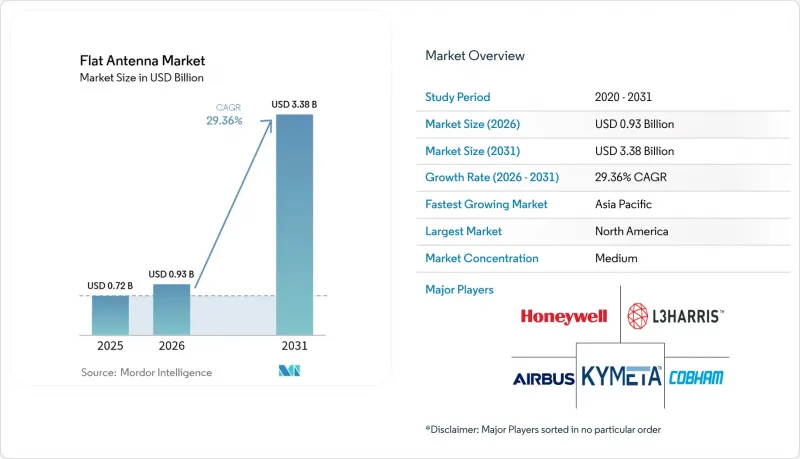
本報告按應用領域(航太、國防與政府、海事及其他)、頻段(Ku波段、 Ka波段及其他)、平台(地面、機載及其他)、天線技術(電子定向相位陣列、機電混合定向天線及其他)和地區進行細分。市場預測以美元計價。
全球平板天線市場趨勢及洞察
低地球衛星星系的部署正在推動小型用戶終端的需求。
主要亮點
- 巨型衛星群營運商已開始運作數百顆衛星,這要求地面終端能夠處理快速切換和寬視野角。 Intellian 為 Telesat Lightspeed 網路開發的Ka波段面板正是這項變革的例證,它實現了毫秒波束切換,並使機械驅動的拋物面天線過時。這種電子控制陣列縮小了尺寸、減輕了重量並降低了維護負擔,有利於平面天線市場的發展,並使其能夠安裝在企業屋頂、行動平台和政府車輛上。新的供應合約已將年產量擴大到數萬台,加速了單一終端成本的降低。此外,更低的延遲也使得演算法交易和遠端工業控制等高階應用場景成為可能,進一步拓展了目標收入來源。 Hughes 為 OneWeb 網路開發的 HL1100W 單面板 ESA 就是一個運營商快速獲得承包終端認證,為 2025 年服務發射做好準備的又一例證。
民航機維修以進行IFC升級
航空公司正大力推廣機上互聯,將其視為競爭優勢。他們採用嵌入式平板天線,與配備雷達罩的拋物面天線相比,這種天線能夠降低空氣阻力和燃油消耗。Delta航空採用休斯公司的「Fusion」解決方案,並搭載ThinKom公司的Ka2517單元,凸顯了航空公司對低地球軌道(LEO)和地球同步軌道(GEO)鏈路多軌道柔軟性的需求。阻力降低研究表明,空氣動力學性能損失可降低75%至90%,從而在整個運營週期中顯著節省燃油成本,足以抵消初始硬體成本。監管機構正在簡化補充型號核准程序,並減少與改造安裝相關的停機時間。夏威夷航空採用星鏈(Starlink)系統,顯示早期採用者正在影響同行採用類似架構。 Viasat公司的「Amara IFC」平台採用雙束ESA,可根據航線擁塞情況動態分配容量,凸顯了智慧終端軟體與硬體創新結合的重要性。
有源相位陣列的研發與製造成本高昂
開發新型平板天線架構通常需要超過5000萬美元的非重複性工程費用。這主要是由於昂貴的氮化鎵(GaN)功率放大器,其成本是矽晶片的三到五倍。專用無塵室生產線和近距離場測試實驗室也需要額外的資本投入。這些經濟因素有利於成熟企業,並減緩了新進入平板天線市場的企業多元化發展,因為它們延長了新創企業的投資回收期。組件供應商正在探索引入3D列印被動層和自動化拾取放置技術以降低人事費用,而系統供應商則在洽談長期的照付不議晶圓合約。隨著超材料設計的成熟,它們或許能夠透過減少元件數量和簡化偏壓電路來降低成本,使其低於傳統的相位陣列,但首先,它們需要實現相當的寬頻效率。
細分市場分析
到2025年,國防和政府部門將佔據平面天線市場37.52%的佔有率,這主要得益於高價多頻段戰術終端和無人飛行器的應用。民用航空將位居第二,這主要得益於對機載互聯設備維修需求的不斷成長。航運公司將繼續採用結合地球靜止軌道(GEO)和低地球軌道(LEO)的混合方案,以改善機組人員的福利和貨物追蹤。就以金額為準,該應用領域佔據平面天線市場規模的最大佔有率,預計到2027年,隨著北約成員國升級其衛星通訊設備,該領域將保持領先地位。
隨著監管航線自2026年起陸續開放,預計電動垂直起降飛行器/城市空中空中運輸(eVTOL/UAM)類別將在應用領域中實現最高的複合年成長率(CAGR),達到33.44%。城際運營商將需要小型、輕便的多軌道面板,這些面板能夠與航空電子設備整合,且不會犧牲電池容量。同時,消費級寬頻終端將利用硬體價格下降的優勢,滲透到通訊服務不足的農村地區。緊急應變機構也在部署攜帶式套件,用於在災害期間恢復通訊,這擴大了平面天線市場的基本客群。
2025年,Ku/ Ka波段解決方案將佔據平面天線市場45.62%的佔有率,主要得益於強大的衛星容量和長期穩定的監管頻率分配。 Ku波段抗雨衰的特性使其適用於海事應用,而Ka波段的高吞吐量則支援視訊、雲端服務和VPN回程傳輸。 X波段在國防領域繼續保持其主導地位,用於安全通訊鏈路和雷達融合。
隨著軍方轉向難以截獲的波形,以及商業衛星星系瞄準兆赫容量,預計甚高頻/極高頻(V/EHF)頻段市場將以30.58%的複合年成長率成長。硬體方面的挑戰,例如更嚴格的接受度和更大的路徑損耗,正在推動熱基板和超透鏡增益結構的創新。能夠在單一孔徑內切換K、Ku和Ka頻寬的多頻段天線正日益受到關注,並有望為艦隊營運商提供無需更換硬體的柔軟性。
區域分析
預計到2025年,北美將佔據40.55%的平面天線市場佔有率,這主要得益於SpaceX和OneWeb早期低地球衛星星系的部署、國防項目的集中以及航空互聯環境的積極升級。美國聯邦通訊委員會(FCC)簡化了非地球同步軌道的許可規定,降低了終端認證的行政門檻,並擴大了頻率共用權以保護現有服務。此外,加拿大放寬出口限制,促進了跨境供應鏈的整合,並加速了聯合開發案的推進。
隨著日本、韓國和澳洲政府為全國航太資產和衛星寬頻計畫撥出預算,預計到2031年,亞太地區將以31.24%的複合年成長率成為該地區成長最快的地區。中國供應商已通過獲得Ku波段面板的出口安全認證,成功進入東南亞海事市場。首爾電子通訊研究院(ETRI)正在對用於高速鐵路的超薄Ku波段天線進行試驗運行,這表明中國市場已從國防領域向其他領域多元化發展。電子商務和遠端醫療在離島的快速發展,正逐步提升企業對VSAT的需求,進而推動平板天線市場的成長。
歐洲市場仍維持穩定成長,歐洲太空總署(ESA)的技術已滲透到民用航空、郵輪和政府網路中。 SES斥資31億美元收購國際通訊衛星公司(Intelsat),旨在透過整合多軌道容量並將合併後的衛星星座與其自身的終端發展藍圖結合,從而確保獲利能力。以荷蘭和法國為首的各國國防機構正積極推進採購可與下一代戰鬥機整合的低可見度平面陣列天線。在中東和非洲,來自海上能源鑽井設施和人道援助組織的訂單正在迅速成長,這些設施和組織尤其在危機時期需要可靠的通訊鏈路,儘管目前仍處於起步階段。
其他好處:
- Excel格式的市場預測(ME)表
- 3個月的分析師支持
目錄
第1章:引言
- 研究假設和市場定義
- 調查範圍
第2章:調查方法
第3章執行摘要
第4章 市場狀況
- 市場概覽
- 市場促進因素
- 低地球衛星星系的部署正在推動小型用戶終端的需求。
- 海事和偏遠地區對寬頻連線的需求日益成長。
- 民航機改裝以進行IFC升級
- 無人系統在國防與情報、監視與偵察領域的部署
- 電動垂直起降飛行器和自動駕駛車輛的衛星通訊(SatCom)要求
- 超材料的製造可以降低成本和重量。
- 市場限制因素
- 有源相位陣列的研發成本和製造成本都很高。
- 溫度控管和射頻功率處理的局限性
- GaN/RF-IC供應鏈中的瓶頸
- 關於軌道空間碎片的新規定將限制其最終密度。
- 價值鏈分析
- 監理情勢
- 技術展望
- 波特五力分析
第5章 市場規模與成長預測
- 透過使用
- 航太
- 國防/政府
- 商業航空
- 海上
- 陸地行動通訊/5G回程傳輸
- 消費者寬頻及其他
- 按頻段
- Ku波段
- Ka波段
- K/u//Ka 多頻段
- X波段
- V-/EHF頻段
- 按平台
- 地面固定站
- 陸基移動設備(車載型)
- 機載
- 海事和離岸
- 可攜式/背負式
- 按類型分類的天線技術
- 電子控制相位陣列(ESA)
- 電子/機械混合轉向
- 機械轉向平板
- 基於超材料/RIS
- 按地區
- 北美洲
- 美國
- 加拿大
- 墨西哥
- 南美洲
- 巴西
- 阿根廷
- 其他南美國家
- 歐洲
- 英國
- 德國
- 法國
- 其他歐洲國家
- 亞太地區
- 中國
- 日本
- 印度
- 韓國
- 其他亞太國家
- 中東和非洲
- 阿拉伯聯合大公國
- 沙烏地阿拉伯
- 南非
- 其他中東和非洲國家
- 北美洲
第6章 競爭情勢
- 市場集中度
- 策略趨勢
- 市佔率分析
- 公司簡介
- Kymeta Corporation
- Cobham(Chelton)
- Intellian Technologies
- ThinKom Solutions
- L3Harris Technologies
- Honeywell International
- Airbus SE
- General Dynamics Mission Systems
- Phasor(Hanwha Systems)
- Ball Aerospace
- Viasat Inc.
- SES SA(SES Techcom)
- Anokiwave Inc.
- China Starwin
- All.Space(Isotropic Systems)
- Hughes Network Systems
- SatixFy Communications
- C-COM Satellite Systems
- Gilat Satellite Networks
- ArrayComm LLC
- Mars Antenna and RF Systems
- MacDonald, Dettwiler and Associates(MDA)
- Mitsubishi Electric
第7章 市場機會與未來展望
According to Mordor Intelligence, the flat antenna market size was valued at USD 0.72 billion in 2025 and estimated to grow from USD 0.93 billion in 2026 to reach USD 3.38 billion by 2031, at a CAGR of 29.36% during the forecast period (2026-2031).
This report is Segmented by Application (Aerospace, Defense and Government, Maritime, and More), Frequency Band (Ku-Band, Ka-Band, and More), Platform (Ground Fixed Stations, Airborne, and More), Antenna Technology (Electronically-Steered Phased Array (ESA), Hybrid Electronically/Mechanically Steered, and More), and Geography. The Market Forecasts are Provided in Terms of Value (USD).
Global Flat Antenna Market Trends and Insights
LEO-Constellation Rollout Drives Demand for Compact User Terminals
Key Highlights
- Mega-constellation operators are commissioning hundreds of satellites, forcing ground terminals to support rapid handovers and wide look-angles. Intellian's Ka-band panel for the Telesat Lightspeed network exemplifies the shift, enabling millisecond beam switching and obsoleting mechanically driven dishes. The flat antenna market benefits because electronically steered arrays shrink size, weight, and maintenance, thereby fitting enterprise rooftops, mobility platforms, and government vehicles. New supply contracts are already scaling annual production into tens of thousands of units, accelerating per-terminal cost declines. Low latency also opens premium use cases such as algorithmic trading and remote industrial control, which further increases addressable revenues. Hughes' HL1100W single-panel ESA for the OneWeb network demonstrates how operators are racing to certify turnkey terminals for service launch in 2025.
Commercial Aircraft Retrofits for IFC Upgrades
Airlines are pursuing cabin connectivity as a competitive differentiator and are installing flush-mounted flat panels that cut drag and fuel burn compared with radome-topped dishes. Delta Air Lines' selection of Hughes' Fusion solution with ThinKom's Ka2517 unit highlights carrier demand for multi-orbit flexibility across LEO and GEO links. Drag reduction studies show 75-90% lower aerodynamic penalty, translating to significant lifetime fuel savings that offset upfront hardware costs. Regulatory agencies have simplified supplemental type certification, compressing downtime for retrofit installations. Hawaiian Airlines' Starlink rollout indicates how early adopters are influencing peer carriers to adopt similar architectures. Viasat's Amara IFC platform adds a dual-beam ESA that dynamically allocates capacity based on route congestion, underscoring the importance of intelligent terminal software in tandem with hardware innovation.
High R&D and Production Cost of Active Phased Arrays
Developing a new flat-panel architecture routinely exceeds USD 50 million in non-recurring engineering spend, largely due to expensive gallium nitride power amplifiers that cost 3-5 times more than silicon chips. Specialized clean-room lines and near-field test chambers impose added capital. These economics favor incumbents and elongate payback for start-ups, decelerating new-entrant diversity in the flat antenna market. Component vendors are exploring 3D-printed passive layers and automated pick-and-place to trim labor, while system primes negotiate long-term take-or-pay wafer contracts. As metamaterial designs mature, they may undercut legacy phased arrays by collapsing element count and simplifying bias networks, but wide-band efficiency must first reach parity.
Other drivers and restraints analyzed in the detailed report include:
- Unmanned Systems Adoption in Defense and ISR
- eVTOL and Autonomous-Vehicle SatCom Requirements
- GaN/RF-IC Supply-Chain Choke-Points
For complete list of drivers and restraints, kindly check the Table Of Contents.
Segment Analysis
Defense and Government represented 37.52% of the flat antenna market share in 2025 due to multiband tactical terminals and unmanned vehicle roll-outs that command premium pricing. Commercial airlines rank second on the back of rising in-flight connectivity retrofits. Ship operators continue adopting hybrid GEO-LEO packages to improve crew welfare and cargo tracking. In value terms, the application segment contributed the largest portion of the flat antenna market size, and is expected to retain primacy until 2027 as NATO members refresh satcom inventories.
The eVTOL/Urban Air Mobility category is projected to register a 33.44% CAGR, the highest within applications, as regulatory corridors open after 2026. City-pair operators will require small, lightweight, multi-orbit panels that integrate with avionics without compromising battery payload. Concurrently, consumer broadband terminals will leverage falling hardware prices to penetrate underserved rural territories. Emergency-response agencies are also adding man-portable kits to restore connectivity during disasters, widening the customer base for the flat antenna market.
Ku/Ka solutions held 45.62% share of the flat antenna market size in 2025 because of robust satellite capacity and long-standing regulatory allocations. Rain-fade resilience at Ku-band suits maritime use, while Ka-band's higher throughput supports video, cloud, and VPN backhaul. X-band remains a defense preserve for secure links and radar fusion.
The V-/EHF-band slice is set to grow at a 30.58% CAGR as militaries move toward low-probability-of-intercept waveforms and commercial constellations target sub-TeraHertz capacity. Hardware challenges such as tighter phase tolerance and higher path loss are spurring innovations in thermal substrates and meta-lens gain structures. Multi-band antennas that switch between K, Ku, and Ka within a single aperture are gaining traction, promising fleet operators flexibility without hardware swap-outs.
Complete Report Scope:
- By Application
- Aerospace
- Defense and Government
- Commercial Aviation
- Maritime
- Land Mobile / 5G Backhaul
- Consumer Broadband and Others
- By Frequency Band
- Ku-Band
- Ka-Band
- K/u//Ka Multi-band
- X-Band
- V-/EHF-Band
- By Platform
- Ground Fixed Stations
- Land-Mobile (Vehicular)
- Airborne
- Maritime and Offshore
- Portable / Man-pack
- By Antenna Technology
- Electronically-Steered Phased Array (ESA)
- Hybrid Electronically/Mechanically Steered
- Mechanically Steered Flat Panel
- Metamaterial / RIS-based
- By Geography
- North America
- United States
- Canada
- Mexico
- South America
- Brazil
- Argentina
- Rest of South America
- Europe
- United Kingdom
- Germany
- France
- Rest of Europe
- Asia Pacific
- China
- Japan
- India
- South Korea
- Rest of Asia Pacific
- Middle East and Africa
- United Arab Emirates
- Saudi Arabia
- South Africa
- Rest of Middle East and Africa
- North America
Geography Analysis
North America captured 40.55% of flat antenna market share in 2025 following early LEO constellation deployments by SpaceX and OneWeb, a high concentration of defense projects, and aggressive airline connectivity upgrades. The U.S. Federal Communications Commission has issued streamlined non-geostationary licensing rules, lowering administrative barriers for terminal certification while extending spectrum sharing rights that protect incumbent services. Canada's export-control liberalization is also enabling cross-border supply-chain integration, accelerating joint development programs.
Asia Pacific is projected to generate the fastest regional CAGR of 31.24% to 2031 as governments in Japan, South Korea, and Australia allocate budget for sovereign space assets and satellite broadband programs. Chinese vendors have achieved export-class safety certifications on Ku-band panels, opening Southeast-Asian maritime markets. Seoul's Electronics and Telecommunications Research Institute is trialing low-profile Ku antennas for high-speed rail, signaling diversification beyond defense. Rapidly expanding e-commerce and telemedicine in remote islands create incremental demand for enterprise VSAT, reinforcing the growth trajectory of the flat antenna market.
Europe remains a stable growth arena where ESA technology permeates commercial aviation, cruise shipping, and governmental networks. SES's planned USD 3.1 billion takeover of Intelsat will consolidate multi-orbit capacity, pairing the merged fleet with in-house terminal roadmaps to protect margins. National defense agencies, led by the Netherlands and France, are channeling procurement toward low observable flat arrays that integrate with next-generation combat aircraft. Middle East and Africa show nascent but accelerating orders, especially from offshore energy rigs and humanitarian agencies that require resilient links during crises.
- Kymeta Corporation
- Cobham (Chelton)
- Intellian Technologies
- ThinKom Solutions
- L3Harris Technologies
- Honeywell International
- Airbus SE
- General Dynamics Mission Systems
- Phasor (Hanwha Systems)
- Ball Aerospace
- Viasat Inc.
- SES S.A. (SES Techcom)
- Anokiwave Inc.
- China Starwin
- All.Space (Isotropic Systems)
- Hughes Network Systems
- SatixFy Communications
- C-COM Satellite Systems
- Gilat Satellite Networks
- ArrayComm LLC
- Mars Antenna and RF Systems
- MacDonald, Dettwiler and Associates (MDA)
- Mitsubishi Electric
Additional Benefits:
- The market estimate (ME) sheet in Excel format
- 3 months of analyst support
TABLE OF CONTENTS
1 INTRODUCTION
- 1.1 Study Assumptions and Market Definition
- 1.2 Scope of the Study
2 RESEARCH METHODOLOGY
3 EXECUTIVE SUMMARY
4 MARKET LANDSCAPE
- 4.1 Market Overview
- 4.2 Market Drivers
- 4.2.1 LEO-constellation rollout drives demand for compact user terminals
- 4.2.2 Rising broadband connectivity needs for maritime and remote areas
- 4.2.3 Commercial aircraft retrofits for IFC upgrades
- 4.2.4 Unmanned systems adoption in defense and ISR
- 4.2.5 eVTOL and autonomous-vehicle SatCom requirements (under-the-radar)
- 4.2.6 Metamaterial manufacturing cuts cost and weight (under-the-radar)
- 4.3 Market Restraints
- 4.3.1 High RandD and production cost of active phased-arrays
- 4.3.2 Thermal management and RF power-handling limits
- 4.3.3 GaN/RF-IC supply-chain choke-points (under-the-radar)
- 4.3.4 Emerging orbital-debris rules restricting terminal density (under-the-radar)
- 4.4 Value Chain Analysis
- 4.5 Regulatory Landscape
- 4.6 Technological Outlook
- 4.7 Porter's Five Forces Analysis
- 4.7.1 Threat of New Entrants
- 4.7.2 Bargaining Power of Buyers
- 4.7.3 Bargaining Power of Suppliers
- 4.7.4 Threat of Substitutes
- 4.7.5 Intensity of Competitive Rivalry
5 MARKET SIZE AND GROWTH FORECASTS (VALUE)
- 5.1 By Application
- 5.1.1 Aerospace
- 5.1.2 Defense and Government
- 5.1.3 Commercial Aviation
- 5.1.4 Maritime
- 5.1.5 Land Mobile / 5G Backhaul
- 5.1.6 Consumer Broadband and Others
- 5.2 By Frequency Band
- 5.2.1 Ku-Band
- 5.2.2 Ka-Band
- 5.2.3 K/u//Ka Multi-band
- 5.2.4 X-Band
- 5.2.5 V-/EHF-Band
- 5.3 By Platform
- 5.3.1 Ground Fixed Stations
- 5.3.2 Land-Mobile (Vehicular)
- 5.3.3 Airborne
- 5.3.4 Maritime and Offshore
- 5.3.5 Portable / Man-pack
- 5.4 By Antenna Technology
- 5.4.1 Electronically-Steered Phased Array (ESA)
- 5.4.2 Hybrid Electronically/Mechanically Steered
- 5.4.3 Mechanically Steered Flat Panel
- 5.4.4 Metamaterial / RIS-based
- 5.5 By Geography
- 5.5.1 North America
- 5.5.1.1 United States
- 5.5.1.2 Canada
- 5.5.1.3 Mexico
- 5.5.2 South America
- 5.5.2.1 Brazil
- 5.5.2.2 Argentina
- 5.5.2.3 Rest of South America
- 5.5.3 Europe
- 5.5.3.1 United Kingdom
- 5.5.3.2 Germany
- 5.5.3.3 France
- 5.5.3.4 Rest of Europe
- 5.5.4 Asia Pacific
- 5.5.4.1 China
- 5.5.4.2 Japan
- 5.5.4.3 India
- 5.5.4.4 South Korea
- 5.5.4.5 Rest of Asia Pacific
- 5.5.5 Middle East and Africa
- 5.5.5.1 United Arab Emirates
- 5.5.5.2 Saudi Arabia
- 5.5.5.3 South Africa
- 5.5.5.4 Rest of Middle East and Africa
- 5.5.1 North America
6 COMPETITIVE LANDSCAPE
- 6.1 Market Concentration
- 6.2 Strategic Moves
- 6.3 Market Share Analysis
- 6.4 Company Profiles (includes Global level Overview, Market level overview, Core Segments, Financials as available, Strategic Information, Market Rank/Share for key companies, Products and Services, and Recent Developments)
- 6.4.1 Kymeta Corporation
- 6.4.2 Cobham (Chelton)
- 6.4.3 Intellian Technologies
- 6.4.4 ThinKom Solutions
- 6.4.5 L3Harris Technologies
- 6.4.6 Honeywell International
- 6.4.7 Airbus SE
- 6.4.8 General Dynamics Mission Systems
- 6.4.9 Phasor (Hanwha Systems)
- 6.4.10 Ball Aerospace
- 6.4.11 Viasat Inc.
- 6.4.12 SES S.A. (SES Techcom)
- 6.4.13 Anokiwave Inc.
- 6.4.14 China Starwin
- 6.4.15 All.Space (Isotropic Systems)
- 6.4.16 Hughes Network Systems
- 6.4.17 SatixFy Communications
- 6.4.18 C-COM Satellite Systems
- 6.4.19 Gilat Satellite Networks
- 6.4.20 ArrayComm LLC
- 6.4.21 Mars Antenna and RF Systems
- 6.4.22 MacDonald, Dettwiler and Associates (MDA)
- 6.4.23 Mitsubishi Electric
7 MARKET OPPORTUNITIES AND FUTURE OUTLOOK
- 7.1 White-space and Unmet-need Assessment

 平面天線市場報告:趨勢、預測與競爭分析(至2035年)
 衛星平板天線天線-全球市佔率及排名、總收入及需求預測(2026-2032年)
 指向平板天線市場-2026-2032年全球市場預測
 平板指向平板天線市場規模、佔有率和成長分析:按類型、頻段、應用和地區分類-2026-2033年產業預測
 平面天線市場規模、佔有率、成長、全球產業分析、區域趨勢及2026年至2034年預測。
 2026年全球平板指向平板天線晶片組市場報告衛星平板指向平板天線市場:依產品類型、平台、安裝類型和應用分類-2026-2032年全球預測
 指向平板天線市場分析與預測(至2035年):類型、產品、技術、組件、應用、材料類型、部署模式、最終用戶、安裝類型、解決方案2026年全球平板指向平板天線市場報告
 全球指向平板天線市場