


 |
市場調查報告書
商品編碼
2124162
汽車車身本體:市場佔有率分析、產業趨勢與統計、成長預測(2026-2031)Automotive Body-in-White - Market Share Analysis, Industry Trends & Statistics, Growth Forecasts (2026 - 2031) |
||||||

※ 本網頁內容可能與最新版本有所差異。詳細情況請與我們聯繫。
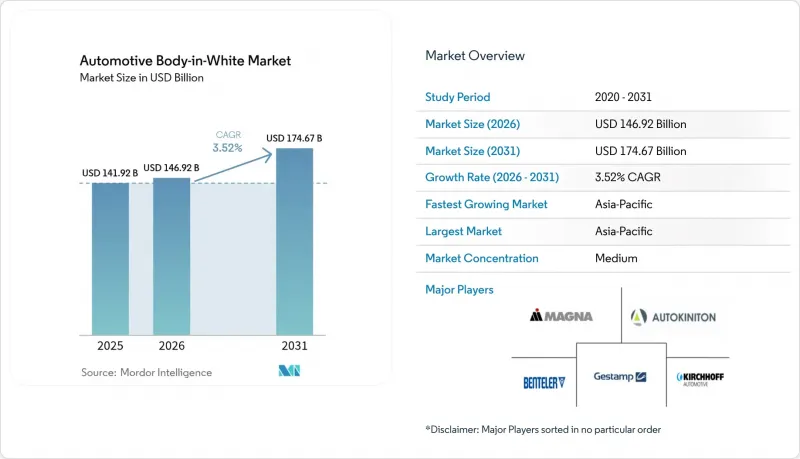
根據 Mordor Intelligence 估計,2026 年汽車車身本體市值將達到 1,469.2 億美元,高於 2025 年的 1,419.2 億美元,預計到 2031 年將達到 1,746.7 億美元。
預計 2026 年至 2031 年的複合年成長率為 3.52%。
本報告按車輛類型(乘用車和商用車)、動力系統(內燃機車輛和電動車)、材質(鋁、鋼、複合材料、鎂)、材料連接技術(焊接、鉚接、壓鉚、黏接)和地區進行細分。市場預測以價值(美元)表示。
全球汽車車身本體市場趨勢及洞察
對輕型車輛的需求日益成長
隨著全球監管標準的日益嚴格,汽車產業越來越重視減重。汽車製造商正採用先進材料和創新設計策略,在確保安全性和性能標準的前提下降低車身重量。新一代高抗張強度鋼處於領先地位,能夠在不影響結構完整性或碰撞安全性的前提下顯著減輕車身重量。同時,隨著電動車的快速普及,人們也越來越關注更輕的車身結構,因為即使是輕微的減重也能顯著提升續航里程。
鋁合金空間框架在豪華車領域越來越受歡迎,但其高昂的製造成本阻礙了其在大眾市場的進一步普及。因此,製造商在選擇材料時會仔細權衡性能、成本和可製造性。
電動車生產平台快速擴張
專用電動車平台顯著減少了零件數量,並支援採用兼具負載傳遞功能的結構化電池組。特斯拉奧斯汀工廠透過整合前後巨型鑄造件,減少了30%至40%的零件。比亞迪和蔚來正在採用電芯到電池組的一體化架構,這需要新的黏合技術和隔熱解決方案。隨著高階電動車採用高壓架構,對更高電氣隔離性能的需求激增,結構件中對複合材料嵌件的依賴性也隨之提升。大型電池組重量的增加進一步凸顯了對超高強度材料和精密結構設計的必要性。為了應對這些挑戰,汽車製造商正在採用先進鋼材並利用拓撲最佳化技術,以在下一代汽車平臺中協調安全性、性能和效率。
先進車身白車身材料高成本
輕量化材料對汽車創新至關重要,但其應用受到成本、基礎設施和供應鏈動態等複雜因素的限制。鋁材因其輕量化優勢而備受青睞,但其價格遠高於傳統鋼材。這種價格差異使得鋁材僅適用於豪華車市場,而無法應用於大眾市場。另一方面,碳纖維增強塑膠(CFRP)擁有卓越的強度重量比,但其高昂的材料和加工成本限制了其應用,目前主要用於超豪華車型。
此外,金屬受益於完善的回收基礎設施,而複合材料則遠遠落後,這推高了擁有成本,限制了循環經濟的潛力。鋁就是一個典型的例子。原物料價格的不確定性進一步加劇了籌資策略的複雜性,並為製造商的長期規劃帶來了挑戰。
細分市場分析
截至2025年,乘用車佔汽車車身本體市場的67.60%,而商用車市場預計到2031年將以年均4.43%的速度成長。車隊營運商優先考慮降低車輛全生命週期的營運成本,因此願意接受鋁製空間框架的高昂材料成本,因為鋁製空間框架能夠減輕電動車的重量並延長其續航里程。配備100千瓦時電池組的電動貨車需要額外增加20-30%的強度,催生了對高抗張強度鋼樑的需求。在預測期內,模組化梯形車架設計將使卡車製造商能夠將貨箱、駕駛室和燃料電池安裝座整合在同一底盤上,這將使設計標準化連接法蘭的白色車身供應商受益。
商業平台較長的產品週期(長達10年)確保了資本密集熱沖壓生產線的穩定產量。歐盟《通用安全法規》等法規強制要求安裝駕駛輔助感測器,因此要求車身白車身設計必須包含受保護的電子元件腔室。將於2027年生效的美國第二階段重型卡車溫室氣體排放法規將進一步增加對輕量化樑和橫樑的需求,推動汽車車身本體市場的穩定成長。
2025年,內燃機車在汽車車身本體市場將佔62.70%的市佔率。電動車和電動卡車正在迅速崛起,預計到2031年將以10.84%的複合年成長率成長。採用結構化電池組無需單獨的底盤,並將扭轉剛度提高15-20%,使汽車製造商能夠省去橫梁,簡化碰撞載荷路徑。隨著向800V電動車的過渡,絕緣要求日益嚴格,迫使工程師採用複合材料和塗層鋁製機殼。內燃機車型在產量方面仍佔據主導地位,維持了最佳化碰撞能量吸收的液壓成型鋼側樑的基準需求。 2026年至2031年,雙車身架構將並存,要求供應商在汽車車身本體市場並行發展焊接和黏接技術。
對續航里程的擔憂也是推動減重預算的因素之一。這是因為車輛每減重一公斤,續航里程就能增加2到3公里。此外,由於歐盟電池法規要求“設計應便於拆卸”,因此汽車製造商正在用螺栓或鉚接系統取代焊接支架,以便在不造成結構損壞的情況下拆卸電池組。
區域分析
預計到2025年,亞太地區將佔據汽車車身本體市場45.60%的佔有率,並在2031年之前以4.69%的複合年成長率成長。中國正透過新能源汽車配額制度推動銷售,而比亞迪和蔚來則憑藉重新設計載重路徑的結構化電池組主導。日本鋼鐵製造商正在開發1500兆帕高抗張強度鋼板(AHSS),並供應給國內和東協地區的工廠。在韓國,垂直整合正在加速,白車身、電池和模組供應商高度集中。
歐洲在多材料連接和低碳生產領域保持技術領先地位。德國模具製造商正在交付帶有局部淬火區的熱沖壓生產線。北歐鋁生產商目前供應的原料碳足跡顯著降低,在汽車產業的表現優於傳統的燃煤冶煉廠。隨著碳邊境調節機制(CBAM)的推出,這些北歐生產商的優勢日益凸顯。該機制對高排放進口產品課稅。汽車製造商正致力於向低碳材料轉型並最佳化車身本體,而這些投入加上不斷上漲的合規成本,往往佔據了其車輛項目預算的很大一部分。這些策略符合監管要求,也是為避免潛在處罰而採取的謹慎措施。
在北美,由於美墨加協定(USMCA)的區域採購規則和對電動車的投資,市場呈現穩定成長態勢。美國工廠正在對適用於鋁材的壓平機進行再投資,而墨西哥工廠則在區域採購標準的範圍內供應具有成本競爭力的沖壓件。加拿大冶煉廠利用水力發電,吸引尋求低碳鋁材的車身本體設備製造商(OEM)。儘管與亞洲的人事費用差距仍然是一個不利因素,但由於國內生產激勵措施和物流韌性,汽車白車身市場的產能擴張正在順利進行。
其他好處:
- Excel格式的市場預測(ME)表
- 3個月的分析師支持
目錄
第1章:引言
- 研究假設和市場定義
- 調查範圍
第2章:調查方法
第3章執行摘要
第4章 市場狀況
- 市場概覽
- 市場促進因素
- 對輕型車輛的需求日益成長
- 更嚴格的全球二氧化碳排放和燃油效率法規
- 電動車生產平台快速擴張
- 高抗張強度鋼和鋁合金的進步
- 中國電動車製造商採用一體式鑄造架構
- 東協地區的新電動車工廠正在擴大本地白車身(BIW)生產能力。
- 市場限制因素
- 先進車身白車身材料高成本
- 多材料結構的複雜連接與修復
- 低碳鋼和鋁供應供不應求
- 一體式鑄造機身的保險和維修費用風險
- 價值供應鏈分析
- 監理情勢
- 技術展望
- 波特五力分析
第5章 市場規模與成長預測
- 車輛類型
- 搭乘用車
- 商用車輛
- 依推進類型
- 內燃機
- 電動車
- 材料類型
- 鋁
- 鋼材(低碳鋼、高速鋼、先進高速鋼、超高速鋼)
- 複合材料(碳纖維增強複合材料、玻璃纖維增強複合材料、SMC)
- 鎂和其他金屬
- 透過材料連接技術
- 焊接(電阻點焊、雷射焊接、摩擦攪拌焊)
- 自穿孔和等離子輔助鉚接
- 鉚接接頭和機械緊固件
- 黏接和混合黏接
- 地區
- 北美洲
- 美國
- 加拿大
- 其他北美國家
- 南美洲
- 巴西
- 阿根廷
- 其他南美國家
- 歐洲
- 德國
- 英國
- 法國
- 西班牙
- 義大利
- 其他歐洲國家
- 亞太地區
- 中國
- 日本
- 印度
- 韓國
- 其他亞太國家
- 中東和非洲
- 沙烏地阿拉伯
- 阿拉伯聯合大公國
- 土耳其
- 南非
- 其他中東和非洲國家
- 北美洲
第6章 競爭情勢
- 市場集中度
- 策略趨勢
- 市佔率分析
- 公司簡介
- Magna International Inc.
- Norsk Hydro ASA
- Gestamp Automocion SA
- Aisin Seiki Co. Ltd.
- thyssenkrupp AG
- Tata Steel Ltd.
- Autokiniton US Holdings, Inc(Tower International)
- CIE Automotive
- Benteler International AG
- AUTOCOMP CORPORATION PANSE PVT. LTD.
- SM Auto Engineering Pvt. Ltd.
- ArcelorMittal SA
- KIRCHHOFF Automotive GmbH
- WEISS GmbH
- KUKA AG
第7章 市場機會與未來展望
According to Mordor Intelligence, the automotive body-in-white market size in 2026 is estimated at USD 146.92 billion, growing from 2025 value of USD 141.92 billion with 2031 projections showing USD 174.67 billion, growing at 3.52% CAGR over 2026-2031.
This report is Segmented by Vehicle Type (Passenger Vehicles and Commercial Vehicles), Propulsion Type (IC-Engine Vehicles and Electric Vehicles), Material Type (Aluminum, Steel, Composites, and Magnesium), Material Joining Technique (Welding, Riveting, Clinching, and Adhesive Bonding), and Geography. The Market Forecasts are Provided in Terms of Value (USD).
Global Automotive Body-in-White Market Trends and Insights
Growing Demand for Lightweight Vehicles
As global markets tighten regulatory standards, the automotive industry is increasingly turning to lightweighting. Automakers are now embracing advanced materials and innovative design strategies to shed vehicle weight, all while upholding safety and performance standards. Next-generation high-strength steels are at the forefront, delivering notable weight reductions without sacrificing structural integrity or crash safety. Concurrently, as electric vehicle adoption surges, there's a heightened emphasis on lighter body structures; even slight weight cuts can lead to substantial improvements in driving range.
Though aluminum space frames have gained traction in premium segments, their elevated production costs hinder broader acceptance in the mass market. Consequently, manufacturers are meticulously weighing performance, cost, and manufacturability in their material selections.
Rapid Scaling of EV Production Platforms
Dedicated EV platforms slash part counts and enable structural battery packs that double as load paths. Tesla's Austin plant reports a 30-40% component reduction after shifting to integrated front and rear giga-castings. BYD and NIO employ cell-to-pack architecture requiring new bonding and thermal-barrier solutions. The demand for enhanced electrical isolation surges as premium electric vehicles embrace high-voltage architectures, leading to a growing reliance on composite inserts in structural components. The heft of sizable battery packs amplifies the necessity for ultra-strong materials and refined structural designs. In response, automakers are turning to advanced steels and employing topology optimization to harmonize safety, performance, and efficiency in their next-gen vehicle platforms.
High Cost of Advanced BIW Materials
Lightweight materials are pivotal to automotive innovation, yet their adoption hinges on a web of cost, infrastructure, and supply chain dynamics. Aluminum, celebrated for its weight-saving advantages, commands a notable premium over conventional steel. This price disparity renders aluminum more suited for premium vehicle segments, sidelining it from mass-market applications. Meanwhile, carbon fiber-reinforced plastics (CFRP) boast an outstanding strength-to-weight ratio, yet their high material and processing costs restrict their use predominantly to ultra-luxury vehicles.
Moreover, while metals benefit from established recycling infrastructures, composites lag significantly, inflating ownership costs and curtailing the potential for a circular economy. Aluminum is a prime example. The unpredictability of raw material prices further muddies sourcing strategies, posing challenges for manufacturers' long-term planning.
Other drivers and restraints analyzed in the detailed report include:
- Stringent Global CO2 and Fuel-Economy Regulations
- Greenfield ASEAN EV Plants Boosting Local BIW Capacity
- Complex Joining and Repair of Multi-Material Structures
For complete list of drivers and restraints, kindly check the Table Of Contents.
Segment Analysis
Passenger cars represented 67.60% of the automotive body-in-white market size in 2025, whereas commercial vehicles are forecast to compound at 4.43% through 2031. Fleet operators prioritize lifetime operating savings, accepting the material premiums of aluminum space frames that cut mass and extend electric range. Electric vans carrying 100 kWh packs need 20-30% extra reinforcement, spawning demand for ultra-high-strength steel cross-members. Over the forecast, modular ladder-frame concepts will let truck OEMs mix cargo boxes, cabins, and fuel-cell mounts on one chassis, rewarding BIW suppliers that design standardized joining flanges.
Longer product cycles in commercial platforms-up to 10 years-provide volume stability for capital-intensive hot-stamping lines. Regulatory layers, such as the EU's General Safety Regulation mandating driver-assistance sensors, push BIW designs to embed protected electronics cavities. The 2027 U.S. Phase 2 greenhouse-gas rules for heavy trucks will further widen demand for lightweight beams and cross-members, supporting steady growth in the automotive body-in-white market.
Internal combustion engines hold a 62.70% share of the automotive body-in-white market 2025. Electric cars and trucks are rising quickly with an 10.84% CAGR through 2031. Structural battery packs eliminate separate floor pans and raise torsional stiffness by 15-20%, letting automakers delete cross rails and simplify crash-load paths. The shift to 800 V electrics ups insulation mandates, steering engineers toward composite or coated aluminum enclosures. Internal-combustion models still dominate unit volumes, preserving baseline demand for hydro-formed steel side sills optimized for crash energy absorption. Over 2026-2031, dual body architectures will coexist, compelling suppliers to maintain parallel welding and bonding competencies in the automotive body-in-white market.
Range anxiety also sustains lightweighting budgets because each kilogram trimmed from the body returns 2-3 km of driving distance. Finally, EU battery regulations require design-for-disassembly, so OEMs are replacing welded brackets with bolt-on or rivet systems that enable pack removal without structural damage.
Complete Report Scope:
- By Vehicle Type
- Passenger Cars
- Commercial Vehicles
- By Propulsion Type
- Internal Combustion Engine
- Electric Vehicles
- By Material Type
- Aluminum
- Steel (Mild, HSS, AHSS, UHSS)
- Composites (CFRP, GFRP, SMC)
- Magnesium and Other Metals
- By Material Joining Technique
- Welding (RSW, Laser, FSW)
- Self-Piercing and Plasma-Assisted Riveting
- Clinching and Mechanical Fastening
- Adhesive and Hybrid Bonding
- Geography
- North America
- United States
- Canada
- Rest of North America
- South America
- Brazil
- Argentina
- Rest of South America
- Europe
- Germany
- United Kingdom
- France
- Spain
- Italy
- Rest of Europe
- Asia-Pacific
- China
- Japan
- India
- South Korea
- Rest of Asia-Pacific
- Middle East and Africa
- Saudi Arabia
- United Arab Emirates
- Turkey
- South Africa
- Rest of Middle East and Africa
- North America
Geography Analysis
Asia-Pacific commanded 45.60% of the automotive body-in-white market share in 2025 and is tracking a 4.69% CAGR to 2031. China drives volume via New Energy Vehicle quotas, while BYD and NIO champion structural battery packs that reshape load-path design. Japanese steelmakers advance 1,500 MPa AHSS, supplying domestic and ASEAN factories. South Korea clusters BIW, battery, and module suppliers, accelerating vertical integration.
Europe retains technological leadership in multi-material joining and decarbonized production. German toolmakers ship hot-stamping lines with localized quench zones. Nordic aluminum producers are now supplying feedstock with a markedly reduced carbon footprint, outpacing traditional coal-based smelters in the automotive manufacturing sector. With the introduction of carbon border adjustment mechanisms (CBAM) imposing taxes on high-emission imports, the advantages of these Nordic producers are becoming more sharply focused. Automakers are pivoting towards low-carbon materials and body-in-white optimization, coupled with escalating compliance costs, frequently taking up a significant portion of vehicle program budgets. These strategies align with regulatory demands and serve as prudent measures to sidestep potential penalties.
North America grows steadily due to USMCA content rules and EV investments. United States factories reinvest in aluminum-ready presses, while Mexican plants supply cost-competitive stampings under regional-content thresholds. Canadian smelters leverage hydroelectric power to attract OEMs seeking low-carbon aluminum. Labor cost differentials versus Asia remain a headwind, but onshoring incentives and logistical resilience keep capacity expansion on track for the automotive body-in-white market.
- Magna International Inc.
- Norsk Hydro ASA
- Gestamp Automocion SA
- Aisin Seiki Co. Ltd.
- thyssenkrupp AG
- Tata Steel Ltd.
- Autokiniton US Holdings, Inc (Tower International)
- CIE Automotive
- Benteler International AG
- AUTOCOMP CORPORATION PANSE PVT. LTD.
- SM Auto Engineering Pvt. Ltd.
- ArcelorMittal SA
- KIRCHHOFF Automotive GmbH
- WEISS GmbH
- KUKA AG
Additional Benefits:
- The market estimate (ME) sheet in Excel format
- 3 months of analyst support
TABLE OF CONTENTS
1 Introduction
- 1.1 Study Assumptions and Market Definition
- 1.2 Scope of the Study
2 Research Methodology
3 Executive Summary
4 Market Landscape
- 4.1 Market Overview
- 4.2 Market Drivers
- 4.2.1 Growing Demand for Lightweight Vehicles
- 4.2.2 Stringent Global CO2 and Fuel-Economy Regulations
- 4.2.3 Rapid Scaling of EV Production Platforms
- 4.2.4 Advances in High-Strength Steel and Aluminum Alloys
- 4.2.5 Adoption of Giga-Cast Structures by Chinese EV OEMs
- 4.2.6 Greenfield ASEAN EV Plants Boosting Local BIW Capacity
- 4.3 Market Restraints
- 4.3.1 High Cost of Advanced BIW Materials
- 4.3.2 Complex Joining and Repair of Multi-Material Structures
- 4.3.3 Scarcity of Low-Carbon Steel/Aluminum Supply
- 4.3.4 Insurance and Repair-Cost Risks for Giga-Cast Bodies
- 4.4 Value / Supply-Chain Analysis
- 4.5 Regulatory Landscape
- 4.6 Technological Outlook
- 4.7 Porter's Five Forces Analysis
- 4.7.1 Bargaining Power of Suppliers
- 4.7.2 Bargaining Power of Consumers
- 4.7.3 Threat of New Entrants
- 4.7.4 Threat of Substitute Products
- 4.7.5 Intensity of Competitive Rivalry
5 Market Size and Growth Forecasts (Value (USD))
- 5.1 By Vehicle Type
- 5.1.1 Passenger Cars
- 5.1.2 Commercial Vehicles
- 5.2 By Propulsion Type
- 5.2.1 Internal Combustion Engine
- 5.2.2 Electric Vehicles
- 5.3 By Material Type
- 5.3.1 Aluminum
- 5.3.2 Steel (Mild, HSS, AHSS, UHSS)
- 5.3.3 Composites (CFRP, GFRP, SMC)
- 5.3.4 Magnesium and Other Metals
- 5.4 By Material Joining Technique
- 5.4.1 Welding (RSW, Laser, FSW)
- 5.4.2 Self-Piercing and Plasma-Assisted Riveting
- 5.4.3 Clinching and Mechanical Fastening
- 5.4.4 Adhesive and Hybrid Bonding
- 5.5 Geography
- 5.5.1 North America
- 5.5.1.1 United States
- 5.5.1.2 Canada
- 5.5.1.3 Rest of North America
- 5.5.2 South America
- 5.5.2.1 Brazil
- 5.5.2.2 Argentina
- 5.5.2.3 Rest of South America
- 5.5.3 Europe
- 5.5.3.1 Germany
- 5.5.3.2 United Kingdom
- 5.5.3.3 France
- 5.5.3.4 Spain
- 5.5.3.5 Italy
- 5.5.3.6 Rest of Europe
- 5.5.4 Asia-Pacific
- 5.5.4.1 China
- 5.5.4.2 Japan
- 5.5.4.3 India
- 5.5.4.4 South Korea
- 5.5.4.5 Rest of Asia-Pacific
- 5.5.5 Middle East and Africa
- 5.5.5.1 Saudi Arabia
- 5.5.5.2 United Arab Emirates
- 5.5.5.3 Turkey
- 5.5.5.4 South Africa
- 5.5.5.5 Rest of Middle East and Africa
- 5.5.1 North America
6 Competitive Landscape
- 6.1 Market Concentration
- 6.2 Strategic Moves
- 6.3 Market Share Analysis
- 6.4 Company Profiles (Includes Global level Overview, Market level overview, Core Segments, Financials as available, Strategic Information, Market Rank/Share for key companies, Products and Services, and Recent Developments)
- 6.4.1 Magna International Inc.
- 6.4.2 Norsk Hydro ASA
- 6.4.3 Gestamp Automocion SA
- 6.4.4 Aisin Seiki Co. Ltd.
- 6.4.5 thyssenkrupp AG
- 6.4.6 Tata Steel Ltd.
- 6.4.7 Autokiniton US Holdings, Inc (Tower International)
- 6.4.8 CIE Automotive
- 6.4.9 Benteler International AG
- 6.4.10 AUTOCOMP CORPORATION PANSE PVT. LTD.
- 6.4.11 SM Auto Engineering Pvt. Ltd.
- 6.4.12 ArcelorMittal SA
- 6.4.13 KIRCHHOFF Automotive GmbH
- 6.4.14 WEISS GmbH
- 6.4.15 KUKA AG
7 Market Opportunities and Future Outlook

 素車市場:依製造方法、材料、車輛類型、應用程式和最終用戶分類-2026-2032年全球市場預測汽車車身電子產品市場:依產品類型、車輛類型、銷售管道和應用程式分類-2026-2032年全球市場預測
 汽車白車身市場分析及預測(至2035年):依類型、產品、技術、組件、應用、材料類型、製程、最終用戶、安裝類型及解決方案分類
 輕量化汽車車身面板市場 - 全球產業規模、佔有率、趨勢、機會、預測:按車輛類型、零件類型、材料、地區和競爭格局分類,2021-2031年
 汽車車身本體市場:按材料、車輛類型、驅動系統、黏合技術和地區分類(2026-2034 年)
 2026年全球汽車車身、沖壓金屬及其他零件市場報告2026年全球汽車車身市場報告2026年全球汽車車身本體市場報告汽車輕量化車身面板市場:按材料、產品類型、製造技術、車輛類型和應用分類-2026-2032年全球市場預測
 輕量化汽車車體面板市場規模、佔有率、成長及全球產業分析:按類型、應用和地區分類的洞察,2026-2034 年預測