


 |
市場調查報告書
商品編碼
2124159
乙太網路控制器:市場佔有率分析、產業趨勢與統計、成長預測(2026-2031 年)Ethernet Controller - Market Share Analysis, Industry Trends & Statistics, Growth Forecasts (2026 - 2031) |
||||||

※ 本網頁內容可能與最新版本有所差異。詳細情況請與我們聯繫。
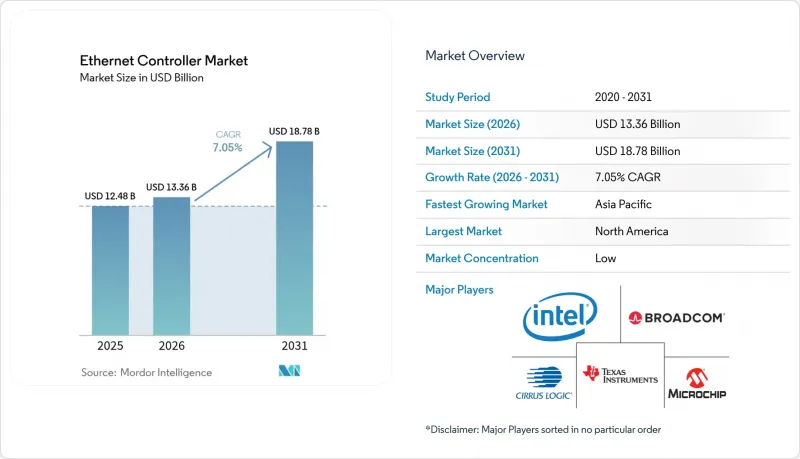
據 Mordor Intelligence 稱,2025 年乙太網路控制器市值為 124.8 億美元,預計到 2031 年將達到 187.8 億美元,而 2026 年為 133.6 億美元,預測期(2026-2031 年)的複合年成長率為 7.05%。
本報告按頻寬類型(例如,10 Mb 乙太網路、快速乙太網路 (100 Mb))、功能(例如,獨立 PHY、整合 MAC-PHY 控制器)、最終用戶(例如,伺服器、路由器和交換器、工業自動化和工業物聯網)、應用(例如,資料中心和雲端、通訊和 5G RAN)以及地區進行細分。市場預測以美元 (USD) 為單位。
全球乙太網路控制器市場趨勢與洞察
超大規模資料中心對人工智慧主導的800G 和 1.6T 乙太網路的需求
大規模語言模型的訓練正推動東西向流量超越傳統 100G 交換的極限,雲端服務供應商正在遷移到 800G 和 1.6T 乙太網路架構,以兼顧成本和效能。超乙太網路聯盟 (Ultra Ethernet Consortium) 正在匯集半導體供應商和超大規模資料超大規模資料中心業者,共同打造人工智慧工作負載所需的擁塞感知傳輸和確定性延遲能力。博通公司報告稱,2024 會計年度人工智慧網路銷售額將達到 44 億美元,隨著營運商從 InfiniBand 遷移,交換 ASIC 晶片將推動乙太網路控制器市場的發展。英特爾在其 E810 控制器中加入了應用裝置排隊和 PTP 時間戳功能,以最佳化分散式訓練的同步。儘管乙太網路控制器市場受益於標準化工具和多供應商採購,但供應商仍需不斷創新遙測和流量控制機制,以在對延遲敏感的人工智慧管線中保持與專有架構相當的效能。 IEEE 802.3df 的標準化工作旨在規範 1.6 T 訊號和車道調變方案,這將構成第二代 AI 叢集部署的基礎。
採用多Gigabit汽車乙太網路的汽車區域為基礎的電子電氣架構
德克薩斯設備製造商 (OEM) 正在從基於域的網路轉向基於區域的拓撲結構,以 2.5G、5G 和 10G 車載乙太網路骨幹網路取代傳統的 CAN 和 LIN 總線,這些骨幹網路可以將雷達、雷射雷達和攝影機的資料流聚合到集中式運算節點。德州儀器 (TI) 的 DP83TG720S-Q1 PHY 晶片支援透過單根雙絞線傳輸 1G 數據,滿足 ISO 26262 ASIL B 安全等級要求,並可實現更輕的線束 (TI.COM)。 Marvell 以 25 億美元收購英飛凌的車載乙太網路業務,凸顯了符合 ASIL 標準的 PHY 智慧財產權在乙太網路控制器市場中的價值。恩智浦半導體 (NXP) 將時間敏感型網路整合到其控制器中,確保線控驅動和故障運行轉向系統實現微秒的確定性。空中下載 (OTA) 更新功能和「網路安全設計」要求進一步鞏固了乙太網路作為汽車軟體平台統一傳輸協議的地位。來自聯合國歐洲經濟委員會 R155 網路安全法規和 R156 軟體更新法規的監管壓力正在加速其普及,多Gigabit乙太網路正在成為未來電動車平台的標準規範。
傳統製程節點半導體的長期供不應求給PHY的供應帶來了壓力。
乙太網路PHY晶片大量使用類比電路,目前仍依賴28nm及更早的製程節點。由於晶圓代工廠將資金轉移到更先進的製程,晶圓短缺問題依然存在。路透社報道稱,2024年底北卡羅來納州一家石英礦的供應中斷將導致某些65nm PHY產品線的交貨前置作業時間超過52週。台積電表示,鑑於製造設備短缺和平均售價(ASP)下降,在成熟製程節點上擴大產能仍面臨經濟挑戰。需要15年使用壽命和極端耐溫等級晶片的汽車製造商和工業OEM廠商面臨最嚴峻的供應限制,迫使控制器供應商考慮採用雙源封裝和二線代晶圓代工廠。儘管乙太網路控制器市場整體需求強勁,但這種供應緊張狀況威脅著短期獲利能力。
細分市場分析
2025年,Gigabit乙太網路仍佔總銷售額的28.05%,企業級、小規模資料中心和工業控制器持續認證成熟的1 Gb/s設計,以滿足可預測的工作負載需求。然而,超大規模資料中心業者目前正引領市場發展,200G、400G、800G以及新興的1.6T乙太網路選項的複合年成長率高達12.1%。預計到2031年,超高速乙太網路埠的市場規模將翻倍以上。工程師傾向於採用整合DSP均衡功能的PAM4訊號方案,以減少前面板面積並控制通道損耗。
在過渡速度頻段,2.5G 和 5G 解決方案支援商業設施透過現有 Cat-5e 線回程傳輸Wi-Fi 7 流量,而 10G 和 25G 仍廣泛應用於營運商的儲存和存取聚合。在乙太網路控制器市場,人們對用於長距離工廠感測器的 10 Mb/s 單對乙太網路方案重新燃起了興趣。這是一個小眾市場,雖然收入有限,但預計銷售將保持穩定。供應商透過生產分段式晶片系列而非通用 PHY 來平衡面積面積的權衡。這是一種即使在成熟節點價格競爭加劇的情況下也能維持毛利率的策略。
到 2025 年,整合 MAC-PHY 設備將佔據乙太網路控制器市場 30.75% 的佔有率,因為 OEM 廠商優先考慮降低消費級和低階企業級設備的組件成本並簡化 PCB 佈線。同時,智慧網卡和基礎設施處理單元 (IPU) 的複合年成長率 (CAGR) 為 12.95%。這是因為雲端架構師正在將 TLS 終止、VXLAN 封裝和儲存 RDMA 等功能轉移到專用加速器上,從而將主機核心分配給產生收入的運算任務。
在光學模組製造商和需要配置柔軟性和寬溫範圍的堅固型工業電路板中,分離式物理層 (PHY) 仍被廣泛應用。超薄筆記型電腦和平板電腦中 USB 轉乙太網路橋接控制器的應用正在不斷擴展,這反映出頻寬受限的辦公環境中對有線Gigabit擴充座的需求日益成長。符合 802.3bt 標準的乙太網路供電 (PoE) 晶片是另一個成長領域,尤其是與遙測引擎結合使用,為建築管理儀錶板提供資料時。在整個預測期內,卸載型設備的乙太網路控制器市場規模預計將縮小與傳統整合解決方案的收入差距,但就出貨量而言,單晶片 MAC-PHY 仍可能在大批量消費級產品中佔據主導地位。
區域分析
2025年,亞太地區以38.20%的市場佔有率領先乙太網路控制器市場,主要得益於中國半導體製造生態系統、日本在汽車電子領域的領先地位以及韓國率先採用基於乙太網路的5G RAN去程傳輸。儘管本土供應鏈自給自足的努力進一步加速了國內無廠半導體公司的設計採用,但全球供應商仍主導著高速光學模組和智慧網卡的市場佔有率,這些產品依賴先進的製程節點。政府對人工智慧超級電腦建設的補貼正在提振該地區對800G交換器晶片的需求,儘管出口限制偶爾不確定性,但仍保持兩位數的成長。
北美仍然是人工智慧最佳化資料中心架構的創新中心,這造就了極高的平均售價 (ASP) 和相對於出貨量而言極高的收入佔有率。乙太網路控制器市場受益於領先的雲端公司可程式設計智慧網卡架構的標準化,以及密西根州和安大略省一級汽車零件供應商對分區ECU的原型開發。 《晶片與科學法案》下的聯邦激勵措施正在加速建立用於汽車PHY的國內封裝生產線,這有望在中期內降低供應風險。
預計到2031年,中東和非洲地區的複合年成長率將達到12.7%,這主要得益於主權財富基金支持的超大規模園區、沙烏地阿拉伯和阿拉伯聯合大公國智慧城市的建設,以及採用以乙太網路為基礎的狀態監測技術的新型工業園區。連接非洲海岸和歐洲的電纜系統(ACE)沿線的光纖電纜鋪設以及教育領域的舉措,進一步推動了控制器進口。在歐洲,需求保持穩定,主要得益於德國的「工業4.0」計畫以及法國的人工智慧和雲端運算叢集。同時,南美洲的成長則由巴西資料中心的擴張和阿根廷汽車產業的重新設計所驅動。在所有地區,貿易政策和外匯的波動仍然是乙太網路控制器市場參與企業需要關注的次要因素。
其他好處:
- Excel格式的市場預測(ME)表
- 3個月的分析師支持
目錄
第1章:引言
- 研究假設和市場定義
- 調查範圍
第2章:調查方法
第3章執行摘要
第4章 市場狀況
- 市場概覽
- 市場促進因素
- 人工智慧主導的超大規模資料中心對 800G 和 1.6T 乙太網路的需求
- 採用多千兆位元汽車乙太網路的汽車「基於區域」電子電氣架構
- 工業級 10BASE-T1L 支援單對 IIoT 感知器連接。
- EtherCAT 在即時機器控制中的應用日益廣泛
- 精簡型用戶端的USB轉乙太網路轉接器迅速普及
- 智慧建築照明和安防必須強制部署 PoE++ 技術。
- 市場限制因素
- 傳統節點半導體短缺問題持續存在,對PHY的供應帶來壓力。
- 亞洲低成本半導體製造工廠和設計訂單對利潤率帶來的巨大壓力。
- InfiniBand及其專有的AI架構解決了乙太網路延遲的挑戰。
- 提高人工智慧叢集的功耗限制
- 價值供應鏈分析
- 監理情勢
- 技術展望
- 波特五力分析
第5章 市場規模與成長預測
- 依頻寬類型
- 10Mb以太網
- 快速乙太網路(100Mb)
- Gigabit乙太網路(1 Gb)
- 2.5/5 Gb 多千兆以太網
- 10Gb以太網
- 25/40/50 Gb 以太網
- 100Gb以太網
- 200/400/800 Gb 和 1.6 Tb 以太網
- 按功能
- 分立式物理層
- 整合 MAC-PHY 控制器
- 智慧網卡/IPU
- USB乙太網路控制器
- 單對 MAC-PHY(SPE/APL)
- PoE/PoE++控制器
- 最終用戶
- 伺服器
- 路由器和交換機
- 工業自動化和工業物聯網
- 車
- 消費性電子產品和智慧家居設備
- 其他
- 透過使用
- 資料中心和雲
- 通訊和5G無線存取網
- 邊緣和企業園區
- 智慧工廠/工業4.0
- 聯網汽車(ADAS 和 IVI)
- 按地區
- 北美洲
- 美國
- 加拿大
- 南美洲
- 巴西
- 阿根廷
- 歐洲
- 德國
- 英國
- 法國
- 義大利
- 俄羅斯
- 亞太地區
- 中國
- 日本
- 印度
- 韓國
- 澳洲和紐西蘭
- 中東和非洲
- GCC
- 南非
- 北美洲
第6章 競爭情勢
- 市場集中度
- 策略趨勢
- 市佔率分析
- 公司簡介
- Intel Corporation
- Broadcom Inc.
- Marvell Technology Group
- Texas Instruments Inc.
- Microchip Technology Inc.
- Realtek Semiconductor Corp.
- Silicon Laboratories Inc.
- Cadence Design Systems Inc.
- Analog Devices Inc.
- NXP Semiconductors
- Renesas Electronics Corp.
- Infineon Technologies AG
- MaxLinear Inc.
- onsemi
- ASIX Electronics Corp.
- MediaTek Inc.
- Qualcomm Technologies Inc.
- STMicroelectronics
第7章 市場機會與未來展望
According to Mordor Intelligence, the ethernet controller market size was valued at USD 12.48 billion in 2025 and estimated to grow from USD 13.36 billion in 2026 to reach USD 18.78 billion by 2031, at a CAGR of 7.05% during the forecast period (2026-2031).
This report is Segmented by Bandwidth Type (10 Mb Ethernet, Fast Ethernet (100 Mb), and More), Function (Discrete PHY, Integrated MAC-PHY Controller, and More), End User (Servers, Routers and Switches, Industrial Automation and IIoT, and More), Application (Data-Centre and Cloud, Telecommunications and 5G RAN, and More), and Geography. The Market Forecasts are Provided in Terms of Value (USD).
Global Ethernet Controller Market Trends and Insights
AI-driven demand for 800 G and 1.6 T Ethernet in hyperscale data-centers
Large language model training pushes east-west traffic beyond the limits of traditional 100 G switching, prompting cloud operators to migrate toward 800 G and 1.6 T Ethernet fabrics that balance cost and performance. The Ultra Ethernet Consortium aligns silicon vendors and hyperscalers on congestion-aware transport and deterministic latency features required for AI workloads. Broadcom reported USD 4.4 billion in AI networking revenue for fiscal 2024, with switching ASICs driving the Ethernet controller market as operators pivot away from InfiniBand. Intel added application-device queues and PTP timestamping to its E810 controllers to optimize distributed training synchronization. While the Ethernet controller market benefits from standardized tooling and multi-vendor sourcing, vendors must continue innovating on telemetry and flow-control mechanisms to maintain parity with proprietary fabrics in latency-sensitive AI pipelines. Standards work inside IEEE 802.3df aims to codify 1.6 T signaling and lane modulation schemes that will underpin second-generation AI cluster roll-outs.
Automotive zonal E/E architectures adopting multi-gig Automotive Ethernet
Original equipment manufacturers transition from domain-based networks to zonal topologies, replacing legacy CAN and LIN buses with 2.5-G, 5-G, and 10-G Automotive Ethernet backbones capable of aggregating radar, lidar, and camera data streams into centralized compute nodes. Texas Instruments' DP83TG720S-Q1 PHY delivers 1 G transmission over single twisted-pair cable, meeting ISO 26262 ASIL B budgets and enabling reduced harness weight TI.COM. Marvell's USD 2.5 billion purchase of Infineon's automotive Ethernet business underscores the value of ASIL-compliant PHY intellectual-property within the Ethernet controller market. NXP integrates time-sensitive networking into controllers to guarantee microsecond-level determinism for drive-by-wire and fail-operational steering systems. Over-the-air update capability and cybersecurity-by-design requirements further elevate Ethernet to a unifying transport for vehicle software platforms. Regulatory pressure from UNECE R155 cybersecurity and R156 software update rules accelerates adoption, locking multi-gig Ethernet into the baseline of future EV platforms.
Persistent legacy-node semiconductor shortages pressuring PHY supply
Analog-heavy Ethernet PHYs remain tied to 28 nm and older nodes where wafer shortages persist as foundries divert capital to advanced processes. Reuters linked late-2024 substrate disruptions in North Carolina quartz mines to extended lead times exceeding 52 weeks for certain 65 nm PHY lineups. TSMC commented that expanding mature-node capacity remains economically challenging given tool scarcity and lower ASPs. Automakers and industrial OEMs, which require 15-year longevity and extreme-temperature grades, face the heaviest allocations, compelling controller suppliers to dual-source packaging and explore second-tier foundries. The squeeze threatens near-term revenue capture even as overall Ethernet controller market demand remains healthy.
Other drivers and restraints analyzed in the detailed report include:
- Industrial 10BASE-T1L enabling single-pair IIoT sensor connectivity
- Growing adoption of EtherCAT for real-time machine control
- Stiff margin compression from low-cost Asian fabs and design wins
For complete list of drivers and restraints, kindly check the Table Of Contents.
Segment Analysis
Gigabit Ethernet retained a 28.05% revenue foothold in 2025 as enterprises, small data-centers, and industrial controllers continued qualifying mature 1 Gb/s designs for predictable workloads. Nevertheless, hyperscalers now drive a 12.1% CAGR for combined 200 G, 400 G, 800 G, and nascent 1.6 T options, ensuring that the Ethernet controller market size for very-high-speed ports will more than double by 2031. Engineers favor PAM4 signaling with integrated DSP equalization to compress front-panel footprint while curbing channel loss budgets.
Among transition speeds, 2.5 G and 5 G solutions help commercial campuses backhaul Wi-Fi 7 traffic over installed cat-5e cabling, whereas 10 G and 25 G remain popular in storage and telco access aggregation. The Ethernet controller market sees revived interest in 10 Mb/s single-pair implementations for span-length factory sensors, a niche forecast to deliver steady volume albeit limited revenue. Suppliers balance die-area trade-offs by producing segmented silicon families rather than one-size-fits-all PHYs, a strategy preserving gross margins despite intensifying price competition on mature nodes.
Integrated MAC-PHY devices captured 30.75% of Ethernet controller market share during 2025 as OEMs prioritized bill-of-materials savings and simplified PCB routing in consumer and low-end enterprise gear. Conversely, Smart NICs and Infrastructure Processing Units (IPUs) are scaling at a 12.95% CAGR because cloud architects shift TLS termination, VXLAN encapsulation, and storage RDMA to dedicated accelerators that free up host cores for revenue-generating compute.
Discrete PHYs persist for optical-module makers and rugged industrial boards that demand configuration flexibility and extended temperature ratings. USB-to-Ethernet bridge controllers expand inside ultra-thin laptops and tablets, reflecting employee appetite for wired gigabit docking in bandwidth-constrained offices. Power-over-Ethernet sourcing silicon that meets 802.3bt is another growth pocket, especially when coupled with telemetry engines that feed building-management dashboards. Over the forecast horizon, the Ethernet controller market size for off-load-centric devices is projected to close the revenue gap with traditional integrated solutions, though unit volumes will still favor single-chip MAC-PHYs in high-run-rate consumer SKUs.
Complete Report Scope:
- By Bandwidth Type
- 10 Mb Ethernet
- Fast Ethernet (100 Mb)
- Gigabit Ethernet (1 Gb)
- 2.5 / 5 Gb Multi-Gig Ethernet
- 10 Gb Ethernet
- 25 / 40 / 50 Gb Ethernet
- 100 Gb Ethernet
- 200 / 400 / 800 Gb and 1.6 Tb Ethernet
- By Function
- Discrete PHY
- Integrated MAC-PHY Controller
- Smart NIC / IPU
- USB-to-Ethernet Controller
- Single-Pair MAC-PHY (SPE / APL)
- PoE / PoE++ Controller
- By End User
- Servers
- Routers and Switches
- Industrial Automation and IIoT
- Automotive
- Consumer and Smart-Home Devices
- Others
- By Application
- Data-Centre and Cloud
- Telecommunications and 5G RAN
- Edge and Enterprise Campus
- Smart Factory / Industry 4.0
- Connected Vehicles (ADAS and IVI)
- By Geography
- North America
- United States
- Canada
- South America
- Brazil
- Argentina
- Europe
- Germany
- United Kingdom
- France
- Italy
- Russia
- Asia-Pacific
- China
- Japan
- India
- South Korea
- Australia and New Zealand
- Middle East and Africa
- GCC
- South Africa
- North America
Geography Analysis
Asia-Pacific led the Ethernet controller market with a 38.20% share in 2025, buoyed by China's semiconductor manufacturing ecosystems, Japan's automotive electronics dominance, and South Korea's early adoption of 5G RAN fronthaul over Ethernet. Local supply-chain self-sufficiency initiatives spur additional design wins for domestic fabless firms, yet global vendors still capture high-speed optics and Smart NIC sockets that hinge on advanced process nodes. Government subsidies for AI supercomputer build-outs strengthen regional demand for 800 G switch silicon, sustaining double-digit growth despite episodic export-control uncertainties.
North America remains the innovation epicenter for AI-optimized data-center fabrics, translating into outsized ASPs that elevate regional revenue share relative to unit shipments. The Ethernet controller market benefits from established cloud titans standardizing on programmable Smart NIC architectures and from Tier-1 automotive suppliers in Michigan and Ontario prototyping zonal ECUs. Federal incentives under the CHIPS and Science Act encourage on-shore packaging lines for automotive PHYs, potentially easing supply risk over the medium term.
The Middle East & Africa posts a 12.7% CAGR through 2031 on the back of sovereign wealth-fund-backed hyperscale campuses, smart-city deployments in Saudi Arabia and the UAE, and greenfield industrial zones embracing Ethernet-based condition-monitoring. Fiber build-outs along the Africa Coast to Europe (ACE) cable system, plus educational cloud initiatives, further stimulate controller imports. Europe exhibits steady demand centered on Germany's Industry 4.0 programs and France's AI-cloud clusters, while South America's growth clusters around Brazilian data-center expansions and Argentine automotive redesigns. Across all regions, trade-policy fluidity and currency fluctuations remain secondary variables that Ethernet controller market participants monitor closely.
- Intel Corporation
- Broadcom Inc.
- Marvell Technology Group
- Texas Instruments Inc.
- Microchip Technology Inc.
- Realtek Semiconductor Corp.
- Silicon Laboratories Inc.
- Cadence Design Systems Inc.
- Analog Devices Inc.
- NXP Semiconductors
- Renesas Electronics Corp.
- Infineon Technologies AG
- MaxLinear Inc.
- onsemi
- ASIX Electronics Corp.
- MediaTek Inc.
- Qualcomm Technologies Inc.
- STMicroelectronics
Additional Benefits:
- The market estimate (ME) sheet in Excel format
- 3 months of analyst support
TABLE OF CONTENTS
1 INTRODUCTION
- 1.1 Study Assumptions and Market Definition
- 1.2 Scope of the Study
2 RESEARCH METHODOLOGY
3 EXECUTIVE SUMMARY
4 MARKET LANDSCAPE
- 4.1 Market Overview
- 4.2 Market Drivers
- 4.2.1 AI-driven demand for 800 G and 1.6 T Ethernet in hyperscale data-centres
- 4.2.2 Automotive 'zonal' E/E architectures adopting multi-gig Automotive Ethernet
- 4.2.3 Industrial 10BASE-T1L enabling single-pair IIoT sensor connectivity
- 4.2.4 Growing adoption of EtherCAT for real-time machine control
- 4.2.5 Rapid proliferation of USB-to-Ethernet adapters for ultra-thin clients
- 4.2.6 Mandatory PoE++ deployment in smart-building lighting and security
- 4.3 Market Restraints
- 4.3.1 Persistent legacy-node semiconductor shortages pressuring PHY supply
- 4.3.2 Stiff margin compression from low-cost Asian fabs and design-wins
- 4.3.3 InfiniBand and proprietary AI fabrics challenging Ethernet latency
- 4.3.4 Rising power-consumption limits within AI clusters
- 4.4 Value / Supply-Chain Analysis
- 4.5 Regulatory Landscape
- 4.6 Technological Outlook
- 4.7 Porter's Five Forces Analysis
- 4.7.1 Threat of New Entrants
- 4.7.2 Bargaining Power of Suppliers
- 4.7.3 Bargaining Power of Buyers
- 4.7.4 Threat of Substitute Products
- 4.7.5 Intensity of Competitive Rivalry
5 MARKET SIZE AND GROWTH FORECASTS (VALUE)
- 5.1 By Bandwidth Type
- 5.1.1 10 Mb Ethernet
- 5.1.2 Fast Ethernet (100 Mb)
- 5.1.3 Gigabit Ethernet (1 Gb)
- 5.1.4 2.5 / 5 Gb Multi-Gig Ethernet
- 5.1.5 10 Gb Ethernet
- 5.1.6 25 / 40 / 50 Gb Ethernet
- 5.1.7 100 Gb Ethernet
- 5.1.8 200 / 400 / 800 Gb and 1.6 Tb Ethernet
- 5.2 By Function
- 5.2.1 Discrete PHY
- 5.2.2 Integrated MAC-PHY Controller
- 5.2.3 Smart NIC / IPU
- 5.2.4 USB-to-Ethernet Controller
- 5.2.5 Single-Pair MAC-PHY (SPE / APL)
- 5.2.6 PoE / PoE++ Controller
- 5.3 By End User
- 5.3.1 Servers
- 5.3.2 Routers and Switches
- 5.3.3 Industrial Automation and IIoT
- 5.3.4 Automotive
- 5.3.5 Consumer and Smart-Home Devices
- 5.3.6 Others
- 5.4 By Application
- 5.4.1 Data-Centre and Cloud
- 5.4.2 Telecommunications and 5G RAN
- 5.4.3 Edge and Enterprise Campus
- 5.4.4 Smart Factory / Industry 4.0
- 5.4.5 Connected Vehicles (ADAS and IVI)
- 5.5 By Geography
- 5.5.1 North America
- 5.5.1.1 United States
- 5.5.1.2 Canada
- 5.5.2 South America
- 5.5.2.1 Brazil
- 5.5.2.2 Argentina
- 5.5.3 Europe
- 5.5.3.1 Germany
- 5.5.3.2 United Kingdom
- 5.5.3.3 France
- 5.5.3.4 Italy
- 5.5.3.5 Russia
- 5.5.4 Asia-Pacific
- 5.5.4.1 China
- 5.5.4.2 Japan
- 5.5.4.3 India
- 5.5.4.4 South Korea
- 5.5.4.5 Australia and New Zealand
- 5.5.5 Middle East and Africa
- 5.5.5.1 GCC
- 5.5.5.2 South Africa
- 5.5.1 North America
6 COMPETITIVE LANDSCAPE
- 6.1 Market Concentration
- 6.2 Strategic Moves
- 6.3 Market Share Analysis
- 6.4 Company Profiles (includes Global level Overview, Market level overview, Core Segments, Financials as available, Strategic Information, Market Rank/Share, Products and Services, and Recent Developments)
- 6.4.1 Intel Corporation
- 6.4.2 Broadcom Inc.
- 6.4.3 Marvell Technology Group
- 6.4.4 Texas Instruments Inc.
- 6.4.5 Microchip Technology Inc.
- 6.4.6 Realtek Semiconductor Corp.
- 6.4.7 Silicon Laboratories Inc.
- 6.4.8 Cadence Design Systems Inc.
- 6.4.9 Analog Devices Inc.
- 6.4.10 NXP Semiconductors
- 6.4.11 Renesas Electronics Corp.
- 6.4.12 Infineon Technologies AG
- 6.4.13 MaxLinear Inc.
- 6.4.14 onsemi
- 6.4.15 ASIX Electronics Corp.
- 6.4.16 MediaTek Inc.
- 6.4.17 Qualcomm Technologies Inc.
- 6.4.18 STMicroelectronics
7 MARKET OPPORTUNITIES AND FUTURE OUTLOOK
- 7.1 White-space and Unmet-Need Assessment

 乙太網路控制器市場:2026-2032年全球市場預測(依產品類型、主機介面、頻寬類型、應用和最終用戶產業分類)
 乙太網路控制器市場預測至 2034 年—按控制器類型、資料傳輸速率、應用、最終用戶和地區分類的全球分析
 乙太網路控制器市場規模、佔有率和成長分析:按應用、控制器類型、資料傳輸速率、最終用戶產業和地區分類-2026-2033年產業預測乙太網路閘道控制器市場按組件、部署模式、資料速率、應用和最終用戶分類,全球預測,2026-2032年
 乙太網路控制器市場 - 全球產業規模、佔有率、趨勢、機會和預測(按頻寬、功能、最終用戶、地區和競爭格局分類,2020-2030 年預測)
 乙太網路控制器:全球市場佔有率和排名、總收入和需求預測(2025-2031年)