


 |
市場調查報告書
商品編碼
2124157
氣霧劑閥門:市場佔有率分析、產業趨勢與統計、成長預測(2026-2031)Aerosol Valve - Market Share Analysis, Industry Trends & Statistics, Growth Forecasts (2026 - 2031) |
||||||

※ 本網頁內容可能與最新版本有所差異。詳細情況請與我們聯繫。
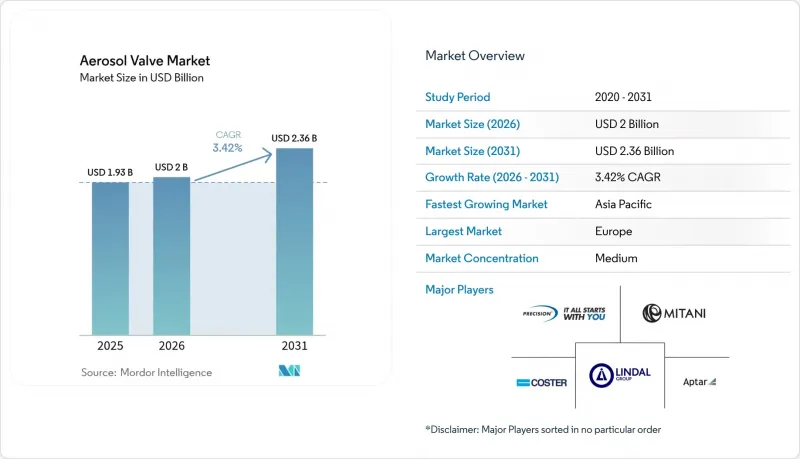
根據 Mordor Intelligence 預測,氣霧劑閥門市場規模將從 2025 年的 19.3 億美元成長到 2026 年的 20 億美元,到 2031 年將達到 23.6 億美元,2026 年至 2031 年的複合年成長率為 3.42%。
本報告按類型(連續閥、計量閥、袋式閥)、材質(鋁、馬口鐵、不銹鋼、塑膠及其他)、組件(閥體、閥桿、彈簧、吸管、閥杯、墊片)、終端用戶行業(個人護理、家庭護理、醫療保健、汽車及工業及其他)和地區進行細分。市場預測以美元計價。
全球氣霧劑閥門市場趨勢與洞察
來自化妝品和個人護理行業的強勁需求。
美妝品牌正在產品線中增加乾洗髮、定型噴霧和造型噴霧等產品,這些產品對均勻的噴霧顆粒和精準的噴灑效果要求極高。受社群媒體影響的「數位美妝」消費者重視氣霧劑閥門帶來的順滑、可控的噴霧效果。閥門供應商正透過客製化噴嘴形狀和對含有天然成分的產品進行相容性測試來滿足這一需求,幫助個人護理品牌在競爭激烈的商店中脫穎而出。
加速氣霧劑產品在醫療領域的應用
隨著氣喘和慢性阻塞性肺病(COPD)盛行率的上升,全球定量吸入器的使用量也不斷增加。美國環保署(EPA)預測,到2025年,吸入器中使用的HFC-134a和HFC-227ea推進劑的用量將達到1595公噸。同時,醫院和公共設施對消毒氣霧劑的需求持續超過疫情前的水準。這些醫療應用需要精確的劑量和藥用級材料,這使得閥門製造商能夠獲得高利潤。
嚴格的揮發性有機化合物和推進劑法規
美國更新後的氣霧劑塗料法規於2025年1月實施,該法規收緊了基於產品重量的反應性限制,並擴大了報告範圍,迫使品牌商重新配製產品,甚至退出市場(epa.gov)。加州空氣資源委員會(CARB)正在強制執行每日揮發性有機化合物(VOC)減排目標,這增加了合規成本。儘管推進劑技術不斷進步,中小企業卻面臨產品上市延遲和研發成本增加的問題。
細分市場分析
2025年,連續閥門佔據了氣霧劑閥門市場76.10%的佔有率,這主要得益於其與高速生產線的兼容性以及極具吸引力的單位成本優勢。在清潔劑、潤滑劑和塗料添加劑等大眾市場領域,連續閥佔據主導地位,因為這些領域對銷售量和耐用性要求極高。儘管連續閥目前仍是氣霧劑閥門市場的主導力量,但為了應對日益成長的安全和環保問題,其設計也在不斷改進,例如採用由再生塑膠製成的塑膠外蓋。
同時,袋式閥門技術以4.50%的複合年成長率(CAGR)位居榜首。品牌商願意接受組件成本的增加,因為該技術透過減少推進劑用量來降低生命週期排放,並可實現360度全方位使用,這對醫用噴霧劑和高階防曬油至關重要。這一細分市場受益於歐洲生態設計法規以及美國零售商採用的再生材料含量評估標準。隨著該技術的普及,預計2026年至2031年間,袋式閥門組件的氣霧劑閥門市場規模將顯著成長。
由於鋁具有優異的阻隔性能和成熟的回收系統,預計到2025年,鋁將佔據氣霧劑閥門市場45.20%的佔有率。它仍然是高壓吸入器和汽車清潔劑的重要材料。然而,隨著製造商開發出能夠承受更高壓力的多層塗層PET外殼,塑膠在氣霧劑閥門市場的佔有率正以每年4.56%的速度成長。 Plastipak公司的「SprayPET Revolution」是一種完全不含金屬的聚合物罐,在實現完全可回收的同時,實現了重量減輕和碳足跡降低。
為了滿足消費者日益成長的透明度需求,一些先鋒企業正在展示透明外殼,使填充量一目了然。然而,在氧氣透過率必須極低的領域,鋁仍然佔據主導地位。鋁製氣霧劑閥門市場預計將繼續成長,儘管成長放緩,而塑膠市場佔有率的成長將主要受注重成本的個人護理和家居護理產品需求的推動。
區域分析
在鼓勵使用低揮發性有機化合物(VOC)和可回收包裝的「綠色新政」指南的支持下,預計到2025年,歐洲將佔全球銷售額的32.60%。製造商正利用本地化的研發優勢,將帶有閥門袋的除臭劑和輕質鋁製容器推向市場。索諾科對Eviosis的整合,增強了尋求在地採購的歐洲品牌的供應穩定性。個人保健產品的永續消費和先進的藥品生產構成了該地區的基礎。
亞太地區是成長最快的地區,複合年成長率達4.61%。中國擁有大規模的製造能力,日本和韓國貢獻了先進的工程技術,東南亞的消費也不斷成長。當地企業正在升級生產線以符合出口限制,並擴大在該地區高階市場的佔有率。醫療基礎設施的快速發展也推動了吸入器閥門的需求,從而擴大了該地區的吸入器閥門市場。
北美憑藉其在特種藥品和高階化妝品領域的應用,仍保持著顯著的市場佔有率。創新重點在於減少碳足跡,波爾公司推出的「re:gen」氣霧罐就是一個典型的例子,據稱與傳統氣霧罐相比,其排放量減少了50%。供應鏈本地化和強制性回收利用正在推動對閉合迴路鋁採購的投資。南美和中東/非洲地區雖然發展落後,但都市化和電子商務的進步正在提高人均便捷噴霧產品的消費量,使其未來發展前景廣闊。
其他好處:
- Excel格式的市場預測(ME)表
- 3個月的分析師支持
目錄
第1章:引言
- 市場定義與研究假設
- 調查範圍
第2章:調查方法
第3章執行摘要
第4章 市場狀況
- 市場概覽
- 市場促進因素
- 來自化妝品和個人護理行業的強勁需求。
- 過渡到易於使用的包裝
- 氣霧劑在醫療領域的應用(吸入器、消毒劑)
- 環保袋式閥門技術應用
- 汽車售後市場氣霧劑產品的激增
- 電子商務中自有品牌SKU數量的激增
- 市場限制因素
- 對揮發性有機化合物和推進劑有嚴格的規定。
- 其他給藥方式(噴霧器、幫浦)
- 特種鋼/彈簧供應鏈中的脆弱性
- 遵守數位序列化規定需要大量資本投入
- 價值供應鏈分析
- 重要法規結構的評估
- 對關鍵相關人員的影響評估
- 技術展望
- 波特五力分析
- 宏觀經濟因素的影響
第5章 市場規模與成長預測
- 按類型
- 連續閥
- 計量閥
- 閥門式氣囊
- 材料
- 鋁
- 馬口鐵
- 不銹鋼
- 塑膠
- 其他
- 按組件
- 住房
- 幹
- 春天
- 浸管
- 杯墊
- 按最終用戶行業分類
- 個人護理
- 居家照護
- 衛生保健
- 汽車和工業
- 其他
- 按地區
- 北美洲
- 美國
- 加拿大
- 墨西哥
- 南美洲
- 巴西
- 阿根廷
- 其他南美國家
- 歐洲
- 德國
- 英國
- 法國
- 義大利
- 西班牙
- 俄羅斯
- 其他歐洲國家
- 亞太地區
- 中國
- 日本
- 印度
- 韓國
- 澳洲和紐西蘭
- 其他亞太國家
- 中東和非洲
- 中東
- 沙烏地阿拉伯
- 阿拉伯聯合大公國
- 土耳其
- 其他中東國家
- 非洲
- 南非
- 奈及利亞
- 埃及
- 其他非洲國家
- 中東
- 北美洲
第6章 競爭情勢
- 市場集中度
- 策略趨勢
- 市佔率分析
- 公司簡介
- AptarGroup Inc.
- Precision Valve Corporation
- Lindal Group Holding GmbH
- Coster Tecnologie Speciali SpA
- Mitani Valve Co., Ltd.
- Summit Packaging Systems, Inc.
- Clayton Corporation
- Newman Green Inc.
- Koh-I-Noor Mlada Vozice as
- Salvalco Ltd.
- Majesty Packaging Systems Limited
- Shanghai Sunhome Industrial Co., Ltd.
- EC Pack Industrial Limited
- C. Ehrensperger AG
- Aroma Industries FZCO
- Seung-il Corporation
- Yingbo Aerosol Valve(Zhongshan)Co., Ltd.
- Guangzhou Zhongpin Aerosol Valves Co., Ltd.
- Maruichi Co., Ltd.
- Weener Plastics Group GmbH
第7章 市場機會與未來趨勢
- 評估未開發的領域和未滿足的需求
According to Mordor Intelligence, the aerosol valve market size is expected to grow from USD 1.93 billion in 2025 to USD 2 billion in 2026 and is forecast to reach USD 2.36 billion by 2031 at 3.42% CAGR over 2026-2031.
This report is Segmented by Type (Continuous Valve, Metered Valve, Bag-On-Valve), Material (Aluminum, Tinplate Steel, Stainless Steel, Plastic, Others), Component (Housing, Stem, Spring, Dip Tube, Cup and Gasket), End-User Industry (Personal Care, Home Care, Healthcare, Automotive and Industrial, Others), and Geography. The Market Forecasts are Provided in Terms of Value (USD).
Global Aerosol Valve Market Trends and Insights
Strong demand from cosmetics and personal care
Beauty brands are adding dry shampoos, setting sprays, and texturizing mists that need consistent particulate delivery and precise coverage. The social-media-influenced "digital beauty" customer values sleek, controlled dispensing, which aerosol valves provide. Valve suppliers are responding with custom actuator shapes and compatibility testing for natural formulations, helping personal care labels differentiate in crowded shelves.
Healthcare aerosol adoption acceleration
Global use of metered-dose inhalers is climbing alongside rising asthma and COPD incidence. The United States Environmental Protection Agency projects HFC-134a and HFC-227ea propellant use in inhalers reaching 1,595 metric tons by 2025. Parallel demand for disinfectant aerosols remains above pre-pandemic baselines in hospitals and public venues. These medical applications require dose accuracy and pharmaceutical-grade materials, allowing valve makers to capture premium margins.
Stringent VOC and propellant regulations
The January 2025 update to U.S. aerosol-coating rules tightened product-weighted reactivity limits and broadened reporting, pushing brands to reformulate or exit the market epa.gov. California's CARB enforces daily VOC reduction targets that elevate compliance costs. While propellant innovation is advancing, smaller firms face delayed launches and higher R&D outlays.
Other drivers and restraints analyzed in the detailed report include:
- Bag-on-valve technology momentum
- E-commerce private-label proliferation
- Alternative dispensing competition
For complete list of drivers and restraints, kindly check the Table Of Contents.
Segment Analysis
Continuous valves accounted for 76.10% of the aerosol valve market in 2025 due to high-speed line compatibility and attractive unit economics. They dominate mass-market cleaners, lubricants, and paint enhancers that reward low cost and robust durability. The aerosol valve market still relies on continuous formats for the bulk of volume, but safety and environmental expectations are nudging design tweaks such as plastic over-caps molded from post-consumer resin.
Bag-on-valve technology, however, posts the fastest 4.50% CAGR. Brand owners accept higher component costs because propellant reductions lower lifecycle emissions and enable 360-degree usage, essential for medical sprays and premium sunscreens. This subsegment benefits Europe's eco-design rules and U.S. retailers' recyclable-content scorecards. As adoption widens, the aerosol valve market size for bag-on-valve assemblies is on course to accelerate notably between 2026 and 2031.
Aluminum held 45.20% of aerosol valve market share in 2025 thanks to excellent barrier performance and an established recycling loop. It remains indispensable for high-pressure inhalers and automotive cleaners. The aerosol valve market nonetheless witnesses plastics growing 4.56% per year as processors develop multi-layer and coated PET housings that tolerate higher pressure. Plastipak's SprayPET Revolution, a metal-free polymer can, cuts weight and carbon footprint while staying fully recyclable.
First movers showcase transparent housings that reveal fill levels, aligning with consumer openness trends. Still, aluminum keeps an edge where oxygen transmission rates must stay extremely low. The aerosol valve market size for aluminum components will continue growing albeit slower, whereas plastic's share rise will stem from cost-sensitive personal and home-care SKUs.
Complete Report Scope:
- By Type
- Continuous Valve
- Metered Valve
- Bag-on-Valve
- By Material
- Aluminum
- Tinplate Steel
- Stainless Steel
- Plastic
- Others
- By Component
- Housing
- Stem
- Spring
- Dip Tube
- Cup and Gasket
- By End-User Industry
- Personal Care
- Home Care
- Healthcare
- Automotive and Industrial
- Others
- By Geography
- North America
- United States
- Canada
- Mexico
- South America
- Brazil
- Argentina
- Rest of South America
- Europe
- Germany
- United Kingdom
- France
- Italy
- Spain
- Russia
- Rest of Europe
- Asia-Pacific
- China
- Japan
- India
- South Korea
- Australia and New Zealand
- Rest of Asia-Pacific
- Middle East and Africa
- Middle East
- Saudi Arabia
- United Arab Emirates
- Turkey
- Rest of Middle East
- Africa
- South Africa
- Nigeria
- Egypt
- Rest of Africa
- Middle East
- North America
Geography Analysis
Europe generated 32.60% of 2025 revenue, underpinned by Green Deal directives that reward low-VOC and recyclable packaging. Producers leverage regional R&D to roll out bag-on-valve deodorants and aluminum-lightweight housings. Sonoco's integration of Eviosys strengthens supply security for European brands seeking local sourcing . Sustained personal-care consumption plus advanced pharma production anchor the region.
Asia-Pacific is the fastest-growing area at a 4.61% CAGR. China supplies scale manufacturing, Japan and South Korea add engineering rigor, and Southeast Asia grows consumption. Local firms upgrade lines to meet export compliance, broadening regional participation in premium segments. Accelerating healthcare infrastructure also fuels inhaler valve demand, enlarging the aerosol valve market in the region.
North America preserves a sizeable share through specialized pharmaceutical and premium beauty applications. Innovation centers on carbon-footprint reduction, exemplified by Ball's re:gen aerosol can that claims a 50% emission cut versus traditional cans. Supply-chain localization and recycling mandates encourage investment in closed-loop aluminum sourcing. South America and the Middle East & Africa trail but show promise as urbanization and e-commerce lift per-capita consumption of convenient spray products.
- AptarGroup Inc.
- Precision Valve Corporation
- Lindal Group Holding GmbH
- Coster Tecnologie Speciali S.p.A.
- Mitani Valve Co., Ltd.
- Summit Packaging Systems, Inc.
- Clayton Corporation
- Newman Green Inc.
- Koh-I-Noor Mlada Vozice a.s.
- Salvalco Ltd.
- Majesty Packaging Systems Limited
- Shanghai Sunhome Industrial Co., Ltd.
- EC Pack Industrial Limited
- C. Ehrensperger AG
- Aroma Industries FZCO
- Seung-il Corporation
- Yingbo Aerosol Valve (Zhongshan) Co., Ltd.
- Guangzhou Zhongpin Aerosol Valves Co., Ltd.
- Maruichi Co., Ltd.
- Weener Plastics Group GmbH
Additional Benefits:
- The market estimate (ME) sheet in Excel format
- 3 months of analyst support
TABLE OF CONTENTS
1 INTRODUCTION
- 1.1 Market Definition and Study Assumptions
- 1.2 Scope of the Study
2 RESEARCH METHODOLOGY
3 EXECUTIVE SUMMARY
4 MARKET LANDSCAPE
- 4.1 Market Overview
- 4.2 Market Drivers
- 4.2.1 Strong demand from cosmetics and personal care
- 4.2.2 Shift toward easy-to-handle packaging
- 4.2.3 Healthcare aerosol adoption (inhalers, disinfectants)
- 4.2.4 Bag-on-valve eco-friendly adoption
- 4.2.5 Automotive aftermarket aerosol surge
- 4.2.6 E-commerce private-label SKU proliferation
- 4.3 Market Restraints
- 4.3.1 Stringent VOC and propellant regulations
- 4.3.2 Alternative dispensing (trigger sprayers, pumps)
- 4.3.3 Specialty steel/spring supply-chain vulnerability
- 4.3.4 High cap-ex for digital serialization compliance
- 4.4 Value / Supply-Chain Analysis
- 4.5 Evaluation of Critical Regulatory Framework
- 4.6 Impact Assessment of Key Stakeholders
- 4.7 Technological Outlook
- 4.8 Porter's Five Forces Analysis
- 4.8.1 Bargaining Power of Suppliers
- 4.8.2 Bargaining Power of Consumers
- 4.8.3 Threat of New Entrants
- 4.8.4 Threat of Substitutes
- 4.8.5 Intensity of Competitive Rivalry
- 4.9 Impact of Macro-economic Factors
5 MARKET SIZE AND GROWTH FORECASTS (VALUE)
- 5.1 By Type
- 5.1.1 Continuous Valve
- 5.1.2 Metered Valve
- 5.1.3 Bag-on-Valve
- 5.2 By Material
- 5.2.1 Aluminum
- 5.2.2 Tinplate Steel
- 5.2.3 Stainless Steel
- 5.2.4 Plastic
- 5.2.5 Others
- 5.3 By Component
- 5.3.1 Housing
- 5.3.2 Stem
- 5.3.3 Spring
- 5.3.4 Dip Tube
- 5.3.5 Cup and Gasket
- 5.4 By End-User Industry
- 5.4.1 Personal Care
- 5.4.2 Home Care
- 5.4.3 Healthcare
- 5.4.4 Automotive and Industrial
- 5.4.5 Others
- 5.5 By Geography
- 5.5.1 North America
- 5.5.1.1 United States
- 5.5.1.2 Canada
- 5.5.1.3 Mexico
- 5.5.2 South America
- 5.5.2.1 Brazil
- 5.5.2.2 Argentina
- 5.5.2.3 Rest of South America
- 5.5.3 Europe
- 5.5.3.1 Germany
- 5.5.3.2 United Kingdom
- 5.5.3.3 France
- 5.5.3.4 Italy
- 5.5.3.5 Spain
- 5.5.3.6 Russia
- 5.5.3.7 Rest of Europe
- 5.5.4 Asia-Pacific
- 5.5.4.1 China
- 5.5.4.2 Japan
- 5.5.4.3 India
- 5.5.4.4 South Korea
- 5.5.4.5 Australia and New Zealand
- 5.5.4.6 Rest of Asia-Pacific
- 5.5.5 Middle East and Africa
- 5.5.5.1 Middle East
- 5.5.5.1.1 Saudi Arabia
- 5.5.5.1.2 United Arab Emirates
- 5.5.5.1.3 Turkey
- 5.5.5.1.4 Rest of Middle East
- 5.5.5.2 Africa
- 5.5.5.2.1 South Africa
- 5.5.5.2.2 Nigeria
- 5.5.5.2.3 Egypt
- 5.5.5.2.4 Rest of Africa
- 5.5.5.1 Middle East
- 5.5.1 North America
6 COMPETITIVE LANDSCAPE
- 6.1 Market Concentration
- 6.2 Strategic Moves
- 6.3 Market Share Analysis
- 6.4 Company Profiles (includes Global level Overview, Market level overview, Core Segments, Financials as available, Strategic Information, Market Rank/Share for key companies, Products and Services, and Recent Developments)
- 6.4.1 AptarGroup Inc.
- 6.4.2 Precision Valve Corporation
- 6.4.3 Lindal Group Holding GmbH
- 6.4.4 Coster Tecnologie Speciali S.p.A.
- 6.4.5 Mitani Valve Co., Ltd.
- 6.4.6 Summit Packaging Systems, Inc.
- 6.4.7 Clayton Corporation
- 6.4.8 Newman Green Inc.
- 6.4.9 Koh-I-Noor Mlada Vozice a.s.
- 6.4.10 Salvalco Ltd.
- 6.4.11 Majesty Packaging Systems Limited
- 6.4.12 Shanghai Sunhome Industrial Co., Ltd.
- 6.4.13 EC Pack Industrial Limited
- 6.4.14 C. Ehrensperger AG
- 6.4.15 Aroma Industries FZCO
- 6.4.16 Seung-il Corporation
- 6.4.17 Yingbo Aerosol Valve (Zhongshan) Co., Ltd.
- 6.4.18 Guangzhou Zhongpin Aerosol Valves Co., Ltd.
- 6.4.19 Maruichi Co., Ltd.
- 6.4.20 Weener Plastics Group GmbH
7 MARKET OPPORTUNITIES AND FUTURE TRENDS
- 7.1 White-space and Unmet-need Assessment


