


 |
市場調查報告書
商品編碼
2124148
直線運動系統:市佔率分析、產業趨勢與統計、成長預測(2026-2031)Linear Motion System - Market Share Analysis, Industry Trends & Statistics, Growth Forecasts (2026 - 2031) |
||||||

※ 本網頁內容可能與最新版本有所差異。詳細情況請與我們聯繫。
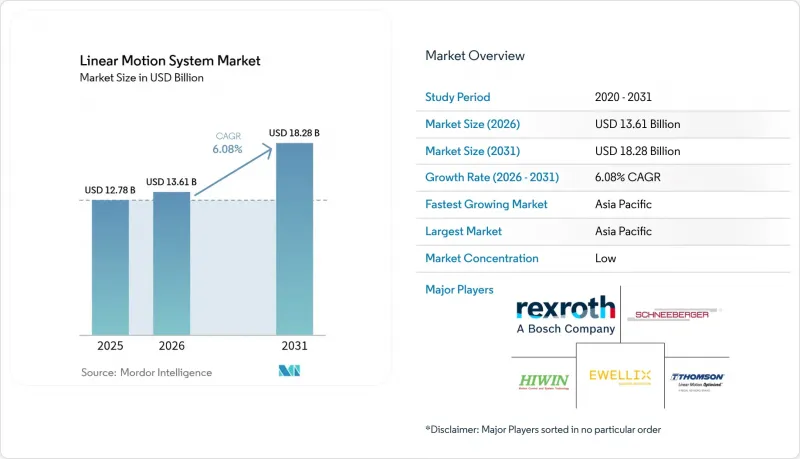
根據 Mordor Intelligence 預測,線性運動系統市場規模預計將在 2026 年達到 136.1 億美元,到 2031 年達到 182.8 億美元,2026 年至 2031 年的複合年成長率為 6.08%。
本報告按類型(單軸、多軸、皮帶驅動、滾珠螺桿等)、組件(執行器和馬達、線性滑軌、直線軸承、控制器、滾珠螺桿和導螺桿等)、終端用戶行業(汽車等)、應用(物料輸送、工具工具機等)和地區進行細分。市場預測以美元(USD)為單位。
全球直線運動系統市場趨勢與洞察
透過工業4.0加速自動化普及
工業主管們已經意識到數位化生產帶來的顯著效益。工廠升級改造,例如用電子機械執行器取代氣壓缸,可以實現亞微米級的回饋、無線更新,並將試運行時間縮短高達 40%。如今,支援邊緣運算的運動控制器配備了基於 Linux 的應用生態系統,能夠將韌體和數位孿生資料直接傳輸到生產現場。這些功能縮短了產品批次分散時的換線週期,並能夠根據即時感測器資料自動產生預測性維護計劃。因此,線性運動系統市場正日益與工業 4.0 投資週期緊密相連,而不再侷限於傳統的資本設備預算。
電子商務的擴張正在推動自動化倉庫的發展。
為了兌現隔天達的承諾,履約業者正在部署垂直升降模組、穿梭車系統和移動機器人。每個子系統都依賴高循環線性平台在毫秒內完成周轉箱的定位。顯著提升的空間利用效率極具吸引力,一座自動化倉庫塔架即可取代 10,000 平方英尺的固定貨架。此外,節能型直驅馬達可在 10 年內降低高達 20% 的總擁有成本。隨著第三方物流供應商將網路擴展到區域城市,面積小、免維護的執行器正成為新型交叉轉運中心的關鍵配置。
稀土元素磁鐵價格波動
永磁線性馬達依賴釹鐵硼合金,其中超過90%的精煉材料產自中國。 2020年至2025年間,釹镨氧化物的價格上漲了243%,而中國以外的新計畫則面臨更高的資本密集度和更嚴格的環境許可要求。考慮採用鐵氧體或磁阻替代方案的馬達製造商,不得不接受功率密度降低30%的現實,而且這些方案僅限於低扭力應用,限制了短期內的多元化發展。
細分市場分析
在所有類型中,直驅直線線性馬達平台預計將實現最高的複合年成長率(CAGR),達到 6.78%,因為它們可以透過預防性維護顯著減少停機時間,並將能耗降低高達 30%。由工具機龍門架和半導體搬運器驅動的多軸組件需要協同操作,預計到 2025 年,它們仍將佔據超過一半的銷售額。單軸系統適用於簡單的拾取放置操作,在這些操作中,成本和速度比亞微米級精度更為重要。
對於中等負載和行程超過 10 公尺的應用,皮帶驅動平台仍然是首選方案;而滾珠螺桿執行器則在一般工業自動化領域實現了推力和價格的良好平衡。線性運動系統市場對多樣化拓樸結構的需求持續存在,使用者會根據循環速率、精確度和環境限制等因素選擇合適的架構。製造商在選擇拓撲結構時,除了機械性能之外,也越來越重視安全認證、總成本和數位孿生相容性。
邊緣模組現在可以處理振動抑制、自適應進給速度控制和狀態監控等功能,這些功能以前需要單獨的硬體才能實現,預計控制器將以 6.96% 的複合年成長率成長,優於其他組件。由於線性導軌在工具機和包裝單元中的廣泛應用,預計到 2025 年,線性滑軌市場將佔總銷售額的近一半。
直線軸承、執行器和馬達正逐步過渡到無刷永磁設計,以延長使用壽命並提高熱穩定性。雖然滾珠螺桿和導螺桿仍能提供 5:1 至 50:1 的機械優勢,但在高精度應用中,它們正日益被直驅馬達所取代。電纜鏈、限位感測器和潤滑脂筒構成了系統的材料清單,而快速連接介面則縮短了安裝時間。
區域分析
到2025年,亞太地區將佔全球出貨量的46.84%,主要得益於中國稀土元素供應鏈和日本的零件技術。印度與生產連結獎勵計畫計畫以及韓國2,300億美元的半導體發展藍圖預計將提振該地區超精密級訂單。北美地區到2025年將佔全球銷售額的約22%,這主要得益於電動車組裝線的建設以及醫療設備回流美國(近期訂定的政策獎勵也起到了推動作用)。墨西哥的近岸外包業務直接推動了美國汽車和電子工廠對執行器的需求。
預計到2025年,歐洲將佔全球工具機裝機量的約20%。儘管能源價格上漲帶來壓力,德國的「工業4.0」計畫仍在幫助維持工具機出口。法國的再工業化舉措正透過引入新一代線性馬達和邊緣控制器,推動包裝和製藥工廠的現代化。以沙烏地阿拉伯和阿拉伯聯合大公國(阿拉伯聯合大公國)主導的中東地區正在崛起為自動化中心,政府津貼為待開發區工廠的初期投資提供資金。
預計到2031年,南美洲將以6.84%的複合年成長率實現最快成長,這主要得益於巴西汽車工業和阿根廷食品加工業為遏制不斷上漲的人事費用而轉向自動化。非洲仍處於發展階段,但南非的汽車組裝和埃及的食品加工廠已開始率先採用運動控制技術。在每個地區,線性運動系統市場都面臨著各種障礙,包括關稅、技能和電力成本,這些因素都在影響著該技術的普及。
其他好處:
- Excel格式的市場預測(ME)表
- 3個月的分析師支持
目錄
第1章:引言
- 研究假設和市場定義
- 調查範圍
第2章:調查方法
第3章執行摘要
第4章 市場狀況
- 市場概覽
- 市場促進因素
- 透過工業4.0實現自動化正在加速發展。
- 電子商務的擴張正在推動自動化倉庫的普及。
- 半導體和電子裝置對更高精度的需求日益成長。
- 市場對緊湊型、免維護的診斷設備學習管理系統 (LMS) 的需求激增。
- 一種永續、軟質包裝形式,需要高精度操作。
- 醫療設備無塵室生產線回流激勵措施
- 市場限制因素
- 客製化系統的初始成本高,且投資回報週期長。
- 熟練的LMS工程師短缺
- 稀土元素磁鐵價格波動
- 智慧學習管理系統中符合IEC-62443網路安全標準的成本
- 產業價值鏈分析
- 宏觀經濟因素對市場的影響
- 技術展望
- 監理情勢
- 波特五力分析
第5章 市場規模與成長預測
- 按類型
- 單軸線性運動系統
- 多軸線性運動系統
- 皮帶驅動直線運動系統
- 滾珠螺桿直線運動系統
- 線性馬達直接驅動系統
- 按組件
- 執行器和電機
- 線性滑軌
- 直線軸承
- 控制器
- 滾珠螺桿和導螺桿
- 其他規則
- 按最終用戶行業分類
- 車
- 電子和半導體
- 製造業,金屬/機械
- 航太/國防
- 醫療保健和醫療設備
- 食品/飲料
- 物流和倉儲
- 其他終端用戶產業
- 透過使用
- 物料輸送
- 工具機
- 機器人和協作機器人
- 包裝和標籤
- 挑選和放置
- 檢驗和測量
- 其他用途
- 按地區
- 北美洲
- 美國
- 加拿大
- 墨西哥
- 南美洲
- 巴西
- 阿根廷
- 其他南美國家
- 歐洲
- 德國
- 法國
- 英國
- 義大利
- 西班牙
- 其他歐洲國家
- 亞太地區
- 中國
- 日本
- 印度
- 韓國
- 澳洲
- 其他亞太國家
- 中東
- 沙烏地阿拉伯
- 阿拉伯聯合大公國
- 土耳其
- 其他中東國家
- 非洲
- 南非
- 埃及
- 奈及利亞
- 其他非洲國家
- 北美洲
第6章 競爭情勢
- 市場集中度
- 策略趨勢
- 市佔率分析
- 公司簡介
- Bosch Rexroth AG
- THK Co. Ltd
- Hiwin Corporation
- Schneeberger Group
- NSK Ltd
- Nippon Bearing Co. Ltd
- Thomson Industries Inc.(Regal Rexnord Corporation)
- The Timken Company
- Rockwell Automation Inc.
- Parker Hannifin Corporation
- HepcoMotion Inc.
- Ewellix AB
- Rollon SpA
- SKF AB
- Schneider Electric Motion USA Inc.
- PBC Linear Inc.
- Altra Industrial Motion Corp.
- Akribis Systems Pte Ltd
- Aerotech Inc.
- Lintech Corporation
第7章 市場機會與未來展望
According to Mordor Intelligence, the linear motion system market size is projected to be USD 13.61 billion in 2026 and reach USD 18.28 billion by 2031, growing at a CAGR of 6.08% between 2026 and 2031.
This report is Segmented by Type (Single-Axis, Multi-Axis, Belt-Driven, and Ball Screw, and More), Component (Actuators and Motors, Linear Guides, Linear Bearings, Controllers, Ball Screws and Lead Screws, and More), End-User Industry (Automotive, and More), Application (Material Handling, Machine Tools, and More), and Geography. The Market Forecasts are Provided in Terms of Value (USD).
Global Linear Motion System Market Trends and Insights
Accelerating Adoption of Industry 4.0 Automation
Industrial executives see measurable gains from digitalized production. Plant upgrades that replace pneumatic cylinders with electromechanical actuators provide sub-micrometer feedback, enable over-the-air updates, and cut commissioning time by up to 40%. Edge-ready motion controllers now host Linux-based app ecosystems that push firmware and digital-twin data directly to the shop floor. These capabilities shorten changeover intervals when product batches fragment and allow predictive maintenance schedules to be generated automatically from live sensor data. As a result, the linear motion system market is increasingly tied to Industry 4.0 investment cycles rather than traditional capital-equipment budgets.
Expanding E-Commerce Boosting Automated Warehousing
Fulfilment operators are deploying vertical lift modules, shuttle systems, and mobile robots to meet next-day delivery promises. Each subsystem relies on high-cycle linear stages that position totes within milliseconds. Space utilization benefits are compelling because a single automated storage tower can replace 10,000 ft2 of static racks, while energy-efficient direct-drive motors reduce total ownership cost by up to 20% over a decade. As third-party logistics providers extend networks into secondary cities, small-footprint, maintenance-free actuators become a core specification for new cross-dock hubs.
Rare-Earth Magnet Price Volatility
Permanent-magnet linear motors depend on neodymium-iron-boron alloys, yet China supplies more than 90% of refined material. Prices for neodymium-praseodymium oxide climbed 243% between 2020 and 2025, and new non-Chinese projects face higher capital intensity and stricter environmental permits. Motor makers evaluating ferrite or reluctance alternatives must accept a 30% loss of force density, limiting those options to low-torque applications and constraining near-term diversification efforts.
Other drivers and restraints analyzed in the detailed report include:
- Rising Semiconductor and Electronics Precision Needs
- Demand Surge for Miniature Maintenance-Free LMS in Diagnostic Devices
- High Upfront Cost and ROI Cycle of Customized Systems
For complete list of drivers and restraints, kindly check the Table Of Contents.
Segment Analysis
Linear motor direct-drive platforms are expected to post a 6.78% CAGR, the highest among type categories, because they slash preventive-maintenance downtime and reduce energy use by up to 30%. Multi-axis assemblies still anchor more than half of 2025 revenue, driven by machine-tool gantries and semiconductor handlers that need coordinated motion. Single-axis systems satisfy simple pick-and-place duties where cost and speed outweigh sub-micron accuracy.
Belt-driven stages remain the preferred solution for strokes exceeding 10 m at moderate loads, while ball-screw actuators balance thrust and pricing for general industrial automation. The linear motion system market maintains diverse topology demand because users match architecture to cycle rate, accuracy, and environmental constraints. Manufacturers increasingly evaluate safety certification, total cost, and digital-twin readiness alongside mechanical performance when selecting a topology.
Controllers are projected to outpace other components at a 6.96% CAGR because edge modules now handle vibration suppression, adaptive feed-rate control, and condition monitoring that once required separate hardware. The linear motion system market size for linear guides was nearly half of 2025 revenue thanks to their ubiquity in machine tools and packaging cells.
Linear bearings, actuators, and motors are transitioning toward brushless permanent-magnet designs that prolong life and improve thermal stability. Ball screws and lead screws still offer 5:1 to 50:1 mechanical advantage but cede precision niches to direct-drive motors. Cable chains, limit sensors, and lubrication cartridges round out system bills of material, and quick-connect interfaces shorten installation time.
Complete Report Scope:
- By Type
- Single-Axis Linear Motion System
- Multi-Axis Linear Motion System
- Belt-Driven Linear Motion System
- Ball Screw Linear Motion System
- Linear Motor Direct-Drive System
- By Component
- Actuators and Motors
- Linear Guides
- Linear Bearings
- Controllers
- Ball Screws and Lead Screws
- Other Components
- By End-User Industry
- Automotive
- Electronics and Semiconductor
- Manufacturing, Metals and Machinery
- Aerospace and Defense
- Healthcare and Medical Devices
- Food and Beverage
- Logistics and Warehousing
- Other End-User Industries
- By Application
- Material Handling
- Machine Tools
- Robotics and Cobots
- Packaging and Labelling
- Pick-and-Place
- Inspection and Metrology
- Other Applications
- By Geography
- North America
- United States
- Canada
- Mexico
- South America
- Brazil
- Argentina
- Rest of South America
- Europe
- Germany
- France
- United Kingdom
- Italy
- Spain
- Rest of Europe
- Asia-Pacific
- China
- Japan
- India
- South Korea
- Australia
- Rest of Asia-Pacific
- Middle East
- Saudi Arabia
- United Arab Emirates
- Turkey
- Rest of Middle East
- Africa
- South Africa
- Egypt
- Nigeria
- Rest of Africa
- North America
Geography Analysis
Asia-Pacific represented 46.84% of global shipments in 2025, anchored by China's rare-earth supply chain and Japan's component expertise. Subsidies under India's production-linked incentive scheme and South Korea's USD 230 billion semiconductor roadmap will bolster regional orders for ultra-precision stages. North America contributed roughly 22% of 2025 revenue, benefitting from electric-vehicle assembly lines and medical-device reshoring supported by recent U.S. policy incentives. Mexico's nearshoring inflows are translating directly into actuator demand for automotive and electronics plants serving United States customers.
Europe accounted for about 20% of 2025 installations, with Germany's Industry 4.0 program sustaining machine-tool exports despite energy-price pressures. France's re-industrialization initiative is upgrading packaging and pharmaceutical plants with next-generation linear motors and edge controllers. The Middle East, led by Saudi Arabia and the United Arab Emirates, is emerging as a boutique automation hub as government grants offset initial capex for greenfield factories.
South America is projected to grow fastest at 6.84% CAGR through 2031 as Brazilian automotive and Argentine food processors automate to curb labour inflation. Africa remains nascent, though South African auto assembly and Egyptian food-processing lines signal early motion-control adoption. Across regions, the linear motion system market encounters varying tariff, skills, and power-cost barriers that shape technology uptake.
- Bosch Rexroth AG
- THK Co. Ltd
- Hiwin Corporation
- Schneeberger Group
- NSK Ltd
- Nippon Bearing Co. Ltd
- Thomson Industries Inc. (Regal Rexnord Corporation)
- The Timken Company
- Rockwell Automation Inc.
- Parker Hannifin Corporation
- HepcoMotion Inc.
- Ewellix AB
- Rollon S.p.A.
- SKF AB
- Schneider Electric Motion USA Inc.
- PBC Linear Inc.
- Altra Industrial Motion Corp.
- Akribis Systems Pte Ltd
- Aerotech Inc.
- Lintech Corporation
Additional Benefits:
- The market estimate (ME) sheet in Excel format
- 3 months of analyst support
TABLE OF CONTENTS
1 INTRODUCTION
- 1.1 Study Assumptions and Market Definition
- 1.2 Scope of the Study
2 RESEARCH METHODOLOGY
3 EXECUTIVE SUMMARY
4 MARKET LANDSCAPE
- 4.1 Market Overview
- 4.2 Market Drivers
- 4.2.1 Accelerating Adoption of Industry 4.0 Automation
- 4.2.2 Expanding E-Commerce Boosting Automated Warehousing
- 4.2.3 Rising Semiconductor and Electronics Precision Needs
- 4.2.4 Demand Surge for Miniature Maintenance-Free LMS in Diagnostic Devices
- 4.2.5 Sustainable Flexible-Package Formats Requiring High-Precision Motion
- 4.2.6 Reshoring Incentives for Medical-Device Clean-Room Lines
- 4.3 Market Restraints
- 4.3.1 High Upfront Cost and ROI Cycle of Customised Systems
- 4.3.2 Scarcity of Skilled LMS Technicians
- 4.3.3 Rare-Earth Magnet Price Volatility
- 4.3.4 IEC-62443 Cybersecurity Compliance Cost for Smart LMS
- 4.4 Industry Value-Chain Analysis
- 4.5 Impact of Macroeconomic Factors on the Market
- 4.6 Technological Outlook
- 4.7 Regulatory Landscape
- 4.8 Porter's Five Forces Analysis
- 4.8.1 Bargaining Power of Suppliers
- 4.8.2 Bargaining Power of Buyers
- 4.8.3 Threat of New Entrants
- 4.8.4 Intensity of Competitive Rivalry
- 4.8.5 Threat of Substitutes
5 MARKET SIZE AND GROWTH FORECASTS (VALUE)
- 5.1 By Type
- 5.1.1 Single-Axis Linear Motion System
- 5.1.2 Multi-Axis Linear Motion System
- 5.1.3 Belt-Driven Linear Motion System
- 5.1.4 Ball Screw Linear Motion System
- 5.1.5 Linear Motor Direct-Drive System
- 5.2 By Component
- 5.2.1 Actuators and Motors
- 5.2.2 Linear Guides
- 5.2.3 Linear Bearings
- 5.2.4 Controllers
- 5.2.5 Ball Screws and Lead Screws
- 5.2.6 Other Components
- 5.3 By End-User Industry
- 5.3.1 Automotive
- 5.3.2 Electronics and Semiconductor
- 5.3.3 Manufacturing, Metals and Machinery
- 5.3.4 Aerospace and Defense
- 5.3.5 Healthcare and Medical Devices
- 5.3.6 Food and Beverage
- 5.3.7 Logistics and Warehousing
- 5.3.8 Other End-User Industries
- 5.4 By Application
- 5.4.1 Material Handling
- 5.4.2 Machine Tools
- 5.4.3 Robotics and Cobots
- 5.4.4 Packaging and Labelling
- 5.4.5 Pick-and-Place
- 5.4.6 Inspection and Metrology
- 5.4.7 Other Applications
- 5.5 By Geography
- 5.5.1 North America
- 5.5.1.1 United States
- 5.5.1.2 Canada
- 5.5.1.3 Mexico
- 5.5.2 South America
- 5.5.2.1 Brazil
- 5.5.2.2 Argentina
- 5.5.2.3 Rest of South America
- 5.5.3 Europe
- 5.5.3.1 Germany
- 5.5.3.2 France
- 5.5.3.3 United Kingdom
- 5.5.3.4 Italy
- 5.5.3.5 Spain
- 5.5.3.6 Rest of Europe
- 5.5.4 Asia-Pacific
- 5.5.4.1 China
- 5.5.4.2 Japan
- 5.5.4.3 India
- 5.5.4.4 South Korea
- 5.5.4.5 Australia
- 5.5.4.6 Rest of Asia-Pacific
- 5.5.5 Middle East
- 5.5.5.1 Saudi Arabia
- 5.5.5.2 United Arab Emirates
- 5.5.5.3 Turkey
- 5.5.5.4 Rest of Middle East
- 5.5.6 Africa
- 5.5.6.1 South Africa
- 5.5.6.2 Egypt
- 5.5.6.3 Nigeria
- 5.5.6.4 Rest of Africa
- 5.5.1 North America
6 COMPETITIVE LANDSCAPE
- 6.1 Market Concentration
- 6.2 Strategic Moves
- 6.3 Market Share Analysis
- 6.4 Company Profiles (includes Global Level Overview, Market Level Overview, Core Segments, Financials as available, Strategic Information, Market Rank/Share, Products and Services, Recent Developments)
- 6.4.1 Bosch Rexroth AG
- 6.4.2 THK Co. Ltd
- 6.4.3 Hiwin Corporation
- 6.4.4 Schneeberger Group
- 6.4.5 NSK Ltd
- 6.4.6 Nippon Bearing Co. Ltd
- 6.4.7 Thomson Industries Inc. (Regal Rexnord Corporation)
- 6.4.8 The Timken Company
- 6.4.9 Rockwell Automation Inc.
- 6.4.10 Parker Hannifin Corporation
- 6.4.11 HepcoMotion Inc.
- 6.4.12 Ewellix AB
- 6.4.13 Rollon S.p.A.
- 6.4.14 SKF AB
- 6.4.15 Schneider Electric Motion USA Inc.
- 6.4.16 PBC Linear Inc.
- 6.4.17 Altra Industrial Motion Corp.
- 6.4.18 Akribis Systems Pte Ltd
- 6.4.19 Aerotech Inc.
- 6.4.20 Lintech Corporation
7 MARKET OPPORTUNITIES AND FUTURE OUTLOOK
- 7.1 White-Space and Unmet-Need Assessment

 直線運動系統市場-2026-2032年全球市場預測
 直線運動產品市場規模、佔有率和成長分析:按產品類型、運動類型、應用、最終用戶產業、負載能力、分銷管道和地區分類-2026-2033年產業預測
 旋轉台市場預測至2034年-按類型、應用和地區分類的全球分析
 直線運動市場規模、佔有率和趨勢分析報告:按軸、產品類型、應用、操作、最終用途、地區和細分市場預測(2026-2033 年)醫療設備直線馬達模組市場:按類型、階段、銷售管道和應用分類,全球預測(2026-2032年)
 直線運動系統市場報告:按類型、組件、最終用途行業和地區分類(2026-2034 年)XYZ龍門平台市場:按驅動類型、軸配置、行程範圍、負載能力、類型、應用、最終用戶分類,全球預測(2026-2032年)平面龍門架市場按驅動類型、軸配置、應用和最終用戶產業分類,全球預測(2026-2032年)
 全球直線運動產品市場:市場規模、佔有率、成長率、產業分析、依類型、應用和地區劃分的分析以及未來預測(2026-2034)
 直線運動系統市場 - 全球產業規模、佔有率、趨勢、機會及預測(按類型、最終用戶產業、地區和競爭格局分類,2021-2031年)