


 |
市場調查報告書
商品編碼
2124146
交易監測:市場佔有率分析、行業趨勢和統計數據、成長預測(2026-2031 年)Transaction Monitoring - Market Share Analysis, Industry Trends & Statistics, Growth Forecasts (2026 - 2031) |
||||||

※ 本網頁內容可能與最新版本有所差異。詳細情況請與我們聯繫。
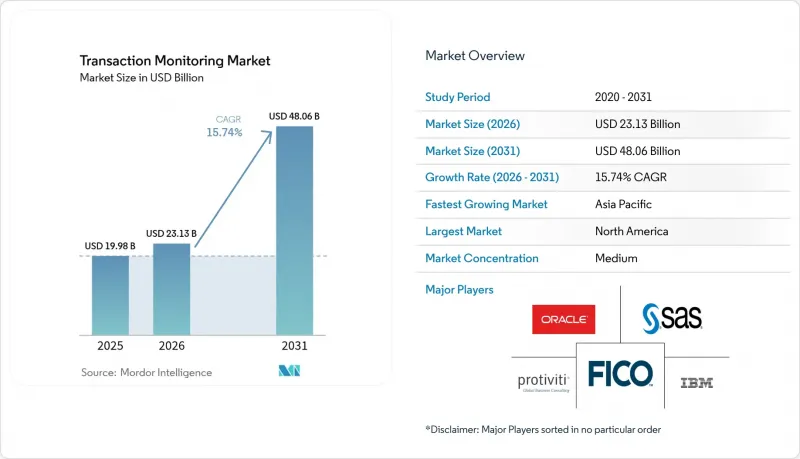
據 Mordor Intelligence 稱,2025 年交易監控市場價值為 199.8 億美元,預計到 2031 年將達到 480.6 億美元,而 2026 年為 231.3 億美元,預測期(2026-2031 年)複合年成長率為 15.74%。
本報告按組件(解決方案和服務)、部署模式(雲端、本地部署)、應用(反洗錢、詐欺偵測和預防等)、組織規模(大型企業、中小企業)、產業(金融、保險和證券(BFSI)、政府和國防等)以及地區進行細分。市場預測以美元計價。
全球貿易監測市場趨勢及洞察
嚴格的反洗錢和了解你的客戶 (AML/KYC) 法規
預計到2024年,全球反洗錢相關罰款將達2.63億美元,比上年增加31%。各銀行正加速從傳統規則體系轉向符合歐盟第六項反洗錢指令(6AMLD)和美國《公司透明法案》的自適應人工智慧引擎。已實施先進模型的金融機構發現,誤報率降低了40%,檢查人員的信心顯著提升,案件處理流程更加快捷,合規瓶頸也得以減少。
隨著數位支付的普及,即時監控變得至關重要。
即時支付網路要求在不到一秒的時間內完成評分,而升級了監控流程的公司在詐欺防範方面的有效性提高了49%。零售商和電商企業正在採用相同的管理方法來阻止忠誠度計畫的欺詐性使用和信用卡測試攻擊,從而在保持客戶體驗的同時,將詐欺損失降低高達60%。
高誤報率導致的警報疲勞
基於規則的系統仍然存在噪音率超過90%的問題,迫使銀行僱用大規模的分析師團隊,並面臨因警報過載而漏報威脅的風險。道明銀行被處以30億美元的罰款,凸顯了不當分類的代價。人工智慧驅動的案件管理系統可將誤報率降低40%,使負責人能夠專注於更有價值的評估。
細分市場分析
預計到2025年,解決方案將佔據70.85%的市場佔有率,而對外部專業知識日益成長的依賴表明,外包模式正朝著持續改進的方向發展。專業服務提供者正在建立以實施後最佳化為中心的永續收入來源,從而確保在整個業務週期中保持強勁的需求,尤其是在合規要求日益嚴格的背景下。
然而,隨著金融機構逐漸意識到僅靠技術無法有效維持合規,交易監控市場的業務收益預計將在2026年至2031年間以18.12%的複合年成長率成長。目前,大多數平台部署都已包含涵蓋人工智慧模型檢驗、場景調優和資料品質改進的服務合約。跨國銀行尤其如此,因為它們面臨各國不同的監管要求。這些諮詢和管理服務層層提升,可將準確性和威脅偵測率提高高達30%。
預計到2025年,雲端平台將佔據交易監控市場規模的63.25%,並在2031年之前以19.28%的複合年成長率成長,這主要得益於其強大的吞吐量和自動化的規則更新。即使對於先前缺乏企業級基礎設施的中型銀行和金融科技公司而言,即時篩檢數億筆交易也已在經濟上可行。
在資料保護條例嚴格的司法管轄區,受監管的公司仍然採用本地核心系統和雲端分析相結合的方式,但隨著隱私增強型運算的普及,這種抵制正在減弱。隨著服務交付成本的降低,雲端技術的採用使得客戶篩檢和製裁核查等相關分析成為可能,從而進一步加速了交易監控市場中供應商的交叉銷售。
區域分析
預計到2025年,北美將以32.65%的市佔率引領交易監控市場。這得歸功於美國金融犯罪執法管理局(FinCEN)的執法活動以及一級銀行持續的技術投資。美國金融機構正迫切尋求降低誤報率,並正在試點「可解釋人工智慧」以滿足監管機構的透明度標準;與此同時,加拿大金融交易報告和分析中心(FinTRAC)正在推動中型金融機構採用即時分析技術。
亞太地區預計將呈現最高成長率,到2031年複合年成長率將達到17.14%,主要得益於中國、印度和印尼支付生態系統的大規模數位化。中國央行的監管政策正迫使國內供應商在其超級應用支付基礎設施中整合持續監控功能。同時,印度的統一支付介面(UPI)生態系統需要全天候篩檢以管理龐大的小額交易量。日本、韓國和澳洲等已開發市場正致力於利用人工智慧驅動的異常檢測來彌補熟練分析師的短缺。
在歐洲,得益於第六項洗錢防制指令 (6AMLD) 下洗錢防制機制的統一以及市場行銷控制局 (MiCA) 將監控範圍擴大至加密貨幣服務供應商,強勁的成長得以持續。德國和法國優先發展隱私保護型分析技術,以符合《一般資料保護規則》(GDPR) 的要求;而英國金融行為監理局 (FCA) 對監控系統不完善的情況處以嚴厲處罰,從而加速了現代平台的普及。泛歐開放銀行計畫正在拓展資料輸入的範圍和複雜性,從而增強整個交易監控市場對以 API 為中心的解決方案的需求。
其他好處:
- Excel格式的市場預測(ME)表
- 3個月的分析師支持
目錄
第1章:引言
- 研究假設和市場定義
- 調查範圍
第2章:調查方法
第3章執行摘要
第4章 市場狀況
- 市場概覽
- 市場促進因素
- 嚴格的反洗錢和了解你的客戶 (AML/KYC) 法規
- 數位和即時支付交易量增加
- 透過整合人工智慧和機器學習來減少誤報
- 遷移到基於雲端的合規平台
- 開放銀行API支援銀行間監控
- 央行數位貨幣試點計畫可能會導致引入新的監測義務。
- 市場限制因素
- 大量誤報會導致警報疲勞。
- 熟練的反洗錢數據分析師短缺
- 資料主權與隱私權法之間的摩擦
- 規避監管的合成身分詐騙激增。
- 價值供應鏈分析
- 監理情勢
- 技術展望
- 區域資訊共用系統
- 安全資料共用的技術基礎
- 波特五力模型
第5章 市場規模與成長預測
- 按組件
- 解決方案
- 服務
- 部署模式
- 雲
- 現場
- 透過使用
- 反洗錢措施
- 詐欺檢測與預防
- 客戶身分管理
- 合規管理
- 其他小眾用例
- 按組織規模
- 大公司
- 中小企業
- 按行業分類
- 銀行、金融服務和保險(BFSI)
- 政府/國防
- IT/通訊
- 零售與電子商務
- 衛生保健
- 能源公用事業
- 製造業
- 其他
- 按地區
- 北美洲
- 美國
- 加拿大
- 墨西哥
- 南美洲
- 巴西
- 阿根廷
- 其他南美國家
- 歐洲
- 英國
- 德國
- 法國
- 義大利
- 西班牙
- 俄羅斯
- 其他歐洲國家
- 亞太地區
- 中國
- 日本
- 印度
- 韓國
- 澳洲和紐西蘭
- 其他亞太國家
- 中東和非洲
- 中東
- GCC
- 土耳其
- 其他中東國家
- 非洲
- 南非
- 奈及利亞
- 其他非洲國家
- 中東
- 北美洲
第6章 競爭情勢
- 市場集中度
- 策略趨勢
- 市佔率分析
- 公司簡介
- NICE Ltd(Actimize)
- Oracle Corp.
- Fair Isaac Corp(FICO)
- SAS Institute Inc.
- IBM Corp.
- Fidelity National Information Services(FIS)
- Fiserv Inc.
- BAE Systems plc
- ACI Worldwide Inc.
- LexisNexis Risk Solutions
- Protiviti Inc.
- Feedzai Inc.
- ComplyAdvantage Ltd
- FeatureSpace Ltd
- Temenos AG
- Napier AI Ltd
- Tookitaki Holding Pte Ltd
- Fenergo Group
- ThetaRay Ltd
- Silent Eight Pte Ltd
第7章 市場機會與未來展望
According to Mordor Intelligence, the transaction monitoring market size was valued at USD 19.98 billion in 2025 and estimated to grow from USD 23.13 billion in 2026 to reach USD 48.06 billion by 2031, at a CAGR of 15.74% during the forecast period (2026-2031).
This report is Segmented by Component (Solution and Services) and by Deployment Mode (Cloud, On-Premises), by Application (Anti-Money Laundering, Fraud Detection and Prevention, and More), by Organization Size (Large Enterprises, Small and Medium Enterprises), by Industry Vertical (BFSI, Government and Defense, and More), and by Geography. The Market Forecasts are Provided in Terms of Value (USD).
Global Transaction Monitoring Market Trends and Insights
Stringent AML & KYC regulations
Global AML penalties climbed 31% year on year to USD 263 million in 2024, prompting banks to retire legacy rule sets in favor of adaptive, AI-enabled engines that address the EU 6AMLD and the US Corporate Transparency Act. Institutions deploying advanced models report 40% fewer false positives and materially stronger examiner confidence, speeding case workflows and reducing compliance backlogs.
Digital payments expansion necessitates real-time monitoring
Real-time payment rails demand sub-second scoring, and firms that upgrade monitoring pipelines see a 49% lift in fraud-prevention effectiveness. Retail and e-commerce adopters leverage the same controls to stem loyalty fraud and card-testing attacks, cutting fraud losses by up to 60% while preserving customer experience.
High false-positive alert fatigue
Rule-centric systems still generate above-90% noise ratios, forcing banks to hire large analyst teams and risking missed threats amid alert overload. TD Bank's USD 3 billion penalty underscored the cost of poor triage. AI-powered case managers are cutting false positives by 40%, freeing investigators for high-value reviews.
Other drivers and restraints analyzed in the detailed report include:
- AI and machine learning transform detection accuracy
- CBDC pilots trigger new surveillance mandates
- Synthetic identity fraud evades traditional controls
For complete list of drivers and restraints, kindly check the Table Of Contents.
Segment Analysis
Solutions held 70.85% share in 2025, growing reliance on external expertise signals a shift toward continuous-improvement outsourcing. Specialized providers build recurring revenue around post-implementation optimization, ensuring the transaction monitoring market maintains resilient demand through economic cycles as compliance requirements tighten.
However, Services revenue within the transaction monitoring market is expected to rise at an 18.12% CAGR from 2026-2031 as institutions recognize that technology alone cannot sustain effective compliance. Engagements covering AI-model validation, scenario tuning, and data-quality remediation now accompany most platform deployments, especially for cross-border banks contending with divergent regulator expectations. These advisory and managed-service layers boost precision, delivering up to 30% better threat capture rates.
Cloud platforms accounted for 63.25% of the transaction monitoring market size in 2025 and are projected to grow at 19.28% CAGR through 2031, propelled by elastic throughput and automatic rule updates. Real-time screening across hundreds of millions of transactions has become economically viable for midsize banks and fintechs that previously lacked enterprise-grade infrastructure.
Regulated entities in data-sensitive jurisdictions still blend on-premise cores with cloud analytics, but privacy-enhancing computation is narrowing resistance. As cost-to-serve falls, cloud adoption unlocks adjacent analytics such as customer screening and sanctions testing, reinforcing vendor cross-sell momentum in the transaction monitoring market.
Complete Report Scope:
- By Component
- Solutions
- Services
- By Deployment Mode
- Cloud
- On-Premises
- By Application
- Anti-Money Laundering (AML)
- Fraud Detection and Prevention
- Customer Identity Management
- Compliance Management
- Other Niche Use-Cases
- By Organization Size
- Large Enterprises
- Small and Medium Enterprises (SMEs)
- By Industry Vertical
- Banking, Financial Services and Insurance (BFSI)
- Government and Defence
- IT and Telecom
- Retail and E-commerce
- Healthcare
- Energy and Utilities
- Manufacturing
- Others
- By Geography
- North America
- United States
- Canada
- Mexico
- South America
- Brazil
- Argentina
- Rest of South America
- Europe
- United Kingdom
- Germany
- France
- Italy
- Spain
- Russia
- Rest of Europe
- APAC
- China
- Japan
- India
- South Korea
- Australia and New Zealand
- Rest of APAC
- Middle East and Africa
- Middle East
- GCC
- Turkey
- Rest of Middle East
- Africa
- South Africa
- Nigeria
- Rest of Africa
- Middle East
- North America
Geography Analysis
North America led the transaction monitoring market with a 32.65% share in 2025, supported by FinCEN enforcement activity and sustained technology spending by tier-1 banks. U.S. institutions racing to lower false positives are piloting explainable AI that meets examiner transparency criteria, while Canada's FinTRAC pushes mid-tier lenders to adopt real-time analytics.
Asia-Pacific is projected to post the highest 17.14% CAGR through 2031 as China, India, and Indonesia digitize payment ecosystems at scale. China's central-bank mandates drive domestic vendors to embed continuous monitoring into super-app payment infrastructure, whereas India's UPI ecosystem requires round-the-clock screening to manage micro-transaction volumes. Developed markets such as Japan, South Korea, and Australia focus on AI-based anomaly detection to offset skilled-analyst shortages.
Europe maintains robust growth as 6AMLD harmonizes AML regimes and MiCA extends surveillance to crypto-asset service providers. Germany and France emphasize privacy-preserving analytics to align with GDPR, while the United Kingdom's FCA levies stiff penalties for tuning lapses, accelerating modern-platform adoption. Pan-European open-banking initiatives simultaneously widen data inputs and complexity, reinforcing demand for API-centric solutions across the transaction monitoring market.
- NICE Ltd (Actimize)
- Oracle Corp.
- Fair Isaac Corp (FICO)
- SAS Institute Inc.
- IBM Corp.
- Fidelity National Information Services (FIS)
- Fiserv Inc.
- BAE Systems plc
- ACI Worldwide Inc.
- LexisNexis Risk Solutions
- Protiviti Inc.
- Feedzai Inc.
- ComplyAdvantage Ltd
- FeatureSpace Ltd
- Temenos AG
- Napier AI Ltd
- Tookitaki Holding Pte Ltd
- Fenergo Group
- ThetaRay Ltd
- Silent Eight Pte Ltd
Additional Benefits:
- The market estimate (ME) sheet in Excel format
- 3 months of analyst support
TABLE OF CONTENTS
1 INTRODUCTION
- 1.1 Study Assumptions and Market Definition
- 1.2 Scope of the Study
2 RESEARCH METHODOLOGY
3 EXECUTIVE SUMMARY
4 MARKET LANDSCAPE
- 4.1 Market Overview
- 4.2 Market Drivers
- 4.2.1 Stringent AML and KYC regulations
- 4.2.2 Rising volumes of digital and real-time payments
- 4.2.3 Integration of AI and ML to cut false positives
- 4.2.4 Shift toward cloud-based compliance platforms
- 4.2.5 Open-Banking APIs enabling cross-bank monitoring
- 4.2.6 CBDC pilots triggering new surveillance mandates
- 4.3 Market Restraints
- 4.3.1 High false-positive alert fatigue
- 4.3.2 Shortage of skilled AML data analysts
- 4.3.3 Data-sovereignty and privacy-law friction
- 4.3.4 Surge in synthetic-ID fraud bypassing rules
- 4.4 Value / Supply-Chain Analysis
- 4.5 Regulatory Landscape
- 4.6 Technological Outlook
- 4.7 Information-Sharing Structures by Region
- 4.8 Technology Enablers for Secure Data Sharing
- 4.9 Porter's Five Forces
- 4.9.1 Bargaining Power of Suppliers
- 4.9.2 Bargaining Power of Buyers
- 4.9.3 Threat of New Entrants
- 4.9.4 Threat of Substitutes
- 4.9.5 Competitive Rivalry
5 MARKET SIZE AND GROWTH FORECASTS (VALUE)
- 5.1 By Component
- 5.1.1 Solutions
- 5.1.2 Services
- 5.2 By Deployment Mode
- 5.2.1 Cloud
- 5.2.2 On-Premises
- 5.3 By Application
- 5.3.1 Anti-Money Laundering (AML)
- 5.3.2 Fraud Detection and Prevention
- 5.3.3 Customer Identity Management
- 5.3.4 Compliance Management
- 5.3.5 Other Niche Use-Cases
- 5.4 By Organization Size
- 5.4.1 Large Enterprises
- 5.4.2 Small and Medium Enterprises (SMEs)
- 5.5 By Industry Vertical
- 5.5.1 Banking, Financial Services and Insurance (BFSI)
- 5.5.2 Government and Defence
- 5.5.3 IT and Telecom
- 5.5.4 Retail and E-commerce
- 5.5.5 Healthcare
- 5.5.6 Energy and Utilities
- 5.5.7 Manufacturing
- 5.5.8 Others
- 5.6 By Geography
- 5.6.1 North America
- 5.6.1.1 United States
- 5.6.1.2 Canada
- 5.6.1.3 Mexico
- 5.6.2 South America
- 5.6.2.1 Brazil
- 5.6.2.2 Argentina
- 5.6.2.3 Rest of South America
- 5.6.3 Europe
- 5.6.3.1 United Kingdom
- 5.6.3.2 Germany
- 5.6.3.3 France
- 5.6.3.4 Italy
- 5.6.3.5 Spain
- 5.6.3.6 Russia
- 5.6.3.7 Rest of Europe
- 5.6.4 APAC
- 5.6.4.1 China
- 5.6.4.2 Japan
- 5.6.4.3 India
- 5.6.4.4 South Korea
- 5.6.4.5 Australia and New Zealand
- 5.6.4.6 Rest of APAC
- 5.6.5 Middle East and Africa
- 5.6.5.1 Middle East
- 5.6.5.1.1 GCC
- 5.6.5.1.2 Turkey
- 5.6.5.1.3 Rest of Middle East
- 5.6.5.2 Africa
- 5.6.5.2.1 South Africa
- 5.6.5.2.2 Nigeria
- 5.6.5.2.3 Rest of Africa
- 5.6.5.1 Middle East
- 5.6.1 North America
6 COMPETITIVE LANDSCAPE
- 6.1 Market Concentration
- 6.2 Strategic Moves
- 6.3 Market Share Analysis
- 6.4 Company Profiles (includes Global level Overview, Market level overview, Core Segments, Financials as available, Strategic Information, Market Rank/Share for key companies, Products and Services, and Recent Developments)
- 6.4.1 NICE Ltd (Actimize)
- 6.4.2 Oracle Corp.
- 6.4.3 Fair Isaac Corp (FICO)
- 6.4.4 SAS Institute Inc.
- 6.4.5 IBM Corp.
- 6.4.6 Fidelity National Information Services (FIS)
- 6.4.7 Fiserv Inc.
- 6.4.8 BAE Systems plc
- 6.4.9 ACI Worldwide Inc.
- 6.4.10 LexisNexis Risk Solutions
- 6.4.11 Protiviti Inc.
- 6.4.12 Feedzai Inc.
- 6.4.13 ComplyAdvantage Ltd
- 6.4.14 FeatureSpace Ltd
- 6.4.15 Temenos AG
- 6.4.16 Napier AI Ltd
- 6.4.17 Tookitaki Holding Pte Ltd
- 6.4.18 Fenergo Group
- 6.4.19 ThetaRay Ltd
- 6.4.20 Silent Eight Pte Ltd
7 MARKET OPPORTUNITIES AND FUTURE OUTLOOK
- 7.1 White-space and Unmet-Need Assessment

 詐欺偵測和交易監控市場規模、佔有率和成長分析:按組件、部署模式、分析功能、最終用戶產業和地區分類-2026-2033年產業預測
 交易監控市場:按組件、交易類型、部署模式、組織規模、應用和產業分類-2026-2032年全球市場預測
 交易監控市場規模、佔有率和成長分析:按組件、部署方式、應用、組織規模、最終用戶產業和地區分類-2026-2033年產業預測
 交易監控市場預測至2034年-按組件、部署模式、監控類型、應用、最終用戶和地區分類的全球分析
 全球金融科技交易監控市場:按組件、部署方式、監控類型、技術、應用及金融科技產業分類-市場規模、產業趨勢、機會分析及2026年至2035年預測交易監控解決方案市場預測至 2034 年—按監控類型、風險類別、技術、部署模式和最終用戶分類的全球分析
 金融科技交易監控市場分析及預測(至2035年):類型、服務、技術、應用、部署、最終用戶與功能
 2026年全球交易監控人工智慧(AI)市場報告
 交易監控軟體市場規模、佔有率、趨勢和預測:按組件、部署類型、企業規模、應用、最終用戶行業和地區分類,2026-2034 年交易監控軟體市場分析及預測(至2035年):依類型、產品類型、服務、技術、組件、應用、部署類型、最終用戶、功能及解決方案分類