


 |
市場調查報告書
商品編碼
2124144
亞太地區機器人流程自動化:市場佔有率分析、產業趨勢與統計及成長預測(2026-2031)Asia-Pacific Robotic Process Automation - Market Share Analysis, Industry Trends & Statistics, Growth Forecasts (2026 - 2031) |
||||||

※ 本網頁內容可能與最新版本有所差異。詳細情況請與我們聯繫。
根據 Mordor Intelligence 預測,亞太地區的機器人流程自動化 (RPA) 市場規模預計將從 2025 年的 12.1 億美元成長到 2026 年的 16.1 億美元,然後在 2031 年達到 68.3 億美元,2026 年至 2031 年的複合年成長率為 3.45%。
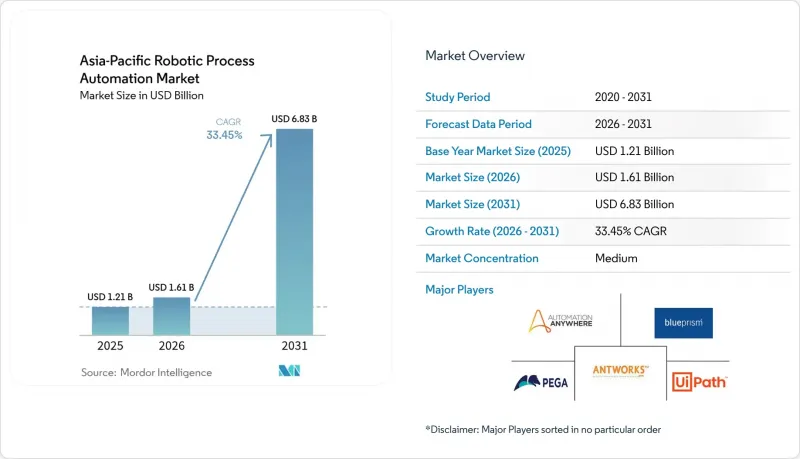
本報告按解決方案(軟體和服務)、企業規模(中小企業和大型企業)、部署類型(本地部署和雲端部署)、最終用戶產業(銀行、金融服務和保險 (BFSI)、IT 和電信、醫療保健和生命科學等)以及國家/地區進行細分。市場預測以價值(美元)表示。
亞太地區機器人流程自動化 (RPA) 市場趨勢與洞察
促進數位化發展的需求日益成長
新加坡的「數位企業藍圖」強制要求政府採購承包商實現工作流程數位化;日本數位廳正在資助地方政府的RPA試點計畫;中國的「人工智慧+」藍圖也將自動化目標納入其五年規劃。因此,亞太地區的機器人流程自動化(RPA)市場正從以投資報酬主導的採用模式轉向以政策主導的合規模式。如今,採購流程始於監管清單,這使得那些提供符合法律規定的本地雲端空間和範本庫的供應商更受青睞。由於各部會和機構要求資料居住本地,本地系統整合商從中受益;而全球供應商則正在開設區域資料中心,以確保其在公共專案中的競爭力。這些指南共同推動了整個產業的基準需求,並規範了自動化部署的最低規模。
後疫情時代加速成本削減計劃
在2020年動盪時期實現紙本文件數位化的工廠,如今正將短期成果轉化為多年自動化發展藍圖。 RPA(機器人流程自動化)的應用場景已從發票記錄擴展到整個訂單管理流程,試點工廠的平均交易時間縮短了90%以上。董事會現在將自動化視為應對未來供應鏈中斷的保障,確保即使在危機記憶消退後,也能持續投資。一家區域性企業集團正在將自動化納入零基預算,並將高階主管獎金與機器人帶來的成本節約掛鉤。這有助於抵消工資上漲的影響,並有助於實現利潤率目標。
亞洲二線城市缺乏認證的RPA人才
自動化技術仍集中在班加羅爾、上海和胡志明市等大都會圈。企業若想拓展到成本較低的二線城市,則面臨招募週期延長的問題,迫使它們採用「中心輻射式」或遠端部署模式,從而推高專案成本。儘管供應商提供短期強化培訓,但平均需要六個月才能達到營運就緒狀態,這進一步加劇了供需失衡。
細分市場分析
預計到2025年,亞太地區機器人流程自動化(RPA)市場中,授權收入仍將佔71.85%的市場佔有率,而服務收入的成長速度將超過軟體收入。企業從任務級機器人過渡到企業級數位化員工計畫需要流程重組、管治框架和混合雲端安全審查的諮詢服務。目前,超過45%的新計畫都包含變更管理工作流程,服務供應商會與企業內部人力資源團隊合作完成這些工作。
培訓和支援是成長最快的服務細分領域,這主要得益於UiPath與印尼Indosat等公司的夥伴關係,這些合作每年為數千名公民開發人員提供認證。隨著越來越多的機器人與企業知識圖譜整合,持續模型增強服務應運而生,並帶來持續的收入。同時,隨著永久授權向訂閱方案的轉變,軟體成長速度有所放緩,導致高峰年收入趨於平穩,但收入可見度有所提高。
在亞太地區的機器人流程自動化 (RPA) 市場,大型企業仍佔 60.95% 的市場佔有率,而中小企業 (SME) 的複合年成長率 (CAGR) 則高達 34.9%。低程式碼介面使中小企業的財務經理和營運負責人能夠建造機器人,而無需給 IT 部門增加沉重的負擔,從而將概念驗證(PoC) 的部署時間從數月縮短至數週。政府津貼,例如馬來西亞的“中小企業數位飛躍計劃”,進一步推動了這一成長勢頭。
大型企業正專注於採用融合人工智慧的編配套件和流程挖掘整合方案,以視覺化企業系統中的瓶頸。同時,市場對獨立於供應商的連接器需求也在不斷成長,這些連接器能夠將傳統的RPA引擎、文件處理工具和互動式AI閘道器整合到單一控制面板中。為了應對這種兩極化的市場需求,平台供應商傾向於為新創公司提供“精簡版”,而對面向財富500強企業的高級AI模組則有所保留。
其他好處:
- Excel格式的市場預測(ME)表
- 3個月的分析師支持
目錄
第1章:引言
- 研究假設和市場定義
- 調查範圍
第2章:調查方法
第3章執行摘要
第4章 市場狀況
- 市場概覽
- 市場促進因素
- 加強與數位化相關的政府法規
- 新冠疫情後加速成本削減計劃
- 雲端原生和低程式碼RPA套件的成熟度
- 中小企業對SaaS機器人的需求日益成長
- 利用基因人工智慧整合自主代理
- 亞太地區共享服務場所勞動成本不斷上漲。
- 市場限制因素
- 亞洲二線城市缺乏認證的RPA人才
- 亞太地區資料隱私法律碎片化
- 對於擁有大量舊有系統。
- 在流程複雜的產業(採礦業、公共產業)中,投資回收期正在延長。
- 產業價值鏈分析
- 監理情勢
- 技術展望
- 波特五力分析
- 投資和資金籌措分析
第5章 市場規模與成長預測
- 透過解決方案
- 軟體
- 服務
- 諮詢
- 實施與整合
- 培訓和支持
- 按公司規模
- 小型企業
- 大公司
- 部署模式
- 現場
- 雲
- 按最終用戶行業分類
- BFSI
- 資訊科技/通訊
- 醫療保健和生命科學
- 零售與電子商務
- 製造業
- 採礦和自然資源
- 公共產業和能源
- 政府/公共部門
- 其他
- 按地區
- 中國
- 印度
- 日本
- 韓國
- 澳洲和紐西蘭
- 新加坡
- 其他亞太國家
第6章 競爭情勢
- 市場集中度
- 策略趨勢
- 市佔率分析
- 公司簡介
- Automation Anywhere Inc.
- UiPath Inc.
- Blue Prism Limited
- Pegasystems Inc.
- NICE Ltd.
- Kofax Inc.
- WorkFusion Inc.
- AntWorks Pte Ltd.
- Datamatics Global Services Ltd.
- EdgeVerve Systems Ltd.
- Softomotive Ltd.(Microsoft)
- AutomationEdge Technologies Inc.
- HelpSystems LLC(Fortra)
- Kryon Systems Ltd.
- NTT DATA Corporation
- IBM Corporation
- SAP SE
- Salesforce, Inc.
- Samsung SDS Co., Ltd.
- Tata Consultancy Services Ltd.
第7章 市場機會與未來展望
According to Mordor Intelligence, the Asia-Pacific robotic process automation market size is expected to grow from USD 1.21 billion in 2025 to USD 1.61 billion in 2026 and is forecast to reach USD 6.83 billion by 2031 at 33.45% CAGR over 2026-2031.
This report is Segmented by Solution (Software and Services), Enterprise Size (Small and Medium Enterprises, and Large Enterprises), Deployment Mode (On-Premises, and Cloud), End-User Industry (BFSI, IT and Telecom, Healthcare and Life Sciences, and More), and Country. The Market Forecasts are Provided in Terms of Value (USD).
Asia-Pacific Robotic Process Automation Market Trends and Insights
Rising Digitization Mandates
Singapore's Digital Enterprise Blueprint enforces workflow digitization for government suppliers, Japan's Digital Agency funds municipal RPA pilots, and China's AI Plus roadmap embeds automation targets into five-year plans, moving the Asia-Pacific robotic process automation market from ROI-led adoption to policy-driven compliance. Procurement cycles now start with regulatory checklists, favoring vendors that offer in-country cloud zones and template libraries matching statutory forms. Local system integrators benefit as ministries demand domestic data residency, while global providers open regional data centers to remain eligible for public projects. Collectively, these directives lift baseline demand and standardize minimum automation footprints across industries.
Accelerated Post-COVID Cost-Take-Out Programs
Factories that digitized paperwork during 2020 disruptions have operationalized quick wins into multiyear automation roadmaps. RPA use cases have expanded from invoice posting to full order-management flows, shrinking average transaction time by over 90% in pilot sites. Boards now treat automation as a hedging tool against future supply-chain shocks, ensuring sustained investment even after immediate crisis memories fade. Regional conglomerates bundle automation in zero-based budgeting exercises, linking executive bonuses to bot-driven savings that offset wage inflation and help meet margin targets.
Scarcity of Certified RPA Talent in Tier-2 Asian Cities
Automation expertise remains concentrated in metro hubs like Bengaluru, Shanghai, and Ho Chi Minh City. Enterprises expanding to cost-efficient tier-2 locations confront extended recruitment cycles, forcing them to adopt hub-and-spoke delivery or remote-deployment models that inflate project overheads. Although vendors run fast-track academies, ramp-up time averages six months, prolonging the supply-demand imbalance.
Other drivers and restraints analyzed in the detailed report include:
- Growing SME Demand for SaaS Bots
- Integration of Gen-AI-Powered Autonomous Agents
- Fragmented Data-Privacy Laws Across APAC
For complete list of drivers and restraints, kindly check the Table Of Contents.
Segment Analysis
Services revenue climbed faster than software even though licenses still represented 71.85% of the Asia-Pacific robotic process automation market share in 2025. Enterprises advancing from task-level bots to enterprise-wide digital-worker programs need consulting for process redesign, governance frameworks, and hybrid-cloud security reviews. Over 45% of new projects now include a change-management work-stream that positions service providers alongside internal HR teams.
Training and support constitute the fastest-growing services sub-segment, fueled by partnerships such as UiPath and Indonesia's Indosat that certify thousands of citizen developers yearly. As more bots interact with enterprise knowledge graphs, ongoing model reinforcement services emerge, creating recurrent revenue. Conversely, software growth moderates as perpetual licenses give way to subscription bundles, flattening peak-year inflows yet improving revenue visibility.
Small and medium enterprises are expanding at a 34.9% CAGR, even as large enterprises still account for 60.95% of the Asia-Pacific robotic process automation market size. Low-code interfaces empower finance managers and operations heads in SMEs to build bots without heavy IT backlogs, accelerating proof-of-concept rollouts from months to weeks. Government grants covering subscription fees amplify this momentum, especially in Malaysia's "SME Digital Leap" scheme.
Large enterprises shift focus to AI-embedded orchestration suites and process-mining integrations that unveil system bottlenecks enterprise-wide. They increasingly demand vendor-agnostic connectors able to orchestrate legacy RPA engines, document-processing tools, and conversational AI gateways within one control panel. This bifurcation prompts platform vendors to release "lite" tiers for startups while reserving premium AI modules for Fortune 500 clients.
Complete Report Scope:
- By Solution
- Software
- Services
- Consulting
- Implementation and Integration
- Training and Support
- By Enterprise Size
- Small and Medium Enterprises
- Large Enterprises
- By Deployment Mode
- On-Premises
- Cloud
- By End-user Industry
- BFSI
- IT and Telecom
- Healthcare and Life Sciences
- Retail and eCommerce
- Manufacturing
- Mining and Natural Resources
- Utilities and Energy
- Government and Public Sector
- Others
- By Geography
- China
- India
- Japan
- South Korea
- Australia and New Zealand
- Singapore
- Rest of Asia-Pacific
List of Companies Covered in this Report:
- Automation Anywhere Inc.
- UiPath Inc.
- Blue Prism Limited
- Pegasystems Inc.
- NICE Ltd.
- Kofax Inc.
- WorkFusion Inc.
- AntWorks Pte Ltd.
- Datamatics Global Services Ltd.
- EdgeVerve Systems Ltd.
- Softomotive Ltd. (Microsoft)
- AutomationEdge Technologies Inc.
- HelpSystems LLC (Fortra)
- Kryon Systems Ltd.
- NTT DATA Corporation
- IBM Corporation
- SAP SE
- Salesforce, Inc.
- Samsung SDS Co., Ltd.
- Tata Consultancy Services Ltd.
Additional Benefits:
- The market estimate (ME) sheet in Excel format
- 3 months of analyst support
TABLE OF CONTENTS
1 INTRODUCTION
- 1.1 Study Assumptions and Market Definition
- 1.2 Scope of the Study
2 RESEARCH METHODOLOGY
3 EXECUTIVE SUMMARY
4 MARKET LANDSCAPE
- 4.1 Market Overview
- 4.2 Market Drivers
- 4.2.1 Rising digitization-linked government mandates
- 4.2.2 Accelerated post-COVID cost-take-out programs
- 4.2.3 Maturity of cloud-native, low-code RPA suites
- 4.2.4 Growing SME demand for SaaS bots
- 4.2.5 Integration of Gen-AI-powered autonomous agents
- 4.2.6 APAC-specific labor cost inflation in shared-service hubs
- 4.3 Market Restraints
- 4.3.1 Scarcity of certified RPA talent in Tier-2 Asian cities
- 4.3.2 Fragmented data-privacy laws across APAC
- 4.3.3 High bot maintenance cost in legacy-heavy industries
- 4.3.4 Slow ROI in process-complex sectors (mining, utilities)
- 4.4 Industry Value Chain Analysis
- 4.5 Regulatory Landscape
- 4.6 Technological Outlook
- 4.7 Porter's Five Forces Analysis
- 4.7.1 Bargaining Power of Suppliers
- 4.7.2 Bargaining Power of Buyers
- 4.7.3 Threat of New Entrants
- 4.7.4 Intensity of Competitive Rivalry
- 4.7.5 Threat of Substitutes
- 4.8 Investment and Funding Analysis
5 MARKET SIZE AND GROWTH FORECASTS (VALUE)
- 5.1 By Solution
- 5.1.1 Software
- 5.1.2 Services
- 5.1.2.1 Consulting
- 5.1.2.2 Implementation and Integration
- 5.1.2.3 Training and Support
- 5.2 By Enterprise Size
- 5.2.1 Small and Medium Enterprises
- 5.2.2 Large Enterprises
- 5.3 By Deployment Mode
- 5.3.1 On-Premises
- 5.3.2 Cloud
- 5.4 By End-user Industry
- 5.4.1 BFSI
- 5.4.2 IT and Telecom
- 5.4.3 Healthcare and Life Sciences
- 5.4.4 Retail and eCommerce
- 5.4.5 Manufacturing
- 5.4.6 Mining and Natural Resources
- 5.4.7 Utilities and Energy
- 5.4.8 Government and Public Sector
- 5.4.9 Others
- 5.5 By Geography
- 5.5.1 China
- 5.5.2 India
- 5.5.3 Japan
- 5.5.4 South Korea
- 5.5.5 Australia and New Zealand
- 5.5.6 Singapore
- 5.5.7 Rest of Asia-Pacific
6 COMPETITIVE LANDSCAPE
- 6.1 Market Concentration
- 6.2 Strategic Moves
- 6.3 Market Share Analysis
- 6.4 Company Profiles (includes Global level Overview, Market level overview, Core Segments, Financials as available, Strategic Information, Market Rank/Share for key companies, Products and Services, and Recent Developments)
- 6.4.1 Automation Anywhere Inc.
- 6.4.2 UiPath Inc.
- 6.4.3 Blue Prism Limited
- 6.4.4 Pegasystems Inc.
- 6.4.5 NICE Ltd.
- 6.4.6 Kofax Inc.
- 6.4.7 WorkFusion Inc.
- 6.4.8 AntWorks Pte Ltd.
- 6.4.9 Datamatics Global Services Ltd.
- 6.4.10 EdgeVerve Systems Ltd.
- 6.4.11 Softomotive Ltd. (Microsoft)
- 6.4.12 AutomationEdge Technologies Inc.
- 6.4.13 HelpSystems LLC (Fortra)
- 6.4.14 Kryon Systems Ltd.
- 6.4.15 NTT DATA Corporation
- 6.4.16 IBM Corporation
- 6.4.17 SAP SE
- 6.4.18 Salesforce, Inc.
- 6.4.19 Samsung SDS Co., Ltd.
- 6.4.20 Tata Consultancy Services Ltd.
7 MARKET OPPORTUNITIES AND FUTURE OUTLOOK
- 7.1 White-space and Unmet-need Assessment

 醫療保健領域的機器人流程自動化 (RPA):市場洞察、競爭格局和市場預測 - 2034年
 2034年製造業機器人流程自動化(RPA)市場預測-按流程類型、部署模式、組件、服務類型、技術、應用、最終用戶和地區分類的全球分析
 機器人流程自動化市場:按類型、部署方式、營運模式、企業規模、最終用途、國家和地區分類-全球產業分析、市場規模及佔有率、未來預測(2026-2033)銀行、金融服務和保險 (BFSI) 產業的機器人流程自動化 (RPA):按組件、部署模式、應用、最終用途、國家和地區分類-產業分析、市場規模、市場佔有率及 2026 年至 2033 年預測IT機器人流程自動化(RPA)市場預測至2034年-按類型、部署模式、組織規模、應用、最終用戶和地區分類的全球分析
 機器人流程自動化 (RPA) 市場:按元件、業務類型、技術類型、應用領域、產業垂直領域、組織規模和部署類型分類-2026-2032 年全球市場預測合規自動化和監管報告市場預測至 2034 年—按組件、部署模式、解決方案類型、技術、應用、最終用戶和地區分類的全球分析認知工作流程自動化市場預測至2034年:按組件、部署模式、技術、應用、最終用戶和地區分類的全球分析IT機器人自動化市場:按類型、應用、部署模式、組織規模、產業垂直領域、國家及地區分類-全球產業分析、市場規模、市場佔有率及2026年至2033年預測
 2026年全球紅綠藍(RGB)可擴展桌墊市場報告