


 |
市場調查報告書
商品編碼
2124143
深度過濾:市場佔有率分析、產業趨勢與統計、成長預測(2026-2031)Depth Filtration - Market Share Analysis, Industry Trends & Statistics, Growth Forecasts (2026 - 2031) |
||||||

※ 本網頁內容可能與最新版本有所差異。詳細情況請與我們聯繫。
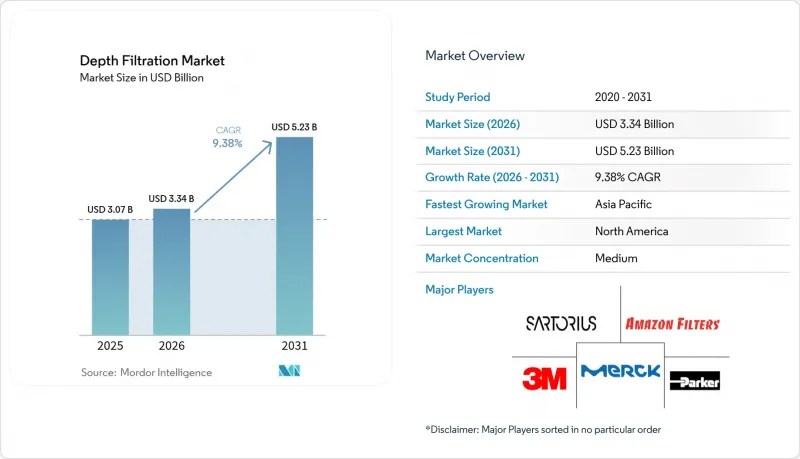
根據 Mordor Intelligence 預測,深度過濾市場規模將從 2025 年的 30.7 億美元和 2026 年的 33.4 億美元成長到 2031 年的 52.3 億美元,2026 年至 2031 年的年複合成長率(CAGR)為 9.38%。
本報告按過濾材料(纖維素纖維、矽藻土、活性碳混合物、珍珠岩等)、產品(濾芯、膠囊、濾片/濾墊、模組化透鏡等)、應用(生物製藥等)、最終用戶(製藥/生物技術等)和地區(北美、歐洲、亞太、中東和非洲、南美)進行細分。市場預測以美元計價。
全球深度過濾市場趨勢及洞察
生物製藥和細胞/基因療法產量增加
2024年,一次性生物反應器的總產能擴張達到420萬公升,其中31%將用於支持需要多次深度過濾的細胞和基因治療計畫。從單次2000公升的CAR-T細胞灌注液中最多可獲得80公升收集液,這些收集液必須在不破壞病毒載體的情況下進行澄清。 2024年,美國生物醫學高級研究與發展局(BARDA)撥款5億美元用於擴大疫苗填充和表面處理工程,強制要求使用一次性深度過濾器,並在聯邦資助的生產設施中將此工作流程製度化。這些過濾器現在採用活性碳或帶電矽藻土的雙層結構,能夠捕獲小於200 bp的DNA片段,同時保留小至20 nm的病毒顆粒,使供應商能夠與治療研發贊助商簽訂長期合約。
在模組化生物製程中引入一次性深層過濾器
預製無塵室艙體可在18個月內運作,而傳統建造方式則需36個月。 CDMO(合約研發生產機構)正利用這項工期優勢來爭取後期專案。 Lonza位於Vispu的工廠於2024年10月投入運作,透過採用全一次性澄清管線,與不銹鋼澄清罐相比,其註入用水量減少了40%。最新的ISPE(國際專業工程師協會)基準指南將一次性深層過濾器歸類為低風險,使其無需進行跨廠區重新驗證,從而加快了其在多個工廠的部署。 2025年3月芬蘭一家紙漿廠發生的火災導致前置作業時間延長了六週,凸顯了供應鏈的脆弱性。這更加強調了CDMO對關鍵過濾器進行雙重採購的必要性。
薄膜過濾和切向流過濾的競爭
2022年至2025年間,切向流過濾(TFF)濾盒的價格下降了22%,縮小了與深層過濾器之間長期存在的成本差距。目前,混合製程線將單一一次性深層過濾器與0.45µm的TFF製程結合,可將每批次的澄清成本降低15-20%。頗爾公司於2024年9月推出的「深度切向流過濾」(Depth-TFF)模組旨在整合此工作流程,並加劇了價格競爭,尤其是在對成本高度敏感的生物相似藥生產設施中。
細分市場分析
到2025年,纖維素纖維將在深度過濾市場佔據最大佔有率,銷售額將達到14.1億美元,佔市場總額的46.02%。活性碳混合物預計將以10.06%的複合年成長率超越所有競爭產品,這主要得益於精釀啤酒廠對香氣調節和微生物減少的雙重需求。矽藻土仍是高固態葡萄酒沉澱物和城市污水預處理的首選材料,但歐盟《廢棄物框架指令》規定的處置成本正促使葡萄酒廠轉向使用更廢棄物的纖維素片材。合成奈米纖維素目前仍處於研發階段,它能夠透過靜電捕獲宿主細胞DNA,從而減少基因治療生產線中的核酸酶處理步驟,同時在高階生物製程應用的深度過濾領域保持其市場佔有率。
介質創新正推動深度過濾產業向多功能過濾器發展,這些過濾器將機械篩分與吸附化學相結合。活性碳去除多酚的能力符合消費者「潔淨標示」的趨勢,並能提高儲存穩定性。帶電奈米纖維素可將DNA含量降低99.5%,無需額外加工即可滿足嚴格的監管要求。鑑於許多治療申辦方不願在試驗臨床實驗更換介質,獲得這些混合物認證的供應商可以確立行業領先地位。
截至2025年,筒式過濾器佔深度過濾市場38.27%的佔有率,但預計到2031年,膠囊式過濾器的複合年成長率將達到11.63%。由於膠囊在運輸過程中經過伽馬射線滅菌,因此無需4-6小時的蒸氣滅菌(SIP)循環,從而在臨床試驗中節省每批次1800美元的驗證成本。由於可與現有外殼整合,RFID筒式過濾器在傳統不銹鋼生產線中仍佔據主導地位,但為了縮短換線時間,膠囊式過濾器正逐漸成為2024年後新建灌裝和包裝生產線的標準配置。
模組化和透鏡式系統將處理能力集中在更緊湊的面積內,這在無塵室租金超過每年每平方米3000美元時成為決定性因素。長期以來用於酒窖的片材和墊片正逐漸被透鏡式堆疊結構所取代,從而減少操作人員接觸矽藻土粉塵的機會。專用線上膠囊在美國市政供水系統維修中被證明可用於現場除鉛,並提供穩定但利潤較低的收入來源。
區域分析
預計到2025年,北美將佔全球銷售額的34.08%,這得益於FDA的快速通道計劃,該計劃加快了一次性醫療器材的510(k)核准流程。波士頓、舊金山和三角研究園區(RTP)是細胞治療叢集的所在地,這些集群要求採用一次性澄清製程以減少交叉污染。此外,美國生物醫學高級研究與發展局(BARDA)投資5億美元擴建灌裝和表面處理工程生產線,將深度過濾作為標準設備,也進一步推動了這項發展。加拿大和墨西哥也為生物相似藥的生產做出了貢獻。輝瑞位於桑福德的工廠計劃於2024年擴建其一次性醫療器材生產線,以供應歐盟和拉丁美洲市場。
亞太地區預計將以11.07%的複合年成長率成為全球成長最快的地區。中國國家藥品監督管理局(NMPA)在2024年批准了七種國產CAR-T療法,所有這些療法均在不使用不銹鋼澄清設備的工廠生產,以避免不同項目之間的交叉污染風險。在印度,生物類似藥生產廠正在維修深層過濾濾芯,以滿足歐洲藥品管理局(EMA)的數據完整性要求,該要求規定必須即時記錄壓力損失。在日本,使用經過驗證的一次性深層過濾製程的再生醫學產品核准週期縮短至12個月,刺激了對合約研發產量機構(CDMO)的投資。
剩餘需求主要來自歐洲、中東和非洲(MEA)以及南美洲。歐盟的永續性指令正迫使供應商轉向可回收濾芯,而薩托裡亞斯公司正在試驗一項回收循環方案,以回收纖維素用於非醫藥應用。巴西的乙醇產業和阿根廷的葡萄酒產業對矽藻土的需求仍然強勁,同時,海灣合作理事會(GCC)的海水淡化廠正在引入深度預過濾器,以延長逆滲透(RO)膜的使用壽命。南美洲的需求仍容易受到大宗商品價格波動的影響,但受益於對清澈無濁水需求量大的飲料出口。
其他好處:
- Excel格式的市場預測(ME)表
- 3個月的分析師支持
目錄
第1章:引言
- 研究假設和市場定義
- 調查範圍
第2章:調查方法
第3章執行摘要
第4章 市場狀況
- 市場概覽
- 市場促進因素
- 生物製藥和細胞/基因療法的處方量增加
- 在模組化生物製程中引入一次性深層過濾器
- 嚴格的食品和飲料透明度標準
- 精釀啤酒廠和小規模酒莊的發展
- 對純化外泌體和病毒載體的需求日益成長
- 擴大微藻類蛋白提取規模
- 市場限制因素
- 薄膜過濾和切向流過濾的競爭
- 原料(纖維素/矽藻土)供應波動
- 一次性濾芯廢棄物的處理成本很高
- 逐步推行無塑膠消費品法規
- 監理情勢
- 技術展望
- 波特五力分析
第5章 市場規模與成長預測
- 通過培養基
- 纖維素纖維
- 矽藻土
- 活性碳混合物
- 珍珠岩和其他
- 依產品
- 濾芯過濾器
- 膠囊過濾器
- 濾紙和濾墊
- 模組和透鏡系統
- 其他產品
- 透過使用
- 生物製藥生產
- 食品和飲料澄清
- 供水和廢水處理
- 其他用途
- 最終用戶
- 製藥和生物技術公司
- 合約研發生產組織(CDMO)
- 學術研究機構
- 其他最終用戶
- 按地區
- 北美洲
- 美國
- 加拿大
- 墨西哥
- 歐洲
- 德國
- 英國
- 法國
- 義大利
- 西班牙
- 其他歐洲國家
- 亞太地區
- 中國
- 日本
- 印度
- 澳洲
- 韓國
- 其他亞太國家
- 中東和非洲
- GCC
- 南非
- 其他中東和非洲國家
- 南美洲
- 巴西
- 阿根廷
- 其他南美國家
- 北美洲
第6章 競爭情勢
- 市場集中度
- 市佔率分析
- 公司簡介
- 3M
- Amazon Filters Ltd.
- Cobetter Filtration
- Critical Process Filtration
- Danaher Corp.(Pall)
- Eaton Filtration
- FILTROX AG
- Gemu Group
- Graver Technologies
- GS-Filt
- Hangzhou Darlly Filtration
- Meissner Filtration Products
- Merck KGaA
- Microclar
- Microdyn-Nadir
- Parker Hannifin Corp.
- Pentair
- Porvair Filtration
- Saint-Gobain Life Sciences
- Sartorius Stedim Biotech
第7章 市場機會與未來展望
According to Mordor Intelligence, the depth filtration market size is projected to expand from USD 3.07 billion in 2025 and USD 3.34 billion in 2026 to USD 5.23 billion by 2031, registering a CAGR of 9.38% between 2026 to 2031.
This report is Segmented by Media (Cellulose Fiber, Diatomaceous Earth, Activated Carbon Blends, Perlite & Others), Product (Cartridge, Capsule, Sheets & Pads, Modules & Lenticular, Other Products), Application (Biopharmaceutical, and More), End-User (Pharma & Biotech, and More), and Geography (North America, Europe, Asia-Pacific, MEA, South America). Market Forecasts are Provided in Terms of Value (USD).
Global Depth Filtration Market Trends and Insights
Rising Biologics & Cell-Gene Therapy Volumes
Single-use bioreactor capacity additions totaled 4.2 million L in 2024, and 31% of those vessels support cell- and gene-therapy programs that require multiple depth-filtration steps. Each 2,000 L CAR-T perfusion run yields up to 80 L of harvest, which must be clarified without damaging viral vectors. BARDA earmarked USD 500 million in 2024 for vaccine fill-finish expansions that mandate the use of disposable depth filters, institutionalizing this workflow in federally funded plants. Filters now incorporate co-layers of activated carbon or charged diatomaceous earth to capture sub-200 bp DNA fragments while preserving 20 nm virus particles, locking suppliers into long-term deals with therapy sponsors.
Single-Use Depth Filter Adoption in Modular Bioprocessing
Prefabricated cleanroom pods can be commissioned in 18 months versus 36 months for traditional builds, a schedule advantage CDMOs exploit to win late-phase projects. Lonza's Visp site came online in October 2024 with fully disposable clarification trains that cut water-for-injection use by 40% compared with stainless-steel clarifiers. The latest ISPE Baseline Guides classify single-use depth filters as low-risk, exempting them from site-to-site revalidation and accelerating multi-facility rollouts. Supply-chain fragility surfaced when a Finnish pulp mill fire in March 2025 added six-week lead times, reminding CDMOs to dual-source critical filters.
Membrane & Tangential-Flow Filtration Price Competition
TFF cassette prices slid 22% between 2022 and 2025, narrowing the historic cost gap with depth filters. Hybrid trains now pair one disposable depth filter with a 0.45 µm TFF step, trimming clarification spends 15-20% per batch. Pall's Depth-TFF module, launched in September 2024, targets this workflow consolidation and intensifies price pressure, especially in cost-sensitive biosimilar plants.
Other drivers and restraints analyzed in the detailed report include:
- Stringent Food & Beverage Clarity Standards
- Growth of Craft Breweries & Micro-Wineries
- Raw Material (Cellulose/ Diatomite) Supply Volatility
For complete list of drivers and restraints, kindly check the Table Of Contents.
Segment Analysis
Cellulose fiber accounted for the largest share of the depth filtration market in 2025, at USD 1.41 billion, or 46.02% of revenue. Activated-carbon blends will outpace all rivals with a 10.06% CAGR, fueled by craft breweries that demand simultaneous aroma polishing and microbial reduction. Diatomaceous earth remains preferred for high-solids wine lees and municipal water pre-treatment, but disposal fees under the EU Waste Framework Directive are tilting wineries toward low-waste cellulose sheets. Synthetic nanocellulose, although nascent, unlocks electrostatic capture of host-cell DNA, trimming nuclease steps in gene-therapy lines and protecting depth filtration market share in premium bioprocess applications.
Media innovation is shifting the depth filtration industry toward multifunctional filters that marry mechanical sieving with adsorptive chemistry. Activated carbon's capacity to strip polyphenols aligns with consumer "clean label" trends and boosts shelf stability. Charged nanocellulose reduces DNA loads by 99.5%, meeting stringent regulatory requirements without adding unit operations. Suppliers that qualify these blends gain first-mover lock-in because therapy sponsors resist media switches mid-trial.
Cartridge filters accounted for 38.27% of the depth filtration market in 2025, yet capsule formats will post an 11.63% CAGR through 2031. Capsules arrive gamma-sterilized, eliminating 4-6 h steam-in-place cycles and cutting per-batch validation labor by USD 1,800 in clinical runs. RFID-enabled cartridges still dominate legacy stainless lines because they integrate with existing housings, but fill-finish suites built since 2024 default to capsules to shave changeover time.
Modules and lenticular systems are concentrating flow capacity into smaller footprints, a decisive factor when cleanroom rent exceeds USD 3,000/m2/y. Sheets and pads, long used in wine cellars, are ceding ground to lenticular stacks that reduce operator exposure to diatomaceous earth dust. Specialty in-line capsules serve point-of-use lead removal in U.S. municipal upgrades, adding a steady but low-margin revenue tail.
Complete Report Scope:
- By Media
- Cellulose Fiber
- Diatomaceous Earth
- Activated Carbon Blends
- Perlite & Others
- By Product
- Cartridge Filters
- Capsule Filters
- Filter Sheets & Pads
- Modules & Lenticular Systems
- Other Products
- By Application
- Biopharmaceutical Processing
- Food & Beverage Clarification
- Water & Waste-water Treatment
- Other Applications
- By End-user
- Pharmaceutical & Biotechnology Companies
- Contract Development & Manufacturing Organizations (CDMOs)
- Academic & Research Institutes
- Other End Users
- By Geography
- North America
- United States
- Canada
- Mexico
- Europe
- Germany
- United Kingdom
- France
- Italy
- Spain
- Rest of Europe
- Asia-Pacific
- China
- Japan
- India
- Australia
- South Korea
- Rest of Asia-Pacific
- Middle East & Africa
- GCC
- South Africa
- Rest of Middle East & Africa
- South America
- Brazil
- Argentina
- Rest of South America
- North America
Geography Analysis
North America generated 34.08% of 2025 revenue, underwritten by FDA fast-track pathways that speed single-use devices through 510(k) clearance. Boston, San Francisco, and RTP anchor cell-therapy clusters that mandate disposable clarification to mitigate cross-contamination, bolstered by BARDA's USD 500 million fill-finish expansion that codified depth filtration as standard equipment. Canada and Mexico contribute biosimilar output, with Pfizer's Sanford site expanding single-use trains in 2024 for EU and LATAM supply.
Asia-Pacific is poised for an 11.07% CAGR, the fastest worldwide. China's NMPA cleared seven domestic CAR-T therapies in 2024, each produced in facilities that reject stainless-steel clarifiers to sidestep cross-program carryover risks. India's biosimilar plants retrofit depth-filter cartridges to satisfy EMA data-integrity rules mandating real-time pressure-drop logs. Japan shortened regenerative-medicine approval timelines to 12 months for processes featuring validated single-use depth filtration, spurring CDMO investment.
Europe, MEA, and South America supply the balance. EU sustainability directives are pushing suppliers toward recyclable cartridges; Sartorius is piloting take-back loops to recover cellulose for non-pharma reuse. Brazil's ethanol and Argentina's wine sectors maintain steady diatomaceous earth demand, while GCC desalination plants add depth pre-filters to extend RO life. South American uptake remains commodity-price sensitive but benefits from beverage exports that require haze-free clarification.
- 3M
- Amazon Filters Ltd.
- Cobetter Filtration
- Critical Process Filtration
- Danaher Corp. (Pall)
- Eaton Filtration
- FILTROX
- Gemu Group
- Graver Technologies
- GS-Filt
- Hangzhou Darlly Filtration
- Meissner Filtration Products
- Merck
- Microclar
- Microdyn-Nadir
- Parker Hannifin
- Pentair
- Porvair Filtration
- Saint-Gobain Life Sciences
- Sartorius
Additional Benefits:
- The market estimate (ME) sheet in Excel format
- 3 months of analyst support
TABLE OF CONTENTS
1 Introduction
- 1.1 Study Assumptions & Market Definition
- 1.2 Scope of the Study
2 Research Methodology
3 Executive Summary
4 Market Landscape
- 4.1 Market Overview
- 4.2 Market Drivers
- 4.2.1 Rising Biologics & Cell-Gene Therapy Volumes
- 4.2.2 Single-Use Depth Filter Adoption in Modular Bioprocessing
- 4.2.3 Stringent Food & Beverage Clarity Standards
- 4.2.4 Growth of Craft Breweries & Micro-Wineries
- 4.2.5 Emerging Demand for Exosome & Viral-Vector Purification
- 4.2.6 Micro-Algae Protein Extraction Scale-Up
- 4.3 Market Restraints
- 4.3.1 Membrane & Tangential-Flow Filtration Price Competition
- 4.3.2 Raw Material (Cellulose/Diatomite) Supply Volatility
- 4.3.3 High Disposal Cost for Single-Use Filter Waste
- 4.3.4 Regulatory Push Toward Plastic-Free Consumables
- 4.4 Regulatory Landscape
- 4.5 Technological Outlook
- 4.6 Porter's Five Forces Analysis
- 4.6.1 Threat of New Entrants
- 4.6.2 Bargaining Power of Buyers
- 4.6.3 Bargaining Power of Suppliers
- 4.6.4 Threat of Substitute Products
- 4.6.5 Intensity of Competitive Rivalry
5 Market Size & Growth Forecasts
- 5.1 By Media
- 5.1.1 Cellulose Fiber
- 5.1.2 Diatomaceous Earth
- 5.1.3 Activated Carbon Blends
- 5.1.4 Perlite & Others
- 5.2 By Product
- 5.2.1 Cartridge Filters
- 5.2.2 Capsule Filters
- 5.2.3 Filter Sheets & Pads
- 5.2.4 Modules & Lenticular Systems
- 5.2.5 Other Products
- 5.3 By Application
- 5.3.1 Biopharmaceutical Processing
- 5.3.2 Food & Beverage Clarification
- 5.3.3 Water & Waste-water Treatment
- 5.3.4 Other Applications
- 5.4 By End-user
- 5.4.1 Pharmaceutical & Biotechnology Companies
- 5.4.2 Contract Development & Manufacturing Organizations (CDMOs)
- 5.4.3 Academic & Research Institutes
- 5.4.4 Other End Users
- 5.5 By Geography
- 5.5.1 North America
- 5.5.1.1 United States
- 5.5.1.2 Canada
- 5.5.1.3 Mexico
- 5.5.2 Europe
- 5.5.2.1 Germany
- 5.5.2.2 United Kingdom
- 5.5.2.3 France
- 5.5.2.4 Italy
- 5.5.2.5 Spain
- 5.5.2.6 Rest of Europe
- 5.5.3 Asia-Pacific
- 5.5.3.1 China
- 5.5.3.2 Japan
- 5.5.3.3 India
- 5.5.3.4 Australia
- 5.5.3.5 South Korea
- 5.5.3.6 Rest of Asia-Pacific
- 5.5.4 Middle East & Africa
- 5.5.4.1 GCC
- 5.5.4.2 South Africa
- 5.5.4.3 Rest of Middle East & Africa
- 5.5.5 South America
- 5.5.5.1 Brazil
- 5.5.5.2 Argentina
- 5.5.5.3 Rest of South America
- 5.5.1 North America
6 Competitive Landscape
- 6.1 Market Concentration
- 6.2 Market Share Analysis
- 6.3 Company Profiles (includes Global Level Overview, Market Level Overview, Core Segments, Financials as Available, Strategic Information, Market Rank/Share for Key Companies, Products & Services, and Recent Developments)
- 6.3.1 3M
- 6.3.2 Amazon Filters Ltd.
- 6.3.3 Cobetter Filtration
- 6.3.4 Critical Process Filtration
- 6.3.5 Danaher Corp. (Pall)
- 6.3.6 Eaton Filtration
- 6.3.7 FILTROX AG
- 6.3.8 Gemu Group
- 6.3.9 Graver Technologies
- 6.3.10 GS-Filt
- 6.3.11 Hangzhou Darlly Filtration
- 6.3.12 Meissner Filtration Products
- 6.3.13 Merck KGaA
- 6.3.14 Microclar
- 6.3.15 Microdyn-Nadir
- 6.3.16 Parker Hannifin Corp.
- 6.3.17 Pentair
- 6.3.18 Porvair Filtration
- 6.3.19 Saint-Gobain Life Sciences
- 6.3.20 Sartorius Stedim Biotech
7 Market Opportunities & Future Outlook
- 7.1 White-space & Unmet-Need Assessment

 深度過濾市場:濾材類型、過濾方法、額定類型、孔徑、流動配置、系統配置、應用和最終用戶產業分類-全球預測,2026-2032年
 2026年全球深度過濾市場報告
 全球深過濾市場規模、佔有率、趨勢和成長分析報告(2026-2034)
 深度過濾市場 - 全球產業規模、佔有率、趨勢、機會及預測(按產品、介質類型、應用、地區和競爭格局分類,2021-2031年)
 深度過濾市場規模、佔有率和成長分析(按產品類型、過濾介質類型、應用、營運規模和地區分類)-2026-2033年產業預測
 深層過濾市場規模、佔有率、趨勢分析報告:按過濾介質、產品、最終用途、地區和細分市場進行預測,2025 年至 2030 年