


 |
市場調查報告書
商品編碼
2124133
人工智慧基礎設施:市場佔有率分析、產業趨勢與統計、成長預測(2026-2031)AI Infrastructure - Market Share Analysis, Industry Trends & Statistics, Growth Forecasts (2026 - 2031) |
||||||

※ 本網頁內容可能與最新版本有所差異。詳細情況請與我們聯繫。
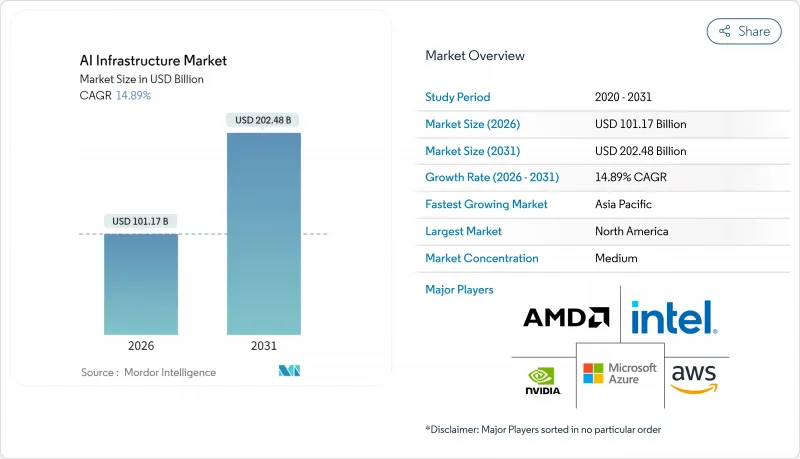
根據 Mordor Intelligence 預測,人工智慧基礎設施市場規模預計將在 2026 年達到 1,011.7 億美元,到 2031 年達到 2,024.8 億美元,預測期內複合年成長率為 14.89%。
本報告按產品(硬體[處理器、儲存、記憶體]、軟體[系統最佳化、AI中介軟體、MLOps])、部署類型(本地部署、雲端部署)、最終用戶(企業、政府/國防、雲端服務供應商)、處理器架構(CPU、GPU、FPGA/ASIC(TPU、Gaudi等)、其他)和地區進行細分。市場預測以美元(USD)為單位。
全球人工智慧基礎設施市場趨勢與洞察
超大規模資料中心營運商對 H100 和 H200 GPU 的訂單激增。
根據英偉達的一份報告,2025 年 H100 和 H200 設備的預訂量已是供應量的三倍,促使微軟撥款 800 億美元用於一項多年採購計劃,而 AWS 也計劃到 2028 年將其基礎設施預算增加 1000 億美元。高頻寬記憶體 (HBM) 的瓶頸進一步加劇了這種供需失衡,因為 SK 海力士和三星壟斷了 95% 的 HBM3E 產能。超大規模資料中心業者營運商現在正與晶圓廠直接合作,共同設計記憶體封裝,這削弱了傳統 GPU 供應商的議價能力。台積電 3 奈米製程的訂單持續超過供應,設備前置作業時間超過 12 個月,加速了向客製化 ASIC(例如 Google TPU v6e)的轉變。面對不可預測的交付時間,企業擴大從雲端服務供應商租賃有保障的實例,即使按需付費的價格超過每小時 30 美元(8 個 GPU 的捆綁包)。
AI專用網路架構(InfiniBand NDR、乙太網路800G)的快速普及
InfiniBand NDR 的運行速率為 400 Gbps,預計到 2025 年將連接約 70% 的 AI 訓練叢集,並且延遲比傳統乙太網路降低 40%。然而,超大規模資料超大規模資料中心業者開始評估 800 Gbps 以太網,因為博通的 Tomahawk 5 和 Spectrum-X 能夠在保持極具競爭力的延遲的同時,將資本成本降低 25%。 Meta 透過在 800 Gbps 鏈路上擴展一個包含 10,000 個 GPU 的 AI 研究叢集,展示了乙太網路的效能,這不僅擴展了供應商的選擇範圍,還降低了供應商對 InfiniBand 的鎖定。 IEEE 802.3df 1.6 Tbps 乙太網路的研發工作仍在繼續,這表明 AI 將與標準資料中心工作負載進一步整合。
人工智慧GPU長期供不應求的局面將持續到2026年。
到2025年,H200顯示卡的前置作業時間將超過52週,AMD的MI300X訂單積壓也反映出類似的供應限制。台積電的CoWoS封裝產能達到每月3.5萬片晶圓,遠低於超過10萬片晶圓的需求預測。高頻寬記憶體仍然稀缺,因為每顆H100裝置都需要80GB的HBM3堆疊五層。因此,各公司推遲了大規模部署,並優先考慮參數要求較低的架構。作為回應,雲端平台採取了庫存過剩、降低運轉率和高現貨價格的策略。這種做法扭曲了供應訊號,並抑制了短期市場採用。
細分市場分析
2025年,硬體支出佔總支出的68.42%。這反映了資本密集型GPU叢集、高頻寬記憶體和NVMe架構推動機架密度超過100千瓦。隨著企業優先考慮推理效率、模型可觀測性和MLOps自動化,預計到2031年,軟體支出將以16.02%的複合年成長率成長。 Triton推理伺服器等工具透過量化和內核融合將延遲降低高達50%。供應商現在將編配框架和可觀測性儀表板捆綁在一起,並從一次性授權模式轉向訂閱模式。因此,儘管加速器的絕對支出仍然很高,但由軟體驅動的AI基礎設施市場規模的成長速度超過了GPU的資本投資。訓練工作負載仍以GPU為中心,但推理已經開始轉向專用ASIC,以降低生產管線的整體擁有成本(TCO)。已經實現成本削減的公司正在將節省下來的預算重新分配給提高數據品質的舉措和搜尋增強生成 (RAG) 管道,這進一步推動了中間件的採用。
第二個催化劑是大規模語言模型即服務 (LLMaaS) 的興起,它整合了內容安全和偏見緩解的保障措施。提供預訓練模型和中間件的供應商正在確保持續收入並加強客戶忠誠度。獨立軟體供應商則透過加強開放原始碼配置堆疊來應對,確保專有授權不會阻礙模型的可移植性。這些新趨勢已將軟體毛利率推高至近 75%,遠超硬體轉售水準。這清楚地表明了為什麼投資者在後期資金籌措輪中更傾向於代碼而非晶片。因此,人工智慧基礎設施市場正從以資本支出 (CAPEX) 為中心的模式轉向混合模式下,訂閱收入可以穩定收益並緩解硬體升級的波動。
到 2025 年,受資料居住要求和 HIPAA 等行業特定框架的驅動,本地部署基礎設施將佔總支出的 57.46%。隨著 AWS Trainium2 和 Google TPU v6e 執行個體以更經濟的價格提供千兆次浮點運算的效能,雲端採用預計將以 15.76% 的複合年成長率成長。因此,與雲端服務相關的 AI 基礎設施市場成長速度超過了企業資本支出 (CAPEX),尤其是在超大規模資料中心業者標準化按推理收費模式之後。曾經堅持國內託管的金融機構現在開始試點“機密計算飛地”,將加密金鑰置於客戶控制之下,從而減少監管摩擦。
隨著企業在本地訓練高度敏感的模型,然後將推理處理遷移到地理位置分散的邊緣節點以降低終端用戶延遲,混合部署正變得越來越普遍。沙烏地阿拉伯和阿拉伯聯合大公國的自主人工智慧舉措已在其境內投資超過1,400億美元建設超大規模園區,以滿足對本地部署的相應需求。雲端服務提供者透過提供具有隔離網路以及針對每個司法管轄區的身份驗證和審計機制的專用區域來滿足主權要求。然而,從長遠來看,18-24個月的硬體更新周期正在將成本曲線向共用基礎設施傾斜,迫使維護本地環境的企業採用模組化設計,以便在不重新佈線的情況下更換節點板。
區域分析
北美地區在《晶片與資訊安全法案》(CHIPS Act)提供的527億美元津貼支持下,以及擁有約佔全球60%人工智慧處理能力的超大規模超大規模資料中心業者的支持下,將在2025年佔據全球39.56%的支出佔有率。半導體產業協會(SIA)警告稱,到2030年,該地區將出現6.7萬名工人的缺口,這可能會減緩晶圓廠產能的擴張,儘管資金充裕。加拿大憑藉其有利的移民政策,已將多倫多和蒙特利爾打造為研究中心,而對墨西哥電網可靠性的擔憂則阻礙了該國的大規模基礎設施建設。美國國防部授予亞馬遜一份價值500億美元的雲端運算契約,凸顯了國家安全考量與向集中式運算的廣泛轉變並存的現狀。
亞太地區預計到2031年將以16.44%的複合年成長率成長,主要得益於中國500億美元的半導體基金和印度150億美元的超大規模資料中心業者投資。阿里巴巴計劃在2025年部署10萬台華為昇騰910C加速器,這顯示儘管面臨出口限制,其國內技術發展仍取得了快速進展。日本已向台積電熊本廠和2奈米製程研發投入2兆美元(約135億美元),以對沖地緣政治風險。韓國佔了95%的HBM3E供應佔有率,這是人工智慧供應鏈中的關鍵瓶頸。澳洲高昂的電力成本限制了超大規模資料中心的部署,但雪梨和墨爾本仍然吸引著尋求與海底光纜穩定連接的託管營運商。
歐洲的成長正在放緩,因為遵守人工智慧法規會使每個跨國部署增加500萬至1500萬歐元(550萬至1650萬美元)的成本。德國和法國在半導體補貼方面處於主導,而瑞典則利用其寒冷的氣候和水力發電優勢來吸引超大規模資料中心業者企業,微軟已確認將在2026年前投資32億美元在斯德哥爾摩建設一個園區。英國脫歐後在資料傳輸面臨摩擦,導致歐洲各地的服務出現延誤和法律負擔。中東主權財富基金正在投資1,400億美元,將能源優勢與人工智慧發展目標結合,支持在利雅德和阿布達比建設資料中心走廊,這些資料中心走廊將主要在西方出口管制制度之外運作。
其他好處:
- Excel格式的市場預測(ME)表
- 3個月的分析師支持
目錄
第1章:引言
- 研究假設和市場定義
- 調查範圍
第2章:調查方法
第3章執行摘要
第4章 市場狀況
- 市場概覽
- 市場促進因素
- 超大規模資料中心業者中心對 H100/G100 GPU 的訂單積壓激增。
- 針對人工智慧最佳化的高速網路架構(InfiniBand NDR、乙太網路 800G)
- 引入節能型液冷技術
- 政府對人工智慧製造的CHIPS型補貼
- 雲端原生人工智慧加速器實例將加速其應用。
- 最佳化開放原始碼人工智慧框架(例如 Triton、TVM)
- 市場限制因素
- 預計人工智慧級GPU的長期供不應求將持續到2026年。
- 400V/48V:傳統資料中心的電源轉換限制
- 對主權人工智慧的出口限制(美國、中國、歐盟)
- 與範圍 2 排放相關的合規成本增加
- 產業價值鏈分析
- 監理情勢
- 技術展望
- 波特五力分析
- 宏觀經濟因素對市場的影響
第5章 市場規模與成長預測
- 報價
- 硬體
- 處理器
- 貯存
- 記憶
- 軟體
- 系統最佳化
- AI 中介軟體和 MLOps
- 硬體
- 不同的發展
- 現場
- 雲
- 最終用戶
- 公司
- 政府/國防
- 雲端服務供應商
- 依處理器架構
- CPU
- GPU
- FPGA/ASIC(TPU、Inferentia、Gaudi、Cerebras)
- 其他處理器架構
- 按地區
- 北美洲
- 美國
- 加拿大
- 墨西哥
- 南美洲
- 巴西
- 阿根廷
- 其他南美國家
- 歐洲
- 英國
- 德國
- 法國
- 瑞典
- 其他歐洲國家
- 亞太地區
- 中國
- 日本
- 印度
- 澳洲
- 韓國
- 其他亞太國家
- 中東
- 沙烏地阿拉伯
- 阿拉伯聯合大公國
- 土耳其
- 其他中東國家
- 非洲
- 南非
- 奈及利亞
- 其他非洲國家
- 北美洲
第6章 競爭情勢
- 市場集中度
- 策略趨勢
- 市佔率分析
- 公司簡介
- NVIDIA Corporation
- Intel Corporation
- Advanced Micro Devices(AMD)
- Amazon Web Services, Inc.
- Microsoft Corporation
- Google LLC
- IBM Corporation
- Cisco Systems, Inc.
- Hewlett Packard Enterprise
- Dell Technologies, Inc.
- Samsung Electronics Co., Ltd.
- Micron Technology, Inc.
- Arm Holdings plc
- Synopsys, Inc.
- Baidu, Inc.
- Alibaba Cloud
- Tencent Cloud
- Cerebras Systems
- Graphcore
- Huawei Technologies Co., Ltd.
第7章 市場機會與未來展望
According to Mordor Intelligence, the AI infrastructure market size reached USD 101.17 billion in 2026 and is projected to reach USD 202.48 billion by 2031, reflecting a 14.89% CAGR over the forecast period.
This report is Segmented by Offering (Hardware [Processor, Storage, and Memory], and Software [System Optimization, and AI Middleware and MLOps]), Deployment (On-Premises, and Cloud), End User (Enterprises, Government and Defense, and Cloud Service Providers), Processor Architecture (CPU, GPU, FPGA/ASIC (TPU, Gaudi, and More), and More), and Geography. The Market Forecasts are Provided in Terms of Value (USD).
Global AI Infrastructure Market Trends and Insights
Soaring H100 and H200 GPU Backlogs Among Hyperscalers
NVIDIA reported that 2025 pre-orders for H100 and H200 devices tripled available supply, prompting Microsoft to earmark USD 80 billion for multi-year allocations and AWS to expand its infrastructure budget by USD 100 billion through 2028. High-bandwidth memory bottlenecks intensified the imbalance, as SK Hynix and Samsung controlled 95% of HBM3E output. Hyperscalers now co-design memory packaging directly with fabs, weakening the negotiating leverage of traditional GPU vendors. TSMC's 3-nanometer capacity remained oversubscribed, extending device lead times past 12 months and accelerating a pivot toward custom ASICs such as Google TPU v6e. Enterprises, facing unpredictable delivery schedules, increasingly rent guaranteed instances from cloud providers even when on-demand prices exceed USD 30 per hour for eight-GPU bundles.
Rapid AI-Specific Network Fabrics (InfiniBand NDR, Ethernet 800G)
InfiniBand NDR operated at 400 Gbps and connected about 70% of 2025 AI training clusters, delivering latency that was 40% lower than traditional Ethernet. Hyperscalers, however, began evaluating 800 Gbps Ethernet as Broadcom's Tomahawk 5 and Spectrum-X switched traffic at competitive latencies with a 25% reduction in capital cost. Meta validated Ethernet performance by scaling its 10,000-GPU AI Research SuperCluster on 800 Gbps links, widening vendor choice and eroding InfiniBand lock-in. IEEE 802.3df work on 1.6 Tbps Ethernet continues, signaling more convergence between AI and standard data-center workloads.
AI-Class GPUs in Chronic Short Supply Through 2026
Lead times for H200 cards lengthened past 52 weeks in 2025, while AMD's MI300X backlog mirrored the constraint. CoWoS packaging capacity at TSMC hit 35,000 wafer starts per month, far below demand estimates above 100,000 equivalents. High-bandwidth memory remains scarce because each H100 device needs 80 GB of HBM3 stacked across five layers. Enterprises consequently delayed large-scale deployments and reprioritized model architectures that require fewer parameters. Cloud platforms countered by over-provisioning inventory, dropping utilization rates, and charging elevated spot prices, a tactic that distorts supply signals and suppresses near-term market adoption.
Other drivers and restraints analyzed in the detailed report include:
- Energy-Efficient Liquid Cooling Adoption
- Government CHIPS-Type Subsidies for AI Fabs
- Sovereign-AI Export Controls
For complete list of drivers and restraints, kindly check the Table Of Contents.
Segment Analysis
Hardware commanded 68.42% of 2025 spending, reflecting capital-intensive GPU clusters, high-bandwidth memory, and NVMe fabrics that push rack densities beyond 100 kilowatts. Software is projected to rise at a 16.02% CAGR to 2031 as enterprises emphasize inferencing efficiency, model observability, and MLOps automation. Tools like Triton Inference Server compress latency by as much as 50% through quantization and kernel fusion. System vendors now bundle orchestration frameworks with observability dashboards, converting one-off licenses into subscriptions. The AI infrastructure market size attributed to software is therefore expanding faster than GPU capital investment, even though absolute spending on accelerators remains larger. Training workloads will stay GPU-centric, but inference is already moving toward purpose-built ASICs that lower total cost of ownership for production pipelines. Enterprises gaining cost relief redeploy freed budgets into data-quality initiatives and retrieval-augmented generation pipelines, pushing middleware adoption higher.
A second catalyst is the rise of large-language-model-as-a-service offerings that embed guardrails for content safety and bias mitigation. Vendors who package middleware with pre-trained models secure recurring revenue and deepen customer lock-in. Independent software providers respond by hardening open-source deployment stacks, ensuring that proprietary licensing does not impede model portability. The emergent dynamic elevates software gross margins toward 75%, well above hardware reselling levels, underscoring why investors favor code over silicon in later-stage funding rounds. The AI infrastructure market therefore shifts from a capital-expenditure cycle to a blended model where subscription revenue stabilizes earnings and mitigates hardware refresh volatility.
On-premise infrastructure held 57.46% of spending in 2025, driven by data-residency mandates and sectoral frameworks like HIPAA. Cloud deployments are forecast to grow at 15.76% CAGR as AWS Trainium2 and Google TPU v6e instances deliver multi-petaflop performance at favorable economics. The AI infrastructure market size associated with cloud offerings is thus expanding faster than enterprise capex, especially as hyperscalers standardize pay-per-inference pricing. Financial institutions that once insisted on sovereign hosting now pilot confidential-compute enclaves that keep encryption keys under customer control, reducing regulatory friction.
Hybrid patterns proliferate as enterprises train sensitive models on-premise then shift inference to geographic edge nodes that lower latency for end users. Sovereign AI initiatives in Saudi Arabia and the United Arab Emirates inject more than USD 140 billion to build domestic hyperscale campuses, sustaining a countervailing demand for local deployments. Cloud providers accommodate sovereignty by offering dedicated regions with jurisdictionally ring-fenced networking, certifications, and auditing. Over the long term, however, hardware obsolescence cycles of 18-24 months tilt the cost curve toward shared infrastructure, compelling on-premise defenders to adopt modular designs that swap node boards without re-cabling entire halls.
Complete Report Scope:
- By Offering
- Hardware
- Processor
- Storage
- Memory
- Software
- System Optimisation
- AI Middleware and MLOps
- Hardware
- By Deployment
- On-Premise
- Cloud
- By End User
- Enterprises
- Government and Defence
- Cloud Service Providers
- By Processor Architecture
- CPU
- GPU
- FPGA/ASIC (TPU, Inferentia, Gaudi, Cerebras)
- Other Processor Architectures
- By Geography
- North America
- United States
- Canada
- Mexico
- South America
- Brazil
- Argentina
- Rest of South America
- Europe
- United Kingdom
- Germany
- France
- Sweden
- Rest of Europe
- Asia Pacific
- China
- Japan
- India
- Australia
- South Korea
- Rest of Asia Pacific
- Middle East
- Saudi Arabia
- United Arab Emirates
- Turkey
- Rest of Middle East
- Africa
- South Africa
- Nigeria
- Rest of Africa
- North America
Geography Analysis
North America commanded 39.56% of 2025 spending, supported by USD 52.7 billion in CHIPS Act grants and by hyperscalers that operate roughly 60% of global AI capacity. The Semiconductor Industry Association warns of a 67,000-worker talent shortage by 2030, which could slow fab ramp-ups even as capital is plentiful. Canada positions Toronto and Montreal as research hubs backed by supportive immigration policy, whereas Mexico's grid reliability questions dampen large-scale build-outs. The United States Department of Defense awarded Amazon a USD 50 billion cloud contract, underscoring that sovereign security concerns coexist with a broader shift toward centrally managed compute.
Asia Pacific is expected to grow at a 16.44% CAGR through 2031, propelled by China's USD 50 billion semiconductor fund and India's USD 15 billion hyperscaler commitments. Alibaba deployed 100,000 Huawei Ascend 910C accelerators in 2025, illustrating rapid indigenous progress despite export curbs. Japan allocated JPY 2 trillion (USD 13.5 billion) for TSMC's Kumamoto site and 2-nanometer R&D to hedge geopolitical exposure. South Korea enjoys 95% share of HBM3E supply, an essential choke point in the AI supply chain. Australia's high power tariffs limit hyperscale, but Sydney and Melbourne still attract colocation players looking for resilient connectivity to submarine cables.
Europe's growth moderates as AI Act compliance layers EUR 5-15 million (USD 5.5-16.5 million) in incremental cost per multi-nation deployment. Germany and France lead semiconductor subsidies, while Sweden leverages cold climate and hydroelectric power to tempt hyperscalers; Microsoft confirmed a USD 3.2 billion Stockholm campus for 2026. The United Kingdom confronts post-Brexit data transfer frictions that add latency and legal overhead to continent-wide services. Middle East sovereign wealth funds pledge USD 140 billion to converge energy advantage with AI ambitions, supporting Riyadh and Abu Dhabi data center corridors that operate largely outside Western export control regimes.
- NVIDIA Corporation
- Intel Corporation
- Advanced Micro Devices (AMD)
- Amazon Web Services, Inc.
- Microsoft Corporation
- Google LLC
- IBM Corporation
- Cisco Systems, Inc.
- Hewlett Packard Enterprise
- Dell Technologies, Inc.
- Samsung Electronics Co., Ltd.
- Micron Technology, Inc.
- Arm Holdings plc
- Synopsys, Inc.
- Baidu, Inc.
- Alibaba Cloud
- Tencent Cloud
- Cerebras Systems
- Graphcore
- Huawei Technologies Co., Ltd.
Additional Benefits:
- The market estimate (ME) sheet in Excel format
- 3 months of analyst support
TABLE OF CONTENTS
1 INTRODUCTION
- 1.1 Study Assumptions and Market Definition
- 1.2 Scope of the Study
2 RESEARCH METHODOLOGY
3 EXECUTIVE SUMMARY
4 MARKET LANDSCAPE
- 4.1 Market Overview
- 4.2 Market Drivers
- 4.2.1 Soaring H100/G100 GPU Backlogs Among Hyperscalers
- 4.2.2 Rapid AI-Specific Network Fabrics (InfiniBand NDR, Ethernet 800 G)
- 4.2.3 Energy-Efficient Liquid Cooling Adoption
- 4.2.4 Government CHIPS-Type Subsidies for AI Fabs
- 4.2.5 Cloud-Native AI Accelerator Instances Democratise Access
- 4.2.6 Open-Source AI Framework Optimisation (e.g., Triton, TVM)
- 4.3 Market Restraints
- 4.3.1 AI-Class GPUs in Chronic Short Supply Through 2026
- 4.3.2 400 V / 48 V Power-Conversion Limitations in Legacy Data Centres
- 4.3.3 Sovereign-AI Export Controls (US-China, EU)
- 4.3.4 Rising Scope-2 Emissions Compliance Costs
- 4.4 Industry Value Chain Analysis
- 4.5 Regulatory Landscape
- 4.6 Technological Outlook
- 4.7 Porter's Five Forces Analysis
- 4.7.1 Bargaining Power of Buyers
- 4.7.2 Bargaining Power of Suppliers
- 4.7.3 Threat of New Entrants
- 4.7.4 Threat of Substitutes
- 4.7.5 Competitive Rivalry
- 4.8 Impact of Macroeconomic Factors on the Market
5 MARKET SIZE AND GROWTH FORECASTS (VALUE)
- 5.1 By Offering
- 5.1.1 Hardware
- 5.1.1.1 Processor
- 5.1.1.2 Storage
- 5.1.1.3 Memory
- 5.1.2 Software
- 5.1.2.1 System Optimisation
- 5.1.2.2 AI Middleware and MLOps
- 5.1.1 Hardware
- 5.2 By Deployment
- 5.2.1 On-Premise
- 5.2.2 Cloud
- 5.3 By End User
- 5.3.1 Enterprises
- 5.3.2 Government and Defence
- 5.3.3 Cloud Service Providers
- 5.4 By Processor Architecture
- 5.4.1 CPU
- 5.4.2 GPU
- 5.4.3 FPGA/ASIC (TPU, Inferentia, Gaudi, Cerebras)
- 5.4.4 Other Processor Architectures
- 5.5 By Geography
- 5.5.1 North America
- 5.5.1.1 United States
- 5.5.1.2 Canada
- 5.5.1.3 Mexico
- 5.5.2 South America
- 5.5.2.1 Brazil
- 5.5.2.2 Argentina
- 5.5.2.3 Rest of South America
- 5.5.3 Europe
- 5.5.3.1 United Kingdom
- 5.5.3.2 Germany
- 5.5.3.3 France
- 5.5.3.4 Sweden
- 5.5.3.5 Rest of Europe
- 5.5.4 Asia Pacific
- 5.5.4.1 China
- 5.5.4.2 Japan
- 5.5.4.3 India
- 5.5.4.4 Australia
- 5.5.4.5 South Korea
- 5.5.4.6 Rest of Asia Pacific
- 5.5.5 Middle East
- 5.5.5.1 Saudi Arabia
- 5.5.5.2 United Arab Emirates
- 5.5.5.3 Turkey
- 5.5.5.4 Rest of Middle East
- 5.5.6 Africa
- 5.5.6.1 South Africa
- 5.5.6.2 Nigeria
- 5.5.6.3 Rest of Africa
- 5.5.1 North America
6 COMPETITIVE LANDSCAPE
- 6.1 Market Concentration
- 6.2 Strategic Moves
- 6.3 Market Share Analysis
- 6.4 Company Profiles (includes Global Level Overview, Market Level Overview, Core Segments, Financials as Available, Strategic Information, Market Rank/Share for Key Companies, Products and Services, Recent Developments)
- 6.4.1 NVIDIA Corporation
- 6.4.2 Intel Corporation
- 6.4.3 Advanced Micro Devices (AMD)
- 6.4.4 Amazon Web Services, Inc.
- 6.4.5 Microsoft Corporation
- 6.4.6 Google LLC
- 6.4.7 IBM Corporation
- 6.4.8 Cisco Systems, Inc.
- 6.4.9 Hewlett Packard Enterprise
- 6.4.10 Dell Technologies, Inc.
- 6.4.11 Samsung Electronics Co., Ltd.
- 6.4.12 Micron Technology, Inc.
- 6.4.13 Arm Holdings plc
- 6.4.14 Synopsys, Inc.
- 6.4.15 Baidu, Inc.
- 6.4.16 Alibaba Cloud
- 6.4.17 Tencent Cloud
- 6.4.18 Cerebras Systems
- 6.4.19 Graphcore
- 6.4.20 Huawei Technologies Co., Ltd.
7 MARKET OPPORTUNITIES AND FUTURE OUTLOOK
- 7.1 White-Space and Unmet-Need Assessment

 人工智慧基礎設施
 2026-2034年全球人工智慧基礎設施市場規模、佔有率、趨勢和成長分析報告
 主權人工智慧:在人們對人工智慧泡沫的擔憂中,它正成為人工智慧基礎設施支出的穩定驅動力。
 全球人工智慧基礎設施市場:2035 年的機會與策略
 人工智慧基礎設施市場-2026-2032年全球市場預測人工智慧(AI)基礎設施市場:按組件、基礎設施類型、技術、部署模式、應用和最終用戶分類——2026-2032年全球市場預測
 2034年神經運算基礎設施市場預測:按組件、部署模式、技術、應用、最終用戶和地區分類的全球分析生成式人工智慧運算和基礎設施市場預測至2034年——按組件、技術類型、部署模式、企業規模、最終用戶和地區分類的全球分析
 2026-2030年全球綠色人工智慧基礎設施市場人工智慧基礎設施市場預測至2034年—按組件、部署、技術、應用、最終用戶和地區分類的全球分析