


 |
市場調查報告書
商品編碼
2124131
數位全像技術:市場佔有率分析、產業趨勢與統計、成長預測(2026-2031)Digital Holography - Market Share Analysis, Industry Trends & Statistics, Growth Forecasts (2026 - 2031) |
||||||

※ 本網頁內容可能與最新版本有所差異。詳細情況請與我們聯繫。
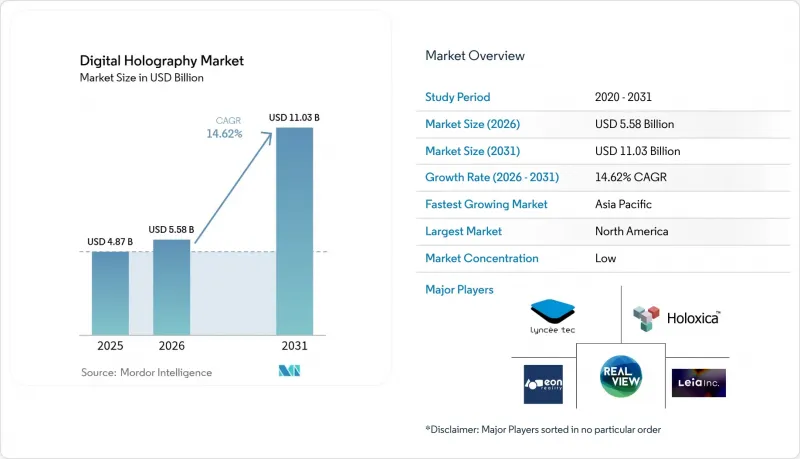
根據 Mordor Intelligence 預測,數位全像市場規模將從 2025 年的 48.7 億美元成長到 2026 年的 55.8 億美元,然後在 2031 年達到 110.3 億美元,2026 年至 2031 年的複合年成長率為 14.62%。
本報告按交付類型(硬體、軟體)、技術(離軸全像、同軸全像等)、應用(數位全像顯示器等)、終端用戶產業(醫療保健與生命科學、航太與國防、汽車、商業與零售等)以及地區(北美、歐洲等)進行細分。市場預測以美元計價。
全球數位全像市場趨勢與洞察
再生醫學臨床試驗中對無無標定定量相位成像的需求激增。
在日本2025年啟動的一項2.15億美元津貼計畫的支持下,日本和韓國的再生醫學研究人員正擴大依賴數位全像顯微鏡來研究活細胞,而無需進行染色。數位全像技術能夠同時捕捉振幅和相位訊息,使研究人員能夠以前所未有的細節分析活細胞,並揭示傳統顯微鏡無法檢測到的細胞形態和動態變化。相位全像成像公司宣布將於2024年第一季策略性地拓展西班牙和葡萄牙市場,並專注於再生醫學應用。此舉實現了對細胞形態和細胞週期動態的即時監測,最佳化了臨床試驗設計,縮短了藥物研發時間,並鞏固了其作為亞洲精準細胞治療領域先驅的地位。類似的定量相位分析工作流程也應用於美國癌症研究中心。
2026 年,多家德國豪華汽車製造商將在旗下車款系列中採用全像顯示器。
德國汽車製造商在將全像抬頭顯示器(HUD)整合到其高階車型方面處於領先地位,並計劃於2026年實現量產。 BMW集團、梅賽德斯-奔馳和奧迪已確認,其2026款車型將配備嵌入擋風玻璃的全像HUD,亮度高達5000尼特,即使佩戴偏光太陽眼鏡也能清晰可見。伊士曼、Ceres Holographics和科思創為此解決方案提供了核心的全像平面透明顯示(HIPTD)薄膜。透過將速度、導航和ADAS(高級駕駛輔助系統)警報資訊置於駕駛員的視線範圍內,製造商旨在提高Euro NCAP碰撞測試成績,並減少因駕駛員分心而導致的事故。
亞太地區晶圓代工廠高效率4K空間燈光調變器供不應求
數位全像市場正面臨高效4K空間燈光調變器(SLM)供應嚴重短缺的困境,而SLM是全像顯示系統的關鍵組件。亞太地區,尤其是日本和韓國的晶圓代工廠,由於產能有限以及與半導體生產線爭奪生產優先權,難以滿足日益成長的需求。 SLM生產的特殊性進一步加劇了供不應求,因為它需要半導體製造和光學工程的專業知識。近期研究正在探索替代方案,例如數位微鏡裝置(DMD),與傳統的液晶SLM相比,DMD具有更高的解析度和更快的切換速度等優勢。預計2025年,專用相位控制器零件的現貨價格將上漲18%。
細分市場分析
到2025年,硬體將佔數位全像市場61.35%的佔有率。其核心是雷射、相機和空間燈光調變器,它們將光學干涉轉換為原始全像圖。如今,相機像素已超過1億,像素間距小於3微米,提高了系統級解析度。同時,預計到2031年,軟體銷售額將成長15.8億美元,因為迭代相位重建、神經網路放大和壓縮模組對於承包部署至關重要。加州大學洛杉磯分校的研究人員展示了一種使用遞迴神經網的重建方法,將結構相似性指數提高了40%,並將計算時間縮短了15倍。這凸顯了軟體在釋放潛在價值方面所扮演的角色。工業OEM買家正在轉向訂閱模式,將韌體升級、雲端渲染管道和本地調試工具捆綁到多年服務等級協定(SLA)中。這些變化預示著未來供應商將提供完整的堆疊,縮短整合週期,增加轉換成本,最終將推動數位全像市場持續成長,帶來可觀的收入。
第二代應用程式介面 (API) 將全像圖生成引擎與 AR/VR 設計軟體包連接起來,消除了以往內容流程碎片化的障礙。醫學影像實驗室正在利用開放原始碼Python 插件實現相位展開工作流程的自動化,將實驗設定時間從數小時縮短至數分鐘。汽車儀錶板供應商已獲得專有校準演算法的授權,用於將雷射調製器與曲面擋風玻璃對準,從而簡化現場服務的物流並保障利潤率。綜上所述,這些趨勢表明,儘管軟體目前僅佔收入的一小部分,但它將在數位全像產業帶來不成比例的長期盈利。
預計到2025年,離軸全像技術將佔總銷售額的68.50%,主要得益於其在光刻掩模偵測和航太測量系統中的廣泛應用。使用者青睞其單次曝光採集和固有的降噪功能,即使在振動的工廠車間也能保持資料完整性。同時,合成孔徑和混合技術預計將以16.42%的複合年成長率成長,這主要得益於多視角對準演算法的推動,該演算法可以將連續影像拼接成單一超高數值孔徑的複合影像。來自加州大學洛杉磯分校、北京航空航太大學和弗勞恩霍夫研究所的研究團隊報告稱,他們利用合成孔徑組裝實現了超過57°的視場角,突破了先前限制其商業性應用的視場角限制。
線上全像術是無標定顯微鏡的基石,在注重成本的大學實驗室中佔據一席之地,因為這些實驗室更傾向於簡化對準而非追求最高解析度。 2025年4月,納瓦拉大學開發的「觸覺全像術」原型利用超音波相控陣增加了觸覺回饋,從而促進了博物館和教育技術領域的先導計畫。雷射二極體價格的下降、高精度伺服技術的進步以及人工智慧驅動的重建技術的融合,有望取代檢測線上的傳統干涉儀,並可能在2028年之前將5%的市場佔有率轉移到合成孔徑架構。隨著空間燈光調變器(SLM)供應的穩定,利用這些技術的數位全像術市場佔有率的擴張速度可能會比預期更快。
區域分析
在美國國防部研發預算撥款和矽谷公司先導計畫的推動下,預計到2025年,北美將佔全球銷售額的41.70%。隨著H.266/VVC頻寬可行性的驗證,美國電信公司正在城市地區迅速發展遠距臨場系統工作室,將芝加哥、達拉斯和舊金山打造成為早期中心。加拿大正崛起為抬頭顯示器(HUD)設計的培養箱,利用省級稅額扣抵吸引光學元件新創公司,為底特律和慕尼黑的供應鏈提供支援。到2025年,蒙特婁感測器公司的創業融資將超過3億美元。
亞太地區已是成長最快的地區,複合年成長率高達15.92%。隨著北京5G-Advanced網路的部署,零售數位全像市場得以擴張,實現了向商業區精品店即時傳輸產品全像圖。在日本,一個生命科學中心引進了用於再生醫學試驗的高通量相位成像設備;韓國一家汽車製造商透過將全像光學元件(HOE)模具與抬頭顯示器(HUD)電子元件同步,縮短了量產時間。在印度,為解決電子廢棄物問題,廢舊液晶顯示器(LCD)背光燈被重新用於全像成像光源,預計到2025年可減少500噸掩埋掩埋。
在歐洲,德國汽車技術夥伴關係和英國國家醫療服務體系(NHS)的試點計畫維持了發展勢頭。歐盟「地平線歐洲」計畫在2025年撥款9,500萬歐元用於先進光電項目,其中相位特定空間光調製器(SLM)和聚合物薄膜波導管的研究獲得了首輪津貼。以色列和阿拉伯聯合大公國正在推動雷射雷達(LiDAR)在國防領域的應用,土耳其也啟動了智慧城市全像測繪的競標。由於缺乏體積影片標準,拉丁美洲的發展相對滯後,巴西一家廣播公司推遲了其3D攝影棚的維修,直到相關規範更加明確。儘管如此,一家墨西哥建築公司已憑藉全像虛擬漫遊技術獲得了一份國際契約,這表明隨著標準的成熟,潛在需求可能會擴大。
其他好處:
- Excel格式的市場預測(ME)表
- 3個月的分析師支持
目錄
第1章:引言
- 研究假設和市場定義
- 調查範圍
第2章:調查方法
第3章執行摘要
第4章 市場狀況
- 市場概覽
- 市場促進因素
- 在日本和韓國的再生醫學臨床試驗中,無標定定量相位成像的需求正在迅速成長。
- 2026年德國豪華汽車製造商的產品陣容中將採用全像顯示器
- H.266/VVC 的標準化將使全像遠距臨場系統成為可能,從而降低美國 5G 網路的頻寬需求。
- 以色列和阿拉伯聯合大公國的國防預算用於遠程全像雷達ISR有效載荷
- 在中國主要城市的購物中心,5G-Advanced 在零售領域的部署,透過邊緣處理實現了基於流量的廣告投放。
- 歐盟醫療器材法規 (EU-MDR) 獎勵措施,鼓勵法國大學醫院採用無輻射全像手術導引技術。
- 市場限制因素
- 亞太地區代工廠中高效率 4K空間燈光調變器的供應十分稀缺。
- 在僅採用相控陣方法的 SLM 製造中,投入巨資(超過 8,000 萬美元)用於無塵室設備。
- 拉丁美洲廣播公司之間缺乏統一的視訊格式,阻礙了內容的傳播。
- 由於缺乏多中心隨機對照試驗(RCT)關於全像診斷的證據,臨床醫生對此持懷疑態度。
- 產業生態系分析
- 技術展望
- 波特五力分析
第5章 市場規模與成長預測
- 報價
- 硬體
- 雷射
- CCD/CMOS影像感測器
- 空間燈光調變器
- 分光鏡和光學元件
- 處理器和記憶體
- 軟體
- 重建演算法
- 視覺化/渲染引擎
- 壓縮和傳輸軟體
- 硬體
- 透過方法
- 離軸全像術
- 線上全像術
- 合成孔徑法和混合技術
- 觸覺全像術
- 透過使用
- 數位全像顯示器
- 數位全像顯微鏡
- 全像遠距臨場系統與通訊
- 抬頭顯示器(汽車和航空)
- 資料儲存和安全認證
- 製造和測量檢驗
- 按最終用戶行業分類
- 醫學與生命科學
- 航太/國防
- 車
- 商業和零售
- 教育和研究機構
- 工業自動化
- 媒體與娛樂
- 家用電子產品
- 按地區
- 北美洲
- 美國
- 加拿大
- 墨西哥
- 歐洲
- 德國
- 英國
- 法國
- 義大利
- 西班牙
- 北歐國家(丹麥、瑞典、挪威、芬蘭)
- 其他歐洲國家
- 亞太地區
- 中國
- 日本
- 韓國
- 印度
- 東南亞
- 澳洲
- 其他亞太國家
- 南美洲
- 巴西
- 阿根廷
- 其他南美國家
- 中東
- 波灣合作理事會(GCC)成員國
- 土耳其
- 其他中東國家
- 非洲
- 南非
- 奈及利亞
- 其他非洲國家
- 北美洲
第6章 競爭情勢
- 市場集中度
- 策略趨勢
- 市佔率分析
- 公司簡介
- RealView Imaging Ltd.
- Lyncee TEC SA
- Phase Holographic Imaging AB
- EON Reality Inc.
- Geola Digital UAB
- MetroLaser Inc.
- Leia Inc.
- Intelligent Imaging Innovations Inc.
- Light Logics Holography and Optics
- Jasper Display Corporation
- Holoxica Limited
- zSpace Inc.
- EchoPixel Inc.
- Zebra Imaging
- NKT Photonics A/S
- HYPERVSN(Baylan Ltd.)
- Ovizio Imaging Systems NV
- Realfiction ApS
- VNTANA
- Looking Glass Factory Inc.
- SeeReal Technologies GmbH
- Light Field Lab Inc.
- HoloTech Switzerland AG
- Daqri LLC
第7章 市場機會與未來展望
According to Mordor Intelligence, the digital holography market size is expected to grow from USD 4.87 billion in 2025 to USD 5.58 billion in 2026 and is forecast to reach USD 11.03 billion by 2031 at 14.62% CAGR over 2026-2031.
This report is Segmented by Offering (Hardware, and Software), Technique (Off-Axis Holography, In-Line Holography, and More), Application (Digital Holographic Displays, and More) End-User Vertical (Medical and Life Sciences, Aerospace and Defense, Automotive, Commercial and Retail, and More), and Geography (North America, Europe, and More). The Market Forecasts are Provided in Terms of Value (USD).
Global Digital Holography Market Trends and Insights
Surge in label-free quantitative phase imaging demand in regenerative medicine trials
Japanese and South Korean regenerative-medicine investigators increasingly relied on digital holographic microscopy to study living cells without stains, supported by Japan's USD 215 million grant program in 2025. The ability of digital holography to capture both amplitude and phase information simultaneously enables researchers to analyze living cells with unprecedented detail, revealing cellular morphology and dynamics that remain invisible to conventional microscopy. Phase Holographic Imaging reported a strategic expansion into the Spanish and Portuguese markets in Q1 2024, specifically targeting regenerative medicine applications. The resulting ability to monitor morphology and cell-cycle kinetics in real time sharpened trial design, shortened discovery timelines and reinforced Asia's first-mover status in precision cell therapy. Spillover demand appeared in U.S. cancer-research centers adopting the same quantitative-phase workflows.
Adoption of holographic HUDs in premium German automotive OEM 2026 line-ups
German automotive manufacturers are at the forefront of integrating holographic head-up displays (HUDs) into their premium vehicle models, with production implementations scheduled for 2026. BMW Group, Mercedes-Benz and Audi confirmed 2026 model-year launches using windshield-embedded holographic HUDs that maintain 5 000-nit brightness and remain visible through polarized sunglasses. Eastman, Ceres Holographics and Covestro supplied Holographic In-Plane Transparent Display (HIPTD) films that anchor the solution. By relocating speed, navigation and ADAS alerts into the driver's line of sight, OEMs targeted higher Euro NCAP scores and reduced distraction-related incidents.
Sparse supply of high-efficiency 4K spatial light modulators from APAC foundries
The digital holography market faces significant supply constraints for high-efficiency 4K spatial light modulators (SLMs), a critical component in holographic display systems. APAC foundries, particularly in Japan and South Korea, are struggling to meet growing demand due to production capacity limitations and competing priorities for semiconductor manufacturing lines. This supply shortage is exacerbated by the specialized nature of SLM production, which requires expertise in both semiconductor fabrication and optical engineering. Recent research has explored alternative approaches, such as digital micromirror devices (DMDs), which offer advantages including higher resolution and faster switching speeds compared to traditional liquid crystal SLMs. Spot prices for phase-only devices spiked 18% in 2025.
Other drivers and restraints analyzed in the detailed report include:
- Standardization of H.266/VVC enabling bandwidth-light holographic telepresence on U.S. 5G networks
- Defense funding for long-range holographic LiDAR ISR payloads in Israel and UAE
- Prohibitive clean-room CAPEX (> USD 80 m) for phase-only SLM fabrication
For complete list of drivers and restraints, kindly check the Table Of Contents.
Segment Analysis
Hardware captured 61.35% of digital holography market share in 2025, anchored by lasers, cameras and spatial-light modulators that convert optical interference into raw holograms. Cameras now exceed 100 MP at sub-3 µm pixel pitches, lifting system-level resolution. Meanwhile, software revenue is on course to add USD 1.58 billion through 2031 as iterative-phase retrieval, neural up-scaling and compression modules become indispensable for turnkey deployments. UCLA researchers demonstrated a recurrent-neural-network reconstruction that lifted structural-similarity metrics 40% and shortened compute time fifteen-fold, underscoring software's role in unlocking latent value. Industrial original-equipment buyers have shifted to subscription models that bundle firmware upgrades, cloud render pipelines and on-premises debugging utilities in multi-year service-level agreements. These shifts point toward a future in which vendors package complete stacks, compressing integration timelines and amplifying switching costs-thereby raising the digital holography market size in recurring-revenue terms.
Second-generation application-programming interfaces link hologram generation engines with AR/VR design packages, removing barriers that previously fragmented content pipelines. Medical imaging labs exploit open-source Python plug-ins to automate phase-unwrap workflows, cutting experiment-setup times from hours to minutes. Automotive dashboard suppliers license proprietary calibration algorithms that align laser modulators to curved windshields, simplifying field-service logistics and protecting margin. Collectively, these dynamics confirm that software, though representing the smaller top-line slice today, will deliver disproportionate long-term profitability inside the digital holography industry.
Off-axis holography retained 68.50% of revenue in 2025 owing to robust photolithography-mask inspection and aerospace metrology installations. Users appreciate its single-exposure acquisition and inherent noise rejection, which preserve data integrity on vibrating factory floors. Yet synthetic-aperture and hybrid approaches are projected to climb at a 16.42% CAGR, propelled by multiview registration algorithms that chain sequential captures into one ultra-high-numerical-aperture composite. UCLA, Beihang University and Fraunhofer teams each reported > 57° viewing angles derived from synthetic-aperture assembly, tearing down the field-of-view wall that once limited commercial viability.
In-line holography, a workhorse for label-free microscopy, maintains a niche in cost-sensitive university labs that favor simpler alignments over maximal resolution. Touchable-holography prototypes from the Public University of Navarra added tactile feedback via ultrasonic phased arrays in April 2025, prompting museum and ed-tech pilots. The confluence of decreasing laser-diode pricing, precision-servo advances and AI reconstruction now positions hybrid systems to usurp legacy interferometers in inspection lines, potentially redirecting another 5% share toward synthetic-aperture architectures by 2028. If spatial-light-modulator supply stabilizes, the digital holography market share of these techniques could accelerate faster than forecast.
Complete Report Scope:
- By Offering
- Hardware
- Lasers
- CCD/CMOS Image Sensors
- Spatial Light Modulators
- Beam Splitters and Optics
- Processors and Memory
- Software
- Reconstruction Algorithms
- Visualization/Rendering Engines
- Compression and Transmission Software
- Hardware
- By Technique
- Off-Axis Holography
- In-Line Holography
- Synthetic Aperture and Hybrid Techniques
- Touchable Holography
- By Application
- Digital Holographic Displays
- Digital Holographic Microscopy
- Holographic Telepresence and Communication
- Head-Up Displays (Automotive and Aviation)
- Data Storage and Security Authentication
- Manufacturing and Metrology Inspection
- By End-User Vertical
- Medical and Life Sciences
- Aerospace and Defense
- Automotive
- Commercial and Retail
- Education and Research Institutes
- Industrial Automation
- Media and Entertainment
- Consumer Electronics
- By Geography
- North America
- United States
- Canada
- Mexico
- Europe
- Germany
- United Kingdom
- France
- Italy
- Spain
- Nordics (Denmark, Sweden, Norway, Finland)
- Rest of Europe
- Asia-Pacific
- China
- Japan
- South Korea
- India
- Southeast Asia
- Australia
- Rest of Asia-Pacific
- South America
- Brazil
- Argentina
- Rest of South America
- Middle East
- Gulf Cooperation Council Countries
- Turkey
- Rest of Middle East
- Africa
- South Africa
- Nigeria
- Rest of Africa
- North America
Geography Analysis
North America captured 41.70% of global revenue in 2025, driven by Pentagon R&D allocations and Silicon Valley enterprise pilots. U.S. telecom carriers fast-tracked city-center telepresence studios after H.266/VVC proved bandwidth-viable, turning Chicago, Dallas and San Francisco into early hubs. Canada emerged as a HUD-design incubator, leveraging provincial tax credits to lure optical-component start-ups that feed Detroit and Munich supply chains. Venture funding exceeded USD 300 million in 2025 for Montreal-based sensor firms.
Asia-Pacific, already the fastest-growing region with a 15.92% CAGR, benefited from Beijing's 5G-Advanced footprint that streams real-time product holograms to high-street boutiques, advancing the digital holography market size for retail. Japanese life-science complexes adopted high-throughput phase-imaging rigs for regenerative-medicine assays, while South Korean automakers synchronized HOE tooling with HUD electronics to shorten ramp-up cycles. India's e-waste challenge repurposed obsolete LCD backlights into holography-ready light-engines, diverting 500 tons of landfill in 2025.
Europe sustained momentum through Germany's auto-tech partnerships and the UK's National Health Service pilots. Horizon Europe earmarked EUR 95 million for advanced photonics projects in 2025, with phase-only SLM and polymer-film waveguide research receiving first-round grants. Israel and the UAE advanced defense LiDAR adoption, while Turkey initiated smart-city holographic-mapping bids. Latin America trailed due to volumetric-video standard gaps; Brazil's broadcasters postponed 3D studio renovations pending specification clarity. Notwithstanding, Mexican architectural firms used holographic walk-throughs to win offshore contracts, hinting at latent demand growth once standards mature.
- RealView Imaging Ltd.
- Lyncee TEC SA
- Phase Holographic Imaging AB
- EON Reality Inc.
- Geola Digital UAB
- MetroLaser Inc.
- Leia Inc.
- Intelligent Imaging Innovations Inc.
- Light Logics Holography and Optics
- Jasper Display Corporation
- Holoxica Limited
- zSpace Inc.
- EchoPixel Inc.
- Zebra Imaging
- NKT Photonics A/S
- HYPERVSN (Baylan Ltd.)
- Ovizio Imaging Systems NV
- Realfiction ApS
- VNTANA
- Looking Glass Factory Inc.
- SeeReal Technologies GmbH
- Light Field Lab Inc.
- HoloTech Switzerland AG
- Daqri LLC
Additional Benefits:
- The market estimate (ME) sheet in Excel format
- 3 months of analyst support
TABLE OF CONTENTS
1 INTRODUCTION
- 1.1 Study Assumptions and Market Definition
- 1.2 Scope of the Study
2 RESEARCH METHODOLOGY
3 EXECUTIVE SUMMARY
4 MARKET LANDSCAPE
- 4.1 Market Overview
- 4.2 Market Drivers
- 4.2.1 Surge in label-free quantitative phase imaging demand in regenerative medicine trials across Japan and South Korea
- 4.2.2 Adoption of holographic HUDs in premium German automotive OEM 2026 line-ups
- 4.2.3 Standardization of H.266/VVC enabling bandwidth-light holographic telepresence on United States 5G networks
- 4.2.4 Defense funding for long-range holographic LiDAR ISR payloads in Israel and United Arab Emirates
- 4.2.5 Retail 5G-Advanced roll-out powering edge-rendered volumetric ads in Chinese Tier-1 malls
- 4.2.6 EU-MDR incentives for radiation-free holographic surgical guidance in French university hospitals
- 4.3 Market Restraints
- 4.3.1 Sparse supply of high-efficiency 4K spatial light modulators from Asia-Pacific foundries
- 4.3.2 Prohibitive clean-room CAPEX (Above USD 80 m) for phase-only SLM fabrication
- 4.3.3 Lack of volumetric-video standards among LATAM broadcasters hindering content roll-out
- 4.3.4 Clinician scepticism due to absence of multi-centre RCT evidence for holographic diagnostics
- 4.4 Industry Ecosystem Analysis
- 4.5 Technological Outlook
- 4.6 Porter's Five Forces Analysis
- 4.6.1 Threat of New Entrants
- 4.6.2 Bargaining Power of Buyers
- 4.6.3 Bargaining Power of Suppliers
- 4.6.4 Threat of Substitutes
- 4.6.5 Intensity of Competitive Rivalry
5 MARKET SIZE AND GROWTH FORECASTS (VALUES)
- 5.1 By Offering
- 5.1.1 Hardware
- 5.1.1.1 Lasers
- 5.1.1.2 CCD/CMOS Image Sensors
- 5.1.1.3 Spatial Light Modulators
- 5.1.1.4 Beam Splitters and Optics
- 5.1.1.5 Processors and Memory
- 5.1.2 Software
- 5.1.2.1 Reconstruction Algorithms
- 5.1.2.2 Visualization/Rendering Engines
- 5.1.2.3 Compression and Transmission Software
- 5.1.1 Hardware
- 5.2 By Technique
- 5.2.1 Off-Axis Holography
- 5.2.2 In-Line Holography
- 5.2.3 Synthetic Aperture and Hybrid Techniques
- 5.2.4 Touchable Holography
- 5.3 By Application
- 5.3.1 Digital Holographic Displays
- 5.3.2 Digital Holographic Microscopy
- 5.3.3 Holographic Telepresence and Communication
- 5.3.4 Head-Up Displays (Automotive and Aviation)
- 5.3.5 Data Storage and Security Authentication
- 5.3.6 Manufacturing and Metrology Inspection
- 5.4 By End-User Vertical
- 5.4.1 Medical and Life Sciences
- 5.4.2 Aerospace and Defense
- 5.4.3 Automotive
- 5.4.4 Commercial and Retail
- 5.4.5 Education and Research Institutes
- 5.4.6 Industrial Automation
- 5.4.7 Media and Entertainment
- 5.4.8 Consumer Electronics
- 5.5 By Geography
- 5.5.1 North America
- 5.5.1.1 United States
- 5.5.1.2 Canada
- 5.5.1.3 Mexico
- 5.5.2 Europe
- 5.5.2.1 Germany
- 5.5.2.2 United Kingdom
- 5.5.2.3 France
- 5.5.2.4 Italy
- 5.5.2.5 Spain
- 5.5.2.6 Nordics (Denmark, Sweden, Norway, Finland)
- 5.5.2.7 Rest of Europe
- 5.5.3 Asia-Pacific
- 5.5.3.1 China
- 5.5.3.2 Japan
- 5.5.3.3 South Korea
- 5.5.3.4 India
- 5.5.3.5 Southeast Asia
- 5.5.3.6 Australia
- 5.5.3.7 Rest of Asia-Pacific
- 5.5.4 South America
- 5.5.4.1 Brazil
- 5.5.4.2 Argentina
- 5.5.4.3 Rest of South America
- 5.5.5 Middle East
- 5.5.5.1 Gulf Cooperation Council Countries
- 5.5.5.2 Turkey
- 5.5.5.3 Rest of Middle East
- 5.5.6 Africa
- 5.5.6.1 South Africa
- 5.5.6.2 Nigeria
- 5.5.6.3 Rest of Africa
- 5.5.1 North America
6 COMPETITIVE LANDSCAPE
- 6.1 Market Concentration
- 6.2 Strategic Moves
- 6.3 Market Share Analysis
- 6.4 Company Profiles (includes Global-level Overview, Market-level Overview, Core Segments, Financials, Strategic Information, Market Rank/Share, Products and Services, Recent Developments)
- 6.4.1 RealView Imaging Ltd.
- 6.4.2 Lyncee TEC SA
- 6.4.3 Phase Holographic Imaging AB
- 6.4.4 EON Reality Inc.
- 6.4.5 Geola Digital UAB
- 6.4.6 MetroLaser Inc.
- 6.4.7 Leia Inc.
- 6.4.8 Intelligent Imaging Innovations Inc.
- 6.4.9 Light Logics Holography and Optics
- 6.4.10 Jasper Display Corporation
- 6.4.11 Holoxica Limited
- 6.4.12 zSpace Inc.
- 6.4.13 EchoPixel Inc.
- 6.4.14 Zebra Imaging
- 6.4.15 NKT Photonics A/S
- 6.4.16 HYPERVSN (Baylan Ltd.)
- 6.4.17 Ovizio Imaging Systems NV
- 6.4.18 Realfiction ApS
- 6.4.19 VNTANA
- 6.4.20 Looking Glass Factory Inc.
- 6.4.21 SeeReal Technologies GmbH
- 6.4.22 Light Field Lab Inc.
- 6.4.23 HoloTech Switzerland AG
- 6.4.24 Daqri LLC
7 MARKET OPPORTUNITIES AND FUTURE OUTLOOK
- 7.1 White-space and Unmet-Need Assessment

 全球數位全像市場規模、佔有率、趨勢和成長分析報告(2026-2034年)
 數位全像市場-2026-2032年全球市場預測
 全像圖市場預測至2034年—按類型、組件、全像圖、應用、技術、最終用戶和地區分類的全球分析
 2026年全像圖全球市場報告2026年全球數位全像市場報告
 數位全像市場規模、佔有率、趨勢和預測:按技術類型、組件類型、應用、行業和地區分類,2026-2034年
 數位全像市場規模、佔有率和成長分析(按產品、規模、技術、工藝類型、應用、最終用途領域和地區分類)-2026-2033年產業預測
 數位全像市場-全球產業規模、佔有率、趨勢、機會及預測(按產品、應用、終端用戶產業、地區和競爭格局分類,2020-2030 年預測)
 全像圖:全球市場佔有率和排名、總收入和需求預測(2025-2031年)數位全像市場規模:按產品、應用、最終用途產業、地理和預測