


 |
市場調查報告書
商品編碼
2124125
α-甲基苯乙烯:市場佔有率分析、行業趨勢和統計數據、成長預測(2026-2031)Alpha Methylstyrene - Market Share Analysis, Industry Trends & Statistics, Growth Forecasts (2026 - 2031) |
||||||

※ 本網頁內容可能與最新版本有所差異。詳細情況請與我們聯繫。
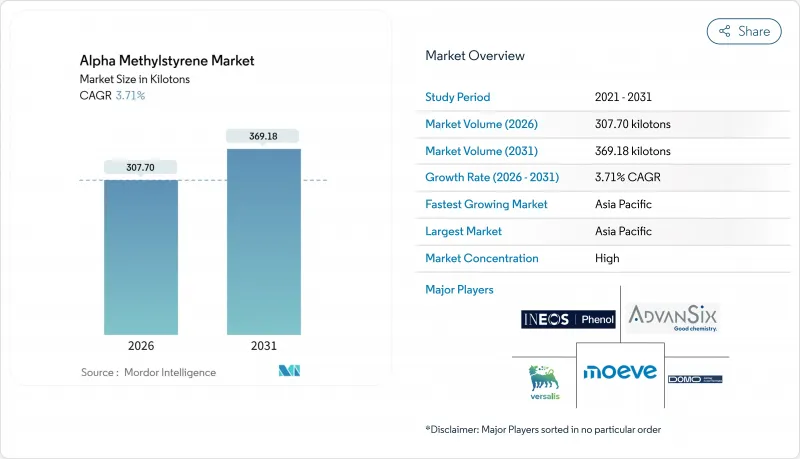
據 Mordor Intelligence 稱,2026 年 α-甲基苯乙烯的市場規模估計為 307.70 千噸,預計到 2031 年將達到 369.18 千噸,在預測期(2026-2031 年)內以 3.71% 的複合年成長率成長。
本報告按純度(純度高於 99% 的高純度 AMS 和純度低於 99% 的標準級 AMS)、形態(液體和固體)、應用(ABS 製造、塑膠添加劑和中間體等)、終端用戶行業(汽車、輪胎、塑膠等)以及地區(亞太地區、北美地區、歐洲地區等)進行細分。市場預測以噸為單位。
全球α-甲基苯乙烯市場趨勢及洞察
輕量化汽車零件需求激增
汽車製造商指定使用α-甲基苯乙烯改質ABS樹脂,以減輕零件重量約五分之一,同時將熱變形溫度提高到100°C以上。由於電池組佔據了更多車內空間,這項優勢至關重要。英力士苯領公司2020年的一項專利描述了一種含有高達10 wt% α-甲基苯乙烯的ABS樹脂,該樹脂滿足內裝件嚴格的VOC和熱性能要求。中國電動車的強勁生產使這些樹脂的需求量保持在高位,北美供應商也朝著類似的配方轉變邁進。隨著電動車比例的加速成長和傳統內燃機計畫的逐步淘汰,預計這種樹脂的普及將在中期內達到高峰。
耐熱電子封裝的消耗量增加
在半導體封裝領域,目前市場對即使在260 度C回流焊接過程中也不會發生翹曲的聚合物有著迫切的需求。高純度α-甲基苯乙烯符合此標準,並符合RoHS和REACH法規,因此適用於東亞地區生產的筆記型電腦、智慧型手機和物聯網設備的機殼。美國食品藥物管理局(FDA)已在多項聯邦法規(CFR)條款中允許其與食品間接接觸,這進一步擴大了消費性電子產品和包裝材料的需求。鑑於亞太地區佔全球電子產品組裝總量的70%以上,預計這種需求在中期內仍將是推動市場成長的主要動力。
危險廢棄物的產生以及加強 REACH/EPA 關於異丙苯的法規。
由於異丙苯被列為有害空氣污染物,因此政府正在鼓勵投資購買減少揮發性有機化合物(VOCs)排放的設備。另一方面,《資源保護與回收法》(RCRA)的相關規定限制了閃點為53.9 度C的α-甲基苯乙烯廢棄物的儲存期限。小規模獨立生產商正努力應對相關的合規成本,產業整合正在加速進行中。
細分市場分析
預計到2025年,高純度(99%以上)α-甲基苯乙烯的產量將佔總產量的71.35%,到2031年,年複合成長率(CAGR)將達到4.69%,是標準級α-甲基苯乙烯增速的兩倍。電子和製藥業的買家對苯酚含量低於20 ppm的無苯材料需求旺盛,像DOMO Chemicals這樣的生產商可以獲得10-20%的溢價。因此,隨著印刷基板和醫療設備供應鏈中檢驗流程的日益嚴格,高純度α-甲基苯乙烯的市場規模預計將進一步擴大。同時,亞洲市場普遍存在標準級α-甲基苯乙烯供應過剩的問題,限制了其差異化發展的空間。
ASTM 的專有測試方法 D7977 使下游買家能夠更嚴格地控制聚合物中的雜質,進一步加劇了α-甲基苯乙烯市場的兩極化。具備現場提純能力的一體化設施可以確保供應的連續性,使其成為半導體、診斷探針和熱成型醫用托盤等高規格應用的理想合作夥伴。
液態α-甲基苯乙烯是目前市場上的主要形式,預計2025年將佔總出貨量的90.88%。這是因為連續式ABS和SAN聚合裝置依賴計量供應的液態原料。儘管液態α-甲基苯乙烯的市佔率仍然很高,但由於對揮發性有機化合物(VOC)排放的監管日益嚴格,固體片狀α-甲基苯乙烯的市場正以4.35%的複合年成長率快速成長。
由於片狀原料在密封容器中熔化,蒸發損失降至最低,因此更容易符合嚴格的職場接觸標準。歐盟針對大批量有機化學品的指導方針推薦這種方法,從而推動了歐洲和日本(這兩個國家的環境授權標準最為嚴格)的固體片狀產品市場的發展。
區域分析
預計到2025年,亞太地區將佔全球產量的56.06%,到2031年將以5.62%的複合年成長率成長。這主要得益於中國龐大的綜合性生產設施,包括一座年產2000萬噸的煉油廠以及生產苯、苯酚和最終產品α-甲基苯乙烯的芳烴裝置。浙江石化和恆力石化就是這種綜合模式的典範,迫使日本和歐洲的老舊工廠停產。
儘管北美地區的生產佔有率有所下降,但它專注於生產用於電子和醫療保健行業的高純度產品。 INEOS Phenol 於 2023 年收購 Mitsui Phenol Singapore,這清楚地表明了該地區為維持與亞洲客戶的接近性並分散原料風險所做的努力。歐洲正努力應對日益嚴格的 REACH 法規,但生產商透過投資沸石甲醇烷基化和 VOC 回收技術來提高產品品質並減少排放,從而維持其在高階市場的地位。
中東、非洲和南美洲是新興市場,其大部分需求嚴重依賴進口。雖然沿岸地區低成本的石腦油可能成為未來α-甲基苯乙烯生產裝置的基礎,但下游ABS和SAN叢集的缺乏削弱了其短期前景。總體而言,預計到2031年,這三個成熟地區仍將佔據α-甲基苯乙烯市場交易量的90%以上。
其他好處:
- Excel格式的市場預測(ME)表
- 3個月的分析師支持
目錄
第1章:引言
- 研究假設和市場定義
- 調查範圍
第2章:調查方法
第3章執行摘要
第4章 市場狀況
- 市場概覽
- 市場促進因素
- 對輕量化汽車零件的需求正在激增。
- 耐熱電子封裝的消耗量增加
- 在醫療設備的應用不斷擴大,推動了需求成長。
- 對氨基苯酚作為電池電解添加劑的出現
- 己內醯胺複合物的閉合迴路AMS回收促進了現場再利用。
- 市場限制因素
- REACH 和 EPA 對異丙苯的監管更加嚴格,導致危險廢棄物來源增加。
- 原油衍生原料價格波動
- 在 3D 列印樹脂領域,生物衍生的 α-甲基-BETA-苯乙烯類似物正在迅速發展。
- 價值鏈分析
- 波特五力模型
第5章 市場規模與成長預測
- 純度
- 高純度AMS,純度超過99%
- 標準級AMS,含量低於99%
- 按形式
- 液體(散裝)
- 固態(片狀)
- 透過使用
- ABS製造
- 塑膠添加劑和中間體
- 黏合劑
- 塗層
- 其他用途
- 按最終用戶行業分類
- 車
- 胎
- 塑膠
- 電子設備
- 其他用途
- 按地區
- 亞太地區
- 中國
- 印度
- 日本
- 韓國
- 東南亞國協
- 其他亞洲國家
- 北美洲
- 美國
- 加拿大
- 墨西哥
- 歐洲
- 德國
- 英國
- 法國
- 義大利
- 西班牙
- 北歐國家
- 其他歐洲國家
- 南美洲
- 巴西
- 阿根廷
- 其他南美國家
- 中東和非洲
- 沙烏地阿拉伯
- 南非
- 其他中東和非洲國家
- 亞太地區
第6章 競爭情勢
- 市場集中度
- 策略性措施(併購、合資、擴大生產能力)
- 市佔率和排名分析
- 公司簡介
- Advansix
- ALTIVIA
- Chang Chun Group
- Deepak
- Domo Chemicals
- Eni SpA
- INEOS
- Kraton Corporation
- KUMHO PandB CHEMICALS.,INC.
- LG Chem
- Mitsubishi Chemical Group Corporation
- Moeve(Cepsa)
- ROSNEFT
- Seqens
- SI Group, Inc.
- SIBUR Holding PJSC
- Solvay
- Sumitomo Chemical Co., Ltd.
- Yangzhou Lida Resin Co.,Ltd.
第7章 市場機會與未來展望
According to Mordor Intelligence, the alpha methylstyrene market size is estimated at 307.70 kilotons in 2026, and is expected to reach 369.18 kilotons by 2031, at a CAGR of 3.71% during the forecast period (2026-2031).
This report is Segmented by Purity (Greater Than or Equal To 99% High-Purity AMS and Less Than 99% Standard Grade AMS), Form (Liquid and Solid), Application (ABS Manufacture, Plastic Additives and Intermediates, and More), End-User Industry (Automotive, Tire, Plastics, and More), and Geography (Asia-Pacific, North America, Europe, and More). The Market Forecasts are Provided in Terms of Volume (Tons).
Global Alpha Methylstyrene Market Trends and Insights
Surging Demand in Lightweight Automotive Parts
Automakers specify Alpha-Methylstyrene-modified ABS to push heat-deflection temperatures beyond 100 °C while trimming component weight by nearly one-fifth, an essential gain as battery packs crowd interior space. A 2020 patent from INEOS Styrolution documents ABS grades with up to 10 wt% Alpha-Methylstyrene that meet strict VOC and thermal targets for interior trims. Strong electric-vehicle output in China keeps the throughput of such resins high, and North American suppliers are mirroring the formulation shift. Adoption should crest in the medium term as the EV mix accelerates and legacy internal-combustion programs sunset.
Rising Consumption in Heat-Resistant Electronic Encapsulants
Semiconductor packaging now requires polymers that survive 260 °C reflow without warping. High-purity Alpha-Methylstyrene meets this bar and complies with RoHS plus REACH, enabling its use in laptop, smartphone, and IoT housings produced across East Asia. The FDA permits indirect food contact under several CFR clauses, which further broadens appliance and packaging demand. With Asia-Pacific responsible for more than 70% of global electronics assembly, the driver maintains a mid-term push.
Hazardous Waste Streams and Stricter REACH/EPA Limits on Cumene
Cumene's classification as a hazardous air pollutant drives capital spending on VOC abatement, while RCRA rules curb the storage time of Alpha-Methylstyrene wastes with a flash point of 53.9 °C. Smaller standalone producers struggle with the resulting compliance cost, accelerating consolidation.
Other drivers and restraints analyzed in the detailed report include:
- Growing Use in Medical Devices Boosting Demand
- Emergence of Para-Cumylphenol as Battery-Electrolyte Additive
- Volatility in Crude-Derived Feedstock Pricing
For complete list of drivers and restraints, kindly check the Table Of Contents.
Segment Analysis
High-purity (>=99%) Alpha-Methylstyrene controlled 71.35% of 2025 volume and is forecast for a 4.69% CAGR to 2031, twice the pace of standard grades. Electronics and pharmaceutical buyers insist on benzene-free material with phenol below 20 ppm, allowing producers such as DOMO Chemicals to fetch 10-20% price premiums. The Alpha-Methylstyrene market size for high-purity volumes is therefore set to widen its lead as validation protocols tighten across printed-circuit and medical-device supply chains. Conversely, the commoditized standard grade remains burdened by Asian oversupply and has limited scope for differentiation.
ASTM's dedicated D7977 test method now gives downstream buyers tighter control over polymer contaminants, reinforcing the bifurcation of the Alpha-Methylstyrene market. Integrated complexes that purify on-site can guarantee supply continuity, positioning themselves as partners of choice for high-spec applications in semiconductors, diagnostic probes, and thermoformed medical trays.
Liquid Alpha-Methylstyrene dominates with 90.88% of 2025 shipments because continuous ABS and SAN polymerization plants depend on metered liquid feed. The Alpha-Methylstyrene market share for this form remains elevated, yet regulatory focus on VOC exposure is spurring a 4.35% CAGR in solid flakes.
Flaked material melts in sealed vessels, curbing vapor loss and easing compliance with tight workplace-exposure limits. EU guidelines for large-volume organic chemicals favor such approaches, giving solids momentum in Europe and Japan, where environmental permitting standards are strictest.
Complete Report Scope:
- By Purity
- Greater Than or Equal To 99% High-Purity AMS
- Less Than 99 % Standard Grade AMS
- By Form
- Liquid (Bulk)
- Solid (Flaked)
- By Application
- ABS Manufacture
- Plastic Additives and Intermediates
- Adhesives
- Coatings
- Other Applications
- By End-user Industry
- Automotive
- Tire
- Plastics
- Electronics
- Other Applications
- By Geography
- Asia-Pacific
- China
- India
- Japan
- South Korea
- ASEAN Countries
- Rest of Asia
- North America
- United States
- Canada
- Mexico
- Europe
- Germany
- United Kingdom
- France
- Italy
- Spain
- NORDIC Countries
- Rest of Europe
- South America
- Brazil
- Argentina
- Rest of South America
- Middle East and Africa
- Saudi Arabia
- South Africa
- Rest of Middle East and Africa
- Asia-Pacific
Geography Analysis
Asia-Pacific held 56.06% of global volume in 2025 and is projected to grow at a 5.62% CAGR to 2031 on the back of mega complexes in China that pair 20 million tons/year refineries with aromatics units churning out benzene, phenol, and ultimately Alpha-Methylstyrene. The hubs of Zhejiang Petroleum & Chemical and Hengli Petrochemical epitomize this integrated model, forcing older Japanese and European plants offline.
North America, while losing some volume share, specializes in high-purity output for electronics and healthcare. INEOS Phenol's 2023 takeover of Mitsui Phenols Singapore underscores the region's drive to secure Asian customer proximity and diversify feedstock risk. Europe grapples with tighter REACH rules, yet its producers invest in zeolite alkylation and VOC capture that elevate product quality and cut emissions, maintaining a premium foothold.
The Middle East and Africa and South America represent nascent pockets that import most of their needs. Low-cost naphtha in the Gulf could anchor future Alpha-Methylstyrene units, but the absence of downstream ABS and SAN clusters dilutes short-term prospects. Overall, the three established regions will continue to account for more than 90% of Alpha-Methylstyrene market transactions to 2031.
- Advansix
- ALTIVIA
- Chang Chun Group
- Deepak
- Domo Chemicals
- Eni S.p.A.
- INEOS
- Kraton Corporation
- KUMHO PandB CHEMICALS.,INC.
- LG Chem
- Mitsubishi Chemical Group Corporation
- Moeve (Cepsa)
- ROSNEFT
- Seqens
- SI Group, Inc.
- SIBUR Holding PJSC
- Solvay
- Sumitomo Chemical Co., Ltd.
- Yangzhou Lida Resin Co.,Ltd.
Additional Benefits:
- The market estimate (ME) sheet in Excel format
- 3 months of analyst support
TABLE OF CONTENTS
1 Introduction
- 1.1 Study Assumptions and Market Definition
- 1.2 Scope of the Study
2 Research Methodology
3 Executive Summary
4 Market Landscape
- 4.1 Market Overview
- 4.2 Market Drivers
- 4.2.1 Surging demand in lightweight automotive parts
- 4.2.2 Rising consumption in heat-resistant electronic encapsulants
- 4.2.3 Growing use in medical devices bossting demand
- 4.2.4 Emergence of para-cumylphenol as battery-electrolyte additive
- 4.2.5 Closed-loop AMS recovery in caprolactam complexes boosts on-site reuse
- 4.3 Market Restraints
- 4.3.1 Hazardous waste streams and stricter REACH/EPA limits on cumene
- 4.3.2 Volatility in crude-derived feedstock pricing
- 4.3.3 Rapid shift toward bio-based alpha-methyl-beta-styrene analogues in 3-D-printing resins
- 4.4 Value Chain Analysis
- 4.5 Porters Five Forces
- 4.5.1 Threat of New Entrants
- 4.5.2 Bargaining Power of Buyers
- 4.5.3 Bargaining Power of Suppliers
- 4.5.4 Threat of Substitutes
- 4.5.5 Degree of Competition
5 Market Size and Growth Forecasts (Volume)
- 5.1 By Purity
- 5.1.1 Greater Than or Equal To 99% High-Purity AMS
- 5.1.2 Less Than 99 % Standard Grade AMS
- 5.2 By Form
- 5.2.1 Liquid (Bulk)
- 5.2.2 Solid (Flaked)
- 5.3 By Application
- 5.3.1 ABS Manufacture
- 5.3.2 Plastic Additives and Intermediates
- 5.3.3 Adhesives
- 5.3.4 Coatings
- 5.3.5 Other Applications
- 5.4 By End-user Industry
- 5.4.1 Automotive
- 5.4.2 Tire
- 5.4.3 Plastics
- 5.4.4 Electronics
- 5.4.5 Other Applications
- 5.5 By Geography
- 5.5.1 Asia-Pacific
- 5.5.1.1 China
- 5.5.1.2 India
- 5.5.1.3 Japan
- 5.5.1.4 South Korea
- 5.5.1.5 ASEAN Countries
- 5.5.1.6 Rest of Asia
- 5.5.2 North America
- 5.5.2.1 United States
- 5.5.2.2 Canada
- 5.5.2.3 Mexico
- 5.5.3 Europe
- 5.5.3.1 Germany
- 5.5.3.2 United Kingdom
- 5.5.3.3 France
- 5.5.3.4 Italy
- 5.5.3.5 Spain
- 5.5.3.6 NORDIC Countries
- 5.5.3.7 Rest of Europe
- 5.5.4 South America
- 5.5.4.1 Brazil
- 5.5.4.2 Argentina
- 5.5.4.3 Rest of South America
- 5.5.5 Middle East and Africa
- 5.5.5.1 Saudi Arabia
- 5.5.5.2 South Africa
- 5.5.5.3 Rest of Middle East and Africa
- 5.5.1 Asia-Pacific
6 Competitive Landscape
- 6.1 Market Concentration
- 6.2 Strategic Moves (Mergers and Acquisitions, JVs, Capacity Expansions)
- 6.3 Market Share(%)/Ranking Analysis
- 6.4 Company Profiles {(includes Global level Overview, Market level overview, Core Segments, Financials as available, Strategic Information, Products and Services, and Recent Developments)}
- 6.4.1 Advansix
- 6.4.2 ALTIVIA
- 6.4.3 Chang Chun Group
- 6.4.4 Deepak
- 6.4.5 Domo Chemicals
- 6.4.6 Eni S.p.A.
- 6.4.7 INEOS
- 6.4.8 Kraton Corporation
- 6.4.9 KUMHO PandB CHEMICALS.,INC.
- 6.4.10 LG Chem
- 6.4.11 Mitsubishi Chemical Group Corporation
- 6.4.12 Moeve (Cepsa)
- 6.4.13 ROSNEFT
- 6.4.14 Seqens
- 6.4.15 SI Group, Inc.
- 6.4.16 SIBUR Holding PJSC
- 6.4.17 Solvay
- 6.4.18 Sumitomo Chemical Co., Ltd.
- 6.4.19 Yangzhou Lida Resin Co.,Ltd.
7 Market Opportunities and Future Outlook
- 7.1 White-space and Unmet-Need Assessment

 2026-2030年全球α-甲基苯乙烯市場
 α-甲基苯乙烯市場:依純度、等級、應用和分銷管道分類-2026-2032年全球市場預測
 全球α-甲基苯乙烯市場規模、佔有率、趨勢和成長分析報告(2026-2034年)α-甲基苯乙烯二聚體市場按等級、形態、應用和最終用途產業分類,全球預測(2026-2032年)
 α-甲基苯乙烯市場規模、佔有率和成長分析(按純度、應用和地區分類):產業預測(2026-2033 年)2026-2032 年 α-甲基苯乙烯市場(依純度、最終用途產業及地區分類)
 世界及美國的Alpha甲基苯乙烯(AMS)市場:預測(2024年~2030年)