


 |
市場調查報告書
商品編碼
2124118
脂醇類:市場佔有率分析、產業趨勢與統計、成長預測(2026-2031)Fatty Alcohol - Market Share Analysis, Industry Trends & Statistics, Growth Forecasts (2026 - 2031) |
||||||

※ 本網頁內容可能與最新版本有所差異。詳細情況請與我們聯繫。
據 Mordor Intelligence 稱,2025 年脂醇類市場價值為 413 萬噸,預計到 2031 年將從 2026 年的 430 萬噸成長至 526 萬噸,預測期(2026-2031 年)複合年成長率為 4.09%。
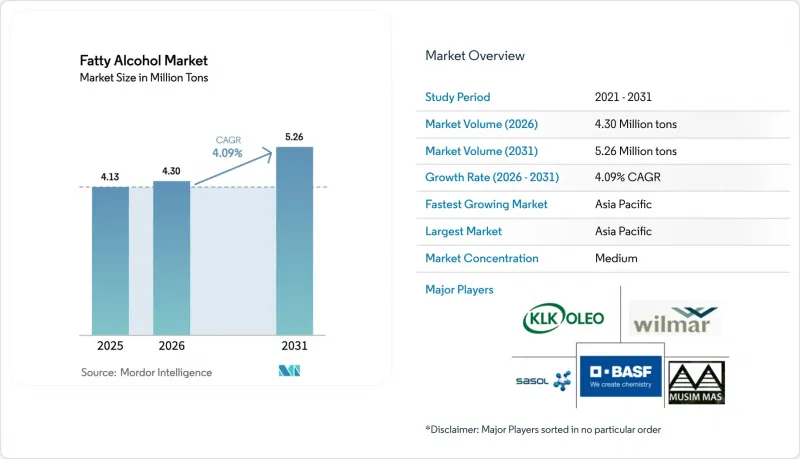
本報告按原料(天然來源、石油化學來源)、應用領域(界面活性劑、個人護理和化妝品、家用和工業清潔劑、潤滑劑和潤滑脂、塑膠添加劑、醫藥輔料等)以及地區(亞太地區、北美地區、歐洲地區、南美地區、中東和非洲地區)進行細分。市場預測以噸為單位。
全球脂醇類市場趨勢及洞察
日常消費品(FMCG) 產業對錶面活性劑的需求激增
到2024年,基於Fatty alcohol ethoxylated的非離子界面活性劑將佔全球界面活性劑使用量的40%,而大型快速消費品公司正在降低陰離子界面活性劑的比例,以提高其在硬水環境下的性能。寶潔公司的專利申請顯示,無硫酸鹽洗髮精中的脂醇類含量每瓶增加了高達20%。亞太地區是這一趨勢的核心,在可支配收入不斷成長的推動下,都市區人均清潔劑消費量已超過8公斤。生物界面活性劑大規模生產的緩慢步伐使得Fatty alcohol ethoxylated的價格保持在每噸1500美元以下,進一步增強了其成本優勢。東南亞製造商正在將棕櫚仁油提取流程後向整合整合到其生產流程中,以確保原料供應,但這項策略增加了其受到歐盟2024年生效的森林砍伐法規約束的風險。
轉向使用無硫酸鹽和低過敏性個人保健產品
2024年,受皮膚問題和社群媒體熱議的推動,無硫酸鹽個人保健產品的成長速度是傳統產品線的兩倍。這一趨勢帶動了對C16-C18醇(因其潤膚特性而備受青睞)和C12-C14醇(可用作溫和清潔基質中的助表面活性劑)的需求成長。儘管歐盟化妝品法規並未強制要求標註無硫酸鹽成分,但主動調整配方是品牌的風險管理策略。科萊恩以8.1億美元收購盧卡斯·邁耶化妝品公司(Lucas Meyer Cosmetics)表明,能夠支撐「清潔美容」標籤的特種成分組合正獲得溢價。這一趨勢正在蔓延至包括沐浴露和洗面乳在內的各個品類,預計在預測期內將使脂醇類的目標市場擴大約12-15%。
月桂酸油和乙烯原料價格波動
受聖嬰現象影響,印尼和馬來西亞的棕櫚仁油價格下跌,導致2025年3月年減75%,達到每噸2,063.59美元。原料成本佔天然醇生產成本的70%之多。 2024年全年,美國乙烷價格持續低於每加侖0.20美元,進一步拉大了美國齊格勒法製油廠與受布蘭特原油價格上漲影響的歐洲石腦油裂解裝置之間的成本差距。中國的煤製合成氣製程使得浙江嘉化不受月桂油和乙烯價格波動的影響,凸顯了區域成本差異。有限的避險選擇(僅30%的油脂化工企業鎖定棕櫚仁油價格)意味著利潤率每年波動幅度高達40%。
細分市場分析
儘管2025年76.91%的產量來自天然來源,但預計到2031年,石化路線的產量將以4.39%的複合年成長率超過脂醇類市場,這主要得益於美國乙烷價格低於每加侖0.20美元以及中國燃煤合成氣的經濟可行性。 Sasol公司明確銷售的合成級產品不受歐盟森林管理標準(EUDR)的約束,這一價值提案引起了關注森林砍伐相關審計的歐洲清潔劑製造商的共鳴。天然生產商正透過永續棕櫚油圓桌會議(RSPO)和可再生能源認證進行反擊,但在通用界面活性劑領域,價格優勢遠大於產地優勢。新的生物製造路線提供了第三條出路。BASF的二氧化碳製甲醇轉化先導計畫和延長石油的年產 15 萬噸FISCHER-TROPSCH法示範裝置都旨在使脂醇類生產與棕櫚油和化石衍生乙烯脫鉤,但它們的商業化取決於排碳權的經濟可行性。
在界面活性劑應用領域,天然脂醇類市場仍佔據主導地位。為了維持銷售量,東南亞企業正加大對特種應用領域的投資。潤膚劑級鯨蠟醇和硬脂醇的價格比C12-C14清潔劑級產品高出30%。同時,石化生產商也在尋求提高生產效率。美國墨西哥灣沿岸的生產設施使用廉價的頁岩乙烷作為原料,並利用沿岸地區的物流網路,儘管航程遙遠,但其向拉丁美洲供應產品的運輸成本卻低於馬來西亞出口商。
區域分析
亞太地區是脂醇類市場的核心,2025年產量佔全球的44.28%,預計2031年將維持5.09%的複合年成長率。中國擁有超過500萬噸/年的油脂化學品產能,浙江嘉化年產20萬噸煤合成氣的工廠具備與東南亞天然醇供應商相媲美的成本競爭力。延長石油的FISCHER-TROPSCH法先導工廠可以進一步分散原料風險,並保護中國生產商免受月桂酸油和乙烯價格波動的影響。印度不斷成長的需求是由消費主導的。儘管出口到65個國家,戈德瑞集團仍需要進口藥用級酒精,這凸顯了高品質等級酒精的供應缺口。日本和韓國仍然是技術出口國,花王集團的專有烷氧基化生產線被應用於高階個人保健產品。儘管東協供應商擁有巨大的生產能力,但由於來自中國和美國的合成原料運輸成本更低,他們仍面臨價格壓力。
到2025年,北美將佔全球產量的約五分之一。頁岩氣乙烷日均產量達到280萬桶,支撐了低於每百萬英熱單位3美元的原料價格,並鞏固了墨西哥灣沿岸齊格勒製程裝置的成本優勢。殼牌公司莫納卡裂解裝置的擴建加劇了美國東部乙烷的供需平衡,同時也提高了拉丁美洲出口的合成乙烷產能。美國環保署的潤滑油法規和無硫酸鹽個人保健產品的普及推動了乙烷市場的成長,但其成長落後於亞太地區。
到2025年,歐洲將佔據脂醇類消費的大部分佔有率。雖然清潔劑消費已趨於飽和,但特種應用領域預計將出現成長。BASF的生物甲醇工廠計畫於2027年運作,其目標市場是高純度細分市場,該市場因歐盟木材法規(EUDR)的限制,進口天然衍生產品面臨許多障礙。沙索的石化級產品由於能夠規避森林砍伐法規,因此找到了穩定的買家。北歐航運公司正主導船用潤滑油的轉型,這趨勢得益於IFF-Kemira在芬蘭對生物聚合物的1.3億歐元投資。
南美、中東和非洲對脂醇類的需求正在成長。巴西的生質柴油熱潮為加氫反應提供了甘油,但產能跟不上需求,導致脂醇類中間體的進口量增加。沙烏地阿拉伯正在利用沙烏地阿美公司以優惠條件供應的乙烷,而沙烏地阿拉伯基礎工業公司(SABIC)則將過剩的烯烴轉化為合成醇,出口到亞洲。撒哈拉以南非洲市場規模仍然較小,但沙索公司(Sasol)的區域企業發展正在滿足需求。
其他好處:
- Excel格式的市場預測(ME)表
- 3個月的分析師支持
目錄
第1章:引言
- 研究假設和市場定義
- 調查範圍
第2章:調查方法
第3章執行摘要
第4章 市場狀況
- 市場概覽
- 市場促進因素
- 快速消費品產業對錶面活性劑的需求激增
- 個人保健產品。
- 監管部門為實現可生物分解潤滑劑目標所做的努力
- 製藥業對脂醇類的需求不斷成長
- 市場限制因素
- 月桂油和乙烯等原物料價格的波動
- 東南亞天然酒精工廠產能過剩,對利潤率帶來壓力。
- CO2衍生烷烴催化水降級製程的技術挑戰。
- 價值鏈分析
- 波特五力模型
第5章 市場規模與成長預測
- 按原料
- 自然的
- 石油化工
- 透過使用
- 界面活性劑
- 個人護理化妝品
- 家庭和工業清潔
- 潤滑劑和潤滑脂
- 塑膠添加劑
- 藥用輔料
- 食品乳化劑
- 其他工業用途
- 按地區
- 亞太地區
- 中國
- 印度
- 日本
- 韓國
- 東南亞國協
- 其他亞太國家
- 北美洲
- 美國
- 加拿大
- 墨西哥
- 歐洲
- 德國
- 英國
- 法國
- 義大利
- 北歐國家
- 其他歐洲國家
- 南美洲
- 巴西
- 阿根廷
- 其他南美國家
- 中東和非洲
- 沙烏地阿拉伯
- 南非
- 其他中東和非洲國家
- 亞太地區
第6章 競爭情勢
- 市場集中度
- 策略趨勢
- 市佔率和排名分析
- 公司簡介
- Arkema
- BASF
- Croda International Plc
- Emery Oleochemicals
- Godrej Industries Limited
- IOI Oleochemical
- Kao Chemicals Europe, SLU
- KLK OLEO
- LG Chem
- Moeve
- Musim Mas
- Procter and Gamble
- PT Ecogreen Oleochemicals
- Sasol
- Shell
- VVF LLC
- Wilmar International Ltd.
- Zhejiang Jiahua Energy Chemical
第7章 市場機會與未來展望
According to Mordor Intelligence, the fatty alcohol market size was valued at 4.13 million tons in 2025 and is estimated to grow from 4.30 million tons in 2026 to reach 5.26 million tons by 2031, at a CAGR of 4.09% during the forecast period (2026-2031).
This report is Segmented by Source (Natural, Petrochemical), Application (Surfactants, Personal Care and Cosmetics, Household and Industrial Cleaning, Lubricants and Greases, Plastics Additives, Pharmaceutical Excipients, and More), and Geography (Asia-Pacific, North America, Europe, South America, and Middle East and Africa). Market Forecasts are Provided in Terms of Volume (tons).
Global Fatty Alcohol Market Trends and Insights
Surfactant Demand Boom in FMCG Sector
Nonionic surfactants built on fatty-alcohol ethoxylates represented 40% of global surfactant use in 2024, and FMCG majors are cutting anionic ratios to improve hard-water performance. Procter & Gamble's patent filings reveal sulfate-free shampoos that raise fatty-alcohol loading by up to 20% per bottle. Asia-Pacific is the epicenter; urban detergent consumption already stands above 8 kg per capita, driven by rising disposable income. Biosurfactant scale-up delays keep fatty-alcohol ethoxylates below USD 1,500 per ton, reinforcing their cost advantage. Southeast Asian producers are back-integrating into palm-kernel crushing to secure feedstock, but the strategy escalates exposure to EU deforestation rules that came into force in 2024.
Shift Toward Sulfate-Free and Milder Personal-Care Formulations
Sulfate-free personal-care products grew twice as fast as conventional lines in 2024, propelled by dermatological concerns and social-media amplification. The trend lifts demand for C16-C18 alcohols, valued for emolliency, and C12-C14 alcohols that co-surfact in mild cleansing bases. Although EU Cosmetics Regulation does not mandate sulfate-free claims, proactive reformulation has become brand risk management. Clariant's USD 810 million purchase of Lucas Meyer Cosmetics underscores premium multiples paid for specialty ingredient portfolios enabling "clean beauty" claims. Cross-category adoption extends to body washes and facial cleansers, expanding the fatty-alcohol addressable market by roughly 12-15% over the forecast horizon.
Volatile Lauric-Oil and Ethylene Feedstock Prices
Palm-kernel-oil prices surged 75% year-on-year to USD 2,063.59 per ton in March 2025 after El Nino trimmed yields in Indonesia and Malaysia, and feedstock represents up to 70% of natural-alcohol production cost. U.S. ethane stayed below USD 0.20 per gallon through 2024, sharpening cost gaps between American Ziegler plants and European naphtha crackers exposed to higher Brent prices. China's coal-to-syngas path shields Zhejiang Jiahua from both lauric oil and ethylene volatility, highlighting regional cost asymmetry. Limited hedging practices-only 30% of oleochemical firms lock in palm-kernel-oil prices-leave margins exposed to 40% intra-year swings.
Other drivers and restraints analyzed in the detailed report include:
- Regulatory Push for Biodegradable Lubricants
- Increasing Demand from Pharmaceutical Applications
- Over-Capacity in Southeast Asian Natural-Alcohol Plants
For complete list of drivers and restraints, kindly check the Table Of Contents.
Segment Analysis
Natural sources delivered 76.91% of the 2025 volume, but petrochemical routes are forecast to outpace the fatty alcohol market at a 4.39% CAGR through 2031 on the back of sub-USD 0.20-per-gallon U.S. ethane and coal-syngas economics in China. Sasol explicitly markets EUDR-exempt synthetic grades, a value proposition resonating with European detergent formulators wary of deforestation audits. Natural producers counter with RSPO and renewable-energy credentials, yet price overlooks provenance in commodity surfactant segments. Emerging bio-routes offer a third path: BASF's CO2-to-methanol pilot and Yanchang Petroleum's 150 ktpa Fischer-Tropsch demo each aim to decouple fatty-alcohol output from both palm oil and fossil ethylene, though commercialization hinges on carbon-credit economics.
Natural alcohols maintain dominance in the fatty alcohol market share for surfactant applications. To defend volume, Southeast Asian players are investing in specialty applications-emollient-grade cetyl and stearyl alcohols fetch 30% premiums over C12-C14 detergent grades. Petrochemical producers, meanwhile, chase efficiency gains; U.S. Gulf Coast sites leverage cheap shale-ethane feedstock and Gulf logistics to supply Latin America at a lower delivered cost than Malaysian exporters despite the longer voyage.
Complete Report Scope:
- By Source
- Natural
- Petrochemical
- By Application
- Surfactants
- Personal Care and Cosmetics
- Household and Industrial Cleaning
- Lubricants and Greases
- Plastics Additives
- Pharmaceutical Excipients
- Food Emulsifiers
- Other Industrial Uses
- By Geography
- Asia-Pacific
- China
- India
- Japan
- South Korea
- ASEAN Countries
- Rest of Asia-Pacific
- North America
- United States
- Canada
- Mexico
- Europe
- Germany
- United Kingdom
- France
- Italy
- Nordic Countries
- Rest of Europe
- South America
- Brazil
- Argentina
- Rest of South America
- Middle East and Africa
- Saudi Arabia
- South Africa
- Rest of Middle-East and Africa
- Asia-Pacific
Geography Analysis
Asia-Pacific owned 44.28% of the 2025 volume and is projected to post a 5.09% CAGR to 2031, making it the epicenter of the fatty alcohol market. China runs more than 5 million tpa of oleochemical capacity, with Zhejiang Jiahua's 200 ktpa coal-syngas plant achieving cost parity with Southeast Asian natural-alcohol providers. Yanchang Petroleum's Fischer-Tropsch pilot further diversifies feedstock risk, potentially insulating Chinese producers from lauric-oil and ethylene volatility. India's demand growth is consumption led; Godrej exports to 65 countries yet still imports pharma-grade alcohols, illustrating a quality-grade supply gap. Japan and South Korea remain technology exporters, with Kao's proprietary alkoxylation lines serving premium personal care. Despite massive capacity, ASEAN suppliers face price pressure as Chinese and U.S. synthetic feedstocks undercut landed costs.
North America contributed about one-fifth of global volume in 2025. Shale-driven ethane output averaging 2.8 mbpd underpins sub-USD 3 per MMBtu feedstock, cementing the cost advantage of Gulf Coast Ziegler plants. Shell's Monaca cracker expansion tightened Eastern U.S. ethane balances but also added synthetic capacity for export to Latin America. EPA lubricant mandates and sulfate-free personal-care adoption sustain growth, albeit below APAC rates.
Europe accounted for the significant consumption of fatty alcohol in 2025. While detergent consumption is saturated, specialty growth abounds; BASF's bio-methanol alcoholates unit slated for 2027 targets high-purity niches where EUDR compliance raises barriers for natural imports. Sasol's petrochemical grades find ready buyers because they circumvent deforestation rules. Nordic shipping lines lead marine lubricant conversion, aided by IFF-Kemira's EUR 130 million Finnish biopolymer investment.
South America and the Middle East-Africa are witnessing rising demand for fatty alcohols. Brazil's biodiesel boom supplies glycerine streams for hydrogenation, yet capacity lags demand, prompting imports of fatty-alcohol intermediates. Saudi Arabia leverages advantaged ethane from Aramco, with SABIC funneling surplus olefins into synthetic alcohols for Asian export. Sub-Saharan Africa remains small but is served by Sasol's regional footprint.
- Arkema
- BASF
- Croda International Plc
- Emery Oleochemicals
- Godrej Industries Limited
- IOI Oleochemical
- Kao Chemicals Europe, S.L.U.
- KLK OLEO
- LG Chem
- Moeve
- Musim Mas
- Procter and Gamble
- PT Ecogreen Oleochemicals
- Sasol
- Shell
- VVF LLC
- Wilmar International Ltd.
- Zhejiang Jiahua Energy Chemical
Additional Benefits:
- The market estimate (ME) sheet in Excel format
- 3 months of analyst support
TABLE OF CONTENTS
1 Introduction
- 1.1 Study Assumptions and Market Definition
- 1.2 Scope of the Study
2 Research Methodology
3 Executive Summary
4 Market Landscape
- 4.1 Market Overview
- 4.2 Market Drivers
- 4.2.1 Surfactant demand boom in FMCG sector
- 4.2.2 Shift toward sulfate-free and milder personal-care formulations
- 4.2.3 Regulatory push for biodegradable lubricants
- 4.2.4 Increasing demand for fatty alcohol from pharmaceutical industry
- 4.3 Market Restraints
- 4.3.1 Volatile lauric-oil and ethylene feedstock prices
- 4.3.2 Over-capacity in SE-Asia natural alcohol plants squeezing margins
- 4.3.3 Technical hurdles in catalytic hydro-downgrading of CO2-derived alkanes
- 4.4 Value Chain Analysis
- 4.5 Porter's Five Forces
- 4.5.1 Threat of New Entrants
- 4.5.2 Bargaining Power of Buyers
- 4.5.3 Bargaining Power of Suppliers
- 4.5.4 Threat of Substitutes
- 4.5.5 Intensity of Competitive Rivalry
5 Market Size and Growth Forecasts (Volume)
- 5.1 By Source
- 5.1.1 Natural
- 5.1.2 Petrochemical
- 5.2 By Application
- 5.2.1 Surfactants
- 5.2.2 Personal Care and Cosmetics
- 5.2.3 Household and Industrial Cleaning
- 5.2.4 Lubricants and Greases
- 5.2.5 Plastics Additives
- 5.2.6 Pharmaceutical Excipients
- 5.2.7 Food Emulsifiers
- 5.2.8 Other Industrial Uses
- 5.3 By Geography
- 5.3.1 Asia-Pacific
- 5.3.1.1 China
- 5.3.1.2 India
- 5.3.1.3 Japan
- 5.3.1.4 South Korea
- 5.3.1.5 ASEAN Countries
- 5.3.1.6 Rest of Asia-Pacific
- 5.3.2 North America
- 5.3.2.1 United States
- 5.3.2.2 Canada
- 5.3.2.3 Mexico
- 5.3.3 Europe
- 5.3.3.1 Germany
- 5.3.3.2 United Kingdom
- 5.3.3.3 France
- 5.3.3.4 Italy
- 5.3.3.5 Nordic Countries
- 5.3.3.6 Rest of Europe
- 5.3.4 South America
- 5.3.4.1 Brazil
- 5.3.4.2 Argentina
- 5.3.4.3 Rest of South America
- 5.3.5 Middle East and Africa
- 5.3.5.1 Saudi Arabia
- 5.3.5.2 South Africa
- 5.3.5.3 Rest of Middle-East and Africa
- 5.3.1 Asia-Pacific
6 Competitive Landscape
- 6.1 Market Concentration
- 6.2 Strategic Moves
- 6.3 Market Share(%)/Ranking Analysis
- 6.4 Company Profiles (includes Global level Overview, ... Recent Developments)
- 6.4.1 Arkema
- 6.4.2 BASF
- 6.4.3 Croda International Plc
- 6.4.4 Emery Oleochemicals
- 6.4.5 Godrej Industries Limited
- 6.4.6 IOI Oleochemical
- 6.4.7 Kao Chemicals Europe, S.L.U.
- 6.4.8 KLK OLEO
- 6.4.9 LG Chem
- 6.4.10 Moeve
- 6.4.11 Musim Mas
- 6.4.12 Procter and Gamble
- 6.4.13 PT Ecogreen Oleochemicals
- 6.4.14 Sasol
- 6.4.15 Shell
- 6.4.16 VVF LLC
- 6.4.17 Wilmar International Ltd.
- 6.4.18 Zhejiang Jiahua Energy Chemical
7 Market Opportunities and Future Outlook
- 7.1 White-space and Unmet-Need Assessment
- 7.2 C1-to-C6 bio-alcohol route commercialization (Formate and syngas fermentation)

 脂醇類市場-2026-2032年全球市場預測1. 癸醇市場-2026-2032年全球市場預測
 合成脂醇類市場分析及預測(至2035年):類型、產品、應用、技術、最終用戶、形態、製程、功能、材料類型、安裝類型
 全球脂醇類市場規模、佔有率、趨勢和成長分析報告(2026-2034年)
 脂醇類市場規模、佔有率及成長分析(按類型、應用和地區分類)-2026-2033年產業預測
 全球1-癸醇市場報告,2026年
 脂醇類市場-全球產業規模、佔有率、趨勢、機會及按類型、應用、地區和競爭格局分類的預測(2021-2031年)線性醇市場按類型、通路、應用和最終用途行業分類-2026年至2032年全球預測脂肪酒市場-全球產業規模、佔有率、趨勢、機會和預測,按產品類型、應用、地區和競爭細分,2020-2030 年
 全球脂肪醇市場需求,預測分析(2018-2034)