


 |
市場調查報告書
商品編碼
2124116
輪胎材料:市場佔有率分析、產業趨勢與統計、成長預測(2026-2031)Tire Material - Market Share Analysis, Industry Trends & Statistics, Growth Forecasts (2026 - 2031) |
||||||

※ 本網頁內容可能與最新版本有所差異。詳細情況請與我們聯繫。
根據 Mordor Intelligence 預測,輪胎材料市場將從 2025 年的 141 萬噸成長到 2026 年的 152 萬噸,然後在 2031 年達到 225 萬噸,2026 年至 2031 年的複合年成長率為 8.13%。
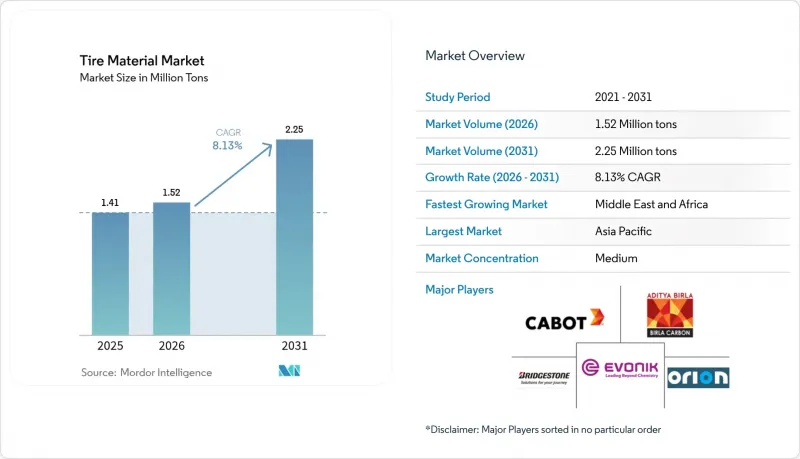
本報告按材料類型(彈性體、增強填料、塑化劑、化學品、金屬增強材料、纖維增強材料)、車輛類型(乘用車、輕型商用車、重型卡車、巴士)和地區(亞太地區、北美地區、歐洲地區、南美地區、中東和非洲地區)進行細分。市場預測以噸為單位。
全球輪胎材料市場趨勢及洞察
透過 OEM 過渡到低滾動阻力化合物
在歐盟,滾動阻力超過 6.5 kg/t 的輪胎將被處以罰款,美國的 CAFE 法規也採用了類似的閾值,因此富含二氧化矽的胎面已成為標準配置。大陸集團的「EcoContact 7」輪胎採用 18-22% 的沉澱二氧化矽和溶液型丁苯橡膠 (SBR),可將滾動阻力降低 15%,並將電動車的續航里程延長 3-4%。但這需要更長的硫化週期,並且每條輪胎的補償增加 1.50-2 美元,而原始設備製造商 (OEM) 必須承擔這些成本才能維持其承諾的性能指標。符合 ISO 28580 標準確保了所宣稱的性能提升能夠經受實驗室檢驗。因此,對二氧化矽的需求與電動車的普及趨勢同步成長,預計即使對炭黑的需求保持平穩,二氧化矽的銷量也將實現兩位數的成長。
電子商務的蓬勃發展導致更換輪胎的里程數不斷增加。
自2024年以來,最後一公里配送使輕型商用車的行駛里程增加了18%至25%,更換週期縮短至不到32,000公里。即使僅亞馬遜的全球貨車車隊,輪胎也每10至12個月更換一次,這種週期適用於富含炭黑且添加天然橡膠以增強抗撕裂強度的耐用輪胎配方。Bridgestone透過整合供應鏈、嵌入式感測器和分析功能,將車隊輪胎成本降低了8%至12%。由於替換輪胎的標籤規定較為寬鬆,輪胎配方製造商可以優先考慮輪胎的耐磨性而非效率,而不會引發監管方面的摩擦。隨著城市物流的成熟,這項因素正促使短期運輸量趨於穩定,尤其是在北美和歐洲。
歐盟即將禁止使用 PFAS,這將導致含氟添加劑的使用受到限制。
歐洲化學品管理局 (ECHA) 於 2025 年 1 月提案的一項提案呼籲在五年內逐步淘汰含氟聚合物加工助劑,但輪胎配方製造商依賴 0.1% 至 0.3% 的添加劑來降低高達 40% 的脫模力。Bridgestone警告稱,取消這些加工助劑將使配方黏度增加 15 至 20 MU,並使未硫化輪胎的保存期限減半,從而導致全部區域額外增加 5,000 萬至 8,000 萬歐元的營運資金需求。矽基替代品的成本是其兩到三倍,並且需要對硫化系統進行徹底的重新設計。歐盟的《化學品永續性戰略》指出,未來甚至可能取消必要用途的豁免,並敦促輪胎製造商現在就加快研發步伐。
細分市場分析
到2025年,彈性體將佔總量的42.94%,預計到2031年將以每年5.51%的速度成長。填料緊隨其後,其中炭黑仍佔填料總量的60%。同時,隨著原始設備製造商(OEM)對效率的追求,沉澱二氧化矽正經歷兩位數的成長。其餘部分包括塑化劑、化學品和金屬增強材料,主要得益於對符合REACH法規的石蠟油和用於徑向輸送帶的鋼絲的穩定需求。
從中長期來看,生物基塑化劑正在佔據一個利基但盈利豐厚的市場,而導電級碳奈米材料則為擁有分散技術專長的供應商開闢了新的收入來源。無氣輪胎設計從長遠來看會抑制彈性體用量的成長,但會推動對工程熱塑性塑膠和抗疲勞纖維的需求,這表明儘管每條輪胎的材料用量逐漸減少,但輪胎材料市場的整體需求可能會增加。
區域分析
亞太地區將持續保持主導地位,預計2025年將佔全球消費量的52.34%。中國從海南島人工林到山東省炭黑工廠的垂直整合生態系統,確保了平均前置作業時間在48小時以內。印度的生產連結獎勵計畫計畫(PLI)已投資12億美元用於國內橡膠混煉業務,並可根據出口量獲得關稅退稅。儘管產量較低,日本和韓國仍透過特種產品(例如溶液型丁苯橡膠和液態橡膠)維持高價。東協地區的橡膠生產基地因免徵原膠關稅和七年免稅期而不斷擴大,但物流瓶頸正在擠壓利潤空間。
北美市場的需求主要受高年行駛里程和以輕型卡車為主的車輛構成驅動。墨西哥工廠利用美墨加協定(USMCA)下的免稅政策以及40-50%的勞動成本降低,同時供應美國和南美市場。加拿大在雪地胎領域的研發成果也延伸至全球高矽含量全天候輪胎產品線。
歐洲是高階和超高性能市場的核心,在這些市場中,操控性能的提升比複合成本更為重要。中東和非洲雖然基數較小,但預計將呈現最快的成長速度,2026年至2031年的複合年成長率將達到5.88%,這主要得益於沙烏地阿拉伯道路建設帶來的卡車數量增加以及阿拉伯聯合大公國物流基礎設施的擴張。儘管巴西採取了進口保護措施、貨幣不穩定以及在地採購法規,南美洲在高階材料的應用方面仍然受到限制。
其他好處:
- Excel格式的市場預測(ME)表
- 3個月的分析師支持
目錄
第1章:引言
- 研究假設和市場定義
- 調查範圍
第2章:調查方法
第3章執行摘要
第4章 市場狀況
- 市場概覽
- 市場促進因素
- 透過 OEM 過渡到低滾動阻力化合物
- 電子商務的蓬勃發展導致更換輪胎的里程數不斷增加。
- 東南亞的再工業化正在推動當地新建輪胎工廠。
- 採用生物基塑化劑(例如大豆油)以滿足 VOC 法規要求。
- 對智慧輪胎的需求正在推動導電橡膠化合物的創新。
- 市場限制因素
- 歐盟即將禁止使用 PFAS,這將限制含氟添加劑的使用。
- 氣候相關的葉斑病正在加劇天然橡膠供應緊張。
- 無氣輪胎結構可減少每個車輪使用的材料量
- 價值鏈分析
- 波特五力模型
第5章 市場規模與成長預測
- 材料類型
- 彈性體
- 天然橡膠
- 合成橡膠
- 增強填料
- 炭黑
- 二氧化矽
- 塑化劑
- 石蠟基油
- 環烷油
- 芳香油
- 化學品
- 硫
- 氧化鋅
- 硬脂酸
- 金屬加固
- 鋼絲
- 輪胎邊緣線
- 纖維增強
- 尼龍
- 聚酯纖維
- 其他
- 彈性體
- 車輛類型
- 搭乘用車
- 輕型商用車(LCV)
- 大型卡車
- 公車
- 按地區
- 亞太地區
- 中國
- 日本
- 印度
- 韓國
- 東南亞國協
- 其他亞太國家
- 北美洲
- 美國
- 加拿大
- 墨西哥
- 歐洲
- 德國
- 英國
- 法國
- 義大利
- 西班牙
- 土耳其
- 北歐國家
- 俄羅斯
- 其他歐洲國家
- 南美洲
- 巴西
- 阿根廷
- 其他南美國家
- 中東和非洲
- 沙烏地阿拉伯
- 阿拉伯聯合大公國
- 南非
- 其他中東和非洲國家
- 亞太地區
第6章 競爭情勢
- 市場集中度
- 策略趨勢
- 市佔率和排名分析
- 公司簡介
- Bekaert
- Birla Carbon
- Bridgestone Corporation
- Cabot Corporation
- Continental AG
- Evonik
- Exxon Mobil Corporation
- JSR Corporation
- Kuraray Co., Ltd.
- LANXESS
- Linglong Tire
- Michelin
- Orion
- Sailun Group Co., Ltd.
- Sumitomo Rubber Industries, Ltd.
- Umicore
- Zhongce Rubber Group Co., Ltd.
第7章 市場機會與未來展望
According to Mordor Intelligence, the tire material market size is expected to grow from 1.41 million tons in 2025 to 1.52 million tons in 2026 and is forecast to reach 2.25 million tons by 2031 at 8.13% CAGR over 2026-2031.
This report is Segmented by Material Type (Elastomers, Reinforcing Fillers, Plasticizers, Chemicals, Metal Reinforcements, and Textile Reinforcements), Vehicle Type (Passenger Cars, Light Commercial Vehicles, Heavy Trucks, and Buses), and Geography (Asia-Pacific, North America, Europe, South America, and Middle East and Africa). Market Forecasts are Provided in Volume (Tons).
Global Tire Material Market Trends and Insights
OEM Shift Toward Low-Rolling-Resistance Compounds
Silica-rich treads now feature in baseline specifications because the European Union penalizes rolling resistance above 6.5 kg/ton, and U.S. CAFE rules follow a comparable threshold. Continental's EcoContact 7 adopts 18-22% precipitated silica and solution SBR, lowering rolling resistance by 15% and extending electric-vehicle range by 3-4%. The trade-off involves longer cure cycles and a USD 1.50-2.00 uplift per tire, which costs OEMs to absorb to protect warranty metrics. Compliance with ISO 28580 assures that the claimed gains withstand laboratory scrutiny. As a result, silica demand tracks electric-vehicle adoption curves, locking in double-digit volume growth even as carbon-black volumes flatten.
Surge in E-Commerce Boosting Replacement-Tire Mileage
Last-mile delivery has pushed light-commercial-vehicle mileage up 18-25% since 2024, cutting replacement intervals below 32,000 km. Amazon's global van fleet alone cycles tires every 10-12 months, a cadence that favors high-durability carbon-black-rich compounds blended with natural rubber for tear strength. Bridgestone bundles supply, embedded sensors, and analytics, slicing fleet tire expense by 8-12%. Because replacement tires face laxer labeling rules, compounders privilege wear life over efficiency without regulatory friction. As urban logistics matures, this driver stabilizes near-term tonnage, especially in North America and Europe.
Looming EU PFAS Ban Limiting Fluorinated Additives
ECHA's January 2025 proposal would phase out fluoropolymer processing aids within five years, yet tire compounders rely on 0.1-0.3% loadings to cut mold-release force by up to 40%. Bridgestone warns that removing the aids lifts compound viscosity by 15-20 MU and halves green-tire shelf life, raising working-capital needs by EUR 50-80 million across the region. Substitutes based on silicone cost two to three times more and require entire cure-system redesigns. The EU Chemical Strategy for Sustainability hints that even essential-use exemptions could sunset, pressuring tire makers to accelerate research and development now.
Other drivers and restraints analyzed in the detailed report include:
- Re-Industrialization of Southeast Asia Creating New Local Tire Plants
- Bio-Based Plasticizers Adopted to Meet VOC Limits
- Climate-Linked Leaf-Fall Disease Squeezing Natural-Rubber Supply
For complete list of drivers and restraints, kindly check the Table Of Contents.
Segment Analysis
Elastomers held 42.94% of the 2025 volume and are set to grow at 5.51% through 2031. The fillers segment follows, with carbon black still owning 60% of filler tonnage, though precipitated silica earns double-digit growth as OEMs chase efficiency mandates. Plasticizers, chemicals, and metal reinforcements fill the balance, driven by REACH-compliant paraffinic oils and the steady need for steel cord in radial belts.
In the medium term, bio-based plasticizers enjoy niche yet lucrative traction, while conductive-grade carbon nanomaterials open a fresh revenue stream for suppliers with dispersion know-how. Airless designs temper long-run elastomer tonnage growth, but they lift demand for engineered thermoplastics and fatigue-resistant fibers, proving that overall tire material market demand can rise even as per-tire material intensity inches downward.
Complete Report Scope:
- By Material Type
- Elastomers
- Natural Rubber
- Synthetic Rubber
- Reinforcing Fillers
- Carbon Black
- Silica
- Plasticizers
- Paraffinic Oil
- Naphthenic Oil
- Aromatic Oil
- Chemicals
- Sulfur
- Zinc Oxide
- Stearic Acid
- Metal Reinforcements
- Steel Cord
- Bead Wire
- Textile Reinforcements
- Nylon
- Polyester
- Others
- Elastomers
- By Vehicle Type
- Passenger Cars
- Light Commercial Vehicles (LCV)
- Heavy Trucks
- Buses
- By Geography
- Asia-Pacific
- China
- Japan
- India
- South Korea
- ASEAN Countries
- Rest of Asia-Pacific
- North America
- United States
- Canada
- Mexico
- Europe
- Germany
- United Kingdom
- France
- Italy
- Spain
- Turkey
- NORDIC Countries
- Russia
- Rest of Europe
- South America
- Brazil
- Argentina
- Rest of South America
- Middle-East and Africa
- Saudi Arabia
- United Arab Emirates
- South Africa
- Rest of Middle-East and Africa
- Asia-Pacific
Geography Analysis
Asia-Pacific retains leadership with 52.34% of 2025 consumption. China's vertically integrated ecosystem, from Hainan plantations to Shandong carbon-black plants, keeps average lead times under 48 hours. India's PLI scheme channels USD 1.2 billion into domestic compounding, unlocking duty rebates on export volumes. Japan and South Korea, though smaller in tonnage, command premium prices through solution SBR and liquid rubber specialities. ASEAN hubs grow on the back of tariff-free raw rubber and seven-year tax holidays, though logistics bottlenecks shave margins.
North America's demand is driven by high annual mileage and a light-truck-heavy vehicle mix. Mexican plants exploit USMCA duty-free corridors and 40-50% labor savings to feed both U.S. and South American markets. Canada's snow-tire research and development spills over into high-silica all-season lines worldwide.
Europe anchors premium and ultra-high-performance segments where compound cost is secondary to handling gains. The Middle East and Africa, at a small base, is anticipated to grow with the fastest CAGR of 5.88% during 2026-2031 as Saudi roadbuilding and UAE logistics muscles expand truck fleets. South America remains import-protected yet currency-volatile, limiting upscale material adoption despite Brazil's local-content rules.
- Bekaert
- Birla Carbon
- Bridgestone Corporation
- Cabot Corporation
- Continental AG
- Evonik
- Exxon Mobil Corporation
- JSR Corporation
- Kuraray Co., Ltd.
- LANXESS
- Linglong Tire
- Michelin
- Orion
- Sailun Group Co., Ltd.
- Sumitomo Rubber Industries, Ltd.
- Umicore
- Zhongce Rubber Group Co., Ltd.
Additional Benefits:
- The market estimate (ME) sheet in Excel format
- 3 months of analyst support
TABLE OF CONTENTS
1 Introduction
- 1.1 Study Assumptions and Market Definition
- 1.2 Scope of the Study
2 Research Methodology
3 Executive Summary
4 Market Landscape
- 4.1 Market Overview
- 4.2 Market Drivers
- 4.2.1 OEM shift toward low-rolling-resistance compounds
- 4.2.2 Surge in e-commerce boosting replacement-tire mileage
- 4.2.3 Re-industrialisation of Southeast Asia creating new local tire plants
- 4.2.4 Bio-based plasticizers (e.g., soybean oil) adopted to meet VOC limits
- 4.2.5 Demand for smart tires driving conductive rubber compound innovation
- 4.3 Market Restraints
- 4.3.1 Looming EU PFAS ban limiting fluorinated additives
- 4.3.2 Climate-linked leaf-fall disease squeezing natural-rubber supply
- 4.3.3 Airless tire architectures reducing material volumes per wheel
- 4.4 Value Chain Analysis
- 4.5 Porter's Five Forces
- 4.5.1 Bargaining Power of Suppliers
- 4.5.2 Bargaining Power of Buyers
- 4.5.3 Threat of New Entrants
- 4.5.4 Threat of Substitute Products
- 4.5.5 Degree of Competition
5 Market Size and Growth Forecasts (Volume)
- 5.1 By Material Type
- 5.1.1 Elastomers
- 5.1.1.1 Natural Rubber
- 5.1.1.2 Synthetic Rubber
- 5.1.2 Reinforcing Fillers
- 5.1.2.1 Carbon Black
- 5.1.2.2 Silica
- 5.1.3 Plasticizers
- 5.1.3.1 Paraffinic Oil
- 5.1.3.2 Naphthenic Oil
- 5.1.3.3 Aromatic Oil
- 5.1.4 Chemicals
- 5.1.4.1 Sulfur
- 5.1.4.2 Zinc Oxide
- 5.1.4.3 Stearic Acid
- 5.1.5 Metal Reinforcements
- 5.1.5.1 Steel Cord
- 5.1.5.2 Bead Wire
- 5.1.6 Textile Reinforcements
- 5.1.6.1 Nylon
- 5.1.6.2 Polyester
- 5.1.6.3 Others
- 5.1.1 Elastomers
- 5.2 By Vehicle Type
- 5.2.1 Passenger Cars
- 5.2.2 Light Commercial Vehicles (LCV)
- 5.2.3 Heavy Trucks
- 5.2.4 Buses
- 5.3 By Geography
- 5.3.1 Asia-Pacific
- 5.3.1.1 China
- 5.3.1.2 Japan
- 5.3.1.3 India
- 5.3.1.4 South Korea
- 5.3.1.5 ASEAN Countries
- 5.3.1.6 Rest of Asia-Pacific
- 5.3.2 North America
- 5.3.2.1 United States
- 5.3.2.2 Canada
- 5.3.2.3 Mexico
- 5.3.3 Europe
- 5.3.3.1 Germany
- 5.3.3.2 United Kingdom
- 5.3.3.3 France
- 5.3.3.4 Italy
- 5.3.3.5 Spain
- 5.3.3.6 Turkey
- 5.3.3.7 NORDIC Countries
- 5.3.3.8 Russia
- 5.3.3.9 Rest of Europe
- 5.3.4 South America
- 5.3.4.1 Brazil
- 5.3.4.2 Argentina
- 5.3.4.3 Rest of South America
- 5.3.5 Middle-East and Africa
- 5.3.5.1 Saudi Arabia
- 5.3.5.2 United Arab Emirates
- 5.3.5.3 South Africa
- 5.3.5.4 Rest of Middle-East and Africa
- 5.3.1 Asia-Pacific
6 Competitive Landscape
- 6.1 Market Concentration
- 6.2 Strategic Moves
- 6.3 Market Share(%)/Ranking Analysis
- 6.4 Company Profiles (includes Global Overview, Market Overview, Core Segments, Financials, Strategic Information, Products and Services, Recent Developments)
- 6.4.1 Bekaert
- 6.4.2 Birla Carbon
- 6.4.3 Bridgestone Corporation
- 6.4.4 Cabot Corporation
- 6.4.5 Continental AG
- 6.4.6 Evonik
- 6.4.7 Exxon Mobil Corporation
- 6.4.8 JSR Corporation
- 6.4.9 Kuraray Co., Ltd.
- 6.4.10 LANXESS
- 6.4.11 Linglong Tire
- 6.4.12 Michelin
- 6.4.13 Orion
- 6.4.14 Sailun Group Co., Ltd.
- 6.4.15 Sumitomo Rubber Industries, Ltd.
- 6.4.16 Umicore
- 6.4.17 Zhongce Rubber Group Co., Ltd.
7 Market Opportunities and Future Outlook
- 7.1 White-space and Unmet-Need Assessment

 輪胎增強材料市場-2026-2032年全球市場預測輪胎材料市場:按結構類型、技術、車輛類型、材料、最終用戶和應用分類-2026-2032年全球市場預測
 輪胎增強材料市場報告:按產品類型、材料類型、輪胎類型、車輛類型、應用和地區分類(2026-2034 年)永續輪胎材料市場:按材料、車輛類型、輪胎類型、分銷管道和最終用途行業分類-2026-2032年全球市場預測
 永續輪胎技術市場-策略性洞察與預測(2026-2031年)
 輪胎增強材料:市場佔有率分析、產業趨勢與統計、成長預測(2026-2031)全球輪胎材料市場規模、佔有率、趨勢和成長分析報告(2026-2034年)
 2026年全球輪胎材料市場報告永續輪胎市場:按技術、結構、應用、車輛類型和分銷管道分類,全球預測(2026-2032年)
 輪胎材料市場規模、佔有率和成長分析(按車輛類型、類型、材料類型、輪胎類型和地區分類)-2026-2033年產業預測