


 |
市場調查報告書
商品編碼
2124101
導電塗層:市場佔有率分析、產業趨勢與統計、成長預測(2026-2031)Electrically Conductive Coating - Market Share Analysis, Industry Trends & Statistics, Growth Forecasts (2026 - 2031) |
||||||

※ 本網頁內容可能與最新版本有所差異。詳細情況請與我們聯繫。
根據 Mordor Intelligence 預測,導電塗料市場規模將從 2025 年的 246.7 億美元成長到 2026 年的 260.1 億美元,到 2031 年將達到 344.9 億美元,2026 年至 2031 年的複合年成長率為 5.81%預計。
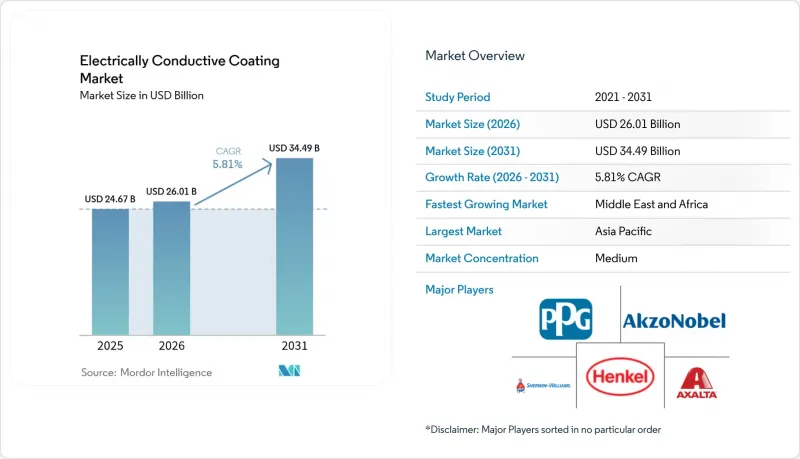
本報告按類型(丙烯酸樹脂、環氧樹脂、聚酯樹脂等)、導電填充材(銅、鋁等)、應用領域(電子、汽車、航太與國防、其他應用)以及地區(亞太地區、北美地區、歐洲地區、南美地區、中東和非洲)進行細分。市場預測以美元計價。
全球導電塗佈市場趨勢及洞察
增加防靜電用途
隨著閘極氧化層厚度向3奈米收窄,半導體晶圓廠正將靜電放電(ESD)閾值收緊至10伏特以下,這促使所有新建無塵室都採用導電地板和工作台塗層。預計到2025年,台灣和韓國的無塵室擴建將成長22%,這些無塵室將採用快速固化的丙烯酸塗層,每平方公尺的電荷耗散時間不到0.1秒。極紫外線(EUV)光刻技術的風險更大,因為一次靜電放電可能會損壞價值15萬美元的光阻。因此,晶圓廠現在要求表面電阻率達到10⁵–10⁹ Ω/m²。馬來西亞和越南的中小型契約製造正在採用水性化學品來滿足 ISO 14644 顆粒物濃度標準,同時又不違反揮發性有機化合物 (VOC) 法規。預計到 2028 年,這一趨勢將推動年產量實現中等個位數的成長。這些因素綜合起來意味著,抗靜電塗層不僅是一種可選的升級,而且正成為一項強制性要求。
來自電氣和電子行業的需求不斷成長
預計到2025年,全球印刷基板(PCB)產量將超過8.2億平方米,其中約35%的面積塗覆導電塗層,用於高速佈線接地。目前,主流智慧型手機整合了18層或更多層電路板,每一層都需要進行過孔填充和選擇性塗層處理,以抑制電磁干擾(EMI)。 5G設備天線數量的翻倍使得在彎曲焊點處保持導電性成為必要,這推動了中國、韓國和日本市場對三防膠的需求。顯示器製造商正在將觸控感測器整合到OLED堆疊結構中,奈米銀線)。預計到2029年,這種結構性轉變將使導電塗層需求每年增加1.2億平方公尺。
重金屬填料的毒性與環境問題
RoHS指令將電子設備中鎘含量限制在100 ppm以內,鉛含量限制在1000 ppm以內,這迫使傳統塗層重組,因為這些塗層先前依賴氧化鎘來增強耐腐蝕性。合規性測試的成本約為每件產品5萬美元,而航太和汽車業的認證項目所需時間可能會翻倍。奈米銀的REACH申請現在要求提交水生毒性數據。這是因為奈米銀對大型蚤(Daphnia magna)的LC50值低於10 µg/L,導致其被列為危險品,並受到更嚴格的運輸限制。中國的重金屬限制草案表明,類似的法規將在2027年前在亞太地區(APAC)訂定。雖然石墨烯和奈米碳管可以作為替代材料,但它們的製造成本比銀片高出30%至40%,這阻礙了它們的廣泛應用。
細分市場分析
由於丙烯酸塗料具有快速紫外線固化和與卷對卷PCB生產線相容的優點,預計到2025年,其在導電塗料市場仍將佔據34.28%的佔有率。同時,聚氨酯塗料預計將以6.22%的複合年成長率成長,超過整體導電塗料市場的成長速度,因為電動車電池組、汽車內飾和醫療穿戴式裝置等都需要能夠承受10萬次彎曲循環而不開裂的塗料。環氧樹脂仍然是暴露在150°C以上高溫環境下的航空電子設備的首選,而聚酯樹脂則在戶外通訊設備領域需求旺盛,因為在該領域,耐候性比極致導電性更為重要。
在溫度波動範圍為-40 度C至85 度C的電池管理系統中,聚氨酯的應用正在加速。在這樣的條件下,丙烯酸塗層會在500次循環內脫落。汽車製造商現在指定使用雙組分、室溫固化的胺甲酸乙酯,以降低烘箱能耗並縮短循環時間。作為回應,丙烯酸樹脂供應商正在使用混合化學結構,將聚氨酯寡聚物接枝到丙烯酸主鏈上,但這些混合樹脂犧牲了曾經賦予丙烯酸樹脂加工優勢的「30秒不黏手」特性。
區域分析
到2025年,亞太地區將佔全球銷售額的48.37%。這主要得益於深圳、蘇州和檳城垂直整合的叢集,這些集群匯集了塗料配製商、PCB製造商和最終組裝,並利用卡車運輸路線實現當日送達。光是在中國,2025年電動車產量就將達到900萬輛,導電塗料的消耗量也將達到18萬噸,主要得益於5G的積極部署。印度的生產連結獎勵計畫計畫(PLI)使國內電子產品產量增加了28%,本地產能從1.2萬噸擴大到1.8萬噸,導致塗料進口量增加。日本和韓國在生物相容性和耐熱環氧樹脂等高價值細分市場佔據主導地位,從而獲得了20-30%的價格溢價。東南亞國家正在吸引從中國轉移過來的組裝業務,但由於樹脂和填料生態系統發展不足,仍依賴進口。
北美對導電塗層的需求主要集中在汽車、航太和資料中心硬體領域。美國《通膨抑制法案》鼓勵在電池工廠附近生產塗層,預計到2027年,密西根州和喬治亞將有三家年產能總計2.5萬噸的工廠運作。加拿大是魁北克省航空電子設備特殊環氧樹脂需求的中心,而墨西哥由於近岸外包熱潮以及線束和醫療設備組裝製造商的擴張,電子產品產量增加了16%,但仍依賴進口塗層。
預計到2025年,歐洲將佔據顯著的市場佔有率,其中德國、法國和英國將引領汽車和工業領域的需求。嚴格的RoHS和REACH法規正在加速向銅和石墨烯的轉型,而不斷上漲的合規成本迫使小型供應商退出市場。歐盟電池法規強制要求容量超過2kWh的驅動電池必須配備電磁干擾屏蔽裝置,確保電動車生產線的持續需求。南美洲和中東及非洲地區佔總銷售額的9%。中東及非洲地區尤其成長迅速,複合年成長率高達5.98%,這主要得益於沙烏地阿拉伯和阿拉伯聯合大公國的資料中心建設,這些資料中心需要為高密度機架配備60 dB的屏蔽裝置。預計到2025年,巴西的靈活燃料汽車市場將消耗約4,500噸塗料,而阿根廷市場預計將因關稅和外匯波動而落後。
其他好處:
- Excel格式的市場預測(ME)表
- 3個月的分析師支持
目錄
第1章:引言
- 研究假設和市場定義
- 調查範圍
第2章:調查方法
第3章執行摘要
第4章 市場狀況
- 市場概覽
- 市場促進因素
- 對防靜電措施的需求日益成長。
- 來自電氣和電子行業的需求不斷成長
- 5G基礎設施中EMI/RFI屏蔽技術的應用正在迅速增加。
- 穿戴式電子設備的快速小型化
- 用於植入的導電生物相容性塗層
- 市場限制因素
- 重金屬填料的毒性與環境問題
- 白銀和銅價格波動
- 奈米填料分散問題導致缺陷
- 價值鏈分析
- 波特五力模型
第5章 市場規模與成長預測
- 按類型
- 丙烯酸纖維
- 環氧樹脂
- 聚酯纖維
- 聚氨酯
- 其他類型
- 導電填充材
- 銅
- 鋁
- 銀
- 其他材料類型
- 透過使用
- 電子與電機工程
- 車
- 航太/國防
- 其他用途
- 按地區
- 亞太地區
- 中國
- 印度
- 日本
- 韓國
- 馬來西亞
- 泰國
- 印尼
- 越南
- 其他亞太國家
- 北美洲
- 美國
- 加拿大
- 墨西哥
- 歐洲
- 德國
- 英國
- 法國
- 義大利
- 西班牙
- 俄羅斯
- 北歐國家
- 其他歐洲國家
- 南美洲
- 巴西
- 阿根廷
- 其他南美國家
- 中東和非洲
- 沙烏地阿拉伯
- 阿拉伯聯合大公國
- 埃及
- 南非
- 其他中東和非洲國家
- 亞太地區
第6章 競爭情勢
- 市場集中度
- 策略趨勢
- 市佔率和排名分析
- 公司簡介
- A & A Coatings
- Akzo Nobel NV
- Ameetuff Technical Paints Industries
- Axalta Coating Systems
- BeDimensional
- CAIG
- Creative Materials Inc.
- Cromas Paints
- Gelest Inc.
- Henkel AG & Co. KGaA
- Holland Shielding Systems BV
- MG Chemicals
- Parker-Hannifin Corporation
- PPG Industries Inc.
- RS Coatings
- Specialty Coating Systems Inc.
- The Sherwin-Williams Company
第7章 市場機會與未來展望
According to Mordor Intelligence, the electrically conductive coating market size is projected to grow from USD 24.67 billion in 2025 to USD 26.01 billion in 2026, and reach USD 34.49 billion by 2031, growing at a CAGR of 5.81% from 2026 to 2031.
This report is Segmented by Type (Acrylics, Epoxy, Polyesters, and More), Conductive Filler Material (Copper, Aluminum, and More), Application (Electronics and Electrical, Automotive, Aerospace and Defense, Other Applications), and Geography (Asia-Pacific, North America, Europe, South America, and Middle East and Africa). Market Forecasts are Provided in Terms of Value (USD).
Global Electrically Conductive Coating Market Trends and Insights
Rising Applications for Anti-Static Protection
Semiconductor fabs are tightening electrostatic-discharge thresholds below 10 V as gate oxides narrow toward 3 nm, pushing conductive floor and workbench coatings into all new cleanroom builds. Cleanroom additions in Taiwan and South Korea climbed 22% in 2025, with each square meter finished in fast-curing acrylic layers that dissipate charge within 0.1 seconds. Extreme-ultraviolet lithography magnifies risk because a single ESD event can destroy a USD 150,000 reticle; consequently, fabs now specify surface resistivity between 105 and 109 Ω/square. Smaller contract manufacturers in Malaysia and Vietnam are adopting water-based chemistries to meet ISO 14644 particulate limits without volatile-organic-compound penalties, a trajectory that supports mid-single-digit volume growth through 2028. Collectively, these forces are anchoring anti-static coatings as a baseline requirement rather than an optional upgrade.
Growing Demand from Electrical and Electronics Industry
Printed-circuit boards (PCBs) surpassed 820 million m2 of global output in 2025, with conductive coatings applied to roughly 35% of that area to ground high-speed traces. Flagship smartphones now integrate more than 18 layers, and each layer needs selective coatings for via fill and EMI suppression. As 5G handsets doubled antenna counts, conformal coatings that maintain conductivity across curved solder joints became mandatory, lifting demand in China, South Korea, and Japan. Display makers are embedding touch sensors into OLED stacks, displacing brittle indium tin oxide with silver-nanowire dispersions that better tolerate flexing. This architecture shift should add an incremental 120 million m2 of coating demand annually by 2029.
Toxicity and Environmental Concerns of Heavy-Metal Fillers
RoHS caps cadmium at 100 ppm and lead at 1,000 ppm in electronics, forcing reformulation of legacy coatings that once relied on cadmium oxide for corrosion resistance. Compliance testing adds about USD 50,000 per SKU and can double the qualification timetable for aerospace or automotive programs. REACH dossiers for nano-silver now require aquatic-toxicity data, as LC50 values below 10 µg/L for Daphnia magna triggered hazard classification and stricter transport rules. China's draft heavy-metal limits signal that similar rules will land in APAC by 2027. Although graphene and carbon nanotubes can substitute, their production costs run 30-40% above silver flakes, slowing broad adoption.
Other drivers and restraints analyzed in the detailed report include:
- Surge in Adoption of EMI/RFI Shielding in 5G Infrastructure
- Rapid Miniaturization in Wearable Electronics
- Volatility in Silver and Copper Prices
For complete list of drivers and restraints, kindly check the Table Of Contents.
Segment Analysis
Acrylics retained 34.28% share of the electrically conductive coating market in 2025, owing to fast UV curing and compatibility with roll-to-roll PCB lines. Polyurethanes, however, are projected to grow at a 6.22% CAGR, outpacing the overall electronically conductive coating market size growth because EV battery packs, automotive interiors, and health-wearables need coatings that endure 100,000 flex cycles without cracking. Epoxies remain the choice for high-heat avionics that see >=150 °C, while polyesters fill outdoor telecom niches where weatherability matters more than ultimate conductivity.
Polyurethane adoption is accelerating in battery-management systems that swing from -40 °C to 85 °C, conditions that delaminate acrylics within 500 cycles. Automakers now specify room-temperature-curing two-component urethanes, trimming oven energy costs and cutting takt time. Acrylic vendors are responding with hybrid chemistries that graft polyurethane oligomers onto acrylic backbones, but these blends sacrifice the 30-second tack-free cure that once gave acrylics a throughput edge.
Complete Report Scope:
- By Type
- Acrylics
- Epoxy
- Polyesters
- Polyurethanes
- Other Types
- By Conductive Filler Material
- Copper
- Aluminum
- Silver
- Other Material Types
- By Application
- Electronics and Electrical
- Automotive
- Aerospace and Defense
- Other Applications
- By Geography
- Asia-Pacific
- China
- India
- Japan
- South Korea
- Malaysia
- Thailand
- Indonesia
- Vietnam
- Rest of Asia-Pacific
- North America
- United States
- Canada
- Mexico
- Europe
- Germany
- United Kingdom
- France
- Italy
- Spain
- Russia
- NORDIC Countries
- Rest of Europe
- South America
- Brazil
- Argentina
- Rest of South America
- Middle-East and Africa
- Saudi Arabia
- United Arab Emirates
- Egypt
- South Africa
- Rest of Middle-East and Africa
- Asia-Pacific
Geography Analysis
Asia-Pacific controlled 48.37% of global revenue in 2025, underpinned by vertically integrated clusters in Shenzhen, Suzhou, and Penang, where coating formulators, PCB shops, and final assemblers operate within the same-day trucking lanes. China alone consumed 180,000 tons of conductive coatings in 2025 on the back of 9 million EVs produced and aggressive 5G roll-outs. India's Production-Linked Incentive scheme lifted domestic electronics output 28%, expanding coating imports as local capacity rose from 12,000 tons to 18,000 tons. Japan and South Korea dominate high-value niches such as biocompatible and high-temperature epoxies, commanding 20-30% price premiums. Southeast Asian nations are winning assembly work relocating from China, but resin and filler ecosystems lag, keeping them import-dependent.
North American electrically conductive coatings demand is concentrated in automotive, aerospace, and data-center hardware. The U.S. Inflation Reduction Act incentivizes coatings made near battery plants; three facilities totaling 25,000 tons/year will open by 2027 in Michigan and Georgia. Canada anchors specialty epoxy demand for avionics built in Quebec, while Mexico's nearshoring boom lifted electronics production 16% as wire-harness and medical-device assemblers expanded, albeit still reliant on imported coatings.
Europe captured significant market share in 2025, with Germany, France, and the U.K. driving automotive and industrial demand. Stringent RoHS and REACH rules are accelerating the pivot to copper and graphene while hiking compliance costs that push smaller suppliers to exit. The EU Battery Regulation mandates EMI shielding on traction batteries exceeding 2 kWh, locking in a recurring volume stream from electric-vehicle lines. South America and the Middle East and Africa share 9% of revenue; the latter is the fastest-growing region at 5.98% CAGR, powered by Saudi and UAE data-center builds that demand 60 dB shielding for high-density racks. Brazil's flex-fuel vehicles absorbed around 4,500 tons of coatings in 2025, but Argentina's market dragged due to tariffs and currency volatility.
- A & A Coatings
- Akzo Nobel NV
- Ameetuff Technical Paints Industries
- Axalta Coating Systems
- BeDimensional
- CAIG
- Creative Materials Inc.
- Cromas Paints
- Gelest Inc.
- Henkel AG & Co. KGaA
- Holland Shielding Systems BV
- MG Chemicals
- Parker-Hannifin Corporation
- PPG Industries Inc.
- RS Coatings
- Specialty Coating Systems Inc.
- The Sherwin-Williams Company
Additional Benefits:
- The market estimate (ME) sheet in Excel format
- 3 months of analyst support
TABLE OF CONTENTS
1 Introduction
- 1.1 Study Assumptions and Market Definition
- 1.2 Scope of the Study
2 Research Methodology
3 Executive Summary
4 Market Landscape
- 4.1 Market Overview
- 4.2 Market Drivers
- 4.2.1 Rising applications for anti-static protection
- 4.2.2 Growing demand from electrical and electronics industry
- 4.2.3 Surge in adoption of EMI/RFI shielding in 5G infrastructure
- 4.2.4 Rapid miniaturization in wearable electronics
- 4.2.5 Conductive bio-compatible coatings for implants
- 4.3 Market Restraints
- 4.3.1 Toxicity and environmental concerns of heavy-metal fillers
- 4.3.2 Volatility in silver and copper prices
- 4.3.3 Dispersion issues of nano-fillers causing defects
- 4.4 Value Chain Analysis
- 4.5 Porter's Five Forces
- 4.5.1 Threat of New Entrants
- 4.5.2 Bargaining Power of Buyers
- 4.5.3 Bargaining Power of Suppliers
- 4.5.4 Threat of Substitute Products
- 4.5.5 Degree of Competition
5 Market Size and Growth Forecasts (Value)
- 5.1 By Type
- 5.1.1 Acrylics
- 5.1.2 Epoxy
- 5.1.3 Polyesters
- 5.1.4 Polyurethanes
- 5.1.5 Other Types
- 5.2 By Conductive Filler Material
- 5.2.1 Copper
- 5.2.2 Aluminum
- 5.2.3 Silver
- 5.2.4 Other Material Types
- 5.3 By Application
- 5.3.1 Electronics and Electrical
- 5.3.2 Automotive
- 5.3.3 Aerospace and Defense
- 5.3.4 Other Applications
- 5.4 By Geography
- 5.4.1 Asia-Pacific
- 5.4.1.1 China
- 5.4.1.2 India
- 5.4.1.3 Japan
- 5.4.1.4 South Korea
- 5.4.1.5 Malaysia
- 5.4.1.6 Thailand
- 5.4.1.7 Indonesia
- 5.4.1.8 Vietnam
- 5.4.1.9 Rest of Asia-Pacific
- 5.4.2 North America
- 5.4.2.1 United States
- 5.4.2.2 Canada
- 5.4.2.3 Mexico
- 5.4.3 Europe
- 5.4.3.1 Germany
- 5.4.3.2 United Kingdom
- 5.4.3.3 France
- 5.4.3.4 Italy
- 5.4.3.5 Spain
- 5.4.3.6 Russia
- 5.4.3.7 NORDIC Countries
- 5.4.3.8 Rest of Europe
- 5.4.4 South America
- 5.4.4.1 Brazil
- 5.4.4.2 Argentina
- 5.4.4.3 Rest of South America
- 5.4.5 Middle-East and Africa
- 5.4.5.1 Saudi Arabia
- 5.4.5.2 United Arab Emirates
- 5.4.5.3 Egypt
- 5.4.5.4 South Africa
- 5.4.5.5 Rest of Middle-East and Africa
- 5.4.1 Asia-Pacific
6 Competitive Landscape
- 6.1 Market Concentration
- 6.2 Strategic Moves
- 6.3 Market Share(%)/Ranking Analysis
- 6.4 Company Profiles (includes Global level Overview, Market level overview, Core Segments, Financials as available, Strategic Information, Products and Services, and Recent Developments)
- 6.4.1 A & A Coatings
- 6.4.2 Akzo Nobel NV
- 6.4.3 Ameetuff Technical Paints Industries
- 6.4.4 Axalta Coating Systems
- 6.4.5 BeDimensional
- 6.4.6 CAIG
- 6.4.7 Creative Materials Inc.
- 6.4.8 Cromas Paints
- 6.4.9 Gelest Inc.
- 6.4.10 Henkel AG & Co. KGaA
- 6.4.11 Holland Shielding Systems BV
- 6.4.12 MG Chemicals
- 6.4.13 Parker-Hannifin Corporation
- 6.4.14 PPG Industries Inc.
- 6.4.15 RS Coatings
- 6.4.16 Specialty Coating Systems Inc.
- 6.4.17 The Sherwin-Williams Company
7 Market Opportunities and Future Outlook
- 7.1 White-space and Unmet-Need Assessment


