


 |
市場調查報告書
商品編碼
2124089
編碼器:市場佔有率分析、行業趨勢和統計數據、成長預測(2026-2031 年)Encoder - Market Share Analysis, Industry Trends & Statistics, Growth Forecasts (2026 - 2031) |
||||||

※ 本網頁內容可能與最新版本有所差異。詳細情況請與我們聯繫。
據 Mordor Intelligence 稱,編碼器市場規模預計在 2026 年達到 38.5 億美元,高於 2025 年的 35.6 億美元,預計到 2031 年將達到 57.1 億美元。
預計 2026 年至 2031 年的複合年成長率為 8.21%。
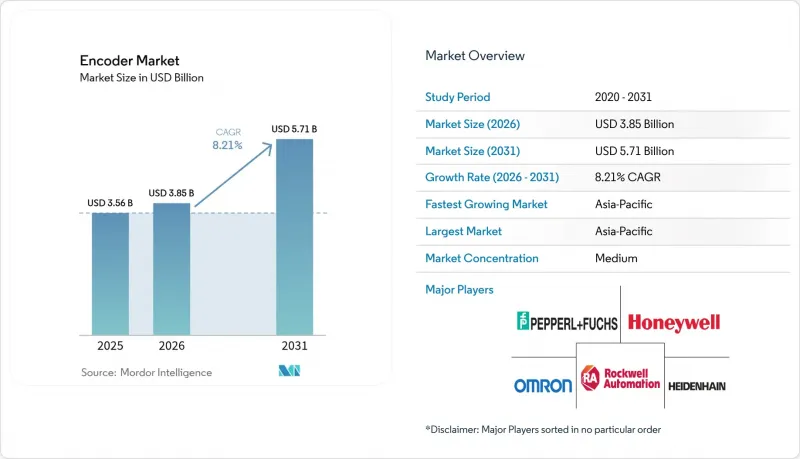
本報告按類型(旋轉式和線性式)、技術(光學、磁性等)、輸出訊號(增量式、絕對式)、終端用戶產業(汽車、電子等)和地區進行細分。市場預測以美元計價。
全球編碼器市場趨勢及洞察
歐盟引進協作機器人
隨著德國、法國和北歐國家工廠中協作機器人(cobot)的日益普及,亞微米級回饋對於確保人機互動安全至關重要。為了滿足力限制標準,原始設備製造商(OEM)現在要求編碼器的解析度達到 1 nm,系統精度達到 ±4 µm,從而使機器人能夠檢測到即使是最輕微的接觸並在毫秒內停止。像雷尼紹 RESOLUTE 系列這樣的高解析度絕對式光學編碼器符合這些標準,並支援高達 100 m/s 的速度,使自動化供應商能夠在不影響工人安全的前提下提高生產效率。因此,儘管銷量有所成長,但隨著符合 ISO/TS 15066 標準的系統應用範圍不斷擴大,編碼器市場的平均售價也在上漲。
中國的智慧包裝線
中國電子和製藥業的包裝公司正在運作線,其零件定位精度可達100奈米以內,每分鐘可處理數百個零件。振動、溫度波動和空氣中的顆粒物迫使生產線製造商要么採用帶有堅固機殼的光學光柵尺,要么過渡到電感式光柵尺,同時還要保持奈米級的精度。每個擴建項目通常都要求對多個軸進行回饋,因此該領域的成長顯著推動了編碼器的出貨量。地方政府對全自動化工廠的補貼降低了中型製造商的投資門檻,進一步擴大了需求。
東協多塵地區鋼鐵廠因光學污染造成的故障。
高爐爐內細小顆粒的沉積會干擾傳統碼盤的正常工作,導致定位突然失準和計劃外停機。目前,設備管理人員正轉向磁性或電感式感測技術,這些技術能夠應對異物干擾而不影響運作,這抑制了光學編碼器的替換需求,並略微放緩了重工業領域編碼器市場的銷售。
細分市場分析
2025年,旋轉編碼器佔據了編碼器市場收入的72.65%。這是因為幾乎所有伺服馬達和機器人關節都需要角度回饋。由於其龐大的用戶群體、廣泛的軸尺寸範圍以及與市售驅動器的直接兼容性,市場需求仍然強勁。同時,受半導體步進馬達、微影術平台和直驅工作台對無摩擦線性運動的需求推動,預計到2031年,線性編碼器的複合年成長率將達到7.28%。線性編碼器市場預計將從2025年的9.7366億美元成長到2031年的14.8億美元,主要得益於工具機製造商用氣浮軸承和磁浮台取代滾珠螺桿機構。積層製造的發展也推動了對能夠實現Z軸亞微米級封閉回路型控制的線性光柵尺的需求。
密封式設計(例如雷尼紹的“FORTiS”)的應用日益普及,減少了大量使用切削液的加工中心的停機時間。同時,超高真空型編碼器在極紫外光刻腔中也佔據了越來越大的市場佔有率。現有設備的維修支撐了對旋轉編碼器的需求,而新安裝的設備擴大採用雙感測器設計,將用於主軸位置的旋轉感測器與用於滑架運動的線性感測器相結合,從而在不蠶食任何子類別市場佔有率的情況下,提升了編碼器市場的整體出貨量。
2025年,光學編碼器仍維持51.85%的市場佔有率,這主要得益於晶圓步進機、座標測量機和高階協作機器人所需的1奈米解析度型號。隨著磁性編碼器在解析度方面縮小差距,到2031年,光學編碼器的市場佔有率可能會略有下降。磁性裝置由於其耐油霧、耐塵、耐溫差變化等特性,正以8.17%的複合年成長率快速成長,從而降低了鋼鐵、採礦和風力發電機應用領域的總體擁有成本。尼得科(Nidec)近期推出的無電池絕對式磁性編碼器無需超級電容和維護,進一步拓展了其應用範圍。
電容式和電感式編碼器平台各自佔據著明確的細分市場。電容式編碼器能夠抵抗磁振造影床和半導體離子布植等環境中的電磁干擾,而電感式編碼器由於其全封閉外殼,被廣泛應用於食品級和沖洗區域。供應商正在投資研發混合堆疊結構,該結構結合了光學碼條和磁性參考軌道,能夠在不犧牲奈米級重複性的前提下,適應較大的軸向偏差。這種融合將使編碼器市場的差異化重點從純粹的感測物理特性轉向韌體、診斷功能和連接性。
區域分析
預計亞太地區將成為全球最大的編碼器市場,到2025年將佔全球銷售額的35.25%,並在2031年之前維持9.45%的複合年成長率。由於中國政府對智慧工廠和化合物半導體製造廠的政策支持,編碼器訂單仍集中在沿海省份。在日本,每萬名工人擁有的機器人數量超過420台,對符合SIL認證且可安裝在傳統伺服設備空間內的回饋組件的需求仍然強勁。印度的生產連結獎勵計畫計畫(PLI)正在推動訂單的快速成長,編碼器訂單與該計畫資助的新型數控工具機(CNC)、印刷電路板(PCB)和醫療設備生產線掛鉤。因此,亞太地區的編碼器市場規模預計將從2025年的12.6億美元成長到2031年的21.6億美元。
到2025年,北美和歐洲合計將佔全球銷售額的約一半,這主要得益於航太、醫療機器人和精密加工產業的強勁成長。美國是臨床級產品需求的核心。強生醫療科技的OTTAVA™手術平台在每個機械臂中都整合了超微型光學編碼器,以確保亞毫米級的重複精度。德國和瑞士的供應商向全球出口高精度秤,即使生產正在向東轉移,也鞏固了歐洲作為創新中心的地位。歐盟對協作機器人應用的補貼正在推動奈米級反饋解決方案的收入成長,並推高全部區域的平均售價。
拉丁美洲和中東及非洲地區仍是服務不足的地區,但隨著現有工廠(棕地)對自動化輸送機、堆垛機和灌裝線進行維修,這些地區的編碼器市場正保持著穩定的個位數成長。巴西汽車組裝和墨西哥一級供應商正在為其馬達驅動器添加磁編碼器,作為更廣泛的「工業4.0」現代化改造的一部分。海灣國家的石油生產商正在指定使用高度耐環境的電感式和磁式編碼器,這些編碼器能夠承受125 度C的環境溫度,並獲得1類2區認證。這種不斷成長的需求正在使全球編碼器市場多元化,從而幫助供應商抵禦特定地區週期性經濟放緩的影響。
其他好處:
- Excel格式的市場預測(ME)表
- 3個月的分析師支持
目錄
第1章:引言
- 研究假設和市場定義
- 調查範圍
第2章:調查方法
第3章執行摘要
第4章 市場狀況
- 市場概覽
- 市場促進因素
- 歐盟協作機器人的普及推動了對高精度編碼器的需求。
- 中國的智慧包裝生產線需要亞微米解析度的編碼器。
- 日本流程工業功能安全(SIL 2/3)相關法規
- 在PLI的支援下,印度CNC工具機的成長正在推動對旋轉編碼器的需求。
- 美國醫療機器人領域OEM廠商轉向整合馬達編碼器模組的轉變。
- 市場限制因素
- 東協多塵地區鋼鐵廠因污染導致光學系統故障。
- 來自蘇州和深圳的低成本磁性積體電路編碼器正在拉低價格。
- 美國和歐盟實施的出口限制正在限制中國超精密光刻編碼器的供應。
- 監理展望
- 波特五力分析
第5章 市場規模與成長預測
- 按類型
- 旋轉式
- 線性
- 透過技術
- 光學
- 磁性
- 電容式
- 歸納法
- 其他技術
- 透過輸出訊號
- 增量
- 絕對值
- 按最終用戶行業分類
- 車
- 電子和半導體
- 產業
- 紡織品
- 印刷機
- 醫療器材
- 能源與電力
- 航太/國防
- 其他終端用戶產業
- 按地區
- 北美洲
- 美國
- 加拿大
- 墨西哥
- 南美洲
- 巴西
- 阿根廷
- 其他南美國家
- 歐洲
- 德國
- 英國
- 法國
- 義大利
- 西班牙
- 其他歐洲國家
- 亞太地區
- 中國
- 日本
- 韓國
- 印度
- 澳洲
- 紐西蘭
- 其他亞太國家
- 中東和非洲
- 阿拉伯聯合大公國
- 沙烏地阿拉伯
- 南非
- 其他中東和非洲國家
- 北美洲
第6章 競爭情勢
- 策略趨勢
- Vendor Positioning Analysis
- 公司簡介{包括全球概覽、市場概覽、主要業務板塊、財務資訊、策略資訊、產品和服務以及近期發展動態}
- Omron Corporation
- Dr. Johannes Heidenhain GmbH
- Honeywell International
- Rockwell Automation Inc.
- Pepperl+Fuchs SE
- Panasonic Holdings Corp.
- Baumer Holding AG
- Sensata Technologies(Hengstler and Dynapar)
- Renishaw plc
- SICK AG
- Maxon Group
- FAULHABER Drive Systems
- Allied Motion Technologies
- AMETEK(Haydon Kerk, Maurey)
- Canon Precision Inc.
- CUI Devices
- TE Connectivity
- Posital FRABA BV
- Tamagawa Seiki Co., Ltd.
第7章 市場機會與未來展望
According to Mordor Intelligence, the encoder market size in 2026 is estimated at USD 3.85 billion, growing from 2025 value of USD 3.56 billion with 2031 projections showing USD 5.71 billion, growing at 8.21% CAGR over 2026-2031.
This report is Segmented by Type (Rotary and Linear), Technology (Optical, Magnetic, and More), Output Signal (Incremental, Absolute), End-User Industry (Automotive, Electronics, and More), and Geography. The Market Forecasts are Provided in Terms of Value (USD).
Global Encoder Market Trends and Insights
EU adoption of collaborative robots
Wider use of cobots in German, French, and Nordic plants requires sub-micron feedback to guarantee safe human-robot interaction. OEMs now specify encoders with 1 nm resolution and +-4 µm system accuracy to meet force-limiting norms, enabling robots to detect the slightest contact and halt within milliseconds. High-resolution absolute optics such as Renishaw's RESOLUTE line meet these thresholds and support speeds up to 100 m/s, letting automation suppliers increase throughput without compromising worker protection. Broader deployment of ISO / TS 15066-compliant systems is therefore lifting average selling prices across the encoder market even as unit volumes climb .
China's smart packaging lines
Electronics and pharmaceutical packagers in China run lines that position parts at sub-100 nm tolerances while cycling hundreds of units per minute. Vibration, thermal fluctuation, and airborne particulates force line builders to blend optical scales with rugged housings or shift to inductive formats that still deliver nanometer-grade precision. Each expansion project typically specifies multiple axes of feedback, so growth in this vertical materially raises encoder shipments. Provincial subsidies for fully automated factories amplify demand by lowering capital hurdles for mid-tier manufacturers.
Optical contamination failures in dust-intensive ASEAN steel mills
Particulate fallout in blast-furnace bays obstructs traditional code discs, leading to sudden position loss and unscheduled outages. Facility managers now pivot toward magnetic or inductive sensing that tolerates debris without sacrificing uptime, curbing replacement demand for optical models and marginally slowing encoder market revenue in heavy-industry niches .
Other drivers and restraints analyzed in the detailed report include:
- Functional-safety (SIL 2/3) rules in Japanese process industries
- PLI-backed CNC machine-tool growth in India
- Suzhou & Shenzhen low-cost magnetic IC encoders driving price erosion
For complete list of drivers and restraints, kindly check the Table Of Contents.
Segment Analysis
Rotary devices generated 72.65% of encoder market revenue in 2025 as virtually every servo motor and robot joint needs angular feedback. Their entrenched base, wide shaft-size offerings, and direct compatibility with off-the-shelf drives keep demand buoyant. Linear encoders, however, post a 7.28% CAGR to 2031 as semiconductor steppers, lithography stages, and direct-drive tables prioritise friction-free translation. The encoder market size for linear solutions is set to climb from USD 973.66 million in 2025 to USD 1.48 billion in 2031, propelled by machine-tool builders replacing ball-screw rigs with air-bearing or magnetic levitation slides. Growth in additive manufacturing also favours linear scales that provide closed-loop z-axis control at sub-micron granularity.
Emerging use of enclosed designs such as Renishaw's FORTiS reduces downtime in coolant-rich machining centres, while ultra-high-vacuum variants capture share in EUV lithography chambers. Although retrofits sustain rotary volumes, new-build capital equipment increasingly incorporates dual sensors-rotary for spindle position and linear for carriage motion raising overall encoder market shipments without cannibalising either sub-category.
Optical encoders retained 51.85% revenue in 2025, driven by 1 nm resolution models required in wafer steppers, coordinate-measuring machines, and high-end cobots. The encoder market share for optical units may slip marginally by 2031 as magnetic options cut the historical resolution gap. Magnetic devices expand at an 8.17% CAGR because they withstand oil mist, dust, and wide temperature swings, lowering total cost of ownership in steel, mining, and wind-turbine applications. Battery-free absolute magnetics recently launched by Nidec further widen use cases by eliminating supercapacitors and maintenance cycles .
Capacitive and inductive platforms occupy well-defined niches: capacitive encoders resist electromagnetic interference for MRI beds and semiconductor ion implanters, whereas inductive solutions thrive in food-grade or wash-down zones thanks to fully sealed housings. Suppliers devote R&D dollars to hybrid stacks that blend optical code strips with magnetic reference tracks, handling high axial misalignment without loss of nanometric repeatability. This convergence should keep encoder market differentiation centred on firmware, diagnostics, and connectivity rather than pure sensing physics.
Complete Report Scope:
- By Type
- Rotary
- Linear
- By Technology
- Optical
- Magnetic
- Capacitive
- Inductive
- Other Technologies
- By Output Signal
- Incremental
- Absolute
- By End-user Industry
- Automotive
- Electronics and Semiconductor
- Industrial
- Textile
- Printing Machinery
- Medical Devices
- Energy and Power
- Aerospace and Defense
- Other End-user Industries
- By Geography
- North America
- United States
- Canada
- Mexico
- South America
- Brazil
- Argentina
- Rest of South America
- Europe
- Germany
- United Kingdom
- France
- Italy
- Spain
- Rest of Europe
- Asia-Pacific
- China
- Japan
- South Korea
- India
- Australia
- New Zealand
- Rest of Asia-Pacific
- Middle East and Africa
- United Arab Emirates
- Saudi Arabia
- South Africa
- Rest of Middle East and Africa
- North America
Geography Analysis
Asia-Pacific led with 35.25% of global revenue in 2025 and sustains a 9.45% CAGR through 2031. Chinese policy backing for smart factories and compound-semiconductor fabs continues to funnel encoder orders into coastal provinces. Japan's installed robot base exceeds 420 units per 10,000 workers, keeping demand resilient for SIL-rated feedback components that fit legacy servo footprints. India's PLI tranche drives the fastest incremental gains, with encoder call-offs attaching to new CNC, PCB, and medical-device lines financed under the scheme. The encoder market size in Asia-Pacific therefore moves from USD 1.26 billion in 2025 toward USD 2.16 billion in 2031.
North America and Europe together represent roughly half of 2025 turnover, powered by aerospace, medical robotics, and precision machining. The United States anchors clinical-grade demand: Johnson & Johnson MedTech's OTTAVA(TM) surgical platform integrates ultra-compact optical encoders on every robotic arm to secure sub-millimetre repeatability. German and Swiss suppliers export high-accuracy scales worldwide, cementing Europe's role as an innovation hub even as unit volumes migrate East. EU subsidies for collaborative-robot deployment channel revenue toward 1 nm-class feedback solutions, lifting average selling price across the region.
Latin America and the Middle East & Africa remain smaller contributor regions yet post steady single-digit growth as brownfield plants retrofit automated conveyors, palletisers, and bottling lines. Brazilian auto assemblers and Mexican Tier-1 suppliers now add magnetic encoders to motor drives as part of broader Industry 4.0 overhauls. Gulf-state oil producers specify ruggedised inductive and magnetic designs rated to 125 °C ambient and certified for Class 1 Div 2 zones. This uptake diversifies the global encoder market and cushions suppliers against cyclical slowdowns in any one geography.
- Omron Corporation
- Dr. Johannes Heidenhain GmbH
- Honeywell International
- Rockwell Automation Inc.
- Pepperl+Fuchs SE
- Panasonic Holdings Corp.
- Baumer Holding AG
- Sensata Technologies (Hengstler and Dynapar)
- Renishaw plc
- SICK AG
- Maxon Group
- FAULHABER Drive Systems
- Allied Motion Technologies
- AMETEK (Haydon Kerk, Maurey)
- Canon Precision Inc.
- CUI Devices
- TE Connectivity
- Posital FRABA B.V.
- Tamagawa Seiki Co., Ltd.
Additional Benefits:
- The market estimate (ME) sheet in Excel format
- 3 months of analyst support
TABLE OF CONTENTS
1 INTRODUCTION
- 1.1 Study Assumptions and Market Definition
- 1.2 Scope of the Study
2 RESEARCH METHODOLOGY
3 EXECUTIVE SUMMARY
4 MARKET LANDSCAPE
- 4.1 Market Overview
- 4.2 Market Drivers
- 4.2.1 EU Adoption of Collaborative Robots Driving High-Precision Encoders
- 4.2.2 Chinas Smart Packaging Lines Requiring Sub-Micron Resolution Encoders
- 4.2.3 Functional-Safety (SIL 2/3) Regulations in Japanese Process Industries
- 4.2.4 PLI-Backed CNC Machine-Tool Growth in India Elevating Rotary Encoder Demand
- 4.2.5 OEM Migration to Integrated Motor-Encoder Modules in US Medical Robotics
- 4.3 Market Restraints
- 4.3.1 Optical Contamination Failures in Dust-Intensive ASEAN Steel Mills
- 4.3.2 Suzhou and Shenzhen Low-Cost Magnetic IC Encoders Driving Price Erosion
- 4.3.3 US-EU Export Controls Limiting Ultra-Precision Encoders for China Lithography
- 4.4 Regulatory Outlook
- 4.5 Porter's Five Forces Analysis
- 4.5.1 Bargaining Power of Suppliers
- 4.5.2 Bargaining Power of Buyers
- 4.5.3 Threat of New Entrants
- 4.5.4 Threat of Substitutes
- 4.5.5 Intensity of Competitive Rivalry
5 MARKET SIZE AND GROWTH FORECASTS (VALUE)
- 5.1 By Type
- 5.1.1 Rotary
- 5.1.2 Linear
- 5.2 By Technology
- 5.2.1 Optical
- 5.2.2 Magnetic
- 5.2.3 Capacitive
- 5.2.4 Inductive
- 5.2.5 Other Technologies
- 5.3 By Output Signal
- 5.3.1 Incremental
- 5.3.2 Absolute
- 5.4 By End-user Industry
- 5.4.1 Automotive
- 5.4.2 Electronics and Semiconductor
- 5.4.3 Industrial
- 5.4.4 Textile
- 5.4.5 Printing Machinery
- 5.4.6 Medical Devices
- 5.4.7 Energy and Power
- 5.4.8 Aerospace and Defense
- 5.4.9 Other End-user Industries
- 5.5 By Geography
- 5.5.1 North America
- 5.5.1.1 United States
- 5.5.1.2 Canada
- 5.5.1.3 Mexico
- 5.5.2 South America
- 5.5.2.1 Brazil
- 5.5.2.2 Argentina
- 5.5.2.3 Rest of South America
- 5.5.3 Europe
- 5.5.3.1 Germany
- 5.5.3.2 United Kingdom
- 5.5.3.3 France
- 5.5.3.4 Italy
- 5.5.3.5 Spain
- 5.5.3.6 Rest of Europe
- 5.5.4 Asia-Pacific
- 5.5.4.1 China
- 5.5.4.2 Japan
- 5.5.4.3 South Korea
- 5.5.4.4 India
- 5.5.4.5 Australia
- 5.5.4.6 New Zealand
- 5.5.4.7 Rest of Asia-Pacific
- 5.5.5 Middle East and Africa
- 5.5.5.1 United Arab Emirates
- 5.5.5.2 Saudi Arabia
- 5.5.5.3 South Africa
- 5.5.5.4 Rest of Middle East and Africa
- 5.5.1 North America
6 COMPETITIVE LANDSCAPE
- 6.1 Strategic Moves
- 6.2 Vendor Positioning Analysis
- 6.3 Company Profiles {includes Global-level Overview, Market-level Overview, Core Segments, Financials as available, Strategic Information, Products and Services, Recent Developments}
- 6.3.1 Omron Corporation
- 6.3.2 Dr. Johannes Heidenhain GmbH
- 6.3.3 Honeywell International
- 6.3.4 Rockwell Automation Inc.
- 6.3.5 Pepperl+Fuchs SE
- 6.3.6 Panasonic Holdings Corp.
- 6.3.7 Baumer Holding AG
- 6.3.8 Sensata Technologies (Hengstler and Dynapar)
- 6.3.9 Renishaw plc
- 6.3.10 SICK AG
- 6.3.11 Maxon Group
- 6.3.12 FAULHABER Drive Systems
- 6.3.13 Allied Motion Technologies
- 6.3.14 AMETEK (Haydon Kerk, Maurey)
- 6.3.15 Canon Precision Inc.
- 6.3.16 CUI Devices
- 6.3.17 TE Connectivity
- 6.3.18 Posital FRABA B.V.
- 6.3.19 Tamagawa Seiki Co., Ltd.
7 MARKET OPPORTUNITIES AND FUTURE OUTLOOK
- 7.1 White-space and Unmet-Need Assessment

 反射式編碼器市場規模、佔有率和成長分析:按產品類型、輸出類型、技術、應用、最終用戶和地區分類-2026-2033年產業預測
 編碼器市場:按類型、技術、訊號類型、產出類型、應用、最終用途和分銷管道分類-2026-2032年全球市場預測
 全球角度編碼器市場:機會與策略展望(至2035年)
 編碼器市場分析及至2035年預測:類型、產品類型、技術、組件、應用、最終用戶、功能、安裝配置、解決方案
 SD碼率編碼器市場預測至2034年—按類型、編碼技術、應用、最終用戶和地區分類的全球分析
 磁軸編碼器市場報告:趨勢、預測和競爭分析(至2035年)
 編碼器市場報告:按類型、技術、訊號類型、產業和地區分類,2026-2034年
 全球磁性角度編碼器IC市場分析:產業佔有率、銷售預測與需求展望(2026-2032年)
 磁編碼器-2026年至2032年全球市佔率及排名、總收入及需求預測位置編碼晶片市場報告:趨勢、預測和競爭分析(至2035年)