

 |
市場調查報告書
商品編碼
2124088
中國辦公家具市場:市場佔有率分析、產業趨勢與統計及成長預測(2026-2031年)China Office Furniture - Market Share Analysis, Industry Trends & Statistics, Growth Forecasts (2026 - 2031) |
||||||

※ 本網頁內容可能與最新版本有所差異。詳細情況請與我們聯繫。
根據 Mordor Intelligence 的數據顯示,2025 年中國辦公家具市值為 360.2 億美元,預計到 2031 年將達到 518.7 億美元,而 2026 年為 382.7 億美元,預測期(2026-2031 年)的複合年成長率為 6.27%。
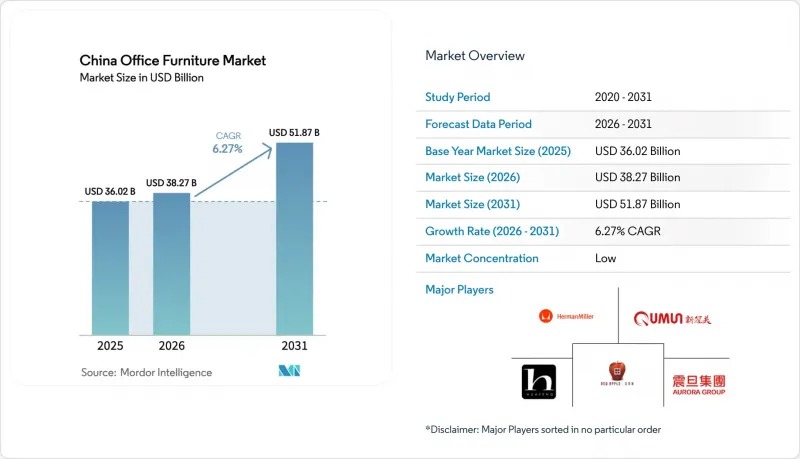
本報告按家具類型(椅子、桌子、儲物家具、書桌及其他家具)、分銷管道(B2B/廠商直銷、B2C/零售)和地區(華東、華北、東北、華中及其他地區)進行細分。市場預測以美元計價。
中國辦公家具市場趨勢與洞察
在辦公空間持續過剩的情況下,對辦公大樓整修「品質」的重視正在推動對高階室內設計的投資。
即使租賃市場正經歷一段調整期,企業建築業主和租戶仍在投資更高品質的配套設施和環保室內設計,以確保入住率並支持混合辦公模式。目前,採購流程優先考慮那些能夠兼顧產品碳排放透明度和提升員工福祉的解決方案,這些方案需符合專案認證目標,例如符合WELL標準的室內設計和低VOC(揮發性有機化合物)塗料。公共部門的需求也在推動這一趨勢,政府採購負責人會根據國家行動計畫做出決策,這些計畫建議在競標中使用環保建材和認證產品。能夠提供產品全生命週期影響證明並滿足基於最新綠色產品評估標準的更嚴格測試指標的供應商,將更有資格參與專案。在此背景下,中國辦公家具市場對那些從一開始就展現出卓越功能性並能在整個生命週期內降低環境影響的產品越來越感興趣,這使得在重新協商租金時更容易獲得高階室內設計的預算。
隨著混合辦公模式將辦公室重新定義為中央商務區高層建築以外的形式,人體工學的投資正在激增。
許多買家將符合人體工學的座椅和高度可調節的辦公桌視為積極的健康管理工具,有助於提高居家和辦公效率。健康調查和產業案例研究強調了久坐帶來的肌肉骨骼風險,促使企業和個人升級座椅、安裝扶手以及採用坐立兩用解決方案。智慧座椅正從概念階段走向商業性化,湧現出一些能夠測量姿勢和用戶生物特徵信息,並生成基於應用程式的指導和警報的智慧座椅。例如,在2025年廣州國際家具展(CIFF Guangzhou 2025)上,Sunon發表了一系列具備物聯網生物識別功能的動態座椅。據亞太地區品牌稱,採用回收材料並兼具高度可調節性的碳中和認證人體工學產品系列正獲得消費者的青睞,進一步加強了健康結果與永續發展績效之間的聯繫。
主要城市的高辦公大樓空置率和謹慎的租賃協議正在減緩新的室內裝修週期。
部分主要城市次級市場的租賃市場低迷,導致租戶重新協商合約條款、延長決策週期並縮小辦公空間。這減緩了新室內裝修的步伐,並推遲了原本會帶來大量辦公桌椅和儲物系統訂單的翻新項目。供應商正透過強調可直接用於維修的解決方案和經濟實惠的套餐來應對這一局面,但可選的升級項目可能仍會被推遲到預算後期。業主則專注於提供維修補貼和與服務品質掛鉤的獎勵以維持入住率,這在短期內限制了溢價的空間。在此背景下,中國辦公家具市場日益關注專案選擇和維繫現有客戶,同時等待需求復甦以支撐大規模的室內裝修。
細分市場分析
到2025年,座椅市場將佔中國辦公家具市場佔有率的29.24%,預計到2031年將以8.84%的複合年成長率成長,成為該細分市場中成長最快的領域,這主要得益於以健康為中心的人體工學設計和智慧功能。配備智慧功能和感測器的座椅已經走出了試點階段。例如,Unigamer於2023年在中國首次推出的商用人工智慧座椅BC03P,並非研究原型,而是面向大眾市場的量產產品,它們整合了壓力感測器和姿勢識別演算法。其檢驗已通過同行評審驗證。根據2025年進行的一項姿勢監測調查,智慧座椅的姿勢檢測準確率達到94.78%,97.59%的用戶在收到警報後3.27秒內糾正了姿勢,這證明了其具有可量化的人體工學效果,而不僅僅是經驗之談。與高度可調辦公桌系統相容的座椅擴大以套裝形式出現,以確保各種調節範圍和正確的身體姿勢,從而滿足不同工作需求。在中國辦公家具市場,能夠展現可衡量的環境效益的平台,例如透過生命週期評估(LCA)驗證的碳中和聲明,以及在座椅框架和部件中更多地使用回收材料,仍然備受青睞。
除了椅子之外,辦公桌椅也受益於混合辦公和模組化佈局的需求,這些佈局優先考慮在不進行大規模結構改造的情況下重新配置空間。現代辦公室內部普遍採用能夠快速實現個人和團隊協作模式切換的組件,以適應團隊規模的頻繁變化。在中國辦公家具市場,整合門禁和環境監測功能的儲物家具更受青睞,用於保護開放式辦公環境中的文件和設備。建構生態系統而非單一產品的供應商可以實現更長週期的交叉銷售,並在椅子、辦公桌和配件之間創造統一的體驗。在政府和監管部門的專案競標中,認證準備和排放氣體測試合規性如今已成為強制性要求,這迫使即使是入門級產品線也必須提升材料和飾面的品質。
其他好處:
- Excel格式的市場預測(ME)表
- 3個月的分析師支持
目錄
第1章:引言
- 研究假設和市場定義
- 調查範圍
第2章:調查方法
第3章執行摘要
第4章 市場狀況
- 市場概覽
- 市場促進因素
- 受避險情緒驅動,辦公大樓維修和室內裝修活動蓬勃發展。
- 對人體工學和員工健康的投資(升降辦公桌、顯示器支架)
- 全通路採購加速發展(京東/天貓、企業平台)
- 推出智慧/物聯網辦公家具
- 綠色產品認證和採購獎勵措施(中國綠色產品認證/生態標籤)
- 製造群能夠實現快速客製化和 DTC(直接面對消費者)規模化(安吉、佛山)。
- 市場限制因素
- 主要城市辦公大樓空置率高企,租金持續下降
- 原料成本波動和供應鏈中斷
- 貿易政策摩擦關稅風險影響出口需求
- 產業結構性限制因素(對原始設備製造商的依賴、設計和智慧財產權創新方面的限制)
- 產業價值鏈分析
- 波特五力模型
- 洞察最新市場趨勢與創新
- 洞察近期市場趨勢(新產品發布、策略性舉措、投資、合作、合資、業務擴張、併購等)
- 對辦公家具法律規範和行業標準的考慮。
第5章 市場規模與成長預測
- 按家具類型
- 座位
- 桌子
- 貯存
- 桌子
- 其他家具類型(辦公桌隔間、辦公沙發、書架、長凳、凳子等)
- 透過分銷管道
- B2B/廠商直銷
- B2C/零售
- 家居建材商店
- 專業家具店
- 線上
- 其他分銷管道
- 按地區
- 中國東部
- 中國北方
- 中國東北
- 華中地區
- 中國等地區
第6章 競爭情勢
- 市場集中度
- 策略趨勢
- 市佔率分析
- 公司簡介
- Sunon
- Dious
- Aurora(China)
- Lamex(KOKUYO Group)
- UE Furniture(Yongyi)
- Henglin Home Furnishings
- Loctek(LoctekMotion/FlexiSpot)
- Sihoo
- Sitzone(JE Group)
- Quama(Guanmei)
- Tiantan(BBMG)
- CJF(Changjiang Furniture)
- IKEA
- Okamura China
- KOKUYO(incl. Lamex brand)
- Steelcase(China operations)
- JEG/JE Group(international site)
- Burgeree(acoustic/office pods & panels)
- Mige/Meet &Co
- BOKE Furniture
第7章 市場機會與未來展望
According to Mordor Intelligence, the China office furniture market size was valued at USD 36.02 billion in 2025 and is estimated to grow from USD 38.27 billion in 2026 to reach USD 51.87 billion by 2031, at a CAGR of 6.27% during the forecast period (2026-2031).
This report is Segmented by Furniture Type (Seating, Tables, Storage, Desks, Other Furniture Type), Distribution Channel (B2B/Directly From Manufacturer, B2C/Retail), and Geography (East China, North China, Northeast China, Central China, Rest of China). Market Forecasts are Provided in Terms of Value (USD).
China Office Furniture Market Trends and Insights
Flight-to-Quality Office Upgrades Propel Premium Fit-Out Spend Despite Vacancy Overhang
Corporate landlords and tenants are investing in higher-quality amenities and greener fit-outs to secure occupancy and support hybrid work policies, even as leasing markets adjust. Procurement cycles now favor solutions that combine embodied carbon transparency and human-wellbeing benefits to align with project certification targets, including WELL-aligned interiors and low-VOC finishes. Public-sector demand reinforces this preference because agency buyers are guided by national action plans that promote green construction materials and certified products in tendering. Suppliers that can document life-cycle impacts and meet tighter testing indicators under updated green product evaluation standards improve their eligibility for projects. Within this backdrop, the China office furniture market shows growing interest in products that raise day-one functionality and lower lifetime environmental impact, which helps premium fit-outs defend budgets during rental renegotiations.
Ergonomic Investments Surge as Hybrid Work Redefines Office Beyond CBD Towers
A larger share of buyers views ergonomic seating and height-adjustable desks as preventive health tools that support productivity in both homes and corporate sites. Health research and industry case studies have spotlighted musculoskeletal risks from prolonged sitting, which is pushing organizations and individuals to upgrade chairs, monitor arms, and sit-stand solutions. Smart seating has moved from concept to commercial reality, with models that capture posture and user biometrics to generate app-based guidance and alerts. For instance, in product launches at CIFF Guangzhou 2025, Sunon showcased dynamic sitting lines with IoT biometrics. Brands active in Asia-Pacific report that carbon-neutral certified ergonomic lines that pair recycled materials with high adjustability are gaining customer preference, which reinforces the link between health outcomes and sustainability performance.
Tier-1 Office Vacancy and Cautious Leasing Slow New Fit-Out Cycles
Weak leasing conditions in select large-city submarkets encourage tenants to renegotiate terms, lengthen decision cycles, and downsize space. These behaviors reduce the pace of new buildouts and delay refreshes that would otherwise activate larger orders for desks, seating, and storage systems. Suppliers respond by emphasizing retrofit-ready solutions and value-engineered packages, but discretionary upgrades can still slip into later budget periods. Landlords focus on incentives tied to renovation allowances and service quality to preserve occupancy, which narrows the window for premium pricing in the near term. In this context, the China office furniture market relies more on project selectivity and account retention strategies while it waits for stronger demand signals to support full-scale fit-outs.
Other drivers and restraints analyzed in the detailed report include:
- Omnichannel Procurement Acceleration Elevates Access, Speed, and Brand Discovery
- Green Product Certification and Procurement Preference Reshape Buying Criteria
- Raw-Material Inflation and Trade Actions Pressure Margins for Export-Oriented Manufacturers
For complete list of drivers and restraints, kindly check the Table Of Contents.
Segment Analysis
Seating captured 29.24% of the China office furniture market share in 2025 and is set to expand at the segment's fastest 8.84% CAGR through 2031, supported by health-centric ergonomics and smart features. Smart and sensor-enabled seating has moved beyond pilot deployments. Commercially available AI-enabled chairs, such as Unigamer's BC03P smart chair, first launched in China in 2023, integrate pressure sensors and posture-recognition algorithms into mass-market SKUs rather than research prototypes. Performance validation is supported by peer-reviewed evidence: a 2025 posture-monitoring study found smart chairs achieved 94.78% posture detection accuracy, with 97.59% of users correcting posture within 3.27 seconds after alerts, demonstrating quantifiable ergonomic impact rather than anecdotal benefit. Height-adjustable desk ecosystems and compatible seating are co-specified more frequently to ensure full-range adjustability and correct body positioning across tasks. The China office furniture market continues to reward platforms that demonstrate measurable environmental gains, such as carbon-neutral claims supported by life-cycle assessments and increased use of recycled inputs in seating frames and components.
Beyond seating, desks and tables benefit from hybrid work and modular planning needs that emphasize space reconfiguration without major structural changes. Configurable elements that allow quick shifts from individual to collaborative modes are common in contemporary fit-outs and support frequent team resizing. The China office furniture market also favors storage that integrates access control and environment monitoring to safeguard documents and equipment in open-plan settings. Vendors that build ecosystems instead of standalone items can cross-sell over longer cycles and create unified experiences across chairs, desks, and accessories. Certification readiness and emissions testing compliance are now table stakes for project bids in government and regulated sectors, which pushes even entry-level lines to step up materials and finishes.
Complete Report Scope:
- By Furniture Type
- Seating
- Tables
- Storage
- Desks
- Other Furniture Type (Desk Divider, Office Sofas, Bookcases, Benches, Stools etc.)
- By Distribution Channel
- B2B/Directly from Manufacturer
- B2C/Retail
- Home Centers
- Specialty Furniture Stores
- Online
- Other Distribution Channel
- By Geography
- East China
- North China
- Northeast China
- Central China
- Rest of China
List of Companies Covered in this Report:
- Sunon
- Dious
- Aurora (China)
- Lamex (KOKUYO Group)
- UE Furniture (Yongyi)
- Henglin Home Furnishings
- Loctek (LoctekMotion/FlexiSpot)
- Sihoo
- Sitzone (JE Group)
- Quama (Guanmei)
- Tiantan (BBMG)
- CJF (Changjiang Furniture)
- IKEA
- Okamura China
- KOKUYO (incl. Lamex brand)
- Steelcase (China operations)
- JEG/JE Group (international site)
- Burgeree (acoustic/office pods & panels)
- Mige/Meet&Co
- BOKE Furniture
Additional Benefits:
- The market estimate (ME) sheet in Excel format
- 3 months of analyst support
TABLE OF CONTENTS
1 Introduction
- 1.1 Study Assumptions & Market Definition
- 1.2 Scope of the Study
2 Research Methodology
3 Executive Summary
4 Market Landscape
- 4.1 Market Overview
- 4.2 Market Drivers
- 4.2.1 Flight-to-quality office upgrades and fit-outs
- 4.2.2 Ergonomics and employee health investments (sit-stand desks, monitor arms)
- 4.2.3 Omnichannel procurement acceleration (JD/Tmall, enterprise platforms)
- 4.2.4 Smart/IoT-integrated office furniture adoption
- 4.2.5 Green product certification and procurement preference (China GP/eco-label)
- 4.2.6 Manufacturing clusters enable rapid customization and DTC scale (Anji, Foshan)
- 4.3 Market Restraints
- 4.3.1 High office vacancy and rent declines in Tier-1 cities
- 4.3.2 Raw-material cost volatility and supply chain shocks
- 4.3.3 Trade policy friction & tariff risk affecting export demand
- 4.3.4 Structural industry constraints (OEM dependence, limited design/IP innovation)
- 4.4 Industry Value Chain Analysis
- 4.5 Porters Five Forces
- 4.5.1 Threat of New Entrants
- 4.5.2 Bargaining Power of Suppliers
- 4.5.3 Bargaining Power of Buyers
- 4.5.4 Threat of Substitutes
- 4.5.5 Industry Rivalry
- 4.6 Insights into the Latest Trends and Innovations in the Market
- 4.7 Insights on Recent Developments (New Product Launches, Strategic Initiatives, Investments, Partnerships, JVs, Expansion, M&As, etc.) in the Market
- 4.8 Insights on Regulatory Framework and Industry Standards for Office Furniture
5 Market Size & Growth Forecasts (Value)
- 5.1 By Furniture Type
- 5.1.1 Seating
- 5.1.2 Tables
- 5.1.3 Storage
- 5.1.4 Desks
- 5.1.5 Other Furniture Type (Desk Divider, Office Sofas, Bookcases, Benches, Stools etc.)
- 5.2 By Distribution Channel
- 5.2.1 B2B/Directly from Manufacturer
- 5.2.2 B2C/Retail
- 5.2.2.1 Home Centers
- 5.2.2.2 Specialty Furniture Stores
- 5.2.2.3 Online
- 5.2.2.4 Other Distribution Channel
- 5.3 By Geography
- 5.3.1 East China
- 5.3.2 North China
- 5.3.3 Northeast China
- 5.3.4 Central China
- 5.3.5 Rest of China
6 Competitive Landscape
- 6.1 Market Concentration
- 6.2 Strategic Moves
- 6.3 Market Share Analysis
- 6.4 Company Profiles (includes Global level Overview, Market level overview, Core Segments, Financials as available, Strategic Information, Market Rank/Share for key companies, Products & Services, and Recent Developments)
- 6.4.1 Sunon
- 6.4.2 Dious
- 6.4.3 Aurora (China)
- 6.4.4 Lamex (KOKUYO Group)
- 6.4.5 UE Furniture (Yongyi)
- 6.4.6 Henglin Home Furnishings
- 6.4.7 Loctek (LoctekMotion/FlexiSpot)
- 6.4.8 Sihoo
- 6.4.9 Sitzone (JE Group)
- 6.4.10 Quama (Guanmei)
- 6.4.11 Tiantan (BBMG)
- 6.4.12 CJF (Changjiang Furniture)
- 6.4.13 IKEA
- 6.4.14 Okamura China
- 6.4.15 KOKUYO (incl. Lamex brand)
- 6.4.16 Steelcase (China operations)
- 6.4.17 JEG/JE Group (international site)
- 6.4.18 Burgeree (acoustic/office pods & panels)
- 6.4.19 Mige/Meet&Co
- 6.4.20 BOKE Furniture
7 Market Opportunities & Future Outlook
- 7.1 Green-certified, low-VOC lines for government/enterprise procurement
- 7.2 Modular pods/partitions and turnkey fit-out for flex and flight-to-quality

 家庭辦公家具市場預測至2034年-按產品類型、材料、價格範圍、通路、最終用戶和地區分類的全球分析
 歐洲辦公家具市場家庭辦公家具及配件市場預測至2034年-全球產品類型、材質、價格範圍、功能、通路、最終用戶及區域分析
 2026-2030年全球辦公家具市場
 辦公家具市場:依材料類型、產品類型、最終用戶、銷售管道和地區分類
 家庭辦公家具市場規模、佔有率和趨勢:按產品類型、材料類型、價格範圍、銷售管道和地區分類,並預測2026年至2034年
 全球家庭辦公家具市場規模、佔有率、趨勢和成長分析報告(2026-2034)辦公家具市場規模、佔有率、成長及全球產業分析:按類型、應用和地區分類,並預測至2026-2034年辦公家具市場規模、佔有率、趨勢及預測(按產品類型、材料類型、分銷管道、價格範圍和地區分類)(2026-2034 年)
 商業家具市場-全球產業規模、佔有率、趨勢、機會和預測:按類型、最終用途、分銷管道、地區和競爭格局分類,2021-2031年