


 |
市場調查報告書
商品編碼
2124079
衝擊改質劑:市場佔有率分析、產業趨勢與統計、成長預測(2026-2031)Impact Modifier - Market Share Analysis, Industry Trends & Statistics, Growth Forecasts (2026 - 2031) |
||||||

※ 本網頁內容可能與最新版本有所差異。詳細情況請與我們聯繫。
根據 Mordor Intelligence 預測,衝擊改質劑市場規模將從 2025 年的 46.1 億美元和 2026 年的 48.8 億美元成長到 2031 年的 66.3 億美元,2026 年至 2031 年的年複合成長率(CAGR)為 6.31%。
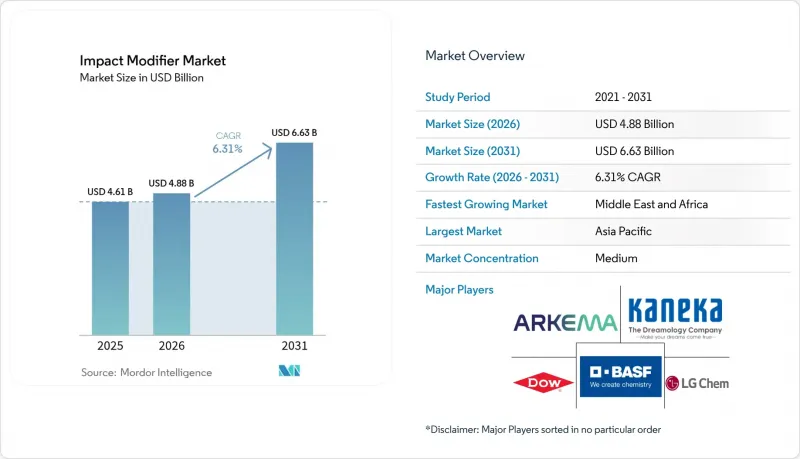
本報告按類型(丙烯腈-丁二烯-苯乙烯共聚物、丙烯酸酯類衝擊改質劑、丙烯腈-苯乙烯-丙烯酸酯共聚物等)、應用(聚氯乙烯、尼龍等)、終端用戶行業(包裝、建築、汽車等)和地區(亞太、北美、歐洲、南美、中東和非洲)進行細分。市場預測以美元計價。
全球衝擊衝擊改質劑市場趨勢及洞察
包裝需求不斷成長
全球電子商務產業對包裝在運輸過程中的耐用性提出了更嚴格的標準,預計到2025年,這將推動用於硬質翻蓋包裝盒和容器的抗衝擊樹脂的需求同比成長7.2%。丙烯酸樹脂能夠使透明PET托盤即使在反覆凍融循環後仍保持透明度。這種性能對於預計到2025年將成長22%的北美食材自煮包服務至關重要。 89個國家已實施可重複使用容器法規,這推動了對能夠承受75 度C下500次洗碗機洗滌循環的乙丙橡膠(EPDM)改質劑的需求。根據美國FDA 2025年食品接觸法規,殘留丙烯酸酯單體的含量限制在100億分之50以內,生產商被迫採用超臨界二氧化碳萃取方法,這將使每公斤的生產成本增加0.18美元。因此,擁有自有萃取系統的大型生產商正在失去市場佔有率,而無法承擔這筆額外成本的代工混合商則取而代之。
PVC管材型材臂
印度、印尼和越南的地方政府實施的計畫加速了從鍍鋅鐵管到PVC管的過渡。原因包括PVC管安裝成本更低(每米42美元,而球墨鑄鐵管為68美元)以及50年的使用壽命保證。預計到2025年,氯化聚乙烯(CPE)改質劑將佔壓力管市場佔有率的62%。這是因為其焊接強度可保持基體樹脂強度的85%以上,從而使接頭能夠通過2.5兆帕的ISO 13953水壓試驗。中國「十四五」規劃撥款4.8兆元(約6,700億美元)用於城市供水管網建設,預計到2025年,抗衝擊PVC的消耗量將達到78萬噸。在歐洲,到2025年,用於生產符合被動式房屋標準(0.8 W/m²K)的三層玻璃PVC窗型材的丙烯腈-苯乙烯-丙烯酸酯共聚物(ASA)的消耗量將達到29萬噸。根據歐盟建築產品法規,2024年實施的認證將使第三方檢測成本每公斤增加0.09歐元,但這部分額外成本對垂直整合的複合材料生產商有利,因為他們可以攤提這部分成本。
原物料價格波動
苯乙烯現貨價格從2025年1月的每噸950美元波動至9月的每噸1280美元,年內漲幅達35%,主要原因是亞洲裂解裝置的運作以及對衍生產品需求的下降。丁二烯價格在2025年第四季達到每噸1520美元,原因是美國墨西哥灣沿岸的裂解裝置更傾向於使用乙烷作為原料,而乙烷每噸乙烯的丁二烯產量比乙烯低40%。沒有長期單體合約的非一體化化合物生產商自行承擔了每公斤0.41美元的成本上漲,而下游PVC管材擠出商則將價格轉嫁率控制在3%以下,因為印度的公開競標將年度價格漲幅限制在通貨膨脹率之上1個百分點。佔全球產能38%的垂直一體化生產商透過內部消化原料價格波動,維持了利潤率並擴大了對競爭對手的領先優勢。
細分市場分析
預計到2025年,ABS將在衝擊衝擊改質劑衝擊改質劑市場佔據33.48%的佔有率,這主要得益於其在消費性電子產品機殼和汽車內部裝潢建材中兼具成本效益和高韌性的優勢。在該細分市場中,ABS貢獻了15.4億美元的市場規模,反映出其在不透明飾面和15 kJ/m²缺口衝擊強度(Izod衝擊強度)應用領域的廣泛認可。丙烯酸樹脂雖然規模較小,但由於市場對透明度的需求,其複合年成長率(CAGR)仍高達6.42%,尤其是在透明PVC窗框和PET翻蓋式容器產品中,即使在經過500小時的QUV紫外線照射後仍能保持良好的耐候性。預計到2025年,MBS將佔硬質PVC管材消費量的22%,但由於中國出口商提供的類似產品價格比歐洲同類產品低14%,MBS面臨價格壓力。
丙烯腈-苯乙烯-丙烯酸酯共聚物(ASA)的應用範圍正在擴展至戶外牆板和汽車外板領域,在這些領域,-30 度C下的抗衝擊性和紫外線耐久性是至關重要的因素。 CPE(聚氯乙烯)因其即使在2.5 MPa的靜水壓力下也能保持延展性,已在飲用水管道領域佔據了一席之地。 EPDM(三元乙丙橡膠)目前仍屬於小眾產品,但其耐洗碗機性能符合可重複使用容器的監管要求。 2025年推出的馬來酸酐接枝丙烯酸酯變體,可使PCR PVC(消費後再生聚氯乙烯)的韌性恢復至原始材料的92%,其價格比標準等級高出每公斤0.90美元。
區域分析
預計到2025年,亞太地區將佔全球衝擊改質劑市場佔有率的47.26%,並在2031年之前以6.35%的複合年成長率成長。光是中國就為「一帶一路」計劃生產了680萬噸PVC管材,而印度的低收入住宅計畫消耗了47萬噸抗衝擊衝擊改質劑PVC導管。在東南亞國協,預計2025年將鋪設1,2,400公里農村供水管道,其中越南和泰國的建設量主導。日本和韓國已提交47項與碳纖維相容改質劑相關的專利申請,目標是從2027年起應用於量產純電動車(BEV)的電池機殼。 GB 18581標準的嚴格規定迫使中國超過三分之一的改質劑企業安裝VOC氧化設備,導致大型綜合企業產能整合加劇。
隨著美國環保署 (EPA) 的燃油效率法規加速了從鋼鐵到聚合物的轉變,北美市場佔有率不斷擴大。加拿大飲用水系統的升級改造帶動了工程塑膠需求的成長;而在墨西哥,汽車產業180億美元的近岸外包熱潮也提振了需求。加州的「更安全的消費品」框架對苯乙烯添加劑提出了額外的測試要求,暫時推遲了硬質包裝材料的上市。
在歐洲,歐洲化學品管理局 (ECHA) 將於 2025 年禁止使用鄰苯二甲酸酯,而《包裝和包裝廢棄物法規》中規定的 30% PCR(再生塑膠)含量要求,正給利潤率帶來壓力。德國、法國和義大利共同承擔了該地區的大部分需求,這些需求主要集中在擠壓成型的窗型材上,這些型材必須符合「被動式房屋」0.8 W/m²K 的能源效率標準。
儘管南美洲最初的需求最低,但巴西780萬套住宅的缺口正在推動對聚氯乙烯(PVC)的需求,阿根廷的鋰產業也指定使用抗衝擊蒸發池襯裡。中東和非洲地區預計將成為複合年成長率最高的地區,因為沙烏地阿拉伯在其3.2兆美元的「2030願景」計畫中,指定使用抗衝擊改質聚合物建造150萬套住宅和8500公里道路。目前標準仍存在差異。沙烏地阿拉伯標準化組織(SASO)允許殘留苯乙烯含量最高為120毫克/公斤,而歐盟的限值為100毫克/公斤,這使得沿岸地區的生產商在非食品應用領域可以將價格定得比歐洲出口商低12%。
其他好處:
- Excel格式的市場預測(ME)表
- 3個月的分析師支持
目錄
第1章:引言
- 研究假設和市場定義
- 調查範圍
第2章:調查方法
第3章執行摘要
第4章 市場狀況
- 市場概覽
- 市場促進因素
- 包裝需求不斷成長
- PVC管材型材臂
- 亞太地區建築業主導樹脂的需求正在成長。
- 關注汽車輕量化與安全性
- 含有再生材料的塑膠需要使用相容劑和 IM(整合加工)相結合的方法。
- 市場限制因素
- 原物料價格波動(苯乙烯、丙烯酸酯)
- 加強VOC和PVC法規
- 高回收性樹脂流的加工挑戰
- 價值鏈分析
- 波特五力模型
第5章 市場規模及成長預測(以金額為準)
- 按類型
- 丙烯腈丁二烯苯乙烯(ABS)
- 丙烯酸衝擊改質劑(AIM)
- 丙烯腈苯乙烯丙烯酸酯(ASA)
- 甲基丙烯酸酯-丁二烯-苯乙烯(MBS)
- 乙丙橡膠(EPDM)
- 氯化聚乙烯(CPE)
- 其他類型
- 透過使用
- 聚氯乙烯(PVC)
- 尼龍
- 聚丁烯對苯二甲酸酯(PBT)
- 工程塑膠
- 其他用途
- 按最終用戶行業分類
- 包裝
- 建造
- 車
- 消費品
- 電氣和電子設備
- 其他終端用戶產業
- 按地區
- 亞太地區
- 中國
- 印度
- 日本
- 韓國
- 東南亞國協
- 其他亞太國家
- 北美洲
- 美國
- 加拿大
- 墨西哥
- 歐洲
- 德國
- 英國
- 法國
- 西班牙
- 義大利
- 俄羅斯
- 北歐國家
- 其他歐洲國家
- 南美洲
- 巴西
- 阿根廷
- 其他南美國家
- 中東和非洲
- 沙烏地阿拉伯
- 南非
- 其他中東和非洲國家
- 亞太地區
第6章 競爭情勢
- 市場集中度
- 策略趨勢
- 市佔率和排名分析
- 公司簡介
- Arkema
- BASF
- SI Group, Inc.
- Akdeniz Kimya
- CLARIANT
- Dow
- Evonik Industries
- Formosa Plastics Corporation
- INEOS Styrolution Group GmbH
- Kaneka Corporation
- LANXESS
- LG Chem
- Mitsubishi Chemical Corporation
- Shandong Novista Chemicals Co.,Ltd.
- Plastics Color Corporation
- Shandong Ruifeng Chemical Cp.Ltd
- SONGWON
- Sundow Polymers Co., Ltd.
- Wacker Chemie AG
第7章 市場機會與未來展望
According to Mordor Intelligence, the impact modifier market size is projected to expand from USD 4.61 billion in 2025 and USD 4.88 billion in 2026 to USD 6.63 billion by 2031, registering a CAGR of 6.31% between 2026 to 2031.
This report is Segmented by Type (Acrylonitrile Butadiene Styrene, Acrylic Impact Modifiers, Acrylonitrile Styrene Acrylate, and More), Application (Polyvinyl Chloride, Nylon, and More), End-User Industry (Packaging, Construction, Automotive, and More), and Geography (Asia-Pacific, North America, Europe, South America, and Middle and Africa). The Market Forecasts are Provided in Terms of Value (USD).
Global Impact Modifier Market Trends and Insights
Growing Packaging Demand
Global e-commerce has tightened package-drop durability standards, lifting impact-modified resin offtake for rigid clamshells and tubs by 7.2% year over year in 2025. Acrylic grades permit clear PET trays to retain transparency after repeated freeze-thaw cycles, a performance essential for North American meal-kit services that expanded 22% in 2025. Reusable-container legislation in 89 countries channels demand toward ethylene-propylene-diene-monomer (EPDM) modifiers that withstand 500 dish-washer cycles at 75°C. Food-contact rules published by the U.S. FDA in 2025 cap residual acrylate monomers at 50 parts per billion, prompting producers to adopt super-critical CO2 extraction that raises manufacturing cost by USD 0.18 per kilogram. Larger producers with in-house extraction systems are therefore capturing share from contract blenders unable to absorb the added expense.
PVC Pipe & Profile Boom
Municipal programs across India, Indonesia and Vietnam accelerated the switch from galvanized iron to PVC, citing installed costs of USD 42 per meter for PVC versus USD 68 for ductile iron and a 50-year service-life guarantee. Chlorinated polyethylene (CPE) modifiers captured 62% of the pressure-pipe segment in 2025 because they retain weld-line strength above 85% of base-resin values, enabling joints to pass ISO 13953 hydrostatic tests at 2.5 MPa. China's 14th Five-Year Plan earmarked CNY 4.8 trillion (USD 670 billion) for urban water networks, absorbing 780,000 metric tons of impact-modified PVC in 2025. In Europe, triple-glazed PVC window profiles satisfying the Passive House 0.8 W/m2K standard consumed 290,000 metric tons of acrylonitrile-styrene-acrylate (ASA) in 2025. Certification under the EU Construction Products Regulation 2024 lifted third-party testing expenditure by EUR 0.09 per kilogram, favoring vertically integrated compounders able to amortize the added cost.
Raw-Material Price Volatility
Styrene spot prices swung between USD 950 per metric ton in January 2025 and USD 1,280 in September, a 35% intra-year spread triggered by Asian cracker outages and derivative-demand dips. Butadiene touched USD 1,520 per metric ton in Q4 2025 as U.S. Gulf Coast crackers favored ethane feedstocks that yield 40% less butadiene per ton of ethylene. Non-integrated compounders lacking long-term monomer contracts absorbed USD 0.41 per kilogram cost upticks, yet downstream PVC-pipe extruders kept pass-through below 3% because public tenders in India cap annual escalation at inflation plus one point. Vertically integrated producers representing 38% of global capacity preserved margins by internalizing feedstock swings, widening the competitive gap.
Other drivers and restraints analyzed in the detailed report include:
- Construction-Led Resin Uptake in APAC
- Automotive Lightweighting & Safety Focus
- Tightening VOC & PVC Regulations
For complete list of drivers and restraints, kindly check the Table Of Contents.
Segment Analysis
ABS commanded 33.48% of the impact modifiers market in 2025 on the back of cost-effective toughness for appliance housings and automotive interiors. Within this segment, ABS contributed USD 1.54 billion to the impact modifiers market size, reflecting broad acceptance where opaque finishes and 15 kJ/m2 notched Izod impact strength are sufficient. Acrylic grades, though smaller, are growing at 6.42% CAGR because transparent PVC window profiles and PET clamshells demand weather-stable clarity after 500-hour QUV exposure. MBS occupied 22% of rigid-PVC pipe consumption in 2025 but faces price pressure as Chinese exporters undercut European equivalents by 14%.
Acrylonitrile-styrene-acrylate (ASA) expands for outdoor siding and automotive exterior panels where -30°C impact retention and UV durability are decisive. CPE secured a share owing to its ability to maintain ductility at 2.5 MPa hydrostatic stress for potable-water pipes. EPDM remains niche, yet its dishwasher-cycle endurance aligns with reusable-container mandates. Maleic-anhydride-grafted acrylic variants launched in 2025 now reclaim 92% of virgin toughness in PCR PVC, attracting a USD 0.90 per kilogram premium over standard grades.
Complete Report Scope:
- By Type
- Acrylonitrile Butadiene Styrene (ABS)
- Acrylic Impact Modifiers (AIM)
- Acrylonitrile Styrene Acrylate (ASA)
- Methacrylate-Butadiene- Styrene (MBS)
- Ethylene Propylene Diene Monomer (EPDM)
- Chlorinated Polyethylene (CPE)
- Other Types
- By Application
- Polyvinyl Chloride (PVC)
- Nylon
- Polybutylene Terephthalate (PBT)
- Engineering Plastics
- Other Applications
- By End-user Industry
- Packaging
- Construction
- Automotive
- Consumer Goods
- Electrical and Electronics
- Other End-user Industries
- By Geography
- Asia-Pacific
- China
- India
- Japan
- South Korea
- ASEAN Countries
- Rest of Asia-Pacific
- North America
- United States
- Canada
- Mexico
- Europe
- Germany
- United Kingdom
- France
- Spain
- Italy
- Russia
- NORDIC Countries
- Rest of Europe
- South America
- Brazil
- Argentina
- Rest of South America
- Middle-East and Africa
- Saudi Arabia
- South Africa
- Rest of Middle-East and Africa
- Asia-Pacific
Geography Analysis
Asia-Pacific controlled 47.26% of the impact modifiers market in 2025 and will compound at 6.35% through 2031. China alone produced 6.8 million metric tons of PVC pipes for Belt-and-Road projects, while India's affordable-housing scheme consumed 470,000 metric tons of impact-modified PVC conduit. ASEAN nations placed 12,400 kilometers of rural water pipelines in 2025, with Vietnam and Thailand leading installations. Japan and South Korea filed 47 patents for carbon-fiber-compatible modifiers targeting mass-production BEV battery enclosures from 2027. Regulatory tightening under GB 18581 forced over one-third of Chinese modifier plants to install VOC oxidizers, consolidating capacity among integrated majors.
North America's share expanded as the US EPA fuel-economy rule accelerated steel-to-polymer substitution. Canada upgraded potable-water systems, while Mexico's USD 18 billion automotive near-shoring boom widened engineering-plastic demand. California's Safer Consumer Products framework introduced additional testing layers for styrene-based additives, momentarily delaying rigid-packaging launches.
Europe faces margin pressure from ECHA's 2025 phthalate restrictions and the 30% PCR requirement under the Packaging and Packaging Waste Regulation. Germany, France and Italy jointly absorbed the majority of regional volumes, predominantly window-profile extrusion that must meet the Passive House 0.8 W/m2 K threshold.
South America represented the lowest demand, with Brazil's 7.8 million-unit housing shortfall fueling PVC uptake, and Argentina's lithium operations specifying impact-modified liners for evaporation ponds. The Middle East and Africa are forecast to post the quickest CAGR as Saudi Arabia's USD 3.2 trillion Vision 2030 pipeline specifies impact-modified polymers for 1.5 million homes and 8,500 kilometers of roads. Differential standards persist: SASO allows 120 mg/kg residual styrene versus the EU cap of 100 mg/kg, enabling Gulf producers to underprice European exporters by up to 12% for non-food applications.
- Arkema
- BASF
- SI Group, Inc.
- Akdeniz Kimya
- CLARIANT
- Dow
- Evonik Industries
- Formosa Plastics Corporation
- INEOS Styrolution Group GmbH
- Kaneka Corporation
- LANXESS
- LG Chem
- Mitsubishi Chemical Corporation
- Shandong Novista Chemicals Co.,Ltd.
- Plastics Color Corporation
- Shandong Ruifeng Chemical Cp.Ltd
- SONGWON
- Sundow Polymers Co., Ltd.
- Wacker Chemie AG
Additional Benefits:
- The market estimate (ME) sheet in Excel format
- 3 months of analyst support
TABLE OF CONTENTS
1 Introduction
- 1.1 Study Assumptions & Market Definition
- 1.2 Scope of the Study
2 Research Methodology
3 Executive Summary
4 Market Landscape
- 4.1 Market Overview
- 4.2 Market Drivers
- 4.2.1 Growing packaging demand
- 4.2.2 PVC pipe & profile boom
- 4.2.3 Construction-led resin uptake in APAC
- 4.2.4 Automotive lightweighting & safety focus
- 4.2.5 Recycled-content plastics need compatibilizer-IM hybrids
- 4.3 Market Restraints
- 4.3.1 Raw-material price volatility (styrene, acrylates)
- 4.3.2 Tightening VOC & PVC regulations
- 4.3.3 Processing issues with high-recycle resin streams
- 4.4 Value Chain Analysis
- 4.5 Porter's Five Forces
- 4.5.1 Bargaining Power of Suppliers
- 4.5.2 Bargaining Power of Buyers
- 4.5.3 Threat of New Entrants
- 4.5.4 Threat of Substitute Products
- 4.5.5 Degree of Competition
5 Market Size & Growth Forecasts (Value )
- 5.1 By Type
- 5.1.1 Acrylonitrile Butadiene Styrene (ABS)
- 5.1.2 Acrylic Impact Modifiers (AIM)
- 5.1.3 Acrylonitrile Styrene Acrylate (ASA)
- 5.1.4 Methacrylate-Butadiene- Styrene (MBS)
- 5.1.5 Ethylene Propylene Diene Monomer (EPDM)
- 5.1.6 Chlorinated Polyethylene (CPE)
- 5.1.7 Other Types
- 5.2 By Application
- 5.2.1 Polyvinyl Chloride (PVC)
- 5.2.2 Nylon
- 5.2.3 Polybutylene Terephthalate (PBT)
- 5.2.4 Engineering Plastics
- 5.2.5 Other Applications
- 5.3 By End-user Industry
- 5.3.1 Packaging
- 5.3.2 Construction
- 5.3.3 Automotive
- 5.3.4 Consumer Goods
- 5.3.5 Electrical and Electronics
- 5.3.6 Other End-user Industries
- 5.4 By Geography
- 5.4.1 Asia-Pacific
- 5.4.1.1 China
- 5.4.1.2 India
- 5.4.1.3 Japan
- 5.4.1.4 South Korea
- 5.4.1.5 ASEAN Countries
- 5.4.1.6 Rest of Asia-Pacific
- 5.4.2 North America
- 5.4.2.1 United States
- 5.4.2.2 Canada
- 5.4.2.3 Mexico
- 5.4.3 Europe
- 5.4.3.1 Germany
- 5.4.3.2 United Kingdom
- 5.4.3.3 France
- 5.4.3.4 Spain
- 5.4.3.5 Italy
- 5.4.3.6 Russia
- 5.4.3.7 NORDIC Countries
- 5.4.3.8 Rest of Europe
- 5.4.4 South America
- 5.4.4.1 Brazil
- 5.4.4.2 Argentina
- 5.4.4.3 Rest of South America
- 5.4.5 Middle-East and Africa
- 5.4.5.1 Saudi Arabia
- 5.4.5.2 South Africa
- 5.4.5.3 Rest of Middle-East and Africa
- 5.4.1 Asia-Pacific
6 Competitive Landscape
- 6.1 Market Concentration
- 6.2 Strategic Moves
- 6.3 Market Share(%)/Ranking Analysis
- 6.4 Company Profiles (includes Global level Overview, Market level overview, Core Segments, Financials as available, Strategic Information,Products & Services, and Recent Developments)
- 6.4.1 Arkema
- 6.4.2 BASF
- 6.4.3 SI Group, Inc.
- 6.4.4 Akdeniz Kimya
- 6.4.5 CLARIANT
- 6.4.6 Dow
- 6.4.7 Evonik Industries
- 6.4.8 Formosa Plastics Corporation
- 6.4.9 INEOS Styrolution Group GmbH
- 6.4.10 Kaneka Corporation
- 6.4.11 LANXESS
- 6.4.12 LG Chem
- 6.4.13 Mitsubishi Chemical Corporation
- 6.4.14 Shandong Novista Chemicals Co.,Ltd.
- 6.4.15 Plastics Color Corporation
- 6.4.16 Shandong Ruifeng Chemical Cp.Ltd
- 6.4.17 SONGWON
- 6.4.18 Sundow Polymers Co., Ltd.
- 6.4.19 Wacker Chemie AG
7 Market Opportunities & Future Outlook
- 7.1 White-space and Unmet-Need Assessment

 塑膠改質劑市場:按類型、產品類型、應用、最終用途、國家和地區分類-全球產業分析、市場規模、市場佔有率及2026年至2033年預測
 衝擊改質劑市場-2026-2032年全球市場預測
 衝擊改質劑市場規模、佔有率和成長分析:按類型、聚合物相容性、應用、形態、終端用戶產業、分銷管道和地區分類-2026-2033年產業預測
 衝擊改質劑市場分析及預測(至2035年):類型、產品類型、技術、成分、應用、形式、材料類型、最終用戶、功能
 2026年全球塑膠改質劑市場報告2026年全球衝擊改質劑市場報告特種改質劑市場:按應用產業、類型、聚合物類型、形態和添加方式分類-2026-2032年全球預測全球衝擊改質劑市場:按類型、應用、最終用戶和地區劃分 - 市場規模、行業趨勢、機會分析和預測(2025-2033 年)
 抗衝改質劑市場-全球產業規模、佔有率、趨勢、機會及預測(按類型、主體聚合物、最終用戶、地區及競爭情況分類,2020-2030 年預測)
 全球塑膠改質劑市場