


 |
市場調查報告書
商品編碼
2124078
碘:市場佔有率分析、行業趨勢和統計數據、成長預測(2026-2031 年)Iodine - Market Share Analysis, Industry Trends & Statistics, Growth Forecasts (2026 - 2031) |
||||||

※ 本網頁內容可能與最新版本有所差異。詳細情況請與我們聯繫。
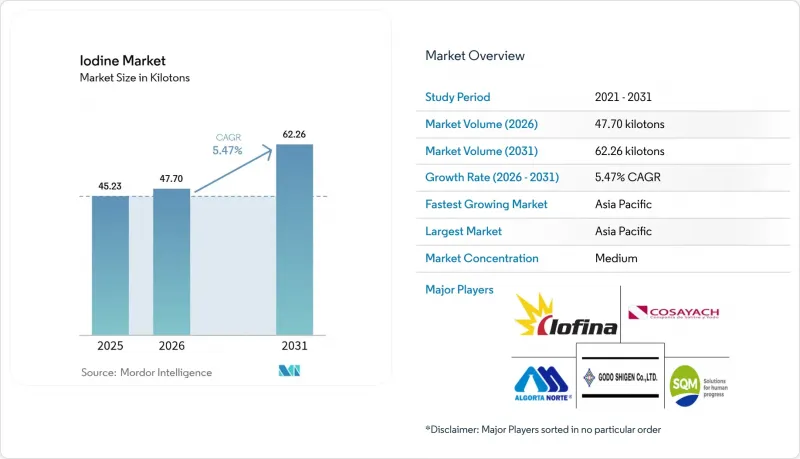
根據 Mordor Intelligence 預測,碘市場規模將從 2025 年的 45.23 千噸和 2026 年的 47.70 千噸成長到 2031 年的 62.26 千噸,2026 年至 2031 年的年複合成長率(CAGR)為 5.47%。
本報告按原料(卡利切礦石、地下鹵水、海藻、回收物)、形態(有機化合物、元素和同位素、無機鹽和錯合)、終端用戶產業(醫藥、動物飼料、除生物劑、氟化學品、尼龍等)以及地區(亞太、北美、歐洲、南美、中東和非洲)進行細分。市場預測以噸為單位。
全球碘市場趨勢及洞察
對X光/CT造影劑的需求增加
碘基造影劑每年用於約7500萬次診斷測試,在美國,約48%的電腦斷層掃描需要使用造影增強。為確保供應,GE醫療於2024年向其位於愛爾蘭科克的工廠投資3000萬美元,因為預計未來10年內全球造影劑的需求將翻倍。雖然光子計數CT技術每增加5 keV能量,每位患者的碘用量可減少約10%,但隨著篩檢計畫的擴展,絕對用量仍持續增加。 SQM透過與醫藥中間體生產商簽訂多年原料供應契約,以高價確保獲得醫用級產品,從而避免商品價格波動對其收入的影響。世界衛生組織已將碘造影劑列入基本藥物清單,確保即使在低收入醫療系統中也能獲得最低限度的供應。
政府計劃在食鹽中添加碘
到2024年,約88%的家庭將使用碘鹽,高於2020年的86%,但仍有超過20億人面臨碘缺乏的風險。印度將於2024年強制實施碘和鐵雙重強化政策,將增加每公斤碘的添加量,擴大農村零售通路的碘市場。東南亞和撒哈拉以南非洲的監管機構正在加強合規性審計,提高對供應商的技術要求,並強制要求根據ISO 9001標準提供可追溯性文件。用於營養強化的低純度碘鹽構成價格上限,可在高純度碘鹽市場景氣衰退時穩定生產商的現金流。聯合國兒童基金會的大宗採購優先考慮擁有成熟物流系統的供應商,這為規模較小、成立時間小規模的區域性企業設定了更高的進入門檻。
智利甘蔗產量變化導致價格波動。
智利碘供應量約佔全球的60%,但2024年阿塔卡馬沙漠的降雨量限制了礦石加工,導致現貨價格從去年的每噸2.7萬美元上漲至3.8萬美元。亞太地區的買家面臨8至12週的運輸時間,而戰略儲備很少超過60天的用量,這進一步加劇了價格波動。雖然地下鹵水產量正以5.56%的複合年成長率成長,但與卡里切(Cariche)相比仍處於個位數水平,限制了短期供應多元化。擁有長期提貨合約的生產商受到的影響較小,但補償劑和催化劑生產商表示,現貨價格超過每噸5000美元正在擠壓利潤空間。因此,天氣風險和硝酸鹽礦開採週期仍然是碘市場供應的主要限制因素。
細分市場分析
即使到了2025年,SQM的碘產量達到16,200噸,卡利切礦石仍將佔據碘市場50.88%的佔有率。然而,由於終端用戶尋求供應多元化,地下鹵水碘產量正以5.56%的複合年成長率快速成長。隨著運作新井,鹵水碘市場規模預計將進一步擴大。
即使碘含量低於 0.1 g L⁻¹,海水碘生產也能透過繞過硝酸鹽礦開採循環並利用原本會被重新註入的回流液來降低邊際提取成本。一家日本公司提取的海水濃度約為海水的 1000 倍,供應了全球 30% 的碘,證明了其商業性可行性。由 GE 醫療的回收網路主導的回收利用計劃,到 2025 年將造影造影劑中使用的 18% 的碘,表明閉合迴路模式仍有成長空間。目前,由於海藻生產勞動密集且產量低,因此供應短缺。
區域分析
亞太地區是碘市場的主要驅動力,預計到2025年將佔全球需求的34.31%,並在2031年之前以6.89%的複合年成長率持續成長。中國的液晶偏光片生產和印度的雙重強化鹽計畫為該地區的碘供應成長提供了支撐。日本以0.1克/公升的濃度供應鹽水,仍然是全部區域下游加工商的重要碘源。
北美正受惠於鹽水產量的成長,其中特別引人注目的是Iofina公司位於二疊紀盆地的新工廠,該工廠計劃於2026年下半年運作,年產能將達到170至220噸。歐洲仍然是一個造影為中心的市場,儘管GE醫療集團位於科克的工廠擴建增強了供應穩定性,但更嚴格的乳製品殘渣標準也對其構成了不利影響。
南美洲透過智利卡里塞供應全球大部分碘,但天氣變化和缺水等因素導致碘供應不穩定。由聯合國兒童基金會主導的碘補充宣傳活動正逐步提高撒哈拉以南非洲地區的需求,但物流障礙依然存在。
其他好處:
- Excel格式的市場預測(ME)表
- 3個月的分析師支持
目錄
第1章:引言
- 研究假設和市場定義
- 調查範圍
第2章:調查方法
第3章執行摘要
第4章 市場狀況
- 市場概覽
- 市場促進因素
- 對X光和CT造影劑的需求不斷成長
- 政府計劃在食鹽中添加碘
- 擴大液晶/OLED偏光片的生產規模。
- 碘基電解液在下一代水系電池中的快速普及
- 監管促進引入需要碘催化劑的低碳氟化學製程。
- 市場限制因素
- 智利甘蔗產量變化導致價格波動。
- 散裝碘的毒性和特殊處理成本
- 歐盟將加強對乳製品中碘殘留量的監管。
- 價值鏈分析
- 波特五力模型
第5章 市場規模與成長預測
- 按原料
- 卡利切礦石
- 地下水
- 海藻
- 回收利用
- 按形式
- 有機化合物
- 元素和同位素
- 無機鹽和錯合
- 按最終用戶行業分類
- 醫療(X光造影劑、藥品、帶碘化合物、優碘)
- 動物飼料
- 除生物劑
- 光學偏光片
- 含氟化學品
- 尼龍
- 其他終端用戶產業
- 按地區
- 亞太地區
- 中國
- 日本
- 印度
- 韓國
- 其他亞太國家
- 北美洲
- 美國
- 加拿大
- 墨西哥
- 歐洲
- 德國
- 英國
- 法國
- 義大利
- 其他歐洲國家
- 南美洲
- 巴西
- 阿根廷
- 其他南美國家
- 中東和非洲
- 沙烏地阿拉伯
- 南非
- 其他中東和非洲國家
- 亞太地區
第6章 競爭情勢
- 市場集中度
- 策略趨勢
- 市佔率和排名分析
- 公司簡介
- Algorta Norte SA
- Calibre Chemicals Pvt. Ltd.
- Cosayach
- Deep Water Chemicals
- Eskay Iodine
- Glide Chem Private Limited
- GODO SHIGEN Co., Ltd.
- Infinium Pharmachem Limited
- Iochem Corporation
- Iofina plc
- ISE CHEMICALS CORPORATION
- K&O Energy Group Inc.
- Nippoh Chemicals Co. Ltd
- Parad Corporation Pvt Ltd
- Proto Chemical Industries
- Salvi Chemical Industries Ltd
- Samrat Pharmachem Limited
- SQM
- TOHO EARTHTECH, INC
- Woodward Iodine LLC
第7章 市場機會與未來展望
According to Mordor Intelligence, the iodine market size is projected to expand from 45.23 kilotons in 2025 and 47.70 kilotons in 2026 to 62.26 kilotons by 2031, registering a CAGR of 5.47% between 2026 to 2031.
This report is Segmented by Source (Caliche Ore, Underground Brine, Seaweed, and Recycling), Form (Organic Compounds, Elementals and Isotopes, and Inorganic Salts and Complexes), End-User Industry (Medical, Animal Feed, Biocides, Fluorochemicals, Nylon, and More), and Geography (Asia-Pacific, North America, Europe, South America, and Middle-East and Africa). The Market Forecasts are Provided in Terms of Volume (Tons).
Global Iodine Market Trends and Insights
Rising Demand for X-Ray/CT Contrast Media
Roughly 75 million diagnostic exams per year use iodinated contrast agents, and about 48% of U.S. CT scans require contrast enhancement. GE Healthcare invested USD 30 million in its Cork, Ireland plant during 2024 to secure additional supply as global contrast demand is expected to double within a decade. Photon-counting CT technology lowers per-patient iodine usage by around 10% per 5 keV energy bin, yet absolute volumes keep rising as screening programs expand. SQM signed multi-year feedstock contracts with pharmaceutical intermediaries to lock in medical-grade output at premium pricing, insulating revenue from commodity swings. The WHO lists iodinated contrast agents on its essential medicines inventory, guaranteeing baseline procurement even in low-income health systems.
Government-Mandated Salt Iodization Programs
Roughly 88% of households used iodized salt in 2024, up from 86% in 2020, yet more than 2 billion people remain at risk of deficiency. India's 2024 mandate for double fortification with iodine and iron has lifted per-kilogram iodine loading, expanding the iodine market across rural retail channels. Southeast Asian and Sub-Saharan regulators are tightening compliance audits, raising the technical threshold for suppliers that must now document ISO 9001 traceability. Low-purity grades funneled into fortification create a price floor that stabilizes producer cash flows during cyclical downturns in higher-spec segments. UNICEF's bulk procurement favors vendors with proven logistics, elevating barriers for small regional entrants.
Volatile Pricing Linked to Chilean Caliche Output Swings
Chile supplies roughly 60% of world iodine, and 2024 precipitation events in the Atacama Desert curtailed ore processing, pushing spot prices to USD 38,000 t-1 from USD 27,000 t-1 the prior year. Asia-Pacific buyers face 8-12-week transit windows, and strategic stockpiles seldom exceed 60 days, magnifying volatility. Underground brine output is scaling at a 5.56% CAGR but remains an order of magnitude smaller than caliche, limiting near-term diversification. Producers with long-term offtake contracts are better cushioned, yet converters in contrast media and catalysts report margin compression when spot jumps exceed USD 5,000 t-1. Weather risk and nitrate-mining cycles therefore remain the leading supply-side drag on the iodine market.
Other drivers and restraints analyzed in the detailed report include:
- Expansion of LCD/OLED Polarizer Film Manufacturing
- Regulatory Push for Low-Carbon Fluorochemical Routes
- Toxicity and Specialized Handling Costs for Bulk Iodine
For complete list of drivers and restraints, kindly check the Table Of Contents.
Segment Analysis
Caliche ore still held 50.88% of the iodine market share in 2025, anchored by SQM's 16,200 t output, yet underground brine is growing faster at a 5.56% CAGR, reflecting end-users' pursuit of supply diversity. The iodine market size attributable to brine is projected to rise as operators such as Iofina commission new wells in the U.S. Permian Basin.
Brine production bypasses nitrate-mining cycles and exploits flowback water that would otherwise be reinjected, lowering marginal extraction costs despite iodine grades below 0.1 g L-1. Japanese firms extracting brine at roughly 1,000-fold seawater concentration supply 30% of global volume, proving commercial viability. Recycling-led by GE Healthcare's take-back network-recovered 18% of iodine used in contrast agents during 2025, signaling white-space for closed-loop growth. Seaweed now accounts for low supply because of labor intensity and low yields.
Complete Report Scope:
- By Source
- Caliche Ore
- Underground Brine
- Seaweed
- Recycling
- By Form
- Organic Compounds
- Elementals and Isotopes
- Inorganic Salts and Complexes
- By End-user Industry
- Medical (X-ray contrast media, pharmaceuticals, iodophors and povidone-iodine)
- Animal Feed
- Biocides
- Optical Polarizing Films
- Fluorochemicals
- Nylon
- Other End-user Industries
- By Geography
- Asia-Pacific
- China
- Japan
- India
- South Korea
- Rest of Asia-Pacific
- North America
- United States
- Canada
- Mexico
- Europe
- Germany
- United Kingdom
- France
- Italy
- Rest of Europe
- South America
- Brazil
- Argentina
- Rest of South America
- Middle-East and Africa
- Saudi Arabia
- South Africa
- Rest of Middle-East and Africa
- Asia-Pacific
Geography Analysis
Asia-Pacific led the iodine market with 34.31% of world demand in 2025 and is expanding at a 6.89% CAGR through 2031. China's LCD polarizer film production and India's double-fortified salt program underpin the region's volume gains. Japan, sourcing brine at 0.1 g L-1, remains a pivotal supplier to downstream processors across the bloc.
North America benefits from rising brine output, notably Iofina's additional 170-220 t yr-1 Permian plant slated for H2 2026. Europe remains contrast-media-centric; GE Healthcare's Cork expansion reinforces supply security yet faces headwinds from stricter dairy residue caps.
South America supplies majority of global iodine via Chilean caliche, but weather disruptions and water scarcity inject volatility. UNICEF-led iodization drives incremental demand across Sub-Saharan Africa, though logistics barriers persist.
- Algorta Norte S.A.
- Calibre Chemicals Pvt. Ltd.
- Cosayach
- Deep Water Chemicals
- Eskay Iodine
- Glide Chem Private Limited
- GODO SHIGEN Co., Ltd.
- Infinium Pharmachem Limited
- Iochem Corporation
- Iofina plc
- ISE CHEMICALS CORPORATION
- K&O Energy Group Inc.
- Nippoh Chemicals Co. Ltd
- Parad Corporation Pvt Ltd
- Proto Chemical Industries
- Salvi Chemical Industries Ltd
- Samrat Pharmachem Limited
- SQM
- TOHO EARTHTECH,INC
- Woodward Iodine LLC
Additional Benefits:
- The market estimate (ME) sheet in Excel format
- 3 months of analyst support
TABLE OF CONTENTS
1 Introduction
- 1.1 Study Assumptions and Market Definition
- 1.2 Scope of the Study
2 Research Methodology
3 Executive Summary
4 Market Landscape
- 4.1 Market Overview
- 4.2 Market Drivers
- 4.2.1 Rising Demand for X-Ray/CT Contrast Media
- 4.2.2 Government-Mandated Salt Iodization Programs
- 4.2.3 Expansion of LCD/OLED Polarizer Film Manufacturing
- 4.2.4 Rapid Adoption of Iodine-Based Electrolytes in Next-Gen Aqueous Batteries
- 4.2.5 Regulatory Push for Low-Carbon Fluorochemical Routes That Require Iodine Catalysts
- 4.3 Market Restraints
- 4.3.1 Volatile Pricing Linked to Chilean Caliche Output Swings
- 4.3.2 Toxicity and Specialised Handling Costs for Bulk Iodine
- 4.3.3 Tightening EU Limits on Residual Iodine in Dairy Products
- 4.4 Value Chain Analysis
- 4.5 Porter's Five Forces
- 4.5.1 Bargaining Power of Suppliers
- 4.5.2 Bargaining Power of Buyers
- 4.5.3 Threat of New Entrants
- 4.5.4 Threat of Substitutes
- 4.5.5 Degree of Competition
5 Market Size and Growth Forecasts (Volume)
- 5.1 By Source
- 5.1.1 Caliche Ore
- 5.1.2 Underground Brine
- 5.1.3 Seaweed
- 5.1.4 Recycling
- 5.2 By Form
- 5.2.1 Organic Compounds
- 5.2.2 Elementals and Isotopes
- 5.2.3 Inorganic Salts and Complexes
- 5.3 By End-user Industry
- 5.3.1 Medical (X-ray contrast media, pharmaceuticals, iodophors and povidone-iodine)
- 5.3.2 Animal Feed
- 5.3.3 Biocides
- 5.3.4 Optical Polarizing Films
- 5.3.5 Fluorochemicals
- 5.3.6 Nylon
- 5.3.7 Other End-user Industries
- 5.4 By Geography
- 5.4.1 Asia-Pacific
- 5.4.1.1 China
- 5.4.1.2 Japan
- 5.4.1.3 India
- 5.4.1.4 South Korea
- 5.4.1.5 Rest of Asia-Pacific
- 5.4.2 North America
- 5.4.2.1 United States
- 5.4.2.2 Canada
- 5.4.2.3 Mexico
- 5.4.3 Europe
- 5.4.3.1 Germany
- 5.4.3.2 United Kingdom
- 5.4.3.3 France
- 5.4.3.4 Italy
- 5.4.3.5 Rest of Europe
- 5.4.4 South America
- 5.4.4.1 Brazil
- 5.4.4.2 Argentina
- 5.4.4.3 Rest of South America
- 5.4.5 Middle-East and Africa
- 5.4.5.1 Saudi Arabia
- 5.4.5.2 South Africa
- 5.4.5.3 Rest of Middle-East and Africa
- 5.4.1 Asia-Pacific
6 Competitive Landscape
- 6.1 Market Concentration
- 6.2 Strategic Moves
- 6.3 Market Share(%)/Ranking Analysis
- 6.4 Company Profiles (includes Global Overview, Market Overview, Core Segments, Financials, Strategic Information, Products and Services, Recent Developments)
- 6.4.1 Algorta Norte S.A.
- 6.4.2 Calibre Chemicals Pvt. Ltd.
- 6.4.3 Cosayach
- 6.4.4 Deep Water Chemicals
- 6.4.5 Eskay Iodine
- 6.4.6 Glide Chem Private Limited
- 6.4.7 GODO SHIGEN Co., Ltd.
- 6.4.8 Infinium Pharmachem Limited
- 6.4.9 Iochem Corporation
- 6.4.10 Iofina plc
- 6.4.11 ISE CHEMICALS CORPORATION
- 6.4.12 K&O Energy Group Inc.
- 6.4.13 Nippoh Chemicals Co. Ltd
- 6.4.14 Parad Corporation Pvt Ltd
- 6.4.15 Proto Chemical Industries
- 6.4.16 Salvi Chemical Industries Ltd
- 6.4.17 Samrat Pharmachem Limited
- 6.4.18 SQM
- 6.4.19 TOHO EARTHTECH,INC
- 6.4.20 Woodward Iodine LLC
7 Market Opportunities and Future Outlook
- 7.1 White-space and Unmet-Need Assessment

 碘市場-2026-2032年全球市場預測
 2026年全球碘缺乏症治療市場報告
 碘市場規模、佔有率、成長及全球產業分析:按類型、應用和地區分類,並預測至2026-2034年
 碘市場:依原料、應用及地區分類碘-131同位素市場:依產品類型、應用、最終用途及通路分類-2026-2032年全球預測
 碘市場報告:按原料、形態、應用和地區分類(2026-2034 年)
 碘市場-全球產業規模、佔有率、趨勢、機會及預測(依來源、形態、應用、區域及競爭格局分類,2021-2031年)
 全球碘市場:產業分析、規模、佔有率、成長、趨勢和預測(2025-2032)2025年全球碘市場報告
 2025-2029年全球碘市場