


 |
市場調查報告書
商品編碼
2124077
智慧電線桿:市場佔有率分析、產業趨勢與統計、成長預測(2026-2031 年)Smart Pole - Market Share Analysis, Industry Trends & Statistics, Growth Forecasts (2026 - 2031) |
||||||

※ 本網頁內容可能與最新版本有所差異。詳細情況請與我們聯繫。
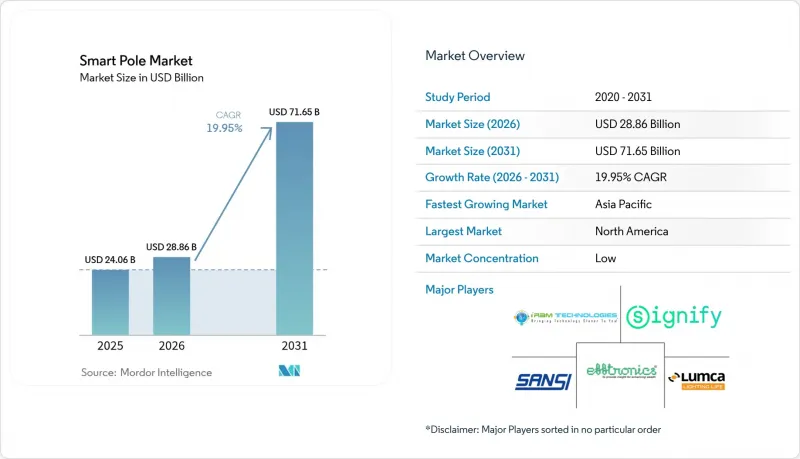
根據 Mordor Intelligence 預測,智慧桿市場規模將從 2025 年的 240.6 億美元成長到 2026 年的 288.6 億美元,然後在 2031 年達到 716.5 億美元,2026 年至 2031 年的複合年成長率為 19.95%。
本報告按產品(硬體、軟體平台和服務)、安裝類型(新建和維修)、連接技術(有線、無線和蜂窩網路)、應用領域(高速公路和道路等)、材質(鋼/鋁、複合材料、碳纖維增強複合材料和混凝土)以及地區進行細分。以上所有細分市場的規模和預測均以美元計價。
全球智慧電線桿市場趨勢及洞察
政府促進智慧城市發展的舉措
國家層級的計畫正在為智慧燈桿市場奠定基礎,因為地方政府面臨著實現氣候中和、安全和數據管治目標的壓力,需要對其照明網路進行現代化改造。歐盟委員會的「城市使命」旨在在2030年建成100個氣候中和城市,並要求發展包括多功能燈桿在內的綜合數位基礎設施。在中國,國家發展和改革委員會於2024年5月發布的指南要求城市負責人將智慧燈桿整合到統一的數據平台中,並推動標準化採購。據報道,芝加哥的智慧照明計畫每年可節省1000萬美元的能源成本,同時透過燈桿上的感測器加強了犯罪監控。這些指南有助於實現可預測的採購週期和大規模生產,從而降低單位成本。
透過LED升級改造促進節能
與高壓鈉燈相比,升級到LED燈可節能50-60%,為城市部署智慧燈桿提供了即時的經濟獎勵。在帕拉馬塔市,一項耗資555萬美元的LED安裝項目替換了4500盞燈具,降低了能源成本,並增加了情境調光功能。美國能源局指出,初始成本可以透過資金籌措和能源服務合約來支付,這使得即使預算緊張的市政當局也能實施智慧燈桿專案。分階段維修可以避免大規模的道路建設,並允許在現有設施中逐步整合感測器和連接模組。隨著各市政當局公佈其節約成本的成果,相互壓力正在形成,智慧燈桿市場正保持快速成長。
高初始資本投入與投資報酬率風險
除非預期能獲得明確的投資回報,否則市政預算很少會撥出數百萬美元用於照明昇級專案。在紐約州北部,一家電力公司要求為一項智慧路燈試點計畫購買500萬美元的責任險,這推高了計畫的總成本。一項針對沃爾瑪停車場的案例研究表明,用LED燈替換1000瓦的金屬鹵素燈需要7.5年才能收回成本,這遠遠超過大多數市政預算週期。像價值獲取融資這樣的官民合作關係,例如維傑亞瓦達的「黃金一英里」項目,可以將風險重新分配給特許經營經營商,但小規模的城市往往缺乏制定類似協議的法律授權,從而抑制了短期需求。
細分市場分析
預計到2025年,智慧燈桿市場中硬體採購將佔市場佔有率的67.20%。這是因為燈桿、照明燈具、感測器和通訊設備的部署需要大量的初始投資。目前軟體市佔率相對較小,但正以每年21.8%的速度成長,顯示市場正從資產提供轉向資訊服務。昕諾飛(Signify)已將其61億歐元照明產品銷售額中的93%轉化為LED產品,這表明規模經濟如何降低市政當局的資本成本。
目前,企業正將雲端儀錶板、API閘道器和人工智慧驅動的分析作為核心價值創造來源。廣域設備管理減少了現場服務次數,而預測性維護則延長了資產壽命,並在整個生命週期中提高了經濟效益。因此,持續的許可和支援費用開始與硬體利潤率相媲美,這一趨勢正在推動智慧桿市場的長期成長。
2025年,新增安裝量佔總銷售額的56.30%。這主要是由於在新建的智慧城市區域,人們更傾向於選擇配備內建無線功能、監視錄影機和電動車充電樁的客製化燈桿。同時,隨著城市將鈉燈更換為LED燈頭和插入式感測器模組,預計到2031年,維修項目將超過新增安裝量,年複合成長率將達到20.1%。在芝加哥,27萬盞路燈被更換為LED燈,並加裝了遠端控制節點,以降低能耗並實現犯罪分析。
利用現有電力線路和基礎維修,可將土木工程成本降低高達 30%。投資回收期可縮短至 4-5 年,與市政預算週期相符,並支持分階段實施。這一趨勢將擴大智慧電線桿市場的地域覆蓋範圍,並進一步豐富其需求。
區域分析
預計到2025年,北美將佔全球銷售額的35.10%,這主要得益於大規模的LED維修項目以及公用事業公司的資金籌措。紐約電力公司計劃利用Signify的Interact平台將50萬盞路燈聯網,凸顯了該專案的規模和可複製性。穩健的市政債券市場使資金籌措更加便捷,而寬頻業者正在利用智慧電線桿填補郊區5G網路覆蓋空白,從而穩定了訂單來源。
亞太地區是成長最快的市場,預計到2031年將以23.6%的複合年成長率成長。中國已發布國家指導方針,推動「車輛、道路和雲」的整合,強制要求安裝配備感測器的路側單元,並與多功能桿配合使用。印度的「智慧城市計畫」已為2025-2026會計年度累計112.1億盧比(約合13.5億美元),其8000個項目中的90%預計將在2024年中期完成,從而形成現成的需求儲備。
在歐洲,由於歐盟的「數位歐洲」和「地平線2020」計劃,經濟持續穩定成長。歐盟已撥款14億歐元用於134個城市的智慧基礎設施試點項目,從而提供了一個風險較低的資金池。 Cornerstone與Signify合作在路燈中安裝中立主機5G無線設備的案例表明,基礎設施共用如何能夠降低電信營運商的營運成本,並在宏觀經濟逆風的情況下保持貿易暢通。
其他好處:
- Excel格式的市場預測(ME)表
- 3個月的分析師支持
目錄
第1章:引言
- 研究假設和市場定義
- 調查範圍
第2章:調查方法
第3章執行摘要
第4章 市場狀況
- 市場概覽
- 市場促進因素
- 政府促進智慧城市發展的舉措
- 透過LED維修促進節能
- 對5G/小型基地台共享安裝的需求
- 降低物聯網感測器的成本
- 廣告收入和數據貨幣化的官民合作關係
- 透過與環境、社會及公司治理(ESG)掛鉤的地方政府債券資金籌措
- 市場限制因素
- 初始資本投入高,投資報酬率風險高。
- 協定間的互通性差距
- 與城市景觀相關的分區限制
- 網實整合保險費
- 價值供應鏈分析
- 監理情勢
- 技術展望
- 波特五力分析
- 冠狀病毒(COVID-19及其宏觀經濟影響)
- 投資分析
第5章 市場規模與成長預測
- 報價
- 硬體單元數量
- 軟體平台
- 服務
- 按安裝類型
- 新推出
- 改裝
- 透過連接技術
- 有線(PLC、光纖)
- 無線(Wi-Fi、BLE、Zigbee)
- 蜂窩網路(4G/LTE、5G、NB-IoT)
- 透過使用
- 高速公路和普通公路
- 公共場所和廣場
- 鐵路和港口
- 停車場和校園
- 材質
- 鋼/鋁
- 複合材料與碳纖維增強複合材料
- 具體的
- 按地區
- 北美洲
- 美國
- 加拿大
- 墨西哥
- 南美洲
- 阿根廷
- 巴西
- 其他南美國家
- 歐洲
- 英國
- 德國
- 法國
- 其他歐洲國家
- 亞太地區
- 中國
- 日本
- 印度
- 其他亞太國家
- 中東和非洲
- 沙烏地阿拉伯
- 阿拉伯聯合大公國
- 南非
- 其他中東和非洲國家
- 北美洲
第6章 競爭情勢
- 市場集中度
- 策略趨勢
- 市佔率分析
- 公司簡介
- Signify Holding NV
- Valmont Industries Inc.
- Iram Technologies Pvt Ltd
- Indus Towers Ltd
- Lumca Inc.
- Efftronics Systems Pvt Ltd
- Shanghai Sansi Electronic Engg.
- SmartCiti Solutions Inc.
- American Tower Corp.
- ENE.HUB Pty Ltd
- Cisco Systems Inc.
- Telensa Ltd
- CU Phosco Lighting
- Keselec Lighting Pvt Ltd
- LEDbow Technologies Ltd
- Norsk Hydro ASA
- Streetscape International
- Omniflow SA
- Ericsson AB
- Nokia Corp.
- HUB Group
第7章 市場機會與未來展望
According to Mordor Intelligence, the smart pole market size is expected to grow from USD 24.06 billion in 2025 to USD 28.86 billion in 2026 and is forecast to reach USD 71.65 billion by 2031 at 19.95% CAGR over 2026-2031.
This report is Segmented by Offering (Hardware Units, Software Platforms, and Services), Installation Type (New Installation and Retrofit), Connectivity Technology (Wired, Wireless, and Cellular), Application (Highways and Roadways, and More), Material (Steel/Aluminum, Composite and CFRP, and Concrete), and Geography. The Market Sizes and Forecasts are Provided in Terms of Value (USD) for all the Above Segments.
Global Smart Pole Market Trends and Insights
Government Smart-City Mandates
Nation-level programmes anchor the smart pole market because municipalities must modernise lighting grids to meet climate neutrality, safety, and data-governance targets. The European Commission's Cities Mission calls for 100 climate-neutral cities by 2030 and prescribes integrated digital infrastructure, including multi-service poles. In China, May 2024 guidance from the National Development and Reform Commission obliges city planners to fold smart poles into unified data platforms, accelerating standardised procurement. Chicago's smart-lighting programme reports USD 10 million annual energy savings while enhancing crime monitoring through pole-mounted sensors. Such directives foster predictable procurement cycles that permit volume manufacturing and lower per-unit costs.
LED-Retrofit Energy-Savings Push
LED retrofits deliver 50-60% energy savings compared with high-pressure sodium lamps, giving cities an immediate fiscal incentive to adopt smart poles. Parramatta's USD 5.55 million LED rollout swapped 4,500 luminaires, cutting energy bills and adding adaptive dimming. The U.S. Department of Energy notes that utility financing and energy-service contracts can cover upfront costs, unlocking adoption by budget-strapped towns. Incremental retrofits also avoid wholesale street works, allowing phased integration of sensors and connectivity modules across existing assets. As jurisdictions publicise cost-avoidance metrics, they create peer pressure that keeps the smart pole market on a rapid adoption curve.
High Upfront Capex and ROI Risk
Municipal budgets rarely stretch to multi-million-dollar lighting upgrades without clear payback. In upstate New York, utilities require USD 5 million liability cover for smart streetlight pilots, inflating overall project cost. Wal-Mart's car-park case study shows a 7.5-year payback when replacing 1,000 W metal halide fittings with LEDs, far longer than most city budget cycles. Public-private partnerships such as value-capture funding, showcased by Vijayawada's Golden Mile, redistribute risk to concessionaires, yet smaller cities often lack the legal capacity to structure similar deals, muting near-term demand.
Other drivers and restraints analyzed in the detailed report include:
- 5G Small-Cell Co-Location Demand
- Falling IoT-Sensor Costs
- Interoperability Gaps in Protocols
For complete list of drivers and restraints, kindly check the Table Of Contents.
Segment Analysis
Hardware purchases amounted to 67.20% of the smart pole market in 2025 as poles, luminaires, sensors, and communications gear demand significant upfront capital. Software, though presently a smaller line-item, is compounding at 21.8% annually, signalling a pivot from asset delivery to data services. Signify converts 93% of its EUR 6.1 billion lighting sales into LED units, demonstrating how economies of scale reduce capital costs for municipalities.
Firms now position cloud dashboards, API gateways, and AI-driven analytics as core value streams. Wide-area device management cuts truck rolls, while predictive maintenance extends asset life, improving total-life economics. Consequently, recurring licence and support fees are beginning to rival hardware margins, a progression that underpins long-run growth for the smart pole market.
New installations comprised 56.30% of 2025 revenue because green-field smart-city districts favour custom-engineered poles with embedded radios, CCTV, and EV chargers. Retrofit programmes, however, should log a 20.1% CAGR through 2031, outpacing new builds, as cities swap sodium lamps for LED heads plus plug-in sensor modules. Chicago upgraded 270,000 lights to LED while adding remote-control nodes, cutting energy use, and enabling crime analytics.
Retrofits exploit existing power feeds and foundations, trimming civil works costs by as much as 30%. Payback windows can narrow to 4-5 years, suiting municipal budgeting cycles and supporting distributed rollouts. The pattern broadens geographic access, reinforcing demand diversity within the smart pole market.
Complete Report Scope:
- By Offering
- Hardware Units
- Software Platform
- Services
- By Installation Type
- New Installation
- Retrofit
- By Connectivity Technology
- Wired (PLC, Fiber)
- Wireless (Wi-Fi, BLE, Zigbee)
- Cellular (4G/LTE, 5G, NB-IoT)
- By Application
- Highways and Roadways
- Public Places and Plazas
- Railways and Harbors
- Parking Lots and Campuses
- By Material
- Steel/Aluminum
- Composite and CFRP
- Concrete
- By Region
- North America
- United States
- Canada
- Mexico
- South America
- Argentina
- Brazil
- Rest of South America
- Europe
- United Kingdom
- Germany
- France
- Rest of Europe
- Asia-Pacific
- China
- Japan
- India
- Rest of Asia-Pacific
- Middle East and Africa
- Saudi Arabia
- United Arab Emirates
- South Africa
- Rest of Middle East and Africa
- North America
Geography Analysis
North America commanded 35.10% of 2025 revenue, underpinned by large-scale LED retrofits and utility financing. The New York Power Authority's plan to network 500,000 streetlights with Signify's Interact platform highlights project scale and replicability. Robust municipal bond markets facilitate capital access, while broadband carriers harness smart poles to fill suburban 5G gaps, keeping order pipelines steady.
Asia Pacific is the quickest-growing arena, rising at 23.6% CAGR to 2031. China issued national guidelines urging "vehicle-road-cloud" integration, mandating sensorized roadside units that dovetail with multipurpose poles. India's Smart Cities Mission budgeted INR 11.21 lakh crore (USD 1.35 billion) for 2025-26, of which 90% of 8,000 projects were completed by mid-2024, creating ready-made demand funnels.
Europe maintains consistent expansion owing to the EU's Digital Europe and Horizon 2020 funds. The bloc allocated EUR 1.4 billion to smart-infrastructure pilots in 134 cities, providing de-risked capital pools. Cornerstone's partnership with Signify to mount neutral-host 5G radios on street lighting demonstrates how infrastructure sharing cuts operator opex, keeping deal flow healthy despite macro headwinds.
- Signify Holding NV
- Valmont Industries Inc.
- Iram Technologies Pvt Ltd
- Indus Towers Ltd
- Lumca Inc.
- Efftronics Systems Pvt Ltd
- Shanghai Sansi Electronic Engg.
- SmartCiti Solutions Inc.
- American Tower Corp.
- ENE.HUB Pty Ltd
- Cisco Systems Inc.
- Telensa Ltd
- CU Phosco Lighting
- Keselec Lighting Pvt Ltd
- LEDbow Technologies Ltd
- Norsk Hydro ASA
- Streetscape International
- Omniflow SA
- Ericsson AB
- Nokia Corp.
- HUB Group
Additional Benefits:
- The market estimate (ME) sheet in Excel format
- 3 months of analyst support
TABLE OF CONTENTS
1 INTRODUCTION
- 1.1 Study Assumptions and Market Definition
- 1.2 Scope of the Study
2 RESEARCH METHODOLOGY
3 EXECUTIVE SUMMARY
4 MARKET LANDSCAPE
- 4.1 Market Overview
- 4.2 Market Drivers
- 4.2.1 Government smart-city mandates
- 4.2.2 LED-retrofit energy-savings push
- 4.2.3 5G/small-cell co-location demand
- 4.2.4 Falling IoT-sensor costs
- 4.2.5 Ad-revenue and data-monetisation PPPs
- 4.2.6 ESG-linked muni-bond funding
- 4.3 Market Restraints
- 4.3.1 High upfront capex and ROI risk
- 4.3.2 Interoperability gaps in protocols
- 4.3.3 Urban-aesthetic zoning limits
- 4.3.4 Cyber-physical insurance premiums
- 4.4 Value/Supply-Chain Analysis
- 4.5 Regulatory Landscape
- 4.6 Technological Outlook
- 4.7 Porter's Five Forces Analysis
- 4.7.1 Threat of New Entrants
- 4.7.2 Bargaining Power of Buyers
- 4.7.3 Bargaining Power of Suppliers
- 4.7.4 Threat of Substitutes
- 4.7.5 Competitive Rivalry
- 4.8 COVID-19 and Macroeconomic Impact
- 4.9 Investment Analysis
5 MARKET SIZE AND GROWTH FORECASTS (VALUE)
- 5.1 By Offering
- 5.1.1 Hardware Units
- 5.1.2 Software Platform
- 5.1.3 Services
- 5.2 By Installation Type
- 5.2.1 New Installation
- 5.2.2 Retrofit
- 5.3 By Connectivity Technology
- 5.3.1 Wired (PLC, Fiber)
- 5.3.2 Wireless (Wi-Fi, BLE, Zigbee)
- 5.3.3 Cellular (4G/LTE, 5G, NB-IoT)
- 5.4 By Application
- 5.4.1 Highways and Roadways
- 5.4.2 Public Places and Plazas
- 5.4.3 Railways and Harbors
- 5.4.4 Parking Lots and Campuses
- 5.5 By Material
- 5.5.1 Steel/Aluminum
- 5.5.2 Composite and CFRP
- 5.5.3 Concrete
- 5.6 By Region
- 5.6.1 North America
- 5.6.1.1 United States
- 5.6.1.2 Canada
- 5.6.1.3 Mexico
- 5.6.2 South America
- 5.6.2.1 Argentina
- 5.6.2.2 Brazil
- 5.6.2.3 Rest of South America
- 5.6.3 Europe
- 5.6.3.1 United Kingdom
- 5.6.3.2 Germany
- 5.6.3.3 France
- 5.6.3.4 Rest of Europe
- 5.6.4 Asia-Pacific
- 5.6.4.1 China
- 5.6.4.2 Japan
- 5.6.4.3 India
- 5.6.4.4 Rest of Asia-Pacific
- 5.6.5 Middle East and Africa
- 5.6.5.1 Saudi Arabia
- 5.6.5.2 United Arab Emirates
- 5.6.5.3 South Africa
- 5.6.5.4 Rest of Middle East and Africa
- 5.6.1 North America
6 COMPETITIVE LANDSCAPE
- 6.1 Market Concentration
- 6.2 Strategic Moves
- 6.3 Market Share Analysis
- 6.4 Company Profiles (includes Global level Overview, Market level overview, Core Segments, Financials as available, Strategic Information, Market Rank/Share for key companies, Products and Services, and Recent Developments)
- 6.4.1 Signify Holding NV
- 6.4.2 Valmont Industries Inc.
- 6.4.3 Iram Technologies Pvt Ltd
- 6.4.4 Indus Towers Ltd
- 6.4.5 Lumca Inc.
- 6.4.6 Efftronics Systems Pvt Ltd
- 6.4.7 Shanghai Sansi Electronic Engg.
- 6.4.8 SmartCiti Solutions Inc.
- 6.4.9 American Tower Corp.
- 6.4.10 ENE.HUB Pty Ltd
- 6.4.11 Cisco Systems Inc.
- 6.4.12 Telensa Ltd
- 6.4.13 CU Phosco Lighting
- 6.4.14 Keselec Lighting Pvt Ltd
- 6.4.15 LEDbow Technologies Ltd
- 6.4.16 Norsk Hydro ASA
- 6.4.17 Streetscape International
- 6.4.18 Omniflow SA
- 6.4.19 Ericsson AB
- 6.4.20 Nokia Corp.
- 6.4.21 HUB Group
7 MARKET OPPORTUNITIES AND FUTURE OUTLOOK
- 7.1 White-space and Unmet-Need Assessment

 物聯網路燈市場:全球市場預測,2026-2032年智慧資訊路燈市場:全球市場預測,2026-2032年
 全球智慧電線桿市場:機會與策略展望(至2035年)
 智慧多功能桿市場規模、佔有率和成長分析:按組成層、安裝類型、應用、分銷管道和地區分類-2026-2033年產業預測智慧電線桿市場:2026-2032年全球市場預測(按組件、動力來源、連接技術、控制架構、安裝配置、應用和銷售管道)面向地方政府的物聯網路燈桿市場:按組件、連接類型和應用分類-全球預測,2026-2032年物聯網智慧燈桿市場:按組件、應用、最終用戶和部署方式分類,全球預測(2026-2032)
 全球智慧桿市場規模、佔有率、趨勢和成長分析報告(2026-2034年)智慧電線桿市場規模、佔有率、成長及全球產業分析:依類型、應用和地區的洞察與預測(2026-2034)2026年全球智慧桿顯示器市場報告