


 |
市場調查報告書
商品編碼
2124074
塗層鋼:市場佔有率分析、產業趨勢與統計、成長預測(2026-2031)Coated Steel - Market Share Analysis, Industry Trends & Statistics, Growth Forecasts (2026 - 2031) |
||||||

※ 本網頁內容可能與最新版本有所差異。詳細情況請與我們聯繫。
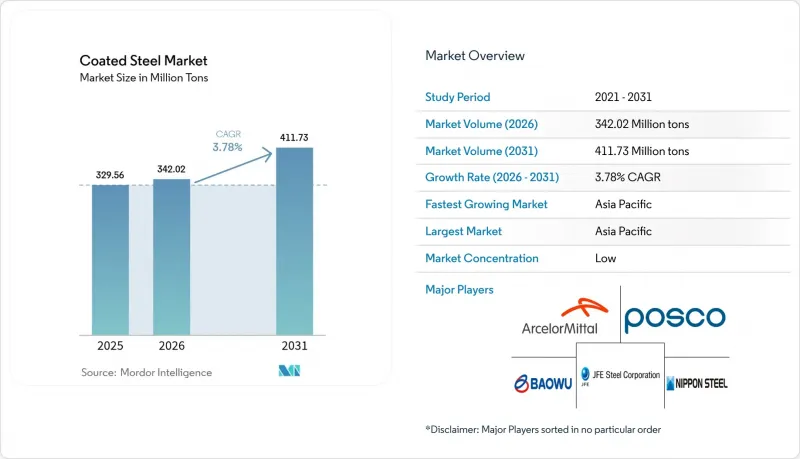
根據 Mordor Intelligence 預測,塗層鋼的市場規模預計將從 2025 年的 3.2956 億噸和 2026 年的 3.4202 億噸成長到 2031 年的 4.1173 億噸,2026 年至 2031 年的複合年成長率為 3.78%。
本報告按產品類型(熱鍍鋅、鍍鋅、電鍍鋅、鋁電鍍及其他)、應用領域(建築材料、汽車零件、家用電器、管道及其他應用)和地區(亞太地區、北美地區、歐洲地區、南美地區以及中東和非洲地區)進行細分。市場規模和預測以噸為單位。
全球塗層鋼板市場趨勢及洞察
提高節能建築圍護結構中預上漆卷材的使用率
歐洲和北美建築規範的修訂要求降低建築的熱傳導係數,而隔熱金屬面板比磚石或木結構建築更經濟地滿足了這一要求,直接導致工廠預塗鍍鋅鋼板的訂單增加。歐盟於2024年修訂的《建築能源性能指令》規定,到2028年,新建非住宅建築的能耗必須接近零。同時,美國18個州正在採用2021年國際節能標準(IECC)或更嚴格的標準,目標是在2025年中期之前完成。像塔塔鋼鐵的Colorcoat HPS200 Ultra這樣的塗漆產品可以反射高達70%的太陽輻射,並在炎熱氣候下降低15-18%的冷氣負荷。目前,保險公司為易發野火地區的金屬覆層建築提供10-15%的保費折扣,進一步拉大了金屬覆層建築與乙烯基和木質牆板之間的經濟差距(III.ORG)。此採購架構參考了 ASTM D7897 和 ISO 12944,為缺乏內部測試能力的鋼鐵廠造成了重大的技術障礙。
亞洲快速引進鋅鋁鎂合金塗層生產線
2024年至2025年間,中國、韓國和日本共運作12條鋅鋁鎂鍍層生產線,每年新增產能850萬噸。這使得亞洲鋼廠能夠為汽車製造商和家電製造商等對邊緣耐腐蝕性有較高要求的整車廠商提供產品。位於寶武的梅山鍍層生產線年產能200萬噸,採用11%鋁和3%鎂的鍍液配比,中性鹽霧試驗性能達1500小時,是標準鍍鋅鋼板的三倍。浦項鋼鐵光陽鍍層生產線年產能150萬噸,主要面向電動車電池機殼,由於板材厚度較薄,對成形性要求較高,該生產線實現了8%的減重。 JFE鋼鐵的「J-Star」鍍層能夠抑制海運過程中白銹的產生,解決了高濕度運輸路線中長期存在的難題。這項技術也正在向東協地區推廣,NS Bluescope計劃在2027年投資50億泰銖對其位於邦帕的工廠維修。
採用鋁複合材料(ACP)的替代立面
鋁塑複合板(ACP)重量為6-8公斤/平方米,而鋼板重量為12-15公斤/平方米,因此可以採用更輕的幕牆框架,從而在高層建築項目中降低8-12%的建造成本。格倫費爾大廈火災以及隨後消防安全標準的修訂,加速了礦物填充鋁塑複合板芯材在18米以上建築中的應用,尤其是在沿岸地區的大型企劃中,例如NEOM和紅海開發項目。 2024年,全球鋁塑複合板市場成長了9.2%,比塗漆鋼板高出5.4個百分點。然而,鋁的低電偶電位會加速沿海空氣中的孔蝕,導致其在7-10年內過早失效,而鋅鋁鎂塗層鋼板則提供更優異的邊緣保護。為了應對這一問題,製造商正在提供帶有陶瓷熔塊或石材飾面的混合鋼板,以滿足美觀要求,同時又不影響其性能。
細分市場分析
到2025年,熱鍍鋅鋼板將佔據塗層鋼板市場63.12%的佔有率,預計到2031年將以3.94%的複合年成長率成長,這主要得益於離岸風力發電單樁和公路基礎設施部件對Z275-Z450鍍層重量的要求。隨著開發商將更厚的鋅層作為標準以確保25年的耐久性,預計2026年至2031年間,熱鍍鋅鋼板的市場規模將增加近5,200萬噸。電鍍鋅鋼板是汽車外露面板的首選材料,但由於歐洲電價上漲,其成本面臨挑戰,預計複合年成長率將放緩至2.5%。同時,儘管供應持續緊張,鍍鋅鋼板仍處於小眾市場,市場佔有率僅為18%,因為汽車製造商正轉向先進的高強度鋅鋁鎂合金解決方案。鍍鋁鋼在高溫排氣管和烤箱內襯中仍發揮重要作用,但其市佔率成長仍低於5%。新興的微量合金鋅鋁鎂塗層,例如安賽樂米塔爾的Magnelis塗層,其邊緣耐腐蝕性提高了10倍,雖然目前市場佔有率僅為2%,但預計將實現兩位數成長。
美國《基礎建設投資與就業法案》也提振了熱鍍鋅捲材的需求。該法案強制要求各州交通部(DOT)手冊中規定在護欄和橋面使用鍍鋅鋼,從而確保了多年供應合約的簽訂。小型鋼廠利用其短生產週期,生產用於家用電器背面的客製化單面鍍鋅鋼板,從那些不願頻繁調整生產的大型綜合製造商手中奪取市場佔有率。浦項製鐵在其光陽工廠投資引進線上雷射光譜技術,將鍍鋅偏差降低至±2 g/m²,從而減少了廢料並提高了成本競爭力。在預測期內,印度和東南亞國協產能的提升預計將滿足該地區不斷成長的建築需求,而歐洲日益成長的環保合規成本可能會導致老舊電解線的改造,並促使全球供應轉向現代化的熱鍍鋅設施。
區域分析
亞太地區引領塗層鋼板市場,預計到2025年將佔據全球61.24%的市場佔有率,並在2031年之前以4.52%的複合年成長率持續成長。在「十四五」規劃的支持下,中國預計2025年塗層鋼板產量將達到約2.1億噸。寶武鋼鐵等綜合性鋼鐵廠正在改造鋅鋁鎂(Zn-Al-Mg)塗層生產線,以滿足電動車和太陽能框架客戶的需求。印度的生產連結獎勵計畫(PLI)計畫推動了2024-2025會計年度需求成長11.3%,其中塔塔鋼鐵和JSW兩家公司合計產能將增加320萬噸。
在北美,美國塗層鋼市場受惠於《基礎設施投資與就業法案》以及消費性電子產品生產的復甦。美國國內鋼鐵廠供應了全國72%的鋼鐵消費量,而紐科亞公司的勃蘭登堡計畫預計到2026年第三季將新增120萬噸產能。加拿大的成長更為穩定,主要得益於採礦業的輸送帶業務,但如果墨西哥在2026年下半年實施反傾銷稅和反補貼稅,其快速成長的趨勢可能會逆轉。
在歐洲,德國的消費量最高,蒂森克虜伯和薩爾茲吉特公司向汽車製造商供應鋅鋁鎂合金鋼板。英國市場穩步成長,這得益於政府對社會住宅建設的補貼政策,該政策強制要求使用隔熱金屬面板。法國和義大利的成長則得益於電池超級工廠和資料中心專案的建設。南美洲、中東和非洲的市場成長主要由巴西的農產品體系和沙烏地阿拉伯的NEOM大型企劃所推動。
其他好處:
- Excel格式的市場預測(ME)表
- 3個月的分析師支持
目錄
第1章:引言
- 研究假設和市場定義
- 調查範圍
第2章:調查方法
第3章執行摘要
第4章 市場狀況
- 市場概覽
- 市場促進因素
- 在節能建築圍護結構中採用塗漆卷材
- 亞洲快速引進鋅鋁鎂合金塗層生產線
- 基於稅收的家電更換支援計畫(歐盟和美國)
- 離岸風力發電單樁對防腐蝕線圈的需求
- 用於農光互補的結構鋼塗層
- 市場限制因素
- 用鋁複合材料替換外立面
- 對塗層鋼板徵收反傾銷稅和反補貼稅
- 低碳鋅原料供應緊張
- 價值鏈分析
- 波特五力模型
第5章 市場規模與成長預測
- 依產品類型
- 熱鍍鋅
- 伽爾瓦納
- 電鍍鋅
- 鋁沉澱
- 其他產品類型
- 透過使用
- 建築材料
- 汽車零件
- 家用電器
- 管道和管材產品
- 其他用途
- 按地區
- 亞太地區
- 中國
- 印度
- 日本
- 韓國
- 東南亞國協
- 其他亞太國家
- 北美洲
- 美國
- 加拿大
- 墨西哥
- 歐洲
- 德國
- 英國
- 法國
- 義大利
- 俄羅斯
- 北歐國家
- 其他歐洲國家
- 南美洲
- 巴西
- 阿根廷
- 其他南美國家
- 中東和非洲
- 沙烏地阿拉伯
- 南非
- 其他中東和非洲國家
- 亞太地區
第6章 競爭情勢
- 市場集中度
- 策略趨勢
- 市佔率和排名分析
- 公司簡介
- AM/NS INDIA
- ArcelorMittal
- China Baowu Steel Group Corp., Ltd
- CUMIC STEEL LIMITED
- JFE Steel Corporation
- Jindal Steel
- JSW
- KOBE STEEL, LTD.
- MMK(PJSC)
- Nippon Steel Coated Sheet Corporation
- NLMK
- NS BlueScope
- Nucor Corporation
- POSCO Coated Steel(Thailand)Co.,Ltd.
- Salzgitter Flachstahl GmbH
- SSAB AB
- Tata Steel
- thyssenkrupp Steel
- United States Steel Corporation
- voestalpine Stahl GmbH
第7章 市場機會與未來展望
According to Mordor Intelligence, the coated steel market size is projected to expand from 329.56 Million tons in 2025 and 342.02 Million tons in 2026 to 411.73 Million tons by 2031, registering a CAGR of 3.78% between 2026 to 2031.
This report is Segmented by Product Type (Hot-Dipped, Galvannealed, Electro-Galvanized, Aluminized, and Others), Application (Construction and Building Components, Automotive Components, Appliances, Pipe and Tubular, and Other Applications), and Geography (Asia-Pacific, North America, Europe, South America, and Middle East and Africa). The Market Sizing and Forecasts are Provided in Terms of Volume (Tons).
Global Coated Steel Market Trends and Insights
Energy-Efficient Building-Envelope Uptake of Pre-Painted Coil
Revised building codes in Europe and North America require lower thermal-transmittance values that insulated metal panels meet more economically than masonry or wood framing, directly boosting orders for factory-finished galvanized sheet. The 2024 recast of the EU Energy Performance of Buildings Directive mandates near-zero energy use for new non-residential structures by 2028, while 18 US states had adopted the 2021 International Energy Conservation Code or stricter variants by mid-2025. Pre-painted products like Tata Steel's Colorcoat HPS200 Ultra reflect up to 70% of solar radiation, cutting cooling loads by 15-18% in hot climates. Insurers now discount premiums for metal-clad buildings in wildfire zones by 10-15%, widening the economic gap versus vinyl or wood siding III.ORG. Procurement frameworks referencing ASTM D7897 and ISO 12944 have raised technical barriers for mills without in-house testing capabilities.
Rapid Rollout of Zn-Al-Mg Alloy Coating Lines in Asia
Twelve Zn-Al-Mg lines commissioned across China, South Korea, and Japan between 2024 and 2025 have added 8.5 million tons of annual capacity, positioning Asian mills to supply automakers and appliance OEMs demanding superior edge-corrosion resistance. Baowu's 2 million t/a Meishan line delivers 1,500-hour neutral-salt-spray performance, triple that of standard galvanized sheet, by using an 11% Al, 3% Mg bath composition. POSCO's 1.5 million t/a Gwangyang line targets electric-vehicle battery enclosures that require high formability at reduced gauge, achieving 8% mass savings. JFE Steel's J-Star coating suppresses white rust during seaborne export, addressing a chronic issue in humid transit routes. The technology is diffusing into ASEAN, where NS BlueScope is investing THB 5 billion to retrofit its Bang Phra plant by 2027.
Aluminum-Composite Facade Substitution
ACPs weigh 6-8 kg/m2 versus 12-15 kg for steel panels, enabling lighter curtain-wall framing and 8-12% construction-cost savings in high-rise projects. Post-Grenfell fire-safety revisions accelerated the adoption of mineral-filled ACP cores above 18 meters, especially in Gulf megaprojects like NEOM and the Red Sea Development. The global ACP market grew 9.2% in 2024, eclipsing coated-steel cladding by 5.4 percentage points. However, aluminium's lower galvanic potential accelerates pitting in coastal atmospheres, prompting premature failures after 7-10 years, whereas Zn-Al-Mg coated steel offers better edge protection. Producers are counteracting by offering hybrid steel panels with ceramic-frit or stone-veneer finishes that meet aesthetic demands without ceding performance.
Other drivers and restraints analyzed in the detailed report include:
- Tax-Driven Appliance-Replacement Programs (EU and US)
- Offshore-Wind Monopile Corrosion-Protected Coil Demand
- AD/CVD Trade Actions on Coated Sheet
For complete list of drivers and restraints, kindly check the Table Of Contents.
Segment Analysis
Hot-dipped coated steel commanded 63.12% of the coated steel market share in 2025 and is forecast to grow at a 3.94% CAGR to 2031, underpinned by Z275-Z450 coating-weight mandates in offshore wind monopiles and highway-infrastructure components. The coated steel market size for hot-dipped grades is projected to expand by nearly 52 million tons between 2026 and 2031 as developers standardize thicker zinc layers to assure 25-year durability. Electro-galvanized variants, favored for exposed auto panels, face cost headwinds from elevated European power prices and will decelerate to 2.5% CAGR, while galvannealed sheet remains supply-tight but niche at 18% share, held back by automaker migration to advanced high-strength Zn-Al-Mg solutions. Aluminized steel maintains relevance in high-temperature exhaust and oven liners but contributes less than 5% of incremental volume. Emerging micro-alloyed Zn-Al-Mg coatings, such as ArcelorMittal's Magnelis, deliver 10-fold edge-corrosion improvement, positioning them for double-digit growth, albeit from a 2% base.
Demand for hot-dipped coil is also reinforced by the U.S. Infrastructure Investment and Jobs Act, which specifies galvanized guardrails and bridge decks in state DOT manuals, locking in multi-year volume commitments. Mini-mills are exploiting shorter campaign cycles to produce customized one-side galvanized sheet for appliance backs, capturing share from integrated giants resistant to frequent changeovers. Investment in inline laser-spectroscopy at POSCO's Gwangyang works trims coating-weight variance to +-2 g/m2, reducing scrap and sharpening cost competitiveness. Over the forecast horizon, capacity adds in India and ASEAN will meet surging regional construction demand, but environmental compliance costs in Europe could rationalize older electrolytic lines, nudging global supply toward modern hot-dip assets.
Complete Report Scope:
- By Product Type
- Hot-dipped
- Galvannealed
- Electro-galvanized
- Aluminized
- Others Product Types
- By Application
- Construction and Building Components
- Automotive Components
- Appliances
- Pipe and Tubular
- Other Applications
- By Geography
- Asia-Pacific
- China
- India
- Japan
- South Korea
- ASEAN Countries
- Rest of Asia-Pacific
- North America
- United States
- Canada
- Mexico
- Europe
- Germany
- United Kingdom
- France
- Italy
- Russia
- NORDIC Countries
- Rest of Europe
- South America
- Brazil
- Argentina
- Rest of South America
- Middle East and Africa
- Saudi Arabia
- South Africa
- Rest of Middle East and Africa
- Asia-Pacific
Geography Analysis
Asia-Pacific dominated the coated steel market with 61.24% volume share in 2025 and is on track for a 4.52% CAGR to 2031. China, supported by its 14th Five-Year Plan, produced about 210 million tons in 2025, and integrated mills such as Baowu are pivoting toward Zn-Al-Mg lines to serve electric-vehicle and solar-frame customers. India's Production Linked Incentive scheme spurred 11.3% demand growth in fiscal 2024-2025, with Tata Steel and JSW collectively adding 3.2 million tons of capacity.
In North America, the US coated steel market benefited from the Infrastructure Investment and Jobs Act and the reshoring of appliance production; domestic mills supplied 72% of the total consumed steel, with Nucor's Brandenburg project adding 1.2 million tons of new capacity by Q3 2026. Canadian growth is steadier. pivoting on mining-sector conveyors, while Mexico's surge risks reversal if AD/CVD tariffs emerge in late 2026.
In Europe, Germany consumed most, with thyssenkrupp and Salzgitter supplying Zn-Al-Mg sheet to automakers. The UK market grows modestly on social-housing grants requiring insulated metal panels, while France and Italy see upside from battery gigafactory and data-center projects. South America and Middle East and Africa's growth in the market is fueled by Brazil's agribusiness structures and Saudi Arabia's NEOM megaproject.
- AM/NS INDIA
- ArcelorMittal
- China Baowu Steel Group Corp., Ltd
- CUMIC STEEL LIMITED
- JFE Steel Corporation
- Jindal Steel
- JSW
- KOBE STEEL, LTD.
- MMK (PJSC)
- Nippon Steel Coated Sheet Corporation
- NLMK
- NS BlueScope
- Nucor Corporation
- POSCO Coated Steel(Thailand) Co.,Ltd.
- Salzgitter Flachstahl GmbH
- SSAB AB
- Tata Steel
- thyssenkrupp Steel
- United States Steel Corporation
- voestalpine Stahl GmbH
Additional Benefits:
- The market estimate (ME) sheet in Excel format
- 3 months of analyst support
TABLE OF CONTENTS
1 Introduction
- 1.1 Study Assumptions and Market Definition
- 1.2 Scope of the Study
2 Research Methodology
3 Executive Summary
4 Market Landscape
- 4.1 Market Overview
- 4.2 Market Drivers
- 4.2.1 Energy-efficient building-envelope uptake of pre-painted coil
- 4.2.2 Rapid rollout of Zn-Al-Mg alloy coating lines in Asia
- 4.2.3 Tax-driven appliance-replacement programs (EU and US)
- 4.2.4 Offshore-wind monopile corrosion-protected coil demand
- 4.2.5 Agrivoltaic structural steel coatings
- 4.3 Market Restraints
- 4.3.1 Aluminium-composite facade substitution
- 4.3.2 AD/CVD trade actions on coated sheet
- 4.3.3 Supply tightness of low-carbon zinc feedstock
- 4.4 Value Chain Analysis
- 4.5 Porter's Five Forces
- 4.5.1 Bargaining Power of Suppliers
- 4.5.2 Bargaining Power of Buyers
- 4.5.3 Threat of New Entrants
- 4.5.4 Threat of Substitute Products
- 4.5.5 Degree of Competition
5 Market Size and Growth Forecasts (Volume)
- 5.1 By Product Type
- 5.1.1 Hot-dipped
- 5.1.2 Galvannealed
- 5.1.3 Electro-galvanized
- 5.1.4 Aluminized
- 5.1.5 Others Product Types
- 5.2 By Application
- 5.2.1 Construction and Building Components
- 5.2.2 Automotive Components
- 5.2.3 Appliances
- 5.2.4 Pipe and Tubular
- 5.2.5 Other Applications
- 5.3 By Geography
- 5.3.1 Asia-Pacific
- 5.3.1.1 China
- 5.3.1.2 India
- 5.3.1.3 Japan
- 5.3.1.4 South Korea
- 5.3.1.5 ASEAN Countries
- 5.3.1.6 Rest of Asia-Pacific
- 5.3.2 North America
- 5.3.2.1 United States
- 5.3.2.2 Canada
- 5.3.2.3 Mexico
- 5.3.3 Europe
- 5.3.3.1 Germany
- 5.3.3.2 United Kingdom
- 5.3.3.3 France
- 5.3.3.4 Italy
- 5.3.3.5 Russia
- 5.3.3.6 NORDIC Countries
- 5.3.3.7 Rest of Europe
- 5.3.4 South America
- 5.3.4.1 Brazil
- 5.3.4.2 Argentina
- 5.3.4.3 Rest of South America
- 5.3.5 Middle East and Africa
- 5.3.5.1 Saudi Arabia
- 5.3.5.2 South Africa
- 5.3.5.3 Rest of Middle East and Africa
- 5.3.1 Asia-Pacific
6 Competitive Landscape
- 6.1 Market Concentration
- 6.2 Strategic Moves
- 6.3 Market Share(%)/Ranking Analysis
- 6.4 Company Profiles (includes Global Overview, Market Overview, Core Segments, Financials, Strategic Information, Products and Services, Recent Developments)
- 6.4.1 AM/NS INDIA
- 6.4.2 ArcelorMittal
- 6.4.3 China Baowu Steel Group Corp., Ltd
- 6.4.4 CUMIC STEEL LIMITED
- 6.4.5 JFE Steel Corporation
- 6.4.6 Jindal Steel
- 6.4.7 JSW
- 6.4.8 KOBE STEEL, LTD.
- 6.4.9 MMK (PJSC)
- 6.4.10 Nippon Steel Coated Sheet Corporation
- 6.4.11 NLMK
- 6.4.12 NS BlueScope
- 6.4.13 Nucor Corporation
- 6.4.14 POSCO Coated Steel(Thailand) Co.,Ltd.
- 6.4.15 Salzgitter Flachstahl GmbH
- 6.4.16 SSAB AB
- 6.4.17 Tata Steel
- 6.4.18 thyssenkrupp Steel
- 6.4.19 United States Steel Corporation
- 6.4.20 voestalpine Stahl GmbH
7 Market Opportunities and Future Outlook
- 7.1 White-space and Unmet-Need Assessment

 耐候鋼市場分析及預測(至2035年):依類型、產品、技術、應用、形式、材料類型、製程、最終用戶及安裝方式分類
 塗層鋼市場:全球市場預測(2026-2032)
 2026-2030年全球塗層鋼市場
 全球耐候鋼市場:按類型、最終用途產業、材料類型和地區分類
 耐候鋼:市場佔有率分析、產業趨勢與統計、成長預測(2026-2031)耐候鋼市場:依產品類型、技術、應用及通路分類-2026-2032年全球市場預測
 全球塗層鋼板市場規模、佔有率、趨勢和成長分析報告(2026-2034)
 2026年全球耐候鋼市場報告鉻碳化物堆焊板市場按產品類型、塗層厚度、終端用戶產業、應用和銷售管道,全球預測(2026-2032年)
 耐候鋼市場規模、佔有率及成長分析(按類型、形式、供應、最終用途產業及地區分類)-2026-2033年產業預測