


 |
市場調查報告書
商品編碼
2124073
智慧鏡:市場佔有率分析、產業趨勢與統計、成長預測(2026-2031)Smart Mirror - Market Share Analysis, Industry Trends & Statistics, Growth Forecasts (2026 - 2031) |
||||||

※ 本網頁內容可能與最新版本有所差異。詳細情況請與我們聯繫。
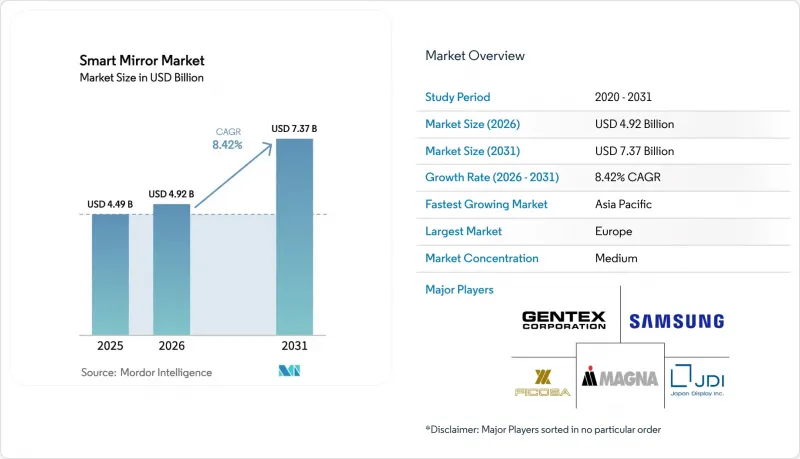
根據 Mordor Intelligence 預測,智慧鏡市場規模將從 2025 年的 44.9 億美元和 2026 年的 49.2 億美元成長到 2031 年的 73.7 億美元,2026 年至 2031 年的年複合成長率(CAGR)為 8.42%。
本報告按組件(硬體、軟體、服務)、最終用戶應用(汽車、零售與行銷、醫療保健、住宅、飯店)、顯示技術(LCD、OLED 等)、銷售管道(B2B、B2C)和地區(北美、歐洲、亞太、南美等)進行細分。市場預測以美元計價。
全球智慧鏡市場趨勢及洞察
汽車產業智慧後視鏡的普及應用日益廣泛
根據聯合國歐洲經濟委員會 (UN ECE) R158 法規,歐洲和亞太地區的卡車製造商已開始採用攝影機監控系統。該法規從法律上取消了對實體後視鏡的需求。這意味著到 2025 年,梅賽德斯-奔馳、沃爾沃、斯堪尼亞和曼恩將為超過 20 萬輛重型卡車配備該系統。現代和起亞已將駕駛員監視錄影機整合到其新型電動車平台的內後視鏡中,以確保獲得 Euro NCAP 五星級安全評級。 Gentex 公司 2025 年推出的「全顯示後視鏡」將 OLED 面板、後視攝影機影像和駕駛員監控功能整合到一個 12 吋的單元中,標誌著從單一感測器向多功能模組的轉變。該法規正在加速這項技術的普及,因為取消外後視鏡可降低 5% 的空氣阻力,從而在不增加電池成本的情況下延長電動車的續航里程。因此,供應商正在墨西哥和波蘭增設專用生產線,並與渴望提升駕駛座用戶體驗 (UX) 的原始設備製造商 (OEM) 簽訂三年合約。
快速整合人工智慧驅動的個人化功能
目前,住宅和零售設備中已整合卷積類神經網路,用於評估皮膚水分含量、檢測細紋並推薦化妝品,使鏡子搖身一變成為日常健康顧問。 CareOS 的「BMind」鏡子將情緒追蹤與飯店浴室中的引導式呼吸練習相結合,榮獲 2024 年 CES 創新獎。歐萊雅與 ModiFace 在法國百貨公司先導計畫顯示,鏡子提案的色調能夠延長顧客停留時間,轉換率因此提升了 30%。 HiMirror 的新韌體會參考皮膚病學資料庫,並在檢測到可疑痣時將使用者轉介至遠端皮膚科醫生進行諮詢。人工智慧驅動的個人化功能正在不斷拓展其應用場景,供應商現在透過安全的無線通訊管道提供每月更新的型號。當資料不離開設備時,使用者選擇加入的比例超過 70%,證明了符合嚴格歐洲隱私法規的邊緣優先架構的有效性。
前期成本高,消費者認知度低
住宅智慧鏡的零售價格從 800 美元到 3000 美元不等,遠高於傳統照明鏡 150 美元的價格,這限制了非富裕家庭的普及。德勤 2024 年的一項調查發現,只有 22% 的美國住宅了解“智慧鏡”,而認為智慧鏡有益健康的人不到 5%。因此,萬豪和希爾頓等酒店正在其高階套房中引入智慧鏡,以突出其優勢並收集反饋,進行成本效益分析,從而實現更廣泛的推廣。電商平台上的分期付款計劃和「先買後付」選項緩解了高價帶來的猶豫,但中等收入消費者仍然不願購買,除非出現突破性的應用程式。價格下降取決於預計在 2027 年實現的 OLED 良率提升以及更廣泛應用的邊緣 AI 晶片的普及。
細分市場分析
儘管硬體在2025年仍將佔總營收的66.73%,但隨著平台向SaaS授權、分層雲端儲存方案和高階分析套餐轉型,預計到2031年,服務業務的複合年成長率將達到9.61%。 Gentex於2024年與Solace Systems合作,推出無線電力傳輸和韌體更新功能,在售後實現高解析度錄製功能和疲勞預測儀錶板。零售商正按次租賃ModiFace和Perfect Corp的AR試衣間引擎,從而將資本預算轉向營運支出。遠端醫療鏡像設備正透過年度維護合約與電子健康記錄(EHR)供應商合作,這些合約佔醫院項目總數的35%。此外,注重隱私的數據湖也在推動業務收益的成長,這些數據湖能夠揭示宏觀趨勢(例如試衣間使用高峰),同時去除用戶身份信息,為零售商提供可操作的洞察。
硬體藍圖優先考慮採用更窄的邊框和側發光LED來減少眩光,從而降低40%的功耗。這對於飯店走廊來說尤其重要,因為那裡的鏡子每天運作18個小時。軟體團隊專注於語音使用者介面和互動式人工智慧,即使在潮濕的浴室或震動的車內,也能實現免持選擇新聞推播、燈光和健康內容。服務差異化源自於一種聯邦學習模型,該模型在設備上進行學習,集中更新,然後重新部署。這既提高了演算法的準確性,又將敏感的幀資料保留在本地。這種轉變構成了持續收入的基礎,而持續收入對於智慧鏡市場的投資者估值至關重要。
預計到2025年,智慧鏡市場將主要由汽車產業主導,佔總銷售量的41.89%,這主要得益於歐盟和亞太地區相關法規推動卡車產業對智慧鏡的廣泛應用。同時,醫療智慧鏡預計將以10.02%的複合年成長率成長,這主要得益於美國醫療保險和醫療補助服務中心(CMS)的報銷政策以及日本「在熟悉的地方養老」政策的推動。零售業也將緊隨其後,越來越多的證據表明其轉換率正在提高,儘管目前住宅領域的應用僅限於單間浴室造價超過5萬美元的豪華裝修項目。希爾頓酒店集團在2025年於旗下12家酒店開展的試驗計畫發現,配備智慧鏡的客房賓客滿意度提高了25%,這促使希爾頓考慮在旗下所有酒店全面推廣智慧鏡。
醫院要求產品符合 ISO 13485 標準、配備皮膚電感測器並具備 FHIR互通性,這會將銷售週期延長至 18 個月,但作為回報,他們會簽訂多年支援合約。汽車產業的終端用戶優先考慮符合 FMVSS 201 標準的頭部衝擊防護性能和低至 -40 度C 的耐熱性能。零售商要求 99.5% 的運轉率和遠端診斷功能,而住宅用戶則購買能夠與室內裝潢融合且可與 Apple HomeKit 整合進行集中控制的鏡框。飯店業的買家會協商五年保固,並透過將智慧鏡與 IPTV 升級捆綁銷售來利用規模經濟,從而提高合約總價值。
區域分析
預計到2025年,歐洲將佔全球銷量的31.47%,這主要得益於2019/2144號法規的實施,該法規強制要求安裝駕駛員疲勞檢測系統,並提振了車載攝影機的需求。德國供應鏈包括Ficosa、Murakami和Valeo,它們分別為大眾和寶馬提供產品。同時,Valeo在法國投資了2億歐元(約2.13億美元)以擴大其相機模組的產能。英國雖然符合聯合國歐洲經濟委員會(UN ECE)的規定,但12個月的時效性使得泛歐型式認證流程較為複雜。
在北美,由於美國國家公路交通安全管理局 (NHTSA) 持續強制要求使用實體側視鏡,汽車產業的普及速度較為緩慢。但隨著智慧家居支出增加,住宅和酒店業的銷售量正在成長。 Gentex 在蒂華納經營一家佔地 50 萬平方英尺的工廠,根據美墨加協定 (USMCA),該工廠可以免稅出口,從而降低了關稅風險。墨西哥城的飯店和精品健身房正在試行使用智慧後視鏡,以提升其為客人提供的健康服務體驗,這表明美國以外的地區對智慧後視鏡的需求強勁。由於價格敏感,南美和非洲市場仍處於起步階段,但聖保羅豪華公寓和開普敦水療度假村的試點部署表明,未來市場潛力巨大。
亞太地區10.86%的複合年成長率主要歸功於中國電動車的蓬勃發展、韓國的顯示器研發津貼以及日本在老年遠距遠端醫療的進步。韓國產業通商資源部(MOTIE)已將透明顯示器列為2024年的戰略產業,並資助LG Display和現代摩比斯(Hyundai Mobis)的聯合計畫。印度的都市區正在購買語音助手,並尋求與之配套的智慧鏡,但超過1000美元的價格阻礙了其廣泛普及。澳洲和紐西蘭正從亞洲和歐洲進口智慧鏡,尤其注重其230伏特的安全標準和適用於太陽能發電的備用電源。
波灣合作理事會(GCC)成員國的中東購屋者正在其豪華公寓中安裝智慧鏡,這些智慧鏡結合了阿拉伯語語音包和防沙塗層,作為其智慧城市計畫的一部分。在阿拉伯聯合大公國政府主導的住宅舉措中,這些智慧鏡必須與建築物的能源管理系統在協議層進行整合,以確保符合淨零排放目標。
其他好處:
- Excel格式的市場預測(ME)表
- 3個月的分析師支持
目錄
第1章:引言
- 研究假設和市場定義
- 調查範圍
第2章:調查方法
第3章執行摘要
第4章 市場狀況
- 市場概覽
- 市場促進因素
- 汽車產業智慧後視鏡的日益普及
- 快速引入人工智慧驅動的個人化功能
- 擴展互聯零售試衣間解決方案
- 遠端醫療和遠端患者監護的需求日益成長
- 政府對汽車數位後視鏡系統的監管規定
- 為滿足居家養老老年人的需求而設計的技術正在推動智慧浴室廂內後視鏡的發展。
- 市場限制因素
- 前期成本高,消費者認知度低
- 網路安全和資料隱私問題
- 專業顯示玻璃的脆弱供應鏈
- 關於配備攝影機的後視鏡的相關法規不確定性
- 產業價值鏈分析
- 監理情勢
- 技術展望
- 波特五力分析
第5章 市場規模與成長預測
- 按組件
- 硬體
- 軟體
- 服務
- 透過最終用戶應用程式
- 車
- 零售與行銷
- 衛生保健
- 住宅
- 飯店業
- 顯示技術
- LCD
- OLED
- 其他顯示技術
- 按銷售管道
- 企業對企業 (B2B) 交易
- 企業對消費者 (B2C)
- 按地區
- 北美洲
- 美國
- 加拿大
- 墨西哥
- 南美洲
- 巴西
- 阿根廷
- 其他南美國家
- 歐洲
- 德國
- 英國
- 法國
- 義大利
- 西班牙
- 俄羅斯
- 比荷盧經濟聯盟
- 北歐的
- 其他歐洲國家
- 亞太地區
- 中國
- 印度
- 日本
- 韓國
- ASEAN
- 澳洲和紐西蘭
- 其他亞太國家
- 中東
- GCC
- 土耳其
- 以色列
- 其他中東國家
- 非洲
- 埃及
- 南非
- 其他非洲國家
- 北美洲
第6章 競爭情勢
- 市場集中度
- 策略趨勢
- 市佔率分析
- 公司簡介
- Gentex Corporation
- Ficosa International SA
- Magna International Inc.
- Samsung Electronics Co., Ltd.
- Japan Display Inc.
- Murakami Corporation
- Dension Ltd.
- Electric Mirror Inc.
- Perseus Mirror
- Seura Inc.
- CareOS(Baracoda)
- Capstone Connected Holdings, Inc.
- Evervue USA Inc.
- HiMirror(New Kinpo Group)
- Acer Inc.
- Mues-Tec GmbH & Co. KG
- Shenzhen Haier Smart Home Co., Ltd.
- ad notam AG
- Panasonic Holdings Corporation
- Shenzhen Pro Display Co., Ltd.
第7章 市場機會與未來展望
According to Mordor Intelligence, the smart mirror market size is projected to expand from USD 4.49 billion in 2025 and USD 4.92 billion in 2026 to USD 7.37 billion by 2031, registering a CAGR of 8.42% between 2026 to 2031.
This report is Segmented by Component (Hardware, Software, and Services), End-User Application (Automotive, Retail and Marketing, Healthcare, Residential, and Hospitality), Display Technology (LCD, OLED, and More), Sales Channel (Business-To-Business, and Business-To-Consumer), and Geography (North America, Europe, Asia Pacific, South America, and More). The Market Forecasts are Provided in Terms of Value (USD).
Global Smart Mirror Market Trends and Insights
Growing Adoption of Smart Mirrors in Automotive Sector
Europe and Asia Pacific truck makers embraced camera-monitor systems after UN ECE R158 removed the legal need for physical mirrors, enabling Mercedes-Benz, Volvo, Scania, and MAN to equip more than 200,000 heavy-duty vehicles by 2025. Hyundai and Kia embedded driver-state cameras in interior mirrors of new EV platforms to secure Euro NCAP five-star ratings. Gentex's 2025 Full Display Mirror fuses an OLED panel, rear-camera feed, and driver-monitoring into a single 12-inch unit, signaling a shift from discrete sensors to multifunction modules. Regulations accelerate adoption because aerodynamic drag falls 5% when external mirrors disappear, extending EV range without battery cost penalties. Suppliers consequently ramp dedicated production lines in Mexico and Poland, locking in three-year contracts with OEMs eager to differentiate cockpit UX.
Rapid Integration of AI-Based Personalization Features
Residential and retail units now package convolutional neural networks that grade skin hydration, detect fine lines, and recommend cosmetics, turning the mirror into a daily health advisor. CareOS's BMind mirror won a 2024 CES Innovation Award for pairing mood tracking with guided breathing in hotel bathrooms. L'Oreal and ModiFace pilots in French department stores raised conversion by 30% as mirrors suggested shades proven to lift dwell time. HiMirror's new firmware references dermatology databases and offers teledermatology hand-offs when it detects suspicious moles. AI personalization widens addressable use cases, motivating vendors to ship monthly model updates via secure over-the-air channels. User opt-in rates exceed 70% when data never leaves the device, validating an edge-first architecture that satisfies stringent European privacy rules.
High Initial Cost and Limited Consumer Awareness
Residential smart mirrors retail between USD 800 and USD 3,000, far above a USD 150 conventional lit mirror, limiting penetration outside affluent households. A 2024 Deloitte poll found that only 22% of U.S. homeowners recognized "smart mirror," and fewer than 5% cited a health benefit. Hotels such as Marriott and Hilton therefore deploy mirrors in premium suites to showcase benefits, collecting feedback that feeds cost-benefit analyses for broader rollouts. Bundled financing and buy-now-pay-later options on e-commerce platforms mitigate sticker shock, yet middle-income consumers remain hesitant until killer apps appear. Price compression hinges on OLED yield gains and commoditized edge AI chips due in 2027.
Other drivers and restraints analyzed in the detailed report include:
- Expansion of Connected Retail Fitting-Room Solutions
- Rising Demand for Tele-health and Remote Patient Monitoring
- Cyber-Security and Data-Privacy Concerns
For complete list of drivers and restraints, kindly check the Table Of Contents.
Segment Analysis
Hardware still delivered 66.73% of 2025 revenue, but services are on pace for a 9.61% CAGR to 2031 as platforms shift to SaaS licenses, cloud storage tiers, and premium analytics bundles. Gentex's 2024 tie-up with Solace Systems introduced wireless power transfer and firmware updates that unlock high-definition recording and fatigue-prediction dashboards post-sale. Retailers rent AR try-on engines from ModiFace and Perfect Corp on a per-session basis, turning capital budgets into operating outlays. Tele-health mirrors integrate with EHR vendors through annual maintenance contracts that represent 35% of hospital project value. Services revenue also scales through privacy-centric data lakes that scrub identifiers yet reveal macro trends such as peak dressing-room occupancy, giving retailers actionable insights.
Hardware roadmaps prioritize slimmer bezels and glare suppression via edge-lit LEDs that cut energy draw 40%, advantages prized in hotel corridors where mirrors run 18 hours daily. Software teams focus on voice UI and conversational AI to enable hands-free selection of news feeds, lighting, and wellness content in humid bathrooms and vibrating cabs. Services differentiation flows from federated learning models that train on-device, update centrally, then redeploy, keeping sensitive frames local while enhancing algorithm accuracy. This pivot underpins recurring income crucial for investor valuations in the smart mirror market.
Automotive dominated the 2025 smart mirror market size with 41.89% revenue as EU and Asia Pacific mandates triggered mass truck deployments. Yet healthcare mirrors will clock a 10.02% CAGR, propelled by CMS reimbursements and Japan's aging-in-place policies. Retail follows as conversion-boost evidence grows, while residential adoption remains confined to luxury renovations exceeding USD 50,000 per bathroom. Hilton's 2025 pilots in 12 properties showed 25% higher guest-satisfaction scores for smart-mirror rooms, prompting chain-wide assessments.
Hospitals demand ISO 13485 compliance, galvanic-skin sensors, and FHIR interoperability, extending sales cycles to 18 months but yielding multiyear support contracts. Automotive end users stress FMVSS 201 head-impact endurance and -40 °C thermal resilience. Retailers push for 99.5% uptime and remote diagnostics, whereas residential customers buy frames that match decor and pair with Apple HomeKit for unified control. Hospitality buyers negotiate five-year warranties and bundle smart mirrors with IPTV upgrades to capture economies of scale, thereby broadening the total contract value.
Complete Report Scope:
- By Component
- Hardware
- Software
- Services
- By End-User Application
- Automotive
- Retail and Marketing
- Healthcare
- Residential
- Hospitality
- By Display Technology
- LCD
- OLED
- Other Display Technologies
- By Sales Channel
- Business-to-Business (B2B)
- Business-to-Consumer (B2C)
- By Geography
- North America
- United States
- Canada
- Mexico
- South America
- Brazil
- Argentina
- Rest of South America
- Europe
- Germany
- United Kingdom
- France
- Italy
- Spain
- Russia
- Benelux
- Nordics
- Rest of Europe
- Asia-Pacific
- China
- India
- Japan
- South Korea
- ASEAN
- Australia and New Zealand
- Rest of Asia-Pacific
- Middle East
- GCC
- Turkey
- Israel
- Rest of Middle East
- Africa
- Egypt
- South Africa
- Rest of Africa
- North America
Geography Analysis
Europe controlled 31.47% of 2025 revenue, anchored by Regulation 2019/2144 which mandated driver-drowsiness detection systems and propelled demand for interior cameras. Germany's supply cluster houses Ficosa, Murakami, and Valeo, each feeding Volkswagen and BMW programs, while France's Valeo spent EUR 200 million (USD 213 million) expanding camera module capacity. The UK mirrors UN ECE rules but with a 12-month lag, complicating pan-European homologation.
North America trails in automotive adoption because NHTSA still mandates physical exterior mirrors, yet residential and hospitality sales rise as smart-home spending climbs. Gentex runs a 500,000-square-foot Tijuana plant that ships duty-free under USMCA, curbing tariff risk. Mexico City hotels and boutique gyms pilot mirrors to differentiate guest wellness offerings, proving regional appetite beyond U.S. borders. South America and Africa remain early-stage due to price sensitivity, but pilot installs in Sao Paulo's luxury condos and Cape Town's spa resorts hint at future upside.
Asia Pacific's 10.86% CAGR stems from China's EV boom, South Korea's display R&D grants, and Japan's geriatrics-driven tele-health push. MOTIE labeled transparent displays a strategic industry in 2024 and funds joint projects between LG Display and Hyundai Mobis. India's urban middle class buys voice assistants and seeks mirrors that sync with them, though tickets above USD 1,000 curb penetration. Australia and New Zealand import mirrors from Asia and Europe, prioritizing 230-volt safety ratings and solar-friendly standby power.
Middle East buyers in the Gulf Cooperation Council outfit premium apartments with smart mirrors as part of smart-city visions, combining Arabic voice packs and sand-resistant coatings. Government housing initiatives in the UAE require mirrors to integrate at the protocol layer with building energy-management systems, ensuring compliance with net-zero goals.
- Gentex Corporation
- Ficosa International SA
- Magna International Inc.
- Samsung Electronics Co., Ltd.
- Japan Display Inc.
- Murakami Corporation
- Dension Ltd.
- Electric Mirror Inc.
- Perseus Mirror
- Seura Inc.
- CareOS (Baracoda)
- Capstone Connected Holdings, Inc.
- Evervue USA Inc.
- HiMirror (New Kinpo Group)
- Acer Inc.
- Mues-Tec GmbH & Co. KG
- Shenzhen Haier Smart Home Co., Ltd.
- ad notam AG
- Panasonic Holdings Corporation
- Shenzhen Pro Display Co., Ltd.
Additional Benefits:
- The market estimate (ME) sheet in Excel format
- 3 months of analyst support
TABLE OF CONTENTS
1 INTRODUCTION
- 1.1 Study Assumptions and Market Definition
- 1.2 Scope of the Study
2 RESEARCH METHODOLOGY
3 EXECUTIVE SUMMARY
4 MARKET LANDSCAPE
- 4.1 Market Overview
- 4.2 Market Drivers
- 4.2.1 Growing Adoption of Smart Mirrors in Automotive Sector
- 4.2.2 Rapid Integration of AI-Based Personalization Features
- 4.2.3 Expansion of Connected Retail Fitting-Room Solutions
- 4.2.4 Rising Demand for Tele-health and Remote Patient Monitoring
- 4.2.5 Government Mandates for Automotive Digital Rear-View Systems
- 4.2.6 Aging-in-Place Tech Driving Smart Bathroom Mirrors
- 4.3 Market Restraints
- 4.3.1 High Initial Cost and Limited Consumer Awareness
- 4.3.2 Cyber-Security and Data-Privacy Concerns
- 4.3.3 Fragile Supply Chain for Specialized Display Glass
- 4.3.4 Regulatory Uncertainty on Camera-Enabled Mirrors
- 4.4 Industry Value Chain Analysis
- 4.5 Regulatory Landscape
- 4.6 Technological Outlook
- 4.7 Porter's Five Forces Analysis
- 4.7.1 Bargaining Power of Suppliers
- 4.7.2 Bargaining Power of Buyers
- 4.7.3 Threat of New Entrants
- 4.7.4 Threat of Substitutes
- 4.7.5 Intensity of Competitive Rivalry
5 MARKET SIZE AND GROWTH FORECASTS (VALUE)
- 5.1 By Component
- 5.1.1 Hardware
- 5.1.2 Software
- 5.1.3 Services
- 5.2 By End-User Application
- 5.2.1 Automotive
- 5.2.2 Retail and Marketing
- 5.2.3 Healthcare
- 5.2.4 Residential
- 5.2.5 Hospitality
- 5.3 By Display Technology
- 5.3.1 LCD
- 5.3.2 OLED
- 5.3.3 Other Display Technologies
- 5.4 By Sales Channel
- 5.4.1 Business-to-Business (B2B)
- 5.4.2 Business-to-Consumer (B2C)
- 5.5 By Geography
- 5.5.1 North America
- 5.5.1.1 United States
- 5.5.1.2 Canada
- 5.5.1.3 Mexico
- 5.5.2 South America
- 5.5.2.1 Brazil
- 5.5.2.2 Argentina
- 5.5.2.3 Rest of South America
- 5.5.3 Europe
- 5.5.3.1 Germany
- 5.5.3.2 United Kingdom
- 5.5.3.3 France
- 5.5.3.4 Italy
- 5.5.3.5 Spain
- 5.5.3.6 Russia
- 5.5.3.7 Benelux
- 5.5.3.8 Nordics
- 5.5.3.9 Rest of Europe
- 5.5.4 Asia-Pacific
- 5.5.4.1 China
- 5.5.4.2 India
- 5.5.4.3 Japan
- 5.5.4.4 South Korea
- 5.5.4.5 ASEAN
- 5.5.4.6 Australia and New Zealand
- 5.5.4.7 Rest of Asia-Pacific
- 5.5.5 Middle East
- 5.5.5.1 GCC
- 5.5.5.2 Turkey
- 5.5.5.3 Israel
- 5.5.5.4 Rest of Middle East
- 5.5.6 Africa
- 5.5.6.1 Egypt
- 5.5.6.2 South Africa
- 5.5.6.3 Rest of Africa
- 5.5.1 North America
6 COMPETITIVE LANDSCAPE
- 6.1 Market Concentration
- 6.2 Strategic Moves
- 6.3 Market Share Analysis
- 6.4 Company Profiles (includes Global Level Overview, Market Level Overview, Core Segments, Financials as Available, Strategic Information, Market Rank/Share for Key Companies, Products and Services, and Recent Developments)
- 6.4.1 Gentex Corporation
- 6.4.2 Ficosa International SA
- 6.4.3 Magna International Inc.
- 6.4.4 Samsung Electronics Co., Ltd.
- 6.4.5 Japan Display Inc.
- 6.4.6 Murakami Corporation
- 6.4.7 Dension Ltd.
- 6.4.8 Electric Mirror Inc.
- 6.4.9 Perseus Mirror
- 6.4.10 Seura Inc.
- 6.4.11 CareOS (Baracoda)
- 6.4.12 Capstone Connected Holdings, Inc.
- 6.4.13 Evervue USA Inc.
- 6.4.14 HiMirror (New Kinpo Group)
- 6.4.15 Acer Inc.
- 6.4.16 Mues-Tec GmbH & Co. KG
- 6.4.17 Shenzhen Haier Smart Home Co., Ltd.
- 6.4.18 ad notam AG
- 6.4.19 Panasonic Holdings Corporation
- 6.4.20 Shenzhen Pro Display Co., Ltd.
7 MARKET OPPORTUNITIES AND FUTURE OUTLOOK
- 7.1 White-Space and Unmet-Need Assessment

 智慧型觸控鏡市場規模、佔有率和成長分析:按產品類型、技術、應用、連接方式和地區分類-2026-2033年產業預測
 智慧鏡技術市場:按組件、技術類型、連接方式、顯示技術、應用和最終用戶分類-2026-2032年全球市場預測
 智慧鏡市場報告:按組件、類型、功能、技術、最終用戶和地區分類(2026-2034 年)
 智慧鏡市場機會、成長要素、產業趨勢分析及2026-2035年預測
 智慧鏡市場:按組件、應用和地區分類
 全球智慧鏡市場規模、佔有率、趨勢和成長分析報告(2026-2034)
 2026年全球智慧鏡市場報告
 智慧鏡市場-全球產業規模、佔有率、趨勢、機會及預測(依安裝類型、應用、通路、地區及競爭格局分類,2021-2031年)日本智慧鏡市場報告(按組件、類型、功能、技術、最終用戶和地區分類,2026-2034 年)
 智慧鏡市場規模、佔有率及成長分析(按地區分類)-2026年至2033年產業預測