


 |
市場調查報告書
商品編碼
2124071
微型逆變器:市場佔有率分析、產業趨勢與統計、成長預測(2026-2031)Micro Inverter - Market Share Analysis, Industry Trends & Statistics, Growth Forecasts (2026 - 2031) |
||||||

※ 本網頁內容可能與最新版本有所差異。詳細情況請與我們聯繫。
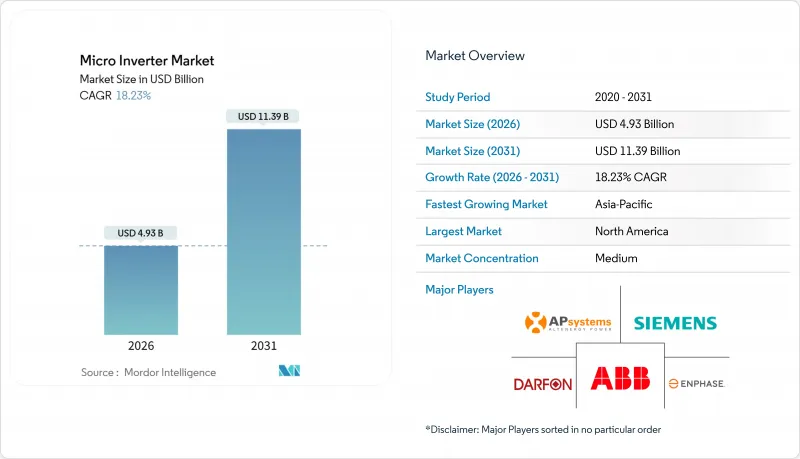
根據 Mordor Intelligence 預測,微型逆變器市場規模預計將在 2026 年達到 49.3 億美元,到 2031 年達到 113.9 億美元,在預測期內複合年成長率將達到 18.23%。
本報告按相位(單相和三相)、通訊技術(有線和無線)、組件(硬體、軟體和服務)、銷售管道(直銷(OEM/線上)、間接銷售(分銷商/安裝商))、應用(住宅屋頂、商業和工業屋頂、太陽能電站/公用事業規模)以及地區進行細分。市場預測以美元(USD)為單位。
全球微型逆變器市場趨勢與洞察
NEC 690.12 消防安全要求
在美國執行NEC 690.12標準的地區,屋頂太陽能發電系統必須在收到緊急訊號後30秒內將導線電壓降至安全水平,這實際上使得傳統的串列型逆變器無法使用。微型逆變器預設符合此要求,因為每個組件在模組層級都進行了隔離,無需額外的關斷盒或佈線。歐洲標準,例如VDE-AR-N 4105,也體現了這些要求,德國和法國也正在採用類似的架構。快速關斷功能如今已成為安裝商的採購標準之一,監管的加強正在推動該行業的結構性成長。銷售符合標準的硬體和數位化試運行工具的供應商已經開闢了一個穩固的利基市場,但在監管力度較弱的市場,此類產品的普及率仍然很低。
雙面光電模組(功率超過 600 瓦)的普及
從300瓦單面組件向600瓦和700瓦雙面組件的主流轉變,導致組串式陣列中出現顯著的功率不匹配損耗。微型逆變器透過追蹤每個組件的最大功率點(MPP)來緩解此問題,從而回收因陰影和灰塵等因素造成的5%至8%的能量損失。製造商正在透過提高輸入電流和電壓容差來應對這項挑戰。 Enphase的IQ9支援640瓦組件,使安裝人員能夠在不降低額定功率的情況下組合使用新一代組件。隨著天窗和暖通空調系統在商業屋頂上的普及,提高能源效率的討論日益激烈,到2020年代中期,微型逆變器很可能成為高功率組件的最佳解決方案。
1千瓦以上三相電機組短缺
商用屋頂光電系統運作208V 或 480V 三相電路,但大多數產品目錄仍僅限於 500W 以下的單相型號。 APsystems 於 2024 年推出了一款 1.8kW 的三相微型逆變器,但產量有限,而競爭對手則優先發展利潤更高的組串式產品。這種供不應求迫使安裝商要么過載電路,要么重新採用組串式系統,從而減緩了微型逆變器在 100kW 以上系統中的普及。技術挑戰、複雜的閘極驅動器、大型濾波器組以及高壓矽晶圓等因素使元件成本增加了約 30%,在新的晶圓廠解決元件短缺問題之前,規模經濟效益的實現將被推遲。
細分市場分析
到2025年,單相設備仍將佔據住宅市場的大部分佔有率,佔微型逆變器市場佔有率的53.44%。這一細分市場的成功得益於即插即用的接線方式、簡化的授權流程以及覆蓋北美和歐洲的成熟供應鏈。然而,預計到2031年,三相設備將以18.77%的複合年成長率成長,隨著大型零售商店、倉庫和輕工業設施屋頂對更高能量密度的需求,三相設備在微型逆變器市場的佔有率也將持續擴大。在超過100千瓦的專案中,這種架構因其在208伏特和400伏特電網中均衡的負載分配而備受青睞,能夠降低中性點電流並改善電壓調節。
商業安裝商也提到了澳洲和加州的電網支援義務。這些義務鼓勵分散式無功功率注入,而三相微型逆變器在這方面比集中式設計能提供更精細的控制。然而,產品供不應求和20-30%的價格溢價阻礙了其廣泛應用,導致一些EPC公司採用串列型逆變器,並將微型逆變器的安裝限制在複雜的天窗區域。能夠大規模生產碳化矽(SiC)功率級並獲得1kW以上SKU認證的供應商,預計在未來兩年內滿足市場積壓的需求。
有線數據平台在2025年佔據了59.83%的市場。這主要歸功於其不易受無線干擾,並且符合關鍵基礎設施環境中更嚴格的網路安全準則。然而,Zigbee、Wi-Fi和sub-GHz網狀網路等無線連結預計到2031年將以18.72%的複合年成長率成長,並有望擴大其在微型逆變器市場的佔有率。據維修團隊稱,由於無需進行管道施工,安裝時間最多可縮短20%,尤其是在維修需要大量人工的西班牙瓦屋頂上。
Enphase 的「Envoy-S」閘道透過 2.4 GHz 網狀網路整合數百台逆變器,無需經過住宅路由器即可將加密資料直接傳送到雲端伺服器。在澳洲和印度的農村地區,寬頻連線不穩定,蜂巢式回程傳輸的使用正在不斷擴展。然而,大型工業設備附近仍存在射頻擁塞和干擾的風險,因此大規模商業專案正轉向混合拓撲結構,將電力線通訊 (PLC) 用於核心監控,並將無線通訊用於輔助模組。
區域分析
2025年,北美微型逆變器市佔率維持在36.94%。這主要得益於美國國家電氣公司(NEC)的快速關斷法規以及聯邦政府的稅收優惠政策,這些政策縮短了太陽能發電和儲能系統維修的投資回收期。加州、紐約州和馬薩諸塞州的安裝量領先,而加拿大安大略省等省份則探索了社區太陽能試點項目,這些項目將利用面板級電子設備向居民計費。 Enphase公司佔據了北美約75%的市場佔有率,這得益於其品牌知名度和將硬體、監控設備和電池捆綁銷售的直銷模式。
預計到2031年,亞太地區將超越其他地區,年複合成長率將達到19.27%,主要得益於中國、印度和澳洲大力推動分散式太陽能發電政策。中國的「碳排放達峰和碳中和」目標以及省級補貼政策加速了都市區屋頂光伏發電項目的推進,使得Hoymiles和Envertech等國內製造商能夠以低於進口產品的價格提供產品,並獲得在地採購積分。印度的目標是到2026年實現40吉瓦的屋頂光伏發電裝置容量,並依靠微型逆變器來緩解人口密集都市區陰影遮蔽的影響。澳洲嚴格的AS/NZS 4777.2併網標準要求具備電壓維持和無功功率支援功能,這些功能已成為現代微型逆變器的標配,並推動了高階型號的普及。
在歐洲,受德國「陽台太陽能」熱潮、法國能源轉型藍圖以及英國智慧出口保障計畫的推動,太陽能市場持續穩定成長。預計2025年,德國內建微型逆變器的即插即用型太陽能系統安裝量將超過50萬套。在西班牙和義大利等南歐市場,由於慷慨的上網電價補貼政策仍偏向價格低廉的組串式太陽能解決方案,太陽能普及速度依然緩慢。但隨著旨在促進自用能源的法規修訂,預計這一差距將會縮小。中東和非洲地區由於熱能降額和住宅經濟的脆弱性,仍處於發展階段,但阿拉伯聯合大公國和南非的先導計畫表明,人們對太陽能的興趣日益濃厚。在南美洲,發展勢頭集中在巴西,儘管貨幣波動,但淨計量系統的改革正在推動屋頂太陽能的普及。
其他好處:
- Excel格式的市場預測(ME)表
- 3個月的分析師支持
目錄
第1章:引言
- 研究假設和市場定義
- 調查範圍
第2章:調查方法
第3章執行摘要
第4章 市場狀況
- 市場概覽
- 市場促進因素
- MLPE(多重生命保護設備)的快速普及是由美國和歐洲的 NEC 690.12 消防安全標準所推動的。
- 隨著功率超過 600W 的雙面太陽能發電組件的日益普及,對每個組件進行最佳化變得至關重要。
- 將微型逆變器整合到住宅儲能系統中
- 在德國和荷蘭,「陽台太陽能」裝置的數量正在迅速增加。
- 關於電力公司接受能力的政策,該政策要求具備先進的電網支援功能
- 插入式太陽能發電設備(DIN VDE V 0126-95)的標準化擴大了 1 kW 以下系統的 DIY 市場。
- 市場限制因素
- 由於功率超過 1 kW 的三相微型逆變器 SKU 短缺,商業性應用受到限制。
- 沙漠氣候中的熱降額與可靠性問題
- 廠商鎖定型專有通訊協定
- SiC/GaN晶片的供應限制正在推高物料清單成本。
- 產業價值鏈分析
- 技術展望
- 監理情勢
- 波特五力分析
- 價格分析
- 宏觀經濟因素對市場的影響
第5章 市場規模與成長預測
- 依相位類型
- 單相
- 三相
- 透過通訊技術
- 有線
- 無線的
- 按組件
- 硬體
- 軟體服務
- 按銷售管道
- 直接(OEM/線上)
- 間接銷售(銷售代理/安裝人員)
- 透過使用
- 住宅屋頂
- 商業和工業屋頂
- 太陽能發電廠/大型發電廠
- 按地區
- 北美洲
- 美國
- 加拿大
- 墨西哥
- 歐洲
- 德國
- 英國
- 法國
- 義大利
- 其他歐洲國家
- 亞太地區
- 中國
- 日本
- 印度
- 韓國
- 澳洲
- 其他亞太國家
- 中東和非洲
- 中東
- 沙烏地阿拉伯
- 阿拉伯聯合大公國
- 其他中東國家
- 非洲
- 南非
- 埃及
- 其他非洲國家
- 中東
- 南美洲
- 巴西
- 阿根廷
- 其他南美國家
- 北美洲
第6章 競爭情勢
- 市場集中度
- 策略趨勢
- 市佔率分析
- 公司簡介
- Enphase Energy Inc.
- Altenergy Power Systems
- ABB Ltd.
- Darfon Electronics Corp.
- Siemens AG
- Hoymiles Power Electronics
- Delta Energy Systems
- SMA Solar Technology AG
- SunPower Corp.
- Zhejiang Envertech Corp.
- Omnik New Energy
- AEconversion GmbH and Co. KG
- Sparq Systems Inc.
- Sensata Technologies Inc.
- EnluxSolar Co. Ltd.
- Chilicon Power LLC
- Northern Electric Power
- ReneSola Power
- Tigo Energy Inc.
- SolarEdge Technologies Inc.
第7章 市場機會與未來展望
According to Mordor Intelligence, the micro inverter market size stood at USD 4.93 billion in 2026 and is projected to reach USD 11.39 billion by 2031, advancing at an 18.23% CAGR over the forecast period.
This report is Segmented by Phase Type (Single-Phase, and Three-Phase), Communication Technology (Wired, and Wireless), Component (Hardware, Software and Services), Sales Channel (Direct (OEM/Online), Indirect (Distributors/Installers)), Application (Residential Rooftop, Commercial and Industrial Rooftop, PV Power Plant / Utility-Scale), and Geography. The Market Forecasts are Provided in Terms of Value (USD).
Global Micro Inverter Market Trends and Insights
NEC 690.12 Fire-Safety Mandates
U.S. jurisdictions that enforce NEC 690.12 require rooftop PV systems to drop conductor voltage to safe levels within 30 seconds of an emergency signal, effectively sidelining legacy string inverters. Microinverters satisfy the rule by default because each panel is isolated at the module level, eliminating extra shutdown boxes and wiring. European standards such as VDE-AR-N 4105 echo these requirements, pulling Germany and France toward similar architectures. Rapid-shutdown compliance is now a purchase criterion for installers, turning code enforcement into a structural growth lever. Vendors that bundle rule-compliant hardware with digital commissioning tools have carved out a defensible niche, while markets with slower enforcement continue to show lagging penetration.
Proliferation of Above 600 W Bifacial PV Modules
The mainstream shift from 300 W monofacial panels to 600 W and 700 W bifacial modules has introduced pronounced mismatch losses in string-tied arrays. Microinverters mitigate the issue by tracking the maximum power point at each module, recapturing 5-8% of the energy otherwise lost to shade and soiling differentials. Manufacturers have responded by uprating input current and voltage thresholds; Enphase's IQ9 handles 640-W modules, enabling installers to pair next-generation panels without derating. As commercial rooftops add skylights and HVAC units, the energy-gain argument intensifies, positioning microinverters as the preferred solution for high-wattage modules through mid-decade.
Scarcity of Above 1 kW Three-Phase Units
Commercial rooftops run on 208 V or 480 V three-phase circuits, yet most catalogs still top out at sub-500 W single-phase models. APsystems released a 1.8 kW three-phase micro inverter in 2024, but production was limited, and rivals prioritized higher-margin string products. The shortage forces installers either to oversubscribe circuits or to revert to string architectures, slowing micro-inverter penetration above 100 kW system sizes. Technical hurdles, complex gate drivers, larger filter banks, and higher-voltage silicon inflate bill-of-material costs by roughly 30%, postponing economies of scale until new fabs alleviate component shortages.
Other drivers and restraints analyzed in the detailed report include:
- Integration With Residential Storage Ecosystems
- Balcony Solar Boom in Germany and the Netherlands
- SiC/GaN Semiconductor Bottlenecks
For complete list of drivers and restraints, kindly check the Table Of Contents.
Segment Analysis
Single-phase devices continued to capture the bulk of residential demand in 2025, accounting for 53.44% of the micro inverter market share. The segment's installed base benefits from plug-and-play wiring, straightforward permitting, and mature supply chains across North America and Europe. Yet three-phase units are poised for an 18.77% CAGR through 2031, raising their share of the micro inverter market as big-box retail, warehouse, and light-industrial rooftops chase higher energy densities. Projects above 100 kW laud the architecture for balanced loading across 208 V and 400 V networks, mitigating neutral currents and improving voltage regulation.
Commercial installers also cite grid-support mandates in Australia and California that favor distributed reactive-power injection, a function that three-phase microinverters implement more granularly than centralized designs. Still, product scarcity and a 20-30% price premium temper adoption, leaving some EPC firms to hybridize arrays with string inverters on non-shaded facets while reserving microinverters for complex skylight zones. Suppliers that can scale silicon-carbide power stages and qualify >1 kW SKUs are likely to capture pent-up demand over the next two years.
Wired data platforms secured a 59.83% share in 2025, favored for their immunity to radio interference and compliance with cyber-hardening guidelines in critical-infrastructure settings. However, wireless links such as Zigbee, Wi-Fi, and sub-GHz mesh are forecast to grow at an 18.72% CAGR through 2031, carving out a rising share of the micro inverter market. Retrofit crews report up to 20% lower installation hours when conduit runs are eliminated, especially on Spanish-tile roofs where retrofits are labor-intensive.
Enphase's Envoy-S gateway aggregates hundreds of inverters over a 2.4 GHz mesh, bypassing homeowner routers and pushing encrypted data directly to cloud servers. Cellular backhaul is gaining favor in rural Australia and India, where broadband access is erratic. Nonetheless, RF congestion and jamming risks persist near heavy industrial equipment, nudging large commercial projects toward hybrid topologies that combine power-line carrier for core monitoring and wireless for ancillary modules.
Complete Report Scope:
- By Phase Type
- Single-Phase
- Three-Phase
- By Communication Technology
- Wired
- Wireless
- By Component
- Hardware
- Software and Services
- By Sales Channel
- Direct (OEM/Online)
- Indirect (Distributors/Installers)
- By Application
- Residential Rooftop
- Commercial and Industrial Rooftop
- PV Power Plant / Utility-Scale
- By Geography
- North America
- United States
- Canada
- Mexico
- Europe
- Germany
- United Kingdom
- France
- Italy
- Rest of Europe
- Asia-Pacific
- China
- Japan
- India
- South Korea
- Australia
- Rest of Asia-Pacific
- Middle East and Africa
- Middle East
- Saudi Arabia
- United Arab Emirates
- Rest of Middle East
- Africa
- South Africa
- Egypt
- Rest of Africa
- Middle East
- South America
- Brazil
- Argentina
- Rest of South America
- North America
Geography Analysis
North America retained a 36.94% micro inverter market share in 2025, propelled by NEC's rapid-shutdown rules and federal tax incentives that shorten payback periods for solar-plus-storage retrofits. California, New York, and Massachusetts led installations, while Canadian provinces such as Ontario explored community solar pilots using panel-level electronics for tenant billing. Enphase commanded roughly 75% of North American revenues, benefiting from brand recognition and a direct-sales model that bundles hardware, monitoring, and batteries.
Asia-Pacific is poised for a 19.27% CAGR through 2031, eclipsing other regions as China, India, and Australia press ahead with distributed-solar policies. China's dual-carbon pledge and provincial subsidies accelerated urban rooftop programs, letting domestic makers like Hoymiles and Envertech underprice imports and capture local content credits. India targets 40 GW of rooftop solar capacity by 2026, relying on microinverters to mitigate shading in densely packed cities. Australia's stringent AS/NZS 4777.2 grid code requires voltage-ride-through and reactive-power support, features native to modern micro inverters, sustaining premium adoption rates.
Europe continues steady growth on the back of Germany's balcony-solar phenomenon, France's energy-transition roadmap, and the United Kingdom's smart export guarantee. Germany surpassed 500,000 plug-in kits in 2025, each equipped with embedded microinverters. Southern markets such as Spain and Italy saw slower uptake due to generous feed-in tariffs that still favor cheaper string solutions, yet revised rules targeting self-consumption are expected to narrow the gap. The Middle East and Africa remain nascent, hindered by thermal derating and weaker residential economies, though pilot projects in the United Arab Emirates and South Africa signal emerging interest. South America's momentum centers on Brazil, where net-metering reforms catalyze rooftop adoption despite currency volatility.
- Enphase Energy Inc.
- Altenergy Power Systems
- ABB Ltd.
- Darfon Electronics Corp.
- Siemens AG
- Hoymiles Power Electronics
- Delta Energy Systems
- SMA Solar Technology AG
- SunPower Corp.
- Zhejiang Envertech Corp.
- Omnik New Energy
- AEconversion GmbH and Co. KG
- Sparq Systems Inc.
- Sensata Technologies Inc.
- EnluxSolar Co. Ltd.
- Chilicon Power LLC
- Northern Electric Power
- ReneSola Power
- Tigo Energy Inc.
- SolarEdge Technologies Inc.
Additional Benefits:
- The market estimate (ME) sheet in Excel format
- 3 months of analyst support
TABLE OF CONTENTS
1 INTRODUCTION
- 1.1 Study Assumptions and Market Definition
- 1.2 Scope of the Study
2 RESEARCH METHODOLOGY
3 EXECUTIVE SUMMARY
4 MARKET LANDSCAPE
- 4.1 Market Overview
- 4.2 Market Drivers
- 4.2.1 Rapid Adoption of MLPE Driven by NEC 690.12 Fire-Safety Codes in the U.S. and Europe
- 4.2.2 Proliferation of above 600 W Bifacial PV Modules Requiring Per-Panel Optimization
- 4.2.3 Integration of Micro-Inverters with Residential Storage Ecosystems
- 4.2.4 Surge in "Balcony Solar" Installations in Germany and the Netherlands
- 4.2.5 Utility Hosting-Capacity Policies Mandating Advanced Grid-Support Functions
- 4.2.6 Standardization of Plug-In Solar Devices (DIN VDE V 0126-95) Unlocks DIY Sub-1 kW Segment
- 4.3 Market Restraints
- 4.3.1 Scarcity of above 1 kW Three-Phase Micro-Inverter SKUs Limits Commercial Uptake
- 4.3.2 Thermal Derating and Reliability Issues in Desert Climates
- 4.3.3 Vendor-Locked Proprietary Communication Protocols
- 4.3.4 SiC/GaN Chip Supply Constraints Inflate BOM Costs
- 4.4 Industry Value Chain Analysis
- 4.5 Technological Outlook
- 4.6 Regulatory Landscape
- 4.7 Porter's Five Forces Analysis
- 4.7.1 Threat of New Entrants
- 4.7.2 Bargaining Power of Buyers
- 4.7.3 Bargaining Power of Suppliers
- 4.7.4 Threat of Substitutes
- 4.7.5 Intensity of Competitive Rivalry
- 4.8 Pricing Analysis
- 4.9 Impact of Macroeconomic Factors on the Market
5 MARKET SIZE AND GROWTH FORECASTS (VALUE)
- 5.1 By Phase Type
- 5.1.1 Single-Phase
- 5.1.2 Three-Phase
- 5.2 By Communication Technology
- 5.2.1 Wired
- 5.2.2 Wireless
- 5.3 By Component
- 5.3.1 Hardware
- 5.3.2 Software and Services
- 5.4 By Sales Channel
- 5.4.1 Direct (OEM/Online)
- 5.4.2 Indirect (Distributors/Installers)
- 5.5 By Application
- 5.5.1 Residential Rooftop
- 5.5.2 Commercial and Industrial Rooftop
- 5.5.3 PV Power Plant / Utility-Scale
- 5.6 By Geography
- 5.6.1 North America
- 5.6.1.1 United States
- 5.6.1.2 Canada
- 5.6.1.3 Mexico
- 5.6.2 Europe
- 5.6.2.1 Germany
- 5.6.2.2 United Kingdom
- 5.6.2.3 France
- 5.6.2.4 Italy
- 5.6.2.5 Rest of Europe
- 5.6.3 Asia-Pacific
- 5.6.3.1 China
- 5.6.3.2 Japan
- 5.6.3.3 India
- 5.6.3.4 South Korea
- 5.6.3.5 Australia
- 5.6.3.6 Rest of Asia-Pacific
- 5.6.4 Middle East and Africa
- 5.6.4.1 Middle East
- 5.6.4.1.1 Saudi Arabia
- 5.6.4.1.2 United Arab Emirates
- 5.6.4.1.3 Rest of Middle East
- 5.6.4.2 Africa
- 5.6.4.2.1 South Africa
- 5.6.4.2.2 Egypt
- 5.6.4.2.3 Rest of Africa
- 5.6.4.1 Middle East
- 5.6.5 South America
- 5.6.5.1 Brazil
- 5.6.5.2 Argentina
- 5.6.5.3 Rest of South America
- 5.6.1 North America
6 COMPETITIVE LANDSCAPE
- 6.1 Market Concentration
- 6.2 Strategic Moves
- 6.3 Market Share Analysis
- 6.4 Company Profiles (includes Global Level Overview, Market Level Overview, Core Segments, Financials as Available, Strategic Information, Market Rank/Share for Key Companies, Products and Services, and Recent Developments)
- 6.4.1 Enphase Energy Inc.
- 6.4.2 Altenergy Power Systems
- 6.4.3 ABB Ltd.
- 6.4.4 Darfon Electronics Corp.
- 6.4.5 Siemens AG
- 6.4.6 Hoymiles Power Electronics
- 6.4.7 Delta Energy Systems
- 6.4.8 SMA Solar Technology AG
- 6.4.9 SunPower Corp.
- 6.4.10 Zhejiang Envertech Corp.
- 6.4.11 Omnik New Energy
- 6.4.12 AEconversion GmbH and Co. KG
- 6.4.13 Sparq Systems Inc.
- 6.4.14 Sensata Technologies Inc.
- 6.4.15 EnluxSolar Co. Ltd.
- 6.4.16 Chilicon Power LLC
- 6.4.17 Northern Electric Power
- 6.4.18 ReneSola Power
- 6.4.19 Tigo Energy Inc.
- 6.4.20 SolarEdge Technologies Inc.
7 MARKET OPPORTUNITIES AND FUTURE OUTLOOK
- 7.1 White-Space and Unmet-Need Assessment

 高壓混合逆變器市場:全球市場預測,2026-2032年整合式高壓逆變器市場:全球市場預測,2026-2032年
 2026-2030年全球可再生能源逆變器市場
 低壓逆變器市場-全球及區域分析:按應用、產品與國家分類-分析與預測(2026-2036年)微型逆變器市場:全球預測,2026-2032年汽車電源逆變器市場:2026-2032年全球市場預測(依變頻器類型、類別、額定輸出、組件、車輛類型和銷售管道)
 VVVF逆變器市場規模、佔有率和成長分析:按產品類型、技術類型、組件類型、最終用戶產業和地區分類-2026-2033年產業預測混合逆變器市場:依電池化學成分、類型、相數、額定功率、安裝方式、連接方式及最終用戶分類-2026-2032年全球市場預測系統互連用)電池整合逆變器市場:按類型、電池化學成分、逆變器配置、容量範圍、安裝類型和應用分類-2026-2032年全球市場預測