

 |
市場調查報告書
商品編碼
2124069
磚塊:市場佔有率分析、行業趨勢和統計數據、成長預測(2026-2031 年)Brick - Market Share Analysis, Industry Trends & Statistics, Growth Forecasts (2026 - 2031) |
||||||

※ 本網頁內容可能與最新版本有所差異。詳細情況請與我們聯繫。
根據 Mordor Intelligence 估計,到 2026 年,磚塊市值將達到 1.78 兆美元,高於 2025 年的 1.73 兆美元,預計到 2031 年將達到 2.03 兆美元。
預計從 2026 年到 2031 年,其複合年成長率將達到 2.74%。
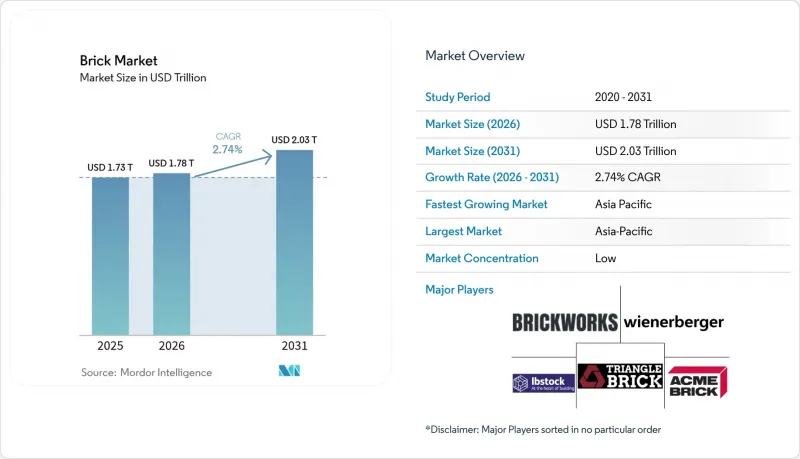
本報告按磚塊類型(粘土磚、砂石灰磚、飛灰粘土磚等)、應用領域(建築、人行道、花壇等)、最終用戶行業(住宅和非住宅建築)、配銷通路(直銷、經銷商和零售網路)以及地區(亞太地區、北美地區、歐洲地區、南美地區以及中東和非洲地區)進行細分。市場預測以美元(USD)計價。
全球磚塊市場趨勢及洞察
新冠疫情後時代都市化進程的有利因素
亞洲主要城市建築業的快速復甦再次推動了中層住宅項目的建設,維持了磚塊市場的強勁需求。聯合國亞洲及太平洋經濟社會委員會(亞太經社會)預測,到2030年,該地區的城市人口將達到32億,並湧現22個特大城市。由於磚石結構作為承重牆具有成本效益,且當地工人熟悉其施工方法,因此廣泛應用於中層住宅。各國政府正在增加社會住宅預算,以應對住宅短缺問題。預計到2024年,光是印度就將面臨1,870萬套住房的缺口,而印尼也已確認缺口達1,250萬套,這兩個國家都進一步推高了對磚塊的基本需求。供應商正將供應基地設在靠近一線城市成長走廊的地方,以最大限度地降低運輸成本。設備升級提高了窯爐的生產能力,同時又不增加燃料消耗,這使得承包商即使在建築需求週期性激增時期也能按時收到交貨。
「綠色」建築標準
歐洲到2040年將碳排放量減少90%的目標正在改變磚塊市場,加速飛灰和矽酸鈣磚的普及,因為這兩種磚的碳足跡較小。矽酸鈣磚的初級能源消耗量為241千瓦時/噸,遠低於傳統黏土磚,因此對於尋求英國淨零碳建築標準認證的設計師來說,矽酸鈣磚是一個極具吸引力的選擇。混凝土磚無需燒製,每戶住宅可減少2.4噸二氧化碳排放,並在其整個生命週期中作為淨二氧化碳匯。公共部門計畫現在都納入了使用再生材料的最低標準,要求工廠將玻璃屑玻璃和固態廢棄物燒製到磚塊混合物中。能夠檢驗從生產到現場的生命週期資料的製造商,可以在維修專案和公共採購競標中獲得規格優勢。
預製建築構件
在人手不足日益加劇的背景下,北美和歐洲的建築商正將目光轉向模組化建築,逐漸放棄傳統的磚砌外牆。預製解決方案可將現場施工時間縮短30%至50%,並將人事費用降低50%至80%。到2025年,美國將需要新增50.1萬名技術純熟勞工,因此建築商將標準板材視為風險對沖手段。雖然低矮的磚片和機器固定的面磚使砌體供應商得以維持市場佔有率,但在傳統磚牆被取代的地區,整體單元需求正在下降。製造商正在投資機器人層壓生產線以生產混合牆板,但由於必須以不斷萎縮的傳統銷售量為基礎來攤銷資本投資,利潤率正受到擠壓。
細分市場分析
儘管預計到2025年黏土磚仍將主導磚塊市場,佔銷售額的64.35%,但飛灰磚在碳排放法規更為嚴格的地區正日益受到青睞,預計到2031年將以3.12%的複合年成長率成長。這項轉變主要得益於工業廢棄物的利用,使工廠能夠將燒製溫度降低20%,從而滿足循環經濟的要求。由於公共採購標準重視使用回收材料,飛灰磚的市場規模預計將比其他任何類型的磚塊成長得更快。在歐洲氣候寒冷的地區,建築師青睞矽酸鈣磚,因為它具有良好的熱容量優勢。同時,在電力供應充足但燃料供應不穩定的地區,無需窯燒的混凝土塊的需求也不斷成長。
技術進步包括吸水率僅4-7%的薄炭磚。這些磚的性能優於市場上同類產品,價格為每平方公尺25.83美元,不到傳統磚價格的一半。製造商也正在推廣中空結構磚,這種磚在生產過程中可以減少二氧化碳排放,並減輕物流負擔。這些創新共同助力磚業實現脫碳目標,同時不影響結構可靠性。目前只有少數早期採用者擁有專利,這意味著在不久的將來,新的授權收入來源將會出現,並有可能改變磚業的利潤結構。
到2025年,建築用磚將佔磚市場佔有率的59.10%,這反映了砌體在結構牆和外觀中的歷史地位。建築規範的修訂,尤其是對氣密性和防火性能的提倡,正在支撐這項核心需求。同時,人行道和鋪路用磚市場正以3.02%的複合年成長率成長,這主要得益於業主對戶外環境維修的投資以及市政當局為應對日益成長的行人流量而對人行道的維修。
磚瓦製造商正利用黏土的抗褪色特性和磚塊的高摩擦係數,來滿足景觀客戶對低維護成本和更多樣化設計的需求。互鎖邊緣的磚塊加快了施工速度,降低了承包商的成本,並能適應短期維修計畫。在高檔住宅,花壇式和裝飾花園風格正重新受到關注,因為美學差異化能夠帶來更高的利潤率。工業客戶更傾向於使用耐酸磚來製作爐襯和化學處理池,這進一步增強了磚瓦的多功能性,並保護生產商免受單一行業衰退的影響。
區域分析
預計到2025年,亞太地區將佔全球磚銷售額的47.30%,並在創紀錄的都市區化進程和大型企劃的推動下,以每年3.30%的速度成長至2031年。中國和印度正引領磚消費,公共部門大力推動住宅建設,同時地鐵、機場和工業園區的建設也同步進行。為了滿足各省的排放標準並減少對煤炭的依賴,生產商正在引入具有餘熱回收功能的隧道窯,從而確保即使在需求激增的情況下也能確保供應穩定。
在北美,由於預期利率走低,專案停滯現象正在加速,推高了市場價值。根據美國建築師協會(AIA)的共識建築預測,繼2023年至2024年穩健成長後,非住宅支出預計將在2025年成長2.2%,2026年成長2.6%。飛灰磚因其有助於獲得LEED認證積分而備受設計師青睞,而低矮的磚板則加速了都市區多用戶住宅的建設。加拿大寒冷的氣候促使住宅維修中對高熱容量黏土建築材料的需求持續成長,以降低暖氣負荷。
儘管歐洲經濟成長速度落後於其他國家,但在創新方面卻扮演領先角色。碳邊境調節機制(CBAM)能夠有效監管高碳排放的進口產品,並扶持本土脫碳先驅。 2022年,歐洲進口了超過5億塊磚,排放了288,190噸二氧化碳。這引發了人們呼籲將更多主導生產能力轉移回國內。斯堪地那維亞的公共採購政策對隱含碳排放量設定了限制,並鼓勵訂購矽酸鈣磚和未燒製混凝土磚。在東歐,為了滿足面臨材料短缺的國內市場和德國市場的需求,產能正在擴大。
南美洲的磚塊市場正圍繞著倉庫和物流設施的建設而發展,電子商務的興起更是推動了這一發展。在巴西,沿著新建高速公路的工業園區建設正在加速推進,這增加了對可縮短鋪設時間的大塊磚的需求。材料供應商正投資當地工廠,以避免外匯波動和進口關稅的影響。中東和非洲雖然目前規模較小,但成長潛力巨大,因為到2040年所需建築的70%尚未建成。肯亞、奈及利亞和埃及正在發展官民合作關係,以提供經濟適用住宅,並在其競標中納入磚塊採購目標,以促進國內製造業的發展。
其他好處:
- Excel格式的市場預測(ME)表
- 3個月的分析師支持
目錄
第1章:引言
- 研究假設和市場定義
- 調查範圍
第2章:調查方法
第3章執行摘要
第4章 市場狀況
- 市場概覽
- 市場促進因素
- 新冠疫情後的都市化正在推動亞洲對中層住宅的需求。
- 「綠色」建築標準正在推動歐洲飛灰和矽酸鈣磚的使用。
- 模組化建築增加了對高強度中空磚的需求。
- 撒哈拉以南非洲政府補貼的低成本住宅
- 南美洲電子商務倉庫擴建
- 市場限制因素
- 預製建築材料的發展趨勢
- 亞洲黏土原料價格波動
- 碳排放稅對歐洲高耗窯爐的影響
- 價值鏈分析
- 波特五力模型
第5章 市場規模與成長預測
- 按磚的類型
- 黏土
- 砂石灰
- 飛灰黏土
- 其他磚型
- 透過使用
- 建築學
- 人行道、步道和公園小徑
- 花壇/觀賞花壇
- 其他用途
- 按最終用途行業分類
- 住宅大樓
- 非住宅建築
- 透過分銷管道
- 直銷(企劃為基礎)
- 經銷商和零售網路
- 按地區
- 亞太地區
- 中國
- 印度
- 日本
- 韓國
- 其他亞太國家
- 北美洲
- 美國
- 加拿大
- 墨西哥
- 歐洲
- 德國
- 英國
- 法國
- 義大利
- 其他歐洲國家
- 南美洲
- 巴西
- 阿根廷
- 其他南美國家
- 中東和非洲
- 沙烏地阿拉伯
- 南非
- 其他中東和非洲國家
- 亞太地區
第6章 競爭情勢
- 市場集中度
- 策略趨勢
- 市佔率分析
- 公司簡介
- Acme Brick Company
- BigBloc Construction Ltd.
- Bowerston Shale
- Brampton Brick
- Brickworks
- Brickworks
- Cemex SAB de CV
- Columbia Brick Inc.
- Forterra Building Products Ltd
- General Shale Inc.
- Glen-Gery Corporation
- HEBRON BRICK
- Ibstock Plc.
- LEE Building Products
- Lignacite Ltd
- Oldcastle APG
- Palmetto Brick Company
- Supreme Concrete
- Triangle Brick Co.
- Wienerberger AG
- Xella International
第7章 市場機會與未來展望
According to Mordor Intelligence, brick market size in 2026 is estimated at USD 1.78 trillion, growing from 2025 value of USD 1.73 trillion with 2031 projections showing USD 2.03 trillion, growing at 2.74% CAGR over 2026-2031.
This report is Segmented by Brick Type (Clay, Sand Lime, Fly-Ash Clay, and More), Application (Buildings, Path, Parterre, and More), End-Use Industry (Residential Buildings and Non-Residential Buildings), Distribution Channel (Direct and Dealer and Retail Network), and Geography (Asia-Pacific, North America, Europe, South America, and Middle East and Africa). The Market Forecasts are Provided in Terms of Value (USD).
Global Brick Market Trends and Insights
Post-COVID Re-urbanisation Boost
Rapid migration back to major Asian cities is refilling pipelines for mid-rise housing projects, sustaining steady brick market demand. UN ESCAP projects the region's urban population will touch 3.2 billion by 2030, spawning 22 megacities. Mid-rise formats rely on masonry for cost-effective load-bearing walls and local labor familiarity. Governments are increasing social-housing budgets to narrow deficits-India alone recorded an 18.7-million-unit gap in 2024, while Indonesia tallied 12.5 million units, each amplifying baseline need for bricks. Vendors position supply hubs close to Tier-1 growth corridors to minimize freight costs. Equipment upgrades that raise kiln capacity without higher fuel burn ensure contractors receive on-time deliveries during cyclical building surges.
'Green' Building Codes
Europe's 90% emissions-cut target for 2040 is reshaping the brick market, accelerating the adoption of fly-ash and calcium-silicate bricks with smaller carbon footprints. Calcium-silicate units consume 241 kWh/t of primary energy versus higher values for traditional clay, appealing to designers seeking certification under the UK Net Zero Carbon Buildings Standard. Concrete bricks that bypass firing processes can save 2.4 tonnes of CO2 per house and become net absorbers over their lifecycle. Public-sector projects now embed minimum recycled-material thresholds, pushing plants to integrate glass cullet and combusted solid waste into mixes. Manufacturers that verify cradle-to-site life-cycle data lock in specification advantage for renovation and public procurement tenders.
Prefabricated Construction Components
As labor shortages intensify, builders in North America and Europe pivot toward volumetric modules that sideline brick facades. Prefab solutions remove 30-50% of on-site time and lower labor costs by 50-80%. With the United States needing another 501,000 skilled workers in 2025, contractors view standard panels as risk hedges. Thin-brick slips and mechanically fixed veneers let masonry suppliers stay relevant, yet overall unit demand dips where full-bed bricks are displaced. Manufacturers invest in robotic laying lines to service hybrid wall panels but must amortize capital across a shrinking traditional volume base, squeezing margins.
Other drivers and restraints analyzed in the detailed report include:
- Modular Construction
- Government-Subsidised Housing
- Carbon-Tax Exposure
For complete list of drivers and restraints, kindly check the Table Of Contents.
Segment Analysis
Clay bricks dominated the brick market with 64.35% of revenue in 2025, yet fly-ash bricks record a 3.12% CAGR through 2031, widening their presence in regions tightening carbon rules. This shift is anchored in industrial-waste utilization, enabling plants to cut firing temperatures by 20% and align with circular-economy mandates. The brick market size for fly-ash variants is forecast to expand faster than any other type, helped by public procurement criteria that reward recycled content. Calcium-silicate units attract architects pursuing thermal-mass advantages in Europe's cool climates, while concrete blocks that skip kiln firing appeal where electricity is available and fuel security is uncertain.
Technological advances include char-based thin bricks exhibiting 4-7% water absorption, outperforming commercial peers and costing USD 25.83 per sq m, less than half the prevailing price for traditional options. Makers also promote hollow configurations that cut embodied CO2 and lighten logistics loads. Collectively, these innovations reinforce the brick market goal of decarbonization without sacrificing structural reliability. Only a handful of early adopters own patents, hinting at near-term licensing revenue streams that could reshape profit pools within the brick industry.
Building applications accounted for 59.10% of brick market share in 2025, reflecting masonry's historic role in structural walls and facades. Code updates promoting airtight envelopes and fire resistance sustain this core demand. The brick market size for path and paving solutions, however, is expanding at a 3.02% CAGR as households invest in outdoor upgrades and municipalities retrofit sidewalks to endure heavier pedestrian flows.
Manufacturers in the brick industry exploit colorfast clays and high-friction textures to serve landscaping customers seeking design variety with low maintenance. Bricks configured with interlocking edges accelerate installation, lowering contractor costs and aligning with quick-turn renovation schedules. Parterre and decorative garden formats resurface in premium estates where aesthetic differentiation commands higher margins. Industrial customers favor acid-resistant bricks for furnace linings and chemical-processing pits, reinforcing a diverse end-use spread that shelters producers from single-sector downturns.
Complete Report Scope:
- By Brick Type
- Clay
- Sand Lime
- Fly-Ash Clay
- Other Brick Types
- By Application
- Building
- Path
- Parterre
- Other Applications
- By End-Use Industry
- Residential Buildings
- Non-Residential Buildings
- By Distribution Channel
- Direct (Project-Based)
- Dealer and Retail Network
- By Geography
- Asia-Pacific
- China
- India
- Japan
- South Korea
- Rest of Asia-Pacific
- North America
- United States
- Canada
- Mexico
- Europe
- Germany
- United Kingdom
- France
- Italy
- Rest of Europe
- South America
- Brazil
- Argentina
- Rest of South America
- Middle East and Africa
- Saudi Arabia
- South Africa
- Rest of Middle East and Africa
- Asia-Pacific
Geography Analysis
Asia-Pacific generated 47.30% of 2025 global sales and is projected to grow 3.30% annually to 2031, buoyed by record urban migration and transport megaprojects. China and India spearhead masonry consumption as public-sector housing pushes converge with subway, airport, and industrial-park builds. Producers deploy tunnel kilns with waste-heat recovery to meet provincial emission caps and reduce coal dependence, safeguarding supply resiliency during demand spikes.
North America is experiencing growth in market value, driven by pending interest-rate cuts that are unlocking stalled projects. The AIA Consensus Construction Forecast sees non-residential spending rising 2.2% in 2025 and 2.6% in 2026 after a strong 2023-2024 run. Fly-ash bricks gain traction among designers chasing LEED points, while thin-brick panels speed up urban multifamily builds. Canada's colder climate sustains demand for high-thermal-mass clay units in residential retrofits to cut heating loads.
Europe trails in growth but leads innovation as the CBAM exposes carbon-intensive imports and rewards local low-carbon pioneers. The continent imported over 500 million bricks in 2022, generating 288,190 tonnes of CO2, prompting calls for onshoring greener capacity. Scandinavia's public-procurement policies stipulate embodied-carbon ceilings, channeling orders toward calcium-silicate or unfired concrete bricks. Eastern Europe builds capacity to serve domestic and German markets facing material tightness.
South America's brick market pivots on warehouse and logistics developments catalyzed by e-commerce. Brazil accelerates industrial parks along new highways, increasing demand for large-format blocks that reduce lay-rate time. Material suppliers invest in local plants to sidestep currency volatility and import duties. Middle East and Africa, although smaller today, hold the loftiest upside as 70% of buildings required by 2040 are yet to be built. Kenya, Nigeria and Egypt roll out public-private partnerships to deliver affordable homes, embedding brick procurement targets into tender documents to stimulate domestic manufacturing.
- Acme Brick Company
- BigBloc Construction Ltd.
- Bowerston Shale
- Brampton Brick
- Brickworks
- Brickworks
- Cemex SAB de CV
- Columbia Brick Inc.
- Forterra Building Products Ltd
- General Shale Inc.
- Glen-Gery Corporation
- HEBRON BRICK
- Ibstock Plc.
- LEE Building Products
- Lignacite Ltd
- Oldcastle APG
- Palmetto Brick Company
- Supreme Concrete
- Triangle Brick Co.
- Wienerberger AG
- Xella International
Additional Benefits:
- The market estimate (ME) sheet in Excel format
- 3 months of analyst support
TABLE OF CONTENTS
1 Introduction
- 1.1 Study Assumptions and Market Definition
- 1.2 Scope of the Study
2 Research Methodology
3 Executive Summary
4 Market Landscape
- 4.1 Market Overview
- 4.2 Market Drivers
- 4.2.1 Post-COVID Re-urbanisation Boosting Mid-Rise Housing Demand in Asia
- 4.2.2 Green' Building Codes Driving Fly-Ash and Calcium-Silicate Brick Uptake in Europe
- 4.2.3 Modular Construction Increases Demand for High-Strength Hollow Bricks
- 4.2.4 Government-Subsidised Low-Cost Housing in Sub-Saharan Africa
- 4.2.5 Expansion of E-Commerce Warehousing in South America
- 4.3 Market Restraints
- 4.3.1 Increasing Trends of Prefabricated Construction Components
- 4.3.2 Volatility in Clay Feedstock Prices in Asia
- 4.3.3 Carbon-Tax Exposure for Energy-Intensive Kilns in Europe
- 4.4 Value Chain Analysis
- 4.5 Porter's Five Forces
- 4.5.1 Threat of New Entrants
- 4.5.2 Bargaining Power of Buyers
- 4.5.3 Bargaining Power of Suppliers
- 4.5.4 Threat of Substitutes
- 4.5.5 Degree of Competition
5 Market Size and Growth Forecasts (Value)
- 5.1 By Brick Type
- 5.1.1 Clay
- 5.1.2 Sand Lime
- 5.1.3 Fly-Ash Clay
- 5.1.4 Other Brick Types
- 5.2 By Application
- 5.2.1 Building
- 5.2.2 Path
- 5.2.3 Parterre
- 5.2.4 Other Applications
- 5.3 By End-Use Industry
- 5.3.1 Residential Buildings
- 5.3.2 Non-Residential Buildings
- 5.4 By Distribution Channel
- 5.4.1 Direct (Project-Based)
- 5.4.2 Dealer and Retail Network
- 5.5 By Geography
- 5.5.1 Asia-Pacific
- 5.5.1.1 China
- 5.5.1.2 India
- 5.5.1.3 Japan
- 5.5.1.4 South Korea
- 5.5.1.5 Rest of Asia-Pacific
- 5.5.2 North America
- 5.5.2.1 United States
- 5.5.2.2 Canada
- 5.5.2.3 Mexico
- 5.5.3 Europe
- 5.5.3.1 Germany
- 5.5.3.2 United Kingdom
- 5.5.3.3 France
- 5.5.3.4 Italy
- 5.5.3.5 Rest of Europe
- 5.5.4 South America
- 5.5.4.1 Brazil
- 5.5.4.2 Argentina
- 5.5.4.3 Rest of South America
- 5.5.5 Middle East and Africa
- 5.5.5.1 Saudi Arabia
- 5.5.5.2 South Africa
- 5.5.5.3 Rest of Middle East and Africa
- 5.5.1 Asia-Pacific
6 Competitive Landscape
- 6.1 Market Concentration
- 6.2 Strategic Moves
- 6.3 Market Share Analysis
- 6.4 Company Profiles (includes Global level Overview, Market level overview, Core Segments, Financials as available, Strategic Information, Market Rank/Share, Products and Services, Recent Developments)
- 6.4.1 Acme Brick Company
- 6.4.2 BigBloc Construction Ltd.
- 6.4.3 Bowerston Shale
- 6.4.4 Brampton Brick
- 6.4.5 Brickworks
- 6.4.6 Brickworks
- 6.4.7 Cemex SAB de CV
- 6.4.8 Columbia Brick Inc.
- 6.4.9 Forterra Building Products Ltd
- 6.4.10 General Shale Inc.
- 6.4.11 Glen-Gery Corporation
- 6.4.12 HEBRON BRICK
- 6.4.13 Ibstock Plc.
- 6.4.14 LEE Building Products
- 6.4.15 Lignacite Ltd
- 6.4.16 Oldcastle APG
- 6.4.17 Palmetto Brick Company
- 6.4.18 Supreme Concrete
- 6.4.19 Triangle Brick Co.
- 6.4.20 Wienerberger AG
- 6.4.21 Xella International
7 Market Opportunities and Future Outlook
- 7.1 White-Space and Unmet-Need Assessment
- 7.2 Increasing Carbon-Neutral Kiln Technologies

 鎂鉻磚市場:全球市場預測(2026-2032)
 荷蘭磚市場:按磚類型、應用、尺寸、最終用戶產業、美學因素、永續和地區分類。中空黏土磚市場:依產品類型、應用、銷售管道和地區分類。
 2026年全球污染吸收磚市場報告磚塊市場:2026-2032年全球市場預測(依產品類型、製造流程、應用及通路分類)絕緣耐火磚市場:2026-2032年全球市場預測(按材質、產品類型、工作溫度、應用和分銷管道分類)
 鎂鉻磚市場分析及預測(至2035年):類型、產品、應用、材質類型、技術、最終用戶、安裝類型、製程、組件、功能
 全球飛灰磚機市場規模、佔有率、趨勢和成長分析報告:2026-2034年
 污染吸收磚市場規模、佔有率和成長分析(按產品類型、應用、原料、技術、最終用戶和地區分類)- 產業預測(2026-2033 年)
 黏土磚市場-全球產業規模、佔有率、趨勢、機會及預測(細分、按混凝土砌塊類型、按製造程序類型、按地區、按競爭情況,2020-2030 年預測)