


 |
市場調查報告書
商品編碼
2124061
富馬酸:市場佔有率分析、產業趨勢與統計、成長預測(2026-2031)Fumaric Acid - Market Share Analysis, Industry Trends & Statistics, Growth Forecasts (2026 - 2031) |
||||||

※ 本網頁內容可能與最新版本有所差異。詳細情況請與我們聯繫。
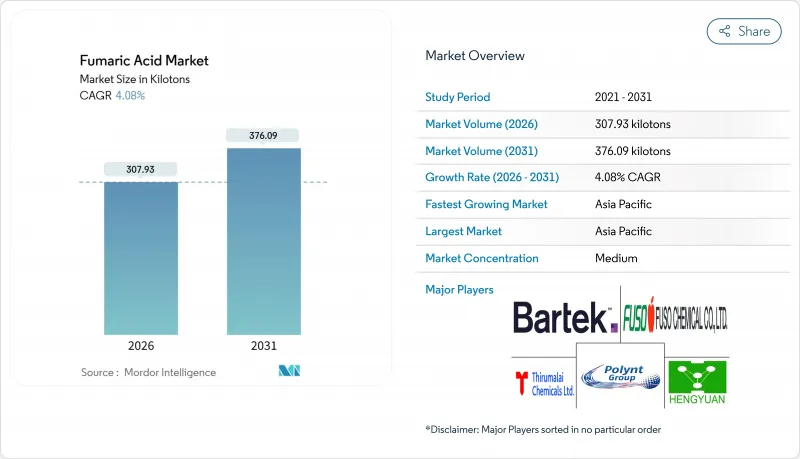
據 Mordor Intelligence 稱,2026 年富馬酸市場規模估計為 307.93 千噸,預計到 2031 年將達到 376.09 千噸,在預測期(2026-2031 年)以 4.08% 的複合年成長率。
本報告按等級(食品級和工業級)、應用(食品飲料加工、不飽和聚酯樹脂等)、終端用戶行業(化學、食品飲料等)和地區(亞太、北美、歐洲、南美、中東和非洲)進行細分。市場預測以噸為單位。
全球富馬酸市場趨勢及洞察
亞洲簡便食品中生物發酵富馬酸對「潔淨標示」的需求。
消費者對配料標籤的關注正在改變日本、韓國和中國酸味劑的採購方式。日本《食品衛生法》修正案於2024年4月生效,該修正案強制要求明確標註合成添加劑,這將導致便利商店連鎖店紛紛調整配方。此外,韓國於2024年11月發布的指導方針鼓勵生產商公開其生產流程,進一步刺激了對發酵衍生原料的需求。預計煙台恆源和昌茂生化等中國企業將在2024年至2025年間將其生物基原料產能提高約1.5萬噸,從而將食品級生物基原料25%的價格溢價在2025年降低至約12%。隨著東南亞國協中產階級收入的成長,也預計會出現類似的趨勢,從而推動區域內生物基原料的普及應用。
在輕量化電動車和風力渦輪機葉片的複合材料中,過渡到使用不飽和聚酯樹脂。
目前,電動車 (EV) 平台大約使用 450 磅塑膠和複合材料,相比之下,內燃機 (ICE) 汽車的用量為 310 磅。這一差異主要是由於電池重量的增加抵消了重量的增加。歐洲汽車製造商的目標是到 2025 年實現所有車型二氧化碳排放目標,他們正在指定使用含有 8% 至 12% 富馬酸酯共聚物的玻璃纖維增強型不飽和聚酯樹脂 (UPR) 零件。同樣,在離岸風力發電專案中,對於長度超過 80 公尺的葉片,由於需要更高的抗疲勞性能,富馬酸酯改性 UPR 是首選材料。同時,豪華車市場正在轉向碳纖維預浸料和生物環氧樹脂材料,但大眾市場電動車的需求才是推動整體趨勢的主要動力,預計產量將持續成長。
馬來酸酐原料和苯的價格波動。
2024年至2025年間,中國馬來酸酐現貨價格在每噸1,050美元至1,400美元之間劇烈波動,反映了苯價格的波動。 2024年第一季,苯價格一度超過每噸7,200元人民幣,導致中國多家小規模富馬酸生產商停產。歐洲業者面臨雙重打擊:不僅要應對苯價格波動,還要承受天然氣價格飆升的衝擊,2024年天然氣平均價格達到每兆瓦時35至45歐元。沒有長期馬來酸合約的生產商難以維持穩定的利潤率,這促使他們進行垂直整合和產品組合多元化。
細分市場分析
預計到2025年,食品級富馬酸將佔市場佔有率的66.28%,並預計在2031年之前以4.51%的複合年成長率成長。 Valtech公司新建的生產線完全專注於食品級富馬酸的生產,這表明該公司策略性地聚焦於這一利潤豐厚且嚴格監管的領域。由於碳邊境調節措施(CBAM)的成本以及馬來酸原料價格的波動,與UPR和醇酸樹脂密切相關的技術級富馬酸的需求疲軟,但在建築和汽車塗料市場仍然至關重要。
生物發酵技術的進步可望將先前20-25%的價格溢價降低至2025年的12-15%,從而擴大對價格敏感的新興市場的潛在需求。BASF預計其二氧化碳負排放製程將於2027年實現商業化,這可能會重新定義食品添加劑碳資訊揭露的架構。擁有雙規格生產線的生產商可以透過切換不同等級的產品來緩解各細分市場的價格波動,這種避險策略在綜合性化工企業中正變得越來越流行。
區域分析
預計到2025年,亞太地區將佔全球產量的60.21%,並將以4.88%的複合年成長率持續成長至2031年。中國佔據全球產能的大部分,生產基地集中在山東、河北和江蘇三省,並且正在擴大其生物發酵工廠的佔有率。印度正在擴大生產以滿足對醫藥級和食品級產品的需求,而日本和韓國則依賴符合嚴格純度標準的進口產品。隨著都市區收入的成長推動簡便食品的普及,東南亞國協,特別是越南和泰國,正在崛起為新的需求中心。
在北美,瓦爾泰克公司產能翻倍,使該地區受益匪淺,並確立了其生物級材料淨出口地位。在歐洲,為因應碳邊境調節措施(CBAM),供應鏈正在重組。德國、法國和義大利是主要的消費中心,區域樹脂生產商正在積極尋求低碳原料認證。歐洲食品安全局(EFSA)對飼料添加劑的積極裁決進一步擴大了歐洲的潛在市場規模。
即使將南美洲和中東/非洲的需求加總,它們在全球需求中所佔的佔有率仍然很低。巴西在食品領域領先南美洲,阿根廷正在進行試點項目,將富馬酸引入牲畜飼料。波灣合作理事會(GCC)成員國正在探索建築樹脂的上游整合,南非在製藥和食品加工領域的需求也逐漸增加。
其他好處:
- Excel格式的市場預測(ME)表
- 3個月的分析師支持
目錄
第1章:引言
- 研究假設和市場定義
- 調查範圍
第2章:調查方法
第3章執行摘要
第4章 市場狀況
- 市場概覽
- 市場促進因素
- 亞洲簡便食品對生物發酵富馬酸的「潔淨標示」需求。
- 在輕型電動車和風力渦輪機葉片的複合材料中,過渡到使用不飽和聚酯樹脂。
- 歐洲和北美有關無抗生素飼料的法規正在推動對富馬酸類酸味劑的需求。
- 半導體製造廠特種水處理聚合物的成長
- Cradle-to-Gate 的碳負排放發酵技術在綠色金融領域引起了廣泛關注。
- 市場限制因素
- 馬來酸酐原料和苯的價格波動。
- 歐盟對石油衍生酸徵收二氧化碳足跡課稅(CBAM)
- 保存期限保存食品。
- 價值鏈分析
- 波特五力模型
第5章 市場規模與成長預測
- 按年級
- 食品級
- 技術級
- 透過使用
- 食品/飲料加工
- 不飽和聚酯樹脂(UPR)
- 醇酸樹脂
- 用松香給紙張施膠
- 個人護理化妝品
- 其他用途
- 按最終用戶行業分類
- 化學品
- 食品/飲料
- 化妝品
- 製藥
- 其他終端用戶產業
- 按地區
- 亞太地區
- 中國
- 印度
- 日本
- 韓國
- 東南亞國協
- 其他亞太國家
- 北美洲
- 美國
- 加拿大
- 墨西哥
- 歐洲
- 德國
- 英國
- 法國
- 義大利
- 其他歐洲國家
- 南美洲
- 巴西
- 阿根廷
- 其他南美國家
- 中東和非洲
- 沙烏地阿拉伯
- 南非
- 其他中東和非洲國家
- 亞太地區
第6章 競爭情勢
- 市場集中度
- 策略趨勢
- 市佔率和排名分析
- 公司簡介
- Anhui Sealong Biotechnology Co., Ltd.,
- Anmol Chemicals Private Limited
- Bartek Ingredients Inc.
- Changmao Biochemical Engineering Co., Ltd.
- ESIM Chemicals GmbH
- FUSO CHEMICAL CO., LTD.
- Henan Shuguang Chemical
- Huntsman International LLC
- Isegen South Africa(Pty)Ltd
- Merck KGaA
- Ningbo Jujia Biotech
- Polynt SpA
- Tate & Lyle
- Thirumalai Chemicals
- UPC Group of Companies
- XST Biological Co. Ltd
- Yantai Hengyuan Biotechnology Co., Ltd.
- Yongsan Chemicals Inc.
第7章 市場機會與未來展望
According to Mordor Intelligence, the fumaric acid market size is estimated at 307.93 kilotons in 2026, and is expected to reach 376.09 kilotons by 2031, at a CAGR of 4.08% during the forecast period (2026-2031).
This report is Segmented by Grade (Food Grade and Technical Grade), Application (Food and Beverage Processing, Unsaturated Polyester Resin, and More), End-User Industry (Chemical, Food and Beverage, and More), and Geography (Asia-Pacific, North America, Europe, South America, and Middle-East and Africa). The Market Forecasts are Provided in Terms of Volume (Tons).
Global Fumaric Acid Market Trends and Insights
Clean-Label Demand for Bio-Fermented Fumaric Acid in Asian Convenience Foods
Spiking consumer scrutiny over ingredient declarations is reshaping acidulant sourcing in Japan, South Korea, and China. Japan's April 2024 Food Sanitation Act amendments require explicit labeling of synthetic additives, spurring a reformulation wave among convenience-store chains. South Korea's November 2024 guidance encourages producers to disclose production routes, further nudging demand toward fermentation-derived material. Chinese firms such as Yantai Hengyuan and Changmao Biochemical added an estimated 15,000 tons of bio-capacity across 2024-2025, narrowing the historical 25% price premium for food-grade bio-material to roughly 12% by 2025. Rising middle-class incomes in ASEAN are expected to mirror this trend, expanding regional uptake.
Shift to Unsaturated Polyester Resins for Lightweight EV and Wind-Blade Composites
Electric-vehicle platforms now incorporate about 450 pounds of plastics and composites compared with 310 pounds in ICE vehicles, a delta largely driven by weight-offsetting battery mass. European automakers seeking to meet 2025 fleet-wide CO2 targets are specifying glass-fiber UPR parts that contain 8%-12% fumaric-based co-monomers. Offshore wind projects similarly favor fumaric-modified UPR for blades over 80 meters long, where enhanced fatigue resistance is critical. Counterbalancing forces include premium-segment moves to carbon-fiber prepregs and bio-epoxy systems, but the overall pull from mass-market EVs supports continued volume growth.
Volatility in Maleic-Anhydride Feedstock and Benzene Spot Prices
Spot maleic-anhydride quotations see-sawed between USD 1,050 and USD 1,400 per ton in China during 2024-2025, mirroring benzene price swings. Several small Chinese fumaric acid producers idled units in Q1 2024 when benzene briefly spiked past CNY 7,200 per ton. European operators faced a double hit from volatile benzene and natural-gas prices that averaged EUR 35-45 per MWh in 2024. Lacking long-term maleic contracts, producers struggle to lock in stable margins, prompting vertical integration and portfolio diversification.
Other drivers and restraints analyzed in the detailed report include:
- Europe and North America Antibiotic-Free Feed Laws Boosting Fumaric-Acid Acidulants
- Growth of Specialty Water-Treatment Polymers in Semiconductor Fabs
- EU CO2-Footprint Taxation on Petro-Route Acids (CBAM)
For complete list of drivers and restraints, kindly check the Table Of Contents.
Segment Analysis
Food-grade accounted for 66.28% of the Fumaric Acid market in 2025, expanding at a 4.51% CAGR to 2031. Bartek's new line is devoted wholly to food-grade output, illustrating strategic emphasis on higher-margin, regulation-intensive channels. Technical-grade demand, tied closely to UPR and alkyd resins, lags amid CBAM costs and volatile maleic feedstocks, yet remains vital for construction and automotive coatings.
Bio-fermentation has compressed the historic 20-25% price premium down to 12-15% by 2025, increasing addressable demand in price-sensitive developing markets. BASF expects its CO2-negative process to reach commercial readiness by 2027, potentially redefining the carbon disclosure landscape for food additives. Producers with dual-spec plants can toggle between grades to cushion swings in either segment, a hedge increasingly favored by integrated chemical houses.
Complete Report Scope:
- By Grade
- Food Grade
- Technical Grade
- By Application
- Food and Beverage Processing
- Unsaturated Polyester Resin (UPR)
- Alkyd Resin
- Rosin Paper Sizing
- Personal Care and Cosmetics
- Other Applications
- By End-user Industry
- Chemical
- Food and Beverage
- Cosmetics
- Pharmaceutical
- Other End-user Industries
- By Geography
- Asia-Pacific
- China
- India
- Japan
- South Korea
- ASEAN Countries
- Rest of Asia-Pacific
- North America
- United States
- Canada
- Mexico
- Europe
- Germany
- United Kingdom
- France
- Italy
- Rest of Europe
- South America
- Brazil
- Argentina
- Rest of South America
- Middle-East and Africa
- Saudi Arabia
- South Africa
- Rest of Middle-East and Africa
- Asia-Pacific
Geography Analysis
Asia-Pacific controlled 60.21% of global volume in 2025 and is set for a 4.88% CAGR through 2031. China alone contributes major world capacity, with clusters in Shandong, Hebei, and Jiangsu and a growing share of bio-fermentation units. India is scaling output to meet pharmaceutical and food-grade demand, while Japan and South Korea rely on imports aligned with stringent purity laws. ASEAN nations, especially Vietnam and Thailand, are emerging demand bases as rising urban incomes fuel convenience-food uptake.
North America benefits from Bartek's capacity doubling, positioning the region as a net exporter of bio-grade material. Europe is reshaping supply chains in response to CBAM. Germany, France, and Italy are key consumption nodes, with regional resin producers qualifying low-carbon feedstock. EFSA's favorable feed-additive ruling further enlarges the European addressable pool.
South America and the Middle East and Africa together account for lower global demand. Brazil leads South America via its food sector, while Argentina trials fumaric acid in livestock rations. Gulf Cooperation Council nations are exploring backward integration for construction-grade resins, and South Africa provides incremental pharmaceutical and food-processing demand.
- Anhui Sealong Biotechnology Co., Ltd.,
- Anmol Chemicals Private Limited
- Bartek Ingredients Inc.
- Changmao Biochemical Engineering Co., Ltd.
- ESIM Chemicals GmbH
- FUSO CHEMICAL CO., LTD.
- Henan Shuguang Chemical
- Huntsman International LLC
- Isegen South Africa (Pty) Ltd
- Merck KGaA
- Ningbo Jujia Biotech
- Polynt S.p.A.
- Tate & Lyle
- Thirumalai Chemicals
- UPC Group of Companies
- XST Biological Co. Ltd
- Yantai Hengyuan Biotechnology Co., Ltd.
- Yongsan Chemicals Inc.
Additional Benefits:
- The market estimate (ME) sheet in Excel format
- 3 months of analyst support
TABLE OF CONTENTS
1 Introduction
- 1.1 Study Assumptions and Market Definition
- 1.2 Scope of the Study
2 Research Methodology
3 Executive Summary
4 Market Landscape
- 4.1 Market Overview
- 4.2 Market Drivers
- 4.2.1 Clean-Label Demand for Bio-Fermented Fumaric Acid in Asian Convenience Foods
- 4.2.2 Shift to Unsaturated Polyester Resins for Lightweight EV and Wind-Blade Composites
- 4.2.3 Europe and North America Antibiotic-Free Feed Laws Boosting Fumaric Acid Acidulants
- 4.2.4 Growth of Specialty Water-Treatment Polymers in Semiconductor Fabs
- 4.2.5 Cradle-To-Gate Carbon-Negative Fermentation Technologies Attracting Green-Finance
- 4.3 Market Restraints
- 4.3.1 Volatility In Maleic-Anhydride Feedstock and Benzene Spot Prices
- 4.3.2 EU CO2-Footprint Taxation on Petro-Route Acids (CBAM)
- 4.3.3 Competitive Threat from Succinic and Malic Acid in Shelf-Stable Foods
- 4.4 Value Chain Analysis
- 4.5 Porter's Five Forces
- 4.5.1 Bargaining Power of Suppliers
- 4.5.2 Bargaining Power of Buyers
- 4.5.3 Threat of New Entrants
- 4.5.4 Threat of Substitutes
- 4.5.5 Competitive Rivalry
5 Market Size and Growth Forecasts (Volume)
- 5.1 By Grade
- 5.1.1 Food Grade
- 5.1.2 Technical Grade
- 5.2 By Application
- 5.2.1 Food and Beverage Processing
- 5.2.2 Unsaturated Polyester Resin (UPR)
- 5.2.3 Alkyd Resin
- 5.2.4 Rosin Paper Sizing
- 5.2.5 Personal Care and Cosmetics
- 5.2.6 Other Applications
- 5.3 By End-user Industry
- 5.3.1 Chemical
- 5.3.2 Food and Beverage
- 5.3.3 Cosmetics
- 5.3.4 Pharmaceutical
- 5.3.5 Other End-user Industries
- 5.4 By Geography
- 5.4.1 Asia-Pacific
- 5.4.1.1 China
- 5.4.1.2 India
- 5.4.1.3 Japan
- 5.4.1.4 South Korea
- 5.4.1.5 ASEAN Countries
- 5.4.1.6 Rest of Asia-Pacific
- 5.4.2 North America
- 5.4.2.1 United States
- 5.4.2.2 Canada
- 5.4.2.3 Mexico
- 5.4.3 Europe
- 5.4.3.1 Germany
- 5.4.3.2 United Kingdom
- 5.4.3.3 France
- 5.4.3.4 Italy
- 5.4.3.5 Rest of Europe
- 5.4.4 South America
- 5.4.4.1 Brazil
- 5.4.4.2 Argentina
- 5.4.4.3 Rest of South America
- 5.4.5 Middle-East and Africa
- 5.4.5.1 Saudi Arabia
- 5.4.5.2 South Africa
- 5.4.5.3 Rest of Middle-East and Africa
- 5.4.1 Asia-Pacific
6 Competitive Landscape
- 6.1 Market Concentration
- 6.2 Strategic Moves
- 6.3 Market Share(%)/Ranking Analysis
- 6.4 Company Profiles (includes Global level Overview, Market level overview, Core Segments, Financials as available, Strategic Information, Products and Services, and Recent Developments)
- 6.4.1 Anhui Sealong Biotechnology Co., Ltd.,
- 6.4.2 Anmol Chemicals Private Limited
- 6.4.3 Bartek Ingredients Inc.
- 6.4.4 Changmao Biochemical Engineering Co., Ltd.
- 6.4.5 ESIM Chemicals GmbH
- 6.4.6 FUSO CHEMICAL CO., LTD.
- 6.4.7 Henan Shuguang Chemical
- 6.4.8 Huntsman International LLC
- 6.4.9 Isegen South Africa (Pty) Ltd
- 6.4.10 Merck KGaA
- 6.4.11 Ningbo Jujia Biotech
- 6.4.12 Polynt S.p.A.
- 6.4.13 Tate & Lyle
- 6.4.14 Thirumalai Chemicals
- 6.4.15 UPC Group of Companies
- 6.4.16 XST Biological Co. Ltd
- 6.4.17 Yantai Hengyuan Biotechnology Co., Ltd.
- 6.4.18 Yongsan Chemicals Inc.
7 Market Opportunities and Future Outlook
- 7.1 White-Space and Unmet-Need Assessment
- 7.2 Emergence of New Potential Application Areas


