


 |
市場調查報告書
商品編碼
2124059
蜂巢式物聯網:市場佔有率分析、行業趨勢和統計數據、成長預測(2026-2031 年)Cellular IoT - Market Share Analysis, Industry Trends & Statistics, Growth Forecasts (2026 - 2031) |
||||||

※ 本網頁內容可能與最新版本有所差異。詳細情況請與我們聯繫。
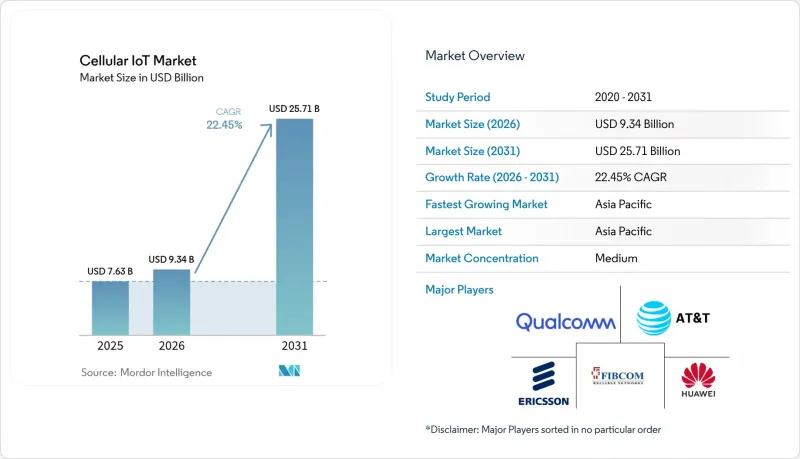
據 Mordor Intelligence 稱,2025 年蜂巢式物聯網市值為 76.3 億美元,預計到 2031 年將達到 257.1 億美元,而 2026 年為 93.4 億美元,預測期(2026-2031 年)的複合年成長率為 22.45%。
本報告按組件(軟體[安全平台等]、硬體[天線等]、其他)、技術(2G、3G、其他)、終端用戶產業(汽車與運輸、能源與公共產業、醫療保健、農業、其他)、應用(資產追蹤、智慧電錶、工業自動化、其他)和地區進行細分。市場預測以美元計價。
全球蜂巢式物聯網市場趨勢與洞察
URLLC物聯網部署5G SA
商用獨立組網 (SA) 5G 網路將提供工業企業實現封閉回路型自動化所需的低於 5 毫秒的延遲。 AT&T 的「RedCap」服務於 2024 年 6 月在達拉斯推出,允許晶片組供應商在運作中的5G SA 網路上對其設備進行認證,結果顯示與 LTE Cat-4 模組相比,功耗降低了 65%。儘管西班牙電信在德國的試點運營以及三星和現代的生產線表明 5G SA 已做好實用化準備,但真正的規模化取決於各國的 5G SA 覆蓋範圍以及價格合理的模組的供應情況。
Cat-1bis 模組的平均售價 (ASP) 低於 4 美元。
2024年,中國大規模競標將Cat-1bis模組的價格降至4美元以下。這在舊網路逐步淘汰之前,擴大了潛在的4G基本客群。移遠通訊和飛博通合計佔據了模組銷量的三分之二,但過度依賴單一製造區域正導致人們重新評估歐美地區的供應穩定性。中國以外的供應商面臨利潤率壓力,而持續虧損的u-blox公司已於2025年1月退出該行業。
電池供電設備中5G模組的高功耗
即使採用 RedCap 技術提高了效率,對於旨在實現 10 年現場運作的感測器而言,絕對功耗仍然是一個挑戰。 Nordic Semiconductor 的 nRF9151 模組引入了 5 級功率輸出,可延長電池循環壽命並支援對遠端農業至關重要的衛星備用鏈路。設備製造商正在整合能量能源採集功能,但這通常會以犧牲性能為代價,增加成本和尺寸。
細分市場分析
在網路服務終止前,製造商爭相更換舊設備,導致硬體在2025年的收入佔比達到63.35%。高通公司2025年第二季的物聯網營收為15.8億美元,年增27%,這主要得益於強勁的晶片組需求。由服務驅動的蜂巢式物聯網市場預計到2031年將以24.10%的複合年成長率超過硬體市場,這反映出全球連接管理、無線韌體更新和零接觸安全修補程式等相關合約數量的不斷成長。
目前,全球企業正在尋求能夠對跨多個營運商和技術的裝置進行整合管理的控制面板。 KORE Wireless 已透過人工智慧驅動的故障偵測技術,在 200 個國家管理著 1,900 萬條活躍線路。專業服務團隊致力於彌補無線規劃、認證和合規的知識缺口。託管服務合約確保了持續的收入,從而緩解了硬體價格下跌的衝擊,同時使供應商的獎勵與客戶的運作和安全性目標保持一致。
隨著中國OEM廠商將模組價格降至4美元以下,預計到2025年,4G LTE Cat-1將佔總銷售量的56.20%。 LTE-M和NB-IoT等互補的低功耗廣域網路(LPWA)模式則適用於計量和洩漏偵測等對吞吐量要求極低的應用場景。隨著營運商將頻寬重新分配給5G SA,傳統的2G/3G網路連線的萎縮速度比先前預期的更快。雖然隨著客戶向RedCap遷移,4G蜂巢式物聯網市場預計將會萎縮,但在覆蓋範圍和成本優先於頻寬的地區,它仍然是大規模部署的一個很有前景的選擇。
5G RedCap 的複合年成長率 (CAGR) 達到 27.10%,被視為 LPWA 和全規格 5G 之間的橋樑。三星和現代在 2025 年 2 月的工廠測試中驗證了 RedCap 的有效性,結果顯示其延遲更低,能耗比 LTE-M 低 40%。與地面 5G 互補的非地面電波網路 (NTN) 正在蓬勃發展。 Viasat 和 Myriota 於 2025 年 3 月推出了首個用於環境感知的 5G NTN 服務,為使用單一模組 SKU 實現全球覆蓋鋪平了道路。
區域分析
預計到2025年,亞太地區將佔全球營收的69.60%,並在2031年之前以28.60%的複合年成長率成長,這主要得益於各國數位化轉型計畫的推動。到2030年,中國預計將擁有41億個授權蜂窩連接,佔全球總量的70%。隨著5G-Advanced覆蓋範圍的擴大,中國境內部署所創造的蜂巢式物聯網市場規模預計將遠遠超過其他所有地區的總和。
區域製造地集中化降低了模組成本,但也帶來了依賴性風險,目前歐洲和美國的監管機構正在密切關注這些風險。印度57.6億美元的「智慧城市計畫」以及印尼計畫中的RedCap頻段競標將進一步提振中國以外的市場需求。在東南亞,新興市場正在採用雲端管理的承包專用網路方案來彌補本地電信技術的不足,從而迅速縮小連接差距。北美已成為高階應用中心,AT&T和T-Mobile專注於低延遲的工業部署。在歐洲,合規性和永續性是物聯網投資的核心,西班牙電信(Telefónica)在德國試行RedCap項目,愛立信(Ericsson)在法國市政當局部署專用5G網路。雖然亞太地區的蜂巢式物聯網市場佔有率在2030年之前不太可能下降,但隨著設備數量的增加,這三個地區的收入結構都將轉向託管服務。
其他好處:
- Excel格式的市場預測(ME)表
- 3個月的分析師支持
目錄
第1章:引言
- 研究假設和市場定義
- 調查範圍
第2章:調查方法
第3章執行摘要
第4章 市場狀況
- 市場概覽
- 市場促進因素
- 5G SA部署支援URLLC物聯網
- Cat-1bis模組的平均售價低於4美元。
- 政府資助的NB-IoT智慧城市計畫強制實施。
- 5G RedCap 模組拓展了中階設備的可能性。
- 與永續發展相關的資產追蹤的需求。
- eSIM/iSIM 的大規模認證
- 市場限制因素
- 電池供電設備中5G模組的高功耗
- 因終止 2G/3G 服務維修的費用。
- Cat-1bis晶片組(中國製造商)供應波動
- 物聯網安全標準與法律責任分散
- 價值鏈分析
- 監理情勢
- 技術展望
- 波特五力分析
第5章 市場規模與成長預測
- 按組件
- 硬體
- 模組/晶片組
- 天線
- 閘道器和路由器
- 軟體
- 連結管理平台
- 設備管理
- 安全平台
- 數據分析平台
- 服務
- 專業服務
- 託管服務
- 硬體
- 透過技術
- 2G
- 3G
- 4G LTE(Cat-1/Cat-4)
- LTE-M
- NB-IoT
- 5G NR(eMBB 和 RedCap)
- 非地面型(衛星NTN)
- 按最終用戶行業分類
- 汽車和運輸業
- 能源公用事業
- 製造業和工業
- 衛生保健
- 零售
- 家用電子產品
- 農業
- 物流和供應鏈
- 智慧城市/公共基礎設施
- 透過使用
- 資產追蹤
- 智慧電錶
- 工業自動化
- 遠端監控和控制
- 穿戴式裝置和個人裝置
- 智慧家庭設備
- 按地區
- 北美洲
- 美國
- 加拿大
- 墨西哥
- 南美洲
- 巴西
- 阿根廷
- 智利
- 其他南美國家
- 歐洲
- 德國
- 英國
- 法國
- 義大利
- 西班牙
- 荷蘭
- 俄羅斯
- 其他歐洲國家
- 亞太地區
- 中國
- 印度
- 日本
- 韓國
- ASEAN
- 其他亞太國家
- 中東和非洲
- 中東
- 海灣合作理事會(沙烏地阿拉伯、阿拉伯聯合大公國、卡達等)
- 土耳其
- 其他中東國家
- 非洲
- 南非
- 奈及利亞
- 肯亞
- 其他非洲國家
- 中東
- 北美洲
第6章 競爭情勢
- 市場集中度
- 策略趨勢
- 市佔率分析
- 公司簡介
- Quectel Wireless Solutions Co., Ltd.
- Fibocom Wireless Inc.
- Telit IoT Solutions Holding Ltd.
- Semtech Corporation(incl. Sierra Wireless, Inc.)
- u-blox Holding AG
- Qualcomm Incorporated
- MediaTek Inc.
- CommSolid GmbH
- Sequans Communications SA
- ZTE Corporation
- Thales Group
- Texas Instruments Incorporated
- Nordic Semiconductor ASA
- Huawei Technologies Co. Ltd.
- Telefonaktiebolaget LM Ericsson
- Vodafone Group plc
- China Mobile Limited
- Verizon Communications Inc.
- AT&T Inc.
- Deutsche Telekom AG
第7章 市場機會與未來展望
According to Mordor Intelligence, the cellular IoT market size was valued at USD 7.63 billion in 2025 and estimated to grow from USD 9.34 billion in 2026 to reach USD 25.71 billion by 2031, at a CAGR of 22.45% during the forecast period (2026-2031).
This report is Segmented by Component (Software [Security Platform, and More], Hardware [Antennas, and More], and More), Technology (2G, 3G, and More), End-User Industry (Automotive and Transportation, Energy and Utilities, Healthcare, Agriculture, and More), Application (Asset Tracking, Smart Metering, Industrial Automation, and More), and Geography. The Market Forecasts are Provided in Terms of Value (USD).
Global Cellular IoT Market Trends and Insights
5G SA roll-out enabling URLLC IoT
Commercial standalone 5G networks deliver sub-5 ms latency that industrial firms require for closed-loop automation. AT&T's June 2024 RedCap launch in Dallas allowed chipset vendors to certify devices on a live 5G SA network and confirmed power-consumption cuts of 65% against LTE Cat-4 modules.Telefonica's German trials and Samsung-Hyundai manufacturing lines underline readiness, yet true scale hinges on national 5G SA coverage and affordable module supply.
Module ASPs below USD 4 for Cat-1bis
Large 2024 tenders in China pushed Cat-1bis modules under USD 4, widening 4G's addressable base before older networks shut down. Quectel and Fibocom together captured two-thirds of module revenue, but heavy reliance on a single manufacturing region has triggered supply-security reviews in Europe and the United States. Non-Chinese suppliers face margin compression; u-blox exited the segment in January 2025 after sustained losses.
High power draw of 5G modules in battery devices
Even after RedCap efficiency gains, absolute power remains a challenge for sensors targeting 10-year field life. Nordic Semiconductor's nRF9151 module introduced Power Class 5 output to extend battery cycles and accommodate satellite fallback links essential for remote agriculture. Device makers are integrating energy-harvest options but must trade cost and size against performance.
Other drivers and restraints analyzed in the detailed report include:
- Government-funded NB-IoT smart-city mandates
- 5G RedCap modules unlock mid-tier devices
- 2G/3G sunsets causing retrofit costs
For complete list of drivers and restraints, kindly check the Table Of Contents.
Segment Analysis
Hardware contributed 63.35% of 2025 revenue as manufacturers rushed to replace legacy units ahead of network sunsets. Qualcomm posted 27% year-over-year IoT revenue growth to USD 1.58 billion in Q2 2025 on the back of robust chipset demand. The cellular IoT market size attributed to services is expected to outpace hardware with a 24.10% CAGR through 2031, reflecting climbing subscriptions for global connectivity management, firmware-over-air updates, and zero-touch security patches.
Global enterprises now insist on unified dashboards that orchestrate multi-carrier, multi-technology fleets. KORE Wireless already manages 19 million active lines across 200 countries through AI-driven fault detection. Professional services teams fill knowledge gaps in radio-planning, certification, and regulatory compliance. Managed-service contracts ensure recurring revenue that cushions hardware price erosion, aligning vendor incentives with customer uptime and security objectives.
4G LTE Cat-1 secured 56.20% revenue share in 2025 after Chinese OEMs slashed module prices below USD 4. Complementary LPWA modes such as LTE-M and NB-IoT serve ultra-low-throughput use cases including metering and leak detection. Legacy 2G/3G connections decline faster than previously forecast because operators are reallocating spectrum to 5G SA. The cellular IoT market size for 4G will taper as customers migrate to RedCap, but it remains a high-volume option where coverage and cost trump bandwidth.
5G RedCap is registering a 27.10% CAGR and is viewed as the bridge between LPWA and full-spec 5G. Samsung and Hyundai validated RedCap in a February 2025 factory trial, showing deterministic latency and 40% energy savings compared with LTE-M. Non-terrestrial networks that complement terrestrial 5G are gaining momentum; Viasat and Myriota launched the first 5G NTN service for environmental sensing in March 2025, opening pathways for global coverage on a single module SKU.
Complete Report Scope:
- By Component
- Hardware
- Modules / Chipsets
- Antennas
- Gateways and Routers
- Software
- Connectivity Management Platform
- Device Management
- Security Platform
- Data Analytics Platform
- Services
- Professional Services
- Managed Services
- Hardware
- By Technology
- 2G
- 3G
- 4G LTE (Cat-1/Cat-4)
- LTE-M
- NB-IoT
- 5G NR (eMBB and RedCap)
- Non-Terrestrial (Satellite NTN)
- By End-User Industry
- Automotive and Transportation
- Energy and Utilities
- Manufacturing and Industrial
- Healthcare
- Retail
- Consumer Electronics
- Agriculture
- Logistics and Supply Chain
- Smart Cities / Public Infrastructure
- By Application
- Asset Tracking
- Smart Metering
- Industrial Automation
- Remote Monitoring and Control
- Wearables and Personal Devices
- Smart Home Devices
- By Geography
- North America
- United States
- Canada
- Mexico
- South America
- Brazil
- Argentina
- Chile
- Rest of South America
- Europe
- Germany
- United Kingdom
- France
- Italy
- Spain
- Netherlands
- Russia
- Rest of Europe
- Asia Pacific
- China
- India
- Japan
- South Korea
- ASEAN
- Rest of Asia Pacific
- Middle East and Africa
- Middle East
- GCC (Saudi Arabia, UAE, Qatar, etc.)
- Turkey
- Rest of Middle East
- Africa
- South Africa
- Nigeria
- Kenya
- Rest of Africa
- Middle East
- North America
Geography Analysis
Asia Pacific secured 69.60% of 2025 revenue and is set to advance at 28.60% CAGR through 2031 on the back of national digital-transformation plans. China expects 4.1 billion licensed cellular connections by 2030, representing 70% of global totals. The cellular IoT market size attached to Chinese deployments alone is poised to dwarf every other region combined as 5G-Advanced coverage blankets additional provinces.
Regional manufacturing concentration cuts module costs but introduces dependency risk that Western regulators now scrutinize. India's USD 5.76 billion Smart Cities Mission and Indonesia's upcoming RedCap spectrum auctions add incremental volume outside China. Emerging markets across Southeast Asia adopt turnkey cloud-managed private-network packages that offset limited local telecom expertise, ensuring that connectivity gaps shrink quickly. North America positions itself as the premium application hub, with AT&T and T-Mobile focusing on low-latency industrial deployments. Europe places compliance and sustainability at the center of IoT spending, with Telefonica testing RedCap in Germany and Ericsson rolling out private 5G in French municipalities. The cellular IoT market share of Asia Pacific is unlikely to erode before 2030, but revenue mix will swing toward managed services in all three regions as device counts grow.
- Quectel Wireless Solutions Co., Ltd.
- Fibocom Wireless Inc.
- Telit IoT Solutions Holding Ltd.
- Semtech Corporation (incl. Sierra Wireless, Inc.)
- u-blox Holding AG
- Qualcomm Incorporated
- MediaTek Inc.
- CommSolid GmbH
- Sequans Communications SA
- ZTE Corporation
- Thales Group
- Texas Instruments Incorporated
- Nordic Semiconductor ASA
- Huawei Technologies Co. Ltd.
- Telefonaktiebolaget LM Ericsson
- Vodafone Group plc
- China Mobile Limited
- Verizon Communications Inc.
- AT&T Inc.
- Deutsche Telekom AG
Additional Benefits:
- The market estimate (ME) sheet in Excel format
- 3 months of analyst support
TABLE OF CONTENTS
1 INTRODUCTION
- 1.1 Study Assumptions and Market Definition
- 1.2 Scope of the Study
2 RESEARCH METHODOLOGY
3 EXECUTIVE SUMMARY
4 MARKET LANDSCAPE
- 4.1 Market Overview
- 4.2 Market Drivers
- 4.2.1 5G SA roll-out enabling URLLC IoT
- 4.2.2 Module ASPs below USD 4 for Cat-1bis
- 4.2.3 Government-funded NB-IoT smart-city mandates
- 4.2.4 5G RedCap modules unlock mid-tier devices
- 4.2.5 Sustainability-linked asset-tracking demand
- 4.2.6 Mass certification of eSIM/iSIM
- 4.3 Market Restraints
- 4.3.1 High power draw of 5G modules in battery devices
- 4.3.2 2G/3G sunsets causing retrofit costs
- 4.3.3 Cat-1bis chipset supply volatility (China fabs)
- 4.3.4 Fragmented IoT security standards and liabilities
- 4.4 Value Chain Analysis
- 4.5 Regulatory Landscape
- 4.6 Technological Outlook
- 4.7 Porter's Five Forces Analysis
- 4.7.1 Bargaining Power of Suppliers
- 4.7.2 Bargaining Power of Buyers
- 4.7.3 Threat of New Entrants
- 4.7.4 Threat of Substitutes
- 4.7.5 Competitive Rivalry
5 MARKET SIZE AND GROWTH FORECASTS (VALUE)
- 5.1 By Component
- 5.1.1 Hardware
- 5.1.1.1 Modules / Chipsets
- 5.1.1.2 Antennas
- 5.1.1.3 Gateways and Routers
- 5.1.2 Software
- 5.1.2.1 Connectivity Management Platform
- 5.1.2.2 Device Management
- 5.1.2.3 Security Platform
- 5.1.2.4 Data Analytics Platform
- 5.1.3 Services
- 5.1.3.1 Professional Services
- 5.1.3.2 Managed Services
- 5.1.1 Hardware
- 5.2 By Technology
- 5.2.1 2G
- 5.2.2 3G
- 5.2.3 4G LTE (Cat-1/Cat-4)
- 5.2.4 LTE-M
- 5.2.5 NB-IoT
- 5.2.6 5G NR (eMBB and RedCap)
- 5.2.7 Non-Terrestrial (Satellite NTN)
- 5.3 By End-User Industry
- 5.3.1 Automotive and Transportation
- 5.3.2 Energy and Utilities
- 5.3.3 Manufacturing and Industrial
- 5.3.4 Healthcare
- 5.3.5 Retail
- 5.3.6 Consumer Electronics
- 5.3.7 Agriculture
- 5.3.8 Logistics and Supply Chain
- 5.3.9 Smart Cities / Public Infrastructure
- 5.4 By Application
- 5.4.1 Asset Tracking
- 5.4.2 Smart Metering
- 5.4.3 Industrial Automation
- 5.4.4 Remote Monitoring and Control
- 5.4.5 Wearables and Personal Devices
- 5.4.6 Smart Home Devices
- 5.5 By Geography
- 5.5.1 North America
- 5.5.1.1 United States
- 5.5.1.2 Canada
- 5.5.1.3 Mexico
- 5.5.2 South America
- 5.5.2.1 Brazil
- 5.5.2.2 Argentina
- 5.5.2.3 Chile
- 5.5.2.4 Rest of South America
- 5.5.3 Europe
- 5.5.3.1 Germany
- 5.5.3.2 United Kingdom
- 5.5.3.3 France
- 5.5.3.4 Italy
- 5.5.3.5 Spain
- 5.5.3.6 Netherlands
- 5.5.3.7 Russia
- 5.5.3.8 Rest of Europe
- 5.5.4 Asia Pacific
- 5.5.4.1 China
- 5.5.4.2 India
- 5.5.4.3 Japan
- 5.5.4.4 South Korea
- 5.5.4.5 ASEAN
- 5.5.4.6 Rest of Asia Pacific
- 5.5.5 Middle East and Africa
- 5.5.5.1 Middle East
- 5.5.5.1.1 GCC (Saudi Arabia, UAE, Qatar, etc.)
- 5.5.5.1.2 Turkey
- 5.5.5.1.3 Rest of Middle East
- 5.5.5.2 Africa
- 5.5.5.2.1 South Africa
- 5.5.5.2.2 Nigeria
- 5.5.5.2.3 Kenya
- 5.5.5.2.4 Rest of Africa
- 5.5.5.1 Middle East
- 5.5.1 North America
6 COMPETITIVE LANDSCAPE
- 6.1 Market Concentration
- 6.2 Strategic Moves
- 6.3 Market Share Analysis
- 6.4 Company Profiles (includes Global level Overview, Market level overview, Core Segments, Financials as available, Strategic Information, Market Rank/Share for key companies, Products and Services, and Recent Developments)
- 6.4.1 Quectel Wireless Solutions Co., Ltd.
- 6.4.2 Fibocom Wireless Inc.
- 6.4.3 Telit IoT Solutions Holding Ltd.
- 6.4.4 Semtech Corporation (incl. Sierra Wireless, Inc.)
- 6.4.5 u-blox Holding AG
- 6.4.6 Qualcomm Incorporated
- 6.4.7 MediaTek Inc.
- 6.4.8 CommSolid GmbH
- 6.4.9 Sequans Communications SA
- 6.4.10 ZTE Corporation
- 6.4.11 Thales Group
- 6.4.12 Texas Instruments Incorporated
- 6.4.13 Nordic Semiconductor ASA
- 6.4.14 Huawei Technologies Co. Ltd.
- 6.4.15 Telefonaktiebolaget LM Ericsson
- 6.4.16 Vodafone Group plc
- 6.4.17 China Mobile Limited
- 6.4.18 Verizon Communications Inc.
- 6.4.19 AT&T Inc.
- 6.4.20 Deutsche Telekom AG
7 MARKET OPPORTUNITIES AND FUTURE OUTLOOK
- 7.1 White-space and Unmet-need Assessment

 2026-2030年全球蜂巢式物聯網市場
 蜂窩模組市場規模、佔有率、成長率、全球產業分析、區域趨勢及2026-2034年預測。
 物聯網市場追蹤調查:LPWA-專屬蜂巢式物聯網市場規模、佔有率、成長及全球產業分析:按類型、應用和地區分類的洞察,2026-2034 年預測追蹤物聯網市場:Cat-M
 蜂窩模組市場:2026-2032年全球市場預測(依網路技術、外形規格、介面類型、等級和應用分類)
 2026年全球蜂巢式物聯網市場報告
 蜂巢式物聯網市場分析及預測(至2035年):按類型、產品類型、服務、技術、組件、應用、設備、部署類型、最終用戶和功能分類全球蜂巢式物聯網市場規模、佔有率、趨勢和成長分析報告(2026-2034)
 全球550個最大的蜂窩物聯網專案—第九版