


 |
市場調查報告書
商品編碼
2124054
自動化邊境控制:市場佔有率分析、行業趨勢和統計數據、成長預測(2026-2031 年)Automated Border Control - Market Share Analysis, Industry Trends & Statistics, Growth Forecasts (2026 - 2031) |
||||||

※ 本網頁內容可能與最新版本有所差異。詳細情況請與我們聯繫。
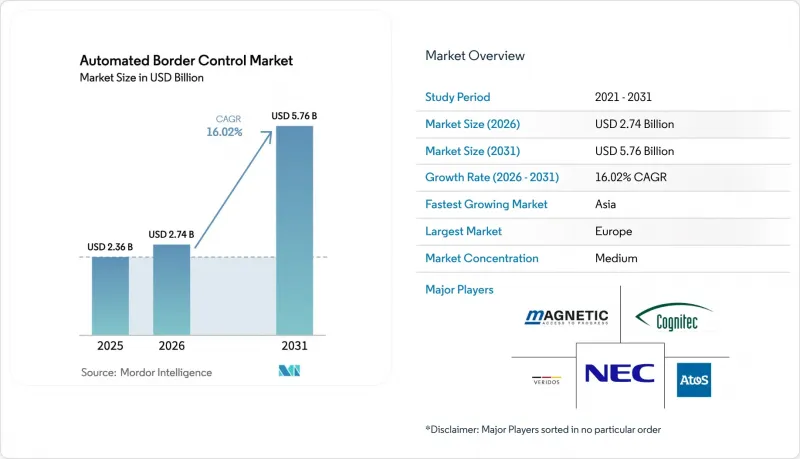
據 Mordor Intelligence 稱,2025 年自動化邊境控制市場價值為 23.6 億美元,預計到 2031 年將從 2026 年的 27.4 億美元成長至 57.6 億美元,預測期(2026-2031 年)的複合年成長率為 16.02%。
本報告按類型(ABC自動查驗通關系統和ABC自助服務終端)、產品(硬體等)、解決方案模式(全自動等)、操作模式(一步式流程等)、最終用途(機場等)、部署方式(本地部署、雲端部署)、處理能力(每小時少於200人等)和地區進行細分。市場預測以美元計價。
全球自動化邊境管制市場趨勢與洞察
歐盟強制出入境管制制度正在加速引入ABC閘門。
計畫於2025年10月實施的出入境管理系統(EES)將要求29個申根成員國透過自助服務終端和電子閘門登記第三國國民的生物識別資訊。成員國必須在歐盟委員會批准後的六個月內完成合規,預計歐盟委員會的批准將使採購期限延長至2026年後。供應商必須能夠與歐盟LISA資料庫直接整合,從而促進從傳統閘門到可互通的智慧通道的快速升級。這項規定已經對鄰近市場產生影響,非歐盟國家的機場正在效仿EES的技術規範,以維持簽證豁免互惠。
政府對資助反恐和邊防安全的興趣日益濃厚
美國在2025年為國防安全保障撥款608億美元,其中1.27億美元用於海關與邊防安全局(CBP)的技術研發。加拿大則撥款3.554億加幣(約2.62億美元)用於與旅客相關的現代化項目。這些預算優先考慮人工智慧驅動的威脅偵測、雲端分析和多模態生物識別,凸顯了財政獎勵策略如何加速自動化邊境控制市場的發展。
GDPR 和類似法律下生物識別資料的隱私問題
嚴格的資料保存法規要求供應商對資料庫進行分區並實施邊緣遮罩技術,這增加了開發成本並延長了認證週期。歐盟部分推遲歐洲電子系統 (EES) 的實施,以便最終完成資料保護影響評估,這清楚地表明了監管方面的摩擦。北美政府機構現在例行性發布隱私影響報告,提高了透明度,但同時也增加了行政負擔。合規性提高了准入門檻,但最終有利於那些擁有成熟管治結構的成熟公司,從而塑造了自動化邊境控制市場的競爭格局。
細分市場分析
預計到2025年,自動查驗通關系統將佔總收入的65.95%,憑藉其高處理能力和緊湊的面積,將支撐主要樞紐機場自動化邊境管制市場的發展。符合國際民航組織(ICAO)標準且多生物識別模組標準化,降低了整合風險,並有助於機場將自動查驗通關系統整合到航站升級計畫中。模組化設計縮短了安裝時間,使營運商能夠分階段進行施工,無需關閉通道,這在旅遊旺季尤其重要。
自助服務終端的複合年成長率 (CAGR) 為 17.12%,深受空間受限環境或租賃物業維修期間尋求靈活部署的營運商青睞。與固定式電子閘門陣列相比,自助服務終端更加靈活,因為可以根據客流量的變化重新定位設備。透過安全網路提供的軟體更新可擴充所有已部署裝置的功能,確保持續適應不斷變化的風險模型。隨著自助服務終端試點計畫在陸路邊境檢查站的推進,供應商正致力於提升其環境和天氣耐受性,從而擴大應用範圍,並擴大自動化邊境管制市場。
預計到2025年,硬體收入將佔總收入的60.85%,這反映了生物識別攝影機、文件閱讀器和障礙物偵測感測器的初始成本。精密光學元件和高耐久性材料滿足了監管機構要求的平均故障間隔時間(MTBF)指標。然而,軟體的年成長率高達16.18%,超過了整體市場成長率。雲端原生分析功能正在減輕邊緣設備的運算負擔,並放寬對硬體規格和動作溫度的要求。監管機構正在重點關注能夠將旅客風險評分與逐車道通行效率關聯起來的即時儀錶板,以便值班經理能夠動態地重新部署人員。
訂閱模式正在取代永久許可,將資本支出轉化為可預測的營運成本。諸如持續威脅情報推送和基於AIOps(人工智慧維運)的預測性維護等SaaS功能,正在提升整個生命週期的效能,進一步增強軟體在自動化邊境控制市場的戰略重要性。
2025年,將文件掃描、臉部影像擷取和資料庫配對整合到單一流程中的全自動通道將處理70.35%的旅客。負責人認為,降低人事費用和可預測的處理時間是其主要優勢。同時,半自動化架構的複合年成長率達到了16.46%,因為當檢測到異常情況時,工作人員可以進行干預。計劃在馬來西亞部署的自動化生物識別識別系統將包含一個「人機互動」層,用於進行特殊篩檢。這種雙路徑策略既支援基於風險的操作,又能保持處理能力。此外,它還允許供應商透過分析模組來實現盈利,這些模組可以指導檢查人員識別異常情況。
區域分析
預計到2025年,歐洲將佔全球銷售額的42.95%。各成員國正在投資建造符合歐洲電子安全標準(EES)的自助服務終端和閘機,以避免罰款和旅客延誤。光是捷克共和國就已向Secunet公司訂購了58台自助服務終端和94座電子塔,用於機場和陸地檢查。英國已撥款350萬英鎊(約470萬美元)用於港口通道的維修。德國、法國、義大利和西班牙都已啟動多年競標,迫使供應商在歐洲擴建其組裝和本地支援團隊。
亞洲的年複合成長率 (CAGR) 為 18.02%,預計到 2028 年,其年度部署量將超過歐洲。新加坡已將所有查核點升級為自動化通道,15 天內處理了 150 萬名旅客。中國拱北口岸新增了 20 條「無卡」通道,為粵港澳大灣區的整合做好準備。印度在德里試點計畫取得成功後,已將「快速通關」服務擴展至 21 個機場,該試點計畫吸引了 18,400 名用戶。日本在羽田機場安裝了 NEC 自助服務終端,以支援其每年 6,000 萬遊客的目標。北美在邊境安全方面的支出排名第三,但單位地點預算排名第一。 《基礎設施投資與就業法案》正在資助 50 個陸路邊境檢查站的現代化改造。加拿大已在邊防安全方面投資 13 億加元(9.59 億美元),其中 3.554 億加元用於旅客管理現代化。這使得自動化邊境控制市場能夠受益於穩定的聯邦預算撥款,從而保證了主要承包商和利基生物識別公司的合約前景。
其他好處:
- Excel格式的市場預測(ME)表
- 3個月的分析師支持
目錄
第1章:引言
- 研究假設和市場定義
- 調查範圍
第2章:調查方法
第3章執行摘要
第4章 市場狀況
- 市場概覽
- 市場促進因素
- 隨著歐洲和亞太地區旅客數量的增加,需要簡化邊境手續。
- 北美各國政府對資助反恐和邊防安全的興趣日益濃厚
- 擴大非接觸式生物識別技術在抗疫交通樞紐的應用。
- 歐盟的強制移民管制系統(EES)正在推動ABC閘門的引入。
- 人工智慧驅動的臉部認證技術正在提升大型機場的處理能力。
- 航空公司與機場合作的 A-CDM 計畫正在加速亞洲地區 ABC 的採用。
- 市場限制因素
- GDPR 和類似法律下生物識別資料的隱私問題
- 新興國家邊境樞紐的大量初始資本投資
- 因欺騙/生物識別失敗導致停機的風險
- 傳統資訊科技和護照資料庫阻礙了開發中地區的整合。
- 產業生態系分析
- 監理展望
- 技術展望
- 波特五力分析
第5章 市場規模與成長預測
- 按類型
- ABC E-gates
- ABC 資訊亭
- 透過提供的服務
- 硬體
- 文件認證系統(DAS)
- 生物識別系統(BVS)
- 臉部辨識
- 指紋認證
- 虹膜辨識
- 掌紋和靜脈鑑定
- 軟體
- 邊境管制軟體
- 中介軟體和SDK
- 分析和報告能力
- 服務
- 安裝與整合
- 維護和支援
- 諮詢和培訓
- 硬體
- 透過解決方案模型
- 全自動
- 半自動
- 透過操作模式
- 一步式流程
- 兩步驟流程
- 按最終用途
- 飛機場
- 陸路口岸
- 港
- 鐵路終點站
- 不同的發展
- 現場
- 基於雲端的
- 按處理能力
- 每小時乘客人數少於200人。
- 每小時200-400人
- 每小時超過400人
- 按地區
- 北美洲
- 美國
- 加拿大
- 墨西哥
- 南美洲
- 巴西
- 阿根廷
- 其他南美國家
- 歐洲
- 英國
- 德國
- 法國
- 義大利
- 西班牙
- 其他歐洲國家
- 亞太地區
- 中國
- 日本
- 韓國
- 印度
- 澳洲和紐西蘭
- 其他亞太國家
- 中東
- 沙烏地阿拉伯
- 阿拉伯聯合大公國
- 土耳其
- 其他中東國家
- 非洲
- 南非
- 埃及
- 肯亞
- 其他非洲國家
- 北美洲
第6章 競爭情勢
- 市場集中度
- 策略趨勢
- 市佔率分析
- 公司簡介
- Thales Group
- IDEMIA Group
- SITA Group
- Vision-Box
- NEC Corporation
- Secunet Security Networks AG
- Gunnebo AB
- Atos SE
- ELCOVISION Technology
- Collins Aerospace
- Veridos GmbH
- Cognitec Systems GmbH
- HID Global Corporation
- Cominfosec Inc.
- Accenture plc
- Magnetic Autocontrol GmbH
- Dormakaba Holding AG
- Dermalog Identification Systems GmbH
- BioID GmbH
- Panasonic Connect Co., Ltd.
- Crossmatch Technologies Inc.
- Siemens Logistics
- ZKTeco Co., Ltd.
- Tascent Inc.
- Regula Baltija Ltd.
- Fujitsu Ltd.
第7章 市場機會與未來展望
According to Mordor Intelligence, the automated border control market size was valued at USD 2.36 billion in 2025 and estimated to grow from USD 2.74 billion in 2026 to reach USD 5.76 billion by 2031, at a CAGR of 16.02% during the forecast period (2026-2031).
This report is Segmented by Type (ABC E-Gates, and ABC Kiosks), Offerings (Hardware, and More), Solution Model (Fully Automated, and More), Mode of Operation (One-Step Process, and More), End-Use Application (Airports, and More), Deployment (On-Premises, and Cloud-Based), Throughput Capacity (Less Than 200 Passengers/Hour, and More), and Geography. The Market Forecasts are Provided in Terms of Value (USD).
Global Automated Border Control Market Trends and Insights
Mandatory EU Entry/Exit System Driving ABC Gate Installations
Scheduled for October 2025, the EES obliges 29 Schengen states to enroll third-country nationals' biometrics through automated kiosks and e-gates. Member states have six months to achieve compliance after European Commission approval, stretching procurement into 2026 and beyond.Suppliers must enable direct integration with eu-LISA databases, prompting rapid upgrades from legacy gates to interoperable smart lanes. The regulation is already influencing adjacent markets as non-EU airports replicate EES technical specifications to maintain visa-waiver reciprocity.
Heightened Government Focus on Counter-Terrorism and Border-Security Funding
The United States allocated USD 60.8 billion in discretionary funding for homeland security in 2025, including USD 127 million channelled to Customs and Border Protection technology. Canada earmarked CAD 355.4 million (USD 262 million) for traveller modernization projects. These budgets prioritise AI-enabled threat detection, cloud analytics, and multi-modal biometrics, underlining how fiscal stimulus accelerates the automated border control market.
Biometric Data-Privacy Concerns under GDPR and Similar Laws
Strict retention rules oblige vendors to partition databases and deploy edge masking, inflating development cost and elongating certification cycles. The EU delayed the EES partly to finalise data-protection impact assessments, illustrating regulatory friction. North American agencies now publish privacy impact statements as standard, adding transparency but also administrative overhead. Although compliance raises barriers to entry, it ultimately favours incumbents with proven governance frameworks, shaping competitive dynamics in the automated border control market.
Other drivers and restraints analyzed in the detailed report include:
- AI-Powered Facial Recognition Improving Throughput at Mega-Airports
- Rising Adoption of Contactless Biometrics for Pandemic-Resilient Travel Hubs
- High Up-front CAPEX for Emerging-Nation Border Points
For complete list of drivers and restraints, kindly check the Table Of Contents.
Segment Analysis
E-gates generated 65.95% of 2025 revenue, anchoring the automated border control market size at major hubs through high throughput and a compact footprint. Standardisation of ICAO compliance and multi-biometric modules has lowered integration risk, encouraging airports to bundle e-gates into terminal refresh programs. Modular designs shorten installation time, letting operators phase works without shutting lanes, a critical advantage during peak travel seasons.
Kiosks, registering a 17.12% CAGR, appeal to operators seeking flexible deployment in space-constrained settings or during leasehold upgrades. Units can be relocated if passenger flows shift, offering agility unmatched by fixed e-gate arrays. Software updates delivered over secure networks extend functionality across the installed base, ensuring continuous alignment with evolving risk models. As more land ports pilot kiosk programs, vendors address ruggedisation and weatherproofing, widening application scope and enlarging the automated border control market.
Hardware captured 60.85% of 2025 revenue, reflecting the upfront cost of biometric cameras, document readers, and obstruction-detect sensors. Precision optics and high-durability materials underpin mean-time-between-failure metrics demanded by regulators. Yet software is scaling 16.18% annually, outstripping headline growth. Cloud-native analytics offload heavy computation from edge devices, lowering hardware spec and operating temperature requirements. Authorities value real-time dashboards that correlate traveller risk scores with lane-level performance, letting duty managers re-allocate staff dynamically.
Subscription models are replacing perpetual licences, converting capital outlay into predictable operating expense. SaaS features like continuous threat-intel feeds and AIOps-based predictive maintenance elevate lifecycle performance, reinforcing the strategic gravity of software within the automated border control market.
Fully automated lanes processed 70.35% of travellers in 2025 by combining document scanning, facial capture, and database checks in one pass. Operators cite labour-cost avoidance and predictable cycle times as core benefits. Semi-automated architectures, however, post a 16.46% CAGR because they let officers intervene when anomalies surface. Malaysia's forthcoming Automatic Biometric Identification System embeds a human-in-the-loop layer for exceptional vetting.This dual-path strategy supports risk-based operations while sustaining throughput. It also positions vendors to monetise analytics modules that guide inspectors to outlier cases.
Complete Report Scope:
- By Type
- ABC E-gates
- ABC Kiosks
- By Offerings
- Hardware
- Document Authentication System (DAS)
- Biometric Verification System (BVS)
- Face Recognition
- Fingerprint Recognition
- Iris Recognition
- Palm and Vein Recognition
- Software
- Border Management Software
- Middleware and SDKs
- Analytics and Reporting
- Services
- Installation and Integration
- Maintenance and Support
- Consultancy and Training
- Hardware
- By Solution Model
- Fully Automated
- Semi-Automated
- By Mode of Operation
- One-Step Process
- Two-Step Process
- By End-Use Application
- Airports
- Land Ports
- Seaports
- Rail Terminals
- By Deployment
- On-Premises
- Cloud-Based
- By Throughput Capacity
- Less than 200 Passengers/Hour
- 200-400 Passengers/Hour
- Above 400 Passengers/Hour
- By Geography
- North America
- United States
- Canada
- Mexico
- South America
- Brazil
- Argentina
- Rest of South America
- Europe
- United Kingdom
- Germany
- France
- Italy
- Spain
- Rest of Europe
- Asia Pacific
- China
- Japan
- South Korea
- India
- Australia and New Zealand
- Rest of Asia Pacific
- Middle East
- Saudi Arabia
- United Arab Emirates
- Turkey
- Rest of Middle East
- Africa
- South Africa
- Egypt
- Kenya
- Rest of Africa
- North America
Geography Analysis
Europe held 42.95% of 2025 revenue. Member states pour capital into EES-compliant kiosks and gates to avoid fines and passenger disruption. The Czech Republic alone ordered 58 kiosks and 94 e-towers from secunet for airport and land checks secunet. The UK allocated GBP 3.5 million (USD 4.7 million) to retrofit port lanes.Germany, France, Italy, and Spain each launched multiyear tenders, compelling vendors to ramp European assembly lines and local support teams.
Asia registers an 18.02% CAGR and will surpass Europe on annual installations by 2028. Singapore moved all checkpoints to automated lanes, processing 1.5 million travellers in 15 days. China's Gongbei Port added 20 "card-free" channels for Guangdong-Hong Kong-Macao integration. India scaled Fast-Track Immigration to 21 airports after a successful Delhi pilot that enrolled 18,400 users. Japan commissioned NEC kiosks at Haneda to support 60 million-visitor targets.North America ranks third by spend but leads in per-site budgets. The Infrastructure Investment and Jobs Act funds 50 land-port modernisations. Canada invests CAD 1.3 billion (USD 959 million) in border security, including CAD 355.4 million for traveller modernisation. The automated border control market thus benefits from stable federal appropriations that guarantee contract visibility for prime contractors and niche biometric firms.
- Thales Group
- IDEMIA Group
- SITA Group
- Vision-Box
- NEC Corporation
- Secunet Security Networks AG
- Gunnebo AB
- Atos SE
- ELCOVISION Technology
- Collins Aerospace
- Veridos GmbH
- Cognitec Systems GmbH
- HID Global Corporation
- Cominfosec Inc.
- Accenture plc
- Magnetic Autocontrol GmbH
- Dormakaba Holding AG
- Dermalog Identification Systems GmbH
- BioID GmbH
- Panasonic Connect Co., Ltd.
- Crossmatch Technologies Inc.
- Siemens Logistics
- ZKTeco Co., Ltd.
- Tascent Inc.
- Regula Baltija Ltd.
- Fujitsu Ltd.
Additional Benefits:
- The market estimate (ME) sheet in Excel format
- 3 months of analyst support
TABLE OF CONTENTS
1 INTRODUCTION
- 1.1 Study Assumptions and Market Definition
- 1.2 Scope of the Study
2 RESEARCH METHODOLOGY
3 EXECUTIVE SUMMARY
4 MARKET LANDSCAPE
- 4.1 Market Overview
- 4.2 Market Drivers
- 4.2.1 Increasing Passenger Traffic Requiring Seamless Border Processing in Europe and APAC
- 4.2.2 Heightened Government Focus on Counter-Terrorism and Border-Security Funding in North America
- 4.2.3 Rising Adoption of Contactless Biometrics for Pandemic-Resilient Travel Hubs
- 4.2.4 Mandatory EU Entry/Exit System (EES) Driving ABC Gate Installations
- 4.2.5 AI-Powered Facial Recognition Improving Throughput at Mega-Airports
- 4.2.6 Airline-Airport A-CDM Programs Accelerating ABC Deployment in Asia
- 4.3 Market Restraints
- 4.3.1 Biometric Data-Privacy Concerns under GDPR and Similar Laws
- 4.3.2 High Up-front CAPEX for Emerging-Nation Border Points
- 4.3.3 Downtime Risks from Spoofing/Liveness-Detection Failures
- 4.3.4 Legacy IT and Passport Databases Limiting Integration in Developing Regions
- 4.4 Industry Ecosystem Analysis
- 4.5 Regulatory Outlook
- 4.6 Technological Outlook
- 4.7 Porter's Five Forces Analysis
- 4.7.1 Bargaining Power of Suppliers
- 4.7.2 Bargaining Power of Consumers
- 4.7.3 Threat of New Entrants
- 4.7.4 Threat of Substitute
- 4.7.5 Intensity of Competitive Rivalry
5 MARKET SIZE AND GROWTH FORECASTS (VALUE)
- 5.1 By Type
- 5.1.1 ABC E-gates
- 5.1.2 ABC Kiosks
- 5.2 By Offerings
- 5.2.1 Hardware
- 5.2.1.1 Document Authentication System (DAS)
- 5.2.1.2 Biometric Verification System (BVS)
- 5.2.1.2.1 Face Recognition
- 5.2.1.2.2 Fingerprint Recognition
- 5.2.1.2.3 Iris Recognition
- 5.2.1.2.4 Palm and Vein Recognition
- 5.2.2 Software
- 5.2.2.1 Border Management Software
- 5.2.2.2 Middleware and SDKs
- 5.2.2.3 Analytics and Reporting
- 5.2.3 Services
- 5.2.3.1 Installation and Integration
- 5.2.3.2 Maintenance and Support
- 5.2.3.3 Consultancy and Training
- 5.2.1 Hardware
- 5.3 By Solution Model
- 5.3.1 Fully Automated
- 5.3.2 Semi-Automated
- 5.4 By Mode of Operation
- 5.4.1 One-Step Process
- 5.4.2 Two-Step Process
- 5.5 By End-Use Application
- 5.5.1 Airports
- 5.5.2 Land Ports
- 5.5.3 Seaports
- 5.5.4 Rail Terminals
- 5.6 By Deployment
- 5.6.1 On-Premises
- 5.6.2 Cloud-Based
- 5.7 By Throughput Capacity
- 5.7.1 Less than 200 Passengers/Hour
- 5.7.2 200-400 Passengers/Hour
- 5.7.3 Above 400 Passengers/Hour
- 5.8 By Geography
- 5.8.1 North America
- 5.8.1.1 United States
- 5.8.1.2 Canada
- 5.8.1.3 Mexico
- 5.8.2 South America
- 5.8.2.1 Brazil
- 5.8.2.2 Argentina
- 5.8.2.3 Rest of South America
- 5.8.3 Europe
- 5.8.3.1 United Kingdom
- 5.8.3.2 Germany
- 5.8.3.3 France
- 5.8.3.4 Italy
- 5.8.3.5 Spain
- 5.8.3.6 Rest of Europe
- 5.8.4 Asia Pacific
- 5.8.4.1 China
- 5.8.4.2 Japan
- 5.8.4.3 South Korea
- 5.8.4.4 India
- 5.8.4.5 Australia and New Zealand
- 5.8.4.6 Rest of Asia Pacific
- 5.8.5 Middle East
- 5.8.5.1 Saudi Arabia
- 5.8.5.2 United Arab Emirates
- 5.8.5.3 Turkey
- 5.8.5.4 Rest of Middle East
- 5.8.6 Africa
- 5.8.6.1 South Africa
- 5.8.6.2 Egypt
- 5.8.6.3 Kenya
- 5.8.6.4 Rest of Africa
- 5.8.1 North America
6 COMPETITIVE LANDSCAPE
- 6.1 Market Concentration
- 6.2 Strategic Moves
- 6.3 Market Share Analysis
- 6.4 Company Profiles (includes Global level Overview, Market level overview, Core Segments, Financials as available, Strategic Information, Market Rank/Share for key companies, Products and Services, and Recent Developments)
- 6.4.1 Thales Group
- 6.4.2 IDEMIA Group
- 6.4.3 SITA Group
- 6.4.4 Vision-Box
- 6.4.5 NEC Corporation
- 6.4.6 Secunet Security Networks AG
- 6.4.7 Gunnebo AB
- 6.4.8 Atos SE
- 6.4.9 ELCOVISION Technology
- 6.4.10 Collins Aerospace
- 6.4.11 Veridos GmbH
- 6.4.12 Cognitec Systems GmbH
- 6.4.13 HID Global Corporation
- 6.4.14 Cominfosec Inc.
- 6.4.15 Accenture plc
- 6.4.16 Magnetic Autocontrol GmbH
- 6.4.17 Dormakaba Holding AG
- 6.4.18 Dermalog Identification Systems GmbH
- 6.4.19 BioID GmbH
- 6.4.20 Panasonic Connect Co., Ltd.
- 6.4.21 Crossmatch Technologies Inc.
- 6.4.22 Siemens Logistics
- 6.4.23 ZKTeco Co., Ltd.
- 6.4.24 Tascent Inc.
- 6.4.25 Regula Baltija Ltd.
- 6.4.26 Fujitsu Ltd.
7 MARKET OPPORTUNITIES AND FUTURE OUTLOOK
- 7.1 White-space and Unmet-Need Assessment

 自助入境檢查亭市場:全球市場預測(2026-2032年)邊境監視雷達市場:全球市場預測,2026-2032年
 2026年全球邊境監控系統市場報告2026年全球自動化邊境管制市場報告
 自動化邊境管制市場分析及預測(至2035年):按類型、產品類型、服務、技術、組件、應用、部署類型、最終用戶和功能分類電子護照市場分析及預測(至2035年):類型、產品類型、服務、技術、組件、應用、形式、材質類型、部署形式、最終用戶
 全球自動化邊境管理市場規模、佔有率、趨勢和成長分析報告(2026-2034)2026年全球機場指紋辨識器市場報告
 自動化邊境管制市場規模、佔有率和成長分析(按組件、解決方案類型、應用、最終用戶和地區分類)—2026-2033年產業預測