


 |
市場調查報告書
商品編碼
2124053
北美商用LED照明:市場佔有率分析、產業趨勢與統計及成長預測(2026-2031年)North America Commercial LED Lighting - Market Share Analysis, Industry Trends & Statistics, Growth Forecasts (2026 - 2031) |
||||||

※ 本網頁內容可能與最新版本有所差異。詳細情況請與我們聯繫。
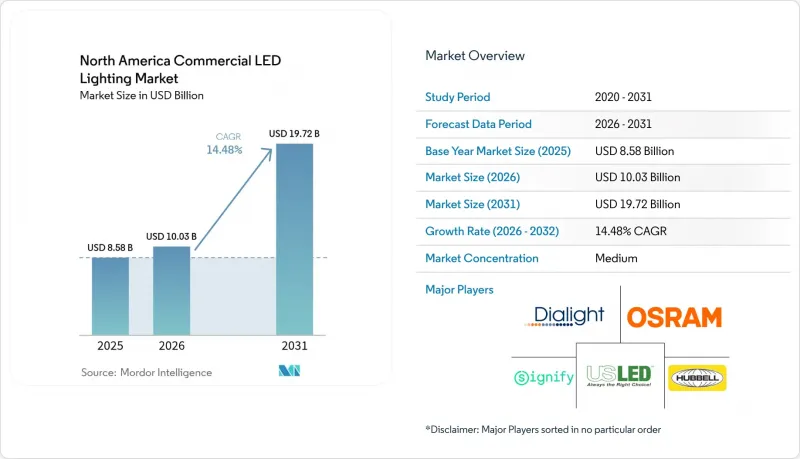
根據 Mordor Intelligence 預測,北美商業 LED 照明市場規模將從 2025 年的 85.8 億美元和 2026 年的 100.3 億美元成長到 2031 年的 197.2 億美元,2026 年至 2031 年的複合年成長率為 14.48%。
本報告按應用領域(零售商店、辦公室、酒店、建築、醫療機構、教育機構、工業/倉儲等)、形狀(獎盃等)、分銷管道(直銷等)、安裝類型(新建、維修)和地區進行分類。市場預測以美元計價。
北美商用LED照明市場趨勢與洞察
嚴格的能源效率法規和建築規範
新的聯邦和州標準正在淘汰大多數傳統照明燈具,迫使業主即使尚未完全計算投資回報率也必須更換螢光。美國2024年最終確定的法規禁止使用鹵素燈和白熾燈,而加拿大2025年的建築規範則提高了最低發光效率基準值。墨西哥的NOM-030-ENER標準為公共建築設定了LED等效基準值。隨著不符合標準的產品目錄逐漸消失,經銷商正在將LED作為標準產品,在醫療和教育領域,基於建築規範的LED照明正成為預設選項。
LED 照明燈具價格的下降和總擁有成本 (TCO) 的降低正在加速其在商業領域的普及。
LED構裝和驅動器整體的快速下降降低了照明設備的初始成本,使得許多商業維修專案的投資回收期縮短至兩年以內。最新的Trofer型照明燈具的光通量效率高達110 lm/W,比螢光的基準值高出40%,同時額定壽命延長至約85,000小時。這相應地減少了維護頻率,降低了設施管理人員的營運成本。 LED高棚燈已使物流中心節能50-70%,並為大型設施每年節省數十萬美元的能源成本。美國多個州的公用事業公司提供的獎勵進一步降低了10-15%的資本成本,從而顯著地促使資金籌措決策傾向採用LED照明。這些經濟因素的綜合作用使得即使對於預算有限的業主來說,投資回報也極具吸引力,從而推動了北美商業LED照明市場的短期成長動能。
隨著軟體包日益商品化,製造商面臨越來越大的壓力,需要擴大規模並捆綁銷售軟體產品以保持競爭力。這一趨勢的驅動力源於在價格敏感且標準化的市場中實現產品差異化的迫切需求。與此同時,小規模分銷商面臨著來自線上競爭對手的挑戰,這些競爭對手提供“直接面向承包商的價格”,為最終用戶帶來便利和成本節約。由於小規模企業難以維持盈利和市場佔有率,這一趨勢正在加速產業整合浪潮。 Signify 就是一個典型的例子,其利潤率的下降凸顯了整個行業面臨的日益成長的壓力,也反映了在不斷變化的市場動態中維持盈利所面臨的更廣泛挑戰。
細分市場分析
農業和園藝產業預計將以14.89%的複合年成長率實現最快成長,這主要得益於頻譜可調照明燈具對垂直農場的支持。儘管LED在該細分市場的滲透率已達66%,但配備輔助照明的溫室市場仍有待開發。預計到2025年,辦公室產業將佔銷售額的27.43%,但由於混合辦公模式的興起導致員工密度下降,其成長速度正在放緩。在醫療保健和零售業,高顯色指數(CRI)照明燈具分別用於提升病患舒適度和產品展示。工業倉庫正在使用每瓦超過180流明的高天花板LED燈,而教育機構則優先使用自然光以滿足ASHRAE 90.1標準。
在建築立面等細分領域,3D列印金屬光學元件的價格較高。在下游市場,雖然垂直行銷市場預計將在北美商業LED照明市場快速擴張,但辦公室領域預計仍將保持北美商業LED照明市場的最大佔有率,直至2031年。
軌道燈預計將以14.94%的複合年成長率成長,這主要得益於博物館和零售商對光通量和色彩還原柔軟性的需求。槽形燈預計到2025年將佔總銷售量的23.17%,並將繼續迎來大規模的更新換代,但價格上漲空間有限。冷庫高棚燈的流明度將超過10萬流明,而下照燈將把色溫分佈的容差縮小到瀝青橢圓的一半,以確保天花板的均勻性。線性燈帶和吊掛式系統將以連續的線條帶來美感。
因此,在北美商業 LED 照明市場,雖然軌道燈的市場規模正在擴大,但就安裝數量而言,軌道燈仍將保持最大的市場佔有率。
其他好處:
- Excel格式的市場預測(ME)表
- 3個月的分析師支持
目錄
第1章:引言
- 研究假設和市場定義
- 調查範圍
第2章:調查方法
第3章執行摘要
第4章 市場狀況
- 市場概覽
- 產業價值鏈分析
- 監理情勢
- 技術展望
- 宏觀經濟因素對市場的影響
- 市場促進因素
- 嚴格的能源效率法規和建築規範
- LED照明燈具價格下降及其在整體擁有成本(TCO)方面的優勢
- 智慧、互聯和物聯網照明系統的發展
- 職場照明向人性化、注重健康的模式轉變
- 企業淨零排放和ESG目標正在加速對維修的需求。
- 來自室內垂直農業和微型倉配中心的需求
- 針對中型企業的公共產業獎勵計畫的出現。
- 微電網和現場可再生能源的整合正在推動直流驅動 LED 系統的發展。
- 市場限制因素
- 價格下跌給商家的利潤率帶來了壓力。
- 老舊設施的維修和安裝成本很高。
- 關鍵零件(磷光體、驅動器、積體電路)供不應求
- 與OLED和Micro-LED照明面板的競爭
- 照明控制互通性標準的複雜性
- 波特五力分析
第5章 市場規模與成長預測
- 透過使用
- 零售商店(展示室、購物中心、商店)
- 辦公室
- 飯店餐飲業(餐廳、賭場、飯店)
- 用於建築(裝飾)用途
- 醫療機構
- 教育機構
- 工業和倉儲
- 戶外商業設施(停車場、建築立面)
- 農業和園藝(垂直農業)
- 按外形規格
- 特羅弗
- 下照燈
- 高棚
- 軌道燈
- 吊掛
- 面板燈
- 線性條帶
- 泛光和區域照明燈
- 其他外形規格
- 透過分銷管道
- 直銷
- 零售/批發
- 節能服務公司/照明即服務供應商
- 線上電子商務
- 按安裝類型
- 新建工程
- 改裝
- 國家
- 美國
- 加拿大
- 墨西哥
第6章 競爭情勢
- 市場集中度
- 策略趨勢
- 市佔率分析
- 公司簡介
- Signify Holding
- Acuity Brands Inc.
- Hubbell Inc.
- Cree Lighting
- Dialight plc
- US LED Ltd.
- Osram Licht AG
- Technical Consumer Products Inc.
- Current Lighting Solutions LLC
- Zumtobel Group
- Lutron Electronics Co. Inc.
- Legrand SA
- Leviton Manufacturing Co. Inc.
- Samsung Electronics America
- LG Innotek USA Inc.
- Nichia America Corp.
- Orion Energy Systems Inc.
- Energy Focus Inc.
- Digital Lumens Inc.
- Fagerhult Group
- Revolution Lighting Technologies
- Cooper Lighting Solutions
- Lumileds Holding BV
第7章 市場機會與未來展望
According to Mordor Intelligence, the North America commercial LED lighting market size is projected to expand from USD 8.58 billion in 2025 and USD 10.03 billion in 2026 to USD 19.72 billion by 2031, registering a CAGR of 14.48% between 2026 and 2031.
This report is Segmented by Application (Retail Stores, Office, Hospitality, Architectural, Healthcare Facilities, Educational Institutions, Industrial and Warehouse, and More), Form Factor (Troffers, and More), Distribution Channel (Direct Sales, and More), Installation Type (New Construction, and Retrofit), and Geography. The Market Forecasts are Provided in Terms of Value (USD).
North America Commercial LED Lighting Market Trends and Insights
Stringent Energy-Efficiency Regulations and Building Codes
New federal and provincial standards eliminate most legacy lamps, so owners replace fluorescents even when payback modelling is incomplete. U.S. rules finalized in 2024 ban halogen and incandescent options, while Canada's 2025 code lifts minimum efficacy thresholds. Mexico's NOM-030-ENER sets LED-equivalent baselines in public buildings. As catalogue lines for non-compliant products disappear, distributors standardize on LEDs, making code-driven conversions the default in healthcare and education.
Declining LED Luminaire Prices and Total-Cost-of-Ownership Advantage Accelerate Commercial Adoption
Rapid cost compression across LED packages and drivers lowers upfront fixture prices, enabling projects to justify payback periods shorter than two years in many commercial retrofits. Contemporary troffer designs deliver 110 lm/W efficacy 40% higher than fluorescent references, while extending rated life to roughly 85,000 hours; maintenance cycles drop proportionally, cutting operating expenses for facility managers. High-bay conversions record energy savings of 50-70% in distribution centers, generating six-figure annual utility reductions in large venues. Utility incentives across multiple U.S. states further shave 10-15% from capital costs, tipping financing decisions decisively toward LED. Together, these economic levers reinforce the North America Commercial LED Lighting market's momentum in the short term as payback math becomes compelling even for budget-constrained property owners.
As package commoditization intensifies, manufacturers are increasingly compelled to either scale up or bundle their software offerings to remain competitive. This trend is driven by the need to differentiate products in a market where price sensitivity and standardization are prevalent. Meanwhile, smaller distributors face mounting challenges from online competitors who provide direct-to-contractor pricing, offering convenience and cost savings to end users. This dynamic is accelerating a wave of consolidation within the industry, as smaller players struggle to maintain profitability and market share. A notable instance of this trend is Signify, whose declining margins highlight the growing pressures faced across the sector, reflecting the broader challenges of maintaining profitability amidst shifting market dynamics.
Other drivers and restraints analyzed in the detailed report include:
- Growth of Smart, Connected, and IoT-Enabled Lighting Creates New Value Propositions
- Shift Toward Human-Centric and Wellness-Focused Lighting Drives Premium Segment Growth
- Price Erosion Squeezing Vendor Margins Intensifies Competitive Pressure
- High Retrofit and Installation Costs in Legacy Facilities Limit Market Penetration
For complete list of drivers and restraints, kindly check the Table Of Contents.
Segment Analysis
Agricultural and horticulture installations are forecast to grow fastest at a 14.89% CAGR, benefiting from spectrum-tuned fixtures that support vertical farms. This niche already shows 66% LED penetration, yet supplemented greenhouses remain largely untapped. Office installations, although holding 27.43% of 2025 revenue, slow as hybrid work reduces density. Healthcare and retail adopt high-CRI fixtures for patient comfort and merchandising, respectively. Industrial warehouses adopt high-bay LEDs topping 180 lumens per watt, while educational sites prioritize daylight harvesting to satisfy ASHRAE 90.1.
Niche segments such as architectural facades command premium rates for 3D-printed metal optics. Downstream, the North America commercial LED lighting market size for vertical farming is projected to rise rapidly, while offices maintain the largest North America commercial LED lighting market share through 2031.
Track lights are set to post a 14.94% CAGR, propelled by museums and retailers needing beam flexibility and colour fidelity. Troffers, with 23.17% of 2025 revenue, continue large-scale replacements but see limited price upside. High-bay fixtures exceed 100,000 lumens for cold-storage; downlights tighten colour bins to half a MacAdam ellipse for uniform ceilings. Linear strips and suspended systems provide continuous-line aesthetics.
The North America commercial LED lighting market size for track lights will therefore widen, while troffers keep the highest North America commercial LED lighting market share based on installed base.
Complete Report Scope:
- By Application
- Retail Stores (Showrooms, Malls, Shops)
- Office
- Hospitality (Restaurants, Casinos, Hotels)
- Architectural (Decorative)
- Healthcare Facilities
- Educational Institutions
- Industrial and Warehouse
- Outdoor Commercial (Parking, Facades)
- Agricultural and Horticulture (Vertical Farm)
- By Form Factor
- Troffers
- Downlights
- High-Bay
- Track Lights
- Suspended Pendants
- Panel Lights
- Linear Strips
- Flood and Area Lights
- Other Form Factors
- By Distribution Channel
- Direct Sales
- Retail / Wholesale
- ESCO / Lighting-as-a-Service Providers
- Online / E-Commerce
- By Installation Type
- New Construction
- Retrofit
- By Country
- United States
- Canada
- Mexico
List of Companies Covered in this Report:
- Signify Holding
- Acuity Brands Inc.
- Hubbell Inc.
- Cree Lighting
- Dialight plc
- US LED Ltd.
- Osram Licht AG
- Technical Consumer Products Inc.
- Current Lighting Solutions LLC
- Zumtobel Group
- Lutron Electronics Co. Inc.
- Legrand SA
- Leviton Manufacturing Co. Inc.
- Samsung Electronics America
- LG Innotek USA Inc.
- Nichia America Corp.
- Orion Energy Systems Inc.
- Energy Focus Inc.
- Digital Lumens Inc.
- Fagerhult Group
- Revolution Lighting Technologies
- Cooper Lighting Solutions
- Lumileds Holding BV
Additional Benefits:
- The market estimate (ME) sheet in Excel format
- 3 months of analyst support
TABLE OF CONTENTS
1 INTRODUCTION
- 1.1 Study Assumptions and Market Definition
- 1.2 Scope of the Study
2 RESEARCH METHODOLOGY
3 EXECUTIVE SUMMARY
4 MARKET LANDSCAPE
- 4.1 Market Overview
- 4.2 Industry Value-Chain Analysis
- 4.3 Regulatory Landscape
- 4.4 Technological Outlook
- 4.5 Impact of Macroeconomic Factors on the Market
- 4.6 Market Drivers
- 4.6.1 Stringent Energy-Efficiency Regulations and Building Codes
- 4.6.2 Declining LED Luminaire Prices and Total Cost-of-Ownership Advantage
- 4.6.3 Growth of Smart, Connected and IoT-Enabled Lighting Systems
- 4.6.4 Shift Toward Human-Centric and Wellness-Focused Lighting in Workplaces
- 4.6.5 Corporate Net-Zero and ESG Targets Accelerating Retrofit Demand
- 4.6.6 Demand from Indoor Vertical Farming and Micro-Fulfillment Centers
- 4.6.7 Emergence of Utility Incentive Programs Targeting Mid-Size Businesses
- 4.6.8 Microgrid and On-Site Renewable Integration Favoring DC-Powered LED Systems
- 4.7 Market Restraints
- 4.7.1 Price Erosion Squeezing Vendor Margins
- 4.7.2 High Retrofit and Installation Costs in Legacy Facilities
- 4.7.3 Critical Component Shortages (Phosphors, Drivers, ICs)
- 4.7.4 Competition from OLED and Micro-LED Illumination Panels
- 4.7.5 Complexity of Lighting Controls Interoperability Standards
- 4.8 Porter's Five Forces Analysis
- 4.8.1 Bargaining Power of Buyers
- 4.8.2 Bargaining Power of Suppliers
- 4.8.3 Threat of New Entrants
- 4.8.4 Threat of Substitutes
- 4.8.5 Industry Rivalry
5 MARKET SIZE AND GROWTH FORECASTS (VALUE)
- 5.1 By Application
- 5.1.1 Retail Stores (Showrooms, Malls, Shops)
- 5.1.2 Office
- 5.1.3 Hospitality (Restaurants, Casinos, Hotels)
- 5.1.4 Architectural (Decorative)
- 5.1.5 Healthcare Facilities
- 5.1.6 Educational Institutions
- 5.1.7 Industrial and Warehouse
- 5.1.8 Outdoor Commercial (Parking, Facades)
- 5.1.9 Agricultural and Horticulture (Vertical Farm)
- 5.2 By Form Factor
- 5.2.1 Troffers
- 5.2.2 Downlights
- 5.2.3 High-Bay
- 5.2.4 Track Lights
- 5.2.5 Suspended Pendants
- 5.2.6 Panel Lights
- 5.2.7 Linear Strips
- 5.2.8 Flood and Area Lights
- 5.2.9 Other Form Factors
- 5.3 By Distribution Channel
- 5.3.1 Direct Sales
- 5.3.2 Retail / Wholesale
- 5.3.3 ESCO / Lighting-as-a-Service Providers
- 5.3.4 Online / E-Commerce
- 5.4 By Installation Type
- 5.4.1 New Construction
- 5.4.2 Retrofit
- 5.5 By Country
- 5.5.1 United States
- 5.5.2 Canada
- 5.5.3 Mexico
6 COMPETITIVE LANDSCAPE
- 6.1 Market Concentration
- 6.2 Strategic Moves
- 6.3 Market Share Analysis
- 6.4 Company Profiles (includes Global Level Overview, Market Level Overview, Core Segments, Financials as available, Strategic Information, Market Rank/Share, Products and Services, Recent Developments)
- 6.4.1 Signify Holding
- 6.4.2 Acuity Brands Inc.
- 6.4.3 Hubbell Inc.
- 6.4.4 Cree Lighting
- 6.4.5 Dialight plc
- 6.4.6 US LED Ltd.
- 6.4.7 Osram Licht AG
- 6.4.8 Technical Consumer Products Inc.
- 6.4.9 Current Lighting Solutions LLC
- 6.4.10 Zumtobel Group
- 6.4.11 Lutron Electronics Co. Inc.
- 6.4.12 Legrand SA
- 6.4.13 Leviton Manufacturing Co. Inc.
- 6.4.14 Samsung Electronics America
- 6.4.15 LG Innotek USA Inc.
- 6.4.16 Nichia America Corp.
- 6.4.17 Orion Energy Systems Inc.
- 6.4.18 Energy Focus Inc.
- 6.4.19 Digital Lumens Inc.
- 6.4.20 Fagerhult Group
- 6.4.21 Revolution Lighting Technologies
- 6.4.22 Cooper Lighting Solutions
- 6.4.23 Lumileds Holding BV
7 MARKET OPPORTUNITIES AND FUTURE OUTLOOK
- 7.1 White-Space and Unmet-Need Assessment

 工作照明市場規模、佔有率和成長分析:按產品類型、光源、電源、應用、最終用戶、分銷管道和地區分類-2026-2033年產業預測
 工業和商業LED照明市場規模、佔有率和成長分析:按光源類型、安裝類型、產品類型、連接方式、應用、分銷管道和地區分類-2026-2033年產業預測
 工業和商業LED照明市場報告:按產品類型、應用、銷售管道、最終用戶和地區分類(2026-2034年)
 2026年全球工作照明市場報告
 工業和商業LED照明市場:按最終用戶和地區分類
 商用LED照明市場:2026年至2032年全球預測(依產品類型、安裝類型、最終用戶、應用及通路分類)
 全球工業和商業LED照明市場:按產品類型、應用、安裝類型、控制方式、最終用戶、國家和地區分類——行業分析、市場規模、市場佔有率和2025-2032年預測2026年全球工業和商業LED照明市場報告2026年全球工業與商業發光二極體(LED)照明市場報告
 LED工作燈市場-全球產業規模、佔有率、趨勢、機會、預測:按產品類型、操作方式、最終用途、地區和競爭格局分類,2021-2031年