


 |
市場調查報告書
商品編碼
2124048
城市監控:市場佔有率分析、產業趨勢與統計、成長預測(2026-2031)City Surveillance - Market Share Analysis, Industry Trends & Statistics, Growth Forecasts (2026 - 2031) |
||||||

※ 本網頁內容可能與最新版本有所差異。詳細情況請與我們聯繫。
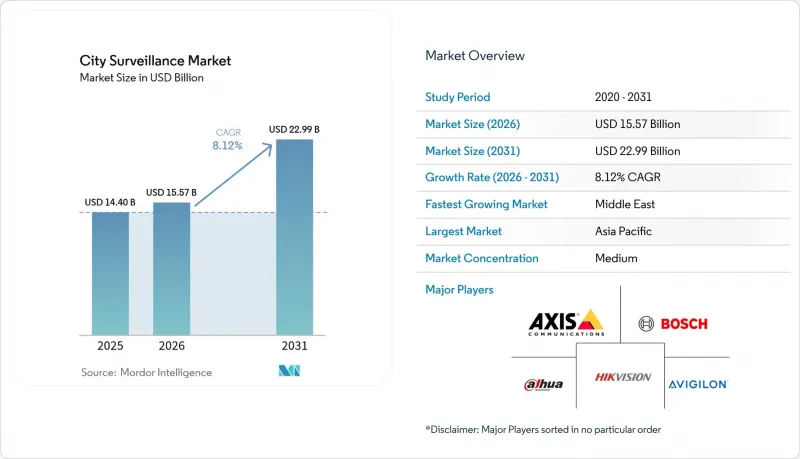
根據 Mordor Intelligence 估計,到 2026 年,城市監控市場價值將達到 155.7 億美元,高於 2025 年的 144 億美元,預計到 2031 年將達到 229.9 億美元。
預計從 2026 年到 2031 年,其複合年成長率將達到 8.12%。
本報告按組件(攝影機、儲存設備等)、部署模式(本地部署、雲端部署、混合部署)、攝影機連接方式(有線、無線)、應用領域(執法機關、關鍵基礎設施保護、公共交通樞紐等)、最終用戶(市政機構、警察局等)和地區進行細分。市場預測以美元計價。
全球城市監控市場趨勢及洞察
增加對城市安全基礎設施的投入
受犯罪率上升和恐怖主義威脅評估升級的推動,各城市已撥款32億美元用於2024年的攝影機網路升級。光是底特律的「綠燈計畫」(Project Greenlight)就投資700萬美元,用於建構連接公共和私營設施的整合式影像分發系統。巴塞隆納也出現了類似的預算成長,該市已撥款5,000萬歐元(約5,450萬美元)用於建設一個整合安防、交通流量和環境監測功能的攝影機網路。包括美國社區警務服務(COPS)在內的聯邦和地方津貼項目,持續降低市政當局在可支配資金有限的情況下進行大規模採購所帶來的風險。由此產生的需求有利於那些能夠提供端到端解決方案並證明其投資回報率(ROA)安全的供應商,從而進一步鞏固了城市監控市場的成長勢頭。
IP攝影機價格下降和進階影像分析
隨著組件成本每年下降15%至20%,採購標準已從影像解析度轉向嵌入式智慧,這使得即使是預算有限的城市也能部署具備設備端分析功能的4K攝影機。舊金山市透過遷移到邊緣運算設備,成功地將整體擁有成本(TCO)降低了40%,這些設備能夠自動對事件進行分類並減少儲存需求。如今,由於人工智慧推理功能已整合在攝影機晶片組上,市政部門可以在獲得即時洞察的同時,將頻寬負載降低高達90%。這種「經濟性」與「智慧性」的協同作用預計將使城市監控市場在2030年之前保持穩定成長。
加強隱私法規和公眾反對
歐盟的人工智慧法案限制了即時生物識別,增加了合規成本,並可能使專案預算增加高達20%。 2024年,針對市政當局的GDPR一般資料保護規則力度增加了兩倍,不當處理監控數據的平均罰款高達280萬歐元(305萬美元)。公民抗議活動導致歐洲15個主要城市的攝影機部署被推遲或暫停,迫使地方政府採用「隱私設計」原則。這導致部署週期延長、功能受限,並減緩了城市監控市場的成長。
細分市場分析
預計到2025年,攝影機硬體將佔城市監控市場收入的45.12%,鞏固其作為關鍵影像擷取層的地位。然而,隨著市政部門從被動錄影轉向即時情報,影像分析平台預計將成為所有組件中複合年成長率最高的,達到9.02%。由於設備端推理處理能夠提高情境察覺,同時降低頻寬和儲存成本,因此城市監控市場中影像分析的市場規模預計將快速成長。
邊緣分析僅保留關鍵元資料,從而限制了長期存檔的數據量,並降低了儲存陣列的市場佔有率。軟體供應商正透過符合 GDPR 標準的匿名化、自動遮罩和與交通及環境感測器整合的開放 API 來凸顯自身優勢。這些功能使分析公司能夠設定更高的價格,主導採購標準,並進一步鞏固其在城市監控市場的新競爭優勢。
到2025年,本地部署解決方案將佔據城市監控市場61.74%的佔有率,這反映了傳統的投資模式以及對資料管理確定性的需求。同時,受彈性儲存、自動化軟體更新和生命週期成本降低等因素的推動,雲端採用預計將以9.29%的複合年成長率成長。混合模式將即時本地處理與雲端分析相結合,使像鳳凰城這樣的大城市能夠在無需增設現場硬體的情況下,長期儲存高清影像。
矛盾的是,更嚴格的監管反而加速了這項轉型,因為獲得認證的雲端服務提供者提供的加密、稽核追蹤和合規文件層級遠遠超出大多數市政當局的IT預算。隨著這些擔憂的消退,城市監控市場將迎來來自軟體即服務 (SaaS) 的新的經常性收入來源,從而進一步實現供應商收入來源的多元化。
區域分析
預計亞太地區將主導市場,到2025年將佔全球營收的35.05%,並維持8.46%的複合年成長率至2031年。中國高密度城市監控計畫和印度150億美元的「智慧城市計畫」是該地區需求的支持。在新加坡的「智慧國家」計畫中,20萬個攝影機已整合到全市分析系統中,用於管理交通、人群密度和環境監測。 2024年,澳洲投資5億澳元(3.35億美元)用於交通樞紐的安全措施,優先考慮隱私保護。同時,在日本,由於人口老化,人工智慧驅動的異常檢測技術正被推廣用於支援緊急應變。
在北美,持續的升級改造正在進行中,美國各市政府計劃在2024年撥款32億美元用於現代化改造。聯邦基礎設施立法為小規模城市提供津貼,而加拿大的大都會圈正在試行混合雲端部署,以滿足區域資料主權要求。歐洲預計7.84%的複合年成長率反映了GDPR(一般資料保護規則)推動的設備更新周期,以及「人工智慧法」所帶來的技術合規加速。儘管這些成熟地區的城市監控市場成長更為穩定,但背後是強制性的網路安全和隱私評估。中東和非洲地區預計將實現8.92%的複合年成長率,這主要得益於沙烏地阿拉伯的「NEOM」和阿拉伯聯合大公國的國家數位城市計畫等大型企劃。卡達正將其2022年世界盃的基礎設施改造為多機構聯合監控網路,而奈及利亞在城市安防方面投入的2億美元則凸顯了撒哈拉以南非洲地區日益成長的需求。南美洲也出現了新的成長點,巴西耗資8億美元的智慧城市計畫以及阿根廷將監控系統與911呼叫中心整合的舉措便是例證。儘管外匯波動和複雜的採購流程限制了部署規模,但並未影響策略意圖,這表明城市監控市場將逐步擴張。
其他好處:
- Excel格式的市場預測(ME)表
- 3個月的分析師支持
目錄
第1章:引言
- 研究假設和市場定義
- 調查範圍
第2章:調查方法
第3章執行摘要
第4章 市場狀況
- 市場概覽
- 市場促進因素
- 增加對城市安全基礎設施的投入
- 更低的IP攝影機價格和更強的影像分析功能。
- 人們越來越擔心主要城市的恐怖主義和犯罪問題
- 擴大智慧城市預算,用於綜合監測
- 邊緣AI晶片降低頻寬成本
- 內建相機模組的智慧照明桿
- 市場限制因素
- 加強隱私法規和公眾反對
- 物聯網攝影機日益增多的網路安全漏洞
- 熟練的影像分析人員短缺
- 與傳統公共安全系統的互通性差距
- 產業價值鏈分析
- 監理情勢
- 技術展望
- 波特五力分析
- 宏觀經濟因素的影響
第5章 市場規模與成長預測
- 按組件
- 相機
- 貯存
- 視訊管理系統
- 影像分析
- 部署模式
- 現場
- 雲
- 混合
- 攝影機連接性別
- 有線
- 無線的
- 透過使用
- 交通管理
- 執法機關
- 關鍵基礎設施保護
- 大眾運輸樞紐
- 其他用途
- 最終用戶
- 地方政府
- 警察局
- 運輸
- 公用事業
- 其他最終用戶
- 按地區
- 北美洲
- 美國
- 加拿大
- 墨西哥
- 歐洲
- 德國
- 英國
- 法國
- 俄羅斯
- 其他歐洲國家
- 亞太地區
- 中國
- 日本
- 印度
- 韓國
- 澳洲
- 其他亞太國家
- 中東和非洲
- 中東
- 沙烏地阿拉伯
- 阿拉伯聯合大公國
- 其他中東國家
- 非洲
- 南非
- 埃及
- 其他非洲國家
- 中東
- 南美洲
- 巴西
- 阿根廷
- 其他南美國家
- 北美洲
第6章 競爭情勢
- 市場集中度
- 策略趨勢
- 市佔率分析
- 公司簡介
- Hangzhou Hikvision Digital Technology Co., Ltd.
- Zhejiang Dahua Technology Co., Ltd.
- Axis Communications AB(Canon Inc.)
- Robert Bosch GmbH-Bosch Security and Safety Systems
- Motorola Solutions, Inc.-Avigilon Corporation
- Hanwha Vision Co., Ltd.
- Honeywell International Inc.-Honeywell Security Group
- Panasonic Holdings Corporation
- NEC Corporation
- Genetec Inc.
- CP Plus International
- Infinova Corporation
- Cisco Systems, Inc.
- Agent Video Intelligence Ltd.
- Verint Systems Inc.
- NICE Ltd.
- Qognify Inc.(Battery Ventures)
- Zhejiang Uniview Technologies Co., Ltd.
第7章 市場機會與未來展望
According to Mordor Intelligence, city surveillance market size in 2026 is estimated at USD 15.57 billion, growing from 2025 value of USD 14.40 billion with 2031 projections showing USD 22.99 billion, growing at 8.12% CAGR over 2026-2031.
This report is Segmented by Component (Camera, Storage, and More), Deployment Mode (On-Premise, Cloud, and Hybrid), Camera Connectivity (Wired, and Wireless), Application (Law Enforcement, Critical Infrastructure Protection, Public Transportation Hubs, and More), End User (Municipal Authorities, Police Departments, and More), and Geography. The Market Forecasts are Provided in Terms of Value (USD).
Global City Surveillance Market Trends and Insights
Increased Spending on Urban Security Infrastructure
Escalating crime and higher terrorism threat assessments prompted cities to earmark USD 3.2 billion for camera-network upgrades during 2024, with Detroit's Project Green Light alone channeling USD 7 million toward integrated video feeds that link public and privately owned sites. Similar budget expansions are visible in Barcelona, where EUR 50 million (USD 54.5 million) funded a camera grid that merges security, traffic flow, and environmental monitoring functions. Federal and regional grant programs, including the U.S. Community Oriented Policing Services, continue to de-risk large-scale procurements for municipalities that lack discretionary capital. The resulting demand pipeline favors platform vendors that supply end-to-end solutions and provide documented return-on-safety metrics, thereby reinforcing the growth trajectory of the city surveillance market.
Declining IP-Camera Prices and Enhanced Video Analytics
A component cost erosion of 15-20% per year has shifted procurement criteria from image resolution to embedded intelligence, enabling budget-constrained cities to deploy 4K cameras with on-device analytics. San Francisco achieved a 40% total cost of ownership reduction after migrating to edge-enabled units that automatically classify events and reduce storage requirements. As AI inference now executes on camera chipsets, municipalities capture real-time insights while trimming bandwidth loads by up to 90%. The affordability-intelligence nexus is expected to keep the city surveillance market on a robust expansion path through 2030.
Heightened Privacy Regulations and Public Opposition
The European Union's AI Act restricts real-time biometric identification, driving compliance costs that can add 20% to project budgets. GDPR enforcement actions against municipalities increased threefold in 2024, with an average fine of EUR 2.8 million (USD 3.05 million) for mishandling surveillance data. Citizen activism has delayed or canceled camera deployments in 15 major European cities, forcing local governments to apply privacy-by-design principles that lengthen roll-out timelines and limit feature sets, thereby tempering the growth of the city surveillance market.
Other drivers and restraints analyzed in the detailed report include:
- Growing Terrorism and Crime Concerns in Mega-Cities
- Expansion of Smart-City Budgets for Integrated Surveillance
- Rising Cybersecurity Vulnerabilities in IoT Cameras
For complete list of drivers and restraints, kindly check the Table Of Contents.
Segment Analysis
Camera hardware accounted for 45.12% of city surveillance market revenue in 2025, affirming its status as the indispensable capture layer. Video analytics platforms, however, are projected to deliver a 9.02% CAGR, the fastest among components, as municipalities shift from passive recording to real-time intelligence. The city surveillance market size for video analytics is set to expand rapidly because on-device inference reduces bandwidth and storage costs while enhancing situational awareness.
Storage arrays face share erosion as edge analytics retains only critical metadata, curbing long-term archiving volumes. Software vendors differentiate through GDPR-compliant anonymization, automated redaction, and open APIs that integrate with traffic and environmental sensors. These attributes position analytics firms to command premium pricing and shape procurement criteria, reinforcing their emerging dominance within the city surveillance market.
On-premise solutions controlled 61.74% of the city surveillance market share in 2025, reflecting legacy investments and a perception of greater data custody. Cloud deployments, however, are forecast to post a 9.29% CAGR, buoyed by elastic storage, automatic software updates, and lower lifecycle costs. Hybrid models bridge real-time local processing with cloud analytics, enabling large cities like Phoenix to store high-resolution footage for extended periods without expanding on-site hardware.
Regulatory stringency is paradoxically accelerating migration, as certified cloud providers offer encryption, audit trails, and compliance documentation that surpass most municipal IT budgets. As these concerns ease, the city surveillance market gains a fresh layer of recurring, software-as-a-service revenue, further diversifying vendor income streams.
Complete Report Scope:
- By Component
- Camera
- Storage
- Video Management System
- Video Analytics
- By Deployment Mode
- On-Premise
- Cloud
- Hybrid
- By Camera Connectivity
- Wired
- Wireless
- By Application
- Traffic Management
- Law Enforcement
- Critical Infrastructure Protection
- Public Transportation Hubs
- Other Application
- By End User
- Municipal Authorities
- Police Departments
- Transportation Agencies
- Utilities
- Other End User
- By Geography
- North America
- United States
- Canada
- Mexico
- Europe
- Germany
- United Kingdom
- France
- Russia
- Rest of Europe
- Asia-Pacific
- China
- Japan
- India
- South Korea
- Australia
- Rest of Asia-Pacific
- Middle East and Africa
- Middle East
- Saudi Arabia
- United Arab Emirates
- Rest of Middle East
- Africa
- South Africa
- Egypt
- Rest of Africa
- Middle East
- South America
- Brazil
- Argentina
- Rest of South America
- North America
Geography Analysis
The Asia-Pacific region dominated with 35.05% of 2025 revenue and is forecasted to grow at an 8.46% CAGR through 2031. China's high-density urban surveillance programs and India's USD 15 billion Smart Cities Mission anchor the region's demand pipeline. Singapore's Smart Nation initiative already interconnects 200,000 cameras with citywide analytics to manage traffic, crowd density, and environmental monitoring. Australia committed AUD 500 million (USD 335 million) in 2024 toward privacy-compliant transport hub security, while Japan's aging population dynamics drive AI-based anomaly detection to assist emergency response.
North America recorded sustained upgrades, with U.S. municipalities allocating USD 3.2 billion for modernization in 2024. Federal infrastructure bills subsidize smaller cities, while Canadian metropolitan areas pilot hybrid-cloud deployments that meet local data-sovereignty requirements. Europe's 7.84% projected CAGR reflects GDPR-driven equipment refresh cycles and the AI Act's technical-compliance impetus. The city surveillance market size expansion across these mature regions is steadier but underpinned by mandatory cybersecurity and privacy overhauls. The Middle East and Africa are projected to record a 8.92% CAGR, powered by megaprojects such as Saudi Arabia's NEOM and the UAE's national digital-city programs. Qatar repurposes 2022 World Cup infrastructure into multi-agency surveillance grids, while Nigeria's USD 200 million urban security outlay underscores the rising demand in sub-Saharan Africa. South America is experiencing emergent growth, as evidenced by Brazil's USD 800 million smart-city commitments and Argentina's integration of surveillance with 911-call centers. Currency volatility and procurement red tape temper volume but not strategic intent, signaling a gradual uptick in the city surveillance market.
- Hangzhou Hikvision Digital Technology Co., Ltd.
- Zhejiang Dahua Technology Co., Ltd.
- Axis Communications AB (Canon Inc.)
- Robert Bosch GmbH - Bosch Security and Safety Systems
- Motorola Solutions, Inc. - Avigilon Corporation
- Hanwha Vision Co., Ltd.
- Honeywell International Inc. - Honeywell Security Group
- Panasonic Holdings Corporation
- NEC Corporation
- Genetec Inc.
- CP Plus International
- Infinova Corporation
- Cisco Systems, Inc.
- Agent Video Intelligence Ltd.
- Verint Systems Inc.
- NICE Ltd.
- Qognify Inc. (Battery Ventures)
- Zhejiang Uniview Technologies Co., Ltd.
Additional Benefits:
- The market estimate (ME) sheet in Excel format
- 3 months of analyst support
TABLE OF CONTENTS
1 INTRODUCTION
- 1.1 Study Assumptions and Market Definition
- 1.2 Scope of the Study
2 RESEARCH METHODOLOGY
3 EXECUTIVE SUMMARY
4 MARKET LANDSCAPE
- 4.1 Market Overview
- 4.2 Market Drivers
- 4.2.1 Increased Spending on Urban Security Infrastructure
- 4.2.2 Declining IP Camera Prices and Enhanced Video Analytics
- 4.2.3 Growing Terrorism and Crime Concerns in Mega-Cities
- 4.2.4 Expansion of Smart City Budgets for Integrated Surveillance
- 4.2.5 Edge AI Chips Cutting Bandwidth Costs
- 4.2.6 Smart Lighting Poles Embedding Camera Modules
- 4.3 Market Restraints
- 4.3.1 Heightened Privacy Regulations and Public Opposition
- 4.3.2 Rising Cybersecurity Vulnerabilities in IoT Cameras
- 4.3.3 Shortage of Skilled Video Analytics Personnel
- 4.3.4 Interoperability Gaps with Legacy Public Safety Systems
- 4.4 Industry Value Chain Analysis
- 4.5 Regulatory Landscape
- 4.6 Technological Outlook
- 4.7 Porter's Five Forces Analysis
- 4.7.1 Bargaining Power of Suppliers
- 4.7.2 Bargaining Power of Buyers
- 4.7.3 Threat of New Entrants
- 4.7.4 Threat of Substitutes
- 4.7.5 Intensity of Competitive Rivalry
- 4.8 Impact of Macroeconomic Factors
5 MARKET SIZE AND GROWTH FORECASTS (VALUE)
- 5.1 By Component
- 5.1.1 Camera
- 5.1.2 Storage
- 5.1.3 Video Management System
- 5.1.4 Video Analytics
- 5.2 By Deployment Mode
- 5.2.1 On-Premise
- 5.2.2 Cloud
- 5.2.3 Hybrid
- 5.3 By Camera Connectivity
- 5.3.1 Wired
- 5.3.2 Wireless
- 5.4 By Application
- 5.4.1 Traffic Management
- 5.4.2 Law Enforcement
- 5.4.3 Critical Infrastructure Protection
- 5.4.4 Public Transportation Hubs
- 5.4.5 Other Application
- 5.5 By End User
- 5.5.1 Municipal Authorities
- 5.5.2 Police Departments
- 5.5.3 Transportation Agencies
- 5.5.4 Utilities
- 5.5.5 Other End User
- 5.6 By Geography
- 5.6.1 North America
- 5.6.1.1 United States
- 5.6.1.2 Canada
- 5.6.1.3 Mexico
- 5.6.2 Europe
- 5.6.2.1 Germany
- 5.6.2.2 United Kingdom
- 5.6.2.3 France
- 5.6.2.4 Russia
- 5.6.2.5 Rest of Europe
- 5.6.3 Asia-Pacific
- 5.6.3.1 China
- 5.6.3.2 Japan
- 5.6.3.3 India
- 5.6.3.4 South Korea
- 5.6.3.5 Australia
- 5.6.3.6 Rest of Asia-Pacific
- 5.6.4 Middle East and Africa
- 5.6.4.1 Middle East
- 5.6.4.1.1 Saudi Arabia
- 5.6.4.1.2 United Arab Emirates
- 5.6.4.1.3 Rest of Middle East
- 5.6.4.2 Africa
- 5.6.4.2.1 South Africa
- 5.6.4.2.2 Egypt
- 5.6.4.2.3 Rest of Africa
- 5.6.4.1 Middle East
- 5.6.5 South America
- 5.6.5.1 Brazil
- 5.6.5.2 Argentina
- 5.6.5.3 Rest of South America
- 5.6.1 North America
6 COMPETITIVE LANDSCAPE
- 6.1 Market Concentration
- 6.2 Strategic Moves
- 6.3 Market Share Analysis
- 6.4 Company Profiles (includes Global Level Overview, Market Level Overview, Core Segments, Financials as Available, Strategic Information, Market Rank/Share for Key Companies, Products and Services, and Recent Developments)
- 6.4.1 Hangzhou Hikvision Digital Technology Co., Ltd.
- 6.4.2 Zhejiang Dahua Technology Co., Ltd.
- 6.4.3 Axis Communications AB (Canon Inc.)
- 6.4.4 Robert Bosch GmbH - Bosch Security and Safety Systems
- 6.4.5 Motorola Solutions, Inc. - Avigilon Corporation
- 6.4.6 Hanwha Vision Co., Ltd.
- 6.4.7 Honeywell International Inc. - Honeywell Security Group
- 6.4.8 Panasonic Holdings Corporation
- 6.4.9 NEC Corporation
- 6.4.10 Genetec Inc.
- 6.4.11 CP Plus International
- 6.4.12 Infinova Corporation
- 6.4.13 Cisco Systems, Inc.
- 6.4.14 Agent Video Intelligence Ltd.
- 6.4.15 Verint Systems Inc.
- 6.4.16 NICE Ltd.
- 6.4.17 Qognify Inc. (Battery Ventures)
- 6.4.18 Zhejiang Uniview Technologies Co., Ltd.
7 MARKET OPPORTUNITIES AND FUTURE OUTLOOK
- 7.1 White-space and Unmet Need Analysis


