


 |
市場調查報告書
商品編碼
2124041
無線通訊測試:市場佔有率分析、產業趨勢與統計、成長預測(2026-2031)Wireless Testing - Market Share Analysis, Industry Trends & Statistics, Growth Forecasts (2026 - 2031) |
||||||

※ 本網頁內容可能與最新版本有所差異。詳細情況請與我們聯繫。
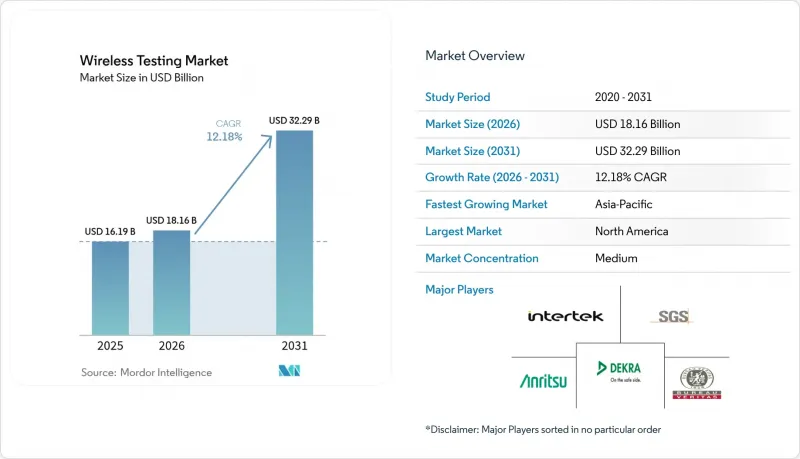
根據 Mordor Intelligence 預測,無線通訊測試市場規模將從 2025 年的 161.9 億美元成長到 2026 年的 181.6 億美元,然後在 2031 年達到 322.9 億美元,2026 年至 2031 年的複合年成長率為 12.18%。
本報告涵蓋以下類別:產品(設備[無線設備測試和無線網路測試]和服務)、技術(藍牙、Wi-Fi、GPS/GNSS、4G/LTE、5G 和其他[2G、3G、Zigbee、UWB 等])、應用(消費性電子、汽車、IT 和通訊、能源和電力、醫療設備、航太和其他地區。
全球無線通訊測試市場趨勢與洞察
5G基礎設施的快速擴張
全球電信業者計畫在2030年僅在亞太地區就投資2,590億美元用於5G部署,將推動無線通訊測試市場朝向超寬頻、多天線校準環境發展,因此能夠近乎即時地對大規模MIMO吞吐量和波束成形精度進行基準測試。日本NTT Docomo、KDDI和Softbank Corporation已合計累計超過130億美元,以涵蓋全部人口,這要求測試實驗室在能夠模擬極端當地氣候條件的溫控艙中模擬網路切片延遲和開放式RAN互通性。這些業者現在要求進行全面的檢驗,涵蓋射頻指標、雲端原生核心整合以及服務水準的關鍵效能指標(KPI)。能夠在單一無線通訊測試週期內整合通道模擬、流量產生和網路安全掃描的供應商正在獲得利潤豐厚的合約。隨著非地面電波網路等5G-Advanced特性的實現,結合衛星和地面電波鏈路的場景化測試變得至關重要,這將為無線通訊測試市場創造新的收入來源。
人工智慧驅動的自癒網路需要預測性測試分析。
網路編配套件現已整合大規模語言模型 (LLM) 代理,這些代理能夠自主調整小區參數、從故障中恢復並重新路由流量,無需人工干預。這使得測試策略從靜態迴歸腳本轉向預測隨機流量負載下的行為。 VIAVI Solutions 和東北大學正在透過運行一個覆蓋全城的數位孿生模型來展示這種轉變,該模型能夠在吞吐量下降前幾分鐘檢測到異常情況。認證工作流程必須檢驗人工智慧決策路徑、訓練資料的完整性以及模型偏差,並涵蓋數千次模擬故障事件。這種複雜性推高了平均合約規模,買家要求的是持續檢驗服務,而不是一次性的設備認證。將硬體在環、容器化模擬和可解釋人工智慧儀表板相結合的供應商正在無線通訊測試市場樹立新的標竿。
先進的檢測設備和熟練人員高成本。
先進的5G頻道模擬器和毫米波訊號產生器如今每台售價超過100萬美元,而五年終身支援合約又會使總擁有成本增加40%。隨著測試複雜性的增加,認證射頻工程師的薪資已達六位數,許多新興經濟體的國內實驗室無法負擔。市場領導如是德科技(Keysight)累計2024會計年度營收將達到49.8億美元,凸顯了規模經濟優勢,使其能夠批量採購組件並跨多個地點充分利用資產。小規模的競爭對手被迫租用共用測試室的運作,面臨更低的利潤率和更長的投資回收期。這種成本失衡正在推動產業整合,透過收購主導區域實驗室整合到全球網路中,並共用人才和設備。
細分市場分析
預計到2025年,設備市場收入將達到115億美元,佔無線測試市場佔有率的71.02%。然而,隨著託管測試服務(預計到2031年將以11.05%的複合年成長率成長)的崛起,其主導地位正在逐漸減弱。資本密集的訊號產生器、無線測試實驗室和通道模擬器是任何測試實驗室的基礎,但隨著韌體更新周期趨於每年一次,買家越來越質疑設備所有權的價值。隨著客戶將快速認證置於資本投資預算之上,由託管服務驅動的無線測試市場規模將縮小兩者之間的差距。一級供應商正透過捆綁雲端連接的分析儀表板來支援這一轉變,從而實現對通過/失敗指標的近即時遠端監控。同時,像亞利桑那州耗資2,170萬美元的VALOR實驗室這樣的政府資助機構正在開放基於訂閱的專用Open-RAN互通性套件存取權限,加速向基於結果的合約模式轉變。對於設備製造商而言,租賃計劃和按使用量計費的方式使他們能夠在保持高運轉率的同時,減少與自身產品的競爭。
專業服務提供者正利用人工智慧驅動的測試腳本來產生和自動化報告模板,大幅縮短專案週期。這種敏捷性與新創企業的需求不謀而合,這些新創公司需要推出多標準物聯網設備,以確保在數月內成功打入全球市場。與此同時,成熟的行動電話製造商仍在持續採購頂級設備以保護其智慧財產權,儘管市場佔有率有所下降,但設備領域的絕對收入仍然可觀。總體而言,這種兩極化的需求支撐著無線通訊測試市場的發展,並促進了結合硬體租賃、合規管理和基於共用基礎設施的持續回歸測試的混合經營模式的出現。
區域分析
預計到2025年,北美將佔全球收入的32.18%,這得益於其早期的5G部署、龐大的國防預算以及強大的頂級設備供應商生態系統。 Keysight在2024年49.8億美元的收入清晰地展現了該地區研發投入的深度,該地區持續生產下一代示波器和通道模擬器。聯邦政府的支持正在加強全國各地的研究機構,例如,美國國家通訊和資訊管理局(NTIA)已向VIAVI的開放式無線接入網(Open-RAN)測試中心注資2170萬美元,以確保該地區能夠獲得面向未來的檢驗環境。汽車和航空航太產業的領導者正在透過在其生產基地整合安全的專用5G網路來進一步推動需求,這一趨勢正在將複雜的合規項目整合到區域服務供應商手中。
亞太地區正崛起為成長最快的地區,預計複合年成長率將達到12.63%。中國移動、中國聯通和中國電信計劃在2025年總合超過30億美元升級至5G-Advanced,其中包括40萬個基地台的維修。每個基地台都需要進行波束成形和邊緣運算延遲的驗收測量。日本電信業者已額外撥款140億美元用於高密度都市區覆蓋和開放式無線接入網(Open-RAN)試點項目,實驗室和現場測試活動正在同步進行。在韓國和台灣等製造業密集型經濟體,半導體工廠正在鋪設專用中波網路,這需要對Wi-Fi 7、5G和工業級TSN協議進行複雜的共存檢驗。因此,區域認證機構正在投資建造多標準測試實驗室和人工智慧驅動的日誌分析引擎,以應對激增的工作量,這推動了無線通訊測試市場兩位數的成長。
歐洲在主導全球法律規範繼續發揮主導作用。計劃於2025年8月生效的無線電設備指令中的網路安全條款,除了射頻和電磁相容性測試外,還強制要求進行安全審查,這將擴大測試範圍並延長專案週期。德國擁有羅德與施瓦茨等主要製造商,該公司在2024會計年度的銷售額達到29.3億歐元(31.3億美元),並持續擴展其承包藍牙和Wi-Fi測試套件。北歐國家在私有5G端口和礦區部署方面處於領先地位,並正在加速北極環境中無線電干擾的研究。在南歐,智慧電錶的部署正在加速,將能源產業的需求與通訊測試架構連結起來。這些努力共同穩定了歐洲的需求,並最終推動了全球標準化進程,這將促成測試標準的協調統一,從而使整個無線通訊測試市場受益。
其他好處:
- Excel格式的市場預測(ME)表
- 3個月的分析師支持
目錄
第1章:引言
- 研究假設和市場定義
- 調查範圍
第2章:調查方法
第3章執行摘要
第4章 市場狀況
- 市場概覽
- 市場促進因素
- 智慧型手機和智慧型穿戴裝置的使用越來越普遍。
- 對雲端運算和物聯網設備的需求日益成長
- 5G基礎設施的快速擴張
- 設備認證和安全方面的監管要求
- 專用 5G/工業無線網路的激增
- 需要進行預測性測試分析的人工智慧驅動型自癒網路
- 市場限制因素
- 連接協議缺乏標準化
- 先進測試設備和技術純熟勞工的人事費用很高
- 射頻元件供應鏈的波動導致校準週期延遲。
- 加強網路安全合規性導致測試核准流程延誤。
- 價值供應鏈分析
- 監理情勢
- 技術展望
- 6G、人工智慧驅動的自動化、數位孿生
- 波特五力分析
- 新冠疫情和宏觀經濟衝擊的影響
第5章 市場規模與成長預測
- 報價
- 裝置
- 無線設備測試
- 示波器
- 訊號產生器
- 頻譜分析儀
- 網路分析儀
- 無線網路測試
- 網路測試儀
- 網路掃描器
- OTA 測試儀
- 無線設備測試
- 服務
- 測試和認證
- 託管測試服務
- 校準和支持
- 裝置
- 透過技術
- Bluetooth
- Wi-Fi
- GPS/GNSS
- 4G/LTE
- 5G
- 其他(2G、3G、Zigbee、UWB 等)
- 透過使用
- 家用電子產品
- 車
- 資訊科技/通訊
- 能源與電力
- 醫療器材
- 航太/國防
- 其他用途
- 按地區
- 北美洲
- 美國
- 加拿大
- 墨西哥
- 南美洲
- 巴西
- 阿根廷
- 其他南美國家
- 歐洲
- 德國
- 英國
- 法國
- 義大利
- 西班牙
- 俄羅斯
- 其他歐洲國家
- 亞太地區
- 中國
- 印度
- 日本
- 韓國
- 其他亞太國家
- 中東和非洲
- 中東
- GCC
- 土耳其
- 其他中東國家
- 非洲
- 南非
- 埃及
- 奈及利亞
- 其他非洲國家
- 中東
- 北美洲
第6章 競爭情勢
- 市場集中度
- 策略趨勢
- 市佔率分析
- 公司簡介
- Keysight Technologies Inc.
- Rohde and Schwarz GmbH and Co KG
- Anritsu Corporation
- VIAVI Solutions Inc.
- SGS SA
- Bureau Veritas SA
- Intertek Group plc
- DEKRA SE
- UL Solutions Inc.
- TUV SUD AG
- TUV Rheinland AG
- TUV Nord AG
- National Instruments(NI)
- Spirent Communications plc
- Teledyne LeCroy Inc.
- Fortive(Tektronix)
- EXFO Inc.
- LitePoint(Teradyne)
- Cobham Limited
- Emite
- Tektronix
第7章 市場機會與未來展望
According to Mordor Intelligence, the wireless testing market size is expected to grow from USD 16.19 billion in 2025 to USD 18.16 billion in 2026 and is forecast to reach USD 32.29 billion by 2031 at 12.18% CAGR over 2026-2031.
This report is Segmented by Offering (Equipment [Wireless Device Testing and Wireless Network Testing] and Services), Technology (Bluetooth, Wi-Fi, GPS/GNSS, 4G/LTE, 5G, and Other [2G, 3G, Zigbee, UWB Etc. ]), Application (Consumer Electronics, Automotive, IT and Telecommunication, Energy and Power, Medical Devices, Aerospace and Defense, Other Applications), and Geography
Global Wireless Testing Market Trends and Insights
Rapid Expansion of 5G Infrastructure
Global operators plan to invest USD 259 billion in 5G roll-outs across Asia-Pacific alone by 2030, pushing the wireless testing market toward ultra-wideband, multi-antenna calibration environments that can benchmark massive-MIMO throughput and beam-forming accuracy in near-real time. Japan's NTT DOCOMO, KDDI, and SoftBank together budget more than USD 13 billion to reach nationwide population coverage, forcing test labs to simulate network-slicing latency and Open RAN interoperability within temperature-controlled chambers that mirror local climatic extremes. These operators now demand holistic validation that covers RF metrics, cloud-native core integration, and service-level key performance indicators. Vendors able to blend channel emulation, traffic generation, and cybersecurity scanning inside a single over-the-air test cycle are capturing premium contracts. As 5G-Advanced capabilities such as non-terrestrial networking materialize, scenario-based testing that blends satellite and terrestrial links is becoming table-stakes, pulling fresh revenue into the wireless testing market.
AI-Driven Self-Healing Networks Needing Predictive Test Analytics
Network orchestration suites now embed large-language-model agents that autonomously tune cell parameters, recover from outages, and reroute traffic, all without human triggers. Test strategies, therefore, pivot from static regression scripts to behavioural prediction under stochastic traffic loads. VIAVI Solutions and Northeastern University illustrate this shift by running a city-scale digital twin that spots anomalies minutes before they degrade throughput. Certification workflows must certify AI decision-paths, training-data integrity, and model bias across thousands of simulated failure events. This complexity lifts average engagement sizes, with buyers asking for continuous validation as a service rather than once-off device approvals. Providers that combine hardware-in-the-loop, containerized emulation, and explainable-AI dashboards are driving new benchmarks for wireless testing market competitiveness.
High Cost of Advanced Test Equipment and Skilled Labour
Advanced 5G channel emulators and millimeter-wave signal generators now surpass USD 1 million per station, with lifetime support contracts adding 40% to ownership cost over five years. As test complexity rises, certified RF engineers command six-figure salaries that many domestic labs in emerging economies cannot match. Market leaders such as Keysight generated USD 4.98 billion in fiscal 2024 revenue, underscoring scale advantages that allow bulk component sourcing and multi-site asset utilization. Smaller competitors left to rent time on shared chambers face thin margins and elongated payback periods. This cost asymmetry encourages industry consolidation, with acquisition-driven platforms integrating regional labs into global networks to pool talent and equipment.
Other drivers and restraints analyzed in the detailed report include:
- Growing Demand for Cloud Computing and IoT Devices
- Surge in Private 5G/Industrial Wireless Networks
- RF-Component Supply-Chain Volatility Delaying Calibration Cycles
For complete list of drivers and restraints, kindly check the Table Of Contents.
Segment Analysis
Equipment generated USD 11.5 billion in 2025, equal to 71.02% of wireless testing market share, but its grip is loosening as managed testing services outpace at an 11.05% CAGR through 2031. Capital-intensive signal generators, over-the-air chambers, and channel emulators form the backbone of every lab, yet buyers increasingly question ownership when firmware refresh cycles arrive annually. The wireless testing market size attributable to managed services will therefore close the gap as customers prioritize fast certification turnarounds over capital budgets. Tier-one vendors help this transition by bundling cloud-linked analytics dashboards, enabling remote monitoring of pass-fail metrics in near real time. In parallel, government-funded facilities such as the USD 21.7 million VALOR lab in Arizona open subscription-based access to specialty Open-RAN interoperability suites, accelerating the shift toward outcome-based engagements. For equipment makers, rental programs and usage-based pricing mitigate cannibalization while keeping utilization rates high.
Professional service providers leverage AI-assisted test-script generation and automated report templates to slash project cycle times. This agility resonates with start-ups launching multi-standard IoT gadgets that must secure global market entry within months. Meanwhile, established handset brands still purchase top-end gear to protect intellectual property, ensuring the equipment segment retains sizable absolute revenue even as its share declines. Overall, dual-track demand sustains the wireless testing market while encouraging hybrid business models that blend hardware leasing, managed compliance, and continuous regression testing on shared infrastructure.
Complete Report Scope:
- By Offering
- Equipment
- Wireless Device Testing
- Oscilloscopes
- Signal Generators
- Spectrum Analysers
- Network Analysers
- Wireless Network Testing
- Network Testers
- Network Scanners
- OTA Testers
- Wireless Device Testing
- Services
- Testing and Certification
- Managed Testing Services
- Calibration and Support
- Equipment
- By Technology
- Bluetooth
- Wi-Fi
- GPS/GNSS
- 4G/LTE
- 5G
- Other (2G, 3G, Zigbee, UWB etc.)
- By Application
- Consumer Electronics
- Automotive
- IT and Telecommunication
- Energy and Power
- Medical Devices
- Aerospace and Defence
- Other Applications
- By Geography
- North America
- United States
- Canada
- Mexico
- South America
- Brazil
- Argentina
- Rest of South America
- Europe
- Germany
- United Kingdom
- France
- Italy
- Spain
- Russia
- Rest of Europe
- Asia-Pacific
- China
- India
- Japan
- South Korea
- Rest of Asia-Pacific
- Middle East and Africa
- Middle East
- GCC
- Turkey
- Rest of Middle East
- Africa
- South Africa
- Egypt
- Nigeria
- Rest of Africa
- Middle East
- North America
Geography Analysis
North America commanded 32.18% revenue in 2025 thanks to early 5G rollouts, large defense budgets, and an entrenched ecosystem of tier-one equipment vendors. Keysight's USD 4.98 billion 2024 revenue underlines the depth of local R&D expenditure that continually spins off next-generation oscilloscopes and channel emulators. Federal support strengthens domestic labs, exemplified by the National Telecommunications and Information Administration backing VIAVI's Open-RAN test center with USD 21.7 million, guaranteeing local access to future-proof validation environments. Automotive and aerospace primes further amplify demand by integrating secure private 5G networks inside production campuses, a trend that funnels complex compliance projects into regional service providers.
Asia-Pacific is shaping up as the fastest-growing territory, with a projected 12.63% CAGR. China Mobile, China Unicom, and China Telecom together plan more than USD 3 billion in 5G-Advanced upgrades during 2025, including 400,000 base-station refits that each require acceptance measurements for beamforming and edge-computing latency. Japan's operators allocate an additional USD 14 billion for dense-urban coverage and Open-RAN pilots, creating parallel streams of lab and field-test activity. Manufacturing-heavy economies such as South Korea and Taiwan overlay private mid-band grids across chip fabs, spawning intricate coexistence checks between Wi-Fi 7, 5G, and industrial TSN protocols. Consequently, regional certification houses invest in multi-standard chambers and AI-enabled log-analysis engines to absorb surging workload, ensuring the wireless testing market maintains double-digit growth.
Europe retains a pivotal role by anchoring global regulatory frameworks. The Radio Equipment Directive's August 2025 cybersecurity clauses mandate security vetting alongside RF and EMC checks, broadening test engagement scope and extending project timetables. Germany hosts leading manufacturers such as Rohde & Schwarz, which reported EUR 2.93 billion (USD 3.13 billion) in fiscal 2024 revenue and continues expanding turnkey Bluetooth and Wi-Fi suites. Nordic countries pioneer private 5G ports and mining sites, stimulating over-the-air interference studies under arctic conditions. Southern Europe accelerates smart-meter deployments, linking energy-sector needs with telecom test architectures. Together, these initiatives stabilize European demand and feed global standardization efforts that ultimately harmonize testing criteria, benefiting the wider wireless testing market.
- Keysight Technologies Inc.
- Rohde and Schwarz GmbH and Co KG
- Anritsu Corporation
- VIAVI Solutions Inc.
- SGS SA
- Bureau Veritas SA
- Intertek Group plc
- DEKRA SE
- UL Solutions Inc.
- TUV SUD AG
- TUV Rheinland AG
- TUV Nord AG
- National Instruments (NI)
- Spirent Communications plc
- Teledyne LeCroy Inc.
- Fortive (Tektronix)
- EXFO Inc.
- LitePoint (Teradyne)
- Cobham Limited
- Emite
- Tektronix
Additional Benefits:
- The market estimate (ME) sheet in Excel format
- 3 months of analyst support
TABLE OF CONTENTS
1 INTRODUCTION
- 1.1 Study Assumptions and Market Definition
- 1.2 Scope of the Study
2 RESEARCH METHODOLOGY
3 EXECUTIVE SUMMARY
4 MARKET LANDSCAPE
- 4.1 Market Overview
- 4.2 Market Drivers
- 4.2.1 Increasing adoption of smartphones and smart wearables
- 4.2.2 Growing demand for cloud computing and IoT devices
- 4.2.3 Rapid expansion of 5G infrastructure
- 4.2.4 Regulatory mandates for device certification and safety
- 4.2.5 Surge in private 5G/industrial wireless networks
- 4.2.6 AI-driven self-healing networks needing predictive test analytics
- 4.3 Market Restraints
- 4.3.1 Lack of standardisation in connectivity protocols
- 4.3.2 High cost of advanced test equipment and skilled labour
- 4.3.3 RF-component supply-chain volatility delaying calibration cycles
- 4.3.4 Heightened cybersecurity compliance lengthening test approvals
- 4.4 Value/Supply-Chain Analysis
- 4.5 Regulatory Landscape
- 4.6 Technological Outlook
- 4.6.1 6G, AI-based automation, digital twins
- 4.7 Porter's Five Forces Analysis
- 4.7.1 Bargaining Power of Suppliers
- 4.7.2 Bargaining Power of Consumers
- 4.7.3 Threat of New Entrants
- 4.7.4 Threat of Substitutes
- 4.7.5 Intensity of Competitive Rivalry
- 4.8 Impact of COVID-19 and macro-economic shocks
5 MARKET SIZE AND GROWTH FORECASTS (VALUE)
- 5.1 By Offering
- 5.1.1 Equipment
- 5.1.1.1 Wireless Device Testing
- 5.1.1.1.1 Oscilloscopes
- 5.1.1.1.2 Signal Generators
- 5.1.1.1.3 Spectrum Analysers
- 5.1.1.1.4 Network Analysers
- 5.1.1.2 Wireless Network Testing
- 5.1.1.2.1 Network Testers
- 5.1.1.2.2 Network Scanners
- 5.1.1.2.3 OTA Testers
- 5.1.1.1 Wireless Device Testing
- 5.1.2 Services
- 5.1.2.1 Testing and Certification
- 5.1.2.2 Managed Testing Services
- 5.1.2.3 Calibration and Support
- 5.1.1 Equipment
- 5.2 By Technology
- 5.2.1 Bluetooth
- 5.2.2 Wi-Fi
- 5.2.3 GPS/GNSS
- 5.2.4 4G/LTE
- 5.2.5 5G
- 5.2.6 Other (2G, 3G, Zigbee, UWB etc.)
- 5.3 By Application
- 5.3.1 Consumer Electronics
- 5.3.2 Automotive
- 5.3.3 IT and Telecommunication
- 5.3.4 Energy and Power
- 5.3.5 Medical Devices
- 5.3.6 Aerospace and Defence
- 5.3.7 Other Applications
- 5.4 By Geography
- 5.4.1 North America
- 5.4.1.1 United States
- 5.4.1.2 Canada
- 5.4.1.3 Mexico
- 5.4.2 South America
- 5.4.2.1 Brazil
- 5.4.2.2 Argentina
- 5.4.2.3 Rest of South America
- 5.4.3 Europe
- 5.4.3.1 Germany
- 5.4.3.2 United Kingdom
- 5.4.3.3 France
- 5.4.3.4 Italy
- 5.4.3.5 Spain
- 5.4.3.6 Russia
- 5.4.3.7 Rest of Europe
- 5.4.4 Asia-Pacific
- 5.4.4.1 China
- 5.4.4.2 India
- 5.4.4.3 Japan
- 5.4.4.4 South Korea
- 5.4.4.5 Rest of Asia-Pacific
- 5.4.5 Middle East and Africa
- 5.4.5.1 Middle East
- 5.4.5.1.1 GCC
- 5.4.5.1.2 Turkey
- 5.4.5.1.3 Rest of Middle East
- 5.4.5.2 Africa
- 5.4.5.2.1 South Africa
- 5.4.5.2.2 Egypt
- 5.4.5.2.3 Nigeria
- 5.4.5.2.4 Rest of Africa
- 5.4.5.1 Middle East
- 5.4.1 North America
6 COMPETITIVE LANDSCAPE
- 6.1 Market Concentration
- 6.2 Strategic Moves
- 6.3 Market Share Analysis
- 6.4 Company Profiles (includes Global level Overview, Market level overview, Core Segments, Financials as available, Strategic Information, Market Rank/Share for key companies, Products and Services, and Recent Developments)
- 6.4.1 Keysight Technologies Inc.
- 6.4.2 Rohde and Schwarz GmbH and Co KG
- 6.4.3 Anritsu Corporation
- 6.4.4 VIAVI Solutions Inc.
- 6.4.5 SGS SA
- 6.4.6 Bureau Veritas SA
- 6.4.7 Intertek Group plc
- 6.4.8 DEKRA SE
- 6.4.9 UL Solutions Inc.
- 6.4.10 TUV SUD AG
- 6.4.11 TUV Rheinland AG
- 6.4.12 TUV Nord AG
- 6.4.13 National Instruments (NI)
- 6.4.14 Spirent Communications plc
- 6.4.15 Teledyne LeCroy Inc.
- 6.4.16 Fortive (Tektronix)
- 6.4.17 EXFO Inc.
- 6.4.18 LitePoint (Teradyne)
- 6.4.19 Cobham Limited
- 6.4.20 Emite
- 6.4.21 Tektronix
7 MARKET OPPORTUNITIES AND FUTURE OUTLOOK
- 7.1 White-space and Unmet-need Assessment

 無線測試市場規模、佔有率、成長、全球產業分析、區域趨勢及2026年至2034年預測
 無線測試市場-2026-2032年全球市場預測
 2026年全球Wi-Fi現場測量設備(FME)市場報告
 無線測試市場規模、佔有率、趨勢和預測:按產品、技術、應用和地區分類,2026-2034 年
 衰減模擬器市場規模、佔有率和成長分析:按類型、應用、最終用戶產業、部署模式和地區分類-2026-2033年產業預測2026年全球無線測試市場報告紡織品耐熱測試儀市場按產品類型、溫度範圍、自動化類型、最終用途產業和銷售管道,全球預測(2026-2032年)
 無線測試市場分析及預測(至2035年):依類型、產品類型、服務、技術、組件、應用、部署類型、最終用戶及設備分類全球無線測試市場規模、佔有率、趨勢和成長分析報告(2026-2034年)
 無線測試市場 - 全球產業規模、佔有率、趨勢、機會、預測、產品、技術、應用、區域及競爭格局(2021-2031年)