


 |
市場調查報告書
商品編碼
2124038
智慧信標:市場佔有率分析、產業趨勢與統計、成長預測(2026-2031)Smart Beacon - Market Share Analysis, Industry Trends & Statistics, Growth Forecasts (2026 - 2031) |
||||||

※ 本網頁內容可能與最新版本有所差異。詳細情況請與我們聯繫。
根據 Mordor Intelligence 估計,智慧信標市場在 2026 年的價值將達到 50.8 億美元,高於 2025 年的 42 億美元,預計到 2031 年將達到 130.7 億美元。
預計從 2026 年到 2031 年,其複合年成長率將達到 20.85%。
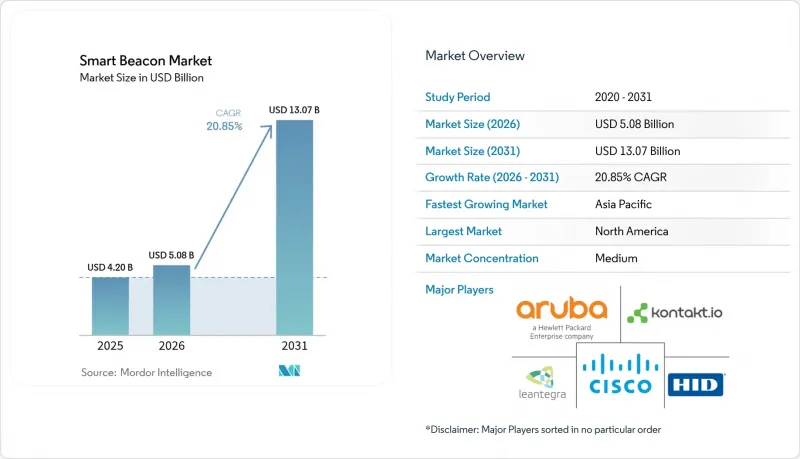
本報告按標準類型(iBeacon、Eddystone、AltBeacon)、連接方式(低功耗藍牙 (BLE)、Wi-Fi (802.11mc/FTM)、超寬頻輔助)、終端用戶產業(零售/購物中心、交通/物流等)、應用程式(近場行銷和優惠券、資產/人員追蹤等)以及地區進行細分。市場預測以美元 (USD) 為單位。
全球智慧信標市場趨勢及洞察
零售業對空間分析的需求日益成長,旨在最佳化客流。
零售商正從靜態熱力圖轉向動態編配引擎,根據消費者在特定貨架附近停留的時間即時調整促銷活動。 GameStop 在 100 家門市部署了信標,用於展示遊戲專屬內容,以應對“展示廳現象效應”,並實現基於位置的精準提升銷售。梅西百貨的「黑色星期五」「走進店裡贏大獎」宣傳活動將數位刮刮樂遊戲與店內位置數據相結合,以提高應用程式安裝量並收集促成購買的詳細路徑數據。 Telstra Retail 透過融合邊緣人工智慧和身分遮罩技術,實現了 95% 的門店客流量測量準確率,在滿足隱私需求的同時,保持了洞察的品質。這些案例表明,差異化的空間智慧能夠提高轉換率、最佳化人員配置和最佳化商品組合決策,即使在零售業客流量波動的情況下,也能確保持續投資。
利用信標技術大幅提升供應鏈視覺性
資產可視性已從單純的便利功能演變為營運必需。 Sky Warehouse 正在貨物托盤中嵌入信標,以縮短搜尋時間、防止貨物錯放並提升轉運中心間的物流效率。北京的「車輛、道路、雲」先導計畫利用 7000 個 5G-A大型基地台和高密度信標叢集,協調物流園區內的自主貨物運輸,展示了厘米級室內精度如何將 V2X 的連續性擴展到室外。 Link Labs 透過部署基於信標的即時定位系統 (RTLS) 平台,在一個多院區醫院系統中將設備搜尋時間縮短了 30%,重複採購減少了 15%。西門子物流正在將信標資料與行李處理軟體整合,以均衡輸送機負載並節省能源。這些案例凸顯了供應鏈營運商為何正在成為智慧信標市場的主要需求群。
大規模部署所需的熟練BLE射頻工程師短缺
光是在美國,預計到2030年半導體工程師缺口就將達到6.7萬人,其中BLE射頻的專業人才特別稀少。麥肯錫公司預測,到2030年新增的4.8萬個技術職位中,可能只有4.35萬個能夠被填補,這將造成人才瓶頸,導致工程工期延長和人事費用上升。 2024年的勞動力調查顯示,53%的半導體產業員工正在考慮在六個月內離職,這進一步加劇了人才流失。在醫院和工廠部署信標需要精確的天線調諧、通道干擾抑制和輸出校準,而這些目前尚無法透過自動化設計工具實現。供應商難以招攬經驗豐富的射頻人才,這可能導致成本超支和客戶不滿,即使市場需求強勁,也可能限制短期內的市場普及。
細分市場分析
iBeacon預計到2025年將佔總收入的60.35%,這反映了蘋果早期的大力推廣及其對整合到行動作業系統生態系統中的支援。同時,Eddystone正以27.12%的複合年成長率成長,這主要得益於企業對Google以網路為中心的「實體網路」模式的青睞,該模式消除了強制下載應用程式的障礙。隨著建築管理平台內建原生支持,以及Matter橋接多個無線協定棧,智慧信標市場預計將隨著Eddystone的普及而快速擴張。 AltBeacon則在尋求廠商中立框架的工業用戶中擁有忠實的用戶群。
仔細分析後,平台戰略才是真正的差異化因素。蘋果將超寬頻 (UWB) 和低功耗藍牙 (BLE) 整合到單一無線前端,實現了安全存取控制和空間運算等在 iBeacon 初代產品問世時無法實現的場景。谷歌則透過在 Chrome 和 Android 的快捷設定中啟用廣播 URL 的可發現性來應對這項挑戰,使公共空間營運商無需開發原生應用程式即可提供上下文資訊。這兩種趨勢正推動企業採用多標準協定棧,並提升了更廣泛的智慧信標市場對能夠在 iBeacon、Eddystone 和 AltBeacon 等不同協定之間進行轉換的閘道器設備的需求。
藍牙低功耗 (BLE) 憑藉其無與倫比的晶片組可用性和亞毫瓦級的功耗,在 2025 年仍保持 81.20% 的市場佔有率,這使得電池供電的標籤能夠運作數年之久。同時,Wi-Fi 802.11mc 的精準授時技術正以 28.67% 的複合年成長率快速成長,因為醫院、機場、倉庫和其他場所對厘米級精度的需求日益成長,且無需額外的無線設備。現有的 Wi-Fi網路基地台只需進行韌體升級即可。預計 BLE 的智慧信標市佔率將保持領先地位直至 2031 年,但隨著結合 BLE 和 Wi-Fi 的混合標籤日益普及,其主導地位將會逐漸減弱。
超寬頻 (UWB) 在安防和 10 公分以下精度應用中發揮特殊作用,例如防盜和自動導引運輸車(AGV),這也解釋了其高昂的組件成本。同時,藍牙技術聯盟 (Bluetooth SIG) 的新頻道探測擴展技術有望實現超越標準低功耗藍牙 (BLE) 的亞米級精度,從而削弱了 Wi-Fi 的精度優勢。目前,連接技術的選擇更取決於延遲接受度、預期電池壽命和預算,而非單一協議的技術優勢,這導致智慧信標市場的收入來源日益多元化。
區域分析
預計到2025年,北美將佔全球整體收入的33.10%,這主要得益於零售業的早期應用以及醫療保健行業嚴格的合規要求(例如對資產進行基於位置的審計)。美國史丹佛健康中心等醫院正在將信標與護士呼叫平台整合,以實現員工響應指標的自動化;而加拿大(例如多倫多和溫哥華)的智慧建築維修項目則利用信標來同步暖通空調和照明系統,以獲得LEED認證。儘管信標的應用正在穩步推進,但由於相關法律和iOS後台掃描限制,其成長速度與新興地區相比可能會放緩。
預計亞太地區將以24.05%的複合年成長率(CAGR)實現最高成長,直至2031年。在中國,超過500個智慧城市示範計畫已整合25.7億個物聯網終端,為大眾運輸、安全監控和零售分析建構了高密度信標網狀網路的基礎。韓國耗資46億美元的「智慧K-City」舉措和48個私人5G網路提供了低延遲骨幹網,非常適合厘米級定位。日本的醫療旅遊即服務(MaaS)市場規模預計在2025年將達到1.17億美元(176億美元),是醫療領域需求旺盛的典型例證。這些因素共同推動亞太地區在智慧信標市場擴張中處於領先地位。
在注重隱私的智慧建築投資的推動下,歐洲正向前發展。德國正加速推動「工業4.0」框架下的工廠數位轉型,並在物流區域部署信標。同時,英國正在維修現有基礎設施,以實施符合GDPR(一般資料保護規範)的以藍牙為基礎的訪客引導工具。歐盟的《網路彈性法案》制定了供應商必須遵守的統一安全標準,提高了進入門檻,同時也增強了關鍵任務部署的信心。這些發展共同凸顯了亞太地區作為成長驅動力的作用,同時也確保了全球貢獻的平衡。
其他好處:
- Excel格式的市場預測(ME)表
- 3個月的分析師支持
目錄
第1章:引言
- 本研究的假設和市場定義;研究範圍
第2章:調查方法
第3章執行摘要
第4章 市場狀況
- 市場概覽
- 市場促進因素
- 零售業對空間分析的需求日益成長,旨在最佳化客流。
- 利用信標技術(物流、航空)大幅提升供應鏈視覺性
- 基於能源採集的無電池信標降低了整體擁有成本(TCO)(未充分報告)
- 與 Matter 整合及統一智慧建築協議(報告不足)
- 市場限制因素
- 大規模部署所需的熟練BLE射頻工程師短缺
- 強制性的「隱私設計」政策限制了被動資料收集。
- 高密度物聯網環境下2.4GHz頻寬壅塞(報告不足)
- 自 iOS 15 以來,作業系統層面對後台掃描的支援不足(已報告的案例很少)。
- 價值供應鏈分析
- 監理情勢
- 技術展望
- 波特五力分析
第5章 市場規模與成長預測
- 依標準類型
- iBeacon
- Eddystone
- AltBeacon
- 透過連接方式
- Bluetooth Low Energy(BLE)
- Wi-Fi(802.11mc/FTM)
- 支援超寬頻 (UWB)
- 透過使用
- 近場行銷和優惠券使用
- 室內導航和路線引導
- 資產和人員追蹤
- 入住狀態及環境監測
- 按最終用戶行業分類
- 零售和購物中心
- 運輸/物流
- 航空與機場
- 醫療機構
- 體育和娛樂設施
- 汽車原廠設備製造商
- 智慧施工現場
- 按地區
- 北美洲
- 美國
- 加拿大
- 墨西哥
- 歐洲
- 德國
- 英國
- 法國
- 其他歐洲國家
- 亞太地區
- 中國
- 日本
- 韓國
- 澳洲
- 其他亞太國家
- 南美洲
- 巴西
- 阿根廷
- 其他南美國家
- 中東和非洲
- 中東
- 沙烏地阿拉伯
- 阿拉伯聯合大公國
- 其他中東國家
- 非洲
- 南非
- 肯亞
- 奈及利亞
- 其他非洲國家
- 中東
- 北美洲
第6章 競爭情勢
- 市場集中度
- 策略趨勢
- 市佔率分析
- 公司簡介
- Aruba Networks Hewlett Packard Enterprise Development LP
- Cisco Systems Inc.
- HID Global Corporation
- Kontakt.io Inc.
- Gimbal Inc.
- Accent Systems SL
- Sensoro Co., Ltd.
- Fujitsu Components Ltd.
- Jaalee Technology Co., Ltd.
- Estimote Inc.
- BlueCats Pty Ltd.
- Radius Networks Inc.
- Quuppa Oy
- BlueVision Wireless Ltd.
- Wiliot Inc.
- Minew Technologies Co., Ltd.
- Onyx Beacon Inc.
- Beaconinside GmbH
- Zebra Technologies Corporation
- Samsung Electronics Co., Ltd.(SmartThings)
第7章 市場機會與未來展望
According to Mordor Intelligence, smart beacon market size in 2026 is estimated at USD 5.08 billion, growing from 2025 value of USD 4.2 billion with 2031 projections showing USD 13.07 billion, growing at 20.85% CAGR over 2026-2031.
This report Segments by Standard Type (iBeacon, Eddystone and AltBeacon), Connectivity (Bluetooth Low Energy (BLE), Wi-Fi (802. 11mc/FTM) and Ultra-Wideband Assisted), End-User Industry (Retail and Malls, Transportation and Logistics and More), Application (Proximity Marketing and Couponing, Asset and Personnel Tracking and More), and Geography. The Market Forecasts are Provided in Terms of Value (USD).
Global Smart Beacon Market Trends and Insights
Growing Demand for Spatial Analytics in Retail Foot-Fall Optimisation
Retailers have progressed from static heat maps to dynamic orchestration engines that adapt promotions in real time as shoppers dwell near specific shelves. GameStop deployed beacons across 100 stores to surface game-specific content and combat showrooming, translating location cues into targeted upsell prompts. Macy's Black Friday "Walk in and Win" campaign blended digital scratch-off games with in-store positioning, boosting app installs and capturing granular path-to-purchase data. Telstra Retail validated 95% foot-traffic counting accuracy by fusing edge AI with identity masking, satisfying privacy expectations while preserving insight quality. These examples show that differentiated spatial intelligence can raise conversion, manage staffing, and refine assortment decisions, sustaining investment even as overall retail traffic fluctuates.
Surge in Beacon-Enabled Supply-Chain Visibility
Asset visibility has shifted from convenience to operational mandate. Sky Warehouse embeds beacons on cargo pallets to cut search time and prevent misplacement, improving dock-to-dock flow metrics. Beijing's vehicle-road-cloud pilot uses 7,000 5G-A macro cells and dense beacon clusters to orchestrate autonomous freight within logistics parks, proving that centimetre-level indoor accuracy can extend outdoor V2X continuity. Link Labs logged a 30% reduction in equipment search time and 15% fewer duplicate purchases across multi-facility hospital systems after rolling out its beacon-based RTLS platform. Siemens Logistics integrates beacon data with baggage-handling software to balance conveyor load and save energy. These cases underline why supply-chain operators are emerging as a dominant demand pool within the smart beacon market.
Scarcity of Skilled BLE RF Engineers for Large-Scale Rollouts
The United States alone faces a projected 67,000 semiconductor-engineering shortfall by 2030, and BLE RF expertise is among the rarest subsets. McKinsey notes that only 43,500 of the 48,000 new technician roles needed by 2030 may be filled, creating a bottleneck that inflates project timelines and wages. A 2024 workforce survey found 53% of semiconductor employees contemplating resignation within six months, compounding churn. Beacon rollouts in hospitals or factories require precise antenna tuning, channel-interference mitigation, and power calibration that automated design tools cannot yet replicate. Vendors struggling to secure seasoned RF talent risk cost overruns and client dissatisfaction, limiting near-term uptake despite robust underlying demand.
Other drivers and restraints analyzed in the detailed report include:
- Energy-Harvesting, Battery-Free Beacons Cut Lifetime TCO
- Integration with Matter and Unified Smart-Building Protocols
- Privacy-by-Design Mandates Restrict Passive Data Capture
For complete list of drivers and restraints, kindly check the Table Of Contents.
Segment Analysis
iBeacon accounted for 60.35% of 2025 revenue, reflecting Apple's early push and embedded support within its mobile OS ecosystem. Eddystone, however, is growing at a 27.12% CAGR as enterprises favour Google's web-centric Physical Web model that removes the friction of mandatory app downloads. The smart beacon market size for Eddystone deployments is forecast to expand sharply as building-management platforms embed native support and as Matter bridges multiple radio stacks. AltBeacon maintains a loyal base among industrial users seeking vendor-neutral frameworks.
A deeper look reveals platform strategy is the true differentiator. Apple's consolidation of Ultra-Wideband and BLE in a single radio front end enables secure access control and spatial computing scenarios unavailable when iBeacon launched. Google counters by making broadcast URLs discoverable in Chrome and Android Quick Settings, empowering public-space operators to push context without cultivating native apps. This dual trajectory encourages enterprises to adopt multi-standard stacks, intensifying demand for gateway devices that translate among iBeacon, Eddystone, and AltBeacon payloads inside the broader smart beacon market.
Bluetooth Low Energy retained 81.20% market share in 2025 thanks to unrivalled chipset availability and sub-milliwatt power draw that keeps battery-based tags alive for years. Yet Wi-Fi 802.11mc fine-time-measurement is rising at a 28.67% CAGR as hospitals, airports, and warehouses seek centimetres-grade accuracy without deploying additional radios; existing Wi-Fi access points only need firmware upgrades. The smart beacon market share for BLE will remain the largest through 2031, but its dominance will narrow as hybrid BLE + Wi-Fi tags proliferate.
Ultra-Wideband plays a specialist role where security and sub-10 cm accuracy justify higher bill-of-materials, such as infant-abduction prevention or automated guided vehicles. Meanwhile, Bluetooth SIG's new channel-sounding extension promises sub-meter precision over standard BLE, blunting Wi-Fi's accuracy advantage. Connectivity decisions now revolve around latency tolerance, battery life expectations, and capital budget rather than any single protocol's technical merit, diversifying revenue streams within the smart beacon market.
Complete Report Scope:
- By Standard Type
- iBeacon
- Eddystone
- AltBeacon
- By Connectivity
- Bluetooth Low Energy (BLE)
- Wi-Fi (802.11mc/FTM)
- Ultra-Wideband Assisted
- By Application
- Proximity Marketing and Couponing
- Indoor Navigation and Way-finding
- Asset and Personnel Tracking
- Occupancy and Environment Monitoring
- By End-User Industry
- Retail and Malls
- Transportation and Logistics
- Aviation and Airports
- Healthcare Facilities
- Sports and Entertainment Venues
- Automotive OEMs
- Smart Construction Sites
- By Geography
- North America
- United States
- Canada
- Mexico
- Europe
- Germany
- United Kingdom
- France
- Rest of Europe
- Asia-Pacific
- China
- Japan
- South Korea
- Australia
- Rest of Asia-Pacific
- South America
- Brazil
- Argentina
- Rest of South America
- Middle East and Africa
- Middle East
- Saudi Arabia
- United Arab Emirates
- Rest of Middle East
- Africa
- South Africa
- Kenya
- Nigeria
- Rest of Africa
- Middle East
- North America
Geography Analysis
North America captured 33.10% of global revenue in 2025 on the back of early retail rollouts and stringent healthcare compliance that mandates asset location auditing. United States hospitals such as Stanford Health integrate beacons with nurse-call platforms to automate staff-response metrics, while Canadian smart-building retrofits in Toronto and Vancouver leverage beacons to synchronize HVAC and lighting for LEED certifications. Adoption remains steady, though privacy legislation and iOS background-scanning limits may temper growth relative to emerging regions.
Asia-Pacific posts the fastest 24.05% CAGR through 2031. China's 500-plus smart-city pilots integrate 2.57 billion IoT endpoints that anchor dense beacon meshes for public transit, safety monitoring, and retail analytics. South Korea's USD 4.6 billion Smart K-Cities initiative and 48 private 5G networks deliver low-latency backbones ideal for centimeter-grade positioning. Japan's medical MaaS segment, valued at JPY 17.6 billion (USD 117 million) in 2025, exemplifies healthcare-focused demand. Combined, these factors place Asia-Pacific at the forefront of scaling the smart beacon market.
Europe advances on the strength of privacy-compliant smart-building investments. Germany pushes factory digitalization under Industrie 4.0, deploying beacons in intralogistics zones, while the United Kingdom retrofits historical infrastructure with Bluetooth-based visitor guidance tools that respect GDPR. The EU's Cyber Resilience Act sets a harmonized security baseline that vendors must meet, raising entry thresholds but also building trust in mission-critical deployments. Collectively, these trajectories ensure balanced global contributions while confirming Asia-Pacific as the growth engine.
- Aruba Networks Hewlett Packard Enterprise Development LP
- Cisco Systems Inc.
- HID Global Corporation
- Kontakt.io Inc.
- Gimbal Inc.
- Accent Systems S.L.
- Sensoro Co., Ltd.
- Fujitsu Components Ltd.
- Jaalee Technology Co., Ltd.
- Estimote Inc.
- BlueCats Pty Ltd.
- Radius Networks Inc.
- Quuppa Oy
- BlueVision Wireless Ltd.
- Wiliot Inc.
- Minew Technologies Co., Ltd.
- Onyx Beacon Inc.
- Beaconinside GmbH
- Zebra Technologies Corporation
- Samsung Electronics Co., Ltd. (SmartThings)
Additional Benefits:
- The market estimate (ME) sheet in Excel format
- 3 months of analyst support
TABLE OF CONTENTS
1 INTRODUCTION
- 1.1 Study Assumptions and Market Definition Scope of the Study
2 RESEARCH METHODOLOGY
3 EXECUTIVE SUMMARY
4 MARKET LANDSCAPE
- 4.1 Market Overview
- 4.2 Market Drivers
- 4.2.1 Growing demand for spatial analytics in retail foot-fall optimisation
- 4.2.2 Surge in beacon-enabled supply-chain visibility (logistics, aviation)
- 4.2.3 Energy-harvesting, battery-free beacons cut lifetime TCO (under-reported)
- 4.2.4 Integration with Matter and unified smart-building protocols (under-reported)
- 4.3 Market Restraints
- 4.3.1 Scarcity of skilled BLE RF engineers for large-scale roll-outs
- 4.3.2 Privacy-by-design mandates restrict passive data capture
- 4.3.3 2.4 GHz spectrum congestion in dense IoT estates (under-reported)
- 4.3.4 Slow OS-level support for background scanning post-iOS 15 (under-reported)
- 4.4 Value / Supply-Chain Analysis
- 4.5 Regulatory Landscape
- 4.6 Technological Outlook
- 4.7 Porter's Five Forces Analysis
- 4.7.1 Threat of New Entrants
- 4.7.2 Bargaining Power of Buyers/Consumers
- 4.7.3 Bargaining Power of Suppliers
- 4.7.4 Threat of Substitute Products
- 4.7.5 Intensity of Competitive Rivalry
5 MARKET SIZE AND GROWTH FORECASTS (VALUE)
- 5.1 By Standard Type
- 5.1.1 iBeacon
- 5.1.2 Eddystone
- 5.1.3 AltBeacon
- 5.2 By Connectivity
- 5.2.1 Bluetooth Low Energy (BLE)
- 5.2.2 Wi-Fi (802.11mc/FTM)
- 5.2.3 Ultra-Wideband Assisted
- 5.3 By Application
- 5.3.1 Proximity Marketing and Couponing
- 5.3.2 Indoor Navigation and Way-finding
- 5.3.3 Asset and Personnel Tracking
- 5.3.4 Occupancy and Environment Monitoring
- 5.4 By End-User Industry
- 5.4.1 Retail and Malls
- 5.4.2 Transportation and Logistics
- 5.4.3 Aviation and Airports
- 5.4.4 Healthcare Facilities
- 5.4.5 Sports and Entertainment Venues
- 5.4.6 Automotive OEMs
- 5.4.7 Smart Construction Sites
- 5.5 By Geography
- 5.5.1 North America
- 5.5.1.1 United States
- 5.5.1.2 Canada
- 5.5.1.3 Mexico
- 5.5.2 Europe
- 5.5.2.1 Germany
- 5.5.2.2 United Kingdom
- 5.5.2.3 France
- 5.5.2.4 Rest of Europe
- 5.5.3 Asia-Pacific
- 5.5.3.1 China
- 5.5.3.2 Japan
- 5.5.3.3 South Korea
- 5.5.3.4 Australia
- 5.5.3.5 Rest of Asia-Pacific
- 5.5.4 South America
- 5.5.4.1 Brazil
- 5.5.4.2 Argentina
- 5.5.4.3 Rest of South America
- 5.5.5 Middle East and Africa
- 5.5.5.1 Middle East
- 5.5.5.1.1 Saudi Arabia
- 5.5.5.1.2 United Arab Emirates
- 5.5.5.1.3 Rest of Middle East
- 5.5.5.2 Africa
- 5.5.5.2.1 South Africa
- 5.5.5.2.2 Kenya
- 5.5.5.2.3 Nigeria
- 5.5.5.2.4 Rest of Africa
- 5.5.5.1 Middle East
- 5.5.1 North America
6 COMPETITIVE LANDSCAPE
- 6.1 Market Concentration
- 6.2 Strategic Moves
- 6.3 Market Share Analysis
- 6.4 Company Profiles (includes Global level Overview, Market level overview, Core Segments, Financials as available, Strategic Information, Market Rank/Share for key companies, Products and Services, and Recent Developments)
- 6.4.1 Aruba Networks Hewlett Packard Enterprise Development LP
- 6.4.2 Cisco Systems Inc.
- 6.4.3 HID Global Corporation
- 6.4.4 Kontakt.io Inc.
- 6.4.5 Gimbal Inc.
- 6.4.6 Accent Systems S.L.
- 6.4.7 Sensoro Co., Ltd.
- 6.4.8 Fujitsu Components Ltd.
- 6.4.9 Jaalee Technology Co., Ltd.
- 6.4.10 Estimote Inc.
- 6.4.11 BlueCats Pty Ltd.
- 6.4.12 Radius Networks Inc.
- 6.4.13 Quuppa Oy
- 6.4.14 BlueVision Wireless Ltd.
- 6.4.15 Wiliot Inc.
- 6.4.16 Minew Technologies Co., Ltd.
- 6.4.17 Onyx Beacon Inc.
- 6.4.18 Beaconinside GmbH
- 6.4.19 Zebra Technologies Corporation
- 6.4.20 Samsung Electronics Co., Ltd. (SmartThings)
7 MARKET OPPORTUNITIES AND FUTURE OUTLOOK
- 7.1 White-space and Unmet-Need Assessment


