


 |
市場調查報告書
商品編碼
2124037
資料轉換器:市場佔有率分析、產業趨勢與統計資料、成長預測(2026-2031)Data Converter - Market Share Analysis, Industry Trends & Statistics, Growth Forecasts (2026 - 2031) |
||||||

※ 本網頁內容可能與最新版本有所差異。詳細情況請與我們聯繫。
根據 Mordor Intelligence 預測,資料轉換器市場規模將從 2025 年的 59.4 億美元成長到 2026 年的 63 億美元,然後在 2031 年達到 84.4 億美元,2026 年至 2031 年的複合年成長率為 6.02%。
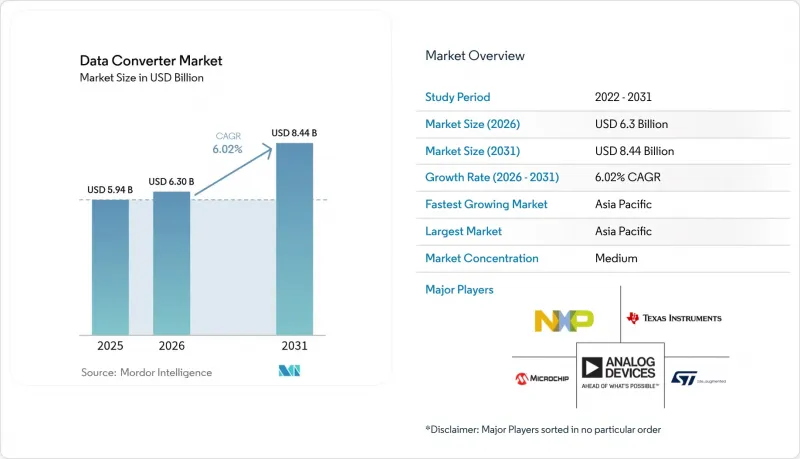
本報告按轉換器類型(類比數位轉換器、數位類比轉換器等)、解析度(8 位元或更低等)、取樣率(高速、中速、低速)、終端用戶產業(電信、汽車、工業自動化和測試等)以及地區(北美、南美、歐洲等)進行細分。市場預測以美元計價。
全球數據轉換器市場趨勢及洞察
5G基礎設施的普及
5G基地台中的大規模MIMO架構需要吉赫的ADC和DAC通道,且無雜訊動態範圍需超過60dB,這要求轉換器製造商在最佳化線性度的同時,盡可能降低功耗。各國政府已累計244億美元(中國)、131億美元(美國)和108億美元(歐洲)用於2024年前的5G部署,這導致對高速、高解析度組件的需求集中,並使專業模擬裝置代工廠的產能捉襟見肘。軟體定義無線電(SDR)平台進一步增加了複雜性。設備製造商現在要求在單一系統晶片(SoC)內實現14至16位元解析度和多GSPS速率,這推高了兼具速度和可程式設計柔軟性的裝置的價格。能夠提供整合式射頻前端和高速轉換器的單晶片解決方案的供應商,正與尋求簡化採購流程和長期支援的電信設備OEM廠商簽訂多年供貨合約。
醫學影像診斷對解析度的要求越來越高。
磁振造影 (MRI)、電腦斷層掃描 (CT) 和新一代超音波診斷設備越來越依賴 16 位元至 24 位元Delta-Σ 類比數位轉換器 (ADC) 來實現卓越的動態範圍和雜訊性能,從而滿足人工智慧 (AI) 驅動的診斷標準。超音波診斷設備通常以 40 MHz 至 200 MHz 的取樣率運行,訊號劣化會直接影響支撐當前異常檢測工作流程的機器學習演算法。由於監管機構在 FDA 510(k) 申請過程中會嚴格審查轉換器規格,因此建議原始設備製造商 (OEM) 選擇具有已記錄的臨床性能和廣泛現場運行資料的裝置。 Δ- Delta拓撲結構因其固有的噪音整形特性而備受青睞,該特性最大限度地減少了模擬濾波需求,使設計人員能夠在保證患者安全標準的同時縮短檢驗週期。由於醫療設備的產品生命週期長達 7 至 10 年,服務於此細分市場的供應商可以增強收入穩定性,並降低其受短期經濟波動的影響。
高取樣率下熱雜訊的局限性
當轉換器取樣率超過 1 GSPS 時,基頻熱雜訊會隨頻寬增加,其下限約為 -174 dBm/Hz,從而限制了可實現的訊號雜訊比。設計人員試圖透過時交錯架構來規避此限制,但失配和校準開銷會增加矽晶圓面積和功耗。雖然採用 28 nm 以下的製程節點可以改善元件的固有噪聲,但會增加晶圓成本和良率風險,從而限制了中等規模工業客戶的採用。因此,物理限制阻礙了尖端領域的成長,一些原始設備製造商 (OEM) 正在轉向其他系統結構,以降低轉換器的效能要求。
細分市場分析
即使到了2025年,類比數位轉換器仍將保持主導地位,佔據資料轉換器市場58.72%的佔有率。這是因為通訊、醫療和工業系統在訊號鏈的每個階段都依賴高精度數位化。儘管整合度不斷提高,但每個系統所需的裝置數量仍然很高,從而維持了大規模的部署基礎。然而,混合訊號轉換器預計將在2031年之前以7.48%的複合年成長率穩步成長,因為它們將分立的ADC和DAC通道整合到單一封裝中,從而節省了基板面積並降低了元件成本。這一趨勢,加上系統級封裝(SiP)模組的普及,使得OEM廠商能夠將轉換器核心與電源管理和介面邏輯整合到單一基板。因此,數據轉換器市場正增加對混合訊號元件的研發投入,這些元件整合了自校準引擎、溫度感測器和片上電壓基準,以提高現場可靠性。
汽車和工業領域的系統整合商高度重視混合訊號設計固有的診斷功能,因為它無需外部電路即可實現預測性維護。德克薩斯(TI) 的 16 通道 DAC60516 正是這一趨勢的體現,它將 12 位元 DAC 陣列與內部 2.5V 基準電壓相結合,從而減少了高達 30% 的外圍元件。在預測期內,混合訊號解決方案有望逐步擴大其市場佔有率,取代先前由獨立 ADC/DAC 對佔據的佔有率,鞏固其作為資料轉換器市場中最具活力細分市場的地位。
至2025年,10至12位元裝置將佔總銷售量的37.85%,主要針對主流無線基礎設施和家用電子電器市場,能夠滿足大多數調變和音訊需求,並具備適中的動態範圍。在高階市場,16位及以上轉換器將以7.86%的複合年成長率推動市場成長,直至2031年。這反映了核磁共振掃描儀、地球物理測量設備和工廠自動化設備等應用領域對高精度資料轉換器的需求不斷成長,這些設備必須測量隱藏在亞微伏特雜訊中的訊號。因此,儘管高精度資料轉換器的銷售基數較小,但由於其平均售價比低解析度產品高出數倍,預計該領域的市場規模將快速擴張。
校準演算法和數位糾錯技術的進步使得16位元及以上元件能夠在2.5V電源下穩定工作,且不會影響線性度,從而擴展了與最新低功耗邏輯電路的兼容性,並減少了對昂貴的類比訊號調整的需求。日清紡微電子(Nisshinbo Microdevices)接腳相容的16位、20位和24位NA220x系列裝置,使OEM廠商能夠在單一PCB佈局上實現不同性能等級的裝置,顯著縮短認證週期。隨著每級解析度成本的持續下降,8位及以下的小眾市場不斷萎縮,且往往僅限於舊有應用程式。
區域分析
亞太地區預計將保持主導地位,到2025年將佔全球銷售額的40.12%,並預計在2031年之前維持6.73%的複合年成長率。這主要得益於中國國內晶圓製造的投資、日本在測量技術方面的專長以及韓國先進的封裝能力。低功耗混合訊號轉換器能夠滿足消費和工業需求,正被區域內專注於本地供應鏈以縮短庫存週期的原始設備製造商(OEM)積極採用。區域各國政府正在支援半導體自給自足計劃,這進一步加速了高效能轉換器在通訊基礎設施和人工智慧物聯網(AIoT)邊緣設備的應用。
北美地區銷售額位居第二,國防電子、寬頻部署和生命科學測量設備等領域的需求持續強勁。符合輻射耐受性要求或FDA設計文件要求的轉換器價格更高,從而緩解了消費和行動電話需求週期性波動的影響。以矽谷和奧斯汀為中心的充滿活力的無廠半導體公司,為專注於專用轉換器架構的新創公司提供了源源不斷的資源,進一步增強了全部區域活力。
歐洲在汽車、工業自動化和可再生能源應用領域佔據領先地位,這些領域對功能安全和電磁相容性標準有嚴格的要求。儘管歐洲在半導體製造能力方面落後於其他地區,但諸如《歐洲晶片法案》等政策舉措正在加速本地模擬製程的開發,未來可望縮短供應鏈。符合 ISO 26262 汽車標準和 IEC 61000 硬度標準的轉換器受到一級供應商的青睞,這使得熟悉歐洲標準的供應商能夠保持穩定的市場佔有率。南美和中東/非洲等新興地區雖然基數小規模,但銷量仍實現了兩位數的成長,不過由於基礎設施不足和外匯波動,絕對銷售成長仍受到限制。
其他好處:
- Excel格式的市場預測(ME)表
- 3個月的分析師支持
目錄
第1章:引言
- 研究假設和市場定義
- 調查範圍
第2章:調查方法
第3章執行摘要
第4章 市場狀況
- 市場概覽
- 市場促進因素
- 5G基礎設施的普及
- 醫學影像中解析度要求的不斷提高
- 汽車系統轉型為電氣化
- 邊緣人工智慧硬體加速器的成長
- 超低功耗物聯網感測器節點的出現
- 國防領域對抗輻射轉換器的需求
- 市場限制因素
- 高取樣率下熱雜訊的局限性
- 專業鑄造廠供應鏈的週期性
- 混合訊號SoC設計的複雜性
- 適應不斷變化的射頻輻射標準的成本
- 產業價值鏈分析
- 監理情勢
- 技術展望
- 波特五力分析
- 宏觀經濟因素對市場的影響
- 投資分析
第5章 市場規模與成長預測
- 按轉換器類型
- 類比數位轉換器(ADC)
- 數位類比轉換器(DAC)
- 混合訊號轉換器(ADC + DAC)
- 通過決議
- 8 位元或更少
- 10-12 位
- 14-16 位
- 超過 16 位
- 按取樣率
- 高速(超過 500 MSPS)
- 中速(50-500 MSPS)
- 低速(低於 50 MSPS)
- 按最終用戶行業分類
- 電訊
- 車
- 工業自動化與測試
- 家用電子產品
- 醫療保健
- 航太/國防
- 其他終端用戶產業(能源、研究實驗室)
- 按地區
- 北美洲
- 美國
- 加拿大
- 墨西哥
- 南美洲
- 巴西
- 阿根廷
- 其他南美國家
- 歐洲
- 德國
- 英國
- 法國
- 義大利
- 其他歐洲國家
- 亞太地區
- 中國
- 日本
- 韓國
- 印度
- 其他亞太國家
- 中東
- 沙烏地阿拉伯
- 阿拉伯聯合大公國
- 其他中東國家
- 非洲
- 南非
- 其他非洲國家
- 北美洲
第6章 競爭情勢
- 市場集中度
- 策略趨勢
- 市佔率分析
- 公司簡介
- Analog Devices, Inc.
- Texas Instruments Incorporated
- Microchip Technology Inc.
- STMicroelectronics NV
- NXP Semiconductors NV
- Infineon Technologies AG
- ON Semiconductor Corporation
- Renesas Electronics Corporation
- Rohm Co., Ltd.
- Cirrus Logic, Inc.
- Silicon Laboratories Inc.
- Maxim Integrated Products, Inc.
- Teledyne e2v(UK)Ltd.
- National Instruments Corporation
- Integrated Device Technology, Inc.
- Mouser Electronics, Inc.
- DATEL, Inc.
- Synopsys, Inc.
- Excelitas Technologies Corp.
- Analogic Corporation
第7章 市場機會與未來展望
According to Mordor Intelligence, the data converter market size is expected to grow from USD 5.94 billion in 2025 to USD 6.3 billion in 2026 and is forecast to reach USD 8.44 billion by 2031 at 6.02% CAGR over 2026-2031.
This report is Segmented by Converter Type (Analog-To-Digital Converters, Digital-To-Analog Converters, and More), Resolution (<= 8-Bit, and More), Sampling Rate (High-Speed, Mid-Speed, Low-Speed), End-User Industry (Telecommunications, Automotive, Industrial Automation and Test, and More), and Geography (North America, South America, Europe, and More). The Market Forecasts are Provided in Terms of Value (USD).
Global Data Converter Market Trends and Insights
Proliferation of 5G Infrastructure
Massive MIMO architectures in 5G base stations call for multi-gigahertz ADC and DAC channels with spurious-free dynamic range above 60 dB, forcing converter makers to optimize linearity without ballooning power budgets. Governments earmarked USD 24.4 billion in China, USD 13.1 billion in the United States, and USD 10.8 billion across Europe for 5G deployments in 2024, concentrating demand on high-speed, high-resolution parts that strain specialty analog foundry capacity. Software-defined radio platforms add further complexity because equipment makers now require 14-16-bit resolution at multi-GSPS rates within a single system-on-chip, spurring premium pricing for devices that combine speed with programmable flexibility. Vendors able to supply monolithic solutions that integrate RF front ends alongside high-speed converters are securing multi-year supply agreements with telecom OEMs seeking to simplify procurement and ensure long-term support.
Rising Resolution Requirements in Medical Imaging
MRI, CT, and next-generation ultrasound modalities increasingly depend on 16-24-bit delta-sigma ADCs to deliver enhanced dynamic range and noise performance that meet AI-enabled diagnostic standards. Ultrasound consoles typically operate between 40 MHz and 200 MHz sampling rates, and any signal degradation directly compromises machine learning algorithms that now underpin anomaly detection workflows. Regulators scrutinize converter specifications during FDA 510(k) submissions, motivating OEMs to select devices with documented clinical performance histories and extensive in-field operating data. Delta-sigma topologies are favored because their inherent noise-shaping characteristics minimize analog filtering requirements, allowing designers to shorten validation cycles while maintaining patient-safety thresholds. Suppliers addressing this niche bolster revenue resiliency because medical devices follow seven-to-ten-year product lifecycles that insulate demand from short-term economic swings.
Thermal-Noise Limitations at Higher Sampling Rates
As converter sampling speeds eclipse 1 GSPS, fundamental thermal noise rises proportionally with bandwidth, setting a floor near -174 dBm/Hz and limiting achievable signal-to-noise ratios. Designers attempt to circumvent the barrier through time-interleaved architectures, yet mismatch and calibration overheads inflate silicon area and power consumption. Migrating to sub-28 nm nodes improves intrinsic device noise but drives up wafer costs and yield risk, constraining accessibility for mid-volume industrial customers. The physics-driven ceiling, therefore, tempers growth in bleeding-edge segments, steering some OEMs toward alternative system architectures that relax converter performance demands.
Other drivers and restraints analyzed in the detailed report include:
- Shift Toward Electrification in Automotive Systems
- Growth of Edge AI Hardware Accelerators
- Supply-Chain Cyclicality of Specialty Foundries
For complete list of drivers and restraints, kindly check the Table Of Contents.
Segment Analysis
Analog-to-digital converters retain primacy with 58.72% of the data converter market share in 2025 as telecom, medical, and industrial systems depend on precise digitization for every signal chain step. Device counts per system stay elevated even as integration rises, maintaining a large installed base. Mixed-signal converters, however, represent the clear growth vector with a 7.48% CAGR to 2031 because they collapse discrete ADC and DAC channels into a single package, saving board area and trimming bill-of-materials cost. The trend dovetails with wider adoption of system-in-package modules, enabling OEMs to combine converter cores with power management and interface logic under one substrate. As a result, the data converter market is witnessing a heavier R&D focus on mixed-signal devices that embed self-calibration engines, temperature sensors, and on-chip voltage references to enhance field reliability.
System integrators in automotive and industrial segments value the diagnostic features implicit in mixed-signal designs because they facilitate predictive maintenance programs without external circuitry. Texas Instruments' 16-channel DAC60516 exemplifies the direction, coupling a 12-bit DAC array with an internal 2.5 V reference to cut peripheral components by up to 30%. Over the forecast horizon, mixed-signal solutions are projected to capture incremental sockets once reserved for separate ADC/DAC pairs, reinforcing their status as the most dynamic portion of the data converter market.
10-12-bit devices commanded 37.85% revenue in 2025, serving mainstream wireless infrastructure and consumer electronics where moderate dynamic range satisfies most modulation and audio requirements. At the premium end, >16-bit converters are pacing the field with an 7.86% CAGR to 2031, reflecting intensified demand from MRI scanners, geophysical instruments, and factory automation rigs that must measure signals buried in sub-microvolt noise. The data converter market size for high-precision segments is therefore projected to expand rapidly despite their smaller volume base because average selling prices sit several multiples above lower-resolution alternatives.
Advances in calibration algorithms and digital error correction now permit >16-bit parts to operate from 2.5 V supplies without sacrificing linearity, broadening their compatibility with modern low-power logic and reducing the need for expensive analog signal conditioning. Nisshinbo Micro Devices' pin-compatible 16-, 20-, and 24-bit NA220x family lets OEMs tier performance grades across a single PCB layout, materially shrinking qualification cycles. Ongoing shrinkage in cost per resolution step will continue to erode the <=8-bit niche, which is increasingly confined to legacy applications.
Complete Report Scope:
- By Converter Type
- Analog-to-Digital Converters (ADC)
- Digital-to-Analog Converters (DAC)
- Mixed-Signal Converters (ADC + DAC)
- By Resolution
- Less than equal to 8-bit
- 10 - 12-bit
- 14 - 16-bit
- Greater than 16-bit
- By Sampling Rate
- High-speed (Greater than 500 MSPS)
- Mid-speed (50 - 500 MSPS)
- Low-speed (Less than 50 MSPS)
- By End-User Industry
- Telecommunications
- Automotive
- Industrial Automation and Test
- Consumer Electronics
- Medical and Healthcare
- Aerospace and Defense
- Other End-user Industries (Energy, Research Labs)
- By Geography
- North America
- United States
- Canada
- Mexico
- South America
- Brazil
- Argentina
- Rest of South America
- Europe
- Germany
- United Kingdom
- France
- Italy
- Rest of Europe
- Asia-Pacific
- China
- Japan
- South Korea
- India
- Rest of Asia-Pacific
- Middle East
- Saudi Arabia
- United Arab Emirates
- Rest of Middle East
- Africa
- South Africa
- Rest of Africa
- North America
Geography Analysis
Asia-Pacific retained leadership with a 40.12% revenue contribution in 2025 and is projected to register a 6.73% CAGR through 2031, supported by China's investments in domestic wafer fabrication, Japan's metrology expertise, and South Korea's advanced packaging capacity. Power-efficient mixed-signal converters that address both consumer and industrial demand profiles find ready adoption across regional OEMs, which favor local supply ecosystems to tighten inventory cycles. Regional governments underwrite semiconductor self-reliance programs that further accelerate the adoption of high-performance converters in communications infrastructure and AIoT edge devices.
North America ranks second by revenue and continues to manifest strong pull from defense electronics, broadband roll-outs, and life-science instrumentation. Converters that meet radiation-tolerant profiles or satisfy FDA design dossiers attract pricing premiums, mitigating cyclicality in consumer and handset demand. A vibrant fabless community centered in Silicon Valley and Austin sustains a healthy pipeline of start-ups targeting specialized converter architectures, reinforcing overall regional dynamism in the data converter market.
Europe leverages leadership in automotive, industrial automation, and renewable-energy applications that specify stringent functional-safety and electromagnetic-compatibility criteria. Although the region trails in raw semiconductor fabrication capacity, policy initiatives such as the European Chips Act aim to stimulate local analog process development, potentially shortening future supply chains. Converters supporting ISO 26262 automotive compliance and IEC 61000 immunity standards enjoy favored status among Tier-1 suppliers, ensuring sustained share for vendors attuned to European norms. Emerging regions in South America and the Middle East, and Africa record double-digit unit growth from a small base, but infrastructure deficits and currency volatility continue to temper absolute revenue expansion.
- Analog Devices, Inc.
- Texas Instruments Incorporated
- Microchip Technology Inc.
- STMicroelectronics N.V.
- NXP Semiconductors N.V.
- Infineon Technologies AG
- ON Semiconductor Corporation
- Renesas Electronics Corporation
- Rohm Co., Ltd.
- Cirrus Logic, Inc.
- Silicon Laboratories Inc.
- Maxim Integrated Products, Inc.
- Teledyne e2v (UK) Ltd.
- National Instruments Corporation
- Integrated Device Technology, Inc.
- Mouser Electronics, Inc.
- DATEL, Inc.
- Synopsys, Inc.
- Excelitas Technologies Corp.
- Analogic Corporation
Additional Benefits:
- The market estimate (ME) sheet in Excel format
- 3 months of analyst support
TABLE OF CONTENTS
1 INTRODUCTION
- 1.1 Study Assumptions and Market Definition
- 1.2 Scope of the Study
2 RESEARCH METHODOLOGY
3 EXECUTIVE SUMMARY
4 MARKET LANDSCAPE
- 4.1 Market Overview
- 4.2 Market Drivers
- 4.2.1 Proliferation of 5G infrastructure
- 4.2.2 Rising resolution requirements in medical imaging
- 4.2.3 Shift toward electrification in automotive systems
- 4.2.4 Growth of edge AI hardware accelerators
- 4.2.5 Emergence of ultra-low-power IoT sensor nodes
- 4.2.6 Defense demand for radiation-hardened converters
- 4.3 Market Restraints
- 4.3.1 Thermal-noise limitations at higher sampling rates
- 4.3.2 Supply-chain cyclicality of specialty foundries
- 4.3.3 Design complexity of mixed-signal SoCs
- 4.3.4 Compliance costs of evolving RF emission norms
- 4.4 Industry Value Chain Analysis
- 4.5 Regulatory Landscape
- 4.6 Technological Outlook
- 4.7 Porter's Five Forces Analysis
- 4.7.1 Bargaining Power of Suppliers
- 4.7.2 Bargaining Power of Buyers
- 4.7.3 Threat of New Entrants
- 4.7.4 Threat of Substitutes
- 4.7.5 Intensity of Competitive Rivalry
- 4.8 Impact of Macroeconomic Factors on the Market
- 4.9 Investment Analysis
5 MARKET SIZE AND GROWTH FORECASTS (VALUE)
- 5.1 By Converter Type
- 5.1.1 Analog-to-Digital Converters (ADC)
- 5.1.2 Digital-to-Analog Converters (DAC)
- 5.1.3 Mixed-Signal Converters (ADC + DAC)
- 5.2 By Resolution
- 5.2.1 Less than equal to 8-bit
- 5.2.2 10 - 12-bit
- 5.2.3 14 - 16-bit
- 5.2.4 Greater than 16-bit
- 5.3 By Sampling Rate
- 5.3.1 High-speed (Greater than 500 MSPS)
- 5.3.2 Mid-speed (50 - 500 MSPS)
- 5.3.3 Low-speed (Less than 50 MSPS)
- 5.4 By End-User Industry
- 5.4.1 Telecommunications
- 5.4.2 Automotive
- 5.4.3 Industrial Automation and Test
- 5.4.4 Consumer Electronics
- 5.4.5 Medical and Healthcare
- 5.4.6 Aerospace and Defense
- 5.4.7 Other End-user Industries (Energy, Research Labs)
- 5.5 By Geography
- 5.5.1 North America
- 5.5.1.1 United States
- 5.5.1.2 Canada
- 5.5.1.3 Mexico
- 5.5.2 South America
- 5.5.2.1 Brazil
- 5.5.2.2 Argentina
- 5.5.2.3 Rest of South America
- 5.5.3 Europe
- 5.5.3.1 Germany
- 5.5.3.2 United Kingdom
- 5.5.3.3 France
- 5.5.3.4 Italy
- 5.5.3.5 Rest of Europe
- 5.5.4 Asia-Pacific
- 5.5.4.1 China
- 5.5.4.2 Japan
- 5.5.4.3 South Korea
- 5.5.4.4 India
- 5.5.4.5 Rest of Asia-Pacific
- 5.5.5 Middle East
- 5.5.5.1 Saudi Arabia
- 5.5.5.2 United Arab Emirates
- 5.5.5.3 Rest of Middle East
- 5.5.6 Africa
- 5.5.6.1 South Africa
- 5.5.6.2 Rest of Africa
- 5.5.1 North America
6 COMPETITIVE LANDSCAPE
- 6.1 Market Concentration
- 6.2 Strategic Moves
- 6.3 Market Share Analysis
- 6.4 Company Profiles (includes Global level Overview, Market level overview, Core Segments, Financials as available, Strategic Information, Market Rank/Share, Products and Services, Recent Developments)
- 6.4.1 Analog Devices, Inc.
- 6.4.2 Texas Instruments Incorporated
- 6.4.3 Microchip Technology Inc.
- 6.4.4 STMicroelectronics N.V.
- 6.4.5 NXP Semiconductors N.V.
- 6.4.6 Infineon Technologies AG
- 6.4.7 ON Semiconductor Corporation
- 6.4.8 Renesas Electronics Corporation
- 6.4.9 Rohm Co., Ltd.
- 6.4.10 Cirrus Logic, Inc.
- 6.4.11 Silicon Laboratories Inc.
- 6.4.12 Maxim Integrated Products, Inc.
- 6.4.13 Teledyne e2v (UK) Ltd.
- 6.4.14 National Instruments Corporation
- 6.4.15 Integrated Device Technology, Inc.
- 6.4.16 Mouser Electronics, Inc.
- 6.4.17 DATEL, Inc.
- 6.4.18 Synopsys, Inc.
- 6.4.19 Excelitas Technologies Corp.
- 6.4.20 Analogic Corporation
7 MARKET OPPORTUNITIES AND FUTURE OUTLOOK
- 7.1 White-space and Unmet-need Assessment

 資料轉換器市場:2026-2032年全球市場預測(按轉換器類型、裝置類型、作業系統、最終用戶、分銷管道和應用分類)
 高速資料轉換器市場機會、成長要素、產業趨勢分析及2026-2035年預測
 2026年全球資料轉換器積體電路(IC)市場報告
 類比數位轉換器市場報告:按產品類型、解析度、應用和地區分類,2026-2034年
 數據轉換器市場:按類型、應用和地區分類類比數位轉換器市場:按類型、解析度、通道和應用分類-2026-2032年全球市場預測
 全球高速數據轉換器市場規模、佔有率、趨勢和成長分析報告(2026-2034)高速資料轉換器市場:2026年至2032年全球市場預測(依產品類型、解析度、取樣率、架構、介面類型、封裝與應用分類)2026年全球數據轉換器市場報告資料轉換器市場規模、佔有率、趨勢和預測:按類型、取樣率、應用和地區分類(2026-2034 年)