


 |
市場調查報告書
商品編碼
2124024
模塑紙漿包裝:市場佔有率分析、產業趨勢與統計、成長預測(2026-2031)Molded Pulp Packaging - Market Share Analysis, Industry Trends & Statistics, Growth Forecasts (2026 - 2031) |
||||||

※ 本網頁內容可能與最新版本有所差異。詳細情況請與我們聯繫。
根據 Mordor Intelligence 預測,模塑紙漿包裝市場規模預計將在 2026 年達到 57.1 億美元,到 2031 年達到 70.5 億美元,年複合成長率為 4.31%。
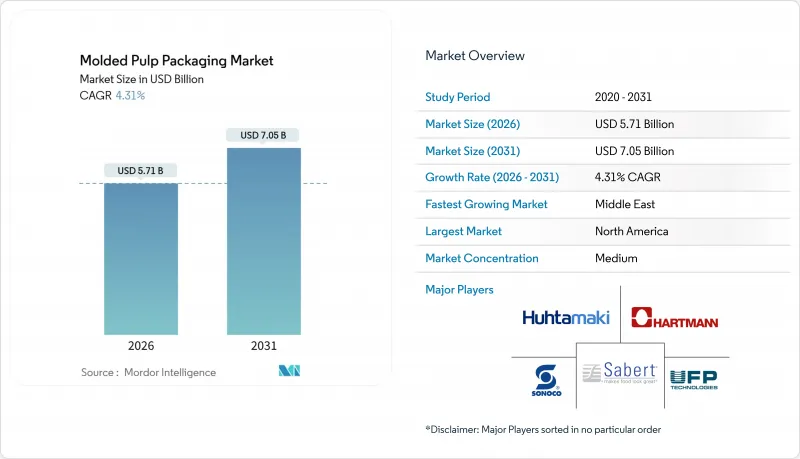
本報告按纖維類型(再生纖維、原生纖維、混紡纖維)、產品類型(托盤、碗/杯、翻蓋盒、盤子、容器/蓋)、成型類型(厚壁、轉注成型、熱成型、加工/薄壁)、終端用戶行業(食品包裝、餐飲服務、家用電子電器、醫療保健、工業、個人護理)和地區進行細分。市場預測以美元(USD)計價。
全球模塑紙漿包裝市場趨勢及洞察
一次性塑膠製品的相關法規與禁令
監管政策的變化正在重新評估整個模塑紙漿包裝市場的採購重點。歐盟的《2030年可回收性法規》和加州的SB 54法案都禁止使用發泡聚苯乙烯,這使得模塑紙漿從成本驅動型選擇轉變為合規要求。印度對19種塑膠製品的禁令進一步加劇了餐飲服務業的需求,但由於不同地區的執法標準各異,跨多個司法管轄區的合規性變得愈發複雜。擁有自有模具和認證資源的一體化製造商更有能力應對各種豁免和加速核准流程,從而進一步加速市場向規模化和垂直整合的轉變。
企業對淨零排放和塑膠中和的承諾
由於採用零售商和品牌商的努力,永續性口號正轉化為切實可行的供應商義務,這有利於模塑紙漿包裝市場的發展。聯合利華的目標是減少50%的原生塑膠使用;沃爾瑪的「十億噸計畫」(Project Gigaton)將可回收包裝納入供應商評估標準;亞馬遜的「無挫折」(Frustration-Free)計畫已減少了數百萬噸塑膠填充材的使用。這些層層遞進的要求迫使代工包裝商採用模塑紙漿模具,即使成本更高,因為貨架擺放不再僅取決於單位成本,還與環境、社會和治理(ESG)指標息息相關。
再生紙板(OCC)和原生紙漿的價格波動
再生瓦楞紙板 (OCC) 和軟木漿價格的波動正在擠壓加工商的利潤空間,並使固定價格合約的執行變得更加複雜。模塑紙漿包裝市場中的許多小規模企業缺乏對沖手段,被迫承受成本飆升,這些成本可能在短短幾個月內使其材料成本翻三倍。儘管大型供應商向紙張貿易領域的垂直整合正在成為一種重要的防御手段,但區域性生產商仍然面臨風險,他們有時會關閉產能,導致在需求高峰期出現供應緊張。
細分市場分析
隨著加工商努力平衡再生紙漿的經濟性和原生紙漿的強度,預計到2031年,混合纖維配方將以8.5%的複合年成長率成長,成為所有纖維類型中成長率最高的。到2025年,再生紙漿將佔需求的70.3%,這反映出其供應鏈的成熟以及比原生紙漿30-40%的成本優勢。然而,為了滿足冷藏和醫療應用的阻隔性能要求,品牌所有者擴大選擇60/40的混合紙漿,即使價格更高,也願意為此付出更高的成本。印度的紙漿廠目前已使用75%的再生紙漿,顯示在快速成長的經濟體中,再生紙漿具有巨大的發展潛力。同時,原生紙漿在二級醫療包裝領域仍佔據重要地位,因為該領域對污染風險的要求極高,這導致這三種類型的紙漿在模塑紙漿包裝市場中並存。
不同地區的偏好各不相同。北美加工商傾向於使用混合配方,以滿足零售商的永續性審核要求,同時又不犧牲紙盒強度。而亞洲生產商則仍偏好全再生配方,以滿足對價格敏感的食品服務需求。透過垂直整合收購,企業可以獲得預先選定的再生材料,從而在不降低強度的前提下提高再生材料含量,進而獲得成本優勢。隨著新興技術降低乾燥能耗並壓縮加工成本,混合產品模塑紙漿包裝的市場預計將穩定成長,而再生紙漿仍將是銷售量的主力。
預計到2025年,托盤將佔總銷售額的41.2%,這主要得益於雞蛋和新鮮農產品包裝領域的應用;而碗和杯子的複合年成長率預計將達到9.1%,超過其他任何產品類別。在已實施《擴大生產者責任法案》的州,快餐店正從聚苯乙烯翻蓋式容器轉向模壓紙漿碗和咖啡蓋,這促使企業加大對專用模壓生產線的投資。在歐洲,可重複使用容器的試點計畫正在對翻蓋式容器的銷售構成壓力,而咖啡店採用符合聚苯乙烯禁令的纖維基蓋子也增加了對容器和蓋子的需求。
根據餐飲服務業的調查數據,模塑紙漿在永續一次性產品中佔據絕對優勢,這一趨勢也正在全球連鎖企業的採購部門中蔓延。一次性塑膠製品合遵循成本,使得其作為生活垃圾的可回收性成為盈利的關鍵因素,即使單價較高,也加速了企業向模塑紙漿的轉型。不含PFAS塗層的獲獎成果,不僅為新產品線提供了合法性,也推動了類似產品的上市,確保了碗盤等產品繼續保持模塑紙漿包裝市場成長最快的地位。
區域分析
預計到2025年,北美將佔全球銷售額的46.56%,這得益於零售商的早期強制採用以及各州擴大生產者責任法的實施。儘管隨著雞蛋和農產品用途接近飽和,成長速度有所放緩,但在加州25%塑膠減量規則等政策利好因素的推動下,市場普及率仍維持上升趨勢。加拿大禁止使用聚苯乙烯餐具以及墨西哥城對可堆肥性餐具的要求,反映了美國的發展趨勢,即使都市區回收項目日益成熟,這些舉措也保持了該地區的發展勢頭。
預計到2031年,中東地區的年複合成長率將達到8.4%,為全球最快成長速度。沙烏地阿拉伯的「2030願景」和阿拉伯聯合大公國的「循環經濟政策」正在推動大規模的本地投資,其中包括投資2.66億美元興建旨在取代亞洲進口的工廠。區域瓦楞紙板製造商也積極推動上游工程業務,確保原料供應,並建立國內供應鏈,以抵禦全球紙漿價格上漲的影響。
歐洲正受惠於歐盟2030年強制實施的可回收性要求,德國、法國和英國在餐飲服務和零售業採用模塑紙漿方面處於領先地位。亞太地區的情況則是喜憂參半。印度憑藉包裝需求的激增、電子商務滲透率的提高以及嚴格的塑膠廢棄物法規,正在推動市場需求。同時,由於回收基礎設施不完善,一些東南亞國家仍依賴廉價塑膠。南美洲和非洲的進展不均衡,但隨著塑膠合規成本的飆升,快餐和工業出口對模塑紙漿的興趣日益濃厚。
其他好處:
- Excel格式的市場預測(ME)表
- 3個月的分析師支持
目錄
第1章:引言
- 研究假設和市場定義
- 調查範圍
第2章:調查方法
第3章執行摘要
第4章 市場狀況
- 市場概覽
- 市場促進因素
- 100多個國家對一次性塑膠製品製定了法規和禁令
- 企業對「淨零排放」和「塑膠中和」的承諾正在推動對零售商採取強制性措施。
- 成本優勢及與EPS及熱成型塑膠的比較
- 電子商務對防護和路邊可重複使用填充材的需求
- 乾式成型技術可加快生產線速度,並降低單位成本。
- 有關不含 PFAS 材料的法律法規正在推動食品服務業對模塑紙漿的需求。
- 市場限制因素
- OCC和原生纖維原料的價格波動
- 與塗層塑膠相比,它的阻隔性和印刷適性較差。
- 一般廢棄物分類設施中彩色紙漿的回收量有限
- 某些工廠在熱壓精加工過程中會消耗大量能量
- 產業價值鏈分析
- 監理情勢
- 技術展望
- 宏觀經濟因素的影響
- 波特五力分析
第5章 市場規模與成長預測
- 依纖維類型
- 再生纖維
- 原生光纖
- 混紡纖維
- 依產品類型
- 托盤
- 碗和杯子
- 蛤殼
- 盤子
- 容器和蓋子
- 其他產品類型
- 按模壓類型
- 厚肉
- 轉注成型
- 熱成型
- 加工產品/薄壁
- 按最終用戶行業分類
- 食品包裝
- 食品服務
- 家用電子產品
- 醫療保健和醫療設備
- 工業產品
- 個人護理化妝品
- 其他終端用戶產業
- 按地區
- 北美洲
- 美國
- 加拿大
- 墨西哥
- 歐洲
- 德國
- 英國
- 法國
- 義大利
- 西班牙
- 俄羅斯
- 其他歐洲國家
- 亞太地區
- 中國
- 日本
- 印度
- 韓國
- 澳洲
- 其他亞太國家
- 中東
- 沙烏地阿拉伯
- 阿拉伯聯合大公國
- 土耳其
- 其他中東國家
- 非洲
- 南非
- 奈及利亞
- 其他非洲國家
- 南美洲
- 巴西
- 阿根廷
- 其他南美國家
- 北美洲
第6章 競爭情勢
- 市場集中度
- 策略趨勢
- 市佔率分析
- 公司簡介
- Brodrene Hartmann A/S
- Huhtamaki Oyj
- UFP Technologies, Inc.
- Sabert Corporation
- Henry Molded Products, Inc.
- Keiding, Inc.
- Pacific Pulp Molding, Inc.
- Protopak Engineering Corporation
- EnviroPAK Corporation
- Maspack Ltd.
- CKF Inc.
- Moulded Fibre Products Ltd.
- Cellulopack Packaging SL
- FiberCel Packaging, LLC
- Greenpack(Yulin)Environmental Technology Co., Ltd.
- Dongguan Flyway Packaging Co., Ltd.
- Shenzhen Maider Packaging Co., Ltd.
- Qingdao Xinya Molded Pulp Packaging Co., Ltd.
- Taiwan Pulp Molding Co., Ltd.
- Nippon Molded Pulp Co., Ltd.
- Vegware Ltd.
- Earthpac Ltd.
- Papelyco SA
- PulpaPack SAS
- Western Pulp Products Co.
第7章 市場機會與未來展望
According to Mordor Intelligence, the molded pulp packaging market size stands at USD 5.71 billion in 2026 and is projected to reach USD 7.05 billion by 2031, advancing at a 4.31% CAGR.
This report is Segmented by Fiber Type (Recycled, Virgin, and Blended), Product Type (Trays, Bowls and Cups, Clamshells, Plates, and Containers and Lids), Molded Type (Thick Wall, Transfer Molded, Thermoformed, and Processed/Slim Wall), End-User Industry (Food Packaging, Foodservice, Consumer Electronics, Healthcare, Industrial, and Personal Care), and Geography. Market Forecasts are in Value (USD).
Global Molded Pulp Packaging Market Trends and Insights
Regulatory Bans On Single-Use Plastics
Legislation is redefining procurement priorities across the molded pulp packaging market. The European Union's 2030 recyclability rule and California's SB 54 both outlaw expanded polystyrene, instantly elevating molded pulp from cost-driven option to compliance necessity. India's ban on 19 plastic items deepens demand in foodservice, while varying enforcement standards make multi-jurisdiction compliance complex. Integrated producers that command their own tooling and certification resources are best positioned to navigate divergent exemptions and accelerated timelines, reinforcing the market's shift toward scale and vertical control.
Corporate Net-Zero And Plastic-Neutral Pledges
Retailer and brand commitments translate sustainability rhetoric into hard supplier mandates that favor the molded pulp packaging market. Unilever targets a 50% cut in virgin plastic, Walmart's Project Gigaton embeds recyclable packaging in supplier scorecards, and Amazon's frustration-free program removed millions of metric tons of plastic fillers. These cascading requirements compel contract packers to adopt molded pulp tooling even at a pricing premium because shelf access now hinges on ESG metrics, not just cents per unit.
Price Volatility Of OCC And Virgin Fiber
Fluctuating old-corrugated-container and softwood-pulp prices compress converter margins and complicate fixed-price contracts. Without hedging tools, many smaller players in the molded pulp packaging market absorb cost spikes that can push material expense up threefold within months. Vertical integration into paper trading, as executed by leading suppliers, is emerging as a key defense, yet regional producers remain exposed and occasionally shutter capacity, tightening supply just as demand surges.
Other drivers and restraints analyzed in the detailed report include:
- Cost Advantage Versus EPS And Thermoformed Plastic
- E-Commerce Demand For Curbside-Recyclable Fillers
- Perceived Poor Barrier And Print Performance Versus Coated Plastic
For complete list of drivers and restraints, kindly check the Table Of Contents.
Segment Analysis
Blended fiber formulations are projected to record an 8.5% CAGR through 2031, the fastest among fiber types, as converters balance recycled-fiber economics with virgin-fiber strength. Recycled grades controlled 70.3% of 2025 demand, reflecting mature supply chains and a 30-40% cost discount to virgin pulp. Yet brand owners seeking barrier performance for refrigerated or medical applications increasingly specify 60-40 blends, absorbing the surcharge to meet durability metrics. India's pulp mills, already operating at 75% recycled content, showcase the scalability of recycled streams even in fast-growing economies. Conversely, virgin fiber retains a foothold in Class II medical packaging, where contamination risk is unacceptable, ensuring that all three fiber types coexist within the molded pulp packaging market.
Regional preferences differ. North American converters gravitate toward blended recipes to satisfy retailer sustainability audits without sacrificing carton strength, whereas Asian producers still favor recycled-only mixes to serve price-led foodservice demand. Vertical acquisitions that secure pre-sorted recycled feedstock enable higher recycled ratios without strength loss, giving integrated players a cost edge. As drying-energy cuts from emerging technology shrink processing overhead, the molded pulp packaging market size for blended products is expected to expand steadily, even as recycled grades remain the volume anchor.
Trays generated 41.2% of 2025 revenue, led by egg and produce applications, but bowls and cups are forecast to grow at 9.1% CAGR, outpacing every other product family. Quick-service restaurants in states with extended producer responsibility laws are shifting from polystyrene clamshells to molded pulp bowls and coffee lids, redirecting capital toward dedicated tooling lines. Clamshell volumes face pressure from nascent reusable-container pilots in Europe, whereas containers and lids gain from coffee-shop adoption of fiber-based covers that comply with polystyrene bans.
Foodservice survey data crowns molded pulp the "clear winner" among sustainable disposables, a sentiment that filters through purchasing portals of global chains. Compliance fees attached to single-use plastics have turned curbside recyclability into a bottom-line lever, accelerating conversion even when molded pulp commands a higher unit price. Awards for PFAS-free coatings validate new product lines and spur copy-cat launches, ensuring that bowls and cups remain the fastest-advancing slice of the molded pulp packaging market.
Complete Report Scope:
- By Fiber Type
- Recycled Fiber
- Virgin Fiber
- Blended Fiber
- By Product Type
- Trays
- Bowls and Cups
- Clamshells
- Plates
- Containers and Lids
- Other Product Types
- By Molded Type
- Thick Wall
- Transfer Molded
- Thermoformed
- Processed / Slim Wall
- By End-User Industry
- Food Packaging
- Foodservice
- Consumer Electronics
- Healthcare and Medical Devices
- Industrial Goods
- Personal Care and Cosmetics
- Other End-User Industries
- By Geography
- North America
- United States
- Canada
- Mexico
- Europe
- Germany
- United Kingdom
- France
- Italy
- Spain
- Russia
- Rest of Europe
- Asia-Pacific
- China
- Japan
- India
- South Korea
- Australia
- Rest of Asia-Pacific
- Middle East
- Saudi Arabia
- United Arab Emirates
- Turkey
- Rest of Middle East
- Africa
- South Africa
- Nigeria
- Rest of Africa
- South America
- Brazil
- Argentina
- Rest of South America
- North America
Geography Analysis
North America captured 46.56% of global sales in 2025 thanks to early retailer mandates and state-level extended producer responsibility laws. Growth is moderating as egg and produce applications near saturation, yet policy tailwinds such as California's 25% plastic-reduction rule keep the adoption curve positive. Canada's ban on polystyrene foodservice ware and Mexico City's compostability requirement echo U.S. shifts, sustaining regional momentum even as urban recycling programs mature.
The Middle East is set to post an 8.4% CAGR through 2031, the fastest worldwide. Saudi Arabia's Vision 2030 targets and the UAE's Circular Economy Policy have catalyzed large-scale local investments, including a USD 266 million plant aimed at displacing Asian imports. Upstream moves by regional containerboard producers secure feedstock, anchoring domestic supply chains that buffer against global pulp price spikes.
Europe benefits from the bloc-wide 2030 recyclability mandate, with Germany, France, and the United Kingdom at the forefront of molded pulp adoption in foodservice and retail. Asia-Pacific remains a mixed picture: India's packaging boom, rising e-commerce penetration, and strict plastic-waste rules make it a demand engine, whereas several Southeast Asian nations still rely on cheap plastic amid under-developed recycling infrastructure. South America and Africa show patchier progress but register rising interest in molded pulp for quick-service restaurants and industrial exports as compliance costs for plastics escalate.
- Brodrene Hartmann A/S
- Huhtamaki Oyj
- UFP Technologies, Inc.
- Sabert Corporation
- Henry Molded Products, Inc.
- Keiding, Inc.
- Pacific Pulp Molding, Inc.
- Protopak Engineering Corporation
- EnviroPAK Corporation
- Maspack Ltd.
- CKF Inc.
- Moulded Fibre Products Ltd.
- Cellulopack Packaging S.L.
- FiberCel Packaging, LLC
- Greenpack (Yulin) Environmental Technology Co., Ltd.
- Dongguan Flyway Packaging Co., Ltd.
- Shenzhen Maider Packaging Co., Ltd.
- Qingdao Xinya Molded Pulp Packaging Co., Ltd.
- Taiwan Pulp Molding Co., Ltd.
- Nippon Molded Pulp Co., Ltd.
- Vegware Ltd.
- Earthpac Ltd.
- Papelyco S.A.
- PulpaPack SAS
- Western Pulp Products Co.
Additional Benefits:
- The market estimate (ME) sheet in Excel format
- 3 months of analyst support
TABLE OF CONTENTS
1 INTRODUCTION
- 1.1 Study Assumptions and Market Definition
- 1.2 Scope of the Study
2 RESEARCH METHODOLOGY
3 EXECUTIVE SUMMARY
4 MARKET LANDSCAPE
- 4.1 Market Overview
- 4.2 Market Drivers
- 4.2.1 Regulatory Bans on Single-Use Plastics in More Than 100 Countries
- 4.2.2 Corporate Net-Zero and Plastic-Neutral Pledges Driving Retailer Mandates
- 4.2.3 Cost Advantage Versus EPS and Thermoformed Plastic
- 4.2.4 E-Commerce Demand for Protective, Curb-Side-Recyclable Fillers
- 4.2.5 Line-Speed Gains From Dry-Formed Technology Cutting Unit Costs
- 4.2.6 PFAS-Free Legislation Boosting Molded Pulp for Foodservice
- 4.3 Market Restraints
- 4.3.1 Price Volatility of OCC and Virgin Fiber Feedstocks
- 4.3.2 Perceived Poor Barrier and Print Performance Versus Coated Plastic
- 4.3.3 Limited Color-Pulp Recycling Streams in Municipal MRFs
- 4.3.4 High Energy Load During Hot-Press Finishing in Some Plants
- 4.4 Industry Value Chain Analysis
- 4.5 Regulatory Landscape
- 4.6 Technological Outlook
- 4.7 Impact of Macroeconomic Factors
- 4.8 Porter's Five Forces Analysis
- 4.8.1 Threat of New Entrants
- 4.8.2 Bargaining Power of Suppliers
- 4.8.3 Bargaining Power of Buyers
- 4.8.4 Threat of Substitutes
- 4.8.5 Competitive Rivalry
5 MARKET SIZE AND GROWTH FORECASTS (VALUE)
- 5.1 By Fiber Type
- 5.1.1 Recycled Fiber
- 5.1.2 Virgin Fiber
- 5.1.3 Blended Fiber
- 5.2 By Product Type
- 5.2.1 Trays
- 5.2.2 Bowls and Cups
- 5.2.3 Clamshells
- 5.2.4 Plates
- 5.2.5 Containers and Lids
- 5.2.6 Other Product Types
- 5.3 By Molded Type
- 5.3.1 Thick Wall
- 5.3.2 Transfer Molded
- 5.3.3 Thermoformed
- 5.3.4 Processed / Slim Wall
- 5.4 By End-User Industry
- 5.4.1 Food Packaging
- 5.4.2 Foodservice
- 5.4.3 Consumer Electronics
- 5.4.4 Healthcare and Medical Devices
- 5.4.5 Industrial Goods
- 5.4.6 Personal Care and Cosmetics
- 5.4.7 Other End-User Industries
- 5.5 By Geography
- 5.5.1 North America
- 5.5.1.1 United States
- 5.5.1.2 Canada
- 5.5.1.3 Mexico
- 5.5.2 Europe
- 5.5.2.1 Germany
- 5.5.2.2 United Kingdom
- 5.5.2.3 France
- 5.5.2.4 Italy
- 5.5.2.5 Spain
- 5.5.2.6 Russia
- 5.5.2.7 Rest of Europe
- 5.5.3 Asia-Pacific
- 5.5.3.1 China
- 5.5.3.2 Japan
- 5.5.3.3 India
- 5.5.3.4 South Korea
- 5.5.3.5 Australia
- 5.5.3.6 Rest of Asia-Pacific
- 5.5.4 Middle East
- 5.5.4.1 Saudi Arabia
- 5.5.4.2 United Arab Emirates
- 5.5.4.3 Turkey
- 5.5.4.4 Rest of Middle East
- 5.5.5 Africa
- 5.5.5.1 South Africa
- 5.5.5.2 Nigeria
- 5.5.5.3 Rest of Africa
- 5.5.6 South America
- 5.5.6.1 Brazil
- 5.5.6.2 Argentina
- 5.5.6.3 Rest of South America
- 5.5.1 North America
6 COMPETITIVE LANDSCAPE
- 6.1 Market Concentration
- 6.2 Strategic Moves
- 6.3 Market Share Analysis
- 6.4 Company Profiles (includes Global level Overview, Market level overview, Core Segments, Financials as available, Strategic Information, Market Rank/Share for key companies, Products and Services, and Recent Developments)
- 6.4.1 Brodrene Hartmann A/S
- 6.4.2 Huhtamaki Oyj
- 6.4.3 UFP Technologies, Inc.
- 6.4.4 Sabert Corporation
- 6.4.5 Henry Molded Products, Inc.
- 6.4.6 Keiding, Inc.
- 6.4.7 Pacific Pulp Molding, Inc.
- 6.4.8 Protopak Engineering Corporation
- 6.4.9 EnviroPAK Corporation
- 6.4.10 Maspack Ltd.
- 6.4.11 CKF Inc.
- 6.4.12 Moulded Fibre Products Ltd.
- 6.4.13 Cellulopack Packaging S.L.
- 6.4.14 FiberCel Packaging, LLC
- 6.4.15 Greenpack (Yulin) Environmental Technology Co., Ltd.
- 6.4.16 Dongguan Flyway Packaging Co., Ltd.
- 6.4.17 Shenzhen Maider Packaging Co., Ltd.
- 6.4.18 Qingdao Xinya Molded Pulp Packaging Co., Ltd.
- 6.4.19 Taiwan Pulp Molding Co., Ltd.
- 6.4.20 Nippon Molded Pulp Co., Ltd.
- 6.4.21 Vegware Ltd.
- 6.4.22 Earthpac Ltd.
- 6.4.23 Papelyco S.A.
- 6.4.24 PulpaPack SAS
- 6.4.25 Western Pulp Products Co.
7 MARKET OPPORTUNITIES AND FUTURE OUTLOOK
- 7.1 White-Space and Unmet-Need Assessment

 全球模塑紙漿包裝市場:按產品、模塑類型、原料、最終用途行業和地區分類-預測至2031年
 2035年前模塑纖維紙漿包裝市場分析和預測 :按類型、產品類型、技術、應用、材料類型、製造流程、最終用戶和功能分類。轉注成型紙漿包裝市場分析及至2035年預測:類型、產品、技術、應用、材料類型、製程、最終用戶、功能
 模塑纖維包裝市場:規模、佔有率、成長、全球產業分析、區域趨勢及2026年至2034年預測
 模塑纖維托盤市場-2026-2032年全球市場預測
 樹木保護罩市場規模、佔有率和成長分析:按材料、產品類型、應用、最終用戶、分銷管道和地區分類-2026-2033年產業預測模塑紙漿包裝市場:2026-2032年全球市場預測(按產品類型、材料類型、製造流程、最終用途和分銷管道分類)紡織品包裝市場:2026-2032年全球市場預測(依材料種類、紙漿原料、包裝形式、阻隔型態、應用等級、封口/密封方法及最終用途分類)
 全球模塑紙漿包裝市場
 模塑纖維包裝市場預測至2034年-全球產品類型、材料類型、模塑類型、功能、分銷管道、最終用戶和區域分析