


 |
市場調查報告書
商品編碼
2124013
特發性肺纖維化:市場佔有率分析、行業趨勢和統計數據、成長預測(2026-2031 年)Idiopathic Pulmonary Fibrosis - Market Share Analysis, Industry Trends & Statistics, Growth Forecasts (2026 - 2031) |
||||||

※ 本網頁內容可能與最新版本有所差異。詳細情況請與我們聯繫。
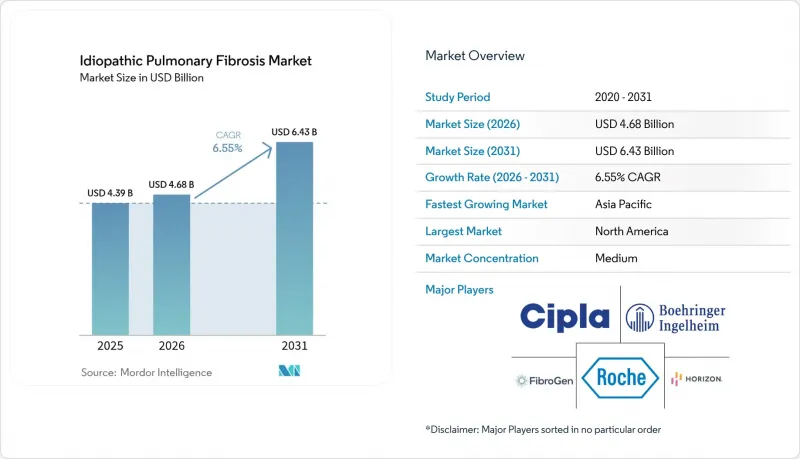
根據 Mordor Intelligence 預測,特發性肺纖維化的市場規模預計將從 2025 年的 43.9 億美元成長到 2026 年的 46.8 億美元,到 2031 年將達到 64.3 億美元,2026 年至 2031 年的複合年成長率為 6.5%。
本報告按藥物類型(尼達尼布、Pirfenidone及其他藥物)、作用機制(抗纖維化藥物、蛋白酪氨酸激酶抑制劑及其他作用機制)、給藥途徑(口服、腸外和吸入)、最終用戶(醫院和診所等)以及地區(北美、歐洲、亞太等)進行細分。市場預測以美元計價。
全球特發性肺纖維化市場趨勢及洞察
特發性肺纖維化盛行率不斷上升以及人口老化。
隨著全球人口老化,特發性肺纖維化(IPF)的發生率持續上升,對醫療保健系統帶來沉重負擔,並推動了對新藥的需求。在歐洲,每年約有4萬例新確診病例;在韓國,其盛行率超過每萬人4.5例,約為北美的兩倍。 IPF患者的治療費用比非患者高出2.5至3.5倍,促使製藥公司加大投資,並推動老年患者專用藥物的研發。
擴大診斷能力和早期檢測計劃
儘管高解析度電腦斷層掃描(CT)仍然是基本的診斷方法,但FDA於2024年批准人工智慧演算法標誌著放射診斷工作流程的重大轉變。血液和呼吸生物標記(例如PROLIFIC多重分析物檢測)的同步發展,使得更早的確診檢測和更有效的患者分層治療方案選擇成為可能。早期介入能夠增強治療效果的永續性,並擴大特發性肺纖維化的潛在市場。
抗纖維化藥物高成本且取得途徑有限
年度治療費用在呼吸系統疾病治療預算中佔很大比例,限制了低收入地區患者獲得治療的機會。由於只有25%的合格的患者實際開始接受治療,製藥公司正在探索基於價值的定價和降低共同支付額的方案。Pirfenidone的學名藥自2021年上市以來,提供了短期解決方案,但更廣泛的商業性影響只有在專利到期和價格進一步下降後才能顯現。
細分市場分析
Pirfenidone憑藉其較高的處方醫生認知度和較早的上市時間,預計到2025年將佔據特發性肺纖維化市場43.35%的佔有率。尼達尼布適應症廣泛,涵蓋進行性纖維化間質性肺部疾病,預計複合年成長率將達7.52%。對比隊列研究報告顯示,兩種藥物在提高存活率方面效果相似,但在不利事件(AE)方面存在差異,而不良事件直接影響醫師的選擇。下一代候選藥物,例如PDE4B和LPA1調變器,可望透過器官特異性標靶化和降低停藥風險,重塑市場佔有率模式。
與參考藥物Pirfenidone相比,Pirfenidone(LYT-100)的引入使消化器官系統不利事件減少了50%。這表明,改進製劑可以延長產品生命週期,並維持Pirfenidone的市場地位。在目前正在研究的聯合治療中,可以將Pirfenidone或尼達尼布作為核心療法,從而鞏固新藥上市後的商業性價值。
蛋白酪氨酸激酶抑制劑,尤其是尼達尼布,由於其多受體阻斷作用,呈現最快速的成長軌跡,年複合成長率高達9.12%。像奈拉尼司特這樣的雙通路藥物兼具抗發炎和抗纖維化作用,這反映了科學界的新共識,即調節平行通路更有利於維持肺功能。
初期計畫重點在於老化細胞清除劑、整合素抑制劑和TGF-BETA訊號路徑抑制劑。上海艾克生物製藥的AK3280在中國31個臨床試驗中心進行的研究中,透過調節與纖維化相關的多個通路,顯著改善了肺功能。先進的生物標記檢測方法指導內型選擇,從而支持差異化的監管申報和與保險公司的談判。
區域分析
預計到2025年,北美地區將佔總收入的41.05%,這得益於廣泛的保險覆蓋、密集的間質性肺病(ILD)中心網路以及人工智慧診斷在放射學領域的快速應用。創業投資持續資助後期臨床試驗項目,而由美國學術聯盟率先推出的適應性試驗設計正在加速法規核准流程。隨著支付機構對生物標記檢測的認可,精準醫療方法正被越來越多的專科醫生採用,並維持著穩定的病患治療遵從率。
亞太地區是成長最快的地區,預計2026年至2031年的複合年成長率將達到8.62%。中國和日本由於確診患者數量龐大,在商業性潛力方面處於主導,而韓國的發病率居世界首位,為每萬人4.5例。特發性肺纖維化(IPF)市場受惠於該地區臨床試驗中心的高密度分佈,目前全球44%的IPF研究都在亞太地區進行。這使得醫生能夠更早了解臨床實驗藥物,並縮短藥物上市後的成長時間。上海方舟等本土創新企業進一步加劇了該地區的競爭。
由於針對罕見疾病治療的強力的監管獎勵,歐洲仍然是至關重要的市場。隨著國家醫保覆蓋範圍的擴大(例如比利時2024年的修訂),抗纖維化藥物的可及性正在提升;歐盟範圍內的「地平線」計畫也為轉化研究計畫提供了資金支持。在專門的間質性肺病(ILD)中心,抗纖維化藥物的可及率高達91%,遠低於非專科機構的60%,凸顯了集中專業知識的優勢。統一的臨床實踐指南有助於在主要經濟體中推廣一致的治療方案,從而維持歐洲對全球銷售的貢獻。
其他好處:
- Excel格式的市場預測(ME)表
- 3個月的分析師支持
目錄
第1章:引言
- 研究假設和市場定義
- 調查範圍
第2章:調查方法
第3章執行摘要
第4章 市場狀況
- 市場概覽
- 市場促進因素
- 特發性肺纖維化盛行率不斷上升以及人口老化。
- 擴大診斷能力並推廣早期檢測項目
- 抗纖維化療法的進展和強大的研發管線
- 策略夥伴關係和對纖維化研究的投資
- 擴大人工智慧在輻射篩檢和疾病進展監測的應用。
- 全球患者權益倡導的興起和宣傳宣傳活動的擴展
- 市場限制因素
- 抗纖維化藥物高成本且取得困難
- 可能導致治療中斷的不良副作用概況
- 除抗纖維化藥物外,其他治療選擇有限。
- 基層醫療院所診斷率低
- 監理情勢
- 波特五力分析
第5章 市場規模與成長預測
- 依藥物類型
- 任天堂
- Pirfenidone
- 其他藥物類型
- 透過作用機制
- 抗纖維化藥物
- 蛋白酪氨酸激酶抑制劑
- 其他作用機制
- 透過行政途徑
- 口服
- 腸外
- 吸入
- 最終用戶
- 醫院和診所
- 專科診所
- 居家醫療
- 其他最終用戶
- 按地區
- 北美洲
- 美國
- 加拿大
- 墨西哥
- 歐洲
- 德國
- 英國
- 法國
- 義大利
- 西班牙
- 其他歐洲國家
- 亞太地區
- 中國
- 日本
- 印度
- 澳洲
- 韓國
- 其他亞太國家
- 中東和非洲
- GCC
- 南非
- 其他中東和非洲國家
- 南美洲
- 巴西
- 阿根廷
- 其他南美國家
- 北美洲
第6章 競爭情勢
- 市場集中度
- 市佔率分析
- 公司簡介
- F. Hoffmann-La Roche Ltd(Genentech)
- Boehringer Ingelheim International GmbH
- Cipla Ltd
- Merck & Co., Inc.
- Bristol-Myers Squibb Company
- United Therapeutics Corp.
- FibroGen Inc.
- Horizon Therapeutics plc
- Avalyn Pharma Inc.
- MediciNova Inc.
- Gyre Therapeutics Inc.
- AstraZeneca plc
- Vicore Pharma
- Novartis AG
- Tvardi Therapeutics
- Pliant Therapeutics
- Galapagos NV
- Gyre Therapeutics
- AdAlta Ltd
第7章 市場機會與未來展望
According to Mordor Intelligence, the idiopathic pulmonary fibrosis market size is expected to grow from USD 4.39 billion in 2025 to USD 4.68 billion in 2026 and is forecast to reach USD 6.43 billion by 2031 at 6.55% CAGR over 2026-2031.
This report is Segmented by Drug Type (Nintedanib, Pirfenidone, Other Drug Types), Mode of Action (Antifibrotic Agents, Tyrosine Kinase Inhibitors, Other Modes of Action), Route of Administration (Oral, Parenteral, Inhalation), End User (Hospitals and Clinics, and More), and Geography (North America, Europe, Asia-Pacific, and More). The Market Forecasts are Provided in Terms of Value (USD).
Global Idiopathic Pulmonary Fibrosis Market Trends and Insights
Increasing Prevalence of IPF Coupled with Aging Demographics
Incidence continues to rise in tandem with global population aging, placing sustained pressure on healthcare systems and pushing demand for novel medicines. Europe diagnoses about 40,000 new cases annually, and prevalence in South Korea tops 4.5 per 10,000 persons, nearly double North American rates. Care costs run 2.5-to-3.5 times higher than for non-IPF patients, incentivizing pharmaceutical investment and stimulating development of geriatric-adapted formulations.
Expansion of Diagnostic Capabilities and Early Detection Programs
High-resolution computed tomography remains foundational, yet 2024 FDA clearance of an AI-enabled algorithm signaled a step-change in radiology workflows. Parallel progress in circulating and exhaled-breath biomarkers such as the PROLIFIC multi-analyte panel supports earlier confirmatory testing and stratifies patients more effectively for therapy selection. Earlier intervention strengthens treatment response durability, expanding the addressable idiopathic pulmonary fibrosis market.
High Cost and Limited Accessibility of Antifibrotic Drugs
Annual treatment bills consume a sizable share of respiratory-care budgets, constraining uptake in lower-income regions. With only 25% of eligible patients started on therapy, manufacturers are exploring value-based pricing and co-pay assistance programs. Generic pirfenidone, available since 2021, offers near-term relief but broad commercial impact hinges on further price erosion once additional patents lapse.
Other drivers and restraints analyzed in the detailed report include:
- Advancements in Antifibrotic Therapies and Robust Pipeline Momentum
- Strategic Collaborations & Investments in Fibrosis Research
- Adverse Side-Effect Profile Leading to Treatment Discontinuation
For complete list of drivers and restraints, kindly check the Table Of Contents.
Segment Analysis
Pirfenidone captured 43.35% idiopathic pulmonary fibrosis market share in 2025 through wider prescriber familiarity and earlier commercial rollout. Nintedanib's broader label covering progressive fibrosing interstitial lung diseases underpins its 7.52% CAGR forecast. Comparative cohort studies report similar survival benefit yet divergent AE profiles that directly shape physician choice. Next-wave candidates such as PDE4B and LPA1 modulators-could recalibrate share distribution by offering organ-specific targeting and lower discontinuation risk.
The introduction of deupirfenidone (LYT-100) lowered gastrointestinal events by 50% versus reference pirfenidone, signaling that reformulations can stretch product lifecycles and sustain pirfenidone's franchise. Combination regimens under investigation could embed pirfenidone or nintedanib as backbone therapy, anchoring their commercial relevance even as new agents arrive.
Antifibrotic agents controlled 82.05% of 2025 revenue, highlighting their foundational role in dampening extracellular-matrix deposition. Tyrosine kinase inhibitors contribute the sharpest growth trajectory at 9.12% CAGR, thanks to nintedanib's multi-receptor blockade. Dual-pathway drugs such as nerandomilast combine anti-inflammatory and antifibrotic effects, mirroring evolving scientific consensus that parallel pathway modulation affords superior lung-function preservation.
Early-stage programs are exploring senolytics, integrin blockers, and TGF-B signaling disruptors. Shanghai Ark Biopharmaceutical's AK3280 illustrated significant lung-function gains by modulating multiple fibrosis-linked pathways across 31 Chinese trial sites. Sophisticated biomarker panels guide endotype selection, supporting differentiated regulatory filings and payer negotiations.
Complete Report Scope:
- By Drug Type
- Nintedanib
- Pirfenidone
- Other Drug Types
- By Mode of Action
- Antifibrotic Agents
- Tyrosine Kinase Inhibitors
- Other Modes of Action
- By Route of Administration
- Oral
- Parenteral
- Inhalation
- By End User
- Hospitals & Clinics
- Specialty Clinics
- Home-Care Settings
- Other End Users
- By Geography
- North America
- United States
- Canada
- Mexico
- Europe
- Germany
- United Kingdom
- France
- Italy
- Spain
- Rest of Europe
- Asia-Pacific
- China
- Japan
- India
- Australia
- South Korea
- Rest of Asia-Pacific
- Middle East & Africa
- GCC
- South Africa
- Rest of Middle East & Africa
- South America
- Brazil
- Argentina
- Rest of South America
- North America
Geography Analysis
North America held 41.05% of 2025 revenue, supported by deep reimbursement coverage, a dense network of ILD centers, and rapid incorporation of AI diagnostics into radiology suites. Venture capital continues to sponsor late-stage programs, and adaptive trial designs pioneered in United States academic consortia are accelerating regulatory timetables. Precision-medicine approaches, bolstered by payer acceptance of biomarker testing, are widening specialist adoption and stabilizing patient retention on therapy.
Asia-Pacific is the fastest-expanding region, posting an 8.62% CAGR across 2026-2031. China and Japan dominate commercial potential owing to large diagnosed populations, while South Korea records the highest prevalence globally at 4.5 per 10,000 persons. The idiopathic pulmonary fibrosis market benefits from regional trial-site density 44% of current IPF studies are run in Asia-Pacific, strengthening early physician familiarity with investigational agents and shortening launch ramp-up times. Domestic innovators such as Shanghai Ark are further stimulating local competition.
Europe remains a pivotal market with strong regulatory incentives for rare-disease therapeutics. National reimbursement expansion exemplified by Belgium's 2024 update broadens antifibrotic accessibility, while pan-EU Horizon funding underwrites translational projects. Specialist ILD centers exhibit 91% antifibrotic access versus 60% in non-specialist facilities, underlining the benefits of concentrated expertise. Harmonized clinical-practice guidelines support consistent uptake across major economies, sustaining Europe's contribution to global revenue.
- Roche
- Boehringer Ingelheim
- Cipla
- Merck
- Bristol-Myers Squibb
- United Therapeutics Corp.
- FibroGen Inc.
- Horizon Therapeutics
- Avalyn Pharma Inc.
- MediciNova Inc.
- Gyre Therapeutics Inc.
- AstraZeneca
- Vicore Pharma
- Novartis
- Tvardi Therapeutics
- Pliant Therapeutics
- Galapagos NV
- Gyre Therapeutics
- AdAlta Ltd
Additional Benefits:
- The market estimate (ME) sheet in Excel format
- 3 months of analyst support
TABLE OF CONTENTS
1 Introduction
- 1.1 Study Assumptions & Market Definition
- 1.2 Scope of the Study
2 Research Methodology
3 Executive Summary
4 Market Landscape
- 4.1 Market Overview
- 4.2 Market Drivers
- 4.2.1 Increasing Prevalence of IPF Coupled with Aging Demographics
- 4.2.2 Expansion of Diagnostic Capabilities and Early Detection Programs
- 4.2.3 Advancements in Antifibrotic Therapies and Robust Pipeline Momentum
- 4.2.4 Strategic Collaborations & Investments in Fibrosis Research
- 4.2.5 Increased Use of Artificial Intelligence for Radiological Screening & Disease Progression Monitoring
- 4.2.6 Rising Patient Advocacy and Awareness Campaigns Worldwide
- 4.3 Market Restraints
- 4.3.1 High Cost and Limited Accessibility of Antifibrotic Drugs
- 4.3.2 Adverse Side-Effect Profile Leading to Treatment Discontinuation
- 4.3.3 Limited Therapeutic Options Beyond Antifibrotics
- 4.3.4 Low Diagnosis Rates in Primary Care Settings
- 4.4 Regulatory Landscape
- 4.5 Porter's Five Forces Analysis
- 4.5.1 Threat of New Entrants
- 4.5.2 Bargaining Power of Buyers/Consumers
- 4.5.3 Bargaining Power of Suppliers
- 4.5.4 Threat of Substitute Products
- 4.5.5 Intensity of Competitive Rivalry
5 Market Size & Growth Forecasts (Value in USD)
- 5.1 By Drug Type
- 5.1.1 Nintedanib
- 5.1.2 Pirfenidone
- 5.1.3 Other Drug Types
- 5.2 By Mode of Action
- 5.2.1 Antifibrotic Agents
- 5.2.2 Tyrosine Kinase Inhibitors
- 5.2.3 Other Modes of Action
- 5.3 By Route of Administration
- 5.3.1 Oral
- 5.3.2 Parenteral
- 5.3.3 Inhalation
- 5.4 By End User
- 5.4.1 Hospitals & Clinics
- 5.4.2 Specialty Clinics
- 5.4.3 Home-Care Settings
- 5.4.4 Other End Users
- 5.5 By Geography
- 5.5.1 North America
- 5.5.1.1 United States
- 5.5.1.2 Canada
- 5.5.1.3 Mexico
- 5.5.2 Europe
- 5.5.2.1 Germany
- 5.5.2.2 United Kingdom
- 5.5.2.3 France
- 5.5.2.4 Italy
- 5.5.2.5 Spain
- 5.5.2.6 Rest of Europe
- 5.5.3 Asia-Pacific
- 5.5.3.1 China
- 5.5.3.2 Japan
- 5.5.3.3 India
- 5.5.3.4 Australia
- 5.5.3.5 South Korea
- 5.5.3.6 Rest of Asia-Pacific
- 5.5.4 Middle East & Africa
- 5.5.4.1 GCC
- 5.5.4.2 South Africa
- 5.5.4.3 Rest of Middle East & Africa
- 5.5.5 South America
- 5.5.5.1 Brazil
- 5.5.5.2 Argentina
- 5.5.5.3 Rest of South America
- 5.5.1 North America
6 Competitive Landscape
- 6.1 Market Concentration
- 6.2 Market Share Analysis
- 6.3 Company Profiles (includes Global level Overview, Market level overview, Core Segments, Financials as available, Strategic Information, Market Rank/Share for key companies, Products & Services, and Recent Developments)
- 6.3.1 F. Hoffmann-La Roche Ltd (Genentech)
- 6.3.2 Boehringer Ingelheim International GmbH
- 6.3.3 Cipla Ltd
- 6.3.4 Merck & Co., Inc.
- 6.3.5 Bristol-Myers Squibb Company
- 6.3.6 United Therapeutics Corp.
- 6.3.7 FibroGen Inc.
- 6.3.8 Horizon Therapeutics plc
- 6.3.9 Avalyn Pharma Inc.
- 6.3.10 MediciNova Inc.
- 6.3.11 Gyre Therapeutics Inc.
- 6.3.12 AstraZeneca plc
- 6.3.13 Vicore Pharma
- 6.3.14 Novartis AG
- 6.3.15 Tvardi Therapeutics
- 6.3.16 Pliant Therapeutics
- 6.3.17 Galapagos NV
- 6.3.18 Gyre Therapeutics
- 6.3.19 AdAlta Ltd
7 Market Opportunities & Future Outlook
- 7.1 White-Space & Unmet-Need Assessment

 特發性肺纖維化治療的市場規模、佔有率、趨勢和預測:按藥物類別、最終用戶和地區分類,2026-2034 年。
 特發性肺纖維化市場:依藥物、給藥途徑、通路及地區分類
 特發性肺纖維化市場:按治療分類、給藥途徑、通路和最終用戶分類 - 全球預測 2026-2032 年
 2026-2034年全球特發性肺纖維化治療市場規模、佔有率、趨勢和成長分析報告
 全球特發性肺纖維化市場:按治療方法和地區分類-市場規模、產業趨勢、機會分析和未來預測(2026-2035 年)
 特發性肺纖維化市場-全球產業規模、佔有率、趨勢、機會、預測:按藥物類型、給藥途徑、分銷管道、地區和競爭格局分類,2021-2031年
 特發性肺纖維化市場規模、佔有率和成長分析(按藥物類型、作用機制、最終用戶和地區分類)—2026-2033年產業預測
 特發性肺纖維化(IPF):全球市場展望、流行病學、競爭格局與市場預測報告(32個主要市場),2025-2035年特發性肺纖維化(IPF):市場展望、流行病學、競爭格局、市場預測報告(2025-2035年)特發性肺纖維化(IPF):新型療法、未滿足的需求和TPP洞察報告,2026年