

 |
市場調查報告書
商品編碼
2123993
起司:市場佔有率分析、產業趨勢與統計、成長預測(2026-2031)Cheese - Market Share Analysis, Industry Trends & Statistics, Growth Forecasts (2026 - 2031) |
||||||

※ 本網頁內容可能與最新版本有所差異。詳細情況請與我們聯繫。
根據 Mordor Intelligence 預測,起司市場規模將從 2025 年的 1,649.5 億美元和 2026 年的 1,718.9 億美元成長到 2031 年的 2,190.7 億美元,2026 年至 2031 年的年複合成長率(CAGR)為 4.97%。
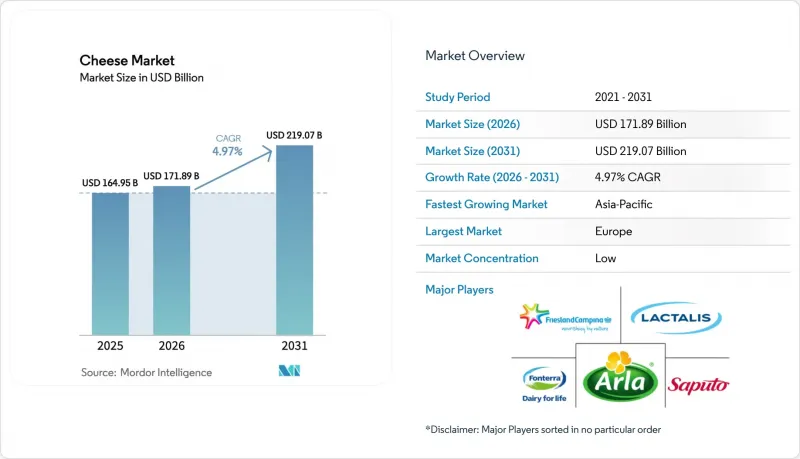
本報告按產品類型(天然乳酪和加工起士)、原料類型(牛奶、羊奶、水牛奶及其他)、形態(塊狀/輪狀、片狀、碎屑/磨碎、塗抹狀等)、分銷管道(餐飲服務業 (HoReCa) 和零售)以及地區(北美、歐洲、亞太及其他)進行細分。市場預測以價值(美元)和數量(噸)呈現。
全球乳酪市場趨勢及洞察
起司種類和特色產品增多
消費者對特色起司的需求日益成長,正在改變市場格局。他們越來越傾向於選擇菲達起司、哈羅米起司和陳年高達起司等特色起司,而不是莫札瑞拉起司和切達起司等常見起司。這種轉變在北美尤為顯著,預計到2025年,北美特色起司的銷售額將逐年成長,增速是整個品類增速的三倍以上。零售商正在擴大精選起司組合的貨架空間,通常將它們與熟食和餅乾一起陳列,以鼓勵消費者同時購買其他配套商品。歐洲也出現了類似的趨勢,帕瑪森乾酪和羅克福起司等受保護原產地名稱(PDO)認證的奶酪,憑藉其正宗性,售價比普通硬質奶酪或藍紋乾酪高出40%至60%。小規模生產商正在利用直銷銷售管道環節,從而確保獲得原本應支付給批發商的利潤。為了因應這種情況,大型企業正在收購手工品牌或推出高階子品牌,以保護其在成長最快的高階價格區間的市場佔有率。
人們對永續發展的關注正在影響對環保起司產品的需求。
環境因素正對採購和包裝策略產生重大影響,酪農合作社擴大採用再生農業實踐來減少牛的甲烷排放。 2025年,恆天然宣布了一項計劃,到2028年將其紐西蘭供應商的30%過渡到低排放量飼料添加劑,目標是將範圍3排放量減少15%。此外,歐盟的LIFE(環境融資工具)計畫於2024年提供了4,500萬歐元(4,800萬美元)的津貼,用於支持法國和荷蘭的碳中和起司生產設施先導計畫。這反映了監管機構對脫碳工作的大力支持。在包裝方面,創新仍然至關重要,因為多個司法管轄區已禁止使用一次性塑膠。 2025年,阿拉食品公司推出了用於切片乳酪的纖維性包裝。這使他們在保持出口市場所需的90天保存期限的同時,減少了60%的塑膠使用量。然而,這些永續性舉措需要大量的初期投資,這對小規模生產商來說是一個挑戰。隨著規模經濟對於遵守永續性標準變得越來越重要,這種財務負擔可能會加速產業重組。
與食品安全、標籤錯誤和標籤相關的監管挑戰。
不同司法管轄區的法律規範各異,導致合規成本上升,出口商和小規模生產者受到的影響尤其嚴重。 2024年,美國食品藥物管理局(FDA)發布修訂指南,強制要求所有進口起司標註原產國,預計將使標籤和文件成本每公斤增加0.15美元。同樣,2025年,歐洲食品安全局(EFSA)收緊了軟乳酪中單增李斯特菌的基準值,要求更頻繁的檢查,並迫使一些法國生產商升級其熟成設施,以改善衛生系統。在價格敏感型市場,非法污染仍是重大隱憂。例如,印度食品安全標準局(FSSAI)在2024年檢測的加工起士樣品中,18%的樣品中含有棕櫚油,導致產品召回,並損害了消費者信心。此外,關於標籤的爭議仍然是爭論的焦點,尤其是「天然」和「手工」等術語,由於缺乏標準化定義,經常被指責為「綠色清洗」。
細分市場分析
預計到2025年,天然起司將佔據73.03%的市場佔有率,凸顯了消費者對加工最少的乳製品的強烈偏好。這一趨勢表明,消費者對更天然、更健康產品的需求日益成長。同時,預計到2031年,加工起士的複合年成長率將達到5.24%。這一成長主要得益於產品向「潔淨標示」方向的改進,這種標籤透過提供成分透明度來吸引注重健康的消費者,同時保持了餐飲服務業所需的便利性。莫札瑞拉起司仍然是天然起司中最大的細分市場,這得益於亞太地區披薩消費量的成長。該地區快餐連鎖店的擴張也進一步推動了這一趨勢。
帕瑪森乾酪和其他硬質乳酪受益於優質化趨勢,陳年品種的零售價比普通莫札瑞拉起司高出約50%。菲達起司和其他鹽水醃製起司在地中海和中東菜餚中越來越受歡迎,反映出消費者對多樣化和地道風味的偏好正在轉變。同時,乳清乾酪和茅屋起司也受到注重健康的消費者的青睞,他們優先考慮高蛋白、低脂肪的飲食選擇。儘管成熟市場成長停滯,但由於西式早餐越來越受歡迎,奶油乳酪在亞洲地區正經歷快速成長。
預計到2025年,牛奶將佔起司市場53.01%的佔有率,這主要歸功於其成本效益和成熟的供應鏈。這一主導地位表明牛奶供應充足且價格適中,使其成為大規模司生產的首選原料。相比之下,山羊乳酪的複合年成長率預計為6.34%。這一成長歸功於其易消化吸收的優勢,以及消費者對其高級產品日益成長的需求。山羊起司的零售價格通常比牛奶起司高出30%至50%,這種價格差異主要歸因於人們認為其營養價值更高以及其生產過程中採用的傳統工藝。
水牛奶酪,主要以“水牛馬蘇里拉奶酪”(莫札瑞拉起司 di Bufala)為代表,在奶酪市場中佔據著一個雖小但盈利豐厚的細分領域。到2025年,義大利對亞太地區的水牛起司出口量將年增19%。這一成長得益於中國和日本等國富裕消費者對正宗地中海產品的日益偏好。同時,綿羊起司的生產仍集中在南歐和中東地區,佩科里諾羅馬諾起司(Pecorino Romano)和菲達起司(菲達起司)等傳統品種受到地理標誌(GI)的保護。雖然這些地理標誌在維護這些起司的正宗性方面發揮著至關重要的作用,但也限制了其供應量的顯著成長。
區域分析
預計到2025年,歐洲將引領全球起司市場,佔27.32%的市場。這一主導地位源自於歐洲悠久的消費傳統和原產地保護(PDO)體系,該體系為區域生產商提供了價格優勢。德國、法國、義大利和荷蘭的產量佔歐洲總產量的60%以上,每個國家都專注於生產反映其地域風土和生產方法的獨特乳酪品種。然而,隨著人均消費量接近飽和,以及人們對飽和脂肪酸健康問題的日益關注影響著飲食偏好,歐洲乳酪市場的成長速度正在放緩。監管仍然嚴格,歐洲食品安全局 (EFSA) 執行嚴格的微生物標準,歐盟的「從農場到餐桌」策略旨在到 2030 年將食物廢棄物減少 20%。生產商正積極投資延長保存期限的技術,同時,以永續性發展為導向的創新,例如碳中和生產和可生物分解包裝,也日益受到關注。在英國,由於脫歐後的貿易中斷,供應鏈成本不斷上升,而波蘭等東歐國家正在擴大產能,以滿足國內和出口需求。
亞太地區是成長最快的乳酪市場,預計到2031年將以6.89%的複合年成長率成長。這一成長主要得益於都市化、可支配收入的增加以及西式飲食習慣的日益普及。中國市場尤其引人注目,預計2020年至2025年間,人均起司消費量將成長兩倍,這主要得益於披薩和漢堡連鎖店的增加以及現代零售業的擴張。在印度,傳統的Paneer 起士)消費仍然強勁,而西式起司的消費則主要集中在都市區和年輕消費者群體。日本和韓國是成熟的市場,需求正轉向高階進口產品以及將起司與傳統食材融合的創新產品。東南亞地區冷鏈基礎設施的改善正在推動需求成長,但價格敏感性仍然是印尼和菲律賓等低收入市場面臨的挑戰。澳洲和紐西蘭是淨出口國,它們利用牧場放養的生產體系,在亞洲出口市場獲得永續性的溢價。
其他地區也在推動全球起司市場的成長。到2025年,北美將佔較大佔有率,其中美國貢獻最大,人均起司年消費量將超過17公斤。該地區餐飲服務業滲透率高,速食店的銷售量佔比接近40%。墨西哥正經歷快速成長,這主要得益於傳統「新鮮起司」(queso fresco)的消費以及加工起士在都市區日益普及。在加拿大,雙語標籤要求和省級貿易壁壘導致分銷管道分散,並增加了全國性品牌的成本。此外,美國食品藥物管理局(FDA)關於原產地標籤的最新指南增加了進口商的合規成本,而關稅的不確定性也使跨國製造商的長期籌資策略變得更加複雜。南美洲正在穩定擴張,巴西和阿根廷是主要市場。在巴西,中產階級的壯大推動了起司消費量的成長,對傳統「requeijao」起司和進口歐洲起司的需求均增加。阿根廷憑藉其強大的酪農基礎,向鄰國和歐洲出口大量硬質乳酪,但面臨著經濟不穩定和外匯波動的挑戰。在中東和非洲,市場較為分散。波灣合作理事會(GCC)成員國嚴重依賴進口,需求主要來自外籍人士和遊客。同時,在埃及和摩洛哥等北非市場,雖然建立了本地生產體系,但如何維持產品品質的穩定性仍然是一大挑戰。
其他好處:
- Excel格式的市場預測(ME)表
- 3個月的分析師支持
目錄
第1章:引言
- 研究假設和市場定義
- 調查範圍
第2章:調查方法
第3章執行摘要
第4章 市場狀況
- 市場概覽
- 市場促進因素
- 擴大我們的起司種類和本地特色產品。
- 人們對永續發展的關注正在影響對環保起司產品的需求。
- 即食食品和簡便食品的受歡迎程度
- 乳酪陳化和風味增強技術的進步
- 消費者對優質化的追求推動了對陳年起司和手工起司的需求成長。
- 透過新形式提高產品知名度
- 市場限制因素
- 與食品安全、標籤錯誤和標籤相關的監管挑戰。
- 高脂肪和高熱量帶來的健康問題
- 缺乏對地區性乳酪的品質和類型的標準化定義
- 從農場到餐桌的供應鏈中的衛生和可追溯性問題。
- 價值鏈分析
- 監理展望
- 波特五力模型
第5章 市場規模與成長預測
- 按類型
- 天然乳酪
- 莫札瑞拉起司
- 菲達起司
- 乳清乾酪
- 小木屋
- 奶油
- 帕瑪森起司
- 其他
- 加工起士
- 天然乳酪
- 按類型分類的牛奶成分
- 牛奶
- 山羊
- 水牛
- 其他
- 按格式
- 塊/輪
- 片
- 切絲或磨碎
- 傳播
- 立方體和木棍
- 其他
- 透過分銷管道
- 餐飲服務業(HoReCa)
- 零售
- 超級市場和大賣場
- 便利商店
- 專業零售商
- 線上零售
- 其他
- 按地區
- 北美洲
- 美國
- 加拿大
- 墨西哥
- 其他北美國家
- 歐洲
- 德國
- 英國
- 義大利
- 法國
- 西班牙
- 荷蘭
- 波蘭
- 比利時
- 瑞典
- 其他歐洲國家
- 亞太地區
- 中國
- 印度
- 日本
- 澳洲
- 印尼
- 韓國
- 泰國
- 新加坡
- 其他亞太國家
- 南美洲
- 巴西
- 阿根廷
- 哥倫比亞
- 智利
- 秘魯
- 其他南美國家
- 中東和非洲
- 南非
- 沙烏地阿拉伯
- 阿拉伯聯合大公國
- 奈及利亞
- 埃及
- 摩洛哥
- 土耳其
- 其他中東和非洲國家
- 北美洲
第6章 競爭情勢
- 市場集中度
- 策略趨勢
- 市場排名分析
- 公司簡介
- Groupe Lactalis SA
- FrieslandCampina NV
- Arla Foods amba
- Fonterra Co-operative Group Ltd
- Saputo Inc.
- The Kraft Heinz Company
- Savencia Fromage & Dairy
- Dairy Farmers of America Inc.
- Land O'Lakes Inc.
- Gujarat Co-operative Milk Marketing Federation
- Almarai Company
- Hochland SE
- DMK Group
- Sargento Foods Inc.
- Associated Milk Producers Inc.
- Ornua Co-operative Ltd
- Emmi AG
- Leprino Foods Company
- Unibel SA
- Hilmar Cheese Company
第7章 市場機會與未來展望
According to Mordor Intelligence, the cheese market size is projected to expand from USD 164.95 billion in 2025 and USD 171.89 billion in 2026 to USD 219.07 billion by 2031, registering a compound annual growth rate (CAGR) of 4.97% between 2026 to 2031.
This report is Segmented Into Product Type (Natural Cheese and Processed Cheese), Milk Source (Cow, Goat, Buffalo, and Others), Format (Blocks/Wheels, Slices, Shredded and Grated, Spreads, and More), Distribution Channels (Foodservice (HoReCa), and Retail), and Geography (North America, Europe, Asia-Pacific, and More). The Market Forecasts are Provided in Terms of Value (USD) and Volume (Tons).
Global Cheese Market Trends and Insights
Growth in cheese varieties and specialty types
The growing demand for specialty cheese varieties is transforming value pools as consumers increasingly opt for options like feta, halloumi, and aged Gouda instead of standard choices such as mozzarella and cheddar. This shift is particularly evident in North America, where specialty cheese sales recorded year-over-year growth in 2025, outpacing the overall category growth by a factor of three. Retailers are expanding shelf space for curated cheese assortments, often positioning them alongside charcuterie and crackers to encourage complementary purchases. In Europe, a similar trend is observed, with protected designation of origin cheeses such as Parmigiano-Reggiano and Roquefort using their authenticity to command price premiums of 40 percent to 60 percent over generic hard and blue cheeses. Smaller producers are leveraging direct-to-consumer channels to bypass traditional distribution markups, allowing them to retain margins that would otherwise go to wholesalers. In response, larger companies are acquiring artisanal brands or launching premium sub-brands to protect their market share in the fastest-growing premium price segments.
Sustainability concerns influencing demand for eco-friendly cheese products
Environmental considerations are significantly shaping sourcing and packaging strategies, with dairy cooperatives increasingly adopting regenerative agriculture practices to reduce methane emissions from cattle. In 2025, Fonterra announced its plan to transition 30% of its New Zealand supplier base to low-emission feed additives by 2028, with the goal of achieving a 15% reduction in Scope 3 emissions. Furthermore, the European Union LIFE (L'Instrument Financier pour l'Environnement) program allocated EUR 45 million (USD 48 million) in grants in 2024 to support pilot projects for carbon-neutral cheese production facilities in France and the Netherlands, reflecting strong regulatory backing for decarbonization efforts . On the packaging front, innovation remains critical as single-use plastics face bans in several jurisdictions. In 2025, Arla Foods introduced a fiber-based wrapper for sliced cheese, which reduced plastic content by 60% while maintaining the 90-day shelf life required for export markets. However, these sustainability initiatives come with substantial upfront capital costs, posing challenges for smaller producers. This financial strain may lead to increased industry consolidation, as achieving compliance with sustainability standards increasingly demands economies of scale.
Regulatory challenges in food safety, adulteration, and labeling
Divergent regulatory frameworks across jurisdictions increase compliance costs, disproportionately affecting exporters and smaller producers. In 2024, the U.S. Food and Drug Administration issued updated guidance requiring country-of-origin labeling for all imported cheeses, adding an estimated USD 0.15 per kilogram in labeling and documentation costs . Similarly, the European Food Safety Authority tightened limits on Listeria monocytogenes in soft cheeses in 2025, necessitating more frequent testing and compelling several French producers to upgrade aging facilities with improved sanitation systems. Adulteration remains a significant concern in price-sensitive markets; for instance, India's Food Safety and Standards Authority found palm oil substitution in 18% of processed cheese samples tested during a 2024 inspection, leading to recalls and diminishing consumer trust . Labeling disputes also remain contentious, particularly regarding terms like "natural" and "artisanal," which lack standardized definitions and often result in accusations of greenwashing.
Other drivers and restraints analyzed in the detailed report include:
- Popularity of ready-to-eat and convenience foods
- Advancements in cheese ripening and flavor enhancement technology
- Health concerns related to high fat and calorie content
For complete list of drivers and restraints, kindly check the Table Of Contents.
Segment Analysis
In 2025, natural cheese accounted for 73.03% of the market share, underscoring a strong consumer preference for dairy products that undergo minimal processing. This preference highlights the growing demand for products perceived as more natural and wholesome. On the other hand, processed cheese is anticipated to grow at a Compound Annual Growth Rate (CAGR) of 5.24% through 2031. This growth is primarily driven by clean-label reformulations, which appeal to health-conscious consumers by offering transparency in ingredients while maintaining the convenience features that are crucial for adoption in the foodservice industry. Mozzarella continues to dominate as the largest sub-segment within natural cheese, supported by the increasing consumption of pizza in Asia-Pacific markets. This trend is further bolstered by the expansion of quick-service restaurant chains in the region.
Parmesan and other hard cheeses are experiencing significant benefits from premiumization trends, with aged variants commanding retail prices that are approximately 50% higher than those of commodity mozzarella. Feta and other brined cheeses are becoming increasingly popular in Mediterranean and Middle Eastern cuisines, reflecting a shift in consumer preferences toward diverse and authentic flavors. Meanwhile, ricotta and cottage cheese are gaining traction among fitness-focused consumers who prioritize high-protein, low-fat options in their diets. Cream cheese, while showing stagnant growth in mature markets, is witnessing rapid expansion in Asia due to the growing popularity of Western-style breakfasts in the region.
Cow milk accounted for 53.01% of the cheese market in 2025, primarily due to its cost efficiency and the presence of well-established supply chains. This dominance underscores the widespread availability and affordability of cow milk, making it the preferred choice for large-scale cheese production. In contrast, goat milk cheese is experiencing a compound annual growth rate (CAGR) of 6.34%. This growth is attributed to increasing consumer demand for its digestibility benefits and its positioning as a premium product. Goat cheese typically commands retail prices 30% to 50% higher than cow milk cheese, a premium linked to its perceived superior nutritional value and the artisanal methods used in its production.
Buffalo milk cheese, primarily represented by mozzarella di bufala, occupies a niche yet profitable segment within the cheese market. Italian exports of buffalo milk cheese to the Asia-Pacific region increased by 19% year-over-year in 2025. This growth is supported by the rising preference among affluent consumers in countries such as China and Japan for authentic Mediterranean products. Meanwhile, sheep milk cheese production remains concentrated in Southern Europe and the Middle East, where traditional varieties such as Pecorino Romano and feta are protected by geographic indications. These geographic protections play a crucial role in preserving the authenticity of these cheeses but also limit the potential for significant expansion in supply.
Complete Report Scope:
- By Type
- Natural Cheese
- Mozzarella
- Feta
- Ricotta
- Cottage
- Cream
- Parmesan
- Others
- Processed Cheese
- Natural Cheese
- By Milk Source
- Cow
- Goat
- Buffalo
- Others
- By Format
- Blocks/Wheels
- Slices
- Shredded and Grated
- Spreads
- Cubes and Sticks
- Others
- By Distribution Channel
- Foodservice (HoReCa)
- Retail
- Supermarkets and Hypermarkets
- Convenience Stores
- Specialist Retailers
- Online Retail
- Others
- By Geography
- North America
- United States
- Canada
- Mexico
- Rest of North America
- Europe
- Germany
- United Kingdom
- Italy
- France
- Spain
- Netherlands
- Poland
- Belgium
- Sweden
- Rest of Europe
- Asia-Pacific
- China
- India
- Japan
- Australia
- Indonesia
- South Korea
- Thailand
- Singapore
- Rest of Asia-Pacific
- South America
- Brazil
- Argentina
- Colombia
- Chile
- Peru
- Rest of South America
- Middle East and Africa
- South Africa
- Saudi Arabia
- United Arab Emirates
- Nigeria
- Egypt
- Morocco
- Turkey
- Rest of Middle East and Africa
- North America
Geography Analysis
In 2025, Europe led the global cheese market, accounting for 27.32% of the total share. This dominance is rooted in its long-standing consumption traditions and the Protected Designation of Origin (PDO) frameworks, which provide regional producers with pricing advantages. Germany, France, Italy, and the Netherlands collectively contributed over 60% of European production, each specializing in unique cheese varieties that reflect local terroir and production methods. However, growth in the region is slowing as per-capita consumption approaches saturation and health concerns over saturated fats influence dietary preferences. Regulatory oversight remains significant, with the European Food Safety Authority (EFSA) enforcing strict microbial limits and the European Union's Farm to Fork strategy targeting a 20% reduction in food waste by 2030. Producers are responding by investing in shelf-life extension technologies, while sustainability-focused innovations, such as carbon-neutral production and biodegradable packaging, are gaining traction. Post-Brexit trade disruptions in the United Kingdom have increased supply chain costs, while Eastern European countries like Poland are expanding production capacity to meet both domestic and export demand.
The Asia-Pacific region is the fastest-growing cheese market, with a compound annual growth rate (CAGR) of 6.89% projected through 2031. This growth is driven by urbanization, rising disposable incomes, and the adoption of Western dietary habits. China is the standout market, with per-capita cheese consumption tripling between 2020 and 2025 due to the proliferation of pizza and burger chains and the expansion of modern retail. In India, traditional paneer consumption remains robust, while Western-style cheese adoption is concentrated in urban areas and among younger consumers. Japan and South Korea are mature markets, where demand is shifting toward premium imported varieties and fusion products that combine cheese with traditional ingredients. Improvements in cold-chain infrastructure across Southeast Asia are unlocking demand, although price sensitivity remains a challenge in lower-income markets such as Indonesia and the Philippines. Australia and New Zealand are net exporters, leveraging pasture-based production systems that command sustainability premiums in Asian export markets.
Other regions are also contributing to the global cheese market's growth. North America held a significant share in 2025, with the United States as the largest contributor, where per-capita cheese consumption exceeded 17 kilograms annually. The region is characterized by high foodservice penetration, with quick-service restaurants accounting for nearly 40% of cheese volume. Mexico is experiencing rapid growth, driven by traditional queso fresco consumption and increasing urban adoption of processed cheese. In Canada, bilingual labeling requirements and provincial trade barriers fragment distribution, raising costs for national brands. Additionally, updated guidance from the U.S. Food and Drug Administration (FDA) on country-of-origin labeling has increased compliance costs for importers, while tariff uncertainties complicate long-term sourcing strategies for multinational producers. South America is steadily expanding, with Brazil and Argentina as key markets. Brazil's cheese consumption is rising as middle-class growth drives demand for both traditional requeijao and imported European varieties. Argentina benefits from a strong dairy farming base and exports significant volumes of hard cheeses to neighboring countries and Europe, although economic instability and currency fluctuations pose challenges. In the Middle East and Africa, the market is fragmented. Gulf Cooperation Council (GCC) countries rely heavily on imports, with demand driven by expatriate populations and tourism. Meanwhile, North African markets such as Egypt and Morocco have established local production but face challenges in maintaining quality consistency.
- Groupe Lactalis SA
- FrieslandCampina NV
- Arla Foods amba
- Fonterra Co-operative Group Ltd
- Saputo Inc.
- The Kraft Heinz Company
- Savencia Fromage & Dairy
- Dairy Farmers of America Inc.
- Land O'Lakes Inc.
- Gujarat Co-operative Milk Marketing Federation
- Almarai Company
- Hochland SE
- DMK Group
- Sargento Foods Inc.
- Associated Milk Producers Inc.
- Ornua Co-operative Ltd
- Emmi AG
- Leprino Foods Company
- Unibel SA
- Hilmar Cheese Company
Additional Benefits:
- The market estimate (ME) sheet in Excel format
- 3 months of analyst support
TABLE OF CONTENTS
1 INTRODUCTION
- 1.1 Study Assumptions and Market Definition
- 1.2 Scope of the Study
2 RESEARCH METHODOLOGY
3 EXECUTIVE SUMMARY
4 MARKET LANDSCAPE
- 4.1 Market Overview
- 4.2 Market Drivers
- 4.2.1 Growth in cheese varieties and specialty types
- 4.2.2 Sustainability concerns influencing demand for eco-friendly cheese products
- 4.2.3 Popularity of ready-to-eat and convenience foods
- 4.2.4 Advancements in cheese ripening and flavor enhancement technology
- 4.2.5 Premiumization trend boosting demand for aged and artisanal cheeses
- 4.2.6 Increasing product visibility through new formats
- 4.3 Market Restraints
- 4.3.1 Regulatory challenges in food safety, adulteration, and labeling
- 4.3.2 Health concerns related to high fat and calorie content
- 4.3.3 Lack of standardization in regional cheese quality and type definitions
- 4.3.4 Hygiene and traceability issues in farm-to-table supply chains
- 4.4 Value Chain Analysis
- 4.5 Regulatory Outlook
- 4.6 Porter's Five Forces
- 4.6.1 Threat of New Entrants
- 4.6.2 Bargaining Power of Buyers
- 4.6.3 Bargaining Power of Suppliers
- 4.6.4 Threat of Substitute Products
- 4.6.5 Intensity of Competitive Rivalry
5 MARKET SIZE AND GROWTH FORECASTS (VALUE AND VOLUME)
- 5.1 By Type
- 5.1.1 Natural Cheese
- 5.1.1.1 Mozzarella
- 5.1.1.2 Feta
- 5.1.1.3 Ricotta
- 5.1.1.4 Cottage
- 5.1.1.5 Cream
- 5.1.1.6 Parmesan
- 5.1.1.7 Others
- 5.1.2 Processed Cheese
- 5.1.1 Natural Cheese
- 5.2 By Milk Source
- 5.2.1 Cow
- 5.2.2 Goat
- 5.2.3 Buffalo
- 5.2.4 Others
- 5.3 By Format
- 5.3.1 Blocks/Wheels
- 5.3.2 Slices
- 5.3.3 Shredded and Grated
- 5.3.4 Spreads
- 5.3.5 Cubes and Sticks
- 5.3.6 Others
- 5.4 By Distribution Channel
- 5.4.1 Foodservice (HoReCa)
- 5.4.2 Retail
- 5.4.2.1 Supermarkets and Hypermarkets
- 5.4.2.2 Convenience Stores
- 5.4.2.3 Specialist Retailers
- 5.4.2.4 Online Retail
- 5.4.2.5 Others
- 5.5 By Geography
- 5.5.1 North America
- 5.5.1.1 United States
- 5.5.1.2 Canada
- 5.5.1.3 Mexico
- 5.5.1.4 Rest of North America
- 5.5.2 Europe
- 5.5.2.1 Germany
- 5.5.2.2 United Kingdom
- 5.5.2.3 Italy
- 5.5.2.4 France
- 5.5.2.5 Spain
- 5.5.2.6 Netherlands
- 5.5.2.7 Poland
- 5.5.2.8 Belgium
- 5.5.2.9 Sweden
- 5.5.2.10 Rest of Europe
- 5.5.3 Asia-Pacific
- 5.5.3.1 China
- 5.5.3.2 India
- 5.5.3.3 Japan
- 5.5.3.4 Australia
- 5.5.3.5 Indonesia
- 5.5.3.6 South Korea
- 5.5.3.7 Thailand
- 5.5.3.8 Singapore
- 5.5.3.9 Rest of Asia-Pacific
- 5.5.4 South America
- 5.5.4.1 Brazil
- 5.5.4.2 Argentina
- 5.5.4.3 Colombia
- 5.5.4.4 Chile
- 5.5.4.5 Peru
- 5.5.4.6 Rest of South America
- 5.5.5 Middle East and Africa
- 5.5.5.1 South Africa
- 5.5.5.2 Saudi Arabia
- 5.5.5.3 United Arab Emirates
- 5.5.5.4 Nigeria
- 5.5.5.5 Egypt
- 5.5.5.6 Morocco
- 5.5.5.7 Turkey
- 5.5.5.8 Rest of Middle East and Africa
- 5.5.1 North America
6 COMPETITIVE LANDSCAPE
- 6.1 Market Concentration
- 6.2 Strategic Moves
- 6.3 Market Ranking Analysis
- 6.4 Company Profiles (includes Global-level Overview, Market-level Overview, Core Segments, Financials (if available), Strategic Information, Market Rank/Share, Products and Services, Recent Developments)
- 6.4.1 Groupe Lactalis SA
- 6.4.2 FrieslandCampina NV
- 6.4.3 Arla Foods amba
- 6.4.4 Fonterra Co-operative Group Ltd
- 6.4.5 Saputo Inc.
- 6.4.6 The Kraft Heinz Company
- 6.4.7 Savencia Fromage & Dairy
- 6.4.8 Dairy Farmers of America Inc.
- 6.4.9 Land O'Lakes Inc.
- 6.4.10 Gujarat Co-operative Milk Marketing Federation
- 6.4.11 Almarai Company
- 6.4.12 Hochland SE
- 6.4.13 DMK Group
- 6.4.14 Sargento Foods Inc.
- 6.4.15 Associated Milk Producers Inc.
- 6.4.16 Ornua Co-operative Ltd
- 6.4.17 Emmi AG
- 6.4.18 Leprino Foods Company
- 6.4.19 Unibel SA
- 6.4.20 Hilmar Cheese Company
7 MARKET OPPORTUNITIES AND FUTURE OUTLOOK

 全球乳酪製造機械市場規模、佔有率、趨勢和成長分析報告(2026-2034年)
 手工起司市場報告:趨勢、預測與競爭分析(至2035年)
 2034年起司市場預測-按產品類型、產地、形態、最終用戶、通路和地區分類的全球分析
 乳酪製造機械市場機會、成長要素、產業趨勢分析及2026-2035年預測。
 乳酪配料市場-全球產業規模、佔有率、趨勢、機會和預測:按乳酪類型、配料、地區和競爭格局分類,2021-2031年
 微發酵酪蛋白披薩(快餐店)市場-規模、佔有率和成長分析:按產品類型、速食店應用、分銷模式和地區分類-2026-2033年產業預測
 冷凍Paneer 起士市場規模、佔有率和成長分析:按產品類型、最終用戶、分銷管道和地區分類-2026-2033年產業預測
 起司配料市場:按起司類型、配料和地區分類全球茅屋起司市場規模、佔有率、趨勢和成長分析報告(2026-2034)全球乳酪市場規模、佔有率、趨勢和成長分析報告(2026-2034年)