


 |
市場調查報告書
商品編碼
2123989
獸醫合約研究組織:市場佔有率分析、行業趨勢和統計數據、成長預測(2026-2031 年)Veterinary CRO - Market Share Analysis, Industry Trends & Statistics, Growth Forecasts (2026 - 2031) |
||||||

※ 本網頁內容可能與最新版本有所差異。詳細情況請與我們聯繫。
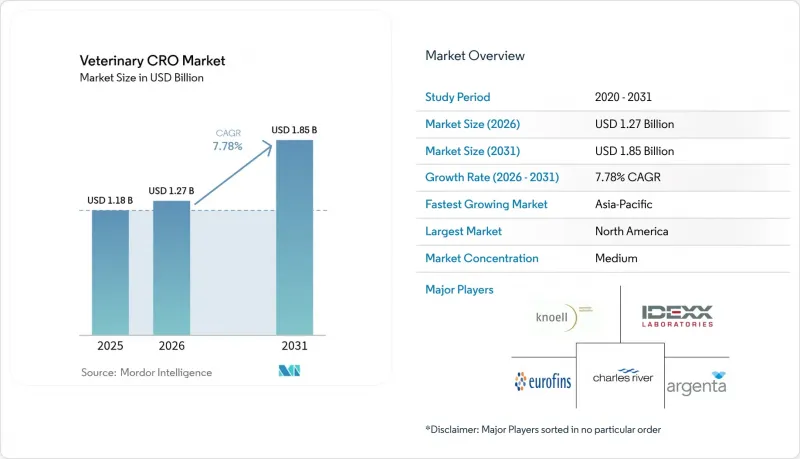
根據 Mordor Intelligence 預測,獸醫 CRO 市場規模預計將在 2025 年達到 11.8 億美元,2026 年達到 12.7 億美元,到 2031 年達到 18.5 億美元,2026 年至 2031 年的複合年成長率為 7.78%。
本報告按服務類型(例如臨床試驗)、動物類型(伴侶動物[犬、貓及其他伴侶動物]和牲畜[牛、豬、家禽及其他牲畜])、最終用戶(例如動物用藥品和生物技術公司)、適應症(例如腫瘤學)和地區(例如北美、歐洲)進行細分。市場預測以美元計價。
全球獸醫合約研究組織(CRO)市場趨勢與洞察
全球動物用藥品支出成長
預計到2025年,包括非處方藥和診斷試劑在內的全球動物用藥品銷售額將超過500億美元,較疫情前水準顯著成長。美國家庭目前平均每年為每隻寵物花費1,500美元,比2020年增加了22%,這推動了對腫瘤學、循環系統和神經病學領域先進臨床試驗的需求。畜牧養殖戶也增加生物安全預算,將高達12%的農場營運成本用於獸醫服務和疫苗。隨著伴侶動物和生產動物支出不斷增加,獸醫合約研究組織(CRO)市場對能夠跨物種攤銷固定基礎設施成本的項目越來越感興趣。人們越來越願意為專業治療付費,這為能夠治療多種動物的服務提供者提供了永續的收入基礎。
動物用藥品監管流程有利
美國《動物用藥品使用者收費法案》(ADUFA)第五修正案每年撥款3,500萬美元,用於加快針對嚴重產品的審查流程,並擴大有條件批准的範圍。在歐洲,平台技術主文件(PTMF)允許在單一申請中涵蓋多種候選疫苗,從而減少了近20%的重複試驗。 VICH指南GL52規範了主要市場的藥物動力學方案,無需進行以往會延長研發週期的區域性橋接試驗。這些措施雖然縮短了產品上市時間,但也提高了文件標準,迫使申辦方選擇在監管合規方面擁有良好記錄的合約研究組織(CRO)。與有條件批准核准途徑相關的上市後療效承諾,進一步擴大了CRO在整個產品生命週期中的參與度。
開發成本高昂,核准流程漫長。
將一種新的獸用生技藥品推向市場可能需要高達1.5億美元的成本,耗時7至9年。與10年前的5至6年相比,時間明顯延長。牲畜疫苗的田間試驗可能需要在10至15個商業農場進行,每個試驗點需要額外20萬至40萬美元的預算。伴侶動物腫瘤學研究同樣成本高昂,有時一項涉及100隻犬、在專業機構進行的研究可能耗資超過500萬美元。歐洲藥品管理局(EMA)對食用動物產品上市後五年的監測規定,也將使整個生命週期成本增加200萬至400萬美元。不斷成長的資金需求可能會阻礙小規模、具有創新精神的公司進入市場,導致專案集中在資金雄厚的贊助商手中,從而可能減緩獸用合約研究組織(CRO)市場的整體成長速度。
細分市場分析
就2025年的收入而言,臨床試驗佔最大佔有率,但該細分市場的成長率為7.2%,低於監管和諮詢服務9.43%的預期複合年成長率,原因是統一的VICH指南簡化了跨區域申請策略。毒理學和安全性測試約佔28%的佔有率,這得益於食品動物治療藥物嚴格的殘留物清除法規。將符合GLP規範的毒性測試與即時生物分析支援相結合的綜合服務提供者正在穩步擴大其在獸醫CRO市場的佔有率。
在預測期內,隨著申辦方優先考慮快速且可審計的申請流程,監管和諮詢行業預計將擴大對獸醫CRO市場的貢獻。 ISO 13485認證已成為關鍵的差異化因素,符合該標準的公司可以收取兩位數的溢價。服務商品搭售正日益普及,使得申請準備、試驗監測和藥物安全性監測等工作能夠透過單一供應商合約完成,從而簡化了資源有限的申辦者的管理工作。
預計到2025年,伴侶動物將佔銷售額的57.45%,其中犬貓計畫(模擬人類藥物方案)是產品組合的核心。腫瘤學和皮膚病學仍然是最有價值的適應症,通常由飼主承擔部分費用以抵消測試成本。然而,隨著非洲豬瘟和禽流感疫苗研發的加速,畜牧業計畫預計將在獸醫合約研究組織(CRO)市場中佔據更大的佔有率。
隨著各國政府加大對糧食安全的投入,預計畜牧業臨床試驗的複合年成長率將達到9.66%。受非洲豬瘟新疫苗候選藥物的推動,豬的臨床試驗成長最為迅速。與牛呼吸道疾病和家禽生物安全法規相關的項目也在增加試驗數量。這種轉變使得收入來源從消費者自願支出轉向公共資金支持的疾病控制預算。
區域分析
北美地區擁有完善的GLP基礎設施、6,700萬寵物家庭,以及FDA對早期資料包的有條件核准流程,預計到2025年將佔全球收入的41.75%。加拿大正透過協調審查擴大其貿易量,而墨西哥則為家禽和豬疫苗的研發提供了成本效益高的基地。儘管預計到2031年,該地區的複合年成長率將放緩至6.5%,但成熟的生產能力和飼主對高階療法的投資意願將確保北美地區繼續保持其在獸藥CRO市場中的最大佔有率。
歐洲約佔全球銷售額的32%,這得益於歐洲藥品管理局(EMA)的藥物監管要求,這些要求帶來了持續的服務收入。臨床試驗活動主要集中在西歐,這主要得益於德國龐大的生豬存欄量、英國快速的抗菌藥物核准流程以及法國龐大的伴侶動物數量。預計該地區將以7.0%的速度成長,歐盟動物健康法的監管要求將支持對流行病學和診斷檢驗服務的需求。
亞太地區預計將以86.5%的複合年成長率超越其他所有地區,這主要得益於中國80億美元的動物醫藥市場規模和印度龐大的牛。 AAALAC認證的擴展、單株抗體的本地核准以及政府疫苗接種計劃的實施,都推動了臨床試驗數量的成長。澳洲和日本擁有強大的合規能力,但漫長的監管流程預計將在短期內限制其收入成長。預計到2025年,中東、非洲和南美洲將佔全球銷售額的8%,但由於基礎設施差異和監管政策的不一致性,到2031年,這些地區的市場佔有率將低於10%。
其他好處:
- Excel格式的市場預測(ME)表
- 3個月的分析師支持
目錄
第1章:引言
- 研究假設和市場定義
- 調查範圍
第2章:調查方法
第3章執行摘要
第4章 市場狀況
- 市場概覽
- 市場促進因素
- 全球動物保健支出成長
- 有利於動物用藥品的監管路徑
- 動物用藥品藥廠研發活動外包程度加劇
- 人們越來越關注「同一健康」概念和通用感染疾病。
- 擴大伴侶動物生物製藥和特殊療法的規模
- 獸醫研究中的數位化和數據驅動方法
- 市場限制因素
- 開發成本高,審核時間長
- 缺乏專門的動物研究基礎設施
- 獸醫研究專業人才短缺
- 動物實驗相關的倫理問題與監管
- 價值供應鏈分析
- 監理情勢
- 技術展望
- 波特五力模型
第5章 市場規模與成長預測
- 按服務類型
- 臨床試驗
- 毒理學和安全性測試
- 監理和諮詢服務
- 其他專業服務
- 依動物類型
- 伴侶動物
- 狗
- 貓
- 其他伴侶動物
- 家畜
- 牛
- 豬
- 家禽
- 其他牲畜
- 伴侶動物
- 最終用戶
- 動物用藥品和生技公司
- 學術研究機構
- 政府和非營利組織
- 其他最終用戶
- 適應症
- 腫瘤學
- 感染疾病
- 皮膚科
- 消化系統疾病
- 神經病學
- 其他改編
- 地區
- 北美洲
- 美國
- 加拿大
- 墨西哥
- 歐洲
- 德國
- 英國
- 法國
- 義大利
- 西班牙
- 其他歐洲國家
- 亞太地區
- 中國
- 日本
- 印度
- 澳洲
- 韓國
- 其他亞太國家
- 中東和非洲
- GCC
- 南非
- 其他中東和非洲國家
- 南美洲
- 巴西
- 阿根廷
- 其他南美國家
- 北美洲
第6章 競爭情勢
- 市場集中度
- 市佔率分析
- 公司簡介
- Altasciences Company, Inc.
- Argenta Limited
- Charles River Laboratories, Inc.
- Clinvet International(Pty)Ltd
- East Tennessee Clinical Research, Inc.
- Envigo RMS Holding Corp.(Inotiv)
- Eurofins Scientific SE
- IDEXX Laboratories, Inc.
- KLIFOVET GmbH
- knoell Germany GmbH
- Labcorp Drug Development
- Mispro Biotech Services Corp.
- Oncovet Clinical Research
- Triveritas(knoell Animal Health Ltd)
- TriviumVet
- Veeda Clinical Research Ltd.
- Vetworks BV
- Wageningen Bioveterinary Research
第7章 市場機會與未來展望
According to Mordor Intelligence, the veterinary CRO market size is projected to be USD 1.18 billion in 2025, USD 1.27 billion in 2026, and reach USD 1.85 billion by 2031, growing at a CAGR of 7.78% from 2026 to 2031.
This report is Segmented by Service Type (Clinical Trials, and More), Animal Type (Companion Animals [Dogs, Cats, and Other Companion Species], and Livestock [Cattle, Swine, Poultry, and Other Livestocks]), End User (Animal-Health Pharma & Biotech Companies, and More), Indication (Oncology, and More), and Geography (North America, Europe, and More). The Market Forecasts are Provided in Terms of Value (USD).
Global Veterinary CRO Market Trends and Insights
Growth in Global Animal Health Expenditure
Global veterinary pharmaceutical sales, including over-the-counter products and diagnostics, exceeded USD 50 billion in 2025, up sharply from pre-pandemic levels. U.S. households now spend an average of USD 1,500 per pet each year, a 22% jump since 2020, which sustains demand for advanced trials in oncology, cardiology, and neurology. Livestock producers have likewise raised biosecurity budgets, allocating up to 12% of farm operating costs to veterinary services and vaccines. As spending expands on both the companion and production sides, the veterinary CRO market attracts projects that amortize fixed infrastructure across species. Heightened willingness to pay for specialty therapies underscores a durable revenue base for providers capable of serving multi-species portfolios.
Favorable Regulatory Pathways for Veterinary Pharmaceuticals
The U.S. Animal Drug User Fee Act V provides USD 35 million a year to expedite reviews and broaden conditional approvals for products targeting serious conditions. In Europe, the Platform Technology Master File enables a single dossier to support multiple vaccine candidates, reducing redundant studies by nearly 20%. VICH guideline GL52 now harmonizes pharmacokinetic protocols across key markets, eliminating region-specific bridging trials that once extended timelines. Although these tailwinds shorten time-to-market, they also elevate documentation standards, prompting sponsors to enlist CROs with proven regulatory track records. Post-approval efficacy commitments linked to conditional pathways further extend CRO engagement across the product life cycle.
High Development Costs and Lengthy Approval Timelines
Bringing a novel veterinary biologic to market can cost up to USD 150 million and take 7-9 years, versus 5-6 years a decade ago. Field trials for livestock vaccines may involve 10-15 commercial farms, with each site adding USD 200,000-400,000 to budgets. Companion-animal oncology studies are similarly expensive, sometimes exceeding USD 5 million for 100 dogs enrolled across specialty centers. The EMA's five-year post-approval monitoring rule for food-animal products adds another USD 2-4 million to lifecycle costs. Escalating capital requirements deter smaller innovators and concentrate projects among well-funded sponsors, which could slow the overall expansion pace of the veterinary CRO market.
Other drivers and restraints analyzed in the detailed report include:
- Increasing Outsourcing of R&D Activities by Animal-Health Companies
- Intensifying Focus on One Health and Zoonotic-Disease Preparedness
- Limited Availability of Specialized Animal Research Infrastructure
For complete list of drivers and restraints, kindly check the Table Of Contents.
Segment Analysis
Clinical trials accounted for the largest share of 2025 revenue, yet the segment's 7.2% growth lags the 9.43% CAGR projected for regulatory and consulting work as harmonized VICH guidelines streamline dossier strategies across regions. Toxicology and safety studies held nearly 28% share, buoyed by stringent residue-depletion rules for food-animal therapies. Integrated providers that pair GLP toxicology with real-time bioanalytical support are steadily increasing their market share in the veterinary CRO market.
Over the forecast horizon, the regulatory-consulting niche is poised to expand its contribution to the veterinary CRO market, as sponsors prize rapid, audit-ready submissions. ISO 13485 certification has emerged as a key differentiator, with compliant firms able to command double-digit price premiums. Service bundling increasingly places dossier preparation, study monitoring, and pharmacovigilance under single-provider contracts, simplifying oversight for resource-constrained sponsors.
Companion species accounted for 57.45% of 2025 revenue, led by canine and feline projects that mimic human medicine protocols. Oncology and dermatology remain the highest-value indications, often supported by owner-paid expenses that offset trial costs. Even so, accelerating vaccine development for African swine fever and avian influenza positions livestock programs to capture a larger share of the veterinary CRO market.
Livestock trials are forecast to post a 9.66% CAGR as governments inject funding to safeguard food security. Swine studies, propelled by new ASF vaccine candidates, are the fastest riser. Cattle respiratory-disease projects and poultry biosecurity mandates also add volume. The shift diversifies revenue streams away from consumer discretionary spending toward publicly financed disease-control budgets.
Complete Report Scope:
- By Service Type
- Clinical Trials
- Toxicology & Safety Studies
- Regulatory & Consulting Services
- Other Specialized Services
- By Animal Type
- Companion Animals
- Dogs
- Cats
- Other Companion Species
- Livestock
- Cattle
- Swine
- Poultry
- Other Livestocks
- Companion Animals
- By End User
- Animal-Health Pharma & Biotech Companies
- Academic & Research Institutes
- Government & Non-Profit Sponsors
- Other End Users
- By Indication
- Oncology
- Infectious Diseases
- Dermatology
- Gastrointestinal Disorders
- Neurology
- Other Indications
- Geography
- North America
- United States
- Canada
- Mexico
- Europe
- Germany
- United Kingdom
- France
- Italy
- Spain
- Rest of Europe
- Asia-Pacific
- China
- Japan
- India
- Australia
- South Korea
- Rest of Asia-Pacific
- Middle East & Africa
- GCC
- South Africa
- Rest of Middle East & Africa
- South America
- Brazil
- Argentina
- Rest of South America
- North America
Geography Analysis
North America contributed 41.75% of 2025 revenue on the strength of its dense GLP infrastructure, 67 million pet-owning households, and the FDA's conditional-approval pathway that rewards early data packages. Canada adds volume via harmonized reviews, while Mexico offers cost-effective sites for poultry and swine vaccine work. Although regional CAGR moderates to 6.5% through 2031, North America will remain the largest component of the veterinary CRO market thanks to entrenched capacity and owner willingness to fund premium therapies.
Europe accounted for roughly 32% of global revenue, supported by EMA pharmacovigilance mandates that generate recurring service streams. Germany's large swine population, the UK's fast-track antimicrobial process, and France's expansive companion-animal base concentrate trial activity in Western Europe. Regional growth is projected at 7.0%, aided by the EU Animal Health Law's surveillance requirements, which sustain demand for epidemiology and diagnostics validation services.
Asia-Pacific is set to outpace all regions with an 8.65% CAGR, led by China's USD 8 billion domestic veterinary-drug market and India's vast cattle population. Expanded AAALAC accreditation, local approval of monoclonal antibodies, and government vaccination programs drive trial volume. Australia and Japan add high-compliance capacity, though longer regulatory timelines temper immediate revenue gains. Middle East & Africa and South America jointly deliver 8% of 2025 sales, yet infrastructure gaps and fragmented rules keep their share below 10% through 2031.
- Altasciences Company, Inc.
- Argenta Limited
- Charles River
- Clinvet International (Pty) Ltd
- East Tennessee Clinical Research, Inc.
- Envigo RMS Holding Corp. (Inotiv)
- Eurofins
- IDEXX
- KLIFOVET GmbH
- knoell Germany GmbH
- LabCorp
- Mispro Biotech Services Corp.
- Oncovet Clinical Research
- Triveritas (knoell Animal Health Ltd)
- TriviumVet
- Veeda Clinical Research Ltd.
- Vetworks BV
- Wageningen Bioveterinary Research
Additional Benefits:
- The market estimate (ME) sheet in Excel format
- 3 months of analyst support
TABLE OF CONTENTS
1 Introduction
- 1.1 Study Assumptions & Market Definition
- 1.2 Scope of the Study
2 Research Methodology
3 Executive Summary
4 Market Landscape
- 4.1 Market Overview
- 4.2 Market Drivers
- 4.2.1 Growth in Global Animal Health Expenditure
- 4.2.2 Favorable Regulatory Pathways for Veterinary Pharmaceuticals
- 4.2.3 Increasing Outsourcing of R&D Activities by Animal-Health Companies
- 4.2.4 Intensifying Focus on One-Health And Zoonotic Disease Preparedness
- 4.2.5 Expansion of Companion-Animal Biologics and Specialty Therapies
- 4.2.6 Digitalization and Data-Driven Approaches in Veterinary Research
- 4.3 Market Restraints
- 4.3.1 High Development Costs and Lengthy Approval Timelines
- 4.3.2 Limited Availability of Specialized Animal Research Infrastructure
- 4.3.3 Shortage of Skilled Veterinary Research Professionals
- 4.3.4 Ethical Concerns and Regulatory Scrutiny Over Animal Testing
- 4.4 Value / Supply-Chain Analysis
- 4.5 Regulatory Landscape
- 4.6 Technological Outlook
- 4.7 Porter's Five Forces
- 4.7.1 Threat Of New Entrants
- 4.7.2 Bargaining Power Of Suppliers
- 4.7.3 Bargaining Power Of Buyers
- 4.7.4 Threat Of Substitutes
- 4.7.5 Competitive Rivalry
5 Market Size & Growth Forecasts (Value, USD)
- 5.1 By Service Type
- 5.1.1 Clinical Trials
- 5.1.2 Toxicology & Safety Studies
- 5.1.3 Regulatory & Consulting Services
- 5.1.4 Other Specialized Services
- 5.2 By Animal Type
- 5.2.1 Companion Animals
- 5.2.1.1 Dogs
- 5.2.1.2 Cats
- 5.2.1.3 Other Companion Species
- 5.2.2 Livestock
- 5.2.2.1 Cattle
- 5.2.2.2 Swine
- 5.2.2.3 Poultry
- 5.2.2.4 Other Livestocks
- 5.2.1 Companion Animals
- 5.3 By End User
- 5.3.1 Animal-Health Pharma & Biotech Companies
- 5.3.2 Academic & Research Institutes
- 5.3.3 Government & Non-Profit Sponsors
- 5.3.4 Other End Users
- 5.4 By Indication
- 5.4.1 Oncology
- 5.4.2 Infectious Diseases
- 5.4.3 Dermatology
- 5.4.4 Gastrointestinal Disorders
- 5.4.5 Neurology
- 5.4.6 Other Indications
- 5.5 Geography
- 5.5.1 North America
- 5.5.1.1 United States
- 5.5.1.2 Canada
- 5.5.1.3 Mexico
- 5.5.2 Europe
- 5.5.2.1 Germany
- 5.5.2.2 United Kingdom
- 5.5.2.3 France
- 5.5.2.4 Italy
- 5.5.2.5 Spain
- 5.5.2.6 Rest of Europe
- 5.5.3 Asia-Pacific
- 5.5.3.1 China
- 5.5.3.2 Japan
- 5.5.3.3 India
- 5.5.3.4 Australia
- 5.5.3.5 South Korea
- 5.5.3.6 Rest of Asia-Pacific
- 5.5.4 Middle East & Africa
- 5.5.4.1 GCC
- 5.5.4.2 South Africa
- 5.5.4.3 Rest of Middle East & Africa
- 5.5.5 South America
- 5.5.5.1 Brazil
- 5.5.5.2 Argentina
- 5.5.5.3 Rest of South America
- 5.5.1 North America
6 Competitive Landscape
- 6.1 Market Concentration
- 6.2 Market Share Analysis
- 6.3 Company Profiles (Includes Global-Level Overview, Market-Level Overview, Core Segments, Financials As Available, Strategic Information, Market Rank/Share For Key Companies, Products & Services, And Recent Developments)
- 6.3.1 Altasciences Company, Inc.
- 6.3.2 Argenta Limited
- 6.3.3 Charles River Laboratories, Inc.
- 6.3.4 Clinvet International (Pty) Ltd
- 6.3.5 East Tennessee Clinical Research, Inc.
- 6.3.6 Envigo RMS Holding Corp. (Inotiv)
- 6.3.7 Eurofins Scientific SE
- 6.3.8 IDEXX Laboratories, Inc.
- 6.3.9 KLIFOVET GmbH
- 6.3.10 knoell Germany GmbH
- 6.3.11 Labcorp Drug Development
- 6.3.12 Mispro Biotech Services Corp.
- 6.3.13 Oncovet Clinical Research
- 6.3.14 Triveritas (knoell Animal Health Ltd)
- 6.3.15 TriviumVet
- 6.3.16 Veeda Clinical Research Ltd.
- 6.3.17 Vetworks BV
- 6.3.18 Wageningen Bioveterinary Research
7 Market Opportunities & Future Outlook
- 7.1 White-Space & Unmet-Need Assessment

