


 |
市場調查報告書
商品編碼
2123982
線上彩票:市場佔有率分析、行業趨勢和統計數據、成長預測(2026-2031)Online Lottery - Market Share Analysis, Industry Trends & Statistics, Growth Forecasts (2026 - 2031) |
||||||

※ 本網頁內容可能與最新版本有所差異。詳細情況請與我們聯繫。
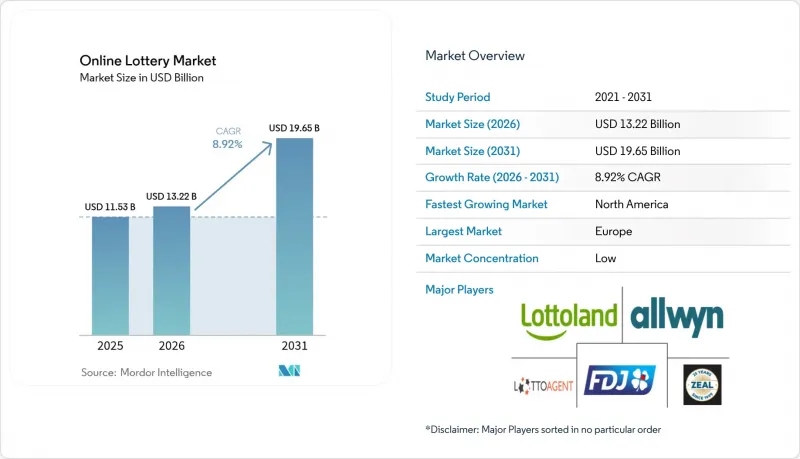
根據 Mordor Intelligence 預測,線上彩券市場規模將從 2025 年的 115.3 億美元和 2026 年的 132.2 億美元成長到 2031 年的 196.5 億美元,2026 年至 2031 年的年複合成長率(CAGR)為 8.92%。
本報告按平台類型(桌面端、行動裝置)、遊戲類型(彩票、即開型彩票、體育彩票、其他)、年齡層(25歲以下、25-40歲、40-55歲、55歲以上)、最終用戶(男性、女性)和地區(北美、歐洲、亞太地區及世界其他地區)進行細分。市場預測以美元計價。
全球線上彩票市場的趨勢和洞察
數位錢包的日益普及和行動支付的整合
目前,數位錢包和行動支付系統在線上彩票交易中佔據主導地位,降低了支付放棄率,並支持衝動消費的即時充值。根據電訊(ITU) 2025 年的報告,全球行動支付帳戶數量將超過 16 億,交易額將超過 1.2 兆美元,這將使彩券業者在銀行基礎設施薄弱的地區也能更便捷地提供服務。 IGT 的平台整合了 Apple Pay、Google Pay 以及肯亞的 M-Pesa 和印度的 Paytm 等區域性錢包,無需輸入銀行卡資訊即可快速充值,從而提高了投注速度。 2024 年,Allwyn Entertainment 在其英國國家彩票應用程式中添加了 PayPal 和 Klarna,使 18-34 歲用戶的行動裝置轉換率提高了 23%。拉丁美洲在嵌入式金融領域處於領先地位,巴西中央銀行的 PIX 系統預計到 2025 年將處理 420 億筆交易,巴西聯邦儲蓄銀行 (Caixa Economica Federal) 正在試點使用 PIX 系統購買彩票。在歐盟,修訂後的支付服務指令 (PSD2) 強制要求進行嚴格的客戶身份驗證,同時提供開放銀行 API,允許彩票平台直接從銀行帳戶發起支付,而無需通過卡網路,從而降低費用。
合法化和放鬆管制
合法線上彩票框架管轄範圍的不斷擴大是短期成長的關鍵促進因素,它開放了先前受限的市場,並將非正式的彩票活動納入監管體系。在美國,密西根州的線上彩券平台預計到2025年年銷售額將達到10億美元,凸顯了數位通路和零售業務可以共存而不影響實體店收入的可能性。全國州博彩立法者委員會(NCLGS)於2024年起草了《線上彩票示範法案》,為考慮發放許可證的各州提供了一個立法框架,並解決了年齡驗證、位置驗證和負責任博彩等挑戰。在歐洲,德國的《州際博彩公約》允許在嚴格的廣告和玩家保護條例下銷售線上彩票。 2025年,德國聯合州博彩監管局(GGL)發放了12張新許可證,加劇了Lotto24和ZEAL Network等現有業者之間的競爭。同樣,拉丁美洲的自由化進程也在推進,阿根廷布宜諾斯艾利斯省將於 2024 年將線上彩券合法化,巴西聯邦政府也將最終敲定 iGaming 法規,該法規計畫於 2026 年生效。這將使目標成人市場的總合超過 2.5 億。
監管和法律挑戰
不同司法管轄區管理體制的碎片化和矛盾增加了合規成本,延緩了市場准入,並造成了法律上的不確定性,阻礙了產品創新。在美國,截至2025年,只有11個州允許銷售網路彩票,而39個州禁止網路彩票或缺乏相關立法,要求營運商在每個州單獨管理其技術和行銷活動。在亞太地區,中國公共安全將網路彩券歸類為非法賭博,並對營運商和支付處理商進行起訴,實際上關閉了合法企業的市場。在印度,1867年的《公共賭博法》將彩票監管權下放給各邦,導致13個邦運營彩票,但只有錫金邦允許在線銷售。此外,商品及服務稅委員會對彩券徵收28%的稅,這是所有消費品中最高的稅率。在歐盟,輔助性原則允許成員國出於公共政策原因限制賭博服務。在波蘭和荷蘭等國家,即使在歐盟其他地區獲得許可的企業也需要當地許可,這進一步加劇了單一市場的分裂。
細分市場分析
預計到2025年,行動端將佔據線上彩券市場佔有率的57.26%,年複合成長率達10.52%,而隨著智慧型手機普及率的提高,桌面端的市場佔有率正在萎縮。隨著5G網路覆蓋範圍的擴大,行動裝置線上彩票市場預計也將實現類似的成長,從而支援諸如現場開獎和AR刮刮卡等富媒體內容。 IGT公司為密蘇裡州推出的生物識別應用程式在六個月內使其每月有效用戶成長了38%,這表明一鍵認證能夠有效鼓勵用戶重複投注。桌面端在管理多張彩票和需要更大螢幕的高價值企業聯合組織彩票方面仍然發揮著重要作用,但其市場佔有率正在逐年下降。在包括印度在內的新興市場,89%的用戶從未使用過桌面瀏覽器,行動端的使用模式幾乎佔據主導地位,這促使營運商優先開發安卓應用程式。
行動端透過地理圍欄、推播通知和遊戲化等機制,有效提升了用戶參與度,但營運商也面臨著諸多挑戰,例如應用程式商店的監管、用戶獲取成本飆升以及螢幕空間有限,難以容納複雜的投注內容。漸進式 Web 應用 (PWA) 可以繞過應用程式商店的規則,但由於缺乏原生通知功能,營運商更依賴簡訊和電子郵件等客戶關係管理 (CRM) 工具。隨著 5G 技術降低延遲並提升圖形效能,營運商計劃推出身臨其境型大廳,以區別於傳統的網頁管道和直播中獎公告。
以強力球 (Powerball) 和歐洲百萬 (EuroMillions) 等品牌為代表的彩票遊戲,憑藉其每周定期開獎和引人注目的巨額獎金,在2025年繼續佔據34.21%的收入佔有率。然而,即時彩票遊戲以10.11%的複合年成長率 (CAGR) 展現出最高的成長率,線上彩票市場正朝著類似於休閒手機遊戲的按需娛樂模式轉型。諸如大富翁 (Monopoly) 等授權IP也提高了復購率和平均消費額,同時,知名主題也提升了玩家的風險感知。即開式產品需要持續的內容供應,而NeoGames透過在2025年推出120款原創電子即開型彩票遊戲,保持了市場的新鮮感。
體育彩票和基諾、抽獎等輔助遊戲迎合了特定群體的需求並分散了風險,但除非獎金遠超地區平均水平,否則它們很難獲得主流關注。雖然抽獎遊戲的單張彩券成本低、平均訂單金額高且開獎頻率有限,但與隨時可用的即開型遊戲相比,用戶參與度較低。目前,營運商透過向主要玩即開型遊戲的用戶定期訂閱抽獎遊戲訂閱服務(反之亦然)來對沖風險,從而降低兩個領域的客戶流失率。
區域分析
2025年,歐洲佔全球彩券收入的46.72%。這得歸功於超過90%的網路普及率以及現有國家彩券的無縫線上轉型,成功避免了對零售銷售的蠶食。英國國家彩券在截至2025年3月的會計年度中,數位收入達18億英鎊(約23億美元)。在德國,新一輪的牌照發放加劇了Lotto24和ZEAL Network之間的競爭。法國FDJ透過行動最佳化和推出品牌即開型彩票,創造了32億歐元(約35億美元)的線上收入。在義大利,由Allwyn、Sisal和IGT組成的財團於2025年獲得了為期九年的彩票營運牌照,凸顯了高價值的南歐市場對全通路合資企業的青睞。
北美地區以10.11%的複合年成長率 (CAGR) 創下最高增速,這主要得益於美國各州網路彩票合法化的不斷推進以及加拿大各省零售和線上博彩模式的融合。預計到2025年,密西根州的數位彩券銷售額將超過10億美元,同時維持其零售銷售額的成長。紐約州於2024年11月推出的網路彩券表現超出預期,上半年銷售額達1.8億美元,比預期高出22%。安大略省的開放博彩框架預計到2025年將使網路博彩總銷售額達到10億加元(約7.4億美元),其中彩票業務將佔15%。在墨西哥,一款針對9,200萬網路用戶的新推出的行動應用程式的目標是在第一年實現5000萬美元的銷售額。
在亞太地區,儘管受到中國、印度部分邦和印尼監管政策的影響,數位彩券產業仍保持穩定成長。澳洲彩券公司報告稱,其2025會計年度的線上收入達到39億澳元(26億美元),年增9%。在紐西蘭,Lotto NZ在2024年創造了6.8億紐西蘭元(4.2億美元)的收入,其中行動端貢獻了72%。在巴西,聯邦層級的線上博彩監管條例已於2025年最終確定,並計劃於2026年生效,預計將開拓一個擁有超過1.5億玩家的市場。然而,在菲律賓以及中東和非洲地區,由於監管機構正在謹慎權衡社會成本和稅收收入,數位彩票的推廣速度正在放緩。
其他好處:
- Excel格式的市場預測(ME)表
- 3個月的分析師支持
目錄
第1章:引言
- 研究假設和市場定義
- 調查範圍
第2章:調查方法
第3章執行摘要
第4章 市場狀況
- 市場概覽
- 市場促進因素
- 數位錢包的普及率不斷提高及其與行動支付的融合
- 合法化和放鬆管制
- 全球網路普及率的提高
- 跨境獎金池正在擴大獎金規模。
- 利用微型網紅進行聯盟行銷,降低顧客獲取成本
- 數位科技的進步
- 市場限制因素
- 監管和法律挑戰
- App Store收緊了有關真錢賭博的政策。
- 網路安全威脅與詐欺風險
- 負面的公眾看法和偏見
- 消費行為分析
- 監理情勢
- 技術展望
- 波特五力模型
第5章 市場規模與成長預測
- 依平台類型
- 桌面
- 移動的
- 按遊戲類型
- 抽籤
- 即開型彩票
- 現場彩券
- 其他
- 按年齡層
- 25歲以下
- 25-40歲
- 40-55歲
- 55歲或以上
- 最終用戶
- 男性
- 女士
- 按地區
- 北美洲
- 美國
- 加拿大
- 墨西哥
- 其他北美國家
- 歐洲
- 英國
- 德國
- 瑞典
- 法國
- 西班牙
- 義大利
- 其他歐洲國家
- 亞太地區
- 大洋洲
- 其他亞太國家
- 其他地區
- 南美洲
- 中東和非洲
- 北美洲
第6章 競爭情勢
- 市場集中度
- 策略趨勢
- 市佔率分析
- 公司簡介
- Allwyn Entertainment
- PlayHugeLottos
- Francaise des Jeux
- ZEAL Network SE
- Lotto Direct Ltd.
- Lottoland
- Lotto Agent
- LottoKings
- WinTrillions
- Lotto247
- Annexio Ltd.
- China Welfare Lottery
- Intralot
- Sisal
- The Lottery Corporation
- International Game Technology(IGT)
- Flutter Entertainment(The Lotteries Pilot)
- NeoGames
- Pollard Banknote
- Jumbo Interactive
第7章 市場機會與未來展望
According to Mordor Intelligence, the online lottery market size is projected to expand from USD 11.53 billion in 2025 and USD 13.22 billion in 2026 to USD 19.65 billion by 2031, registering a CAGR of 8.92% between 2026 and 2031.
This report is Segmented by Platform Type (Desktop, Mobile), Game Type (Draw-Based Lottery, Instant Lottery, Sports Lottery, Others), Age Group (Below 25 Years, 25-40 Years, 40-55 Years, 55+ Years), End User (Male, Female), and Geography (North America, Europe, Asia-Pacific, Rest of the World). The Market Forecasts are Provided in Terms of Value (USD).
Global Online Lottery Market Trends and Insights
Rising Penetration of Digital Wallets and Mobile Payments Integration
Digital wallets and mobile payment systems now dominate online lottery transactions, reducing checkout abandonment and enabling instant deposits for impulse purchases. In 2025, the International Telecommunication Union reported over 1.6 billion mobile money accounts globally, with transaction values exceeding USD 1.2 trillion, easing access for lottery operators in regions with limited banking infrastructure. IGT's platform integrates Apple Pay, Google Pay, and regional wallets like M-Pesa in Kenya and Paytm in India, allowing quick account funding without card details and speeding up betting. In 2024, Allwyn Entertainment added PayPal and Klarna to its UK National Lottery app, boosting mobile conversion rates by 23% among users aged 18-34. Latin America is leading in embedded finance, with Banco Central do Brasil's PIX system processing 42 billion transactions in 2025, and Caixa Economica Federal piloting PIX-enabled ticket purchases. In the European Union, the revised Payment Services Directive (PSD2) enforces strong customer authentication while enabling open banking APIs, allowing lottery platforms to initiate payments directly from bank accounts, bypassing card networks and reducing fees.
Legalization and Regulatory Liberalization
Jurisdictional expansion of legal online lottery frameworks serves as a significant near-term growth driver, opening previously restricted markets and transitioning informal lottery activities into regulated systems. In the U.S., Michigan's iLottery platform achieved USD 1 billion in annual sales in 2025, highlighting the compatibility of digital channels with retail operations without eroding brick-and-mortar revenue. The National Council of Legislators from Gaming States (NCLGS) introduced a Model iLottery Act in 2024, providing a legislative framework for states exploring authorization while addressing issues like age verification, geolocation, and responsible gaming. In Europe, Germany's Interstate Treaty on Gambling allows online lottery sales under strict advertising and player-protection regulations. In 2025, the Gemeinsame Glucksspielbehorde der Lander (GGL) issued 12 new licenses, intensifying competition among established players such as Lotto24 and ZEAL Network. Similarly, Latin America is experiencing liberalization, with Argentina's Buenos Aires province legalizing online lotteries in 2024 and Brazil's federal government finalizing igaming regulations set to take effect in 2026, creating a combined addressable market of over 250 million adults.
Regulatory and Legal Challenges
Fragmented and contradictory regulatory regimes across jurisdictions increase compliance costs, delay market entry, and create legal uncertainties that hinder product innovation. In the U.S., as of 2025, only 11 states allow iLottery sales, while 39 states either prohibit or lack legislation, requiring operators to manage separate technology and marketing efforts for each state. In Asia-Pacific, China's Ministry of Public Security classifies online lotteries as illegal gambling, prosecuting operators and payment processors, effectively closing the market to legitimate providers. In India, the 1867 Public Gambling Act delegates lottery regulation to states, resulting in 13 states running lotteries, with only Sikkim permitting online sales. Additionally, the Goods and Services Tax Council imposes a 28% tax on lottery tickets, the highest for any consumer product. In the European Union, the principle of subsidiarity allows member states to restrict gambling services for public-policy reasons. Countries like Poland and the Netherlands require local licenses, even for operators authorized elsewhere in the EU, further fragmenting the single market.
Other drivers and restraints analyzed in the detailed report include:
- Increasing Global Internet Penetration
- Cross-Border Jackpot Pooling Boosting Prize Sizes
- App-Store Policy Tightening on Real-Money Gambling
For complete list of drivers and restraints, kindly check the Table Of Contents.
Segment Analysis
Mobile captured 57.26% of the online lottery market share in 2025 and is expanding at a 10.52% CAGR, while desktop erodes as smartphone penetration deepens. The online lottery market size for mobile transactions is predicted to grow in parallel to rising 5G coverage that supports richer media such as live draws and AR scratch cards. IGT's biometric-enabled Missouri app lifted monthly active users by 38% within six months, illustrating that single-tap authentication sparks repeat play. Desktop remains relevant for high-value syndicates that require multi-ticket management and larger screens, but cedes share each year. Emerging markets, including India, exhibit virtually mobile-only usage patterns because 89% of users never touch a desktop browser, pushing operators toward Android-first builds.
Mobile provides geofencing, push alerts, and gamification loops that accelerate engagement, yet operators grapple with app-store restrictions, rising acquisition costs, and limited screen real estate for complex bets. Progressive Web Apps bypass store rules but sacrifice native notifications, forcing heavier CRM reliance through SMS and email. As 5G reduces latency and elevates graphics, operators expect to roll out immersive lobbies and livestreamed prize reveals that differentiate mobile from legacy web channels.
Draw-based games retained 34.21% of 2025 revenue, anchored by brands such as Powerball and EuroMillions that deliver ritualized weekly play and viral jackpots. However, instant-win titles record the fastest 10.11% CAGR, shifting the online lottery market size toward on-demand entertainment that mirrors casual mobile gaming. Licensed IP, such as Monopoly, lifts repeat purchase rates and average spending because recognizable themes reduce perceived risk. Instant products demand aggressive content pipelines; NeoGames released 120 unique eInstant titles in 2025 to sustain novelty.
Sports lottery and ancillary games like keno or raffles fill niche appetites and diversify risk but struggle to capture mainstream attention unless jackpots swell well beyond local averages. Draw games still boast lower cost per ticket and bigger average order values, yet limited draw frequency caps engagement versus always-on instant catalogs. Operators now hedge by cross-selling draw subscriptions to instant-first users and vice versa, lowering churn across both verticals.
Complete Report Scope:
- By Platform Type
- Desktop
- Mobile
- By Game Type
- Draw-based Lottery
- Instant Lottery
- Spots Lottery
- Others
- By Age Group
- Below 25 Years
- 25-40 Years
- 40-55 Years
- 55+ Years
- By End User
- Male
- Female
- By Geography
- North America
- United States
- Canada
- Mexico
- Rest of North America
- Europe
- United Kingdom
- Germany
- Sweden
- France
- Spain
- Italy
- Rest of Europe
- Asia-Pacific
- Oceanic Countries
- Rest of Asia-Pacific
- Rest of the World
- South America
- Middle East and Africa
- North America
Geography Analysis
In 2025, Europe contributed 46.72% of global lottery revenues, supported by over 90% internet penetration and the seamless online transition of established national lotteries, which successfully avoided cannibalizing retail sales. The UK's National Lottery reported GBP 1.8 billion (USD 2.3 billion) in digital revenues for the fiscal year ending March 2025. In Germany, a new licensing wave intensified competition between Lotto24 and ZEAL Network. France's FDJ leveraged mobile optimizations and branded instant releases to generate EUR 3.2 billion (USD 3.5 billion) online. In Italy, a nine-year Lotto concession was awarded in 2025 to a consortium comprising Allwyn, Sisal, and IGT, highlighting the preference for omnichannel joint ventures in high-value Southern European markets.
North America recorded the highest growth, with a 10.11% CAGR, driven by the expansion of iLottery legalization across U.S. states and the integration of retail and online play in Canadian provinces. Michigan surpassed USD 1 billion in digital sales in 2025 while maintaining retail revenue. New York's iLottery launch in November 2024 exceeded expectations, generating USD 180 million in its first six months, 22% above forecasts. Ontario's open gaming framework resulted in total igaming revenues of CAD 1 billion (USD 740 million) by 2025, with the lottery segment accounting for 15%. In Mexico, a newly introduced mobile app targeting 92 million internet users aimed to achieve USD 50 million in its first year.
The Asia-Pacific region experienced steady digital growth, though it was constrained by restrictions in China, several Indian states, and Indonesia. Australia's Lottery Corporation reported a 9% year-over-year increase, achieving AUD 3.9 billion (USD 2.6 billion) in online revenues for FY 2025. In New Zealand, Lotto NZ generated NZD 680 million (USD 420 million) in 2024, with mobile accounting for 72% of the total. Brazil finalized its federal igaming regulations in 2025, with implementation planned for 2026, potentially unlocking a market of over 150 million players. However, in the Philippines and across the Middle East and Africa, regulators are proceeding cautiously, weighing social costs against fiscal revenues, which has slowed the adoption of digital lotteries.
- Allwyn Entertainment
- PlayHugeLottos
- Francaise des Jeux
- ZEAL Network SE
- Lotto Direct Ltd.
- Lottoland
- Lotto Agent
- LottoKings
- WinTrillions
- Lotto247
- Annexio Ltd.
- China Welfare Lottery
- Intralot
- Sisal
- The Lottery Corporation
- International Game Technology (IGT)
- Flutter Entertainment (The Lotteries Pilot)
- NeoGames
- Pollard Banknote
- Jumbo Interactive
Additional Benefits:
- The market estimate (ME) sheet in Excel format
- 3 months of analyst support
TABLE OF CONTENTS
1 INTRODUCTION
- 1.1 Study Assumptions and Market Definition
- 1.2 Scope of the Study
2 RESEARCH METHODOLOGY
3 EXECUTIVE SUMMARY
4 MARKET LANDSCAPE
- 4.1 Market Overview
- 4.2 Market Drivers
- 4.2.1 Rising Penetration Of Digital Wallets And Mobile Payments Integration
- 4.2.2 Legalization And Regulatory Liberalization
- 4.2.3 Increasing Global Internet Penetration
- 4.2.4 Cross-Border Jackpot Pooling Boosting Prize Sizes
- 4.2.5 Micro-Influencer Affiliate Marketing Lowering Acquisition Costs
- 4.2.6 Advancement of Digital Technologies
- 4.3 Market Restraints
- 4.3.1 Regulatory And Legal Challenges
- 4.3.2 App-Store Policy Tightening On Real-Money Gambling
- 4.3.3 Cybersecurity Threats And Fraud Risks
- 4.3.4 Negative Public Perception And Stigma
- 4.4 Consumer Behavior Analysis
- 4.5 Regulatory Landscape
- 4.6 Technological Outlook
- 4.7 Porter's Five Forces
- 4.7.1 Threat of New Entrants
- 4.7.2 Bargaining Power of Buyers
- 4.7.3 Bargaining Power of Suppliers
- 4.7.4 Threat of Substitutes
- 4.7.5 Competitive Rivalry
5 MARKET SIZE AND GROWTH FORECASTS
- 5.1 By Platform Type
- 5.1.1 Desktop
- 5.1.2 Mobile
- 5.2 By Game Type
- 5.2.1 Draw-based Lottery
- 5.2.2 Instant Lottery
- 5.2.3 Spots Lottery
- 5.2.4 Others
- 5.3 By Age Group
- 5.3.1 Below 25 Years
- 5.3.2 25-40 Years
- 5.3.3 40-55 Years
- 5.3.4 55+ Years
- 5.4 By End User
- 5.4.1 Male
- 5.4.2 Female
- 5.5 By Geography
- 5.5.1 North America
- 5.5.1.1 United States
- 5.5.1.2 Canada
- 5.5.1.3 Mexico
- 5.5.1.4 Rest of North America
- 5.5.2 Europe
- 5.5.2.1 United Kingdom
- 5.5.2.2 Germany
- 5.5.2.3 Sweden
- 5.5.2.4 France
- 5.5.2.5 Spain
- 5.5.2.6 Italy
- 5.5.2.7 Rest of Europe
- 5.5.3 Asia-Pacific
- 5.5.3.1 Oceanic Countries
- 5.5.3.2 Rest of Asia-Pacific
- 5.5.4 Rest of the World
- 5.5.4.1 South America
- 5.5.4.2 Middle East and Africa
- 5.5.1 North America
6 COMPETITIVE LANDSCAPE
- 6.1 Market Concentration
- 6.2 Strategic Moves
- 6.3 Market Share Analysis
- 6.4 Company Profiles (includes Global level Overview, Market level overview, Core Segments, Financials as available, Strategic Information, Market Rank/Share for key companies, Products and Services, and Recent Developments)
- 6.4.1 Allwyn Entertainment
- 6.4.2 PlayHugeLottos
- 6.4.3 Francaise des Jeux
- 6.4.4 ZEAL Network SE
- 6.4.5 Lotto Direct Ltd.
- 6.4.6 Lottoland
- 6.4.7 Lotto Agent
- 6.4.8 LottoKings
- 6.4.9 WinTrillions
- 6.4.10 Lotto247
- 6.4.11 Annexio Ltd.
- 6.4.12 China Welfare Lottery
- 6.4.13 Intralot
- 6.4.14 Sisal
- 6.4.15 The Lottery Corporation
- 6.4.16 International Game Technology (IGT)
- 6.4.17 Flutter Entertainment (The Lotteries Pilot)
- 6.4.18 NeoGames
- 6.4.19 Pollard Banknote
- 6.4.20 Jumbo Interactive


