


 |
市場調查報告書
商品編碼
2123789
紡織染料:市場佔有率分析、產業趨勢與統計、成長預測(2026-2031)Textile Dye - Market Share Analysis, Industry Trends & Statistics, Growth Forecasts (2026 - 2031) |
||||||

※ 本網頁內容可能與最新版本有所差異。詳細情況請與我們聯繫。
根據 Mordor Intelligence 預測,紡織染料市場規模預計將在 2025 年達到 126.5 億美元,2026 年達到 132.1 億美元,2031 年達到 167.1 億美元,2026 年至 2031 年的複合年成長率為 4.81%。
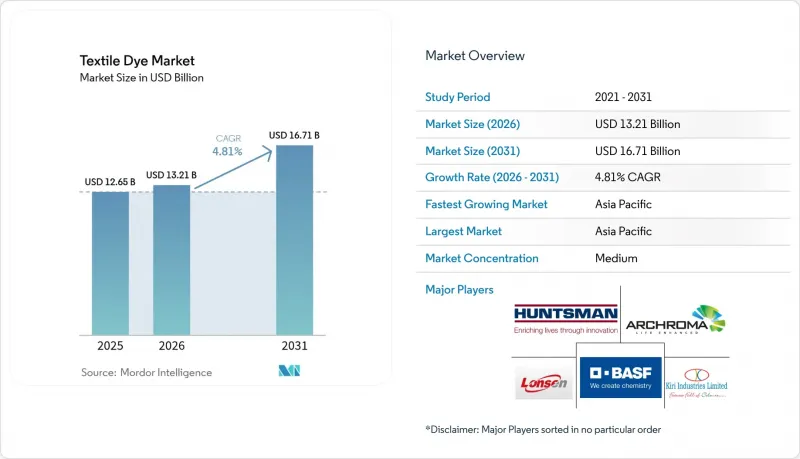
本報告按染料類型(活性染料、分散染料、直接染料、還原染料等)、纖維類型(棉、聚酯纖維、尼龍、羊毛、腈綸、粘膠纖維及其他纖維)、應用領域(服裝、家用紡織品、工業紡織品及其他應用)和地區(亞太地區、北美地區、歐洲地區、南美地區以及中東和非洲地區)進行細分。市場預測以美元計價。
全球紡織染料市場趨勢與洞察
新興國家快時尚生產的激增
預計孟加拉2025年成衣出口額將達474億美元,較2024年成長12%,其中聚酯混紡服飾佔其出口總額的68%。越南預計2025年紡織業將吸引32億美元的外國直接投資(FDI),主要用於印染和後整理廠,以支持西方零售商的近岸外包策略。印度的生產連結獎勵計畫計畫(PLI)預計到2029年將投資14.4億美元,用於提高功能性紡織品的產能,並促進符合零排放有害化學品(ZDHC)協議的廢水處理設施的建設。聚酯染色每公斤織物耗水量為30-40公升,而棉織物染色則需80-100公升,使得能源成本降低近20%,從而推動了紡織染料市場的長期成長。前置作業時間從 45 天縮短到 21 天,如今已成為全球快時尚連鎖店的標準,分散式化學技術帶來的快速生產週期優勢已變得不可或缺。
拓展按需數位紡織印花業務
2025年,全球數位紡織印花產能成長28%,這得益於Kornit Digital工業印表機出貨量年增28%,達到1847台。客製印刷使品牌能夠快速製作微型系列樣品,而無需受限於5000件的最低訂購量,從而減少35-40%的庫存損失。對於棉織物噴墨墨水而言,共用鍵活性染料仍佔據主導地位,因為它們無需額外加工即可達到ISO 105-C06 4級耐洗標準。顏料型染料在聚酯纖維布料中越來越受歡迎,但其有限的色域仍然限制了它們在需要鮮豔色彩的時尚領域的應用。隨著印表機墨滴尺寸縮小至10皮升,染料供應商需要重新配製產品,以改善黏度控制、乾燥速度和防止噴嘴堵塞。
更嚴格的全球廢水標準
中國於2025年1月實施的污水排放法規修訂將化學需氧量(COD)的允許限值降低至50毫克/公升,迫使Delta地區的127家印染廠暫停運營,直至完成設備維修。此外,2024年,18種偶氮染料被列入ZDHC限制物質清單,並在11個國家進行了審計。實施封閉回路型水處理系統的成本在每家工廠280萬美元至510萬美元之間。這項負擔導致2025年約四分之一的小規模印染廠關閉,加速了區域重組。孟加拉環境部在2025年發布了89份停產通知,迫使15%至18%的用於西方品牌的聚酯混紡布料產能停產。更嚴格的法規對生化需氧量 (BOD) 高的活性染料和直接染料造成了不成比例的影響,刺激了消費轉向分散染料,以跟上聚酯市場的成長步伐。
細分市場分析
到2025年,分散染料將佔總銷售額的32.11%,預計到2031年,該細分市場的複合年成長率將達到5.61%,超過紡織染料市場的整體成長率。聚酯纖維在全球紡織品消費中的高比例支撐了這一成長趨勢,因為分散染料無需輔助還原劑即可有效結合,從而將製程時間縮短高達25%。隨著棉花環保監管日益嚴格,活性染料的成長率預計將低於4%。直接染料因其經濟實惠的纖維素家用紡織品著色能力而備受青睞,預計將佔12-14%的市場佔有率,但在廢水排放法規更為嚴格的地區,其市場佔有率預計將會增加。
亨斯邁的超臨界二氧化碳相容型分散染料系列將於2025年在東亞七家紡紗廠實現商業化,透過完全無水化處理,有效應對監管壓力並支撐其高階定價。 BETA-α染料將憑藉其在耐用戶外服裝和工作服領域的應用,保持盈利的市場佔有率;酸性染料將在尼龍和羊毛領域佔據一定地位。鹼性染料和特殊化學品將佔據剩餘市場佔有率,但由於腈綸纖維使用量的下降,其成長將受到限制。預計到2031年,這些變化將共同推動分散染料在紡織染料市場中的佔有率保持上升趨勢。
區域分析
預計到2025年,亞太地區將佔全球市場價值的49.85%,並在2031年之前以5.75%的複合年成長率成長。孟加拉的服飾出口預計將成長12%,達到474億美元;越南2025年吸引的32億美元外國直接投資將集中在印染設施;印度14.4億美元的激勵預算將加速廢水處理技術的推廣應用。中國仍然是最大的單一市場,但隨著品牌多元化發展以增強其抵禦地緣政治風險的能力,預計到2025年,中國市場佔有率將下降180個基點。日本和韓國透過嚴格執行OEKO-TEX認證標準,滿足了汽車和電子紡織品對特殊染料的需求。印尼和泰國受益於工資套利,但高度依賴進口中間原料,並面臨原物料價格波動的風險。
北美市場佔有率得益於墨西哥的近岸外包,預計到2025年,墨西哥紡織業的外國直接投資總額將達到8.9億美元。加州AB 405法案優先考慮報廢產品的可回收性,並鼓勵投資於生物基、易脫墨的染料,這些染料適用於紡織品到紡織品的回收過程。在加拿大的戶外服飾領域,對具有極高色牢度的還原染料和酸性染料的需求依然旺盛,而在美國,超過75%的染料需求仍依賴進口。
在歐洲,市場受到以下因素的限制:2024年起,REACH法規將禁止使用34種偶氮染料;以及計畫於2027年推出的生態設計護照制度。德國、義大利和法國佔據了該地區一半以上的需求,並正利用其高階市場定位,將推廣永續發展帶來的成本增加轉嫁給消費者。英國脫歐後將面臨4.5%的進口關稅,而受制裁影響的俄羅斯服裝業則面臨特種中間體供不應求的問題。南美洲市場以巴西為首,其國內服飾消費群高達2.14億。同時,中東和非洲地區的成長動力則來自埃及31億美元的出口額里程碑以及沙烏地阿拉伯在其「2030願景」計畫下的投資。
其他好處:
- Excel格式的市場預測(ME)表
- 3個月的分析師支持
目錄
第1章:引言
- 研究假設和市場定義
- 調查範圍
第2章:調查方法
第3章執行摘要
第4章 市場狀況
- 市場概覽
- 市場促進因素
- 新興國家快時尚生產的激增
- 拓展按需數位紡織印花業務
- 技術性和防護性紡織品的廣泛應用
- 零售品牌的永續性要求(生物基染料)
- 電子商務推動了小批量服裝訂單的成長。
- 市場限制因素
- 更嚴格的全球廢水標準
- 石油衍生染料中間體的價格波動
- 來自天然色棉花的競爭威脅
- 價值鏈分析
- 波特五力模型
第5章 市場規模與成長預測
- 按染料類型
- 反應性
- 去中心化
- 直接的
- 蝙蝠
- 酸性
- 基本的
- 其他染料類型
- 依纖維類型
- 棉布
- 聚酯纖維
- 尼龍
- 羊毛
- 丙烯酸纖維
- 黏膠纖維
- 其他類型的纖維
- 透過使用
- 服飾
- 家用紡織品
- 工業用織物
- 其他用途
- 按地區
- 亞太地區
- 中國
- 印度
- 日本
- 韓國
- 其他亞太國家
- 北美洲
- 美國
- 加拿大
- 墨西哥
- 歐洲
- 德國
- 英國
- 法國
- 義大利
- 俄羅斯
- 其他歐洲國家
- 南美洲
- 巴西
- 阿根廷
- 其他南美國家
- 中東和非洲
- 沙烏地阿拉伯
- 阿拉伯聯合大公國
- 南非
- 埃及
- 其他中東和非洲國家
- 亞太地區
第6章 競爭情勢
- 市場集中度
- 策略趨勢
- 市佔率和排名分析
- 公司簡介
- AkikDye
- Archroma
- Atul Ltd
- BASF
- Clariant
- Colourtex Industries Private Limited
- Huntsman International LLC
- Jiangsu World Chemical Co., Ltd
- KeyColour
- Kiri Industries Ltd
- Zhejiang Longsheng Group
- Mahickra Chemicals Limited
- NICCA CHEMICAL CO.,LTD.
- Sun Chemical
- TAIYO HOLDINGS CO., LTD.
- Vipul Organics Ltd
第7章 市場機會與未來展望
According to Mordor Intelligence, the textile dye market size is projected to be USD 12.65 billion in 2025, USD 13.21 billion in 2026, and reach USD 16.71 billion by 2031, growing at a CAGR of 4.81% from 2026 to 2031.
This report is Segmented by Dye Type (Reactive, Dispersive, Direct, Vat, and More), Fiber Type (Cotton, Polyester, Nylon, Wool, Acrylic, Viscose, and Other Fiber Types), Application (Apparel, Household Textiles, Industrial Fabrics, and Other Applications), and Geography (Asia-Pacific, North America, Europe, South America, and Middle East and Africa). The Market Forecasts are Provided in Terms of Value (USD).
Global Textile Dye Market Trends and Insights
Soaring Fast-Fashion Output in Emerging Economies
Bangladesh exported USD 47.4 billion in ready-made garments in 2025, a 12% rise over 2024, and polyester-blend fabrics represented 68% of those shipments. Vietnam attracted USD 3.2 billion in textile foreign direct investment during 2025, mainly in dyeing and finishing plants serving near-shoring strategies of Western retailers. India's Production-Linked Incentive program committed USD 1.44 billion through 2029 to upgrade technical-textile capacity, spurring installations of effluent-treatment units that comply with Zero Discharge of Hazardous Chemicals (ZDHC) protocols. Polyester dyeing consumes 30-40 liters of water per kilogram of fabric compared with 80-100 liters for cotton, lowering energy costs by close to 20% and reinforcing the long-term growth of the textile dyes market. Shorter lead times, from 45 days to 21 days, are now standard for global fast-fashion chains, making the rapid-cycle advantages of dispersive chemistries indispensable.
Expansion of On-Demand Digital Textile Printing
Global digital textile printing capacity increased 28% in 2025, buoyed by 1,847 industrial printer shipments from Kornit Digital, up 28% year on year. On-demand printing slashes inventory waste by 35-40% because brands can trial micro-collections without committing to 5,000-unit minimums. Reactive dyes remain dominant in inkjet formulations for cotton because of their covalent bonding, which delivers ISO 105-C06 Grade 4 wash-fastness without extra processing. Pigment-based solutions are gaining traction on polyester but still face color-gamut limitations that constrain their penetration in fashion lines driven by vibrant shades. As printer droplet sizes shrink to 10 picoliters, dye suppliers must reformulate products for viscosity control, drying speed, and nozzle anti-clogging performance.
Tightening Global Effluent Discharge Norms
China's January 2025 wastewater revision cut allowable chemical oxygen demand to 50 mg/L, forcing 127 dye houses in the Yangtze River Delta to suspend operations pending upgrades. The ZDHC Manufacturing Restricted Substances List added 18 azo dyes in 2024, prompting audits across 11 countries. Installing closed-loop water systems costs USD 2.8-5.1 million per plant, a burden that eliminated roughly one-quarter of smaller facilities in 2025 and drove regional consolidation. Bangladesh's Department of Environment issued 89 closure notices in 2025, disrupting 15-18% of polyester-blend capacity used by Western brands. Stricter norms disproportionately affect reactive and direct dyes with higher biochemical oxygen demand, nudging consumption toward dispersive formulations aligned with polyester growth.
Other drivers and restraints analyzed in the detailed report include:
- Growth in Technical & Protective Textile Usage
- Retail Brand Sustainability Mandates (Bio-Based Dyes)
- Volatility in Petro-Derived Dye Intermediates
For complete list of drivers and restraints, kindly check the Table Of Contents.
Segment Analysis
Dispersive dyes secured 32.11% of 2025 revenue, while the segment's 5.61% CAGR forecast to 2031 exceeds the overall textile dyes market. Polyester's share of global fiber use underpins that trajectory because dispersive formulations bond effectively without auxiliary reducing agents, trimming process time by up to 25%. Reactive dyes will trail at sub-4% growth as cotton's environmental scrutiny intensifies. Direct dyes, valued for economical coloration of cellulosic home textiles, contribute 12-14% but face substitution in regions tightening effluent rules.
Huntsman's supercritical CO2-compatible dispersive range, commercialized in seven East Asian mills during 2025, eliminates water completely, aligning with regulatory pressures and bolstering premium pricing. Vat dyes retain a lucrative slice through durable outdoor and workwear applications, while acidic dyes keep a foothold in nylon and wool. Basic dyes and niche chemistries round out the remainder, with growth limited by declining acrylic fiber use. Collectively, these shifts will keep the textile dyes market share of dispersive dyes on an upward course through 2031.
Complete Report Scope:
- By Dye Type
- Reactive
- Dispersive
- Direct
- Vat
- Acidic
- Basic
- Other Dye Types
- By Fiber Type
- Cotton
- Polyester
- Nylon
- Wool
- Acrylic
- Viscose
- Other Fiber Types
- By Application
- Apparel
- Household Textiles
- Industrial Fabrics
- Other Applications
- By Geography
- Asia-Pacific
- China
- India
- Japan
- South Korea
- Rest of Asia-Pacific
- North America
- United States
- Canada
- Mexico
- Europe
- Germany
- United Kingdom
- France
- Italy
- Russia
- Rest of Europe
- South America
- Brazil
- Argentina
- Rest of South America
- Middle East and Africa
- Saudi Arabia
- United Arab Emirates
- South Africa
- Egypt
- Rest of Middle East and Africa
- Asia-Pacific
Geography Analysis
Asia-Pacific commanded 49.85% of global value in 2025 and is on track for a 5.75% CAGR to 2031. Bangladesh delivered 12% garment-export growth to USD 47.4 billion, Vietnam's USD 3.2 billion 2025 FDI inflows targeted dyeing facilities, and India's USD 1.44 billion incentive budget accelerated effluent-treatment adoption. China remains the largest single country, but ceded 180 basis points of share in 2025 as brands diversify for geopolitical resilience. Japan and South Korea, with stringent OEKO-TEX adoption, fulfill specialty-dye demand in automotive and electronics textiles. Indonesia and Thailand benefit from wage arbitrage yet rely heavily on imported intermediates, exposing them to feedstock volatility.
North America's market share is aided by near-shoring to Mexico, whose 2025 textile FDI totaled USD 890 million. California's AB 405 places end-of-life recyclability at the forefront, prompting investment in bio-based and easily de-inkable dyes suitable for fiber-to-fiber recycling streams. Canada's cold-climate outdoor sector continues to specify vat and acidic dyes with extreme colorfastness, while the United States remains import-reliant for 75-plus % of its dye needs.
Europe is constrained by the 2024 REACH ban on 34 azo dyes and the pending Ecodesign passports by 2027. Germany, Italy, and France compose more than half of regional demand, leveraging premium positioning to pass through sustainability-driven cost uplifts. The United Kingdom contends with 4.5% import tariffs post-Brexit, and Russia's sanctions-impacted sector struggles with specialty-intermediate shortages. South America, led by Brazil is driven by a 214-million-consumer domestic apparel base, while the Middle East and Africa, anchored by Egypt's USD 3.1 billion export milestone and Saudi Arabia's Vision 2030 investments.
- AkikDye
- Archroma
- Atul Ltd
- BASF
- Clariant
- Colourtex Industries Private Limited
- Huntsman International LLC
- Jiangsu World Chemical Co., Ltd
- KeyColour
- Kiri Industries Ltd
- Zhejiang Longsheng Group
- Mahickra Chemicals Limited
- NICCA CHEMICAL CO.,LTD.
- Sun Chemical
- TAIYO HOLDINGS CO., LTD.
- Vipul Organics Ltd
Additional Benefits:
- The market estimate (ME) sheet in Excel format
- 3 months of analyst support
TABLE OF CONTENTS
1 Introduction
- 1.1 Study Assumptions & Market Definition
- 1.2 Scope of the Study
2 Research Methodology
3 Executive Summary
4 Market Landscape
- 4.1 Market Overview
- 4.2 Market Drivers
- 4.2.1 Soaring Fast-Fashion Output in Emerging Economies
- 4.2.2 Expansion of On-Demand Digital Textile Printing
- 4.2.3 Growth in Technical & Protective Textile Usage
- 4.2.4 Retail Brand Sustainability Mandates (Bio-Based Dyes)
- 4.2.5 E-commerce Led Rise in Small-Lot Apparel Orders
- 4.3 Market Restraints
- 4.3.1 Tightening Global Effluent Discharge Norms
- 4.3.2 Volatility in Petro-Derived Dye Intermediates
- 4.3.3 Competitive Threat from Naturally-Colored Cotton
- 4.4 Value Chain Analysis
- 4.5 Porter's Five Forces
- 4.5.1 Bargaining Power of Suppliers
- 4.5.2 Bargaining Power of Buyers
- 4.5.3 Threat of New Entrants
- 4.5.4 Threat of Substitutes
- 4.5.5 Degree of Competition
5 Market Size & Growth Forecasts (Value)
- 5.1 By Dye Type
- 5.1.1 Reactive
- 5.1.2 Dispersive
- 5.1.3 Direct
- 5.1.4 Vat
- 5.1.5 Acidic
- 5.1.6 Basic
- 5.1.7 Other Dye Types
- 5.2 By Fiber Type
- 5.2.1 Cotton
- 5.2.2 Polyester
- 5.2.3 Nylon
- 5.2.4 Wool
- 5.2.5 Acrylic
- 5.2.6 Viscose
- 5.2.7 Other Fiber Types
- 5.3 By Application
- 5.3.1 Apparel
- 5.3.2 Household Textiles
- 5.3.3 Industrial Fabrics
- 5.3.4 Other Applications
- 5.4 By Geography
- 5.4.1 Asia-Pacific
- 5.4.1.1 China
- 5.4.1.2 India
- 5.4.1.3 Japan
- 5.4.1.4 South Korea
- 5.4.1.5 Rest of Asia-Pacific
- 5.4.2 North America
- 5.4.2.1 United States
- 5.4.2.2 Canada
- 5.4.2.3 Mexico
- 5.4.3 Europe
- 5.4.3.1 Germany
- 5.4.3.2 United Kingdom
- 5.4.3.3 France
- 5.4.3.4 Italy
- 5.4.3.5 Russia
- 5.4.3.6 Rest of Europe
- 5.4.4 South America
- 5.4.4.1 Brazil
- 5.4.4.2 Argentina
- 5.4.4.3 Rest of South America
- 5.4.5 Middle East and Africa
- 5.4.5.1 Saudi Arabia
- 5.4.5.2 United Arab Emirates
- 5.4.5.3 South Africa
- 5.4.5.4 Egypt
- 5.4.5.5 Rest of Middle East and Africa
- 5.4.1 Asia-Pacific
6 Competitive Landscape
- 6.1 Market Concentration
- 6.2 Strategic Moves
- 6.3 Market Share(%)/Ranking Analysis
- 6.4 Company Profiles (includes Global level Overview, Market level overview, Core Segments, Financials as available, Strategic Information, Products & Services, Recent Developments)
- 6.4.1 AkikDye
- 6.4.2 Archroma
- 6.4.3 Atul Ltd
- 6.4.4 BASF
- 6.4.5 Clariant
- 6.4.6 Colourtex Industries Private Limited
- 6.4.7 Huntsman International LLC
- 6.4.8 Jiangsu World Chemical Co., Ltd
- 6.4.9 KeyColour
- 6.4.10 Kiri Industries Ltd
- 6.4.11 Zhejiang Longsheng Group
- 6.4.12 Mahickra Chemicals Limited
- 6.4.13 NICCA CHEMICAL CO.,LTD.
- 6.4.14 Sun Chemical
- 6.4.15 TAIYO HOLDINGS CO., LTD.
- 6.4.16 Vipul Organics Ltd
7 Market Opportunities & Future Outlook
- 7.1 White-space & Unmet-need Assessment

 紡織染料市場-2026-2032年全球市場預測
 壬基酚市場-全球產業規模、佔有率、趨勢、機會、預測:按應用、銷售管道、地區和競爭格局分類,2021-2031年
 紡織染料市場:預測(至2034年)-按染料、紡織品、應用和地區分類的全球分析
 紡織染料市場報告:按染料、纖維類型、應用和地區分類(2026-2034 年)
 紡織染料市場:商業機會、成長要素、產業趨勢分析及2026-2035年預測。
 紡織染料市場:市場規模、佔有率、成長率、全球產業分析、按類型、應用和地區分類的考察以及未來預測(2026-2034年)全球紡織染料市場規模、佔有率、趨勢和成長分析報告(2026-2034年)全球紡織染料市場規模、佔有率、趨勢和成長分析報告(2026-2034年)日本紡織染料市場規模、佔有率、趨勢和預測:按染料類型、纖維類型、應用和地區分類,2026-2034年
 2026年全球紡織染料市場報告