


 |
市場調查報告書
商品編碼
2123787
有機顏料:市佔率分析、產業趨勢與統計、成長預測(2026-2031)Organic Pigments - Market Share Analysis, Industry Trends & Statistics, Growth Forecasts (2026 - 2031) |
||||||

※ 本網頁內容可能與最新版本有所差異。詳細情況請與我們聯繫。
據 Mordor Intelligence 稱,2026 年有機顏料市場規模估計為 757.84 千噸,預計在預測期(2026-2031 年)內將以 3.26% 的複合年成長率成長,到 2031 年達到 889.69 千噸。
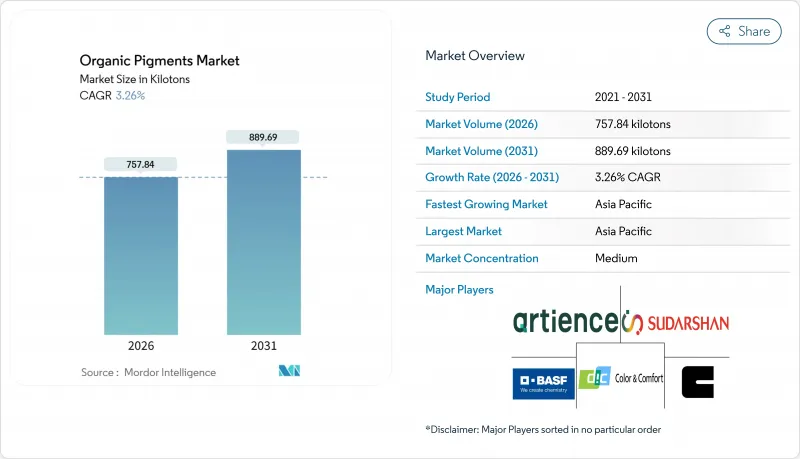
本報告按顏料類型(偶氮顏料、酞菁顏料、Quinacridones、蒽醌顏料等)、原料(合成和天然/生物基)、終端用戶行業(油漆和塗料、塑膠和聚合物、印刷油墨、紡織品等)以及地區(亞太地區、北美地區、歐洲地區、南美地區以及中東和非洲地區)進行細分。市場預測以噸為單位。
全球有機顏料市場趨勢與洞察
油漆和塗料行業的需求不斷成長
2024年,建築和工業塗料佔中國顏料總產量25.1萬噸的39%。這反映了城市快速更新和基礎設施建設的發展。水性丙烯酸乳液作為溶劑型醇酸樹脂的替代品,正日益普及。這類塗料需要無需偶聯劑即可分散的顏料,而Quinacridones品紅和酞菁藍在pH值較高的乳膠漆中不易聚集,因此備受青睞。汽車修補店指定使用混合了Quinacridones和鋁片的特殊效果顏料,以確保其在電動車中的雷達滲透性性能。此外,核准顏料清單也正朝著粒徑小於100奈米的產品方向發展。連續流反應器能夠幫助製造商滿足這些粒徑需求,同時將批次間的色差控制在±2以內,以維持品牌色彩的一致性。這些技術前提使得即使原物料成本波動,也能維持較高的價格。
向環保高性能顏料過渡
歐盟的微塑膠法規於2023年10月生效,禁止故意釋放小於5毫米的微塑膠顆粒,這促使配方研發人員測試由木質素合成的生物基喹Quinacridones前驅物。加州的「更安全的消費品」計畫指定了幾種偶氮顏料,要求每年出貨量超過1噸的訂單考慮使用替代品。薑黃和螺旋藻的天然萃取物在食品接觸包裝領域市場佔有率不斷成長,但其耐光性(低於藍羊毛4級)限制了其戶外應用。在監管日益嚴格的背景下,有機顏料市場呈現兩極化,一邊是通用型生產商,另一邊是提供低遷移認證等級的專業生產商,供應商更重視那些兼顧生物分解性和性能的產品。
嚴格的環境法規導致生產成本上升
歐盟2024年修訂的《分類、標籤和包裝法規》要求提交新的毒理學資料集,每種顏料的費用為5萬至15萬歐元。中國2024年《水污染防治法》規定化學需氧量(COD)排放限值為50毫克/公升,並要求維修污水處理設施,費用為2,000萬至5,000萬歐元(約280萬至700萬美元)。在印度,即時廢水監測使中型製造商的營運成本增加了12%至18%。這些投資對規模不足以攤銷合規成本的公司來說是一項負擔,減緩了有機顏料市場的成長。
細分市場分析
到2025年,偶氮顏料將佔有機顏料市場佔有率的45.36%。這項預測得益於低複雜度的重氮偶聯合成工藝,即使在大規模生產中也能生產出鮮豔的黃色和紅色顏料。由於其優異的分散性,與Quinacridones吖啶酮顏料相比,水性柔版油墨中的研磨能耗可降低20%。在聚丙烯母粒,濃度為0.5%的重氮橙色顏料即可展現遮蓋力,從而使扭力降低型擠出機的生產速度提高一倍。喹吖Quinacridones顏料雖然產量較小,但由於原始設備製造商(OEM)要求其多晶型顏料在經過2000小時的氙弧燈照射後仍能保持色澤(這對於10年車輛保固至關重要),其市場正以4.43%的複合年成長率快速成長。
在預測期內,熱穩定性超過200 度C的Quinacridones顏料有望在有機顏料市場開闢新的應用領域,例如電池外殼和複合材料。然而,由於軟包裝產業對成本的敏感性,偶氮顏料仍將佔據主導地位。酞菁藍和酞菁綠顏料仍是建築塗料產業的關鍵產品,其中α-結晶銅酞菁的交易價格低於每公斤8美元。蒽醌和Perylenes紅顏料的細分市場交易價格超過每公斤50美元,其中耐光性(例如「藍羊毛7」級)至關重要。數位配色系統有望使人們能夠使用最佳化混合物代替昂貴的顏料,而有機顏料市場對特種級產品的需求也將日益成長,以證明其終身價值。
區域分析
亞太地區預計在2025年佔全球出貨量的49.63%,並預計在2031年之前以4.92%的複合年成長率持續成長,這主要得益於中國25.1萬噸的產量以及印度紡織和塗料行業的快速發展。中國製造商如百合花和啟才化工正在採用連續流反應器,並透過將色強度控制在±2ΔE的可接受範圍內,滿足汽車產業認證要求(CPCIF.CN)。在2024-2025會計年度,印度有機顏料市場成長了11%,這主要得益於價值444億美元的紡織品出口以及基礎建設推動的塗料消費。
北美和歐洲合計約佔全球整體的30%。歐盟微塑膠法規和REACH法規的修訂正促使配方生產商轉向低遷移性和可生物分解等級的產品,使專業供應商能夠提高利潤率。在美國,加州的監管立場正加速從問題重重的偶氮顏料轉向Quinacridones和酞菁等替代品,迫使現有通用顏料生產商更新其毒性數據。數位配色工具正在整個汽車噴漆產業鏈中迅速普及,促進了服務的差異化。
剩餘佔有率由南美洲、中東和非洲佔據。在巴西,建設業的復甦支撐了當地對顏料的需求;而在沙烏地阿拉伯,基於「2030願景」的下游產業多元化發展正在促進與石化產業叢集相關的塗料產能成長。這些地區進口高性能顏料,同時從亞洲採購通用偶氮顏料,凸顯了亞太地區作為有機顏料市場供應基地的重要地位。
其他好處:
- Excel格式的市場預測(ME)表
- 3個月的分析師支持
目錄
第1章:引言
- 研究假設和市場定義
- 調查範圍
第2章:調查方法
第3章執行摘要
第4章 市場狀況
- 市場概覽
- 市場促進因素
- 油漆和塗料行業的需求不斷成長
- 向環保高性能顏料過渡
- 軟包裝和數位印刷用油墨的需求正在激增。
- 新興國家紡織品生產的擴張
- 人工智慧驅動的數位配色技術正在推動高度均勻分散體的廣泛應用。
- 市場限制因素
- 嚴格的環境法規導致生產成本上升
- 無機顏料在特定應用中的性能和成本優勢
- 石化原料價格波動
- 價值鏈分析
- 波特五力模型
第5章 市場規模與成長預測
- 依顏料類型
- 偶氮
- 酞菁
- Quinacridones
- 蒽醌
- 其他顏料類型
- 來源
- 合成
- 天然來源/生物來源
- 按最終用戶行業分類
- 油漆和塗料
- 塑膠和聚合物
- 印刷油墨
- 紡織品
- 其他終端用戶產業
- 按地區
- 亞太地區
- 中國
- 印度
- 日本
- 韓國
- 東南亞
- 其他亞太國家
- 北美洲
- 美國
- 加拿大
- 墨西哥
- 歐洲
- 德國
- 英國
- 義大利
- 法國
- 俄羅斯
- 其他歐洲國家
- 南美洲
- 巴西
- 阿根廷
- 其他南美國家
- 中東和非洲
- 沙烏地阿拉伯
- 南非
- 其他中東和非洲國家
- 亞太地區
第6章 競爭情勢
- 市場集中度
- 策略趨勢
- 市佔率/排名分析
- 公司簡介
- BASF
- artience Co., Ltd.
- Changzhou Longyu Pigment Chemical CO.,LTD.
- Clariant
- DIC CORPORATION(Sun Chemical)
- Ferro Corporation
- Hangzhou Han-Color Chemical CO. LTD
- Heubach GmbH
- Indian Chemical Industries
- Koel Colours Pvt Ltd
- LANXESS AG
- Meghmani Organics Ltd.
- Origo Chemical
- Pidilite Industries Ltd
- Sudarshan Chemical Industries Limited
- Trust Chem Co. Ltd
- VIBFAST PIGMENTS PVT LTD
- Vipul Organics Ltd
第7章 市場機會與未來展望
According to Mordor Intelligence, the organic pigments market size is estimated at 757.84 kilotons in 2026, and is expected to reach 889.69 kilotons by 2031, at a CAGR of 3.26% during the forecast period (2026-2031).
This report is Segmented by Pigment Type (Azo, Phthalocyanine, Quinacridone, Anthraquinone, and More), Source (Synthetic and Natural/Bio-based), End-User Industry (Paints and Coatings, Plastics and Polymer, Printing Inks, Textile, and More), and Geography (Asia-Pacific, North America, Europe, South America, and Middle-East and Africa). The Market Forecasts are Provided in Terms of Volume (tons).
Global Organic Pigments Market Trends and Insights
Growing Demand From Paints And Coatings Industry
Architectural and industrial coatings absorbed 39% of China's 251,000-tonne pigment output in 2024, reflecting rapid urban renewal and infrastructure upgrades. Water-based acrylic emulsions replacing solvent-borne alkyds require pigments that disperse without coupling agents, favoring quinacridone magenta and phthalocyanine blue that resist flocculation in high-pH latex paints. Automotive refinish shops specify effect grades combining quinacridone with aluminum flakes to ensure radar-friendly finishes on electric vehicles, pushing approved pigment lists toward sub-100-nanometer products. Continuous-flow reactors help producers meet this granularity while holding batch-to-batch ΔE within +-2, preserving brand color integrity. These technical prerequisites sustain premium pricing even when feedstock costs swing.
Shift Toward Eco-Friendly High-Performance Pigments
The European Union's microplastics restriction, active since October 2023, prohibits intentional particle release under 5 millimeters, propelling formulators to experiment with bio-based quinacridone precursors synthesized from lignin. California's Safer Consumer Products program lists several azo grades, obligating alternatives analysis for shipments above 1 tonne annually. Natural extractions from turmeric and spirulina win share in food-contact packaging but lack light-fastness beyond Blue Wool 4, limiting outdoor use. As regulations tighten, the organic pigments market rewards suppliers that can balance biodegradability with performance, spurring a bifurcation between commodity producers and specialty players offering certified low-migration grades.
Higher Production Costs From Stringent Environmental Regulations
The EU's 2024 Classification, Labelling and Packaging update requires fresh toxicology dossiers costing EUR 50,000-150,000 per pigment. China's 2024 Water-Pollution Law capped COD discharges at 50 mg/L, prompting CNY 20-50 million (USD 2.8-7 million) wastewater-treatment retrofits. India's real-time effluent monitoring adds 12%-18% to operating costs for mid-tier producers. These investments burden firms that lack scale to amortize compliance, tempering growth in the organic pigments market.
Other drivers and restraints analyzed in the detailed report include:
- Surging Flexible-Packaging And Digital-Printing Ink Demand
- Expanding Textile Production In Emerging Economies
- Performance/Cost Advantages Of Inorganic Pigments
For complete list of drivers and restraints, kindly check the Table Of Contents.
Segment Analysis
Azo grades secured 45.36% of the organic pigments market share in 2025, a position supported by low-complexity diazo-coupling synthesis that yields vivid yellows and reds at scale. Their ready dispersibility enables water-based flexographic inks to cut milling energy by 20% compared with quinacridone options. Disazo oranges deliver opacity in polypropylene masterbatch at 0.5% loading, doubling output rates on extruders that throttle back torque. Quinacridone pigments, though smaller in tonnage, expand at a 4.43% CAGR as OEMs demand polymorphs retaining hue after 2,000 hours of xenon-arc exposure, critical for 10-year vehicle warranties.
In the forecast horizon, the organic pigments market expects quinacridone's heat stability above 200°C to unlock new battery-cover and composite-body uses, yet cost sensitivity in flexible packaging keeps azo grades entrenched. Phthalocyanine blues and greens remain workhorses in architectural coatings, trading under USD 8/kg for alpha-crystal copper phthalocyanine. Niche anthraquinone and perylene reds fetch prices beyond USD 50/kg, where Blue Wool 7 light-fastness is non-negotiable. Digital color-matching systems may substitute costly pigments with optimized blends, pressuring specialty grades to prove lifetime value in the organic pigments market.
Complete Report Scope:
- By Pigment Type
- Azo
- Phthalocyanine
- Quinacridone
- Anthraquinone
- Other Pigment Types
- By Source
- Synthetic
- Natural / Bio-based
- By End-User Industry
- Paints and Coatings
- Plastics and Polymer
- Printing Inks
- Textile
- Other End-user Industries
- By Geography
- Asia-Pacific
- China
- India
- Japan
- South Korea
- Southeast Asia
- Rest of Asia-Pacific
- North America
- United States
- Canada
- Mexico
- Europe
- Germany
- United Kingdom
- Italy
- France
- Russia
- Rest of Europe
- South America
- Brazil
- Argentina
- Rest of South America
- Middle-East and Africa
- Saudi Arabia
- South Africa
- Rest of Middle-East and Africa
- Asia-Pacific
Geography Analysis
Asia-Pacific commanded 49.63% of 2025 volume and will expand at a 4.92% CAGR to 2031 as China's 251,000-tonne output and India's fast-growing textile and coatings sectors lift regional offtake. Chinese producers such as Baihehua and Qicai Chemical employ continuous-flow reactors that achieve color-strength tolerances within +-2 ΔE, qualifying for automotive approvals CPCIF.CN. India's organic pigments market registered 11% growth in FY 2024-25 on the back of USD 44.4 billion in textile exports and infrastructure-driven paint consumption.
North America and Europe jointly represent roughly 30% of global volume. The EU's microplastics restriction and REACH updates steer formulators toward low-migration and biodegradable grades, letting specialty suppliers capture margin. In the United States, California's regulatory stance accelerates the substitution of flagged azo pigments with quinacridone and phthalocyanine alternatives, pressuring commodity incumbents to upgrade toxicology data. Digital color-matching tools see early adoption across automotive refinish chains, enhancing service differentiation.
South America and the Middle East-Africa cover the remaining share. Brazil's construction rebound supports local pigment demand, whereas Saudi Arabia's downstream diversification under Vision 2030 seeds coatings capacity tied to petrochemical clusters. These regions import high-performance grades yet source commodity azo pigments from Asia, underscoring Asia-Pacific's role as the supply backbone of the organic pigments market.
- BASF
- artience Co., Ltd.
- Changzhou Longyu Pigment Chemical CO.,LTD.
- Clariant
- DIC CORPORATION (Sun Chemical)
- Ferro Corporation
- Hangzhou Han-Color Chemical CO. LTD
- Heubach GmbH
- Indian Chemical Industries
- Koel Colours Pvt Ltd
- LANXESS AG
- Meghmani Organics Ltd.
- Origo Chemical
- Pidilite Industries Ltd
- Sudarshan Chemical Industries Limited
- Trust Chem Co. Ltd
- VIBFAST PIGMENTS PVT LTD
- Vipul Organics Ltd
Additional Benefits:
- The market estimate (ME) sheet in Excel format
- 3 months of analyst support
TABLE OF CONTENTS
1 Introduction
- 1.1 Study Assumptions & Market Definition
- 1.2 Scope of the Study
2 Research Methodology
3 Executive Summary
4 Market Landscape
- 4.1 Market Overview
- 4.2 Market Drivers
- 4.2.1 Growing demand from paints and coatings industry
- 4.2.2 Shift toward eco-friendly high-performance pigments
- 4.2.3 Surging flexible-packaging and digital-printing ink demand
- 4.2.4 Expanding textile production in emerging economies
- 4.2.5 AI-enabled digital color-matching boosting high-consistency dispersions
- 4.3 Market Restraints
- 4.3.1 Higher production costs from stringent environmental regulations
- 4.3.2 Performance/cost advantages of inorganic pigments in specific uses
- 4.3.3 Volatility of petrochemical-based feedstock prices
- 4.4 Value Chain Analysis
- 4.5 Porter's Five Forces
- 4.5.1 Bargaining Power of Suppliers
- 4.5.2 Bargaining Power of Buyers
- 4.5.3 Threat of New Entrants
- 4.5.4 Threat of Substitute Products and Services
- 4.5.5 Degree of Competition
5 Market Size & Growth Forecasts (Volume)
- 5.1 By Pigment Type
- 5.1.1 Azo
- 5.1.2 Phthalocyanine
- 5.1.3 Quinacridone
- 5.1.4 Anthraquinone
- 5.1.5 Other Pigment Types
- 5.2 By Source
- 5.2.1 Synthetic
- 5.2.2 Natural / Bio-based
- 5.3 By End-User Industry
- 5.3.1 Paints and Coatings
- 5.3.2 Plastics and Polymer
- 5.3.3 Printing Inks
- 5.3.4 Textile
- 5.3.5 Other End-user Industries
- 5.4 By Geography
- 5.4.1 Asia-Pacific
- 5.4.1.1 China
- 5.4.1.2 India
- 5.4.1.3 Japan
- 5.4.1.4 South Korea
- 5.4.1.5 Southeast Asia
- 5.4.1.6 Rest of Asia-Pacific
- 5.4.2 North America
- 5.4.2.1 United States
- 5.4.2.2 Canada
- 5.4.2.3 Mexico
- 5.4.3 Europe
- 5.4.3.1 Germany
- 5.4.3.2 United Kingdom
- 5.4.3.3 Italy
- 5.4.3.4 France
- 5.4.3.5 Russia
- 5.4.3.6 Rest of Europe
- 5.4.4 South America
- 5.4.4.1 Brazil
- 5.4.4.2 Argentina
- 5.4.4.3 Rest of South America
- 5.4.5 Middle-East and Africa
- 5.4.5.1 Saudi Arabia
- 5.4.5.2 South Africa
- 5.4.5.3 Rest of Middle-East and Africa
- 5.4.1 Asia-Pacific
6 Competitive Landscape
- 6.1 Market Concentration
- 6.2 Strategic Moves
- 6.3 Market Share/Ranking Analysis
- 6.4 Company Profiles {(includes Global level Overview, Market level overview, Core Segments, Financials as available, Strategic Information, Market Rank/Share, Products & Services, and Recent Developments)}
- 6.4.1 BASF
- 6.4.2 artience Co., Ltd.
- 6.4.3 Changzhou Longyu Pigment Chemical CO.,LTD.
- 6.4.4 Clariant
- 6.4.5 DIC CORPORATION (Sun Chemical)
- 6.4.6 Ferro Corporation
- 6.4.7 Hangzhou Han-Color Chemical CO. LTD
- 6.4.8 Heubach GmbH
- 6.4.9 Indian Chemical Industries
- 6.4.10 Koel Colours Pvt Ltd
- 6.4.11 LANXESS AG
- 6.4.12 Meghmani Organics Ltd.
- 6.4.13 Origo Chemical
- 6.4.14 Pidilite Industries Ltd
- 6.4.15 Sudarshan Chemical Industries Limited
- 6.4.16 Trust Chem Co. Ltd
- 6.4.17 VIBFAST PIGMENTS PVT LTD
- 6.4.18 Vipul Organics Ltd
7 Market Opportunities and Future Outlook
- 7.1 White-space and Unmet-Need Assessment

 有機顏料市場:按類型、形態、等級、原料、應用和銷售管道分類-2026-2032年全球市場預測
 有機顏料市場:按類型、應用程式和地區分類
 全球酞菁顏料市場規模、佔有率、趨勢及成長分析報告(2026-2034)
 2026年全球有機顏料市場報告塗料用有機顏料市場:按產品類型、顏色、形態、應用和最終用途分類 - 全球預測(2026-2032年)塗料用酞菁顏料市場:依技術、樹脂類型、顏料等級、形態和應用分類,全球預測(2026-2032年)
 偶氮顏料市場規模、佔有率和成長分析(按產品類型、溶解度/形態、應用、最終用途產業和地區分類)-2026-2033年產業預測
 有機顏料市場規模、佔有率和趨勢分析報告:按產品、應用、地區和細分市場預測:2025-2033年
 偶氮顏料市場:全球產業分析、規模、佔有率、成長、趨勢與預測,2025-2032
 2025-2029年全球有機顏料市場