


 |
市場調查報告書
商品編碼
2123778
單螺桿偏心泵:市場佔有率分析、行業趨勢和統計數據、成長預測(2026-2031 年)Progressing Cavity Pump - Market Share Analysis, Industry Trends & Statistics, Growth Forecasts (2026 - 2031) |
||||||

※ 本網頁內容可能與最新版本有所差異。詳細情況請與我們聯繫。
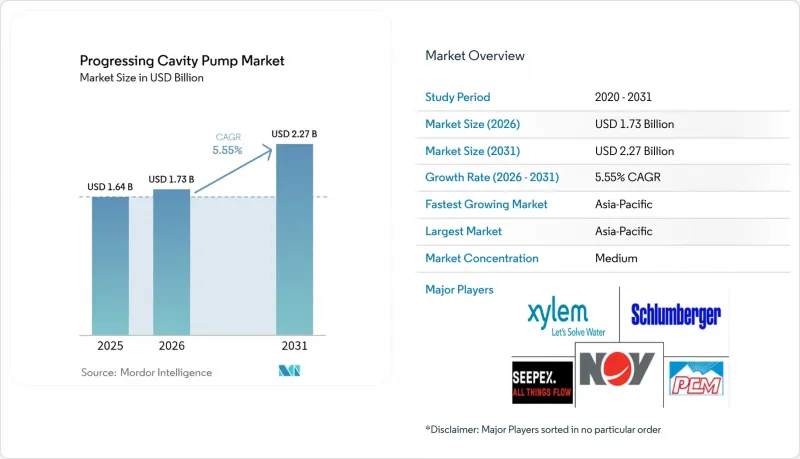
單螺桿偏心泵的市場規模預計將從 2025 年的 16.4 億美元成長到 2026 年的 17.3 億美元,並預計從 2026 年到 2031 年將以 5.55% 的複合年成長率成長,到 2031 年達到 22.7 億美元。
本報告按額定功率(50馬力及以下、51-150馬力、150馬力以上)、流量(500加侖/分鐘及以下、501-1000加侖/分鐘、其他)、級數(單級、多級)、北美用戶行業(水和污水處理、石油和天然氣、其他)以及級數(單級、多級)、北美用戶業(水和污水處理、石油和天然氣、其他)以及地區(北美、南美、其他地區)進行細分。市場預測以美元計價。
單螺桿偏心泵浦全球市場趨勢及洞察
對用水和污水基礎設施的需求增加
各大市政當局對用於污泥輸送、濃縮和化學藥劑注入的單螺桿偏心泵的產業計畫強勁。馬尼拉水務公司已投入訂單一座耗資4.3573億美元的泵站,每天向比南戈南地區的居民供水5,000萬公升。日本的「水2040基金」(規模達100億美元)正在運作建造分散式循環利用系統,該系統採用高精度單螺桿偏心泵(PCP)進行營養物回收。修訂後的歐盟《都市污水處理指令》要求在2045年建成能源中性處理廠,而高效的螺桿泵(PCP)是實現這一目標的必要手段。印尼的新建設項目正在推動該地區對先進污泥處理技術的需求,以滿足未來200萬人口的需求。這些項目共同延長了設備的更換週期,並為處理脫水泥餅且佔用面積最小的底卸式螺桿泵的維修創造了機會。
適用於高黏度和多相流體。
螺桿泵能夠以近乎恆定的流量輸送剪切敏感流體、含砂流體或含氣流體,這是離心式幫浦或齒輪泵無法比擬的性能。耐馳(NETZSCH)的新型錐形轉子設計即使在高含砂量和高含氣量條件下也能實現75%至90%的容積效率。加拿大一家SAGD(蒸氣輔助重油開採)生產商將其採收率提高到80%以上。這提高了操作員在將重質乳狀液泵送至地面時,每口井的螺桿泵運作。使用丁烷-丙烷混合氣體的新型溶劑SAGD方法對黏度提出了更高的挑戰,但正是這些挑戰推動了螺桿泵的普及應用。食品加工商也使用螺桿泵來保持黏稠醬汁的質地,而化學企業則重視彈性體定子相比金屬定子的耐腐蝕性。
高昂的實施和維修成本
生命週期成本是其廣泛應用的一大障礙,尤其是在對價格敏感的工廠。定子更換週期依固態負荷的不同,從6個月到3年不等,而彈性體成本也是一項主要的預算支出。機械軸封、大型底座和感測器組件使得其安裝成本高於低剪切力替代方案。格雷科公司的一項對比研究表明,對於類似的計量操作,壓力控制泵(PCP)所需的維護時間比蠕動泵更長。發展中地區的小規模公用事業營運商由於缺乏專業技術人員和備件,面臨設備升級延遲和投資回收期延長的問題。
細分市場分析
截至2025年,50馬力以下的單螺桿偏心泵市佔率佔43.62%。這是因為小規模水務設施和輕工業更傾向於選擇能耗適中的產品。然而,51-150馬力細分市場正以8.05%的複合年成長率快速成長,預計隨著數位控制器帶來的效率提升和停機時間減少,該細分市場與50馬力以下泵的市場佔有率差距將進一步縮小。變頻驅動器與中功率馬達結合,可實現20-30%的節能效果,這對於採用階梯電價制度的市政營運商來說極具吸引力。
在相同的功率範圍內,電動潛水泵也越來越受歡迎,這為以前桿柱安裝空間有限的上游區域開闢了新的應用領域。利用機器學習預測最佳功率的選用工具的精度進一步提高,誤差率已降至僅0.1%。這使得工程師能夠選擇合適尺寸的設備,避免超支。隨著這些分析技術的成熟,預計單軸螺旋泵浦市場的新訂單中,51-150馬力類別的訂單比例將有所增加,儘管低功率機組仍將在老舊設施中佔據主導地位。
流量在501至1000加侖/分鐘(GPM)範圍內的高容量系統實現了最高的複合年成長率(CAGR),達到8.52%,這主要是因為地方政府為了滿足人口成長的需求,用更大的設備替換了老舊的設施。馬尼拉水務公司的東灣設施安裝了多個大口徑輸送管道(PCP),日輸送量達5000萬公升,充分展現了新計畫的規模。即使到了2025年,流量低於500加侖/分鐘的細分市場仍將佔總收入的46.78%,因為數千家食品和化學企業以及小規模加工廠運作此流量範圍。
先進的CFD建模技術使製造商能夠針對每個流量範圍最佳化轉子幾何形狀,從而在整個流量範圍內將容積效率提高75%至90%。數位孿生技術提供預測分析,可在空化發生前提醒操作人員注意異常。這些技術的結合有助於降低生命週期成本,並推動單軸偏心螺桿泵市場滲透到以往僅限於離心式幫浦的高流量應用領域。
區域分析
到2025年,亞太地區將佔據單螺桿偏心泵市場34.21%的佔有率,預計到2031年將以8.72%的複合年成長率成長。中國100億美元的「水2040基金」和日本近乎封閉式的循環利用系統正在支持永續的市政支出。印尼新首都努沙登加拉計畫就污泥處理和化學藥劑注入設備進行多年競標。來自印度和越南等高成長製造地的工業訂單正在使該地區的收入來源多元化。
在北美,重質原油生產和水利基礎設施維修為當地經濟奠定了堅實的基礎。預計到2025年,加拿大的SAGD(蒸汽輔助重力洩油)日產量將達到165萬桶,這將推動泵送系統的現代化和擴建。在美國,全面實施美國環保署(EPA)提案的廢水排放指南將導致每年2.32億美元的合規成本,這促使供水事業升級到更節能的預製混凝土泵(PCP)。
歐洲市場受監管合規性和效率目標驅動。 《都市廢水處理指令》的能源中和要求設定了嚴格的期限,推動了低洩漏個人化學處理裝置(PCP)的普及。德國和英國正大力投資化學注入和消化池供水的技術升級,而法國核能發電廠則需要堅固耐用、無洩漏的泵浦。儘管地緣政治不確定性,但預計東歐和俄羅斯的石油生產項目收入將有所成長。
其他好處:
- Excel格式的市場預測(ME)表
- 3個月的分析師支持
目錄
第1章:引言
- 研究假設和市場定義
- 調查範圍
第2章:調查方法
第3章執行摘要
第4章 市場狀況
- 市場概覽
- 市場促進因素
- 對用水和污水基礎設施的需求增加
- 與高黏度流體和多相流體的相容性
- 重油人工抽油(PCP)專案的投資
- 降低電力消耗的水下電動PCP(儘管它們尚未受到太多關注)
- 利用物聯網進行定子和轉子磨損的預測性維護(一個研究不足的領域)
- 有關污泥脫水的法規正在推動(儘管不是公開地推動)底卸式PCP 的改進。
- 市場限制因素
- 高昂的初始設定和維護成本
- 含砂生產流體中的磨損
- 彈性體供應鏈的波動(此因素尚未受到重視)
- 用蠕動幫浦取代低流量輸液幫浦(一種被低估的趨勢)
- 宏觀經濟因素的影響
- 價值鏈分析
- 監理情勢
- 技術展望
- 波特五力分析
- 宏觀經濟因素影響評估
第5章 市場規模與成長預測
- 額定功率
- 50馬力或以下
- 51~150 HP
- 150馬力或以上
- 泵浦容量
- 500 加侖/分鐘或更少
- 501~1000 GPM
- 1000 加侖/分鐘或以上
- 按舞台類型
- 單級類型(12級或以下)
- 多層級(12 層或以上)
- 按最終用戶行業分類
- 水和污水處理
- 石油和天然氣
- 化工/石油化工
- 食品/飲料
- 其他最終用戶
- 按地區
- 北美洲
- 美國
- 加拿大
- 墨西哥
- 南美洲
- 巴西
- 阿根廷
- 其他南美國家
- 歐洲
- 德國
- 英國
- 法國
- 俄羅斯
- 其他歐洲國家
- 亞太地區
- 中國
- 日本
- 韓國
- 印度
- 其他亞太國家
- 中東和非洲
- 中東
- 沙烏地阿拉伯
- 阿拉伯聯合大公國
- 土耳其
- 其他中東國家
- 非洲
- 南非
- 奈及利亞
- 其他非洲國家
- 中東
- 北美洲
第6章 競爭情勢
- 市場集中度
- 策略趨勢
- 市佔率分析
- 公司簡介
- Schlumberger Limited
- National Oilwell Varco, Inc.
- Xylem Inc.
- NETZSCH Holding GmbH & Co. KG
- PCM SA
- Weatherford International plc
- Halliburton Company
- Seepex GmbH
- ChampionX Corporation
- Moyno, LLC
- Roto Pumps Limited
- Pumpenfabrik Wangen GmbH
- Leistritz Pumpen GmbH
- Liberty Process Equipment, Inc.
- Verder Liquids BV
- Borets International Limited
- Canadian Advanced ESP Inc.
- John Crane Production Solutions, Inc.
- Baker Hughes Company
- C-Flex Pump Company
- Allweiler GmbH(CIRCOR Intl.)
- Atlas Copco AB(Varisco PCP line)
- Graco Inc.
- NETCO Pumps & Equipment Pty Ltd
- BBP Pumps BV
- Shanley Pump & Equipment, Inc.
第7章 市場機會與未來展望
According to Mordor Intelligence, the progressing cavity pump market size is expected to grow from USD 1.64 billion in 2025 to USD 1.73 billion in 2026 and is forecast to reach USD 2.27 billion by 2031 at 5.55% CAGR over 2026-2031.
This report is Segmented by Power Rating (Up To 50 HP, 51-150 HP, Above 150 HP), Pumping Capacity (Up To 500 GPM, 501-1000 GPM, and More), Stage Type (Single-Stage, Multistage), End-User Industry (Water and Wastewater, Oil and Gas, and More), and Geography (North America, South America, and More). The Market Forecasts are Provided in Terms of Value (USD).
Global Progressing Cavity Pump Market Trends and Insights
Rising demand from water and wastewater infrastructure
Major municipal programs have been driving steady orders for progressing cavity pumps used in sludge transfer, thickening, and chemical dosing. Manila Water commissioned a USD 435.73 million pumping station that delivers 50 million liters per day to Binangonan households. Japan's USD 10 billion Water 2040 Fund channels capital into decentralized recycling systems that rely on high-precision PCPs for nutrient recovery. The European Union's revised Urban Wastewater Treatment Directive mandates energy-neutral plants by 2045, turning efficient PCPs into compliance tools. Indonesia's new capital project reinforces regional demand by requiring advanced sludge technology for 2 million future residents. These programs collectively lengthen replacement cycles and open retrofit opportunities for hopper-type PCPs that handle dewatered cakes with minimal footprint.
Suitability for high-viscosity and multiphase fluids
Progressing cavity pumps transfer shear-sensitive, sand-laden, or gas-cut fluids at near-constant flow, a performance unmatched by centrifugal or gear pumps. NETZSCH's new conical rotor design reached 75-90% volumetric efficiency even under high sand and gas content. Canadian SAGD producers raised recovery rates above 80%, which in turn lifted PCP run hours per well as operators lifted heavy emulsions to surface. Emerging solvent-SAGD schemes using butane-propane blends heighten viscosity challenges that favor PCP adoption. Food processors also deploy PCPs to protect texture in viscous sauces, while chemical firms value the elastomer stator's corrosion resistance over metal alternatives.
High deployment and maintenance cost
Life-cycle economics remain a hurdle for widespread adoption, especially in price-sensitive plants. Stator replacement intervals ranged from 6 months to 3 years depending on solids load, making elastomer cost a major budget item. Mechanical seals, large skid bases, and sensor packages push installed costs beyond low-shear alternatives. Comparative studies by Graco noted higher maintenance hours for PCPs versus peristaltic pumps in similar dosing duties. Small utilities in developing regions delay upgrades because specialized technicians and spares are scarce, extending payback periods.
Other drivers and restraints analyzed in the detailed report include:
- Investments in heavy-oil artificial-lift projects
- Electric-submersible PCPs lowering power use
- Abrasive wear in sand-laden produced fluids
For complete list of drivers and restraints, kindly check the Table Of Contents.
Segment Analysis
The up to 50 HP class retained 43.62% of the progressing cavity pump market share in 2025 because small water plants and light industry favor modest power draws. The 51-150 HP bracket, however, is expanding at an 8.05% CAGR and is set to close the gap as digital controllers raise efficiency and cut downtime. Variable-frequency drives paired with mid-range motors achieve 20-30% energy savings, a benefit that appeals to municipal operators with tiered electricity tariffs.
Electric-submersible formats thrive in the same power window, opening new upstream uses where rod strings were space-constrained. Machine-learning sizing tools that predict optimal horsepower now deliver higher accuracy, with chances of error being as low as 0.1%, thus helping engineers use the right-size equipment and prevent overspend. As these analytics mature, the progressing cavity pump market is expected to allocate a greater share of new orders to the 51-150 HP category while low-horsepower units remain dominant in legacy facilities.
High-capacity systems ranging from 501-1,000 GPM posted the fastest 8.52% CAGR as municipalities replaced aging equipment with larger units to keep pace with population growth. Manila Water's East Bay facility installed multiple large-bore PCPs to move 50 million L/day, illustrating the scale of new projects. The <=500 GPM segment still controlled 46.78% of revenue in 2025 because thousands of food, chemical, and small treatment plants operate within that flow envelope.
Advanced CFD modeling lets manufacturers optimize rotor geometry for each flow band, raising volumetric efficiency to 75-90% across capacities. Digital twins add predictive insights that alert operators to deviations before cavitation sets in. Together, these advances keep life-cycle costs in check and sustain the progressing cavity pump market's penetration into high-flow duties once reserved for centrifugal machines.
Complete Report Scope:
- By Power Rating
- Up to 50 HP
- 51 - 150 HP
- Above 150 HP
- By Pumping Capacity
- Up to 500 GPM
- 501 - 1000 GPM
- Above 1000 GPM
- By Stage Type
- Single-stage (< 12 stages)
- Multistage (> 12 stages)
- By End-User Industry
- Water and Wastewater
- Oil and Gas
- Chemicals and Petrochemicals
- Food and Beverage
- Other End-Users
- By Geography
- North America
- United States
- Canada
- Mexico
- South America
- Brazil
- Argentina
- Rest of South America
- Europe
- Germany
- United Kingdom
- France
- Russia
- Rest of Europe
- Asia-Pacific
- China
- Japan
- South Korea
- India
- Rest of Asia-Pacific
- Middle East and Africa
- Middle East
- Saudi Arabia
- United Arab Emirates
- Turkey
- Rest of Middle East
- Africa
- South Africa
- Nigeria
- Rest of Africa
- Middle East
- North America
Geography Analysis
Asia-Pacific held 34.21% of the progressing cavity pump market in 2025 and is projected to expand at a 8.72% CAGR to 2031. China's USD 10 billion Water 2040 Fund and Japan's near-closed-loop recycling systems underpin sustained municipal spending. Indonesia's new capital Nusantara opens a multiyear tender pipeline for sludge and dosing equipment. High-growth manufacturing hubs in India and Vietnam add industrial orders that diversify regional revenue.
North America maintains a strong base through heavy-oil production and water infrastructure refurbishment. Canadian SAGD production averaged 1.65 million bpd in 2025, driving lift system replacements and expansions. The United States faces USD 232 million in annual compliance costs once the EPA's proposed effluent guidelines take full effect, incentivizing utilities to upgrade to energy-efficient PCPs.
Europe's market revolves around regulatory compliance and efficiency targets. The Urban Wastewater Treatment Directive's energy-neutral mandate sets a hard deadline that favors low-slip PCPs. Germany and the United Kingdom invest heavily in technology upgrades for chemical dosing and digester feed, while France's nuclear plants demand robust, leak-free pumps. Eastern Europe and Russia provide incremental revenue through oil production projects despite geopolitical uncertainty.
- Schlumberger Limited
- National Oilwell Varco, Inc.
- Xylem Inc.
- NETZSCH Holding GmbH & Co. KG
- PCM S.A.
- Weatherford International plc
- Halliburton Company
- Seepex GmbH
- ChampionX Corporation
- Moyno, LLC
- Roto Pumps Limited
- Pumpenfabrik Wangen GmbH
- Leistritz Pumpen GmbH
- Liberty Process Equipment, Inc.
- Verder Liquids BV
- Borets International Limited
- Canadian Advanced ESP Inc.
- John Crane Production Solutions, Inc.
- Baker Hughes Company
- C-Flex Pump Company
- Allweiler GmbH (CIRCOR Intl.)
- Atlas Copco AB (Varisco PCP line)
- Graco Inc.
- NETCO Pumps & Equipment Pty Ltd
- BBP Pumps BV
- Shanley Pump & Equipment, Inc.
Additional Benefits:
- The market estimate (ME) sheet in Excel format
- 3 months of analyst support
TABLE OF CONTENTS
1 INTRODUCTION
- 1.1 Study Assumptions and Market Definition
- 1.2 Scope of the Study
2 RESEARCH METHODOLOGY
3 EXECUTIVE SUMMARY
4 MARKET LANDSCAPE
- 4.1 Market Overview
- 4.2 Market Drivers
- 4.2.1 Rising demand from water and wastewater infrastructure
- 4.2.2 Suitability for high-viscosity and multiphase fluids
- 4.2.3 Investments in heavy-oil artificial-lift (PCP) projects
- 4.2.4 Electric-submersible PCPs lowering power use (under-radar)
- 4.2.5 IoT-enabled predictive maintenance for stator-rotor wear (under-radar)
- 4.2.6 Sludge-dewatering regulations spurring hopper-type PCP retrofits (under-radar)
- 4.3 Market Restraints
- 4.3.1 High deployment and maintenance cost
- 4.3.2 Abrasive wear in sand-laden produced fluids
- 4.3.3 Elastomer supply-chain volatility (under-radar)
- 4.3.4 Peristaltic-hose pump substitution in low-flow dosing (under-radar)
- 4.4 Impact of Macroeconomic Factors
- 4.5 Value Chain Analysis
- 4.6 Regulatory Landscape
- 4.7 Technological Outlook
- 4.8 Porter's Five Forces Analysis
- 4.8.1 Bargaining Power of Suppliers
- 4.8.2 Bargaining Power of Buyers
- 4.8.3 Threat of New Entrants
- 4.8.4 Threat of Substitutes
- 4.8.5 Intensity of Competitive Rivalry
- 4.9 Assessment of Impact of Macroeconomic Factors
5 MARKET SIZE AND GROWTH FORECASTS (VALUE)
- 5.1 By Power Rating
- 5.1.1 Up to 50 HP
- 5.1.2 51 - 150 HP
- 5.1.3 Above 150 HP
- 5.2 By Pumping Capacity
- 5.2.1 Up to 500 GPM
- 5.2.2 501 - 1000 GPM
- 5.2.3 Above 1000 GPM
- 5.3 By Stage Type
- 5.3.1 Single-stage (? 12 stages)
- 5.3.2 Multistage (> 12 stages)
- 5.4 By End-User Industry
- 5.4.1 Water and Wastewater
- 5.4.2 Oil and Gas
- 5.4.3 Chemicals and Petrochemicals
- 5.4.4 Food and Beverage
- 5.4.5 Other End-Users
- 5.5 By Geography
- 5.5.1 North America
- 5.5.1.1 United States
- 5.5.1.2 Canada
- 5.5.1.3 Mexico
- 5.5.2 South America
- 5.5.2.1 Brazil
- 5.5.2.2 Argentina
- 5.5.2.3 Rest of South America
- 5.5.3 Europe
- 5.5.3.1 Germany
- 5.5.3.2 United Kingdom
- 5.5.3.3 France
- 5.5.3.4 Russia
- 5.5.3.5 Rest of Europe
- 5.5.4 Asia-Pacific
- 5.5.4.1 China
- 5.5.4.2 Japan
- 5.5.4.3 South Korea
- 5.5.4.4 India
- 5.5.4.5 Rest of Asia-Pacific
- 5.5.5 Middle East and Africa
- 5.5.5.1 Middle East
- 5.5.5.1.1 Saudi Arabia
- 5.5.5.1.2 United Arab Emirates
- 5.5.5.1.3 Turkey
- 5.5.5.1.4 Rest of Middle East
- 5.5.5.2 Africa
- 5.5.5.2.1 South Africa
- 5.5.5.2.2 Nigeria
- 5.5.5.2.3 Rest of Africa
- 5.5.5.1 Middle East
- 5.5.1 North America
6 COMPETITIVE LANDSCAPE
- 6.1 Market Concentration
- 6.2 Strategic Moves
- 6.3 Market Share Analysis
- 6.4 Company Profiles (includes Global level Overview, Market level overview, Core Segments, Financials as available, Strategic Information, Market Rank/Share for key companies, Products and Services, and Recent Developments)
- 6.4.1 Schlumberger Limited
- 6.4.2 National Oilwell Varco, Inc.
- 6.4.3 Xylem Inc.
- 6.4.4 NETZSCH Holding GmbH & Co. KG
- 6.4.5 PCM S.A.
- 6.4.6 Weatherford International plc
- 6.4.7 Halliburton Company
- 6.4.8 Seepex GmbH
- 6.4.9 ChampionX Corporation
- 6.4.10 Moyno, LLC
- 6.4.11 Roto Pumps Limited
- 6.4.12 Pumpenfabrik Wangen GmbH
- 6.4.13 Leistritz Pumpen GmbH
- 6.4.14 Liberty Process Equipment, Inc.
- 6.4.15 Verder Liquids BV
- 6.4.16 Borets International Limited
- 6.4.17 Canadian Advanced ESP Inc.
- 6.4.18 John Crane Production Solutions, Inc.
- 6.4.19 Baker Hughes Company
- 6.4.20 C-Flex Pump Company
- 6.4.21 Allweiler GmbH (CIRCOR Intl.)
- 6.4.22 Atlas Copco AB (Varisco PCP line)
- 6.4.23 Graco Inc.
- 6.4.24 NETCO Pumps & Equipment Pty Ltd
- 6.4.25 BBP Pumps BV
- 6.4.26 Shanley Pump & Equipment, Inc.
7 MARKET OPPORTUNITIES AND FUTURE OUTLOOK
- 7.1 White-space and Unmet-Need Assessment

 單螺桿偏心幫浦市場-2026-2032年全球市場預測
 2026年全球單軸偏心螺桿幫浦市場報告2026年全球彈性體泵殼市場報告
 螺桿泵市場報告:按泵容量、額定功率、最終用戶和地區分類(2026-2034 年)
 螺桿幫浦市場:按功率、終端用戶產業和地區分類多相單軸偏心螺桿泵市場按流量範圍、壓力範圍、驅動類型、轉子材料、潤滑類型、銷售管道、最終用戶和應用進行分類 - 全球預測,2026-2032年
 單螺桿偏心泵全球市場規模、佔有率、趨勢和成長分析報告(2026-2034年)
 凱西先進泵浦市場-全球產業規模、佔有率、趨勢、機會及預測(依產量、應用、功率等級、地區及競爭格局分類,2021-2031年)
 2025-2029年全球漸進式洞穴幫浦市場全球正螺桿幫浦市場(按幫浦類型、材料、驅動類型、應用、終端用戶產業和銷售管道分類),2026-2032年預測