


 |
市場調查報告書
商品編碼
2123770
工業橡膠:市場佔有率分析、產業趨勢與統計、成長預測(2026-2031)Industrial Rubber - Market Share Analysis, Industry Trends & Statistics, Growth Forecasts (2026 - 2031) |
||||||

※ 本網頁內容可能與最新版本有所差異。詳細情況請與我們聯繫。
預計工業橡膠市場規模將從 2025 年的 163.3 億美元和 2026 年的 168.8 億美元成長到 2031 年的 203.6 億美元,2026 年至 2031 年的年複合成長率(CAGR)為 3.81%。
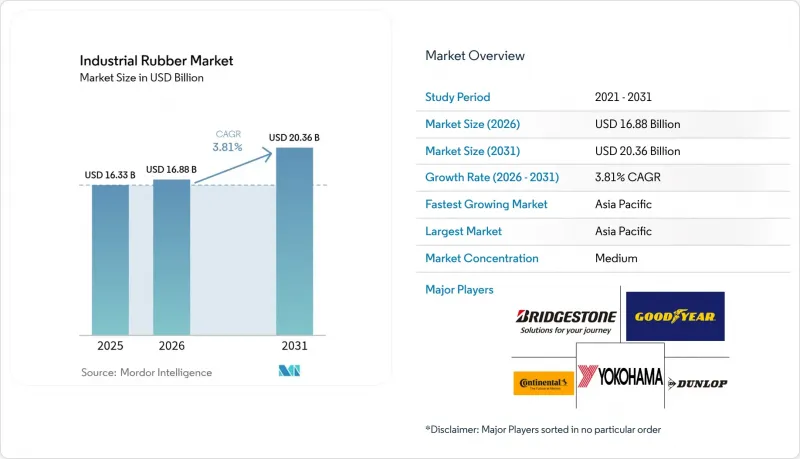
本報告按橡膠類型(天然橡膠、合成橡膠等)、加工方法(擠出成型、壓延等)、應用領域(輸送機、傳動帶等)、終端用戶行業(汽車和交通運輸等)以及地區(亞太地區、北美地區、歐洲地區、南美地區、中東和非洲地區)進行細分。市場預測以美元計價。
全球工業橡膠市場趨勢與洞察
擴展應用範圍,例如作為輸送機和傳動皮帶
在採礦、散裝卸和電子商務物流領域,鋼絲橡膠輸送帶的需求日益成長,其額定扭矩超過3150牛/毫米,並可在60度C以上的環境溫度下運作,這推動了亞太和南美地區輸送帶規格的升級。印尼2024年鎳產量預計將達到180萬噸,加速了符合ISO 340標準的阻燃輸送帶的訂單成長,以降低地下火災風險。智利530萬噸的銅產量正在推動傳統輸送機的維修,低滾動阻力輸送帶的引入可使驅動馬達的負載降低15%。傳動皮帶也在不斷發展,醯胺纖維增強材質已取代高速數控加工中心和自動化包裝線上的棉帆布。此外,嵌入式RFID標籤的加入使操作人員能夠根據即時磨損資料更換輸送帶,從而降低整體擁有成本(TCO)。
高壓軟管的需求不斷成長
隨著海上石油、海底工程和移動油壓設備等領域的設備運作不斷提高,額定壓力超過350巴的液壓組件的需求也不斷成長。派克漢尼芬公司於2024年推出的787TC軟管符合SAE 100R13和EN 856 4SP標準,工作壓力可達420巴,安全係數為6:1。一家計劃於2025年運作的中東裂解裝置指定使用氟聚合物內襯軟管輸送腐蝕性流體,這一細分市場的成長速度超過了整體油壓設備市場。在北美頁岩氣盆地,預計2025年日均產量將達到980億立方英尺,因此需要能夠承受1萬次壓力循環的軟管,而符合ISO 18752標準在新競標中也變得越來越重要。
嚴格的環境法規
歐盟2023年微塑膠法規將逐步淘汰人工草皮和地板材料中小於5毫米的橡膠顆粒,這將導致每件產品額外增加5萬至15萬歐元的第三方檢測和向國家主管部門提交文件的費用。 REACH法規附件十七將八種多環芳烴(PAHs)的含量限制在1毫克/公斤以內,迫使輪胎和皮帶製造商採購低芳烴加工油,從而使原料成本增加8%至12%。中國修訂後的2024年「綠色製造」計畫要求到2027年每噸橡膠的揮發性有機化合物(VOCs)含量降低15%,鼓勵投資溶劑回收系統。如果美國環保署(EPA)提案的臭氧濃度限值65 ppb(目前正在考慮於2025年實施)得以實施,那麼未能達到該標準的地區可能需要每個場地花費200萬至500萬美元用於減排設備。
細分市場分析
到2025年,合成橡膠將佔據工業橡膠市場71.12%的佔有率。丁苯橡膠(SBR)仍將是耐磨軟管和密封件的主要材料,而丁腈橡膠將在高階燃油系統中獲得更多需求。同時,再生橡膠正以每年5.06%的速度成長。這主要得益於歐盟指令推動2030年使用25%的再生材料,以及中國的生產者延伸責任制(EPR)鼓勵輪胎製造商實施循環經濟。 Tyromer和Genan等公司透過對廢舊輪胎進行脫硫處理,回收了70-80%的原生橡膠性能,使再生橡膠實用化用於生產墊子和屋頂材料,但由於ISO 1795測試的不足,其在汽車安全部件中的應用仍然受到限制。
在原料價格波動和微塑膠監管日益嚴格的背景下,橡膠生產商正將合成橡膠、天然橡膠和再生橡膠混合使用,以平衡性能和成本。氟橡膠和矽橡膠雖然仍屬於小眾市場,但其成長率已達到中個位數,超過了整體工業橡膠市場,這主要得益於半導體潔淨室、航太燃料系統和醫療設備等對熱穩定性要求極高的領域的需求。
擠出成型製程應用廣泛,涵蓋型材、軟管和密封條等領域,預計2025年將佔工業橡膠市場規模的45.18%。配備在線流變感測器的雙螺桿生產線可透過即時調整模具幾何形狀,將設定損失降低30%。模塑和澆鑄製程仍用於引擎支架和減振器等高精度應用領域,而液態矽膠射出成型由於符合FDA 21 CFR 177.2600標準,其在醫療和食品接觸領域的市場佔有率正在不斷擴大。
2024年,Stratasys公司的TPU 92A獲得航太認證,可依需求生產延伸率高達500%的墊片和密封件,推動積層製造市場成長4.20%。美國國防部標準MIL-STD-3049正在加速現場維護圖的材料認證,擴大了國防領域的需求。在壓延製程中(此製程是輸送機罩和屋頂膜的關鍵部件),將壓花和層壓整合到單一製程中,提高了生產線速度和材料利用率。
區域分析
預計到2025年,亞太地區將佔全球工業橡膠市場需求的59.09%,並在2031年之前以4.14%的複合年成長率持續成長,這主要得益於價值1兆美元的“一帶一路”基礎設施走廊項目以及印度針對汽車製造業的生產連結獎勵計畫(PLI)。在東南亞國協,2024年核准的橡膠相關專案總價值將達到8.9億美元,反映出企業正努力實現供應鏈多元化,減少對中國的依賴。同時,日本和韓國的加工商正在引入利用數位孿生技術的混煉生產線,以實現向汽車行業的準時交貨。
北美市場佔有率得益於日產980億立方英尺的頁岩氣以及一項價值1.2兆美元的基礎設施項目,這些項目維持了對橋樑支座、屋頂防水卷材和高壓液壓軟管的高需求。墨西哥年產汽車350萬輛,橡膠零件的在地化生產正在推進,以滿足美墨加協定(USMCA)的加值標準,投資也正湧入瓜納華托州和普埃布拉州的擠出產業叢集。
歐洲的消費趨勢反映了嚴格的REACH法規,這些法規加速了再生材料和生物基材料的普及應用;同時,德國先進的化合物為機械製造商(OEM)提供低揮發性有機化合物(VOC)的零件。南美洲依賴銅、鋰和鐵礦石的開採,這需要重型傳送帶和軟管;而中東和非洲則透過「沙烏地阿拉伯2030願景」下的建設項目以及南非採礦業的現代化而蓬勃發展。
其他好處:
- Excel格式的市場預測(ME)表
- 3個月的分析師支持
目錄
第1章:引言
- 研究假設和市場定義
- 調查範圍
第2章:調查方法
第3章執行摘要
第4章 市場狀況
- 市場概覽
- 市場促進因素
- 應用範圍擴大至傳送帶和動力傳輸帶。
- 高壓軟管的需求不斷成長
- 電動車推動了輕量化汽車零件市場的蓬勃發展。
- 新興國家基礎建設的擴張
- 引進符合工業4.0標準的智慧橡膠混煉生產線
- 市場限制因素
- 嚴格的環境法規
- 原物料價格波動與原油價格相關
- 再生橡膠的迅速普及
- 價值鏈分析
- 波特五力模型
第5章 市場規模與成長預測
- 不同類型的橡膠
- 天然橡膠
- 合成橡膠
- 再生橡膠
- 透過流程
- 擠壓
- 模具和澆鑄
- 日曆
- 3D列印/積層製造
- 透過使用
- 輸送機
- 傳動皮帶
- 壓力軟管
- 其他用途(屋頂材料、管材、捲材等)
- 按最終用戶行業分類
- 汽車和運輸業
- 建築和基礎設施
- 採礦和金屬
- 工業機械和設備
- 化工/石油化工
- 航太/國防
- 電氣和電子設備
- 其他終端用戶產業(例如包裝產業)
- 按地區
- 亞太地區
- 中國
- 印度
- 日本
- 韓國
- 泰國
- 印尼
- 越南
- 馬來西亞
- 菲律賓
- 其他亞太國家
- 北美洲
- 美國
- 加拿大
- 墨西哥
- 歐洲
- 德國
- 英國
- 法國
- 義大利
- 西班牙
- 俄羅斯
- 北歐國家
- 土耳其
- 其他歐洲國家
- 南美洲
- 巴西
- 阿根廷
- 哥倫比亞
- 其他南美國家
- 中東和非洲
- 沙烏地阿拉伯
- 阿拉伯聯合大公國
- 卡達
- 南非
- 奈及利亞
- 埃及
- 其他中東和非洲國家
- 亞太地區
第6章 競爭情勢
- 市場集中度
- 策略趨勢
- 市佔率和排名分析
- 公司簡介
- Bando Chemical Industries, LTD.
- Bridgestone Industrial
- China Petrochemical Corporation(Sinopec)
- ContiTech Deutschland GmbH
- Denka Company Limited
- ENEOS Materials Corporation
- Parker Hannifin Corp
- SIBUR Holding PJSC
- Sumitomo Rubber Industries, Ltd.
- The Goodyear Tire & Rubber Company
- THE YOKOHAMA RUBBER CO., LTD.
- Trelleborg AB
- Trinseo
- TSRC
- UBE Corporation
第7章 市場機會與未來展望
According to Mordor Intelligence, the industrial rubber market size is projected to expand from USD 16.33 billion in 2025 and USD 16.88 billion in 2026 to USD 20.36 billion by 2031, registering a CAGR of 3.81% between 2026 to 2031.
This report is Segmented by Rubber Type (Natural Rubber, Synthetic Rubber, and More), Process (Extrusion, Calendaring, and More), Application (Conveyor Belts, Transmission Belts, and More), End-User Industry (Automotive and Transportation and More), and Geography (Asia-Pacific, North America, Europe, South America, and Middle East and Africa). The Market Forecasts are Provided in Terms of Value (USD).
Global Industrial Rubber Market Trends and Insights
Increasing Application as Conveyor & Transmission Belts
Mining, bulk-handling, and e-commerce logistics are switching to steel-cord rubber belts rated above 3,150 N/mm and able to run at ambient temperatures beyond 60°C, spurring specification upgrades in Asia-Pacific and South America. Indonesia's 1.8 million-ton nickel surge in 2024 accelerated orders for flame-retardant belts compliant with ISO 340 to mitigate underground fire risk. Chile's 5.3 million-ton copper output retrofit legacy conveyors with low-rolling-resistance belts that cut drive-motor loads 15%. Transmission belts are also evolving, with aramid-fiber reinforcement replacing cotton canvas in high-speed CNC machining centers and automated packaging lines. Embedded RFID tags now allow operators to replace belts based on real-time wear data, lowering the total cost of ownership.
Growing Demand for High-Pressure Hoses
Hydraulic assemblies rated above 350 bar are expanding in offshore oil, subsea construction, and mobile hydraulics as equipment operates at higher loads. Parker Hannifin's 787TC hose, launched in 2024, delivers 420 bar working pressure and a 6:1 safety factor under SAE 100R13 and EN 856 4SP. Middle-East crackers commissioned in 2025 specify fluoropolymer-lined hoses for corrosive transfers, a niche growing faster than overall hydraulics. North America's shale basins, averaging 98 bcf/day in 2025, require hoses able to withstand 10,000 pressure cycles, reinforcing ISO 18752 compliance in new tenders.
Stringent Environmental Regulations
The EU's 2023 microplastics restriction phases out rubber granules <5 mm in turf and flooring, adding EUR 50,000-150,000 per product for third-party testing and dossiers to national authorities. REACH Annex XVII limits eight PAHs to 1 mg/kg, forcing tire and belt makers to source low-aromatic process oils and raising raw-material spend by 8-12%. China's 2024 Green Manufacturing update mandates a 15% VOC reduction per ton of rubber by 2027, driving investment in solvent-recovery systems. The U.S. EPA's proposed 65 ppb ozone cap under review in 2025 could require USD 2 million-5 million per site for abatement gear in non-attainment areas.
Other drivers and restraints analyzed in the detailed report include:
- EV-Led Boom in Lightweight Automotive Components
- Adoption of Industry 4.0 Smart Rubber-Compounding Lines
- Volatile Crude-Oil-Linked Feedstock Prices
For complete list of drivers and restraints, kindly check the Table Of Contents.
Segment Analysis
Synthetic rubber commanded a 71.12% industrial rubber market share in 2025 as SBR remained the workhorse for abrasion-resistant hoses and seals, while nitrile captured premium fuel-system demand. Reclaimed rubber, however, is expanding 5.06% annually as EU directives push for 25% recycled content by 2030 and China's EPR scheme incentivizes tire makers to close loops. Tyromer and Genan devulcanize waste tires to recover 70-80% of virgin properties, making reclaimed viable for mats and roofing, but still constrained by ISO 1795 testing gaps that limit use in automotive safety parts.
Feedstock volatility and microplastics scrutiny are prompting compounders to blend synthetic, natural, and reclaimed grades for balanced performance and cost. Fluoro- and silicone-based elastomers, though niche, are outgrowing the broader industrial rubber market at mid-single-digit rates thanks to semiconductor cleanroom, aerospace fuel-system, and medical-device demand where thermal stability is paramount.
Extrusion represented 45.18% of the industrial rubber market size in 2025 because of its scalability for profiles, hoses, and weather-strips. Twin-screw lines with inline rheology sensors now cut setup waste by 30% by adapting die geometry in real time. Molding and casting continue to serve high-tolerance engine mounts and vibration isolators, with liquid silicone injection gaining medical and food-contact share under FDA 21 CFR 177.2600 compliance.
Additive manufacturing is advancing 4.20% as Stratasys TPU 92A gained aerospace certification in 2024, allowing on-demand fabrication of gaskets and seals with 500% elongation. The US Department of Defense standard MIL-STD-3049 accelerates material qualification for field maintenance prints, expanding defense demand. Calendaring, vital for conveyor-belt covers and roofing membranes, is integrating embossing and laminating in a single pass to raise line speed and material utilization.
Complete Report Scope:
- By Rubber Type
- Natural Rubber
- Synthetic Rubber
- Reclaimed Rubber
- By Process
- Extrusion
- Molding and Casting
- Calendaring
- 3-D Printing / Additive Manufacturing
- By Application
- Conveyor Belts
- Transmission Belts
- Pressure Hoses
- Other Application (Roofing, Tubes, Rolls, etc.)
- By End-User Industry
- Automotive and Transportation
- Construction and Infrastructure
- Mining and Metals
- Industrial Machinery and Equipment
- Chemical and Petrochemical
- Aerospace and Defence
- Electrical and Electronics
- Other End-user Industries (Packaging Industry, etc.)
- By Geography
- Asia-Pacific
- China
- India
- Japan
- South Korea
- Thailand
- Indonesia
- Vietnam
- Malaysia
- Philippines
- Rest of Asia-Pacific
- North America
- United States
- Canada
- Mexico
- Europe
- Germany
- United Kingdom
- France
- Italy
- Spain
- Russia
- NORDIC Countries
- Turkey
- Rest of Europe
- South America
- Brazil
- Argentina
- Colombia
- Rest of South America
- Middle East and Africa
- Saudi Arabia
- United Arab Emirates
- Qatar
- South Africa
- Nigeria
- Egypt
- Rest of Middle East and Africa
- Asia-Pacific
Geography Analysis
Asia-Pacific held 59.09% of global industrial rubber market demand in 2025, expanding at a forecast 4.14% CAGR to 2031, supported by USD 1 trillion Belt and Road infrastructure corridors and India's Production-Linked Incentive for auto manufacturing. ASEAN states attracted USD 890 million in approved rubber projects in 2024 as firms diversify supply chains away from China, while Japanese and Korean processors deploy digital-twin compounding lines for just-in-time auto deliveries.
North America's share is anchored by 98 bcf/day shale gas production and a USD 1.2 trillion infrastructure program that keeps demand high for bridge bearings, roofing membranes, and high-pressure hydraulic hoses. Mexico's 3.5 million-vehicle output is localizing rubber components to meet USMCA value rules, drawing investment into extrusion clusters in Guanajuato and Puebla.
Europe's consumption reflects stringent REACH limits that accelerate reclaimed and bio-based uptake, while Germany's advanced compounds supply low-VOC parts to machinery OEMs. South America relies on copper, lithium, and iron-ore extraction that needs heavy-duty belts and hoses, whereas the Middle East and Africa grow through Saudi Vision 2030 construction and South Africa's mining-sector upgrades.
- Bando Chemical Industries, LTD.
- Bridgestone Industrial
- China Petrochemical Corporation (Sinopec)
- ContiTech Deutschland GmbH
- Denka Company Limited
- ENEOS Materials Corporation
- Parker Hannifin Corp
- SIBUR Holding PJSC
- Sumitomo Rubber Industries, Ltd.
- The Goodyear Tire & Rubber Company
- THE YOKOHAMA RUBBER CO., LTD.
- Trelleborg AB
- Trinseo
- TSRC
- UBE Corporation
Additional Benefits:
- The market estimate (ME) sheet in Excel format
- 3 months of analyst support
TABLE OF CONTENTS
1 Introduction
- 1.1 Study Assumptions & Market Definition
- 1.2 Scope of the Study
2 Research Methodology
3 Executive Summary
4 Market Landscape
- 4.1 Market Overview
- 4.2 Market Drivers
- 4.2.1 Increasing application as conveyor & transmission belts
- 4.2.2 Growing demand for high-pressure hoses
- 4.2.3 EV-led boom in lightweight automotive components
- 4.2.4 Infrastructure build-out in emerging economies
- 4.2.5 Adoption of Industry 4.0 smart rubber-compounding lines
- 4.3 Market Restraints
- 4.3.1 Stringent environmental regulations
- 4.3.2 Volatile crude-oil-linked feedstock prices
- 4.3.3 Rapid uptake of reclaimed rubber
- 4.4 Value Chain Analysis
- 4.5 Porter's Five Forces
- 4.5.1 Bargaining Power of Suppliers
- 4.5.2 Bargaining Power of Buyers
- 4.5.3 Threat of New Entrants
- 4.5.4 Threat of Substitutes
- 4.5.5 Degree of Competition
5 Market Size & Growth Forecasts (Value)
- 5.1 By Rubber Type
- 5.1.1 Natural Rubber
- 5.1.2 Synthetic Rubber
- 5.1.3 Reclaimed Rubber
- 5.2 By Process
- 5.2.1 Extrusion
- 5.2.2 Molding and Casting
- 5.2.3 Calendaring
- 5.2.4 3-D Printing / Additive Manufacturing
- 5.3 By Application
- 5.3.1 Conveyor Belts
- 5.3.2 Transmission Belts
- 5.3.3 Pressure Hoses
- 5.3.4 Other Application (Roofing, Tubes, Rolls, etc.)
- 5.4 By End-User Industry
- 5.4.1 Automotive and Transportation
- 5.4.2 Construction and Infrastructure
- 5.4.3 Mining and Metals
- 5.4.4 Industrial Machinery and Equipment
- 5.4.5 Chemical and Petrochemical
- 5.4.6 Aerospace and Defence
- 5.4.7 Electrical and Electronics
- 5.4.8 Other End-user Industries (Packaging Industry, etc.)
- 5.5 By Geography
- 5.5.1 Asia-Pacific
- 5.5.1.1 China
- 5.5.1.2 India
- 5.5.1.3 Japan
- 5.5.1.4 South Korea
- 5.5.1.5 Thailand
- 5.5.1.6 Indonesia
- 5.5.1.7 Vietnam
- 5.5.1.8 Malaysia
- 5.5.1.9 Philippines
- 5.5.1.10 Rest of Asia-Pacific
- 5.5.2 North America
- 5.5.2.1 United States
- 5.5.2.2 Canada
- 5.5.2.3 Mexico
- 5.5.3 Europe
- 5.5.3.1 Germany
- 5.5.3.2 United Kingdom
- 5.5.3.3 France
- 5.5.3.4 Italy
- 5.5.3.5 Spain
- 5.5.3.6 Russia
- 5.5.3.7 NORDIC Countries
- 5.5.3.8 Turkey
- 5.5.3.9 Rest of Europe
- 5.5.4 South America
- 5.5.4.1 Brazil
- 5.5.4.2 Argentina
- 5.5.4.3 Colombia
- 5.5.4.4 Rest of South America
- 5.5.5 Middle East and Africa
- 5.5.5.1 Saudi Arabia
- 5.5.5.2 United Arab Emirates
- 5.5.5.3 Qatar
- 5.5.5.4 South Africa
- 5.5.5.5 Nigeria
- 5.5.5.6 Egypt
- 5.5.5.7 Rest of Middle East and Africa
- 5.5.1 Asia-Pacific
6 Competitive Landscape
- 6.1 Market Concentration
- 6.2 Strategic Moves
- 6.3 Market Share(%)/Ranking Analysis
- 6.4 Company Profiles (includes Global level Overview, Market level overview, Core Segments, Financials as available, Strategic Information, Products & Services, and Recent Developments)
- 6.4.1 Bando Chemical Industries, LTD.
- 6.4.2 Bridgestone Industrial
- 6.4.3 China Petrochemical Corporation (Sinopec)
- 6.4.4 ContiTech Deutschland GmbH
- 6.4.5 Denka Company Limited
- 6.4.6 ENEOS Materials Corporation
- 6.4.7 Parker Hannifin Corp
- 6.4.8 SIBUR Holding PJSC
- 6.4.9 Sumitomo Rubber Industries, Ltd.
- 6.4.10 The Goodyear Tire & Rubber Company
- 6.4.11 THE YOKOHAMA RUBBER CO., LTD.
- 6.4.12 Trelleborg AB
- 6.4.13 Trinseo
- 6.4.14 TSRC
- 6.4.15 UBE Corporation
7 Market Opportunities & Future Outlook
- 7.1 White-space & unmet-needs assessment
- 7.2 Introducing New Manufacturing Techniques to Reduce Hazardous Waste

 工業橡膠市場:依產品類型、材料類型、製造流程和最終用途產業分類-2026-2032年全球市場預測
 工業橡膠市場規模、佔有率、趨勢和預測:按類型、產品類型、最終用途行業和地區分類,2026-2034年
 全球工業橡膠製品市場規模、佔有率、趨勢和成長分析報告(2026-2034年)
 2026年全球工業橡膠市場報告
 工業橡膠市場規模、佔有率和成長分析(按類型、產品類型、產品加工和地區分類)-2026-2033年產業預測
 工業橡膠市場-全球產業規模、佔有率、趨勢、機會及預測(按類型、應用、地區和競爭細分,2020-2030 年)
 全球工業橡膠市場(依最終使用流程、類型、產品、應用和地區分類)-預測至2030年