


 |
市場調查報告書
商品編碼
2123767
海上鑽井:市場佔有率分析、行業趨勢和統計數據、成長預測(2026-2031 年)Offshore Drilling - Market Share Analysis, Industry Trends & Statistics, Growth Forecasts (2026 - 2031) |
||||||

※ 本網頁內容可能與最新版本有所差異。詳細情況請與我們聯繫。
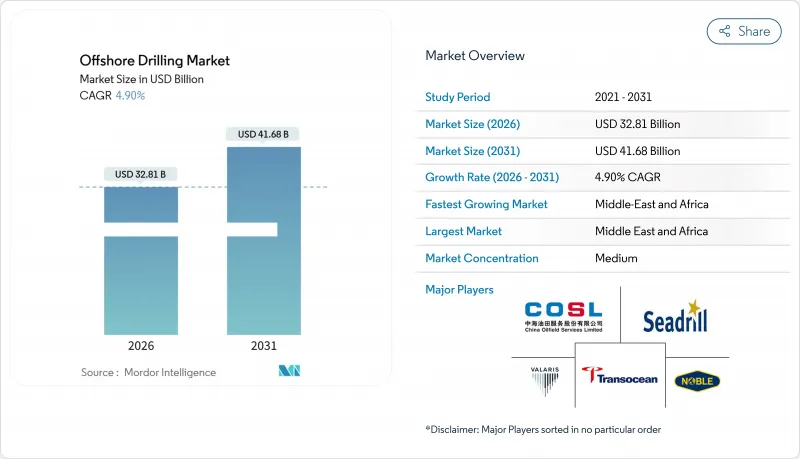
根據 Mordor Intelligence 預測,海上開採市場規模預計將在 2025 年達到 312.2 億美元,在 2026 年擴大到 328.1 億美元,並最終在 2031 年達到 416.8 億美元,年複合成長率為 4.90%。
這顯示上游產業對複雜油井和長壽命儲存的投資穩定增加。
本報告按井類型(傳統型和傳統型)、水深(淺水井、深水井和超深水井)、服務範圍(探勘開發鑽井、生產和維修、封裝和退役以及海底支援)和地區(北美、歐洲、亞太、南美以及中東和非洲)進行細分。市場規模和預測均以美元計價。
全球海上開採市場趨勢與洞察
中東大型專案對自升式鑽機的需求不斷成長
由於沙烏地阿拉伯減產導致現貨價格波動,得益於海灣國家石油公司(ADNOC)簽署的多年期契約,自升式鑽機的運轉率一直保持在90%以上。 2025年5月,ADNOC授予了一份價值11.5億美元的契約,用於建造兩座高規格鑽井平台,並簽訂了一份為期15年的租約,使其鑽機平台數量超過140座。這反映了卡達能源公司因其1.26億噸液化天然氣(LNG)產能擴張計畫而產生的額外產能需求。陸架鑽井和深井鑽井業務均受益於此成長,而印度石油天然氣公司(ONGC)正在克里希納-戈達瓦里河谷推行類似的長期模式。因此,訂單,海上開採市場的前景正在改善,但如果歐佩克+的配額限制了沙烏地阿拉伯的活動,則仍有可能出現暫時的供應過剩。
在巴西、圭亞那和奈米比亞發現深海油田
在水深超過7500英尺的超深海中發現的油氣資源,正在重新定義商業性盈虧平衡點,促使巴西石油公司(Petrobras)、埃克森美孚(ExxonMobil)和道達爾能源(Total Energy)批准開發數十億桶儲量的油田,這些油田適用於使用動態定位鑽井船進行作業。 Atapu-2和Sepia-2油田將在未來十年內滿足Transocean和Noble的訂單,而Equinor的Bacalhau油田在2025年實現了首批原油的盈虧平衡,預計盈虧平衡點將低於每桶35美元。奈米比亞的奧蘭治盆地正在吸引早期資本,這表明海上開採市場未來的成長將越來越依賴新興盆地。
向離岸風電租賃區域的轉移正在加速。
在英國、美國和荷蘭,海底區域和重型裝運船隻正轉移到風力發電工程,這使得原本用於海上油氣開發的資源捉襟見肘。預計2024年至2025年間,起重機操作員和海底技術人員的人事費用成本將上漲25%至30%,將對鑽井承包商的營業利潤率造成壓力。
細分市場分析
到2025年,常規油井將佔海上鑽井市場佔有率的90.33%,這反映了數十年來累積的地下數據將降低墨西哥灣、北海和其他近海地區的專案風險。可預測的地質條件和成熟的完井技術使營運商能夠快速將有前景的井位轉化為生產井,從而縮短開發週期並保持較高的現金流前景。然而,隨著水平鑽井和水力壓裂等陸上技術被引入淺水區,使得開發以前被認為沒有商業性價值的緻密儲存成為可能,預計到2031年,傳統型海上油井的複合年成長率將達到10.49%。長延伸井和多分支井的設計使生產商能夠從現有平台探勘新的生產層,從而減少初始投資並延長油田的壽命。因此,隨著傳統型油氣發現率的下降和租賃庫存的老化,與這些發展相關的傳統型海上鑽井市場規模在新計畫核准中所佔的比例越來越大。
這種發展動能在現有資產具備基礎設施領先優勢的盆地最為顯著,使營運商無需新建樞紐即可鑽探遠距離水平井。 BP公司針對緊湊型設施提出的「設計一套,建造多套」模式,充分展現了簡化的上部模組、標準化的井口裝置以及工廠化生產模式如何降低損益平衡點並縮短專案週期。隨著營運商對更小井距和透過增產措施儲存儲層體積的需求不斷成長,提供高精度旋轉井架系統、高功率壓裂設備和即時水下遙測技術的承包商有望從中受益。傳統型專案通常每個油田的井數較多,從而導致服務需求增加,並形成持續的需求流,與傳統的探勘和評估工作形成互補。因此,海上鑽井市場正在向雙軌制模式轉變:高性能鑽機專注於深海礦區的探勘,而高度適應性的升降式鑽機和平台鑽機則用於近海非傳統資源的開採。
區域分析
中東和非洲以31.09%的市場佔有率和5.50%的預期複合年成長率引領海上鑽井市場。卡達的長期液化天然氣相關項目、沙烏地阿拉伯的天然氣開發以及奈及利亞和安哥拉的深海區塊開發都支撐著市場擴張。南美洲緊追在後,市佔率約22%,主要得益於巴西的鹽層下氣田和圭亞那的斯塔布布魯克區塊。北美市場佔有率為18%,主要集中在墨西哥灣,高壓技術正在推動新儲存的開發,但這與頁岩氣投資資金的競爭密切。歐洲市場佔有率為15%,主要得益於挪威的產量,但優先租賃土地用於風力發電的做法正在減少可開採油氣資源的面積。亞太地區市場佔有率為14%,主要反映了中國的渤海灣、印度的克里米亞-格陵蘭盆地和澳洲的斯卡伯勒天然氣項目,儘管面臨天氣和物流方面的挑戰,這些項目仍在支撐著區域鑽機需求。這些區域趨勢結合起來,使得海上鑽井市場呈現成熟項目和未開發項目之間較為均衡的組合。
其他好處:
- Excel格式的市場預測(ME)表
- 3個月的分析師支持
目錄
第1章:引言
- 研究假設和市場定義
- 調查範圍
第2章:調查方法
第3章執行摘要
第4章 市場狀況
- 市場概覽
- 市場促進因素
- 中東大型專案對自升式鑽機的需求不斷成長
- 在巴西、圭亞那和奈米比亞發現深海油田
- 探勘與生產資本支出已恢復到 2014 年以上的水平。
- 混合動力驅動的「低碳」鑽井鑽機可顯著降低燃料消耗。
- 自主鑽井和數位孿生技術提高了運轉率。
- 天然氣需求不斷成長以及天然氣基礎設施的開發
- 市場限制因素
- 離岸風力發電租賃區塊的引入正在加速。
- 布蘭特原油損益平衡價格波動劇烈,抑制了財務獨立性決定(FID)。
- 海上作業人員短缺導致營運成本飆升。
- 由於環境、社會和治理因素,新建鑽井鑽機資金短缺。
- 供應鏈分析
- 監理情勢
- 技術展望
- 大型海上專案的管道
- 現有項目
- 正在規劃和公佈的項目
- 波特五力模型
第5章 市場規模與成長預測
- 按井類型
- 傳統的
- 傳統型
- 按水深
- 淺水區(小於 400 英尺)
- 深海(400-5000英尺)
- 超深海(超過5000英尺)
- 按服務
- 探勘與開發鑽井
- 生產/維修
- 連接/斷開
- 海底支持
- 按地區
- 北美洲
- 美國
- 加拿大
- 墨西哥
- 歐洲
- 德國
- 英國
- 挪威
- 俄羅斯
- 其他歐洲國家
- 亞太地區
- 中國
- 印度
- 泰國
- 越南
- 澳洲
- 亞太地區(其他)
- 南美洲
- 巴西
- 千里達及托巴哥
- 其他南美國家
- 中東和非洲
- 沙烏地阿拉伯
- 阿拉伯聯合大公國
- 卡達
- 埃及
- 奈及利亞
- 安哥拉
- 奈米比亞
- 其他中東和非洲國家
- 北美洲
第6章 競爭情勢
- 市場集中度
- 策略趨勢(併購、聯盟、購電協議)
- 市場佔有率分析(主要公司的市場排名和佔有率)
- 公司簡介
- Transocean Ltd.
- Valaris plc
- China Oilfield Services Ltd.(COSL)
- Noble Corp.
- Seadrill Ltd.
- Shelf Drilling Ltd.
- Borr Drilling Ltd.
- ADNOC Drilling
- PetroSaudi
- KCA Deutag
- Saipem SpA
- Odfjell Drilling
- Stena Drilling
- Maersk Drilling(Noble)
- Baker Hughes Co.
- Halliburton Co.
- Schlumberger Ltd.
- Weatherford Int'l
- Petrofac Ltd.
- Exalo Drilling
第7章 市場機會與未來展望
According to Mordor Intelligence, the offshore drilling market size reached USD 31.22 billion in 2025 and is projected to climb to USD 32.81 billion in 2026, eventually advancing to USD 41.68 billion by 2031 at a 4.90% CAGR, underscoring a steady upswing in upstream spending on complex wells and longer-life reservoirs.
This report is Segmented by Well Type (Conventional and Unconventional), Water Depth (Shallow Water, Deepwater, and Ultra-Deepwater), Service (Exploration and Development Drilling, Production/Workover, Plug and Abandonment, and Subsea Support), and Geography (North America, Europe, Asia-Pacific, South America, and Middle East and Africa). The Market Sizes and Forecasts are Provided in Terms of Value (USD).
Global Offshore Drilling Market Trends and Insights
Growing Jack-up Demand in Middle East Mega-Programs
Multi-year contracts signed by national oil companies in the Arabian Gulf keep jack-up utilization above 90% even as Saudi production cuts introduce spot-rate volatility. ADNOC's USD 1.15 billion award for two high-specification units in May 2025, locked in fifteen-year charters and expanded the contractor's fleet past 140 rigs, mirroring QatarEnergy's requirement for additional capacity tied to a 126 million-tonnes LNG build-out. Shelf Drilling and Borr Drilling benefit from this surge, while India's ONGC pursues a similar long-term model in the Krishna-Godavari basin. The offshore drilling market, therefore, enjoys improved backlog visibility, though episodic oversupply remains possible whenever OPEC+ quotas constrain Saudi activity.
Deepwater Discoveries in Brazil, Guyana & Namibia
Ultra-deepwater finds exceeding 7,500 feet are redefining commercial breakevens, with Petrobras, ExxonMobil, and TotalEnergies sanctioning multi-billion-barrel fields that favor dynamic-positioning drillships. Atapu-2 and Sepia-2 anchor Transocean and Noble backlogs through the decade, while Equinor's Bacalhau delivered first oil at sub-USD 35/bbl breakevens in 2025. Namibia's Orange Basin attracts early-stage capital, indicating that the offshore drilling market will lean increasingly on frontier basins for future growth.
Accelerating Switch to Offshore Wind Lease Blocks
Seabed acreage and heavy-lift vessels are being redirected to UK, U.S., and Dutch wind projects, tightening resource pools that once served offshore hydrocarbon campaigns. Labor premiums for crane operators and subsea technicians climbed 25-30% between 2024 and 2025, squeezing operating margins for drilling contractors.
Other drivers and restraints analyzed in the detailed report include:
- E&P CAPEX Rebound Above 2014 Levels
- Hybrid-Powered "Low-Carbon" Rigs Slash Fuel Burn
- Volatile Brent Breakevens Curb FIDs
For complete list of drivers and restraints, kindly check the Table Of Contents.
Segment Analysis
Conventional wells controlled 90.33% of the offshore drilling market share in 2025, reflecting decades of accumulated subsurface data that de-risk projects in the Gulf of Mexico, the North Sea, and offshore. Predictable geology and proven completion techniques let operators convert prospects quickly, keeping development cycles short and cash-flow visibility high. However, unconventional offshore wells are expanding at a 10.49% CAGR through 2031 as horizontal drilling and hydraulic-fracturing methods, refined onshore, migrate to shallow-water settings and unlock tight reservoirs previously viewed as non-commercial. Extended-reach and multilateral designs allow producers to tap new pay zones from existing platforms, trimming upfront capital and stretching field life. The unconventional offshore drilling market size associated with these developments, therefore, represents a growing slice of new-project sanctioning as conventional discovery rates wane and lease inventories mature.
Momentum is sharpest in basins where legacy assets offer infrastructure head starts, letting operators drill long-step-out laterals without building new hubs. BP's "design one and build many" template for compact facilities exemplifies how simplified topsides, standardized wellhead trees, and factory-style execution lower break-evens and shorten schedules. Contractors that supply precision rotary-steerable systems, high-horsepower frac spreads, and real-time downhole telemetry stand to benefit as operators seek tighter well spacing and higher stimulated reservoir volumes. Because unconventional programs often involve a higher well count per field, service intensity rises, anchoring a durable demand stream that augments traditional exploration and appraisal work. As a result, the offshore drilling market is transitioning toward a dual-track model in which high-spec rigs chase deepwater prospects while adaptable jackups and platform rigs exploit near-field unconventional targets.
Complete Report Scope:
- By Well Type
- Conventional
- Unconventional
- By Water Depth
- Shallow Water (Below 400 ft)
- Deepwater (400 to 5,000 ft)
- Ultra-deepwater (Above 5,000 ft)
- By Service
- Exploration and Development Drilling
- Production/Workover
- Plug and Abandonment
- Subsea Support
- By Geography
- North America
- United States
- Canada
- Mexico
- Europe
- Germany
- United Kingdom
- Norway
- Russia
- Rest of Europe
- Asia-Pacifc
- China
- India
- Thailand
- Vietnam
- Australia
- Rest of Asia-Pacifc
- South America
- Brazil
- Trinidad and Tobago
- Rest of South America
- Middle East and Africa
- Saudi Arabia
- United Arab Emirates
- Qatar
- Egypt
- Nigeria
- Angola
- Namibia
- Rest of Middle East and Africa
- North America
Geography Analysis
The Middle East and Africa lead the offshore drilling market with a 31.09% share and a 5.50% forecast CAGR. Long-term LNG-linked projects in Qatar, gas development in Saudi Arabia, and deepwater prospects in Nigeria and Angola underpin expansion. South America follows at roughly 22%, driven mainly by Brazil's pre-salt and Guyana's Stabroek Block. North America's 18% share centers on the Gulf of Mexico, where high-pressure technology unlocks new reservoirs but competes with shale capital. Europe's 15% share is anchored by Norwegian output, but wind-lease priority narrows hydrocarbon acreage. Asia-Pacific's 14% stake reflects China's Bohai Bay, India's KG Basin, and Australia's Scarborough gas project, each sustaining localized rig demand despite weather and logistics hurdles. These regional dynamics collectively give the offshore drilling market a balanced mix of mature and frontier opportunities.
- Transocean Ltd.
- Valaris plc
- China Oilfield Services Ltd. (COSL)
- Noble Corp.
- Seadrill Ltd.
- Shelf Drilling Ltd.
- Borr Drilling Ltd.
- ADNOC Drilling
- PetroSaudi
- KCA Deutag
- Saipem SpA
- Odfjell Drilling
- Stena Drilling
- Maersk Drilling (Noble)
- Baker Hughes Co.
- Halliburton Co.
- Schlumberger Ltd.
- Weatherford Int'l
- Petrofac Ltd.
- Exalo Drilling
Additional Benefits:
- The market estimate (ME) sheet in Excel format
- 3 months of analyst support
TABLE OF CONTENTS
1 Introduction
- 1.1 Study Assumptions & Market Definition
- 1.2 Scope of the Study
2 Research Methodology
3 Executive Summary
4 Market Landscape
- 4.1 Market Overview
- 4.2 Market Drivers
- 4.2.1 Growing jack-up demand in Middle East mega-programs
- 4.2.2 Deepwater discoveries in Brazil, Guyana & Namibia
- 4.2.3 E&P CAPEX rebound above 2014 levels
- 4.2.4 Hybrid-powered "low-carbon" rigs slash fuel burn
- 4.2.5 Autonomous drilling & digital twins lift uptime
- 4.2.6 Growing demand for natural gas and developing gas infrastructure
- 4.3 Market Restraints
- 4.3.1 Accelerating switch to offshore wind lease blocks
- 4.3.2 Volatile Brent breakevens curb FIDs
- 4.3.3 Offshore-crew shortage inflates OPEX
- 4.3.4 ESG-driven capital drought for newbuild rigs
- 4.4 Supply-Chain Analysis
- 4.5 Regulatory Landscape
- 4.6 Technological Outlook
- 4.7 Key Offshore Projects Pipeline
- 4.7.1 Existing Projects
- 4.7.2 Planned and Announced Projects
- 4.8 Porter's Five Forces
- 4.8.1 Bargaining Power of Suppliers
- 4.8.2 Bargaining Power of Buyers
- 4.8.3 Threat of New Entrants
- 4.8.4 Threat of Substitutes
- 4.8.5 Competitive Rivalry
5 Market Size & Growth Forecasts
- 5.1 By Well Type
- 5.1.1 Conventional
- 5.1.2 Unconventional
- 5.2 By Water Depth
- 5.2.1 Shallow Water (Below 400 ft)
- 5.2.2 Deepwater (400 to 5,000 ft)
- 5.2.3 Ultra-deepwater (Above 5,000 ft)
- 5.3 By Service
- 5.3.1 Exploration and Development Drilling
- 5.3.2 Production/Workover
- 5.3.3 Plug and Abandonment
- 5.3.4 Subsea Support
- 5.4 By Geography
- 5.4.1 North America
- 5.4.1.1 United States
- 5.4.1.2 Canada
- 5.4.1.3 Mexico
- 5.4.2 Europe
- 5.4.2.1 Germany
- 5.4.2.2 United Kingdom
- 5.4.2.3 Norway
- 5.4.2.4 Russia
- 5.4.2.5 Rest of Europe
- 5.4.3 Asia-Pacifc
- 5.4.3.1 China
- 5.4.3.2 India
- 5.4.3.3 Thailand
- 5.4.3.4 Vietnam
- 5.4.3.5 Australia
- 5.4.3.6 Rest of Asia-Pacifc
- 5.4.4 South America
- 5.4.4.1 Brazil
- 5.4.4.2 Trinidad and Tobago
- 5.4.4.3 Rest of South America
- 5.4.5 Middle East and Africa
- 5.4.5.1 Saudi Arabia
- 5.4.5.2 United Arab Emirates
- 5.4.5.3 Qatar
- 5.4.5.4 Egypt
- 5.4.5.5 Nigeria
- 5.4.5.6 Angola
- 5.4.5.7 Namibia
- 5.4.5.8 Rest of Middle East and Africa
- 5.4.1 North America
6 Competitive Landscape
- 6.1 Market Concentration
- 6.2 Strategic Moves (M&A, Partnerships, PPAs)
- 6.3 Market Share Analysis (Market Rank/Share for key companies)
- 6.4 Company Profiles (includes Global level Overview, Market level overview, Core Segments, Financials as available, Strategic Information, Products & Services, and Recent Developments)
- 6.4.1 Transocean Ltd.
- 6.4.2 Valaris plc
- 6.4.3 China Oilfield Services Ltd. (COSL)
- 6.4.4 Noble Corp.
- 6.4.5 Seadrill Ltd.
- 6.4.6 Shelf Drilling Ltd.
- 6.4.7 Borr Drilling Ltd.
- 6.4.8 ADNOC Drilling
- 6.4.9 PetroSaudi
- 6.4.10 KCA Deutag
- 6.4.11 Saipem SpA
- 6.4.12 Odfjell Drilling
- 6.4.13 Stena Drilling
- 6.4.14 Maersk Drilling (Noble)
- 6.4.15 Baker Hughes Co.
- 6.4.16 Halliburton Co.
- 6.4.17 Schlumberger Ltd.
- 6.4.18 Weatherford Int'l
- 6.4.19 Petrofac Ltd.
- 6.4.20 Exalo Drilling
7 Market Opportunities & Future Outlook
- 7.1 White-space & Unmet-Need Assessment

 2026 年至 2035 年海上鑽井服務的市場機會、成長促進因素、產業趨勢分析與預測。
 海上鑽井市場報告:按鑽機類型、深度和地區分類(2026-2034 年)
 全球海上鑽井市場規模、佔有率、趨勢和成長分析報告(2026-2034)
 2026年全球井筒清洗工具市場報告2026年全球海上鑽井市場報告
 海上鑽井市場:依井型、鑽機類型及應用分類,全球預測(2026-2032年)全球海上鑽井市場:市場規模、市場佔有率、成長率、產業分析、依類型、應用和地區劃分的考察、未來預測(2026-2034)海上鑽井市場-2025年至2030年預測
 井筒清潔工具市場-全球產業規模、佔有率、趨勢、機會和預測,按工具類型、井類型、最終用戶、地區和競爭情況細分,2020-2030 年海上鑽井設備市場 - 全球產業規模、佔有率、趨勢、機會和預測,按類型、應用、地區和競爭細分,2020-2030F 2020-2030F