


 |
市場調查報告書
商品編碼
2123766
發電機租賃:市場佔有率分析、產業趨勢與統計、成長預測(2026-2031)Power Generator Rental - Market Share Analysis, Industry Trends & Statistics, Growth Forecasts (2026 - 2031) |
||||||

※ 本網頁內容可能與最新版本有所差異。詳細情況請與我們聯繫。
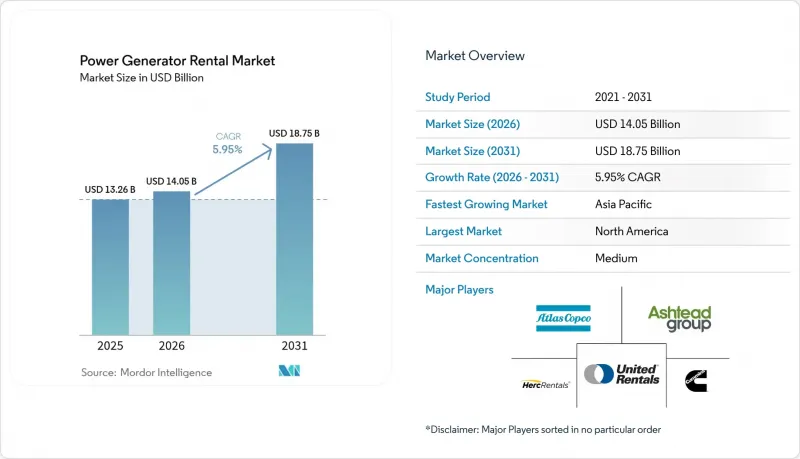
據 Mordor Intelligence 稱,發電機租賃市場預計到 2026 年價值 140.5 億美元,高於 2025 年的 132.6 億美元,預計到 2031 年將達到 187.5 億美元。
預計從 2026 年到 2031 年,其複合年成長率將達到 5.95%。
本報告按燃料類型(柴油、天然氣、混合動力/電池整合、氫能等)、額定功率(小於 100 kVA、101–500 kVA、501–1,000 kVA 及以上)、應用(備用/後備、主用/連續運行、尖峰用電調節)、最終用戶(建築、石油和分類、北美地區製造、資料中心和歐洲地區(北美
全球發電機租賃市場趨勢及洞察
老化的電網基礎設施和頻繁的停電
美國和西歐的電力資產平均運作已達40年以上,這使得它們越來越容易受到極端天氣造成的停電影響,而極端天氣已佔重大服務中斷的近80%。規劃容錯方案通常需要長時間的饋線停機,在此期間,行動發電機組會維持使用者的電力供應,並為在保持供電區域的工作人員提供支援。當風暴造成的損失超過復原力時,電力公司會將拖車式發電機組部署到醫院、通訊塔和社區避難所,推高了租賃需求。電網營運商實施的預測分析正在縮短維護週期,但矛盾的是,這反而增加了計畫停電的頻率,進一步維持了租賃需求。無需擁有固定資產即可靈活增減發電容量的能力,使發電機租賃市場成為電力公司提升韌性的核心工具,並增強了輸配電基礎設施的韌性。
新興國家的基礎建設和建築業蓬勃發展
各國政府和多邊組織支出激增,例如1.2兆美元的《基礎設施投資和就業法案》以及印度、印尼和沙烏地阿拉伯正在進行的類似大型企劃,導致數千個建築工地無法連接穩定的電網。建設公司傾向於租賃設備,以避免前期設備成本,並可根據專案從土方工程到室內裝修的進度,靈活調整發電容量以適應不斷變化的工地負載。隨著都市化的持續快速推進,預計到2030年亞太地區城市人口將增加9,000多萬,道路、地鐵和污水處理廠等設施在各個施工階段的臨時電力消耗需求正在加速成長。除了資金柔軟性之外,租賃設備還能讓承包商在當地政府收緊空氣品質法規時,透過更換老舊引擎,立即符合第五階段排放標準。這些因素表明,新興地區的發電機租賃市場預計將在長期內實現快速成長。
電池儲能的替代方案
自2013年以來,鋰離子電池系統的成本已下降80%,使得商業設施能夠透過安裝可運作1-4小時的電池來降低尖峰時段的電費並提供零排放備用電源。模擬結果表明,在為節日慶典、電影拍攝現場和通訊塔供電的混合微電網中,將電池儲能與現場太陽能發電相結合,可將柴油發電機的運作減少高達80%。在巴西,微電網所有者透過在高峰時段以電池取代發電機組,已將其年度電費降低了33%。加州SGIP補貼等監管獎勵正在加速電池的普及,而隨著靜音、快速反應的電池滿足可靠性標準,短期租賃需求正在萎縮。然而,電池不足以應對颶風或電網故障造成的持續數天的停電,這凸顯了對可透過補充燃料無限期運作的租賃引擎的需求。
細分市場分析
2025年,柴油發電機市場規模維持在91.1億美元,持續領先發電機租賃市場。其完善的加氣基礎設施和久經考驗的可靠性支撐了其68.72%的市場佔有率。然而,隨著租賃者對更低燃料成本、更小噪音以及即時符合第五階段排放標準的需求日益成長,預計到2031年,混合動力(電池-柴油)發電機組的複合年成長率將達到9.35%,成為市場成長最快的方案。營運商表示,智慧控制設備可以透過保持引擎怠速並將波動負載轉移到電池,從而降低高達80%的能耗並延長維護週期。天然氣發電機在擁有完善管網和嚴格顆粒物排放法規的地區表現良好。同時,德國和日本的氫能試點計畫在初期就展現出良好的前景,並有望成為零碳節慶活動的理想能源。
競爭格局正在改變。聯合租賃公司(United Rentals)的EHR太陽能電池發電機將5千瓦太陽能座艙罩、45千伏安丙烷發電機和鋰離子電池組組合在一起,打造出超低噪音的貨櫃式微電網,適用於都市區維修專案。阿特拉斯·科普柯(Atlas Copco)、康明斯(Cummins)和艾格瑞科(Aggreco)目前已在其10-100千伏安級別的機型中將電池作為標準配置。氫能仍然是一個小眾市場,但歐洲的補貼政策正在推動在偏遠通訊塔中用PEM電池組取代柴油發電機的現場試驗。在整個預測期內,混合動力系統的應用預計將降低柴油的市場佔有率,但在兆瓦級礦山和煉油廠,由於電池的經濟性仍然面臨挑戰,對柴油的絕對需求將繼續成長。
預計到2025年,額定輸出功率在101至500千伏安之間的發電機組銷售額將達到50.6億美元,佔發電機租賃市場38.12%的佔有率,並以6.62%的複合年成長率成長,這主要得益於客戶對負載平衡靈活性的日益重視。一台250千伏安的發電機組即可為塔式起重機、混凝土攪拌站或邊緣資料中心供電,並且可用標準卡車牽引,從而最大限度地降低物流成本。 100千伏安以下的租賃發電機組主要面向行動診所和零售商店,但在噪音敏感的地區,它們將面臨來自電池組的競爭。
在石化廠停產檢修和需要總合電力容量的大型事件期間,對501-1000千伏安設備的需求最為集中。容量超過1兆伏安的設備通常容器化包裝,並可並聯運行,在變壓器更換期間作為電網備用電源。租賃業者擴大採用叢集增加了成本,但標準化的中容量機組在採購、維護和遠端資訊處理整合方面具有規模經濟效益,這鞏固了其市場領先地位。
區域分析
到2025年,亞太地區仍將維持最大的區域市場佔有率,銷售額達43.1億美元,佔發電機租賃市場佔有率的32.48%。由於菲律賓電網遭受颱風破壞、印度「智慧城市」計畫以及印尼新首都的建設,拖車式發電機的訂單持續湧入。同時,光是2024年第一季,該地區的超大規模發電裝置容量就增加了2996兆瓦。在澳大利亞,由於針對偏遠礦區採用太陽能、電池和柴油發電相結合的微電網的補貼計劃,混合發電機租賃業務正在蓬勃發展。
預計到2025年,北美將成為全球第二大市場,市場規模達41.2億美元,其中個位數中段的成長預計將得益於加強電網韌性以及加州和德克薩斯州應對野火的預算支援。目前,大多數租賃車輛已符合第五階段/第四階段排放標準,低氮氧化物排放車輛的價格也相對較高。歐洲緊隨其後。自2022年以來,能源價格的波動促使工廠積極尋求短期租賃,以平衡尖峰負載並應對緊急情況。包括非道路移動機械在內的排放氣體法規正在推動企業從老舊的自有車輛轉向更現代化的租賃車隊。
儘管到2024年,南美洲和中東及非洲地區的銷售額將佔總銷售額的不到15%,但受資源開採、石化產業擴張和國家電網擴建的推動,這些地區展現出兩位數的成長潛力。巴西的尖峰負載均衡獎勵、卡達液化天然氣設施的維護週期以及奈及利亞的數據本地化立法,都促使企業選擇租賃而非購買,這預示著未來十年混合動力和燃氣發電廠機組的部署速度將加快。
其他好處:
- Excel格式的市場預測(ME)表
- 3個月的分析師支持
目錄
第1章:引言
- 研究假設和市場定義
- 調查範圍
第2章:調查方法
第3章執行摘要
第4章 市場狀況
- 市場概覽
- 市場促進因素
- 老化的電網基礎設施和頻繁的停電
- 新興國家的基礎建設和建築業蓬勃發展
- 資料中心容量擴展和電力/延遲限制
- 油氣天然氣田的維護與管理/停產
- 結合太陽能發電、電瓶儲能和柴油發電機的微電網租賃方案。
- 氫燃料動力租賃發電機試運行
- 市場限制因素
- 取代電池儲能
- 柴油價格波動和碳排放稅增加
- Tier 4 Final引擎供不應求
- 向租賃燃氣渦輪機微電網過渡
- 供應鏈分析
- 監理情勢
- 技術展望
- 波特五力模型
第5章 市場規模與成長預測
- 按燃料類型
- 柴油引擎
- 天然氣
- 混合/內建電池
- 氫和其他
- 額定功率
- 小於100千伏安
- 101~500 kVA
- 501~1,000 kVA
- 1000千伏安或以上
- 透過使用
- 備用/備份
- 主/連續
- 尖峰用電調節
- 最終用戶
- 建造
- 石油和天然氣
- 礦業
- 製造業
- 資料中心
- 其他
- 按地區
- 北美洲
- 美國
- 加拿大
- 墨西哥
- 歐洲
- 德國
- 英國
- 法國
- 義大利
- 俄羅斯
- 其他歐洲國家
- 亞太地區
- 中國
- 印度
- 日本
- 韓國
- 東南亞國協
- 其他亞太國家
- 南美洲
- 巴西
- 阿根廷
- 其他南美國家
- 中東和非洲
- 沙烏地阿拉伯
- 阿拉伯聯合大公國
- 南非
- 其他中東和非洲國家
- 北美洲
第6章 競爭情勢
- 市場集中度
- 策略趨勢(併購、聯盟、購電協議)
- 市場佔有率分析(主要公司的市場排名和佔有率)
- 公司簡介
- Aggreko plc
- United Rentals Inc.
- Ashtead Group plc(Sunbelt Rentals)
- Caterpillar Inc.(CAT Rental)
- Cummins Inc.
- Herc Rentals Inc.
- Atlas Copco AB
- Wartsila Corporation
- Generac Power Systems
- APR Energy
- Kohler-SDMO
- FG Wilson
- Wacker Neuson Group
- Speedy Hire plc
- Pramac
- Rolls-Royce Power Systems(MTU)
- Powerica Ltd.
- Atlas Copco(India)Ltd
- Modern Hiring Service
- Aggreko Energy Rental India Pvt Ltd
第7章 市場機會與未來展望
According to Mordor Intelligence, power generator rental market size in 2026 is estimated at USD 14.05 billion, growing from 2025 value of USD 13.26 billion with 2031 projections showing USD 18.75 billion, growing at 5.95% CAGR over 2026-2031.
This report is Segmented by Fuel Type (Diesel, Natural Gas, Hybrid/Battery-integrated, and Hydrogen and Others), Power Rating (Below 100 KVA, 101 To 500 KVA, 501 To 1, 000 KVA, and More), Application (Standby/Backup, Prime/Continuous, and Peak Shaving), End User (Construction, Oil and Gas, Mining, Manufacturing, Data Centers, and Others), and Geography (North America, Europe, Asia-Pacific, and More).
Global Power Generator Rental Market Trends and Insights
Aging Grid Infrastructure & Outage Frequency
Utility assets in the United States and Western Europe average more than four decades in service, increasing vulnerability to severe weather-related outages that already account for nearly 80% of major service disruptions.Planned hardening programs often require extended feeder shutdowns, during which mobile sets maintain customer supply and support crews working on energized sections. Rental demand intensifies when storms exceed restoration resources and utilities dispatch fleets of trailer-mounted gen-sets to hospitals, telecom towers, and community shelters. Predictive analytics adopted by grid operators shorten maintenance intervals, paradoxically increasing the frequency of scheduled outages and sustaining rental call-outs. The flexibility to scale power up or down without owning fixed assets positions the power generator rental market as a core resilience tool for utilities, strengthening transmission and distribution infrastructure.
Infrastructure & Construction Boom in Emerging Economies
A surge in sovereign and multilateral spending-illustrated by the USD 1.2 trillion Infrastructure Investment and Jobs Act and parallel megaproject pipelines across India, Indonesia, and Saudi Arabia-creates thousands of active job sites lacking stable grid access. Construction firms prefer rentals to circumvent upfront equipment costs and to match power capacity with evolving site loads as projects move from earthwork to fit-out phases. Urbanization remains rapid; Asia-Pacific cities will add more than 90 million residents by 2030, accelerating demand for roads, metros, and wastewater plants that consume temporary electricity at each build stage. Beyond capital flexibility, renting allows contractors to comply instantly with local emission limits by swapping older engines for Stage V-rated models when authorities tighten air-quality rules. These factors will keep the power generator rental market on a steep growth curve in emerging zones over the long term.
Battery Energy-Storage Substitution
Lithium-ion system costs have fallen 80% since 2013, allowing commercial sites to deploy 1-4 hour batteries that shave peak tariffs and supply zero-emission backup power. Modeling indicates that integrating battery storage with onsite solar can reduce diesel runtime by up to 80% in hybrid microgrids serving festivals, film sets, or telecom towers. In Brazil, microgrid owners cut annual electricity bills by 33% when batteries displaced gen-sets during peak-rate windows. Regulatory incentives such as California's SGIP rebates accelerate adoption, squeezing short-duration rental hours in markets where silent, quick-response batteries satisfy reliability criteria. Nevertheless, batteries struggle to carry multi-day outages caused by hurricanes or transmission faults, which highlights a critical need for rental engines that can run indefinitely when refueled.
Other drivers and restraints analyzed in the detailed report include:
- Data-Center Capacity Expansion & Power-Delay Constraints
- Oil & Gas Field Maintenance / Shutdown Activities
- Volatile Diesel Prices & Rising Carbon Taxes
For complete list of drivers and restraints, kindly check the Table Of Contents.
Segment Analysis
Diesel continued leading the power generator rental market with a USD 9.11 billion value in 2025; its extensive refueling infrastructure and proven reliability underpin 68.72% share. Yet hybrid battery-diesel packages are registering the fastest 9.35% CAGR to 2031 as renters chase fuel savings, lower noise, and immediate compliance with Stage V limits. Operators confirm that intelligent controllers can idle engines and let batteries shoulder variable loads, cutting consumption up to 80% and extending service intervals. Natural-gas units hold steady in municipalities with pipeline networks and stricter particulate regulations, while hydrogen pilots in Germany and Japan show early promise for zero-carbon festivals and event power.
Competitive positioning is shifting: United Rentals' EHR Solar Battery Generator marries a 5 kW PV canopy, 45 kVA propane unit, and lithium pack into a containerized microgrid suited for ultra-low-noise urban refurbishments. Atlas Copco, Cummins, and Aggreko now bundle batteries across 10-100 kVA frames as standard. Hydrogen remains niche, but European subsidies fund field tests where PEM stacks replace diesel sets for remote telecom towers. Over the forecast horizon, hybrid deployments will erode diesel's hold, though absolute diesel demand will still rise in megawatt-scale mines and refineries where battery economics remain challenging.
Units rated 101-500 kVA generated USD 5.06 billion in 2025, equal to a 38.12% share of the power generator rental market and poised for a 6.62% CAGR as customers favor their load-matching versatility. A single 250 kVA set can energize tower cranes, batch plants, or edge data halls, yet remains towable by standard trucks, minimizing logistics costs. Below-100 kVA rentals address mobile clinics and retail outlets but face competition from battery packs in noise-sensitive districts.
Demand for 501-1,000 kVA machines concentrates in petrochemical shutdowns and mega-events requiring aggregated capacity. Above-1 MVA packages, frequently containerized and parallellable, serve utility grid-support roles during transformer replacements. Rental fleets increasingly deploy clusters of mid-range units instead of single high-capacity frames, boosting redundancy and letting operators service equipment without a full site outage. Stage V engine introductions with SCR and DPF modules add cost; therefore, standardized mid-range blocks deliver economies of scale in procurement, maintenance, and telematics integration that underpin their ongoing leadership.
Complete Report Scope:
- By Fuel Type
- Diesel
- Natural Gas
- Hybrid/Battery-integrated
- Hydrogen & Others
- By Power Rating
- Below 100 kVA
- 101 to 500 kVA
- 501 to 1,000 kVA
- Above 1,000 kVA
- By Application
- Standby/Backup
- Prime/Continuous
- Peak Shaving
- By End User
- Construction
- Oil and Gas
- Mining
- Manufacturing
- Data Centers
- Others
- By Geography
- North America
- United States
- Canada
- Mexico
- Europe
- Germany
- United Kingdom
- France
- Italy
- Russia
- Rest of Europe
- Asia-Pacific
- China
- India
- Japan
- South Korea
- ASEAN Countries
- Rest of Asia-Pacific
- South America
- Brazil
- Argentina
- Rest of South America
- Middle East and Africa
- Saudi Arabia
- United Arab Emirates
- South Africa
- Rest of Middle East and Africa
- North America
Geography Analysis
Asia-Pacific retained the largest regional stake in 2025, with USD 4.31 billion revenue translating into 32.48% of the power generator rental market share. Storm-damaged Philippine grids, India's Smart Cities program, and Indonesia's new capital construction funnel ongoing orders for trailer-mounted units, while regional hyperscale capacity added 2.996 MW in Q1 2024 alone. Hybrid rentals gain impetus in Australia, where subsidy schemes reward PV-battery-diesel microgrids on remote mine leases.
North America ranked second at USD 4.12 billion in 2025, and grid-hardening budgets combined with wildfire contingencies in California and Texas will underpin mid-single-digit growth. Stage 5/Tier 4 compliance is already baked into most rental fleets, allowing premium pricing for low-NOx inventory. Europe follows closely, with energy-price volatility since 2022 spurring factories to secure short-term rentals for peak-load shaving and emergency coverage. Emission-linked regulations, including non-road mobile machinery rules, create a replacement pulse favoring modern rental fleets over owned legacy stock.
South America, plus the Middle East & Africa, accounted for less than 15% of 2024 turnover but exhibits double-digit potential tied to resource extraction, petrochemical expansions, and national grid extensions. Brazilian peak-shaving incentives, Qatar's LNG maintenance cycles, and Nigeria's data-localization law all provide catalysts for rentals over outright purchase, hinting at accelerating uptake of hybrid and gas-fired sets as the decade advances.
- Aggreko plc
- United Rentals Inc.
- Ashtead Group plc (Sunbelt Rentals)
- Caterpillar Inc. (CAT Rental)
- Cummins Inc.
- Herc Rentals Inc.
- Atlas Copco AB
- Wartsila Corporation
- Generac Power Systems
- APR Energy
- Kohler-SDMO
- FG Wilson
- Wacker Neuson Group
- Speedy Hire plc
- Pramac
- Rolls-Royce Power Systems (MTU)
- Powerica Ltd.
- Atlas Copco (India) Ltd
- Modern Hiring Service
- Aggreko Energy Rental India Pvt Ltd
Additional Benefits:
- The market estimate (ME) sheet in Excel format
- 3 months of analyst support
TABLE OF CONTENTS
1 Introduction
- 1.1 Study Assumptions & Market Definition
- 1.2 Scope of the Study
2 Research Methodology
3 Executive Summary
4 Market Landscape
- 4.1 Market Overview
- 4.2 Market Drivers
- 4.2.1 Aging grid infrastructure & outage frequency
- 4.2.2 Infrastructure & construction boom in emerging economies
- 4.2.3 Data-center capacity expansion & power-delay constraints
- 4.2.4 Oil & gas field maintenance/shutdown activities
- 4.2.5 Hybrid solar-battery-diesel rental packages for micro-grids
- 4.2.6 Pilot adoption of hydrogen-fueled rental generators
- 4.3 Market Restraints
- 4.3.1 Battery energy-storage substitution
- 4.3.2 Volatile diesel prices & rising carbon taxes
- 4.3.3 Tier-4 Final engine supply shortages
- 4.3.4 Shift to gas-turbine micro-grid rentals
- 4.4 Supply-Chain Analysis
- 4.5 Regulatory Landscape
- 4.6 Technological Outlook
- 4.7 Porter's Five Forces
- 4.7.1 Bargaining Power of Suppliers
- 4.7.2 Bargaining Power of Consumers
- 4.7.3 Threat of New Entrants
- 4.7.4 Threat of Substitutes
- 4.7.5 Intensity of Competitive Rivalry
5 Market Size & Growth Forecasts
- 5.1 By Fuel Type
- 5.1.1 Diesel
- 5.1.2 Natural Gas
- 5.1.3 Hybrid/Battery-integrated
- 5.1.4 Hydrogen & Others
- 5.2 By Power Rating
- 5.2.1 Below 100 kVA
- 5.2.2 101 to 500 kVA
- 5.2.3 501 to 1,000 kVA
- 5.2.4 Above 1,000 kVA
- 5.3 By Application
- 5.3.1 Standby/Backup
- 5.3.2 Prime/Continuous
- 5.3.3 Peak Shaving
- 5.4 By End User
- 5.4.1 Construction
- 5.4.2 Oil and Gas
- 5.4.3 Mining
- 5.4.4 Manufacturing
- 5.4.5 Data Centers
- 5.4.6 Others
- 5.5 By Geography
- 5.5.1 North America
- 5.5.1.1 United States
- 5.5.1.2 Canada
- 5.5.1.3 Mexico
- 5.5.2 Europe
- 5.5.2.1 Germany
- 5.5.2.2 United Kingdom
- 5.5.2.3 France
- 5.5.2.4 Italy
- 5.5.2.5 Russia
- 5.5.2.6 Rest of Europe
- 5.5.3 Asia-Pacific
- 5.5.3.1 China
- 5.5.3.2 India
- 5.5.3.3 Japan
- 5.5.3.4 South Korea
- 5.5.3.5 ASEAN Countries
- 5.5.3.6 Rest of Asia-Pacific
- 5.5.4 South America
- 5.5.4.1 Brazil
- 5.5.4.2 Argentina
- 5.5.4.3 Rest of South America
- 5.5.5 Middle East and Africa
- 5.5.5.1 Saudi Arabia
- 5.5.5.2 United Arab Emirates
- 5.5.5.3 South Africa
- 5.5.5.4 Rest of Middle East and Africa
- 5.5.1 North America
6 Competitive Landscape
- 6.1 Market Concentration
- 6.2 Strategic Moves (M&A, Partnerships, PPAs)
- 6.3 Market Share Analysis (Market Rank/Share for key companies)
- 6.4 Company Profiles (includes Global level Overview, Market level overview, Core Segments, Financials as available, Strategic Information, Products & Services, and Recent Developments)
- 6.4.1 Aggreko plc
- 6.4.2 United Rentals Inc.
- 6.4.3 Ashtead Group plc (Sunbelt Rentals)
- 6.4.4 Caterpillar Inc. (CAT Rental)
- 6.4.5 Cummins Inc.
- 6.4.6 Herc Rentals Inc.
- 6.4.7 Atlas Copco AB
- 6.4.8 Wartsila Corporation
- 6.4.9 Generac Power Systems
- 6.4.10 APR Energy
- 6.4.11 Kohler-SDMO
- 6.4.12 FG Wilson
- 6.4.13 Wacker Neuson Group
- 6.4.14 Speedy Hire plc
- 6.4.15 Pramac
- 6.4.16 Rolls-Royce Power Systems (MTU)
- 6.4.17 Powerica Ltd.
- 6.4.18 Atlas Copco (India) Ltd
- 6.4.19 Modern Hiring Service
- 6.4.20 Aggreko Energy Rental India Pvt Ltd
7 Market Opportunities & Future Outlook
- 7.1 White-space & unmet-need assessment

 電力租賃市場-2026-2032年全球市場預測
 2034年電力租賃市場預測-按燃料類型、設備類型、額定功率、應用、最終用戶和地區分類的全球分析發電機租賃市場:2026-2032年全球市場預測(依燃料類型、輸出功率、租賃期限、輸出類型、控制類型及應用分類)
 空間雲運算與人工智慧:趨勢與預測(2025-2035)
 發電機租賃市場規模、佔有率和成長分析:按租賃類型、發電機類型、功率輸出、應用、最終用戶產業和地區分類-2026-2033年產業預測
 發電設備租賃市場:按燃料類型、應用、最終用途和地區分類 -
 電力租賃市場機會、成長要素、產業趨勢分析及2026-2035年預測
 發電機租賃市場規模、佔有率、趨勢和預測:按燃料類型、設備類型、輸出功率、應用、最終用戶行業和地區分類,2026-2034 年共用行動電池市場:按容量範圍、電池類型和地區分類
 發電機租賃市場規模、佔有率、成長及全球產業分析:按類型、應用和地區分類的洞察,2026-2034 年預測