


 |
市場調查報告書
商品編碼
2123753
量子密碼學:市場佔有率分析、產業趨勢與統計、成長預測(2026-2031)Quantum Cryptography - Market Share Analysis, Industry Trends & Statistics, Growth Forecasts (2026 - 2031) |
||||||

※ 本網頁內容可能與最新版本有所差異。詳細情況請與我們聯繫。
預計量子密碼市場將從 2025 年的 7 億美元和 2026 年的 9.4 億美元成長到 2031 年的 29.8 億美元,2026 年至 2031 年的年複合成長率(CAGR)為 25.96%。
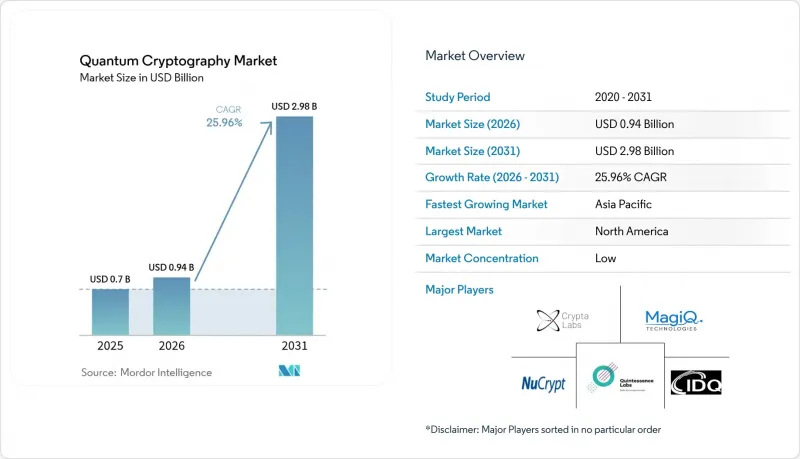
本報告按組件(硬體、軟體、服務)、技術(量子金鑰傳輸、後量子密碼學、量子隨機數產生等)、部署模式(本地部署等)、應用(網路安全等)、最終用戶(IT、電信等)和地區進行細分。市場預測以美元計價。
全球量子密碼市場趨勢與洞察
利用量子技術的網路攻擊日益增多
2025年,隨著攻擊者攔截加密流量以待日後解密的事件激增,討論的焦點從理論風險轉向了實際操作風險。金融機構、領先的國防公司和雲端服務供應商紛紛加快了量子金鑰傳輸(QKD)和後量子密碼技術的藍圖。如今,各董事會每季都會報告「先收集後解密」的風險,並在更廣泛的IT更新周期之前,優先為抗量子攻擊升級分配預算。保險公司也擴大將與量子攻擊相關的安全漏洞排除在新的網路保險保單之外,這進一步凸顯了問題的緊迫性。因此,量子密碼市場正從概念驗證(PoC)階段邁向企業級部署。
政府資助量子通訊基礎設施
2025年,公共部門投資將達到42億美元,用於支持建立全國骨幹網路,從而降低私部門部署的風險。中國1萬公里的光纖網路、歐盟的主要跨境連結、美國國防衛星計畫以及日本都市區的部署,都為國內供應商建立了龐大的基本客群。這些初期網路展現了長距離和城域傳輸效能,並證明了商業服務等級協定(SLA)的達成。此外,政府機構對可互通設備的需求加速了補貼性標準化工作的推進,間接緩解了考慮採用多供應商策略的企業對供應商鎖定問題的擔憂。
QKD硬體部署與維護成本高昂
單光子檢測器、高精度雷射和同步電子元件仍屬於小眾組件,生產規模有限,通常導致每個節點的成本超過50萬美元。由於需要嚴格的環境控制以確保運作,維護合約也成為營運成本的一大負擔。在新興市場,外匯波動進一步推高了進口價格,加劇了價格差距。儘管供應商正在推出功耗低於100瓦的緊湊型19吋框架單位,但其成本曲線仍比傳統網路設備高出一個數量級,這阻礙了量子密碼技術在價格敏感地區的普及。
細分市場分析
就量子密碼市場各組成部分的市場規模而言,預計到2025年,硬體將佔據46.19%的銷售額,這反映了初期網路建設需要專用發送器、接收器和光子交換器。然而,越來越多的公司傾向於採用基於營運成本(OPEX)的契約,將設備、整合和全天候監控打包在一起。因此,預計到2031年,服務領域將成長26.67%,成為各組成部分中成長率最高的。這主要得益於訂閱模式的興起,反映了更廣泛的IT外包趨勢。
企業內部量子技術人才短缺以及監管機構對金鑰管理營運進行第三方審計的要求,也是推動向服務轉型的重要因素。功耗低於100瓦的緊湊型機架式量子金鑰分發(QKD)節點簡化了託管流程,但單光子檢測器的日常調試仍需要專業知識。隨著供應商發布將QKD來源連接到傳統公鑰基礎設施(PKI)平台的API,軟體也不斷改進,但由於缺乏統一的管理編配,許多公司在實施相關策略方面仍然面臨挑戰。隨著實務經驗的積累,服務目錄現已涵蓋量子風險評估、自動化金鑰生命週期管理和合規性報告等功能,進一步豐富了量子密碼市場的產品和服務。
量子金鑰傳輸(QKD) 將在 2025 年佔技術支出的 54.16%,因為它仍然是基於資訊理論的金鑰交換中唯一經過驗證的方法。然而,到 2031 年,整合量子安全通訊平台預計將以 26.91% 的複合年成長率實現最高成長,因為客戶需要一個能夠整合 QKD 通道、後量子密碼學和量子隨機數產生器的控制面板。這種平台方法減少了營運孤島,並與安全團隊目前管理防火牆和 VPN 集中器的方式一致。
隨著美國國家標準與技術研究院 (NIST) 對演算法進行標準化,後量子密碼軟體在量子密碼市場中正不斷擴大市場佔有率。在光纖距離和預算限制導致量子金鑰分發 (QKD) 部署困難的情況下,這一趨勢尤其顯著。此外,量子隨機數產生器 (QRNG) 晶片正被整合到硬體安全模組 (HSM) 中,消除了可能被側頻道利用的熵差。最後,衛星 QKD 正從概念驗證階段邁向有限的商業試點階段,為沒有光纖骨幹網路的地區提供全球覆蓋範圍。透過整合這些方法,量子安全不再只是一種罕見的附加功能,而成為一項整合功能。
區域分析
北美在量子密碼市場佔據領先地位,預計2025年將佔全球銷售額的36.67%,主要得益於金融服務和國防領域的早期應用。大都會圈的量子密碼活動涵蓋了從都會地區的光纖走廊到實驗性衛星鏈路等多個領域,並得到了聯邦政府的資助和強大的風險投資生態系統的支持。歐洲緊隨其後,利用歐盟的「量子旗艦計畫」來協調跨境認證並為區域供應商叢集津貼。使用巴黎-柏林-維也納鏈路進行的性能基準測試已經納入歐盟範圍內的採購標準。
亞太地區是成長最快的地區,預計年複合成長率將達到27.01%。這主要得益於中國國家骨幹網的建設、日本東京-大阪城域網路的開發以及韓國基於QRNG技術的5G基地台網路。這些項目正在建構國內供應鏈,降低零件成本,並提升本地標準化機構的影響力。
儘管中東和非洲市場仍在發展中,但它們在海灣國家的智慧城市計畫中佔據著重要的戰略地位,主權財富基金正在投資建設金融中心和關鍵基礎設施。拉丁美洲的發展則不平衡。巴西政府的一個試點計畫由於檢測器供不應求而進度滯後,這表明供應鏈的脆弱性仍在影響該地區的發展。
其他好處:
- Excel格式的市場預測(ME)表
- 3個月的分析師支持
目錄
第1章:引言
- 研究假設和市場定義
- 調查範圍
第2章:調查方法
第3章執行摘要
第4章 市場狀況
- 市場概覽
- 市場促進因素
- 利用量子技術的網路攻擊日益增多
- 政府資助量子通訊基礎設施
- 5G 和物聯網生態系中對抗量子攻擊安全性的需求
- ETSI 和 ITU 在標準化方面的進展將使量子金鑰分發 (QKD) 實現互通性。
- 量子網路測試平台的出現正在加速商業試點計畫的推進。
- QKD與軟體定義網路(SDN)的融合,實現金鑰的自動化編配。
- 市場限制因素
- QKD硬體的實施和維護成本很高。
- 缺乏熟練的量子安全專家
- 光子元件供應鏈中的瓶頸
- 不同司法管轄區量子通訊頻道的認證架構不一致
- 產業價值鏈分析
- 監理情勢
- 技術展望
- 波特五力分析
- 宏觀經濟因素對市場的影響
第5章 市場規模與成長預測
- 按組件
- 硬體
- 軟體
- 服務
- 透過技術
- 量子金鑰傳輸(QKD)
- 後量子密碼學(PQC)
- 量子隨機數產生器(QRNG)
- 量子安全通訊平台
- 部署模式
- 現場
- 雲
- 混合
- 透過使用
- 網路安全
- 應用程式安全
- 資料庫/儲存安全
- 雲端存取
- 其他用途
- 最終用戶
- 資訊科技/通訊
- BFSI
- 政府/國防
- 醫療保健和生命科學
- 能源公用事業
- 其他最終用戶
- 按地區
- 北美洲
- 美國
- 加拿大
- 墨西哥
- 南美洲
- 巴西
- 阿根廷
- 其他南美國家
- 歐洲
- 英國
- 德國
- 法國
- 義大利
- 俄羅斯
- 其他歐洲國家
- 亞太地區
- 中國
- 日本
- 韓國
- 印度
- 其他亞太國家
- 中東
- GCC
- 土耳其
- 其他中東國家
- 非洲
- 南非
- 其他非洲國家
- 北美洲
第6章 競爭情勢
- 市場集中度
- 策略趨勢
- 市佔率分析
- 公司簡介
- ID Quantique SA
- Toshiba Corporation
- QuantumCTek Co., Ltd.
- QuintessenceLabs Pty Ltd
- Huawei Technologies Co., Ltd.
- Crypta Labs Ltd.
- MagiQ Technologies, Inc.
- NuCrypt LLC
- PQ Solutions Ltd.
- ISARA Corporation
- Quantum Xchange Inc.
- QuNu Labs Pvt Ltd
- Qutools GmbH
- AUREA Technology
- Infineon Technologies AG
- KETS Quantum Security Ltd.
- IBM Corporation
- Qrypt Inc.
- BT Group plc
- SK Telecom Co., Ltd.
- NEC Corporation
- Verizon Communications Inc.
- ZTE Corporation
第7章 市場機會與未來展望
According to Mordor Intelligence, the quantum cryptography market size is projected to expand from USD 0.70 billion in 2025 and USD 0.94 billion in 2026 to USD 2.98 billion by 2031, registering a CAGR of 25.96% between 2026 to 2031.
This report is Segmented by Component (Hardware, Software, and Services), Technology (Quantum Key Distribution, Post-Quantum Cryptography, Quantum Random Number Generation, and More), Deployment Mode (On-Premises, and More), Application (Network Security, and More), End-User (IT and Telecommunications, and More), and Geography. The Market Forecasts are Provided in Terms of Value (USD).
Global Quantum Cryptography Market Trends and Insights
Rising Number of Quantum-Enabled Cyber-Attacks
Incidents in which adversaries captured encrypted traffic for future decryption rose sharply during 2025, moving the discussion from theoretical to operational risk. Financial institutions, defense primes, and cloud providers reacted by accelerating roadmaps for both QKD and post-quantum cryptography. Boards are now briefed quarterly on "harvest-now-decrypt-later" exposures, pushing budgets for quantum-safe upgrades ahead of broader IT refresh cycles. Insurance carriers excluding quantum-related breaches from new cyber policies are amplifying the urgency. As a result, the quantum cryptography market is transitioning from proof-of-concept trials to enterprise-wide rollouts.
Government Funding for Quantum Communication Infrastructure
Public-sector capital reached USD 4.2 billion in 2025, underwriting nationwide backbones that de-risk private adoption. China's 10 000-kilometer fiber network, the EU's flagship cross-border links, U.S. defense satellite projects, and Japan's metro deployments all created anchor tenants for domestic vendors. These early networks validated performance over long haul and urban metro distances, demonstrating commercial service-level agreements. Subsidies also accelerated standards work because agencies demanded interoperable gear, indirectly lowering vendor lock-in fears for enterprises evaluating multi-supplier strategies.
High Deployment and Maintenance Costs of QKD Hardware
Per-node spending frequently exceeds USD 500 000 because single-photon detectors, precision lasers, and synchronization electronics remain niche components with limited manufacturing scale. Maintenance contracts add material operational expenditure because uptime requires tight environmental control. Currency volatility further inflates import prices in emerging markets, widening the affordability gap. Vendors are responding with compact 19-inch rack units that consume under 100 watts, but cost curves still trail conventional networking equipment by an order of magnitude, slowing the quantum cryptography market adoption in price-sensitive regions.
Other drivers and restraints analyzed in the detailed report include:
- Need for Quantum-Safe Security in 5G and IoT Ecosystems
- Standardization Progress at ETSI and ITU Enabling Interoperable QKD
- Shortage of Skilled Quantum-Security Professionals
For complete list of drivers and restraints, kindly check the Table Of Contents.
Segment Analysis
The quantum cryptography market size for components shows hardware leading with 46.19% of 2025 revenue, reflecting early network buildouts that required dedicated transmitters, receivers, and photonic switches. A growing share of enterprises, however, prefer opex-based engagements that bundle equipment, integration, and 24/7 monitoring. Services consequently are projected to grow at 26.67% through 2031, the fastest among components, supported by subscription models that mirror broader IT outsourcing trends.
Momentum toward services is also propelled by a lack of internal quantum talent and by regulators urging third-party audits of key management operations. Compact rackmount QKD nodes consuming under 100 watts simplify colocation, yet day-to-day tuning of single-photon detectors remains specialized. Software continues to mature as vendors expose APIs that link QKD sources to classical public-key-infrastructure platforms, but without managed orchestration, many enterprises still struggle to operationalize policies. As field experience accumulates, service catalogues now include quantum-risk assessments, automated key-lifecycle management, and compliance reporting, rounding out the quantum cryptography market offering.
Quantum key distribution commanded 54.16% of 2025 technology spend because it remains the only field-proven method for information-theoretic key exchange. Yet integrated quantum secure communications platforms should post the highest growth, 26.91% CAGR to 2031, as customers demand unified dashboards that merge QKD channels, post-quantum cryptography, and quantum random number generators. This platform approach reduces operational silos and matches how security teams already manage firewalls and VPN concentrators.
The quantum cryptography market share for post-quantum cryptography software is expanding following NIST algorithm standardization, especially where fiber distance or budget constraints preclude QKD. QRNG silicon is now embedded inside hardware security modules, closing entropy gaps exploited via side-channels. Finally, satellite QKD has moved from demonstrations to limited commercial pilots, offering global coverage for regions lacking fiber backbones. Together, these modalities reposition quantum security as an integrated feature rather than an exotic bolt-on.
Complete Report Scope:
- By Component
- Hardware
- Software
- Services
- By Technology
- Quantum Key Distribution (QKD)
- Post-Quantum Cryptography (PQC)
- Quantum Random Number Generation (QRNG)
- Quantum Secure Communications Platforms
- By Deployment Mode
- On-Premises
- Cloud
- Hybrid
- By Application
- Network Security
- Application Security
- Database/Storage Security
- Secure Cloud Access
- Other Applications
- By End-User
- IT and Telecommunications
- BFSI
- Government and Defense
- Healthcare and Life Sciences
- Energy and Utilities
- Other End-Users
- By Geography
- North America
- United States
- Canada
- Mexico
- South America
- Brazil
- Argentina
- Rest of South America
- Europe
- United Kingdom
- Germany
- France
- Italy
- Russia
- Rest of Europe
- Asia-Pacific
- China
- Japan
- South Korea
- India
- Rest of Asia-Pacific
- Middle East
- GCC
- Turkey
- Rest of Middle East
- Africa
- South Africa
- Rest of Africa
- North America
Geography Analysis
North America led the quantum cryptography market with 36.67% of 2025 revenue owing to early financial-services and defense rollouts. Activity spans both metropolitan fiber corridors and experimental satellite links, anchored by federal funding and strong venture ecosystems. Europe follows closely, leveraging the EU Quantum Flagship to harmonize cross-border certification and subsidize regional vendor clusters. Performance benchmarks from Paris-Berlin-Vienna links have already fed back into procurement standards across the bloc.
Asia-Pacific is the fastest-growing region, projected at 27.01% CAGR, propelled by China's national backbone, Japan's Tokyo-Osaka metro buildouts, and South Korea's QRNG-enabled 5G base-station networks. These projects create domestic supply chains, lowering component costs and accelerating local standardization bodies' influence.
Middle East and Africa markets are nascent but strategically important as Gulf smart-city initiatives allocate sovereign wealth to secure financial hubs and critical infrastructure. Latin America is progressing unevenly; Brazil's pilot government network has slipped schedules because of photonic-detector shortages, illustrating how supply-chain fragility still shapes regional rollouts.
- ID Quantique SA
- Toshiba Corporation
- QuantumCTek Co., Ltd.
- QuintessenceLabs Pty Ltd
- Huawei Technologies Co., Ltd.
- Crypta Labs Ltd.
- MagiQ Technologies, Inc.
- NuCrypt LLC
- PQ Solutions Ltd.
- ISARA Corporation
- Quantum Xchange Inc.
- QuNu Labs Pvt Ltd
- Qutools GmbH
- AUREA Technology
- Infineon Technologies AG
- KETS Quantum Security Ltd.
- IBM Corporation
- Qrypt Inc.
- BT Group plc
- SK Telecom Co., Ltd.
- NEC Corporation
- Verizon Communications Inc.
- ZTE Corporation
Additional Benefits:
- The market estimate (ME) sheet in Excel format
- 3 months of analyst support
TABLE OF CONTENTS
1 INTRODUCTION
- 1.1 Study Assumptions and Market Definition
- 1.2 Scope of the Study
2 RESEARCH METHODOLOGY
3 EXECUTIVE SUMMARY
4 MARKET LANDSCAPE
- 4.1 Market Overview
- 4.2 Market Drivers
- 4.2.1 Rising Number of Quantum-Enabled Cyber-Attacks
- 4.2.2 Government Funding for Quantum Communication Infrastructure
- 4.2.3 Need for Quantum-Safe Security in 5G and IoT Ecosystems
- 4.2.4 Standardization Progress at ETSI and ITU Enabling Interoperable QKD
- 4.2.5 Emergence of Quantum Network Testbeds Accelerating Commercial Pilots
- 4.2.6 Convergence of QKD with Software-Defined Networking for Automated Key Orchestration
- 4.3 Market Restraints
- 4.3.1 High Deployment and Maintenance Costs of QKD Hardware
- 4.3.2 Shortage of Skilled Quantum-Security Professionals
- 4.3.3 Photonic Component Supply-Chain Bottlenecks
- 4.3.4 Inconsistent Quantum Channel Certification Frameworks Across Jurisdictions
- 4.4 Industry Value-Chain Analysis
- 4.5 Regulatory Landscape
- 4.6 Technological Outlook
- 4.7 Porter's Five Forces Analysis
- 4.7.1 Threat of New Entrants
- 4.7.2 Bargaining Power of Suppliers
- 4.7.3 Bargaining Power of Buyers
- 4.7.4 Threat of Substitutes
- 4.7.5 Degree of Competition
- 4.8 Impact of Macroeconomic Factors on the Market
5 MARKET SIZE AND GROWTH FORECASTS (VALUE)
- 5.1 By Component
- 5.1.1 Hardware
- 5.1.2 Software
- 5.1.3 Services
- 5.2 By Technology
- 5.2.1 Quantum Key Distribution (QKD)
- 5.2.2 Post-Quantum Cryptography (PQC)
- 5.2.3 Quantum Random Number Generation (QRNG)
- 5.2.4 Quantum Secure Communications Platforms
- 5.3 By Deployment Mode
- 5.3.1 On-Premises
- 5.3.2 Cloud
- 5.3.3 Hybrid
- 5.4 By Application
- 5.4.1 Network Security
- 5.4.2 Application Security
- 5.4.3 Database/Storage Security
- 5.4.4 Secure Cloud Access
- 5.4.5 Other Applications
- 5.5 By End-User
- 5.5.1 IT and Telecommunications
- 5.5.2 BFSI
- 5.5.3 Government and Defense
- 5.5.4 Healthcare and Life Sciences
- 5.5.5 Energy and Utilities
- 5.5.6 Other End-Users
- 5.6 By Geography
- 5.6.1 North America
- 5.6.1.1 United States
- 5.6.1.2 Canada
- 5.6.1.3 Mexico
- 5.6.2 South America
- 5.6.2.1 Brazil
- 5.6.2.2 Argentina
- 5.6.2.3 Rest of South America
- 5.6.3 Europe
- 5.6.3.1 United Kingdom
- 5.6.3.2 Germany
- 5.6.3.3 France
- 5.6.3.4 Italy
- 5.6.3.5 Russia
- 5.6.3.6 Rest of Europe
- 5.6.4 Asia-Pacific
- 5.6.4.1 China
- 5.6.4.2 Japan
- 5.6.4.3 South Korea
- 5.6.4.4 India
- 5.6.4.5 Rest of Asia-Pacific
- 5.6.5 Middle East
- 5.6.5.1 GCC
- 5.6.5.2 Turkey
- 5.6.5.3 Rest of Middle East
- 5.6.6 Africa
- 5.6.6.1 South Africa
- 5.6.6.2 Rest of Africa
- 5.6.1 North America
6 COMPETITIVE LANDSCAPE
- 6.1 Market Concentration
- 6.2 Strategic Moves
- 6.3 Market Share Analysis
- 6.4 Company Profiles (includes Global Level Overview, Market Level Overview, Core Segments, Financials as available, Strategic Information, Market Rank/Share, Products and Services, Recent Developments)
- 6.4.1 ID Quantique SA
- 6.4.2 Toshiba Corporation
- 6.4.3 QuantumCTek Co., Ltd.
- 6.4.4 QuintessenceLabs Pty Ltd
- 6.4.5 Huawei Technologies Co., Ltd.
- 6.4.6 Crypta Labs Ltd.
- 6.4.7 MagiQ Technologies, Inc.
- 6.4.8 NuCrypt LLC
- 6.4.9 PQ Solutions Ltd.
- 6.4.10 ISARA Corporation
- 6.4.11 Quantum Xchange Inc.
- 6.4.12 QuNu Labs Pvt Ltd
- 6.4.13 Qutools GmbH
- 6.4.14 AUREA Technology
- 6.4.15 Infineon Technologies AG
- 6.4.16 KETS Quantum Security Ltd.
- 6.4.17 IBM Corporation
- 6.4.18 Qrypt Inc.
- 6.4.19 BT Group plc
- 6.4.20 SK Telecom Co., Ltd.
- 6.4.21 NEC Corporation
- 6.4.22 Verizon Communications Inc.
- 6.4.23 ZTE Corporation
7 MARKET OPPORTUNITIES AND FUTURE OUTLOOK
- 7.1 White-Space and Unmet-Need Assessment

 量子密碼市場-2026-2032年全球市場預測加密市場:2026-2032年全球市場預測(按交付方式、類型、應用、最終用戶和企業規模分類)資料安全領域加密技術市場:按組件、類型、組織規模、應用、部署模式和產業分類-2026-2032年全球市場預測
 量子密碼市場(至 2035 年):依產品類型、服務類型、組件、部署協議、應用領域、最終用戶行業、企業結構和地區劃分:行業趨勢和全球預測
 量子密碼市場分析及預測(至2035年):類型、產品類型、服務、技術、組件、應用、部署狀態、最終用戶、解決方案量子密碼晶片市場分析及預測(至2035年):依類型、產品、服務、技術、組件、應用、部署、最終用戶、功能及解決方案分類
 2026年全球量子密碼市場報告2026年全球量子密碼解決方案市場報告
 全球量子密碼市場規模、佔有率、趨勢和成長分析報告(2026-2034)
 量子密碼市場:依產品類型(硬體、軟體、服務)、應用(網路安全、應用安全、資料庫安全)和最終用戶(政府與國防、銀行、金融服務和保險 (BFSI)、醫療保健、IT 與通訊、其他)劃分 - 全球預測至 2036 年