


 |
市場調查報告書
商品編碼
2123750
油壓設備:市場佔有率分析、產業趨勢與統計、成長預測(2026-2031)Hydraulic Equipment - Market Share Analysis, Industry Trends & Statistics, Growth Forecasts (2026 - 2031) |
||||||

※ 本網頁內容可能與最新版本有所差異。詳細情況請與我們聯繫。
2025年油壓設備市場價值為421.1億美元,預計到2031年將達到566.3億美元,而2026年為442.5億美元,預測期(2026-2031年)複合年成長率為5.05%。
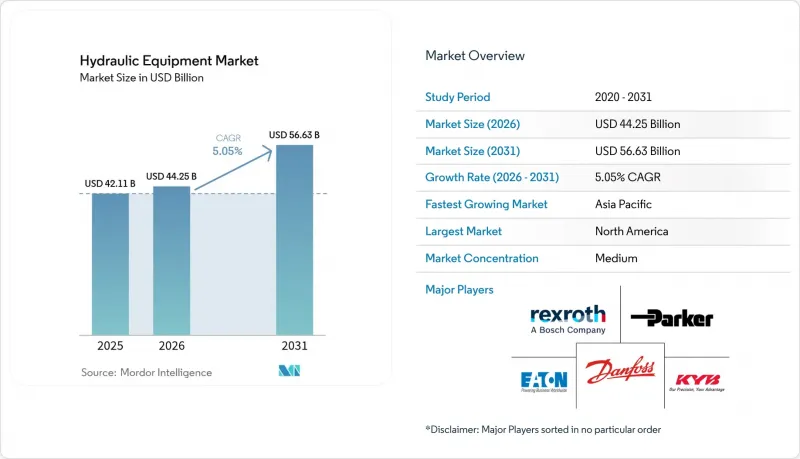
本報告按設備類型(泵浦、閥門、油缸、馬達、過濾器和蓄能器、變速箱等)、終端用戶產業(建築、農業、物料輸送等)、應用領域(行動油壓設備和工業固定油壓設備)、工作壓力範圍(低壓、中壓、高壓)和地區進行細分。市場預測以美元(USD)為單位。
全球油壓設備市場趨勢及洞察
加速電子商務物流倉庫履約
隨著電商訂單量的爆炸性成長,物流中心被迫部署自主堆高機、穿梭車系統和「貨到人」機器人,這些設備均採用緊湊型伺服油壓缸,可實現毫米級精度。亞馬遜的移動機器人網路表明,無洩漏、配備感測器並具備預測性維護警報功能的液壓系統對於最大限度地減少全天候運作期間的停機時間至關重要。倉庫營運商報告稱,生產效率通常提高了 40%,這使得零件供應商能夠為高度可靠、污染控制嚴格的組件收取更高的價格。
政府資助的大型基礎建設項目
從1.2兆美元的美國基礎設施投資和就業法案到1.4兆美元的中國地方政府債務計劃,多年期公共工程項目清晰地展現了對挖掘機、混凝土泵和大口徑油缸的需求前景。不斷擴大的專案儲備使原始設備製造商(OEM)能夠獲得長期契約,拓展其區域服務基地,並共同開發用於橋樑、港口和可再生能源建設的特定應用液壓系統。
鐵和稀土元素原料價格波動加劇。
儘管2024年鋼鐵價格波動幅度高達40%,但中國在稀土元素加工領域的主導地位使磁電機供應鏈面臨地緣政治風險。對來自中國的液壓元件徵收44%至54%的關稅進一步擠壓了利潤空間,迫使供應商進行大宗商品套期保值、重新設計以減少材料用量,或透過併購擴大規模。
細分市場分析
2025年,泵浦將佔油壓設備市場27.85%的佔有率,成為建築、農業和工業機械等各個領域不可或缺的動力來源。可變排氣量和負載感測型式幫浦可降低油耗,滿足OEM廠商的效率目標,並促進售後改裝市場的銷售。預計到2031年,泵浦的油壓設備市場規模將隨著基礎設施投資週期的推進而持續成長。過濾器和蓄壓器的成長速度最快,複合年成長率達6.18%。這主要歸因於ISO 4406清潔度標準的日益嚴格,使得污染控制成為品質保證談判的關鍵因素。高流量、低壓差濾材的需求不斷成長,也推高了利潤率。同時,充氮囊可在混合動力迴路中儲存再生能量,從而擴大該油壓設備市場在行動應用領域的市場佔有率。
閥門供應商正利用遠端操作和自主運作所需的精確流量控制,把握商機。電商倉庫的機器人技術也為汽缸提供了應用,滿足其對高重複性、高循環直線運動的需求。馬達和變速器則應用於扭矩密度和過載能力至關重要的專用移動設備。此外,整合式動力單元簡化了OEM組裝,縮短了產品上市時間,也為配件(儲液罐、歧管、冷卻器)帶來了更多優勢。
在全球公共產業計畫和商業房地產建設項目開工的推動下,建築業預計到2025年將佔油壓設備市場銷售額的31.05%。車輛業者正在採用電液油壓混合動力,以滿足現場日益嚴格的排放氣體法規,同時維持較高的正常運轉率和零件消耗量。受橋樑、港口和鐵路項目多年施工過程中對長行程執行器和重型泵的需求驅動,建築業的油壓設備市場預計將以中等個位數的成長率穩步成長。同時,航太和國防產業呈現最快的成長軌跡,複合年成長率達6.35%,這主要得益於民用窄體飛機產量的擴大以及國防機構對飛機的現代化改造。用於飛行控制和起落架的高壓、輕量化執行器價格高昂,擴大了航太供應商在油壓設備市場的佔有率。
在農業領域,隨著用於厘米級播種的GPS引導液壓系統被應用於精密農業,農業領域保持穩定成長。物料輸送行業因全通路零售物流的擴張而蓬勃發展,而石油和天然氣行業的需求保持穩定,主要由海上建設和管道維護所驅動。在工具機、塑膠和汽車領域,趨勢隨全球製造業週期而波動,但它們仍然是支撐密封件、閥門和小缸徑氣缸需求的重要支柱。
區域分析
預計到2025年,北美將佔全球整體銷售額的37.65%,這得益於688億美元的水利基礎建設投資和8.5億美元的土地復墾項目投資。對倉庫自動化和老舊車輛更換的大力投資正在推動氣缸、比例閥和過濾套件的銷售。然而,運輸設備市場的低迷帶來了不利影響,促使供應商將重點轉向售後服務合約和數位化維護服務。
預計亞太地區將實現最快成長,到2031年年複合成長率(CAGR)將達到8.07%。這主要得益於中國1.4兆美元的信貸計畫以及印度的城市軌道交通和供水項目,這些舉措使得需求高峰得以持續,超越了國內經濟週期。本地整車製造商正與專業零件製造商合作,以滿足Tier 4f排放標準;同時,跨國供應商在關稅爭端的背景下,正將其在東南亞的組裝基地多元化佈局。高壓微型幫浦和污染物閥門在韓國和日本的精密製造群中得到越來越廣泛的應用。
歐洲前景喜憂參半。 2024年德國流體動力相關產品的訂單下降了8%,但法國的「大巴黎快線」等項目以及義大利風電場的建設正在推動高壓油缸這一細分市場的需求。 PFAS法規正在加速生物基密封件的轉型,刺激油壓設備市場進行大量研發投資。 「REPowerEU」計畫下,3,000億歐元(3,390億美元)的可再生能源基礎設施預算撥款正在擴大離岸風力發電安裝船用伸縮油缸的需求,從而緩解宏觀經濟放緩的影響。
其他好處:
- Excel格式的市場預測(ME)表
- 3個月的分析師支持
目錄
第1章:引言
- 研究假設和市場定義
- 調查範圍
第2章:調查方法
第3章執行摘要
第4章 市場狀況
- 市場概覽
- 產業供應鏈分析
- 監理情勢
- 技術展望
- 波特五力分析
- 市場促進因素
- 加速電子商務物流倉庫履約
- 政府資助的大型基礎設施開發項目
- 向節能型電液混合動力系統過渡
- 非公路領域電氣化的進步正在推動緊湊型、高功率液壓系統的廣泛應用。
- 精密農業機械的廣泛應用。
- 在經合組織國家,老舊工業機械的更換週期正在延長。
- 市場限制因素
- 在小型車領域,燃油車的總擁有成本(TCO)高於電動驅動系統。
- 鋼鐵和稀土元素的原物料價格波動劇烈。
- 加強液壓油洩漏的環境、社會和治理(ESG)監測。
- 維修維修工作中技術純熟勞工短缺
- 宏觀經濟因素的影響
第5章 市場規模與成長預測
- 依設備類型
- 泵浦
- 閥門
- 圓柱
- 引擎
- 過濾器和蓄能器
- 傳播
- 其他
- 按最終用戶行業分類
- 建造
- 農業
- 物料輸送
- 航太/國防
- 工具機
- 石油和天然氣
- 油壓機
- 塑膠
- 車
- 其他最終用戶
- 透過使用
- 移動液壓
- 工業固定油壓設備
- 按工作壓力範圍
- 低壓(低於150巴)
- 中壓(150-350 巴)
- 高壓(350 巴或更高)
- 按地區
- 北美洲
- 美國
- 加拿大
- 墨西哥
- 南美洲
- 巴西
- 阿根廷
- 哥倫比亞
- 其他南美國家
- 歐洲
- 英國
- 德國
- 法國
- 義大利
- 西班牙
- 其他歐洲國家
- 亞太地區
- 中國
- 日本
- 韓國
- 印度
- 其他亞太國家
- 中東和非洲
- 中東
- 沙烏地阿拉伯
- 阿拉伯聯合大公國
- 其他中東國家
- 非洲
- 南非
- 埃及
- 其他非洲國家
- 中東
- 北美洲
第6章 競爭情勢
- 市場集中度
- 策略趨勢
- 市佔率分析
- 公司簡介
- Bosch Rexroth AG
- Parker Hannifin Corporation
- HYDAC International GmbH
- Danfoss A/S
- SMC Corporation
- Festo SE and Co. KG
- Norgren Limited(IMI plc)
- Bucher Hydraulics GmbH(Bucher Industries AG)
- HAWE Hydraulik SE
- Linde Hydraulics GmbH and Co. KG
- Caterpillar Inc.
- KYB Corporation
- Eaton Corporation plc
- Kawasaki Heavy Industries Ltd.
- Yuken Kogyo Co., Ltd.
- Daikin Industries, Ltd.
- Komatsu Ltd.
- Sun Hydraulics LLC(Helios Technologies, Inc.)
- Moog Inc.
- Argo-Hytos Group AG
第7章 市場機會與未來展望
According to Mordor Intelligence, the hydraulic equipment market size was valued at USD 42.11 billion in 2025 and estimated to grow from USD 44.25 billion in 2026 to reach USD 56.63 billion by 2031, at a CAGR of 5.05% during the forecast period (2026-2031).
This report is Segmented by Equipment Type (Pumps, Valves, Cylinders, Motors, Filters and Accumulators, Transmissions, and Others), End-User Industry (Construction, Agriculture, Material Handling, and More), Application (Mobile Hydraulics and Industrial Stationary Hydraulics), Operating-Pressure Range (Low, Medium, and High), and Geography. The Market Forecasts are Provided in Terms of Value (USD).
Global Hydraulic Equipment Market Trends and Insights
Accelerated Warehouse Automation in E-commerce Fulfillment
Explosive e-commerce order volumes compel distribution centers to deploy autonomous forklifts, shuttle systems, and goods-to-person robots that rely on compact servo-hydraulic cylinders for milli-meter accuracy. Amazon's network of mobile robots illustrates how 24/7 operation requires leak-free, sensor-equipped hydraulics offering predictive failure alerts to minimize downtime. Warehouse operators typically report 40% productivity gains, enabling component suppliers to charge premium prices for ultra-reliable, contamination-controlled assemblies.
Government-Funded Mega-Infrastructure Programmes
Multi-year public works-from the USD 1.2 trillion U.S. Infrastructure Investment and Jobs Act to China's USD 1.4 trillion local-government debt plan-create demand visibility for excavators, concrete pumps, and large-bore cylinders. Extended project pipelines allow OEMs to lock-in long-term contracts, expand regional service hubs, and co-develop application-specific hydraulics for bridge, port, and renewable-energy construction.
Intensifying Raw-Material Price Volatility for Steel and Rare Earths
Steel prices swung 40% in 2024, while China's dominance of rare-earth processing exposes magnet-motor supply chains to geopolitical risk. Tariffs of 44-54% on Chinese hydraulic components further compress margins, forcing suppliers to hedge commodities, redesign to reduce material intensity, or pursue scale through mergers.
Other drivers and restraints analyzed in the detailed report include:
- Shift to Energy-Efficient Electro-Hydraulic Hybrids
- Increasing Off-Highway Electrification
- Skilled-Labor Shortage for Maintenance and Retrofits
For complete list of drivers and restraints, kindly check the Table Of Contents.
Segment Analysis
Pumps anchored 27.85% of the hydraulic equipment market in 2025 as the indispensable power-source across construction, agriculture, and industrial machinery. Variable-displacement and load-sensing models cut fuel draw, satisfying OEM efficiency targets and boosting aftermarket retrofit sales. The hydraulic equipment market size for pumps is positioned to advance with infrastructure investment cycles through 2031. Filters and accumulators log the quickest gains at a 6.18% CAGR as stricter ISO 4406 cleanliness codes make contamination control decisive during warranty negotiations. Demand for high-flow, low-delta-pressure filter media elevates margins, while nitrogen-charged bladders store regenerative energy in hybrid circuits, extending the hydraulic equipment market share of this sub-segment across mobile applications.
Valve suppliers capitalize on precision flow control required by tele-operation and autonomous tasks. Cylinders benefit from e-commerce warehouse robotics that necessitate repeatable, high-cycle linear motion. Motors and transmissions cater to specialty mobile equipment where torque density and overload capacity remain critical. Ancillary components-reservoirs, manifolds, coolers-gain from integrated power-packs that simplify OEM assembly lines and shorten time-to-market.
Construction contributed 31.05% of hydraulic equipment market revenue in 2025, buoyed by global public-works pipelines and commercial real-estate starts. Fleet operators adopt electro-hydraulic hybrids to meet stricter job-site emissions caps, sustaining high utilization and parts consumption. The hydraulic equipment market size for construction is poised for stable mid-single-digit growth as bridge, port, and rail projects consume long-stroke actuators and heavy-duty pumps over multi-year timelines. Aerospace and defense, however, posts the sharpest trajectory at 6.35% CAGR as commercial narrow-body production ramps and defense agencies modernize airframes. High-pressure, weight-optimized actuation for flight-control and landing-gear commands premium pricing, increasing the hydraulic equipment market share captured by aerospace suppliers.
Agriculture maintains steady gains as precision farming embeds GPS-guided hydraulics for centimeter-level seed placement. Material-handling thrives on omnichannel retail logistics, while oil and gas demand stabilizes around offshore construction and pipeline maintenance. Machine-tool, plastics, and automotive segments experience mixed trends tied to global manufacturing cycles yet remain indispensable volume anchors for seal, valve, and small-bore cylinder demand.
Complete Report Scope:
- By Equipment Type
- Pumps
- Valves
- Cylinders
- Motors
- Filters and Accumulators
- Transmissions
- Others
- By End-user Industry
- Construction
- Agriculture
- Material Handling
- Aerospace and Defence
- Machine Tools
- Oil and Gas
- Hydraulic Press
- Plastics
- Automotive
- Other End-users
- By Application
- Mobile Hydraulics
- Industrial Stationary Hydraulics
- By Operating-Pressure Range
- Low (Less than 150 bar)
- Medium (150-350 bar)
- High (Greater than 350 bar)
- By Geography
- North America
- United States
- Canada
- Mexico
- South America
- Brazil
- Argentina
- Colombia
- Rest of South America
- Europe
- United Kingdom
- Germany
- France
- Italy
- Spain
- Rest of Europe
- Asia-Pacific
- China
- Japan
- South Korea
- India
- Rest of Asia-Pacific
- Middle East and Africa
- Middle East
- Saudi Arabia
- United Arab Emirates
- Rest of Middle East
- Africa
- South Africa
- Egypt
- Rest of Africa
- Middle East
- North America
Geography Analysis
North America generated 37.65% of global revenue in 2025, supported by USD 68.8 billion in obligated water-infrastructure funds and USD 850 million dedicated to reclamation projects. Robust warehouse-automation investments and aging fleet replacements underpin sales of cylinders, proportional valves, and filtration kits. Nevertheless, the softness of transport equipment presents a headwind, prompting suppliers to emphasize aftermarket service contracts and digitalized maintenance offers.
The Asia-Pacific region registers the fastest growth, with an 8.07% CAGR through 2031, as China's USD 1.4 trillion credit package and India's urban-rail and water-supply programs sustain demand peaks beyond domestic cycles. Local OEMs partner with component specialists to meet Tier 4f standards, while tariff disputes prompt multinational suppliers to diversify assembly footprints into Southeast Asia. High-pressure micro-pumps and contamination-resistant valves are seeing a rising take-up in Korean and Japanese precision-manufacturing clusters.
Europe presents a mixed outlook: German fluid-power orders fell 8% in 2024, yet projects such as France's Grand Paris Express and Italy's wind-farm builds drive niche high-pressure requirements. PFAS restrictions are accelerating the shift to bio-based seals, prompting significant R&D investment across the hydraulic equipment market. The REPowerEU plan's EUR 300 billion (USD 339 billion) allocation for renewable energy infrastructure multiplies demand for telescopic cylinders in offshore wind installation vessels, cushioning macroeconomic softness.
- Bosch Rexroth AG
- Parker Hannifin Corporation
- HYDAC International GmbH
- Danfoss A/S
- SMC Corporation
- Festo SE and Co. KG
- Norgren Limited (IMI plc)
- Bucher Hydraulics GmbH (Bucher Industries AG)
- HAWE Hydraulik SE
- Linde Hydraulics GmbH and Co. KG
- Caterpillar Inc.
- KYB Corporation
- Eaton Corporation plc
- Kawasaki Heavy Industries Ltd.
- Yuken Kogyo Co., Ltd.
- Daikin Industries, Ltd.
- Komatsu Ltd.
- Sun Hydraulics LLC (Helios Technologies, Inc.)
- Moog Inc.
- Argo-Hytos Group AG
Additional Benefits:
- The market estimate (ME) sheet in Excel format
- 3 months of analyst support
TABLE OF CONTENTS
1 INTRODUCTION
- 1.1 Study Assumptions and Market Definition
- 1.2 Scope of the Study
2 RESEARCH METHODOLOGY
3 EXECUTIVE SUMMARY
4 MARKET LANDSCAPE
- 4.1 Market Overview
- 4.2 Industry Supply-Chain Analysis
- 4.3 Regulatory Landscape
- 4.4 Technological Outlook
- 4.5 Porter's Five Forces Analysis
- 4.5.1 Bargaining Power of Suppliers
- 4.5.2 Bargaining Power of Buyers
- 4.5.3 Threat of New Entrants
- 4.5.4 Threat of Substitutes
- 4.5.5 Intensity of Competitive Rivalry
- 4.6 Market Drivers
- 4.6.1 Accelerated warehouse automation in e-commerce fulfilment
- 4.6.2 Government-funded mega infrastructure programmes
- 4.6.3 Shift to energy-efficient electro-hydraulic hybrids
- 4.6.4 Increasing off-highway electrification driving compact power-dense hydraulics
- 4.6.5 Growing adoption of precision agriculture machinery
- 4.6.6 Ageing industrial machinery replacement cycle in OECD
- 4.7 Market Restraints
- 4.7.1 Total cost of ownership (TCO) higher than electric drives in light-duty ranges
- 4.7.2 Intensifying raw-material price volatility for steel and rare earths
- 4.7.3 Rising ESG scrutiny over hydraulic-fluid leakage
- 4.7.4 Skilled-labour shortage for maintenance and retrofits
- 4.8 Impact of Macroeconomic Factors
5 MARKET SIZE AND GROWTH FORECASTS (VALUE)
- 5.1 By Equipment Type
- 5.1.1 Pumps
- 5.1.2 Valves
- 5.1.3 Cylinders
- 5.1.4 Motors
- 5.1.5 Filters and Accumulators
- 5.1.6 Transmissions
- 5.1.7 Others
- 5.2 By End-user Industry
- 5.2.1 Construction
- 5.2.2 Agriculture
- 5.2.3 Material Handling
- 5.2.4 Aerospace and Defence
- 5.2.5 Machine Tools
- 5.2.6 Oil and Gas
- 5.2.7 Hydraulic Press
- 5.2.8 Plastics
- 5.2.9 Automotive
- 5.2.10 Other End-users
- 5.3 By Application
- 5.3.1 Mobile Hydraulics
- 5.3.2 Industrial Stationary Hydraulics
- 5.4 By Operating-Pressure Range
- 5.4.1 Low (Less than 150 bar)
- 5.4.2 Medium (150-350 bar)
- 5.4.3 High (Greater than 350 bar)
- 5.5 By Geography
- 5.5.1 North America
- 5.5.1.1 United States
- 5.5.1.2 Canada
- 5.5.1.3 Mexico
- 5.5.2 South America
- 5.5.2.1 Brazil
- 5.5.2.2 Argentina
- 5.5.2.3 Colombia
- 5.5.2.4 Rest of South America
- 5.5.3 Europe
- 5.5.3.1 United Kingdom
- 5.5.3.2 Germany
- 5.5.3.3 France
- 5.5.3.4 Italy
- 5.5.3.5 Spain
- 5.5.3.6 Rest of Europe
- 5.5.4 Asia-Pacific
- 5.5.4.1 China
- 5.5.4.2 Japan
- 5.5.4.3 South Korea
- 5.5.4.4 India
- 5.5.4.5 Rest of Asia-Pacific
- 5.5.5 Middle East and Africa
- 5.5.5.1 Middle East
- 5.5.5.1.1 Saudi Arabia
- 5.5.5.1.2 United Arab Emirates
- 5.5.5.1.3 Rest of Middle East
- 5.5.5.2 Africa
- 5.5.5.2.1 South Africa
- 5.5.5.2.2 Egypt
- 5.5.5.2.3 Rest of Africa
- 5.5.5.1 Middle East
- 5.5.1 North America
6 COMPETITIVE LANDSCAPE
- 6.1 Market Concentration
- 6.2 Strategic Moves
- 6.3 Market Share Analysis
- 6.4 Company Profiles (includes Global level Overview, Market level overview, Core Segments, Financials as available, Strategic Information, Market Rank/Share for key companies, Products and Services, and Recent Developments)
- 6.4.1 Bosch Rexroth AG
- 6.4.2 Parker Hannifin Corporation
- 6.4.3 HYDAC International GmbH
- 6.4.4 Danfoss A/S
- 6.4.5 SMC Corporation
- 6.4.6 Festo SE and Co. KG
- 6.4.7 Norgren Limited (IMI plc)
- 6.4.8 Bucher Hydraulics GmbH (Bucher Industries AG)
- 6.4.9 HAWE Hydraulik SE
- 6.4.10 Linde Hydraulics GmbH and Co. KG
- 6.4.11 Caterpillar Inc.
- 6.4.12 KYB Corporation
- 6.4.13 Eaton Corporation plc
- 6.4.14 Kawasaki Heavy Industries Ltd.
- 6.4.15 Yuken Kogyo Co., Ltd.
- 6.4.16 Daikin Industries, Ltd.
- 6.4.17 Komatsu Ltd.
- 6.4.18 Sun Hydraulics LLC (Helios Technologies, Inc.)
- 6.4.19 Moog Inc.
- 6.4.20 Argo-Hytos Group AG
7 MARKET OPPORTUNITIES AND FUTURE OUTLOOK
- 7.1 White-space and Unmet-Need Assessment

 油壓設備市場-2026-2032年全球市場預測
 2026年全球二氧化碳(CO2)井口控制面板市場報告2026年全球真空鑽井服務市場報告
 工業油壓設備市場規模、佔有率、成長及全球產業分析:按類型、應用和地區的洞察,2026-2034年的預測全球工業油壓設備市場規模、佔有率、趨勢和成長分析報告(2026-2034年)全球液壓輔助設備市場規模、佔有率、趨勢和成長分析報告(2026-2034年)2026年全球拆除機械液壓附件市場報告井口控制面板及系統市場(依控制系統類型、產品類型、井類型、壓力等級、系統材料及最終用戶產業分類),全球預測,2026-2032年井口控制面板和控制系統市場(依控制類型、面板類型、最終用途產業、壓力等級和井口配置分類)-全球預測,2026-2032年
 日本油壓設備市場規模、佔有率、趨勢和預測:按類型、最終用途行業和地區分類,2026-2034年