


 |
市場調查報告書
商品編碼
2123747
乙烯基酯:市場佔有率分析、行業趨勢和統計數據、成長預測(2026-2031)Vinyl Ester - Market Share Analysis, Industry Trends & Statistics, Growth Forecasts (2026 - 2031) |
||||||

※ 本網頁內容可能與最新版本有所差異。詳細情況請與我們聯繫。
據 Mordor Intelligence 稱,乙烯基酯市場預計到 2026 年價值 12.2 億美元,高於 2025 年的 11.7 億美元,預計到 2031 年將達到 15.4 億美元。
預計從 2026 年到 2031 年,其複合年成長率將達到 4.66%。
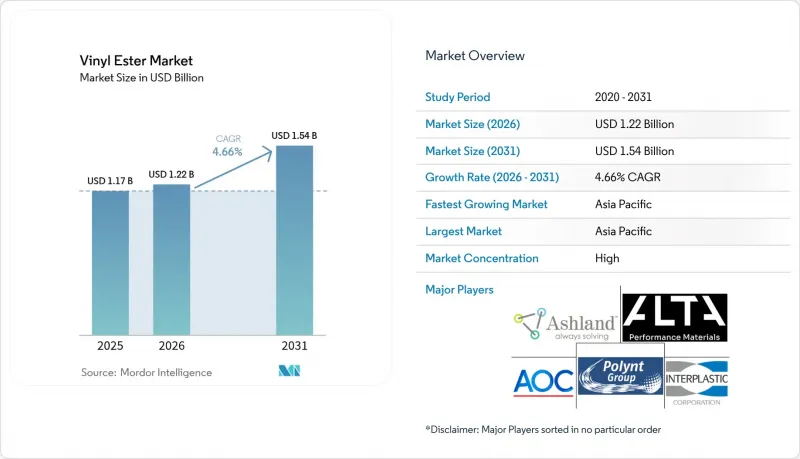
本報告按「類型」(雙酚A二縮水甘油醚(DGEBA)、環氧酚醛PHENOLIC NOVOLAC(EPN)、其他)、「應用」(管道和儲罐、油漆和塗料、運輸、其他)以及「地區」(亞太地區、北美地區、歐洲地區、南美地區、中東和非洲地區)對產業進行分類。市場預測以美元(USD)為單位。
全球乙烯基酯市場趨勢及洞察
優異的耐化學性和耐腐蝕性
與鋼、混凝土或聚酯複合材料相比,乙烯基酯樹脂具有更優異的耐酸、耐鹼和耐溶劑性能,延長了化學處理設備、污水處理廠和海上平台的使用壽命。其較低的酯鍵密度可抑制水解,降低材料失效和停機造成的成本。含有碳化矽顆粒的新型乙烯基酯樹脂可提高攪拌器和泵殼的耐磨性。終端用戶越來越重視整個生命週期的經濟效益,當停機損失超過初始投資時,選擇乙烯基酯樹脂的趨勢日益明顯。
可再生能源領域的擴張
乙烯基酯複合材料具有優異的抗疲勞性和耐濕性,被應用於風力發電機機葉片。陸上和離岸風電場裝置容量的不斷成長,推動了多年來對支管帽和機艙罩的需求。氫氣儲存容器製造商在3型氣瓶中使用高模量乙烯基酯包覆材料,以滿足爆破強度標準。鍍錫玻璃/乙烯基酯反射器可實現95%的太陽反射率,為聚光型太陽光電發電廠開闢了新的可能性。
苯乙烯和環氧樹脂原料價格的波動給利潤率帶來了壓力。
2024年,苯乙烯和環氧單體價格的急劇上漲迫使樹脂生產商提高了乙烯基酯類樹脂的標價。目前,維持利潤率主要依賴長期供應合約、避險交易以及基於配方的價格轉嫁條款。同時,對苯乙烯含量降低或不含苯乙烯的混合物的研究也在加速進行。
細分市場分析
由於DGEBA樹脂在船舶、化學和基礎設施應用領域具有優異的性價比,預計到2025年,其在乙烯基酯樹脂市場將佔53.45%的佔有率。該細分市場預計將以4.74%的複合年成長率成長,這主要得益於低苯乙烯配方的持續研發,這些配方有助於降低職場的排放法規要求。此外,製造商也正在開發不含苯乙烯的DGEBA衍生產品,以擴大其在通風條件有限的生產場所的應用。
環氧酚醛清漆(EPN)樹脂雖然市場規模較小,但已獲得高溫洗滌器和酸廠的訂單。溴化級EPN樹脂符合鐵路車輛內裝阻燃標準,而彈性體改質樹脂則用於需要減震的船舶船體。近期符合UL 94 V0標準的化合物拉伸強度超過80 MPa,反映了無需過量使用鹵素的混煉技術的進步。
區域分析
預計到2025年,亞太地區將維持55.60%的銷售佔有率,並在2031年之前保持4.85%的年均最高成長率。中國和印度的政府支持的鐵路走廊、海水淡化計畫以及陸上風電場正在支撐對樹脂的需求。區域生產商受益於本地化的供應鏈,從而降低了跨洋運輸的風險。
在北美,墨西哥灣沿岸煉油廠的改造升級以及政府對離岸風力發電電場的激勵措施正在推動市場成長。此外,美國橋樑橋面更換計畫也促進了乙烯基酯市場規模的擴大,這些計畫指定使用耐腐蝕複合材料,以將橋樑的使用壽命延長至75年以上。
在歐洲,回收和降低苯乙烯排放是優先事項,這促使人們採用新一代複合材料。德國和荷蘭對氫氣示範中心的津貼正在加速對帶有乙烯基酯內襯的3型儲槽的需求。
在南美洲,由於巴西水處理設施的擴建和石化工廠產能的提升,訂單依然強勁。同時,在中東,乙烯基酯複合材料正被用於新建煉油廠的海水淡化管道和化學品處理設備中。在非洲採礦業,正在進行採用乙烯基酯襯裡的浸出槽的試驗,以提高銅提取迴路的耐酸性。
其他好處:
- Excel格式的市場預測(ME)表
- 3個月的分析師支持
目錄
第1章:引言
- 研究假設和市場定義
- 調查範圍
第2章:調查方法
第3章執行摘要
第4章 市場狀況
- 市場概覽
- 市場促進因素
- 優異的耐化學性和耐腐蝕性
- 拓展在纖維增強塑膠罐和容器製造的應用。
- 可再生能源領域的擴張
- 基礎設施和工業應用領域的需求不斷成長
- 複合材料製造技術的進步
- 市場限制因素
- 苯乙烯和環氧樹脂原料價格的波動給利潤率帶來了壓力。
- 替代方案的可用性
- 保存期限短
- 價值鏈分析
- 波特五力模型
- 進出口趨勢
- 原料分析
- 技術趨勢概述
- 價格分析
第5章 市場規模與成長預測
- 按類型
- 雙酚A二縮水甘油醚(DGEBA)
- 環氧酚醛清漆(EPN)
- 其他類型
- 透過使用
- 管道和儲罐
- 油漆和塗料
- 運輸
- 其他用途
- 按地區
- 亞太地區
- 中國
- 印度
- 日本
- 韓國
- 其他亞太國家
- 北美洲
- 美國
- 加拿大
- 墨西哥
- 歐洲
- 德國
- 英國
- 法國
- 義大利
- 其他歐洲國家
- 南美洲
- 巴西
- 阿根廷
- 其他南美國家
- 中東和非洲
- 沙烏地阿拉伯
- 南非
- 其他中東和非洲國家
- 亞太地區
第6章 競爭情勢
- 市場集中度
- 策略趨勢
- 市佔率分析
- 公司簡介
- AOC
- Allnex GmbH
- ALTA Performance Materials
- Ashland Inc.
- Changzhou Tianma Group
- DIC Corporation
- Hexion Inc.
- Huntsman Corporation
- Interplastic Corporation
- Nan Ya Plastics
- Poliya Composite Resins
- Polynt-Reichhold Group
- Reichhold LLC2
- Resoltech
- Resonac Holdings Corporation
- Royal DSM
- Scott Bader Co. Ltd
- Sino Polymer Co. Ltd
- Sir Industriale
- Swancor Holding
第7章 市場機會與未來展望
According to Mordor Intelligence, vinyl ester market size in 2026 is estimated at USD 1.22 billion, growing from 2025 value of USD 1.17 billion with 2031 projections showing USD 1.54 billion, growing at 4.66% CAGR over 2026-2031.
This report Segments the Industry by Type (Bisphenol A Diglycidyl Ether (DGEBA), Epoxy Phenol Novolac (EPN), and Other Types), Application (Pipes and Tanks, Paints and Coatings, Transportation, and Other Applications), and Geography (Asia-Pacific, North America, Europe, South America, and Middle East and Africa). The Market Forecasts are Provided in Terms of Value (USD).
Global Vinyl Ester Market Trends and Insights
Superior Chemical and Corrosion Resistance
Vinyl ester resins resist acids, alkalis, and solvents better than steel, concrete, or polyester composites, enabling longer service life for chemical processing gear, wastewater assets, and marine platforms. Fewer ester linkages limit hydrolysis, cutting material failures, and shutdown costs. New grades containing silicon-carbide particles boost abrasion resistance for agitators and pump housings. End users increasingly weigh full lifecycle economics, favoring vinyl ester when downtime penalties exceed initial outlay.
Expansion of Renewable Energy Sector
Wind-turbine blades rely on vinyl ester composites for superior fatigue resistance and moisture tolerance. Capacity additions in onshore and offshore parks drive multi-year pull-through for spar caps and nacelle covers. Hydrogen-storage vessel builders use high-modulus vinyl ester wraps on Type 3 cylinders to meet burst-strength codes. Tin-treated glass/vinyl-ester reflectors achieving 95% solar reflectivity unlock scope in concentrated-solar plants.
Styrene/Epoxy Feedstock Price Volatility Pressuring Margins
Styrene and epoxide monomers faced sharp price spikes in 2024, prompting resin makers to raise list prices for vinyl-ester formulations. Margin protection now hinges on long-term supply deals, hedging, and formula-based pass-through clauses. Research into lower-styrene or styrene-free blends is also accelerating.
Other drivers and restraints analyzed in the detailed report include:
- Growing Demand in Infrastructure and Industrial Applications
- Advancements in Composite Manufacturing
- Availability of Substitutes
For complete list of drivers and restraints, kindly check the Table Of Contents.
Segment Analysis
DGEBA resins accounted for 53.45% vinyl ester market share in 2025, underpinned by a cost-to-performance balance suited to marine, chemical, and infrastructure laminates. The segment records a 4.74% CAGR, supported by the ongoing development of low-styrene mixes that ease workplace emission caps. Manufacturers are also pursuing styrene-free DGEBA variants to gain acceptance in tight-ventilation production halls.
Epoxy-phenol-novolac (EPN) resins, though smaller, secure orders for high-temperature scrubbers and acid plants. Brominated grades address flame-spread codes in rail interiors, while elastomer-modified resins supply hull sections needing impact damping. Recent UL 94 V0-compliant compounds maintain tensile strength above 80 MPa, reflecting formulation progress without halogen overuse.
Complete Report Scope:
- By Type
- Bisphenol A Diglycidyl Ether (DGEBA)
- Epoxy Phenol Novolac (EPN)
- Other Types
- By Application
- Pipes and Tanks
- Paints and Coatings
- Transportation
- Other Applications
- By Geography
- Asia-Pacific
- China
- India
- Japan
- South Korea
- Rest of Asia-Pacific
- North America
- United States
- Canada
- Mexico
- Europe
- Germany
- United Kingdom
- France
- Italy
- Rest of Europe
- South America
- Brazil
- Argentina
- Rest of South America
- Middle East and Africa
- Saudi Arabia
- South Africa
- Rest of Middle East and Africa
- Asia-Pacific
Geography Analysis
Asia-Pacific retained a 55.60% revenue share in 2025 and grows fastest at 4.85% through 2031. State-backed rail corridors, desalination projects, and onshore wind farms in China and India underpin the resin offtake. Regional producers benefit from localized supply chains that sidestep transocean freight risks.
North America is buoyed by refinery overhauls along the Gulf Coast and government incentives for offshore wind arrays. The vinyl ester market size in the United States is also lifted by bridge-deck replacement programs that specify corrosion-resistant composites to extend asset life beyond 75 years.
Europe emphasizes recycling and low-styrene emissions, prompting the adoption of next-generation formulations. Grants for hydrogen-demo hubs in Germany and the Netherlands accelerate demand for Type 3 vessels with vinyl-ester liners.
South America sees strong orders in Brazil's water-treatment build-outs and petrochemical capacity additions, while the Middle East applies vinyl-ester composites in desalination piping and chemical handling at new refining complexes. Africa's mining sector is trialing vinyl-ester lined leach tanks to improve acid resistance in copper extraction circuits.
- AOC
- Allnex GmbH
- ALTA Performance Materials
- Ashland Inc.
- Changzhou Tianma Group
- DIC Corporation
- Hexion Inc.
- Huntsman Corporation
- Interplastic Corporation
- Nan Ya Plastics
- Poliya Composite Resins
- Polynt-Reichhold Group
- Reichhold LLC2
- Resoltech
- Resonac Holdings Corporation
- Royal DSM
- Scott Bader Co. Ltd
- Sino Polymer Co. Ltd
- Sir Industriale
- Swancor Holding
Additional Benefits:
- The market estimate (ME) sheet in Excel format
- 3 months of analyst support
TABLE OF CONTENTS
1 Introduction
- 1.1 Study Assumptions and Market Definition
- 1.2 Scope of the Study
2 Research Methodology
3 Executive Summary
4 Market Landscape
- 4.1 Market Overview
- 4.2 Market Drivers
- 4.2.1 Superior Chemical and Corrosion Resistance
- 4.2.2 Growing Application in the Manufacture of Fiber Reinforced Plastic Tanks and Vessels
- 4.2.3 Expansion of Renewable Energy Sector
- 4.2.4 Growing Demand in Infrastructure and Industrial Applications
- 4.2.5 Advancements in Composite Manufacturing
- 4.3 Market Restraints
- 4.3.1 Styrene/Epoxy Feedstock Price Volatility Pressuring Margins
- 4.3.2 Availability of Substitutes
- 4.3.3 Limited Shelf Life
- 4.4 Value Chain Analysis
- 4.5 Porter's Five Forces
- 4.5.1 Threat of New Entrants
- 4.5.2 Bargaining Power of Buyers
- 4.5.3 Bargaining Power of Suppliers
- 4.5.4 Threat of Substitute Products
- 4.5.5 Degree of Competition
- 4.6 Import-Export Trends
- 4.7 Feedstock Analysis
- 4.8 Technological Snapshot
- 4.9 Price Analysis
5 Market Size and Growth Forecasts (Value)
- 5.1 By Type
- 5.1.1 Bisphenol A Diglycidyl Ether (DGEBA)
- 5.1.2 Epoxy Phenol Novolac (EPN)
- 5.1.3 Other Types
- 5.2 By Application
- 5.2.1 Pipes and Tanks
- 5.2.2 Paints and Coatings
- 5.2.3 Transportation
- 5.2.4 Other Applications
- 5.3 By Geography
- 5.3.1 Asia-Pacific
- 5.3.1.1 China
- 5.3.1.2 India
- 5.3.1.3 Japan
- 5.3.1.4 South Korea
- 5.3.1.5 Rest of Asia-Pacific
- 5.3.2 North America
- 5.3.2.1 United States
- 5.3.2.2 Canada
- 5.3.2.3 Mexico
- 5.3.3 Europe
- 5.3.3.1 Germany
- 5.3.3.2 United Kingdom
- 5.3.3.3 France
- 5.3.3.4 Italy
- 5.3.3.5 Rest of Europe
- 5.3.4 South America
- 5.3.4.1 Brazil
- 5.3.4.2 Argentina
- 5.3.4.3 Rest of South America
- 5.3.5 Middle East and Africa
- 5.3.5.1 Saudi Arabia
- 5.3.5.2 South Africa
- 5.3.5.3 Rest of Middle East and Africa
- 5.3.1 Asia-Pacific
6 Competitive Landscape
- 6.1 Market Concentration
- 6.2 Strategic Moves
- 6.3 Market Share Analysis
- 6.4 Company Profiles (includes Global level Overview, Market level overview, Core Segments, Financials as available, Strategic Information, Market Rank/Share for key companies, Products and Services, and Recent Developments)
- 6.4.1 AOC
- 6.4.2 Allnex GmbH
- 6.4.3 ALTA Performance Materials
- 6.4.4 Ashland Inc.
- 6.4.5 Changzhou Tianma Group
- 6.4.6 DIC Corporation
- 6.4.7 Hexion Inc.
- 6.4.8 Huntsman Corporation
- 6.4.9 Interplastic Corporation
- 6.4.10 Nan Ya Plastics
- 6.4.11 Poliya Composite Resins
- 6.4.12 Polynt-Reichhold Group
- 6.4.13 Reichhold LLC2
- 6.4.14 Resoltech
- 6.4.15 Resonac Holdings Corporation
- 6.4.16 Royal DSM
- 6.4.17 Scott Bader Co. Ltd
- 6.4.18 Sino Polymer Co. Ltd
- 6.4.19 Sir Industriale
- 6.4.20 Swancor Holding
7 Market Opportunities and Future Outlook
- 7.1 White-Space and Unmet-Need Assessment
- 7.2 Growing Application in Flue Gas Desulphurization

 乙烯基酯市場-2026-2032年全球市場預測
 乙烯基酯市場規模、佔有率、趨勢和預測:按類型、分銷管道、應用和地區分類,2026-2034年乙烯乙烯醚市場:依產品類型、純度等級、終端用戶產業及通路分類-2026-2032年全球市場預測乙炔醚市場依純度、通路、應用及終端用戶產業分類,全球預測(2026-2032年)高溫酚醛樹脂市場:依樹脂類型、製造流程、應用、終端用戶產業及銷售管道,全球預測,2026-2032年
 乙烯基酯樹脂市場規模、佔有率及成長分析(按類型和地區分類)-2026-2033年產業預測
 乙烯基醚:全球市場佔有率和排名、總收入和需求預測(2025-2031年)
 乙烯基酯樹脂市場:依類型、應用、最終用戶和地區,2026-2032年乙烯基酯市場:未來預測(2025-2030)
 到 2030 年乙烯基酯市場預測:按產品、形式、分銷管道、應用、最終用戶和地區進行的全球分析