


 |
市場調查報告書
商品編碼
2123728
套模標籤:市場佔有率分析、產業趨勢與統計、成長預測(2026-2031 年)In Mold Labels - Market Share Analysis, Industry Trends & Statistics, Growth Forecasts (2026 - 2031) |
||||||

※ 本網頁內容可能與最新版本有所差異。詳細情況請與我們聯繫。
2025 年套模標籤市場價值為 14.7 億美元,預計到 2031 年將達到 18.7 億美元,而 2026 年為 15.3 億美元,預測期(2026-2031 年)複合年成長率為 4.12%。
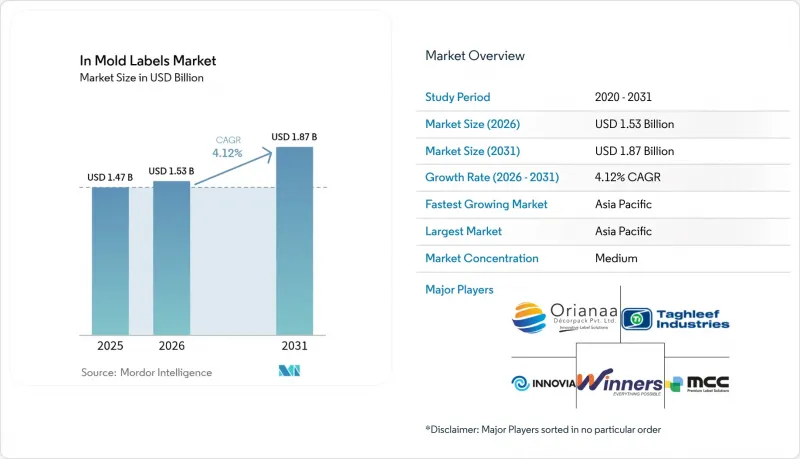
本報告依製造流程(射出成型、吹塑成型、熱成型)、材料類型(聚丙烯、聚乙烯等)、印刷技術(柔版印刷、數位印刷等)、終端用戶產業(食品、飲料等)以及地區(北美、歐洲、亞太、中東和非洲、南美)進行細分。市場預測以美元計價。
全球套模標籤市場趨勢與洞察
對便於回收的單一材料包裝的需求正在激增。
根據《塑膠包裝回收法》(PPWR),自2028年起強制回收,這將迫使加工商重新設計標籤,使容器和裝飾元素採用同一種聚合物。這不僅無需分揀,還能提高包裝的純度。 MCC Verstraete 的「NextCycle IML」提供了一種解決方案,可將聚丙烯標籤貼合到聚丙烯容器上,該方案不滲墨,並通過了機械回收測試。飲料和乳製品行業的品牌所有者擴大簽訂三年期供應契約,其中明確規定了單一材料的要求,從而為套模標籤市場的資本投資回報率建立了一個可預測的基準。亞洲樹脂製造商正在積極開發適用於食品接觸的高透明度聚丙烯等級產品,而美國零售商也正在引入評估標準,對混合材料裝飾進行處罰。隨著回收目標的日益嚴格,已獲得單一材料預認證的加工商將被選為優先合作夥伴,進一步鞏固其首模優勢。
在亞洲擴大高腔射出成型能力
2023年至2025年間,中國、越南和泰國共安裝了超過1,200台高腔射出成型機。光是FCS Machinery一家公司就已訂單可容納多達128個腔體的模具訂單,與傳統液壓注塑機相比,這些模具可降低單位人事費用28%,能耗30%。全球品牌商正在調整安全庫存政策以配合該地區的產能,到2026年的訂單預測也日趨明朗。較低的零件成本使加工商能夠在不影響利潤率的情況下應對PP價格波動,從而推動套模標籤市場的長期成長。由地方政府和跨國包裝集團共同資助的技能發展項目,進一步擴大了亞太地區與歐美競爭對手之間的成本品質差距,尤其是在食品級應用領域。
PP價格波動給加工商的利潤率帶來了壓力。
受丙烯單體供不應求和再生樹脂需求增加的影響,2025年第一季北美聚丙烯(PP)現貨價格上漲9美分/磅。小規模加工商缺乏避險手段,被迫每季重新談判,可能導致客戶流失。一些公司透過採用薄壁熱成型製程來降低風險,在不改變設計的情況下,重量可減少11%。另一些公司則透過簽訂與布蘭特原油價格掛鉤的多年期樹脂供應合約來穩定現金流,但這增加了它們的營運資金需求。在德克薩斯州和寧波的原物料產能提升計畫於2027年全面實現之前,利潤率壓力可能會抑制套模標籤市場的激進擴張計畫。
細分市場分析
預計到2025年,射出成型將佔據套模標籤市場8.4億美元的佔有率,佔總銷售額的56.83%。另一方面,熱成型正以7.21%的複合年成長率成長,超過了所有其他成型工藝。許多乳製品廠正從射出成型轉向熱成型,因為博朗機械的Quad系列成型機每小時可生產25萬個瓶蓋,同時能耗降低高達35%。吹塑成型對於可重複填充飲料瓶仍然至關重要,因為其肋條強度和抗跌落衝擊性能至關重要。
從資本投資預算來看,熱成型生產線採用了機器人堆垛機和攝影機偵測系統,將整體設備效率 (OEE) 提升至 85% 以上。內建的分析功能可偵測片材溫度波動,並在 50 毫秒內自動校正加熱區域,進而提高成品率。加工商指出,使用薄壁 PP 捲材可使每 1000 次壓印的樹脂成本降低近 18 美元,並減輕 PP 價格波動的影響。射出成型在複雜的瓶蓋和多成分零件領域仍佔據主導地位,但隨著永續性審核開始評估熱成型的低碳優勢,其在套模標籤市場的佔有率可能會趨於穩定。
到2025年,聚丙烯標籤將應用於價值6.6億美元的容器,佔據套模標籤市場44.92%的佔有率,並以8.74%的複合年成長率成長。監管機構建議使用聚丙烯標籤,因為它可以與容器分離,無需移除標籤。新型無規共聚物已成功將霧度降低至1%以下,並將衝擊強度提高至35 kJ/m²以上,從而擴大了其在透明食品容器中的應用。聚乙烯仍是需要抗彎裂性能的軟管的首選材料,而聚對苯二甲酸乙二醇酯則僅限於高透明度的展示槽。
中國主要樹脂生產商正在快速研發間茂催化劑,該催化劑可在不降低剛性的前提下將熔體流動速率提高一倍,有助於生產薄壁零件。目前,一些化妝品軟管含有超過60%的再生聚丙烯(PP),符合高階品牌的要求。雖然生物基聚丙烯的測試結果令人鼓舞,但原料供應有限。因此,獲得ISCC Plus認證的化石基聚丙烯仍將在套模標籤市場佔據主導地位。
區域分析
預計到2025年,亞太地區將以40.37%的市佔率引領套模標籤市場,並在2031年之前維持7.83%的複合年成長率。中國產能的擴張正在加速模具的供應,而日本的正面表列法規正在規範食品接觸適用性並促進市場准入。印度Chemplast Sanmar公司已投資16,000萬印度盧比用於特種樹脂的研發,以滿足當地標籤需求並履行出口合約。地方政府為電動印刷機的維修提供補貼,使單位溫室氣體排放強度降低了28%。
歐洲在監管方面仍處於領先地位。 《塑膠包裝和回收條例》(PPWR) 推動到 2030 年,PET 食品包裝中再生塑膠 (PCR) 的比例提高 30%,促進了對可剝離阻隔塗層和繫繩式封口的投資。瑞士油墨條例增加了透明度要求,強制供應商維護全面的材料登記冊。雖然這些法規給小規模企業帶來了壓力,但提前合規的加工商會獲得獎勵,從而在套模標籤市場中維持了高價位。
在北美,儘管聚丙烯(PP)價格波動和勞動力短缺帶來了成本壓力,但消費者對高階包裝的需求推動了化妝品和功能性乳製品行業的蓬勃發展。 「晶片與工廠」(CHIPS-and-FABS)計畫為模具機械回流提供的津貼鼓勵模具製造商實現備件在地化生產,從而減少了停機時間。在中東和非洲,對強化乳製品和調理食品的需求不斷成長,為阿拉伯聯合大公國物流區的新工廠建設創造了機會。南美洲對大豆衍生PET的投資正在拓展基材選擇,但其成長速度低於亞太地區。
其他好處:
- Excel格式的市場預測(ME)表
- 3個月的分析師支持
目錄
第1章:引言
- 研究假設和市場定義
- 調查範圍
第2章:調查方法
第3章執行摘要
第4章 市場狀況
- 市場概覽
- 市場促進因素
- 市場對易於回收的單一材料包裝的需求激增。
- 在亞洲擴大高腔射出成型能力
- 品牌擁有者正轉向以高階為導向、無標籤的美學理念。
- 數位IML印刷技術在小批量生產和個人化客製化領域的發展。
- 繫繩帽的強制性規定促進了輕型帽的IML生產。
- 市場限制因素
- PP價格波動給加工商的利潤率帶來了壓力。
- 與套管/PSL替代品相比,其阻隔性能有限。
- 更換工具的過程耗時較長,阻礙了 SKU 數量的大幅增加。
- 歐洲加強對溶劑型油墨揮發性有機化合物(VOC)的監管
- 供應鏈分析
- 監理情勢
- 技術展望
- 波特五力分析
- 投資分析
第5章 市場規模與成長預測
- 透過生產過程
- 射出成型
- 吹塑成型
- 熱成型
- 材料類型
- 聚丙烯(PP)
- 聚乙烯(PE)
- 聚對苯二甲酸乙二醇酯(PET)
- 其他材料類型
- 透過印刷技術
- 柔版印刷
- 數位(噴墨、EP)
- 凹版印刷
- 其他印刷技術
- 按最終用戶行業分類
- 食物
- 飲料
- 化妝品和個人護理
- 其他終端用戶產業
- 按地區
- 北美洲
- 美國
- 加拿大
- 墨西哥
- 歐洲
- 德國
- 英國
- 法國
- 義大利
- 西班牙
- 俄羅斯
- 其他歐洲國家
- 亞太地區
- 中國
- 印度
- 日本
- 韓國
- 澳洲和紐西蘭
- 其他亞太國家
- 中東和非洲
- 中東
- 阿拉伯聯合大公國
- 沙烏地阿拉伯
- 土耳其
- 其他中東國家
- 非洲
- 南非
- 奈及利亞
- 埃及
- 其他非洲國家
- 中東
- 南美洲
- 巴西
- 阿根廷
- 其他南美國家
- 北美洲
第6章 競爭情勢
- 市場集中度
- 策略趨勢
- 市佔率分析
- 公司簡介
- Innovia Films(CCL Industries)
- Multi-Color Corporation(MCC Verstraete)
- Taghleef Industries
- Constantia Flexibles
- Huhtamaki Oyj
- Coveris Holdings
- Inland Label & Marketing Services
- Cosmo Films
- Jindal Films
- UPM Raflatac
- ITC Packaging SLU
- Nissha Metallizing Solutions
- MCC Verstraete(Belgium)
- Mold-Tek Packaging Ltd.
- IML Labels & Systems
- ORIANA Decorpack
- Letra Graphix Pvt. Ltd.
- WINNERS LABELS LLP
- RPC Superfos
- Greiner Packaging
第7章 市場機會與未來展望
According to Mordor Intelligence, the in-mold labels market size was valued at USD 1.47 billion in 2025 and estimated to grow from USD 1.53 billion in 2026 to reach USD 1.87 billion by 2031, at a CAGR of 4.12% during the forecast period (2026-2031).
This report is Segmented by Production Process (Injection Molding, Blow Molding, Thermoforming), Material Type (Polypropylene, Polyethylene, and More), Printing Technology (Flexographic, Digital, and More), End-User Industry (Food, Beverage, and More), and Geography (North America, Europe, Asia-Pacific, Middle East and Africa, South America). The Market Forecasts are Provided in Terms of Value (USD).
Global In Mold Labels Market Trends and Insights
Surging Demand for Mono-Material Packaging Enabling Easier Recycling
Mandatory recyclability from 2028 under the PPWR forces converters to redesign labels so container and decoration share the same polymer, eliminating separation steps and improving bale purity. MCC Verstraete's NextCycle IML delivers a polypropylene label-on-polypropylene container solution that passes mechanical recycling trials without ink bleed.Brand owners in beverages and dairy increasingly lock in three-year supply agreements that specify mono-material requirements, creating a predictable baseline for capex returns in the in-mold labels market. Asian resin makers respond with higher-clarity PP grades compatible with food contact, and US retailers introduce scorecards that penalize mixed-material decoration. As recycling targets tighten, converters that pre-qualify mono-material formats will be preferred partners, reinforcing first-mover advantage.
Expansion of High-Cavitation Injection Molding Capacity in Asia
China, Vietnam, and Thailand added more than 1,200 high-cavitation presses during 2023-2025. FCS Machinery alone booked tool sets that run up to 128 cavities, cutting unit labor costs by 28% and energy use by 30% against legacy hydraulic presses. Global brand owners shift safety-stock policies to align with this regional capacity, accelerating order visibility through 2026. Lower per-part costs allow converters to absorb PP price fluctuation without eroding margin, supporting long-term upside in the in-mold labels market. Skills programs jointly funded by local governments and multinational packaging groups further widen Asia-Pacific's cost-quality gap over Western competitors, especially in food-grade applications.
PP Price Volatility Squeezing Converter Margins
Polypropylene spot prices in North America rose 9 cents per lb in Q1 2025, driven by propylene monomer shortages and higher recycled resin demand. Smaller converters lack hedging instruments, forcing them to renegotiate quarterly, which risks account churn. Some mitigate exposure by adopting thin-wall thermoforming, cutting gram weight by 11% without redesign. Others sign multi-year resin supply agreements indexed to Brent crude, smoothing cash flows but raising working-capital needs. Until feedstock capacity additions in Texas and Ningbo come onstream in 2027, margin pressure will temper aggressive expansion plans in the in-mold labels market.
Other drivers and restraints analyzed in the detailed report include:
- Brand-Owner Shift Toward Premium, No-Label-Look Decoration
- Growth of Digital IML Printing for Short Runs and Personalization
- Limited Barrier Properties Versus Sleeve/PSL Alternatives
For complete list of drivers and restraints, kindly check the Table Of Contents.
Segment Analysis
Injection molding accounted for USD 0.84 billion of the in-mold labels market size in 2025, translating to 56.83% revenue. Thermoforming, however, is on pace to log a 7.21% CAGR, outstripping every other process. Brown Machine's Quad Series machines cut energy draw by up to 35% while running 250,000 lids per hour, converting many dairy plants from injection to thermoforming. Blow molding remains vital for refillable beverage bottles where rib-strength and drop-impact resistance are critical.
Capital budgets show thermoforming lines integrating robotic stackers and camera inspection, raising overall equipment effectiveness (OEE) above 85%. Embedded analytics detect sheet temperature variation and auto-correct heater zones within 50 ms, enhancing yield. Converters note that thin-gauge PP rollstock lowers resin cost per thousand impressions by nearly 18 USD, cushioning PP price volatility. Injection molding still dominates complex closures and multi-component parts, but its share will plateau as sustainability audits favor thermoforming's lower carbon intensity in the in-mold labels market.
Polypropylene supplied labels on USD 0.66 billion worth of containers in 2025, capturing 44.92% of in-mold labels market share and expanding at an 8.74% CAGR. Regulators endorse PP because it can be sorted with containers, eliminating detaching steps. New random copolymer grades achieve haze below 1% and impact strength beyond 35 kJ/m2, widening their use in clear food pots. PE remains the choice for squeeze tubes that require flex-crack resistance, while PET is confined to high-clarity display jars.
Chinese resin majors fast-track meta-allocene catalysts that double melt-flow rate without compromising stiffness, aiding thin-wall parts. Post-consumer recycled PP now exceeds 60% inclusion in some cosmetic tubes, meeting premium brand pledges. Although bio-based PP trials show promise, feedstock supply is limited; thus, fossil-based PP with ISCC Plus certification will remain mainstream across the in-mold labels market.
Complete Report Scope:
- By Production Process
- Injection Molding
- Blow Molding
- Thermoforming
- By Material Type
- Polypropylene (PP)
- Polyethylene (PE)
- Polyethylene Terephthalate (PET)
- Other Material Types
- By Printing Technology
- Flexographic
- Digital (Inkjet, EP)
- Gravure
- Other Printing Technology
- By End-user Industry
- Food
- Beverage
- Cosmetics and Personal Care
- Other End-user Industry
- By Geography
- North America
- United States
- Canada
- Mexico
- Europe
- Germany
- United Kingdom
- France
- Italy
- Spain
- Russia
- Rest of Europe
- Asia-Pacific
- China
- India
- Japan
- South Korea
- Australia and New Zealand
- Rest of Asia-Pacific
- Middle East and Africa
- Middle East
- United Arab Emirates
- Saudi Arabia
- Turkey
- Rest of Middle East
- Africa
- South Africa
- Nigeria
- Egypt
- Rest of Africa
- Middle East
- South America
- Brazil
- Argentina
- Rest of South America
- North America
Geography Analysis
Asia-Pacific led the in-mold labels market with a 40.37% revenue share in 2025 and is forecast to post a 7.83% CAGR through 2031. Capacity additions in China drive tooling availability, while Japanese positive-list regulations harmonize food-contact compliance, easing market access. India's Chemplast Sanmar invested INR 160 crore in specialty resins supporting local label demand and export contracts. Regional governments subsidize electric press retrofits, lowering greenhouse gas intensity per unit by 28%.
Europe remains the regulatory pacesetter. PPWR pushes for 30% PCR in PET food packs by 2030, catalyzing investment in removable barrier coatings and tethered closures. Switzerland's ink ordinance adds transparency requirements, compelling suppliers to maintain exhaustive substance registers.These rules squeeze marginal players but reward converters with early-compliance track records, sustaining premium pricing in the in-mold labels market.
North America feels cost headwinds from PP volatility and labor shortages, yet consumer appetite for premium packaging keeps cosmetics and functional dairy lines vibrant. Reshoring grants for molding machinery under the CHIPS-and-FABS programs spur toolmakers to localize spare-parts hubs, trimming downtime. The Middle East and Africa see rising demand for fortified dairy and ready-meals, opening green-field plant opportunities in UAE logistics zones. South America's soybean-oil derived PET investments widen substrate choices, albeit slower than APAC growth trajectories.
- Innovia Films (CCL Industries)
- Multi-Color Corporation (MCC Verstraete)
- Taghleef Industries
- Constantia Flexibles
- Huhtamaki Oyj
- Coveris Holdings
- Inland Label & Marketing Services
- Cosmo Films
- Jindal Films
- UPM Raflatac
- ITC Packaging SLU
- Nissha Metallizing Solutions
- MCC Verstraete (Belgium)
- Mold-Tek Packaging Ltd.
- IML Labels & Systems
- ORIANA Decorpack
- Letra Graphix Pvt. Ltd.
- WINNERS LABELS LLP
- RPC Superfos
- Greiner Packaging
Additional Benefits:
- The market estimate (ME) sheet in Excel format
- 3 months of analyst support
TABLE OF CONTENTS
1 INTRODUCTION
- 1.1 Study Assumptions and Market Definition
- 1.2 Scope of the Study
2 RESEARCH METHODOLOGY
3 EXECUTIVE SUMMARY
4 MARKET LANDSCAPE
- 4.1 Market Overview
- 4.2 Market Drivers
- 4.2.1 Surging demand for mono-material packaging enabling easier recycling
- 4.2.2 Expansion of high-cavitation injection molding capacity in Asia
- 4.2.3 Brand-owner shift toward premium, no-label-look decoration
- 4.2.4 Growth of digital IML printing for short runs and personalization
- 4.2.5 Mandatory tethered-cap rules driving IML for lightweight closures
- 4.3 Market Restraints
- 4.3.1 PP price volatility squeezing converter margins
- 4.3.2 Limited barrier properties versus sleeve/PSL alternatives
- 4.3.3 Slow tool-changeover deterring very high SKU counts
- 4.3.4 Stricter VOC limits on solvent-based inks in Europe
- 4.4 Supply-Chain Analysis
- 4.5 Regulatory Landscape
- 4.6 Technological Outlook
- 4.7 Porter's Five Forces Analysis
- 4.7.1 Threat of New Entrants
- 4.7.2 Bargaining Power of Buyers/Consumers
- 4.7.3 Bargaining Power of Suppliers
- 4.7.4 Threat of Substitute Products
- 4.7.5 Intensity of Competitive Rivalry
- 4.8 Investment Analysis
5 MARKET SIZE AND GROWTH FORECASTS (VALUE)
- 5.1 By Production Process
- 5.1.1 Injection Molding
- 5.1.2 Blow Molding
- 5.1.3 Thermoforming
- 5.2 By Material Type
- 5.2.1 Polypropylene (PP)
- 5.2.2 Polyethylene (PE)
- 5.2.3 Polyethylene Terephthalate (PET)
- 5.2.4 Other Material Types
- 5.3 By Printing Technology
- 5.3.1 Flexographic
- 5.3.2 Digital (Inkjet, EP)
- 5.3.3 Gravure
- 5.3.4 Other Printing Technology
- 5.4 By End-user Industry
- 5.4.1 Food
- 5.4.2 Beverage
- 5.4.3 Cosmetics and Personal Care
- 5.4.4 Other End-user Industry
- 5.5 By Geography
- 5.5.1 North America
- 5.5.1.1 United States
- 5.5.1.2 Canada
- 5.5.1.3 Mexico
- 5.5.2 Europe
- 5.5.2.1 Germany
- 5.5.2.2 United Kingdom
- 5.5.2.3 France
- 5.5.2.4 Italy
- 5.5.2.5 Spain
- 5.5.2.6 Russia
- 5.5.2.7 Rest of Europe
- 5.5.3 Asia-Pacific
- 5.5.3.1 China
- 5.5.3.2 India
- 5.5.3.3 Japan
- 5.5.3.4 South Korea
- 5.5.3.5 Australia and New Zealand
- 5.5.3.6 Rest of Asia-Pacific
- 5.5.4 Middle East and Africa
- 5.5.4.1 Middle East
- 5.5.4.1.1 United Arab Emirates
- 5.5.4.1.2 Saudi Arabia
- 5.5.4.1.3 Turkey
- 5.5.4.1.4 Rest of Middle East
- 5.5.4.2 Africa
- 5.5.4.2.1 South Africa
- 5.5.4.2.2 Nigeria
- 5.5.4.2.3 Egypt
- 5.5.4.2.4 Rest of Africa
- 5.5.4.1 Middle East
- 5.5.5 South America
- 5.5.5.1 Brazil
- 5.5.5.2 Argentina
- 5.5.5.3 Rest of South America
- 5.5.1 North America
6 COMPETITIVE LANDSCAPE
- 6.1 Market Concentration
- 6.2 Strategic Moves
- 6.3 Market Share Analysis
- 6.4 Company Profiles (includes Global level Overview, Market level overview, Core Segments, Financials as available, Strategic Information, Market Rank/Share for key companies, Products and Services, and Recent Developments)
- 6.4.1 Innovia Films (CCL Industries)
- 6.4.2 Multi-Color Corporation (MCC Verstraete)
- 6.4.3 Taghleef Industries
- 6.4.4 Constantia Flexibles
- 6.4.5 Huhtamaki Oyj
- 6.4.6 Coveris Holdings
- 6.4.7 Inland Label & Marketing Services
- 6.4.8 Cosmo Films
- 6.4.9 Jindal Films
- 6.4.10 UPM Raflatac
- 6.4.11 ITC Packaging SLU
- 6.4.12 Nissha Metallizing Solutions
- 6.4.13 MCC Verstraete (Belgium)
- 6.4.14 Mold-Tek Packaging Ltd.
- 6.4.15 IML Labels & Systems
- 6.4.16 ORIANA Decorpack
- 6.4.17 Letra Graphix Pvt. Ltd.
- 6.4.18 WINNERS LABELS LLP
- 6.4.19 RPC Superfos
- 6.4.20 Greiner Packaging
7 MARKET OPPORTUNITIES AND FUTURE OUTLOOK
- 7.1 White-space and Unmet-need Assessment

 2026-2030年全球套模貼標市場
 套模標籤市場:2026-2032年全球市場預測(依產品類型、材料類型、印刷技術、標籤形狀和最終用途產業分類)
 套模標示市場(2026 年)
 套模標籤市場報告:按材料、技術、印刷技術、印刷油墨、應用和地區分類(2026-2034 年)
 全球套模貼標 (IML) 市場:市場規模、佔有率、成長和行業分析:按材料類型、技術類型、最終用途和區域預測
 套模標籤市場規模、佔有率和成長分析(按材料類型、製造流程、印刷技術、最終用途產業和地區分類)-2026-2033年產業預測模內貼標市場:依生產流程、材料、印刷技術、應用、國家及地區分類-全球產業分析、市場規模、市場佔有率及2025-2032年預測
 全球套模貼標市場
 套模標籤市場按製造程序、材料、印刷技術、油墨類型、最終使用行業和地區分類