


 |
市場調查報告書
商品編碼
2123690
醇醚:市場佔有率分析、產業趨勢與統計、成長預測(2026-2031)Alcohol Ethoxylates - Market Share Analysis, Industry Trends & Statistics, Growth Forecasts (2026 - 2031) |
||||||

※ 本網頁內容可能與最新版本有所差異。詳細情況請與我們聯繫。
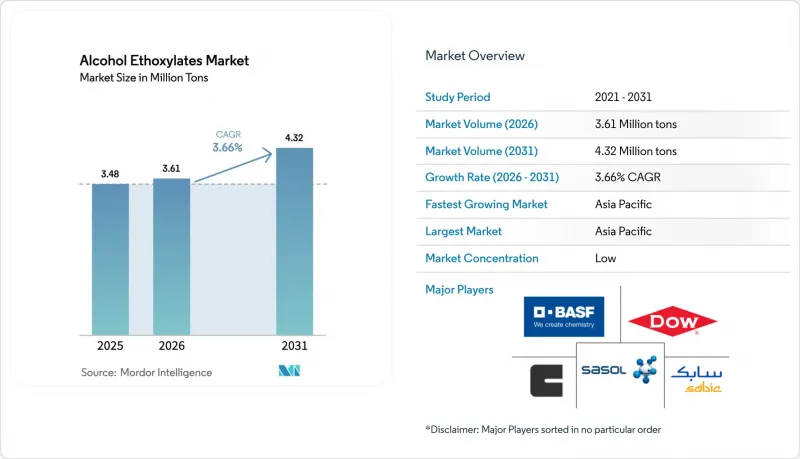
根據 Mordor Intelligence 預測,醇醚市場規模將從 2025 年的 348 萬噸和 2026 年的 361 萬噸成長到 2031 年的 432 萬噸,2026 年至 2031 年的年複合成長率(CAGR)為 3.66%。
本報告按原料類型(油脂化學品、石油化學品)、碳鏈長度(C9-C11(直鏈醇聚氧乙烯醚)、C12-C14(月桂醇聚氧乙烯醚)等)、形態(液體、膏狀/固體)、應用領域(個人護理、肥皂和清潔劑等)以及地區(亞太地區、北美地區等)進行細分。市場預測以噸為單位。
全球醇醚市場趨勢與洞察
全部區域個人護理和家庭護理的需求不斷成長
中國、印度和東南亞國協的都市化、可支配收入的成長以及政府主導的衛生項目,正推動著人均液體清潔劑、衣物柔順劑和沖洗型個人保健產品的消費量成長。這些產品利用了醇醚類化合物的溫和性、低溫性和冷水清潔能力。在中國二、三線城市,從固態轉向液體洗手劑的趨勢正以每年中等個位數的速度發展;而在印度農村地區,清潔劑的普及率低於50%,隨著電子商務和直銷物流的普及,未來幾年洗滌劑市場仍有成長空間。該地區的清潔美妝品牌正迅速從硫酸基陰離子界面活性劑轉向C12-C14醇醚類化合物,後者泡沫豐富,但對皮膚刺激性較小。這一趨勢反映了歐美產品配方改進的趨勢,並因社群媒體的影響而加速發展。與石油化學替代品相比,採用RSPO認證的棕櫚仁油衍生月桂醇,透過簡化供應鏈和縮短前置作業時間,鞏固了區域原料的優勢。隨著市場需求集中在液體產品和一次性膠囊,即使原物料價格波動導致銷售利潤率承壓,高階配方仍能維持定價權。
工業和設施清潔劑的擴展配方
醫療機構、餐廳和連鎖飯店正在加強衛生規程,以符合疫情後時代的標準和綠色建築認證要求,這促使低發泡醇醚類清潔劑在自動地面清潔機和集中式液體分配系統中得到更廣泛的應用。美國環保署 (EPA) 的「更安全選擇」計畫和歐盟生態標籤標準都傾向於使用高生物分解性的非離子介面活性劑,推動了從烷基酚聚氧乙烯醚類清潔劑向符合 OECD 301 標準的線性級清潔劑的轉變。機構使用者重視清潔劑性能的穩定性,不受水硬度波動的影響,這使得配方生產商能夠應對原料價格的波動並維持利潤率——這種韌性對於價格敏感的消費級清潔劑而言並非總是能夠實現。濃縮清潔膠囊通常含有 10-15%(重量比)的醇醚類清潔劑,使經銷商能夠根據其企業 ESG 政策減少包裝廢棄物。不斷擴大的第三方認證供應商網路正在實現採購集中化,並進一步鞏固線性醇醚類清潔劑作為機構通路標準領先表面活性劑的地位。
原物料價格波動
2024年12月,美國墨西哥灣沿岸環氧乙烷現貨價格因裂解裝置意外停產而上漲30%。同時,馬來西亞洪災和印尼出口配額導致脂醇類價格環比上漲25%,給尚未整合上游業務的乙氧基化物生產商的利潤率帶來壓力。歐洲和北美的契約製造生產商面臨雙重風險:一方面,需要從東南亞進口C12-C14原料;另一方面,區域環氧乙烷供應受能源價格波動的影響。多季供應合約雖然可以對沖風險,但會佔用營運資金,限制其開發特種產品的柔軟性。沙烏地基礎工業公司(SABIC)、殼牌和沙索等垂直整合型企業正利用其原料優勢,以低於獨立公司的價格供應產品,從而獲得市場佔有率,加速產業整合。此外,在持續波動的市場環境下,當成本確定性優先於性能差異化時,配方生產商被迫轉向烷基聚葡萄糖苷等替代界面活性劑。
細分市場分析
預計2025年,油脂化學品衍生的醇醚將佔市場佔有率的58.32%,進一步拉大與石化級醇醚的差距,到2031年複合年成長率將達到3.97%。這主要歸功於品牌所有者承諾在2030年實現100%使用可再生碳。東南亞的垂直整合正在推動醇醚市場的發展,棕櫚油精煉廠正在向下游拓展脂醇類和醇醚的生產,在獲得附加價值的同時,還能以具有競爭力的成本結構獲得RSPO物料平衡認證。同時,石化產品在中東和美國墨西哥灣沿岸地區仍然至關重要。在這些地區,企業自有的乙烯和丙烯生產線抵消了永續性溢價,並維持了通用石油產品和工業清潔劑的供應。BASF和陶氏的物料平衡計算方案提供了一種混合管道,用於在全球網路中分配可再生原料信用額度,但不同認證機構的認可度有所不同。新興技術,例如從生質乙醇合成環氧乙烷或直接髮酵醣類生產脂醇類,顯示第三種完全生物基的途徑,可以在醫藥輔料領域獲得溢價,因為在該領域,可追溯性比成本更重要。
Indorama Ventures 以 13 億美元收購 Oxiteno,進一步增強了其脂醇類業務得以進入拉丁美洲市場,並打造了一個價值 36 億美元的表面活性劑部門,該部門預計將上市。 Wilmar、KLK OLEO 和 Musim Mas 等公司正積極投資再生能源和甲烷回收,以減少範圍 1 的排放,這提高了無法達到類似 ESG 評分的中小型契約製造的准入門檻。因此,在醇醚市場,能夠提供可驗證的生產歷史、最佳化碳排放強度並確保即使在原料供應中斷的情況下也能保持物流柔軟性的生產商將更受青睞。
預計到2025年,C12-C14醇乙氧基化物將佔總銷售量的41.66%,並在2031年之前以4.12%的複合年成長率成長。由於其親水-疏水平衡值在12-15之間,具有卓越的清潔力和親膚的泡沫,預計其成長速度將超過鍊長更短或更長的醇類。經RSPO認證的月桂醇約佔全球C12-C14脂醇類供應量的70%,確保了大宗清潔劑和高階個人護理產品的充足原料供應。在目標莫耳比附近具有高濃度環氧乙烷分佈的窄範圍醇類產品價格高出15-20%,因為配方研發人員在研發無硫酸鹽洗髮精時,會優先考慮低刺激性和更佳的泡沫效果。 C9-C11級醇類產品由於發泡性較低,更適用於硬表面清潔劑,但在化妝品應用上存在氣味和揮發性問題。 C15-C18 和支鏈固醇在高溫油田和聚合應用中被廣泛使用,在這些應用中,乳化穩定性在 100 度C以上至關重要,但由於能源轉型和塗層產品的重組,它們的擴展前景受到限制。
C12-C14級洗滌劑的需求也受惠於歐洲能源效率法規,該法規建議使用低溫洗衣精。月桂醇聚氧乙烯醚即使在20-30 度C下也能有效去除污垢,進而為消費者節省電費。在新興的亞太地區,液體清潔劑日益普及,推動了銷售量成長,因為液體清潔劑所需的活性成分濃度高於粉狀清潔劑。儘管面臨生物界面活性劑和烷基聚葡萄糖苷等競爭因素,但由於其性價比優勢,C12-C14醇聚氧乙烯醚仍是主流配方。
區域分析
預計到2025年,亞太地區將佔全球銷售量的52.34%,並在2031年之前以4.82%的複合年成長率持續成長。這主要得益於液體清潔劑使用量的成長,而這又受到可支配收入增加、城市化進程加快以及中國、印度和東協主要市場廣泛推行的衛生宣傳活動的推動。在中國,隨著農村地區電子商務的普及,從固態肥皂到液體洗手劑的轉變正以中等個位數的速度持續進行。在印度,隨著政府衛生政策和微型分銷模式改善「最後一公里」的供應,農村地區清潔劑供不應求在未來幾年將帶來成長空間。印尼和越南等東協主要國家正在吸引乙氧基化產業的待開發區投資,以避免進口關稅並實現價值鏈在地化。同時,在日本和韓國等成熟市場,高附加價值的小眾化妝品級產品正成為市場的焦點。
在北美和歐洲,市場成熟度和嚴格的生態毒性法規限制了生產成長。儘管線性醇醚在商用清洗領域的應用正在加速,但由於高階個人保健產品中生物界面活性劑的替代率不斷提高,整體成長速度正在放緩。在這兩個地區,生物基乙氧基化生產能力(例如黑田製藥位於斯奈斯的工廠維修和BASF位於路德維希港的工廠改造)正在引入,以利用歐盟「綠色新政」和美國「生物優先」計畫的獎勵。更嚴格的法規推動了對完全合規的承包表面活性劑系統的需求,使大型綜合公司比小規模區域供應商更具優勢。
南美洲、中東和非洲對醇醚的需求正在成長。以巴西奧克西特諾(Oxiteno)綜合設施為中心的巴西油脂化學生態系統,為國內農業化學品和家庭護理行業供應產品,這些行業優先考慮在地採購和RSPO認證的供應。在阿根廷,宏觀經濟波動限制了界面活性劑的進口;而在中東,低成本的乙烯被用於向非洲出口石油化工衍生的醇醚,這削弱了亞洲生產商曾經享有的運輸成本優勢。在南非,液體清潔劑的使用呈上升趨勢,但由於基礎設施不足和價格敏感性,粉狀洗滌劑在撒哈拉以南非洲市場仍然佔據主導地位。
其他好處:
- Excel格式的市場預測(ME)表
- 3個月的分析師支持
目錄
第1章:引言
- 研究假設和市場定義
- 調查範圍
第2章:調查方法
第3章執行摘要
第4章 市場狀況
- 市場概覽
- 市場促進因素
- 全部區域對個人護理和家庭護理的需求正在激增。
- 擴大工業和設施清潔劑的配方
- 擴大農藥作為永續添加劑的使用範圍
- 快速擴大專門用於環氧乙烷/烷氧基化反應的生產能力
- 利用酵素催化劑向生物基乙氧基化製程過渡
- 市場限制因素
- 原料(環氧乙烷和脂醇類)價格波動
- 加強乙氧基化物/壬基酚聚氧乙烯醚的生態毒性法規
- 與生物基取代界面活性劑的競爭
- 價值鏈分析
- 波特五力模型
第5章 市場規模與成長預測
- 按原產地
- 源自油脂化學品
- 石油化工衍生性商品
- 按碳鍊長度
- C9-C11(線性醇乙氧基化物)
- C12-C14(月桂醇乙氧基化物)
- C15-C18 和支鏈(甾醇乙氧基化物)
- 按形式
- 液體
- 糊狀/固態
- 透過使用
- 個人護理
- 肥皂和清潔劑
- 工業和設施清潔
- 農業化學品
- 油漆和塗料
- 紡織加工
- 其他用途(石油和天然氣(提高採收率、鑽井液))
- 按地區
- 亞太地區
- 中國
- 印度
- 日本
- 韓國
- 東南亞國協
- 其他亞太國家
- 北美洲
- 美國
- 加拿大
- 墨西哥
- 歐洲
- 德國
- 英國
- 法國
- 義大利
- 其他歐洲國家
- 南美洲
- 巴西
- 阿根廷
- 其他南美國家
- 中東和非洲
- 沙烏地阿拉伯
- 南非
- 其他中東和非洲國家
- 亞太地區
第6章 競爭情勢
- 市場集中度
- 策略趨勢
- 市佔率和排名分析
- 公司簡介
- BASF
- Clariant
- Croda International plc
- Dow
- Evonik Industries AG
- Huntsman International LLC
- India Glycols Limited
- Indorama Ventures Public Company Limited
- Kao Chemicals Europe, SLU
- Kemipex
- Mitsui Chemicals Inc.
- Nouryon
- Procter & Gamble
- SABIC
- Sasol Ltd
- Shell plc
- Stepan Company
- Syensqo
- Thai Ethoxylate Co., Ltd.(TEX)
第7章 市場機會與未來展望
According to Mordor Intelligence, the alcohol ethoxylates market size is projected to expand from 3.48 million tons in 2025 and 3.61 million tons in 2026 to 4.32 million tons by 2031, registering a CAGR of 3.66% between 2026 to 2031.
This report is Segmented by Origin Type (Oleochemical-Derived, and Petrochemical-Derived), Carbon Chain Length (C9-C11 (Linear Alcohol Ethoxylates), C12-C14 (Lauryl Alcohol Ethoxylates), and More), Form (Liquid, and Paste/Solid), Application (Personal Care, Soaps and Detergents, and More), and Geography (Asia-Pacific, North America, and More). The Market Forecasts are Provided in Terms of Volume (Tons).
Global Alcohol Ethoxylates Market Trends and Insights
Surging Personal- and Home-Care Demand Across Asia-Pacific
Urbanization, rising disposable incomes, and government-sponsored sanitation programs in China, India, and ASEAN economies are lifting per-capita consumption of liquid detergents, fabric softeners, and rinse-off personal-care products that rely on alcohol ethoxylates for mildness, foam control, and cold-water detergency. China's tier-2 and tier-3 cities are replacing bar soap with liquid handwash at a mid-single-digit annual pace, while India's rural detergent penetration sits below 50%, providing a multiyear runway as e-commerce and direct-to-consumer logistics expand access. Clean-beauty brands across the region are quickly swapping sulfated anionics for C12-C14 alcohol ethoxylates that deliver comparable lather with lower skin irritation, mirroring Western reformulation patterns but accelerating through social-media influence. The preference for RSPO-certified, palm-kernel-based lauryl alcohol streamlines supply chains and shortens lead times compared with petrochemical alternatives, locking in regional feedstock advantages. As demand concentrates in liquids and single-dose pods, premium formulations maintain pricing power even when feedstock volatility compresses merchant margins.
Expanding Industrial and Institutional Cleaning Formulations
Healthcare facilities, food-service operators, and hospitality chains are tightening hygiene protocols to comply with post-pandemic standards and green-building certifications, driving adoption of low-foaming alcohol ethoxylates in automated scrubbers and central dosing systems. U.S. EPA Safer Choice and EU Ecolabel criteria reward readily biodegradable nonionics, triggering a shift from alkylphenol ethoxylates to linear grades that meet OECD 301 benchmarks. Institutional buyers value performance consistency across variable water hardness, enabling formulators to absorb feedstock swings and preserve margin, a resilience not always feasible in price-sensitive consumer detergents. Concentrated cleaning capsules typically contain 10-15% alcohol ethoxylates by weight, letting distributors reduce packaging waste in line with corporate ESG mandates. The growing network of third-party-certified suppliers consolidates procurement, further entrenching linear alcohol ethoxylates as the default workhorse surfactant in the institutional channel.
Feedstock Price Volatility
Unplanned cracker outages drove U.S. Gulf Coast ethylene-oxide spot prices up 30% in December 2024, while Malaysian flooding and Indonesian export quotas lifted fatty-alcohol prices 25% month-on-month, creating a margin vice for ethoxylators without upstream integration. European and North American tollers face dual exposure: imported C12-C14 feedstocks from Southeast Asia and regional ethylene-oxide supply subject to energy-price shocks. Multi-quarter supply contracts hedge risk but tie up working capital, limiting flexibility for specialty-grade development. Vertically integrated players such as SABIC, Shell, and Sasol exploit their feedstock control to undercut independents and capture share, accelerating industry consolidation. Persistent volatility also nudges formulators toward alternative surfactants like alkyl polyglucosides when budget certainty outranks performance differentiation.
Other drivers and restraints analyzed in the detailed report include:
- Growing Agrochemical Use as Sustainable Adjuvants
- Rapid Build-Out of Dedicated EO/Alkoxylation Capacity
- Tightening Eco-Toxicity Regulations on Ethoxylates/NPEs
For complete list of drivers and restraints, kindly check the Table Of Contents.
Segment Analysis
Oleochemical alcohol ethoxylates held 58.32% volume share in 2025, and their 3.97% CAGR through 2031 is set to widen the gap over petrochemical grades as brand owners pledge 100% renewable carbon by 2030. The alcohol ethoxylates market benefits from Southeast-Asian vertical integration, where palm-oil refiners downstream into fatty-alcohols and ethoxylation, capturing value while guaranteeing RSPO mass-balance certification at competitive cost structures. Petrochemical variants remain essential in the Middle East and U.S. Gulf Coast, where captive ethylene and propylene chains offset sustainability premiums, sustaining supply into commodity oilfields and industrial cleaners. Mass-balance accounting schemes from BASF and Dow offer a hybrid pathway, allocating renewable-feedstock credits across global networks, though acceptance varies by certification body. Emerging technologies that synthesize ethylene oxide from bio-ethanol or ferment sugars directly into fatty alcohols hint at a third, fully bio-based pathway that could command premium pricing in pharma excipients where traceability outweighs cost.
Oleochemical supply resilience is reinforced by Indorama Ventures' USD 1.3 billion purchase of Oxiteno, which extended its fatty-alcohol footprint into Latin America and created a USD 3.6 billion surfactant segment potentially poised for a public listing. Wilmar, KLK OLEO, and Musim Mas invest aggressively in renewable electricity and methane-capture to lower scope-1 emissions, raising the barrier to entry for smaller tollers unable to achieve comparable ESG scores. The alcohol ethoxylates market, therefore, rewards producers that can certify chain-of-custody, optimize carbon intensity, and guarantee logistics agility during feedstock shocks.
C12-C14 alcohol ethoxylates accounted for 41.66% of volume in 2025 and are projected to grow at a 4.12% CAGR to 2031, outperforming shorter and longer chain segments due to their hydrophilic-lipophilic balance of 12-15 that yields superior detergency and skin-mild foam. RSPO-certified lauryl alcohol represents roughly 70% of global C12-C14 fatty-alcohol supply, ensuring ample feedstock for both bulk detergents and premium personal-care applications. Narrow-range variants that concentrate the ethylene-oxide distribution around the target molar ratio command 15-20% premiums, as formulators value lower irritation indexes and improved foam aesthetics in sulfate-free shampoos. C9-C11 grades, while lower-foaming and favored in hard-surface cleaners, face odor and volatility limitations in cosmetics. C15-C18 and branched steryl chains serve high-temperature oilfield and polymerization end-uses where emulsion stability at >100 °C is critical, but the energy transition and coatings reformulations cap their expansion prospects.
Demand for C12-C14 grades also benefits from European energy-efficiency mandates that encourage cold-wash detergents, where lauryl ethoxylates maintain soil removal at 20-30 °C, enabling electrical-utility savings for consumers. In emerging Asia-Pacific, increasing liquid-detergent penetration amplifies volume, as liquids require higher active-matter loading than powders. Headwinds include competing biosurfactants and alkyl polyglucosides, but cost and performance differentials keep C12-C14 alcohol ethoxylates entrenched in mainstream formulations.
Complete Report Scope:
- By Origin Type
- Oleochemical-derived
- Petrochemical-derived
- By Carbon Chain Length
- C9-C11 (Linear Alcohol Ethoxylates)
- C12-C14 (Lauryl Alcohol Ethoxylates)
- C15-C18 and Branched (Steryl Alcohol Ethoxylates)
- By Form
- Liquid
- Paste / Solid
- By Application
- Personal Care
- Soaps and Detergents
- Industrial and Institutional Cleaning
- Agricultural Chemicals
- Paints and Coatings
- Textile Processing
- Other Applications (Oil and Gas (EOR, drilling fluids))
- By Geography
- Asia-Pacific
- China
- India
- Japan
- South Korea
- ASEAN Countries
- Rest of Asia-Pacific
- North America
- United States
- Canada
- Mexico
- Europe
- Germany
- United Kingdom
- France
- Italy
- Rest of Europe
- South America
- Brazil
- Argentina
- Rest of South America
- Middle-East and Africa
- Saudi Arabia
- South Africa
- Rest of Middle-East and Africa
- Asia-Pacific
Geography Analysis
Asia-Pacific commanded 52.34% of global volume in 2025 and is poised to advance at a 4.82% CAGR through 2031, underscored by rising disposable incomes, urban migration, and sanitation campaigns proliferating liquid-detergent usage in China, India, and key ASEAN markets. China's transition from bar soaps to liquid handwash continues at a mid-single-digit pace, supported by e-commerce penetration in lower-tier cities. India's rural detergent gap offers multi-year upside as government hygiene initiatives and micro-distribution models bridge last-mile access. ASEAN hubs such as Indonesia and Vietnam attract greenfield ethoxylation investments to sidestep import tariffs and localize value chains, while mature Japan and South Korea target high-value narrow-range grades for cosmetics.
In North America and Europe, market maturity and stringent eco-toxicity rules limit incremental tonnage. Uptake of linear alcohol ethoxylates in institutional cleaning accelerates, yet biosurfactant substitution in premium personal-care products moderates overall growth. Both regions deploy bio-based ethoxylation capacity-Croda's Snaith plant and BASF's Ludwigshafen retrofit-to capture incentives under the EU Green Deal and U.S. BioPreferred program. Regulatory rigor fuels demand for turnkey, fully compliant surfactant systems, giving integrated majors an edge over smaller, regional suppliers.
South America and the Middle East and Africa are witnessing rising demand for alcohol ethoxylates. Brazil's oleochemical ecosystem, centered on Oxiteno's integrated facilities, serves domestic agrochemical and home-care sectors that value local content and RSPO-certified supply. Argentina's macroeconomic volatility constrains surfactant imports, while the Middle East leverages low-cost ethylene to export petrochemical-derived alcohol ethoxylates into Africa, eroding freight advantages once enjoyed by Asian producers. South Africa's detergent shift toward liquids is tempered by infrastructure gaps and price sensitivity that keep powder formats dominant across sub-Saharan markets.
- BASF
- Clariant
- Croda International plc
- Dow
- Evonik Industries AG
- Huntsman International LLC
- India Glycols Limited
- Indorama Ventures Public Company Limited
- Kao Chemicals Europe, S.L.U.
- Kemipex
- Mitsui Chemicals Inc.
- Nouryon
- Procter & Gamble
- SABIC
- Sasol Ltd
- Shell plc
- Stepan Company
- Syensqo
- Thai Ethoxylate Co., Ltd. (TEX)
Additional Benefits:
- The market estimate (ME) sheet in Excel format
- 3 months of analyst support
TABLE OF CONTENTS
1 Introduction
- 1.1 Study Assumptions and Market Definition
- 1.2 Scope of the Study
2 Research Methodology
3 Executive Summary
4 Market Landscape
- 4.1 Market Overview
- 4.2 Market Drivers
- 4.2.1 Surging personal- and home-care demand across Asia-Pacific
- 4.2.2 Expanding industrial and institutional cleaning formulations
- 4.2.3 Growing agrochemical use as sustainable adjuvants
- 4.2.4 Rapid build-out of dedicated EO/alkoxylation capacity
- 4.2.5 Shift to enzyme-catalysed, bio-based ethoxylation processes
- 4.3 Market Restraints
- 4.3.1 Feedstock (ethylene oxide and fatty alcohol) price volatility
- 4.3.2 Tightening eco-toxicity regulations on ethoxylates/NPEs
- 4.3.3 Competition from bio-based alternative surfactants
- 4.4 Value Chain Analysis
- 4.5 Porter's Five Forces
- 4.5.1 Bargaining Power of Suppliers
- 4.5.2 Bargaining Power of Buyers
- 4.5.3 Threat of New Entrants
- 4.5.4 Threat of Substitutes
- 4.5.5 Degree of Competition
5 Market Size and Growth Forecasts (Volume)
- 5.1 By Origin Type
- 5.1.1 Oleochemical-derived
- 5.1.2 Petrochemical-derived
- 5.2 By Carbon Chain Length
- 5.2.1 C9-C11 (Linear Alcohol Ethoxylates)
- 5.2.2 C12-C14 (Lauryl Alcohol Ethoxylates)
- 5.2.3 C15-C18 and Branched (Steryl Alcohol Ethoxylates)
- 5.3 By Form
- 5.3.1 Liquid
- 5.3.2 Paste / Solid
- 5.4 By Application
- 5.4.1 Personal Care
- 5.4.2 Soaps and Detergents
- 5.4.3 Industrial and Institutional Cleaning
- 5.4.4 Agricultural Chemicals
- 5.4.5 Paints and Coatings
- 5.4.6 Textile Processing
- 5.4.7 Other Applications (Oil and Gas (EOR, drilling fluids))
- 5.5 By Geography
- 5.5.1 Asia-Pacific
- 5.5.1.1 China
- 5.5.1.2 India
- 5.5.1.3 Japan
- 5.5.1.4 South Korea
- 5.5.1.5 ASEAN Countries
- 5.5.1.6 Rest of Asia-Pacific
- 5.5.2 North America
- 5.5.2.1 United States
- 5.5.2.2 Canada
- 5.5.2.3 Mexico
- 5.5.3 Europe
- 5.5.3.1 Germany
- 5.5.3.2 United Kingdom
- 5.5.3.3 France
- 5.5.3.4 Italy
- 5.5.3.5 Rest of Europe
- 5.5.4 South America
- 5.5.4.1 Brazil
- 5.5.4.2 Argentina
- 5.5.4.3 Rest of South America
- 5.5.5 Middle-East and Africa
- 5.5.5.1 Saudi Arabia
- 5.5.5.2 South Africa
- 5.5.5.3 Rest of Middle-East and Africa
- 5.5.1 Asia-Pacific
6 Competitive Landscape
- 6.1 Market Concentration
- 6.2 Strategic Moves
- 6.3 Market Share(%)/Ranking Analysis
- 6.4 Company Profiles (includes Global level Overview, Market level overview, Core Segments, Financials as available, Strategic Information, Products and Services, Recent Developments)
- 6.4.1 BASF
- 6.4.2 Clariant
- 6.4.3 Croda International plc
- 6.4.4 Dow
- 6.4.5 Evonik Industries AG
- 6.4.6 Huntsman International LLC
- 6.4.7 India Glycols Limited
- 6.4.8 Indorama Ventures Public Company Limited
- 6.4.9 Kao Chemicals Europe, S.L.U.
- 6.4.10 Kemipex
- 6.4.11 Mitsui Chemicals Inc.
- 6.4.12 Nouryon
- 6.4.13 Procter & Gamble
- 6.4.14 SABIC
- 6.4.15 Sasol Ltd
- 6.4.16 Shell plc
- 6.4.17 Stepan Company
- 6.4.18 Syensqo
- 6.4.19 Thai Ethoxylate Co., Ltd. (TEX)
7 Market Opportunities and Future Outlook
- 7.1 White-space and Unmet-Need Assessment

 醇醚市場-2026-2032年全球市場預測
 全球醇醚市場:按產品、應用、最終用途和地區分類
 2026年全球烷氧基化物市場報告2026年全球醇醚市場報告
 烷氧基化物市場-全球產業規模、佔有率、趨勢、機會和預測,按類型、最終用戶、地區和競爭格局分類,2020-2030年預測
 烷氧基化物:全球市場佔有率和排名、總收入和需求預測(2025-2031年)
 醇乙氧基化物市場規模、佔有率、成長分析(按產品、應用、最終用途和地區)- 產業預測,2025 年至 2032 年
 烷氧基化物市場報告:2031 年趨勢、預測與競爭分析脂肪醇聚氧乙烯醚市場報告:2030 年趨勢、預測與競爭分析
 全球烷氧基化物市場:市場規模、佔有率、趨勢分析報告 - 按等級、按類型、按應用、按最終用途行業、按地區、展望、預測,2024-2031 年