


 |
市場調查報告書
商品編碼
2123649
條碼列印機:市場佔有率分析、行業趨勢和統計數據、成長預測(2026-2031 年)Barcode Printer - Market Share Analysis, Industry Trends & Statistics, Growth Forecasts (2026 - 2031) |
||||||

※ 本網頁內容可能與最新版本有所差異。詳細情況請與我們聯繫。
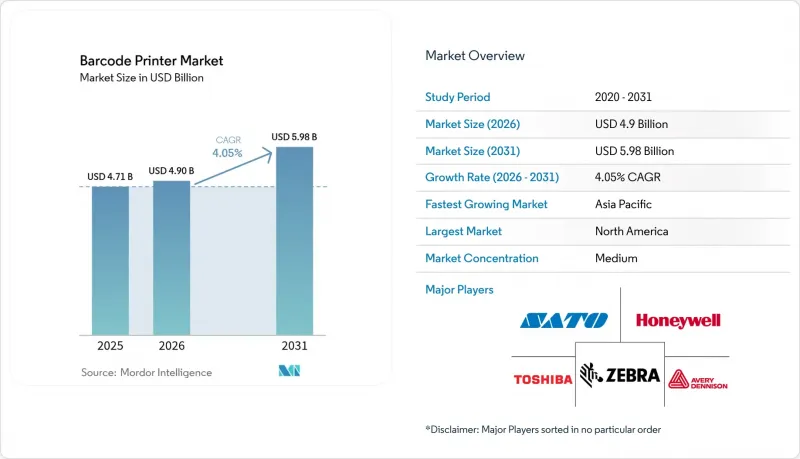
根據 Mordor Intelligence 預測,條碼列印機市場將從 2025 年的 47.1 億美元成長到 2026 年的 49 億美元,然後在 2031 年達到 59.8 億美元,2026 年至 2031 年的複合年成長率為 4.05%。
本報告按產品類型(桌上型印表機、行動印表機、工業印表機)、列印技術(熱轉印、直接熱轉印、雷射、噴墨及其他)、終端用戶產業(製造業、零售業、運輸物流業、醫療保健業及其他終端用戶產業)及地區進行細分。市場預測以美元計價。
全球條碼列印機市場趨勢及洞察
全通路零售和電子商務物流快速成長。
為了因應季節性需求波動,跨通路管理庫存的零售商需要在履約中心即時列印標籤。 American Eagle Outfitters 在其位於賓夕法尼亞州佔地 165 萬平方英尺的物流中心實施了基於影像識別的解決方案後,紙箱讀取準確率提升至 99%,這表明更高的掃描率能夠轉化為更精準的列印。 Blue Sky Distribution 透過客製印刷與配送路線管理軟體整合,實現了 100% 的訂單準確率並提高了履約效率,即使訂單量增加了 70%,也減少了當日送達錯誤。零售商現在透過在揀貨車上部署行動印表機來提高倉庫的柔軟性,從而消除固定設備造成的瓶頸。此外,對基於雲端的監控的需求也在不斷成長,這使得 IT 團隊能夠遠端管理韌體和安全性修補程式。這些需求正推動條碼列印機市場發展到無線、堅固耐用且可透過集中式控制面板進行維護的設備。
工業4.0主導的智慧工廠實施AIDC
智慧工廠利用自動識別和數據採集 (AIDC) 技術,將生產資產與 ERP 和 MES 平台直接整合。斑馬的 FS42 固定式掃描器整合了神經處理功能,可偵測條碼並將資料提供給 AI 模型,從而檢測生產線上的缺陷。條碼列印機將序號傳輸到工廠網路,從而實現基於零件 ID 的預測性維護程序。 Brady Corporation 的研究表明,基於列印條碼的自動資料輸入可將人工輸入錯誤減少高達 90%,同時將工作效率提高 40%。因此,製造商正在指定支援工業協議、邊緣運算和高容量處理的印表機。因此,儘管各產業的資本投資放緩,硬體升級週期仍在持續。
熱敏印表機頭供應及價格波動
由於關稅和原物料價格上漲,2024年熱敏紙成本出現了兩位數的成長。印表機頭生產集中在東亞少數幾家專業工廠,與熱轉印模式相比,直接熱敏模式下的替換用刷頭磨損速度快25%至50%。原始設備製造商(OEM)需要維持更大的庫存,這增加了對營運資金的需求,並導致終端用戶面臨更高的價格。由於買家等待零件成本恢復正常,一些項目被推遲。從長遠來看,製造商正在考慮採用多供應商策略,但資金障礙限制了供應多元化。
細分市場分析
到2025年,工業印表機將佔據條碼列印機市場56.60%的佔有率,銷售量遙遙領先。這些設備具有寬幅介質、鋼製底盤和超過全天候運作的超長工作週期,滿足製造商和物流中心對運作需求。 SATO的CL4NX Plus列印速度高達14吋/秒,並透過韌體追蹤列印頭磨損狀況,實現預測性零件更換。儘管如此,行動終端市場預計到2031年將以5.95%的複合年成長率成長,因為零工宅配員、現場工程師和店內負責人需要輕鬆易攜的設備。行動條碼列印機市場預計將從2025年的10.2億美元成長到2031年的14.4億美元,這表明便攜性正在重新定義客戶的期望。桌上型印表機因其可接受的運作時間和相對較低的初始投資成本,仍然受到中小企業的青睞。將工業引擎整合到推車式平台中的混合設計有可能模糊產品線的界限,這表明未來的細分將由工作流程而不是外形規格驅動。
就出貨量而言,工業印表機仍佔據絕對出貨量的最大佔有率,因為多線工廠正在部署印表機叢集進行在製品管理。然而,來自中國OEM廠商日益激烈的價格競爭正對中階市場的利潤率帶來壓力。行動印表機的平均售價(ASP)保持穩定,因為買家優先考慮電池續航時間、無線安全性和抗摔性。在預測期內,工業印表機的更新換代將專注於連接性升級,例如乙太網路、藍牙5和WPA3,而行動印表機的競爭將主要集中在輕量化設計和醫療產業導向的抗菌外殼上。成熟的工業需求與高度行動化產品的普及並存,顯示即使某個細分市場趨於成熟,條碼列印機市場仍能持續成長。
區域分析
預計到2025年,北美將佔據條碼列印機市場31.40%的佔有率。聯邦政府的採購,包括美國郵政服務公司更換數千台斑馬(Zebra)設備,正在推動硬體銷售。此外,藥品供應鏈法規要求醫院和藥局投資購買與GS1 DataMatrix媒體相容的印表機。加拿大零售業的現代化以及墨西哥加工廠的出口進一步刺激了該地區的需求。預計到2025年,北美條碼列印機市場規模將達到14.8億美元,到2031年將接近18.6億美元。該地區的用戶普遍關注總體擁有成本(TCO),並正在推動採用遠端設備管理解決方案,以便在無需現場訪問的情況下安排韌體更新。
亞太地區是成長最快的市場,預計到2031年將以4.72%的複合年成長率成長。中國和印度的消費電子和服裝工廠持續建設,這兩個產業對出口所需的線上貼標技術都有著迫切的需求。 Gainscha擁有超過4萬平方公尺的生產空間,並持有50項熱敏相關專利,這充分展現了其在亞太地區的技術優勢。根據HPRT報道,Gainscha的銷售網路遍佈80多個國家,凸顯了這個中國品牌的全球影響力。日本正大力推動汽車工廠的工業4.0整合,而東南亞的近岸外包模式也不斷發展,推動貼標設備的需求向南轉移。預計到2025年,亞太地區條碼列印機市場規模將達13.3億美元,到2031年將超過17.5億美元。
其他好處:
- Excel格式的市場預測(ME)表
- 3個月的分析師支持
目錄
第1章:引言
- 研究假設和市場定義
- 調查範圍
第2章:調查方法
第3章執行摘要
第4章 市場狀況
- 市場概覽
- 市場促進因素
- 全通路零售和電子商務物流的快速成長
- 工業4.0主導的智慧工廠及其AIDC實施方案
- 醫療和食品產業對冷鏈可追溯性的需求
- 行動式和穿戴式條碼列印機可提高現場生產力
- 雲端原生遠端列印管理和安全
- 推出符合ESG法規的無底紙標籤
- 市場限制因素
- 熱敏印表機頭的供應和價格波動
- 向QR碼/RFID技術的轉變正在降低對基本條碼的需求。
- 對電子廢棄物的監管越嚴格,其生命週期成本就越高。
- 在要求嚴苛的工業應用中,過渡到直接零件標記和雷射蝕刻。
- 供應鏈分析
- 監理情勢
- 技術展望
- 波特五力分析
- 對影響市場的宏觀經濟因素進行評估
第5章 市場規模與成長預測
- 依產品類型
- 桌上型印表機
- 行動印表機
- 工業印表機
- 透過印刷技術
- 熱傳遞
- 直接傳熱
- 雷射
- 噴墨
- 其他
- 按最終用戶行業分類
- 製造業
- 車
- 電子設備
- 食品/飲料
- 其他
- 零售
- 運輸/物流
- 衛生保健
- 其他終端用戶產業
- 製造業
- 按地區
- 北美洲
- 美國
- 加拿大
- 墨西哥
- 南美洲
- 巴西
- 阿根廷
- 其他南美國家
- 歐洲
- 德國
- 英國
- 法國
- 義大利
- 俄羅斯
- 其他歐洲國家
- 亞太地區
- 中國
- 日本
- 印度
- 韓國
- 其他亞太國家
- 中東和非洲
- 中東
- GCC
- 土耳其
- 以色列
- 其他中東國家
- 非洲
- 南非
- 奈及利亞
- 肯亞
- 其他非洲國家
- 中東
- 北美洲
第6章 競爭情勢
- 市場集中度
- 策略趨勢
- 市佔率分析
- 公司簡介
- Zebra Technologies Corporation
- Sato Holdings Corporation
- Honeywell International Inc.
- Toshiba Tec Corporation
- Avery Dennison Corporation
- Seiko Epson Corporation
- TSC Auto ID Technology Co. Ltd.
- Brother Industries Ltd.
- Postek Electronics Co. Ltd.
- Primera Technology Inc.
- Bixolon Co. Ltd.
- Citizen Systems Japan Co. Ltd.
- Godex International Co. Ltd.
- Wasp Barcode Technologies
- Cab Produkttechnik GmbH and Co KG
- Printronix Auto ID Inc.
- Gainscha Technology Group Ltd.
- Domino Printing Sciences plc
- IDPRT(Xiamen Hanin Co. Ltd.)
- Datamax
第7章 市場機會與未來展望
According to Mordor Intelligence, the barcode printer market size is expected to grow from USD 4.71 billion in 2025 to USD 4.9 billion in 2026 and is forecast to reach USD 5.98 billion by 2031 at 4.05% CAGR over 2026-2031.
This report is Segmented by Product Type (Desktop Printers, Mobile Printers, Industrial Printers), Printing Technology (Thermal Transfer, Direct Thermal, Laser, Inkjet, Others), End-User Industry (Manufacturing, Retail, Transportation and Logistics, Healthcare, Other End-User Industries), and by Geography. The Market Forecasts are Provided in Terms of Value (USD).
Global Barcode Printer Market Trends and Insights
Omnichannel retail and e-commerce logistics boom
Retailers that manage unified inventories across multiple channels need labels printed in real time at fulfillment sites to cope with seasonal demand swings. American Eagle Outfitters lifted carton reading accuracy to 99% after installing image-based solutions in its 1.65 million sq ft Pennsylvania distribution center, illustrating how higher scan rates feed back into precise print requirements. Blue Sky Distribution recorded 100% order accuracy and an 80% jump in fulfillment efficiency once it synchronized on-demand printing with routing software, which cut single-day delivery errors as orders rose 70%. Retailers now deploy mobile printers on picking carts to remove stationary bottlenecks, enhancing flexibility on warehouse floors. Demand for cloud oversight is also rising so that IT teams can manage firmware and security patches remotely. These needs push the barcode printer market toward devices that are wireless, rugged, and serviceable through centralized dashboards.
Industry 4.0-driven smart factories adopting AIDC
Smart factories rely on automated identification and data capture to link production assets directly with ERP and MES platforms. Zebra's FS42 fixed scanner integrates neural processing to inspect codes and feed AI models that flag defects on the line. When barcode printers relay serial numbers to plant networks, they enable predictive maintenance programs that rely on component IDs. Brady Corporation observed that automated data entry based on printed codes can eliminate up to 90% of manual typing errors while increasing lifting efficiency by 40%. Manufacturers therefore specify printers that support industrial protocols, edge computing, and high-volume throughput. The result is sustained hardware refresh cycles despite the broader slowdown in capital expenditure across sectors.
Supply volatility and price swings for thermal printheads
Tariffs and rising input prices pushed thermal paper costs up by double digits in 2024. Printhead fabrication is concentrated among a handful of specialist plants in East Asia, and replacement heads wear 25-50% faster in direct thermal modes than in thermal transfer settings. OEMs must stock larger buffers, elevating working capital needs and pushing end-user prices higher. Some projects have slipped because buyers wait for component costs to normalize. Longer term, manufacturers are evaluating multi-supplier strategies, yet the capital barrier keeps supply diversity modest.
Other drivers and restraints analyzed in the detailed report include:
- Cold-chain traceability demand in healthcare and food
- Mobile and wearable barcode printers enhancing field productivity
- Migration toward QR / RFID reducing basic barcode demand
For complete list of drivers and restraints, kindly check the Table Of Contents.
Segment Analysis
Industrial printers produced the highest revenue in 2025 by securing 56.60% of the barcode printer market. These devices deliver wide media widths, steel chassis, and duty cycles that exceed 24-hour operation, which manufacturers and logistics hubs value for uptime. SATO's CL4NX Plus prints at 14 ips while tracking head wear in firmware, ensuring predictive part replacement. Nonetheless, mobile units record a 5.95% CAGR to 2031 as gig-economy couriers, field engineers, and in-store pickers seek lightweight devices that roam with workers. The barcode printer market size for mobile models is projected to expand from USD 1.02 billion in 2025 to USD 1.44 billion by 2031, indicating that portability is redefining customer expectations. Desktop printers keep traction among small firms because they blend acceptable duty cycles with modest capex. Hybrid designs that mount industrial engines on cart platforms may blur product lines, suggesting future segmentation will hinge on workflow rather than form factor.
In volume terms, industrial printers still ship the largest absolute unit count because multi-line factories employ fleets for work-in-process tickets. However, price aggression by Chinese OEMs is compressing margins in the mid-tier. Mobile printer ASPs have proven more resilient because buyers prioritize battery life, wireless security, and drop resistance. Over the forecast, industrial SKU turnover will center on connectivity upgrades, Ethernet, Bluetooth 5, and WPA3, while mobile SKUs will compete on weight reductions and antimicrobial casings for healthcare. The coexistence of entrenched industrial demand with agile mobile adoption underscores how the barcode printer market can grow even as one segment matures.
Complete Report Scope:
- By Product Type
- Desktop Printers
- Mobile Printers
- Industrial Printers
- By Printing Technology
- Thermal Transfer
- Direct Thermal
- Laser
- Inkjet
- Others
- By End-user Industry
- Manufacturing
- Automotive
- Electronics
- Food and Beverage
- Others
- Retail
- Transportation and Logistics
- Healthcare
- Other End-user Industries
- Manufacturing
- By Geography
- North America
- United States
- Canada
- Mexico
- South America
- Brazil
- Argentina
- Rest of South America
- Europe
- Germany
- United Kingdom
- France
- Italy
- Russia
- Rest of Europe
- Asia-Pacific
- China
- Japan
- India
- South Korea
- Rest of Asia-Pacific
- Middle East and Africa
- Middle East
- GCC
- Turkey
- Israel
- Rest of Middle East
- Africa
- South Africa
- Nigeria
- Kenya
- Rest of Africa
- Middle East
- North America
Geography Analysis
North America retained 31.40% of the barcode printer market in 2025. Federal procurement, such as the United States Postal Service's refresh of thousands of Zebra devices, anchors hardware volumes. Drug supply chain laws also oblige hospitals and pharmacies to invest in printers that handle GS1 DataMatrix media. Canada's retail modernization and Mexico's maquiladora exports further reinforce regional demand. The barcode printer market size for North America is estimated at USD 1.48 billion in 2025 and will edge toward USD 1.86 billion by 2031. Users in the region typically prioritize total cost of ownership, driving adoption of remote fleet management suites that schedule firmware updates without site visits.
Asia-Pacific is the fastest-expanding arena with a 4.72% CAGR to 2031. China and India keep building new factories for consumer electronics and apparel, each requiring inline labeling for export. Gainscha operates over 40,000 sqm of manufacturing space and holds 50 thermal patents, underscoring indigenous capability gains. HPRT reports distribution in more than 80 countries, reflecting the global reach of Chinese brands. Japan advances Industry 4.0 integration in automotive plants, while Southeast Asia wins near-shoring that moves labeling equipment demand southward. The barcode printer market size in Asia-Pacific is projected at USD 1.33 billion in 2025 and should exceed USD 1.75 billion by 2031.
- Zebra Technologies Corporation
- Sato Holdings Corporation
- Honeywell International Inc.
- Toshiba Tec Corporation
- Avery Dennison Corporation
- Seiko Epson Corporation
- TSC Auto ID Technology Co. Ltd.
- Brother Industries Ltd.
- Postek Electronics Co. Ltd.
- Primera Technology Inc.
- Bixolon Co. Ltd.
- Citizen Systems Japan Co. Ltd.
- Godex International Co. Ltd.
- Wasp Barcode Technologies
- Cab Produkttechnik GmbH and Co KG
- Printronix Auto ID Inc.
- Gainscha Technology Group Ltd.
- Domino Printing Sciences plc
- IDPRT (Xiamen Hanin Co. Ltd.)
- Datamax
Additional Benefits:
- The market estimate (ME) sheet in Excel format
- 3 months of analyst support
TABLE OF CONTENTS
1 INTRODUCTION
- 1.1 Study Assumptions and Market Definition
- 1.2 Scope of the Study
2 RESEARCH METHODOLOGY
3 EXECUTIVE SUMMARY
4 MARKET LANDSCAPE
- 4.1 Market Overview
- 4.2 Market Drivers
- 4.2.1 Omnichannel retail and e-commerce logistics boom
- 4.2.2 Industry 4.0-driven smart factories adopting AIDC
- 4.2.3 Cold-chain traceability demand in healthcare and food
- 4.2.4 Mobile and wearable barcode printers enhancing field productivity
- 4.2.5 Cloud-native remote print management and security
- 4.2.6 Adoption of linerless labeling for ESG compliance
- 4.3 Market Restraints
- 4.3.1 Supply volatility and price swings for thermal printheads
- 4.3.2 Migration toward QR/RFID reducing basic barcode demand
- 4.3.3 Tightening e-waste directives inflating lifecycle costs
- 4.3.4 Shift to direct-part marking and laser etching in harsh industrial use
- 4.4 Supply-Chain Analysis
- 4.5 Regulatory Landscape
- 4.6 Technological Outlook
- 4.7 Porter's Five Forces Analysis
- 4.7.1 Bargaining Power of Suppliers
- 4.7.2 Bargaining Power of Consumers
- 4.7.3 Threat of New Entrants
- 4.7.4 Intensity of Competitive Rivalry
- 4.7.5 Threat of Substitute Products
- 4.8 Assessment of the Macroeconomic Factors on the Market
5 MARKET SIZE AND GROWTH FORECASTS (VALUE)
- 5.1 By Product Type
- 5.1.1 Desktop Printers
- 5.1.2 Mobile Printers
- 5.1.3 Industrial Printers
- 5.2 By Printing Technology
- 5.2.1 Thermal Transfer
- 5.2.2 Direct Thermal
- 5.2.3 Laser
- 5.2.4 Inkjet
- 5.2.5 Others
- 5.3 By End-user Industry
- 5.3.1 Manufacturing
- 5.3.1.1 Automotive
- 5.3.1.2 Electronics
- 5.3.1.3 Food and Beverage
- 5.3.1.4 Others
- 5.3.2 Retail
- 5.3.3 Transportation and Logistics
- 5.3.4 Healthcare
- 5.3.5 Other End-user Industries
- 5.3.1 Manufacturing
- 5.4 By Geography
- 5.4.1 North America
- 5.4.1.1 United States
- 5.4.1.2 Canada
- 5.4.1.3 Mexico
- 5.4.2 South America
- 5.4.2.1 Brazil
- 5.4.2.2 Argentina
- 5.4.2.3 Rest of South America
- 5.4.3 Europe
- 5.4.3.1 Germany
- 5.4.3.2 United Kingdom
- 5.4.3.3 France
- 5.4.3.4 Italy
- 5.4.3.5 Russia
- 5.4.3.6 Rest of Europe
- 5.4.4 Asia-Pacific
- 5.4.4.1 China
- 5.4.4.2 Japan
- 5.4.4.3 India
- 5.4.4.4 South Korea
- 5.4.4.5 Rest of Asia-Pacific
- 5.4.5 Middle East and Africa
- 5.4.5.1 Middle East
- 5.4.5.1.1 GCC
- 5.4.5.1.2 Turkey
- 5.4.5.1.3 Israel
- 5.4.5.1.4 Rest of Middle East
- 5.4.5.2 Africa
- 5.4.5.2.1 South Africa
- 5.4.5.2.2 Nigeria
- 5.4.5.2.3 Kenya
- 5.4.5.2.4 Rest of Africa
- 5.4.5.1 Middle East
- 5.4.1 North America
6 COMPETITIVE LANDSCAPE
- 6.1 Market Concentration
- 6.2 Strategic Moves
- 6.3 Market Share Analysis
- 6.4 Company Profiles (includes Global level Overview, Market level overview, Core Segments, Financials as available, Strategic Information, Market Rank/Share for key companies, Products and Services, and Recent Developments)
- 6.4.1 Zebra Technologies Corporation
- 6.4.2 Sato Holdings Corporation
- 6.4.3 Honeywell International Inc.
- 6.4.4 Toshiba Tec Corporation
- 6.4.5 Avery Dennison Corporation
- 6.4.6 Seiko Epson Corporation
- 6.4.7 TSC Auto ID Technology Co. Ltd.
- 6.4.8 Brother Industries Ltd.
- 6.4.9 Postek Electronics Co. Ltd.
- 6.4.10 Primera Technology Inc.
- 6.4.11 Bixolon Co. Ltd.
- 6.4.12 Citizen Systems Japan Co. Ltd.
- 6.4.13 Godex International Co. Ltd.
- 6.4.14 Wasp Barcode Technologies
- 6.4.15 Cab Produkttechnik GmbH and Co KG
- 6.4.16 Printronix Auto ID Inc.
- 6.4.17 Gainscha Technology Group Ltd.
- 6.4.18 Domino Printing Sciences plc
- 6.4.19 IDPRT (Xiamen Hanin Co. Ltd.)
- 6.4.20 Datamax
7 MARKET OPPORTUNITIES AND FUTURE OUTLOOK
- 7.1 White-space and Unmet-Need Assessment

 條碼列印機市場:2026-2032年全球市場預測(按印表機類型、技術、列印解析度、連接類型、應用和最終用戶產業分類)
 條碼列印機市場規模、佔有率和趨勢分析報告:按產品、技術、應用、地區和細分市場分類(2026-2033 年)
 條碼列印機市場:按印表機類型、列印技術、應用程式和地區分類
 全球條碼列印機市場規模、佔有率、趨勢和成長分析報告(2026-2034年)行動式無底紙印表機市場:依技術、印表機類型、連接方式、應用和銷售管道,全球預測,2026-2032年工業用彩色標籤印表機市場:依列印技術、印表機類型、顏色類型、連接方式、應用、最終用戶和通路分類,全球預測(2026-2032年)
 條碼列印機市場機會、成長要素、產業趨勢分析及2026年至2035年預測
 條碼列印機市場規模、佔有率和成長分析(按印表機類型、列印技術、應用和地區分類)-產業預測,2026-2033年
 全球行動無底紙印表機市場條碼列印機市場規模(依產品類型、技術、區域範圍、預測)