


 |
市場調查報告書
商品編碼
2123610
汽車電池管理系統:市場佔有率分析、產業趨勢與統計、成長預測(2026-2031)Automotive Battery Management Systems - Market Share Analysis, Industry Trends & Statistics, Growth Forecasts (2026 - 2031) |
||||||

※ 本網頁內容可能與最新版本有所差異。詳細情況請與我們聯繫。
據 Mordor Intelligence 稱,汽車電池管理系統市場預計到 2026 年價值 186.6 億美元,高於 2025 年的 152.1 億美元,預計到 2031 年將達到 518.5 億美元。
預計從 2026 年到 2031 年,其複合年成長率將達到 22.68%。
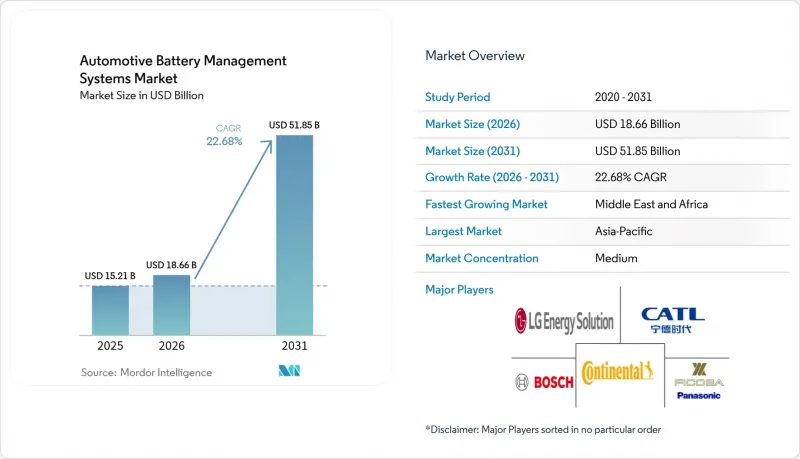
本報告按組件(電池積體電路、電池感測器等)、拓撲結構(集中式、模組化等)、動力系統(混合動力汽車 (HEV)、純電動車 (BEV) 等)、車輛類型(乘用車、輕型商用車等)和地區(北美等)進行分類。市場預測以美元計價。
全球汽車電池管理系統市場趨勢與洞察
全球強制電動車銷售的擴張
歐盟和加州等地區強制零排放車輛 (ZEV) 政策正在提高電池耐久性、續航里程維持率和電池健康透明度的標準。歐盟7排放標準將於2026年生效,而加州的「先進清潔汽車II」計畫要求車輛行駛15萬英里後續航里程維持率達到80%,這迫使電池管理系統 (BMS) 供應商採用更複雜的電池健康分析和劣化建模技術。監管協調正在加速全球平台上採用統一合規架構,隨著原始設備製造商 (OEM) 避免採用區域性設計,汽車電池管理系統市場正在擴張。已經採用自適應演算法的供應商獲得了領先優勢,而傳統供應商則面臨額外的檢驗週期和成本。
降低電池組成本
鋰離子電池組價格的快速下降正在重塑成本結構。到2024年,主流磷酸鐵鋰電池組的平均價格將為每千瓦時75美元,而鈉離子電池的試驗生產已證明其成本可低至每千瓦時10美元。隨著電芯價格的下降,原始設備製造商(OEM)可以將更大比例的電池預算分配給更先進的電池管理系統(BMS)功能,例如預測分析和無線連接,而不是僅僅關注硬體成本的降低。這種向更高單包價值的轉變正在推動整個汽車電池管理系統市場對先進電池管理解決方案的需求。
因過熱導致的召回事件推高了保固準備金。
備受矚目的火災事故導致了大規模召回,迫使汽車製造商提高保固條款並採用更保守的封裝設計。三星SDI的多品牌召回以及現代摩比斯開發的自熄模組凸顯了該行業面臨的緊迫性。絕緣、滅火和冗餘感測器的額外成本可能會延緩實驗性電池管理系統(BMS)功能的推出,並減緩汽車電池管理系統市場的短期成長。
細分市場分析
至2025年,電池感測器將佔汽車電池管理系統市場佔有率的35.02%,預計到2031年,該細分市場將以24.12%的複合年成長率成長。涵蓋溫度、壓力、排放氣體和濕度等多物理場感測技術的普及,將使原始設備製造商(OEM)能夠從被動保護轉向即時預測診斷。隨著監管機構要求提高熱失控偵測能力,以及車輛業者尋求更詳細的數據以最佳化運作週期和保固範圍,該技術的應用正在加速推進。將二氧化碳和氫氣感測器整合到模組級基板中,可以提高預警能力,有助於避免代價高昂的召回和運作。隨著電動車電池組電壓超過800V,高解析度分流器和霍爾效應感測器對於精確估算荷電狀態(SOC)和健康狀態(SOH)至關重要,這將鞏固該細分市場的長期成長勢頭。
隨著電池級電壓精度達到±2 mV,更精確的充電均衡和更長的電池組壽命成為可能,使得積體電路的精度成為採購決策的關鍵因素。領先的晶片製造商正在將測量、均衡和通訊模組整合到單一晶片上,從而縮小基板尺寸並簡化汽車認證流程。其餘的「其他電子元件和材料」類別,包括導熱間隙填充材料、氣凝膠片和相變複合材料,隨著能量密度的不斷提高而持續擴展,對卓越的散熱和絕緣解決方案提出了更高的要求。
到2025年,模組化配置將佔據汽車電池管理系統48.42%的市場。這反映了原始設備製造商(OEM)對高度擴充性的子電池模組的偏好,這些模組無需完全重新設計即可重新定位。在電池盒層級分離感測和執行功能,可提供適用於商用車和高流量共享汽車的容錯能力。此外,可擴展的硬體模組支援快速的現場更換,從而提高車輛的運轉率。
無線設計正在迅速發展,小型化天線、安全網狀協定和認證射頻協定堆疊已實現量產,預計2026年至2031年將以33.82%的複合年成長率成長。取消菊鏈線束可減輕電池組重量,從而為主動冷卻板和更多電芯騰出寶貴的空間。在入門級乘用車中,組件配置的精簡比擴充性更為重要,因此集中式拓撲結構仍然被廣泛採用。同時,賽車和航太領域的跨界項目滿足了特定分散式架構極高的冗餘要求,從而促進了汽車電池管理系統市場的多元化發展。
區域分析
到2025年,亞太地區仍將維持其在汽車電池管理系統市場60.77%的主導地位。在中國,從上游提煉到最終整車組裝的垂直整合電池價值鏈正在壓縮成本結構並加快設計迭代週期。政府的採購獎勵、主要城市的優惠車牌政策以及成熟的充電生態系統正在推動電動車的普及,並促進電池管理系統出貨量的成長。隨著中國電芯和模組供應商在波蘭、匈牙利和內華達州等地開設工廠,以確保免關稅市場進入並縮短物流路線,這項供應鏈優勢也延伸至歐洲和北美。
中東和非洲地區基數較低,但成長速度最快,預計到2031年複合年成長率將達到26.9%。杜拜、利雅德和開羅正在推行純電動公車路線和最後一公里配送電氣化目標,這需要耐熱的電池管理系統(BMS)設計。公私合營正在推動併網電池的投資,並為翻新車輛電池組和二次利用的BMS軟體創造輔助銷售機會。
在北美,《通膨抑制法案》正在推動國內電池單體和模組製造業的發展。 BMW、豐田和現代在卡羅來納州、喬治亞和安大略省的投資,正在減少對亞洲進口的依賴,並促進電池管理系統(BMS)基板的在地採購。歐洲繼續引領監管潮流,計劃引入的電池護照制度將推動可追溯性,並增加系統的複雜性和軟體含量。這些要求正在提高單車收入,並使擁有安全雲端管道的供應商脫穎而出,從而保持汽車電池管理系統市場的整體健康發展前景。
其他好處:
- Excel格式的市場預測(ME)表
- 3個月的分析師支持
目錄
第1章:引言
- 研究假設和市場定義
- 調查範圍
第2章:調查方法
第3章執行摘要
第4章 市場狀況
- 市場概覽
- 市場促進因素
- 全球強制銷售電動車的趨勢正在擴大。
- 降低電池組成本
- 從集中式拓撲結構過渡到模組化和無線拓撲結構
- 對磷酸鐵鋰電池日益成長的需求,需要先進的主動均衡技術。
- 對「符合網路安全標準的建築管理系統」的需求源自於 ISO 21434 標準。
- 為了降低智慧財產權使用費,OEM廠商正在轉向為建築管理系統(BMS)設計自己的專用積體電路(ASIC)。
- 市場限制因素
- 因過熱問題導致的召回增加了保固儲備金。
- 功率半導體嚴重供不應求
- 從2027年起,歐盟「電池護照」計畫下的可追溯性負擔
- 人工智慧驅動的預測性建築管理系統尚未獲得功能安全認證。
- 價值供應鏈分析
- 監理情勢
- 技術展望
- 波特五力模型
第5章 市場規模與成長預測
- 按組件
- 電池積體電路
- 電池感應器
- 其他電子設備和材料
- 拓樸
- 集中
- 模組化的
- 去中心化
- 無線的
- 依推進類型
- 混合動力電動車(HEV)
- 插電式混合動力車(PHEV)
- 電池式電動車(BEV)
- 燃料電池汽車(FCEV)
- 車輛類型
- 搭乘用車
- 輕型商用車
- 中型和重型商用車輛
- 二輪車和三輪車
- 非公路用車及特殊車輛
- 按地區
- 北美洲
- 美國
- 加拿大
- 其他北美國家
- 南美洲
- 巴西
- 阿根廷
- 其他南美國家
- 歐洲
- 德國
- 英國
- 法國
- 西班牙
- 義大利
- 俄羅斯
- 其他歐洲國家
- 亞太地區
- 中國
- 日本
- 印度
- 韓國
- 澳洲
- 其他亞太國家
- 中東和非洲
- 沙烏地阿拉伯
- 阿拉伯聯合大公國
- 土耳其
- 埃及
- 南非
- 其他中東和非洲國家
- 北美洲
第6章 競爭情勢
- 市場集中度
- 策略趨勢
- 市佔率分析
- 公司簡介
- LG Energy Solution
- CATL
- Panasonic(Ficosa)
- Robert Bosch GmbH
- Continental AG
- Texas Instruments
- Analog Devices
- Infineon Technologies
- NXP Semiconductors
- Renesas Electronics
- Hitachi Astemo
- Mitsubishi Electric
- Denso Corporation
- Preh GmbH
- Eaton Mobility(Eatron)
- Lithium Balance
- Sensata Technologies
- Eberspacher Vecture
- Rimac Technology
第7章 市場機會與未來展望
According to Mordor Intelligence, the automotive battery management system market size in 2026 is estimated at USD 18.66 billion, growing from 2025 value of USD 15.21 billion with 2031 projections showing USD 51.85 billion, growing at 22.68% CAGR over 2026-2031.
This report is Segmented by Component (Battery IC, Battery Sensors, and More), Topology (Centralized, Modular, and More), Propulsion Type (Hybrid Electric Vehicle (HEV), Battery Electric Vehicle (BEV), and More), Vehicle Type (Passenger Cars, Light Commercial Vehicles, and More), and Geography (North America, and More). The Market Forecasts are Provided in Terms of Value (USD).
Global Automotive Battery Management Systems Market Trends and Insights
EV sales mandates widening globally
Binding ZEV policies in regions such as the EU and California raise the baseline for durability, range retention, and transparency of battery health. Euro 7 rules will be effective in 2026, and California's Advanced Clean Cars II demands 80% range retention for 150,000 miles, compelling BMS suppliers to incorporate more refined state-of-health analytics and degradation modeling. Harmonizing rules incentivize global platforms to adopt one compliance-ready architecture, elevating the automotive battery management system market as OEMs avoid region-specific designs. Suppliers that already embed adaptive algorithms gain a head start, whereas legacy providers face added validation cycles and cost.
Falling cost of battery packs
Rapid declines in lithium-ion battery-pack prices are reshaping cost structures. Mainstream LFP packs averaged USD 75 per kWh in 2024, and pilot sodium-ion runs have demonstrated costs as low as USD 10 per kWh. As cells get cheaper, OEMs can allocate larger portions of the battery budget to smarter BMS functions, such as predictive analytics and wireless connectivity, rather than focusing solely on hardware cost reduction. This shift toward higher value content per pack reinforces demand for advanced battery management solutions across the automotive battery management system market.
Thermal-runaway recalls raising warranty reserves
High-profile fire events have led to sizable recalls, forcing automakers to boost warranty accruals and adopt conservative pack design. Samsung SDI's multi-brand recall and Hyundai Mobis' development of self-extinguishing modules underscore industry urgency. Added cost for insulation, fire suppression, and redundant sensors can slow deployment of experimental BMS functions, tempering near-term growth in the automotive battery management system market.
Other drivers and restraints analyzed in the detailed report include:
- Shift from centralized to modular and wireless topologies
- Soaring demand for LFP chemistry requiring advanced active balancing
- Acute power-semiconductor shortages
For complete list of drivers and restraints, kindly check the Table Of Contents.
Segment Analysis
Battery Sensors captured 35.02% of the automotive battery management system market share in 2025, and the segment is forecast to post a 24.12% CAGR through 2031. Wider deployment of multi-physics sensing, covering temperature, pressure, off-gas, and humidity, allows OEMs to move from passive protection toward real-time predictive diagnostics. Adoption accelerates as regulators demand enhanced thermal-runaway detection and as fleet operators seek granular data to optimize duty cycles and warranty coverage. Integrating CO2 and H2 sensors into module-level boards improves early-warning capabilities, helping avoid costly recalls and downtime. As EV packs scale above 800 V, high-resolution shunt and Hall-effect sensors become indispensable for accurate state-of-charge and state-of-health estimation, cementing the segment's long-term expansion path.
Tight cell-level voltage accuracy, now reaching +-2 mV, enables finer charge balancing and extended pack life, making IC precision a decisive purchase criterion. Leading chipmakers have fused measurement, balancing, and communication blocks onto single dies, shrinking board footprints and simplifying automotive qualifications. The residual "Other electronics and materials" bucket, encompassing thermally conductive gap fillers, aerogel sheets, and phase-change composites, continues to broaden as energy density rises, calling for superior heat-spreading and insulation solutions.
In 2025, Modular arrangements accounted for 48.42% of the automotive battery management system market share, reflecting OEM preference for scalable sub-battery modules that can be rearranged without wholesale redesign. Box-level isolation of sensing and actuation delivers fault tolerance suited to commercial fleets and high-utilization ride-hailing vehicles. Incremental hardware blocks also facilitate rapid line-side replacement, lifting vehicle uptime.
Wireless designs are scaling rapidly, showing a 33.82% CAGR across 2026-2031 as antenna miniaturization, secure mesh protocols, and certified RF stacks reach production maturity. Eliminating daisy-chain harnesses cuts pack weight and opens valuable cubic centimeters for active cooling plates or extra cells. Centralized topologies continue in entry-price passenger cars, where minimal components trump expandability, whereas niche distributed architectures meet extreme redundancy mandates in motorsports and aerospace crossover programs, cushioning product diversity inside the automotive battery management system market.
Complete Report Scope:
- By Component
- Battery IC
- Battery Sensors
- Other Electronics and Materials
- By Topology
- Centralized
- Modular
- Distributed
- Wireless
- By Propulsion Type
- Hybrid Electric Vehicle (HEV)
- Plug-in Hybrid Electric Vehicle (PHEV)
- Battery Electric Vehicle (BEV)
- Fuel-Cell Electric Vehicle (FCEV)
- By Vehicle Type
- Passenger Cars
- Light Commercial Vehicles
- Medium and Heavy Commercial Vehicles
- Two and Three-Wheelers
- Off-Highway and Specialty Vehicles
- By Geography
- North America
- United States
- Canada
- Rest of North America
- South America
- Brazil
- Argentina
- Rest of South America
- Europe
- Germany
- United Kingdom
- France
- Spain
- Italy
- Russia
- Rest of Europe
- Asia-Pacific
- China
- Japan
- India
- South Korea
- Australia
- Rest of Asia-Pacific
- Middle East and Africa
- Saudi Arabia
- United Arab Emirates
- Turkey
- Egypt
- South Africa
- Rest of Middle East and Africa
- North America
Geography Analysis
Asia-Pacific retained a commanding 60.77% share of the automotive battery management system market in 2025. China's vertically integrated battery value chain-from upstream refining to final vehicle assembly-compresses cost structures and quickens design iterations. Government purchase incentives, favorable license-plate policies in megacities, and a mature charging ecosystem lift EV penetration and reinforce BMS unit shipments. Supply-chain leverage even extends to Europe and North America, as Chinese cell and module suppliers open factories in Poland, Hungary, and Nevada to secure tariff-free access and shorten logistics lanes.
The Middle East and Africa region, although emerging from a low base, is the fastest-growing region with a 26.9% CAGR through 2031. Dubai, Riyadh, and Cairo are rolling out e-bus corridors and last-mile delivery electrification targets that demand heat-tolerant BMS designs. Public-private alliances channel investment into grid-tied battery storage, creating adjacent sales for repurposed vehicle packs and second-life BMS software.
North America gains momentum as the Inflation Reduction Act galvanizes domestic cell and module manufacturing. Investments by BMW, Toyota, and Hyundai in the Carolinas, Georgia, and Ontario shrink reliance on Asian imports and underpin local sourcing of BMS boards. Europe remains a regulatory trailblazer, with the upcoming battery passport pushing traceability features that increase system complexity and software content. Such requirements elevate per-vehicle revenue and differentiate suppliers ready with secure cloud pipelines, sustaining a healthy overall outlook for the automotive battery management system market.
- LG Energy Solution
- CATL
- Panasonic (Ficosa)
- Robert Bosch GmbH
- Continental AG
- Texas Instruments
- Analog Devices
- Infineon Technologies
- NXP Semiconductors
- Renesas Electronics
- Hitachi Astemo
- Mitsubishi Electric
- Denso Corporation
- Preh GmbH
- Eaton Mobility (Eatron)
- Lithium Balance
- Sensata Technologies
- Eberspacher Vecture
- Rimac Technology
Additional Benefits:
- The market estimate (ME) sheet in Excel format
- 3 months of analyst support
TABLE OF CONTENTS
1 Introduction
- 1.1 Study Assumptions & Market Definition
- 1.2 Scope of the Study
2 Research Methodology
3 Executive Summary
4 Market Landscape
- 4.1 Market Overview
- 4.2 Market Drivers
- 4.2.1 EV sales mandates widening globally
- 4.2.2 Falling cost of battery packs
- 4.2.3 Shift from centralized to modular and wireless topologies
- 4.2.4 Soaring demand for LFP chemistry requiring advanced active balancing
- 4.2.5 ISO 21434-driven "cyber-secure BMS" demand
- 4.2.6 OEM move to in-house BMS ASIC design to cut IP royalty cost
- 4.3 Market Restraints
- 4.3.1 Thermal-runaway recalls raising warranty reserves
- 4.3.2 Acute power-semiconductor shortages
- 4.3.3 Post-2027 EU "battery-passport" traceability overheads
- 4.3.4 AI-based predictive BMS still lacks functional-safety certification
- 4.4 Value / Supply-Chain Analysis
- 4.5 Regulatory Landscape
- 4.6 Technological Outlook
- 4.7 Porter's Five Forces
- 4.7.1 Threat of New Entrants
- 4.7.2 Bargaining Power of Buyers
- 4.7.3 Bargaining Power of Suppliers
- 4.7.4 Threat of Substitutes
- 4.7.5 Competitive Rivalry
5 Market Size & Growth Forecasts (Value in USD)
- 5.1 By Component
- 5.1.1 Battery IC
- 5.1.2 Battery Sensors
- 5.1.3 Other Electronics and Materials
- 5.2 By Topology
- 5.2.1 Centralized
- 5.2.2 Modular
- 5.2.3 Distributed
- 5.2.4 Wireless
- 5.3 By Propulsion Type
- 5.3.1 Hybrid Electric Vehicle (HEV)
- 5.3.2 Plug-in Hybrid Electric Vehicle (PHEV)
- 5.3.3 Battery Electric Vehicle (BEV)
- 5.3.4 Fuel-Cell Electric Vehicle (FCEV)
- 5.4 By Vehicle Type
- 5.4.1 Passenger Cars
- 5.4.2 Light Commercial Vehicles
- 5.4.3 Medium and Heavy Commercial Vehicles
- 5.4.4 Two and Three-Wheelers
- 5.4.5 Off-Highway and Specialty Vehicles
- 5.5 By Geography
- 5.5.1 North America
- 5.5.1.1 United States
- 5.5.1.2 Canada
- 5.5.1.3 Rest of North America
- 5.5.2 South America
- 5.5.2.1 Brazil
- 5.5.2.2 Argentina
- 5.5.2.3 Rest of South America
- 5.5.3 Europe
- 5.5.3.1 Germany
- 5.5.3.2 United Kingdom
- 5.5.3.3 France
- 5.5.3.4 Spain
- 5.5.3.5 Italy
- 5.5.3.6 Russia
- 5.5.3.7 Rest of Europe
- 5.5.4 Asia-Pacific
- 5.5.4.1 China
- 5.5.4.2 Japan
- 5.5.4.3 India
- 5.5.4.4 South Korea
- 5.5.4.5 Australia
- 5.5.4.6 Rest of Asia-Pacific
- 5.5.5 Middle East and Africa
- 5.5.5.1 Saudi Arabia
- 5.5.5.2 United Arab Emirates
- 5.5.5.3 Turkey
- 5.5.5.4 Egypt
- 5.5.5.5 South Africa
- 5.5.5.6 Rest of Middle East and Africa
- 5.5.1 North America
6 Competitive Landscape
- 6.1 Market Concentration
- 6.2 Strategic Moves
- 6.3 Market Share Analysis
- 6.4 Company Profiles (Includes Global Level Overview, Market Level Overview, Core Segments, Financials as Available, Strategic Information, Market Rank/Share for Key Companies, Products and Services, SWOT Analysis, and Recent Developments)
- 6.4.1 LG Energy Solution
- 6.4.2 CATL
- 6.4.3 Panasonic (Ficosa)
- 6.4.4 Robert Bosch GmbH
- 6.4.5 Continental AG
- 6.4.6 Texas Instruments
- 6.4.7 Analog Devices
- 6.4.8 Infineon Technologies
- 6.4.9 NXP Semiconductors
- 6.4.10 Renesas Electronics
- 6.4.11 Hitachi Astemo
- 6.4.12 Mitsubishi Electric
- 6.4.13 Denso Corporation
- 6.4.14 Preh GmbH
- 6.4.15 Eaton Mobility (Eatron)
- 6.4.16 Lithium Balance
- 6.4.17 Sensata Technologies
- 6.4.18 Eberspacher Vecture
- 6.4.19 Rimac Technology
7 Market Opportunities & Future Outlook
- 7.1 White-space & Unmet-Need Assessment

 汽車電池管理系統市場分析及預測(至2035年):類型、產品、技術、組件、應用、最終用戶、功能、安裝類型、解決方案
 汽車電池管理系統市場預測至2034年-全球分析(按拓樸結構、組件、電池類型、驅動系統、車輛類型、電壓、功能、連接方式、銷售管道和地區分類)
 2026年全球汽車電池管理系統市場報告
 汽車電池管理系統市場:按組件、電池化學成分、系統結構、銷售管道和車輛類型分類-2026-2032年全球預測汽車級BMS AFE市場:按車輛類型、電池類型、通道數、應用和最終用戶分類-2026-2032年全球預測
 日本動態負載管理系統市場規模、佔有率、趨勢及預測(按組件、應用、技術、部署類型、最終用戶和地區分類),2026-2034年
 摩托車電池管理系統市場 - 全球產業規模、佔有率、趨勢、機會及預測(按電池類型、車輛類型、類型、地區和競爭格局分類),2021-2031年BMS AFE晶片市場按電池化學成分、均衡方式、技術、應用、終端用戶產業和分銷管道分類,全球預測,2026-2032年依技術類型、通路、額定電壓和應用分類的煙火電池斷開裝置市場-2026年至2032年全球預測工業級BMS AFE市場依產品類型、電池化學成分、拓樸結構、終端用戶產業及銷售管道,全球預測,2026-2032年