


 |
市場調查報告書
商品編碼
2123595
涼感布料:市場佔有率分析、產業趨勢與統計、成長預測(2026-2031)Cooling Fabrics - Market Share Analysis, Industry Trends & Statistics, Growth Forecasts (2026 - 2031) |
||||||

※ 本網頁內容可能與最新版本有所差異。詳細情況請與我們聯繫。
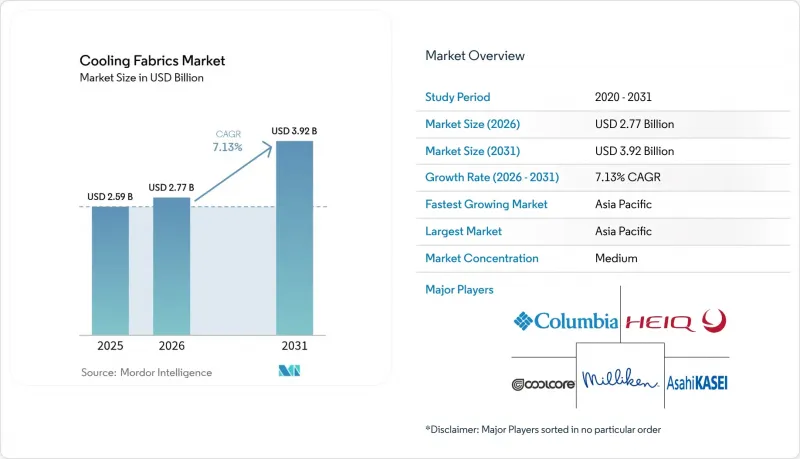
據 Mordor Intelligence 稱,到 2026 年,涼感布料市場價值估計為 27.7 億美元,高於 2025 年的 25.9 億美元,預計到 2031 年將達到 39.2 億美元。
預計 2026 年至 2031 年的複合年成長率為 7.13%。
本報告按纖維類型(天然纖維和合成纖維)、織物結構(機織、針織和不織布)、應用領域(運動服、防護衣及其他)、終端用戶行業(消費品、工業/製造業、醫療保健及其他)以及地區(亞太地區、北美地區、歐洲地區、南美地區以及中東和非洲地區)進行細分。市場預測以美元計價。
全球涼感布料市場趨勢及洞察
運動和休閒對吸濕排汗合成纖維的需求激增。
在休閒和高性能運動服領域,動態散熱功能如今已成為一項基本要求。各大品牌紛紛採用「COOLMAX EcoMade」和「brrr°」等類似紗線,這些紗線融合了相變材料和微礦物,即使在大量出汗的情況下也能持續散熱。全球健身和戶外休閒的普及推動了市場滲透,而合成纖維憑藉其穩定的吸濕排汗性能、良好的彈性和機械耐久性,繼續佔據市場主導地位。技術紡織品的進步使合成紗線在全球紡織品需求中的佔有率超過19%,進一步增強了支撐涼感布料市場的規模經濟效益。奈米混合填充材提升了導熱性能,使工程合成纖維的性能超越了許多天然材料。同時,再生聚對苯二甲酸乙二醇酯(PET)的供應在滿足日益嚴格的生態設計法規的同時,也提供了穩定的成本基礎。
全球戶外和運動服飾品牌的擴張
跨國戶外品牌正將其專有的降溫平台應用於其戶外運動和日常都會服飾系列。哥倫比亞運動服飾公司的 Omni-Heat Infinity 和 Omni- 簾子技術就是這種跨界融合的典範。這些降溫布料透過應對都市區氣溫(城市氣溫可能比周邊農村地區高出 8.9度C) ,拓展了目標市場。透過利用亞太地區的製造群,各品牌縮短了研發週期,降低了單位成本,使消費者能夠以更實惠的價格享受高品質的降溫功能。結合 3D 列印結構和空氣動力學面板的產品分階段上市,顯示精英運動領域的經驗正被應用於休閒服飾,從而擴大了涼感布料的市場。跨洲技術轉移進一步加速了全球的普及應用。
高冷卻紡織品生產成本高
被動散熱層需要二氧化鈦奈米顆粒、聚合物薄膜和銀奈米線,這推高了材料成本,使其高於普通服裝。專用塗層生產線需要資本投入,而嚴格的品管流程則增加了勞動強度。雖然製程最佳化已將成本加成降低至近10%,但高昂的價格仍是低收入地區的主要問題,阻礙了銷售成長。供應商需要改進連續輥塗技術並拓展原料選擇,以實現大眾市場定價。儘管規模化生產停滯不前,但國防、專業運動和工業個人防護設備(PPE) 等高階類別正在吸收成本,從而可以攤提研發費用。這種情況最終應該會蔓延到中低階市場。
細分市場分析
到2025年,合成纖維憑藉其大規模實現均勻吸濕排汗和彈性的特性,在涼感布料市場仍將佔據60.45%的佔有率。這些特性支撐著許多取得專利的降溫化學技術,使其在大量生產的運動服裝中保持成本效益。同時,隨著監管機構和消費者對生物分解性的日益重視,天然纖維正以8.03%的複合年成長率穩定成長。添加奈米鑽石和幾丁聚醣的微孔棉目前可達到2-3 度C的降溫效果,而閉合迴路氨纖維紗線則將植物來源原料與工業可回收性結合。混紡結構將再生纖維素與微礦物合成纖維結合,以平衡觸感和功能。因此,投資者正在資助棉花軋花機的升級改造和酵素預處理技術的應用,以提高天然纖維的質量,這預示著涼感布料市場將迎來更廣泛的認可。
混紡紗線的進步表明,永續性目標與性能指標並非必然衝突。 Bemberg Cupro 的溶劑回收率超過 99%,在不犧牲散熱性能的前提下實現了循環經濟。試點測試也表明,再生棉在耐熱性方面優於原生棉。隨著時尚集團發布基於科學的碳排放減排目標,採購活動正轉向對環境影響較小的選擇,而環保考量也轉化為可衡量的需求。在預測期內,天然纖維冷卻產品線的市場佔有率預計將逐步成長,但合成纖維在速乾性和彈性至關重要的服裝領域仍可能繼續發揮核心作用。
預計到2025年,紡織品將佔銷售額的40.12%,複合年成長率(CAGR)為8.25%。這主要歸功於其精細的織造工藝,這種工藝為奈米顆粒塗層、反光膜和相變印刷漿料提供了高度尺寸穩定的基材。紡織廠目前已運作高產能運轉,從而最大限度地降低了添加冷卻功能時的額外成本。針織布料憑藉其舒適的彈性和透氣性,在運動服領域保持著強勁的地位,但其環狀結構需要較慢的機器運轉,並且可能會使多層塗層的加工變得複雜。不織布在一次性醫療用品和過濾細分市場中的重要性日益凸顯,在這些市場中,手感和懸垂性並非主要考慮因素。
製程創新不斷提升紡織生產效率,噴水織布機在生產更細旦數織物的同時,還能實現節能。多相織造技術可透過調整孔隙形態,促進水蒸氣傳輸。同時,針織機也採用數位化控制和更精細的針距,進一步縮小了表面均勻性的差距。靜電紡絲薄膜層壓到針織物和梭織物上,形成超薄散熱層,從而創造出兼具兩種結構優勢的混合層壓材料。由於成本和多功能性優勢,梭織物預計將繼續在涼感布料市場保持主導地位,但消費者對拉伸的需求日益成長,這意味著針織產品的市場佔有率有望保持穩定,不會出現下滑。
區域分析
預計到2025年,亞太地區將佔全球銷售額的31.05%,並在2031年之前以7.63%的複合年成長率成長。這主要得益於中國科技紡織品出口規模的龐大,以及其在被動輻射冷卻技術(可將服裝溫度降低攝氏5度C)研究方面的領先地位。政府津貼正在支持超材料纖維原型工廠的建設,而越南、印尼和印度的下游服裝製造商正在將這些纖維整合到具有成本競爭力的裁剪和縫紉生產線中。日本的材料科學生態系統正在改進用於紫外線反射的聚合物混合物,而韓國的電子產業正在開發可將體溫數據傳輸到行動裝置的智慧紡織品。不斷壯大的中產階級人口面臨著潮濕的夏季,這進一步推動了零售需求。
在北美,國防相關合約和戶外休閒文化正在推動這一趨勢。美國海軍航空系統辦公室的一項計劃正在加速供應商的學習進程,並展示環境友善涼感布料的實用性。總部位於奧勒岡州和科羅拉多的戶外品牌每年夏季都會推出新系列,持續提升消費者的接受度。加拿大極端的氣溫波動催生了多季疊穿的概念,這種設計一面具有冷卻功能,另一面則具有保暖功能,從而拓展了產品的實用性。墨西哥正在擴大其作為近岸縫紉中心的作用,為品牌在全球物流中斷的情況下提供柔軟性。
歐洲的發展趨勢與環境政策緊密相連。歐盟的生態設計法規優先考慮紡織品,強制要求價值鏈可追溯性和使用再生材料。德國紡紗企業,例如Outlast,正在使用美國太空總署(NASA)開發的相變材料( 英國 )製程生產獲得生態認證的襯裡,而義大利紡紗企業則在推廣使用再生紗線的環保染色技術。英國研究理事會正在資助一個專注於奈米結構輻射薄膜的產學研聯盟。該地區不斷上漲的能源成本增加了對被動式個人降溫的需求,儘管價格昂貴,但仍推動了在國內的普及。
在南美洲、中東和非洲,快速的都市化和強烈的陽光正在創造新的商機。巴西運動服裝的蓬勃發展推動了相變聚酯纖維的在地採購,海灣國家正在試點為在白天溫度高達45度C的環境中工作的建築工人提供降溫工作服。儘管基礎設施和可支配收入的不足限制了短期銷量,但持續的氣候變暖預示著長期的成長機會。全球供應商正致力於與當地合作夥伴建立合資企業和技術許可機制,以克服關稅和物流壁壘,這有望促進涼感布料市場實現更廣泛的區域平衡。
其他好處
- Excel格式的市場預測(ME)表
- 3個月的分析師支持
目錄
第1章:引言
- 研究假設和市場定義
- 調查範圍
第2章:調查方法
第3章執行摘要
第4章 市場狀況
- 市場概覽
- 市場促進因素
- 運動和休閒運動對合成吸濕排汗纖維的需求激增。
- 全球戶外運動服飾品牌擴張
- 一種突破性的被動輻射系統“Metafabric”,用於緩解都市區熱島現象。
- 為沙漠作戰採購耐熱軍服
- 永續發展法規正在加速採用再生涼感布料。
- 市場限制因素
- 先進涼感布料生產成本高昂
- 反覆洗滌後性能下降
- 高反射率放射性纖維中染料吸收的限制
- 價值鏈分析
- 波特五力模型
第5章 市場規模與成長預測
- 依纖維類型
- 天然纖維
- 合成纖維
- 織物結構
- 織物
- 針織
- 不織布
- 透過使用
- 運動服
- 防護衣
- 服飾
- 其他用途(醫療保健紡織品等)
- 按最終用戶行業分類
- 一般消費者
- 工業和製造業
- 國防與安全
- 衛生保健
- 汽車和運輸業
- 按地區
- 亞太地區
- 中國
- 日本
- 印度
- 韓國
- 東南亞國協
- 其他亞太國家
- 北美洲
- 美國
- 加拿大
- 墨西哥
- 歐洲
- 德國
- 英國
- 法國
- 義大利
- 西班牙
- 俄羅斯
- 北歐國家
- 其他歐洲國家
- 南美洲
- 巴西
- 阿根廷
- 其他南美國家
- 中東和非洲
- 沙烏地阿拉伯
- 南非
- 其他中東和非洲國家
- 亞太地區
第6章 競爭情勢
- 市場集中度
- 策略趨勢
- 市佔率和排名分析
- 公司簡介
- Ahlstrom
- Asahi Kasei Advance Corporation
- Balavigna Mills Pvt. Ltd.
- brrr°
- Cocona Labs
- Columbia Sportswear Company
- Coolcore
- Elevate Textiles, Inc.
- Everest Textile Co., Ltd.
- FORMOSA TAFFETA CO., LTD.
- HeiQ Materials AG
- LunaMicro AB
- Milliken & Company
- NAN YA PLASTICS CORPORATION
- NILIT
- Outlast Technologies GmbH
第7章 市場機會與未來展望
According to Mordor Intelligence, cooling fabrics market size in 2026 is estimated at USD 2.77 billion, growing from 2025 value of USD 2.59 billion with 2031 projections showing USD 3.92 billion, growing at 7.13% CAGR over 2026-2031.
This report is Segmented by Fiber Type (Natural and Synthetic), Fabric Construction (Woven, Knitted, and Non-Woven), Application (Sportswear, Protective Wear, and More), End-User Industry (Consumer, Industrial and Manufacturing, Healthcare, and More), and Geography (Asia-Pacific, North America, Europe, South America, and Middle East and Africa). The Market Forecasts are Provided in Terms of Value (USD).
Global Cooling Fabrics Market Trends and Insights
Surge in Synthetic Moisture-wicking Fibers for Sports and Athleisure
Athleisure and performance sportswear now treat dynamic cooling as a baseline expectation. Brands integrate COOLMAX EcoMade, brrr° and comparable yarns that embed phase-change materials or micro-minerals, providing continuous heat draw-down even under heavy perspiration . Market penetration benefits from global participation in fitness and outdoor recreation, and synthetic fibers retain dominance because they deliver repeatable moisture transport, stretch and mechanical durability. Technical-textile advances lift synthetic yarns' share of global fiber demand above 19%, reinforcing scale economies that underpin the cooling fabrics market. With nanohybrid fillers improving thermal conductivity, engineered synthetics outperform many natural alternatives. In parallel, recycled Polyethylene Terephthalate (PET) streams keep cost bases stable while satisfying tightening eco-design rules.
Expansion of Outdoor and Performance Apparel Brands Globally
Multinational outdoor labels channel proprietary cooling platforms into both back-country and everyday urban lines. Columbia Sportswear's Omni-Heat Infinity and Omni-Shade technologies exemplify such crossover. Heat-mitigating fabrics combat city temperatures that can sit 8.9°C higher than surrounding rural zones, broadening addressable demand. As brands leverage Asia-Pacific manufacturing clusters, they shorten development cycles and lower per-unit costs, making premium cooling attainable for mainstream consumers. Iterative launches that combine 3D-printed structures with aerodynamic panels demonstrate a migration of elite-sport learnings to lifestyle garments, thus enlarging the cooling fabrics market. Technology transfer across hemispheres further accelerates global uptake.
High Production Cost of Advanced Cooling Textiles
Passive-radiative layers call for titanium dioxide nanoparticles, polymer membranes and silver nanowires that elevate bill-of-materials costs relative to commodity apparel. Specialized coating lines introduce capital outlays, while stringent quality-control protocols add labor intensity. Although process optimization has trimmed the premium to almost 10%, sticker shock persists in lower-income regions, slowing volume. Suppliers must refine continuous-roll deposition and broaden raw-material options to reach mass-price points. Scaling pauses notwithstanding, premium categories such as defense, professional sports and industrial Personal Protective Equipment (PPE) absorb the cost, allowing research and development (R&D) amortization that should eventually spill into value segments.
Other drivers and restraints analyzed in the detailed report include:
- Breakthrough Passive Radiative "Metafabrics" for Urban Heat Mitigation
- Military Procurement of Heat-stress Uniforms for Desert Operations
- Performance Degradation After Repeated Laundering Cycles
For complete list of drivers and restraints, kindly check the Table Of Contents.
Segment Analysis
Synthetic yarns retained 60.45% of cooling fabrics market share in 2025 by delivering uniform moisture transport and stretch at scale. They underpin many patented cooling chemistries that remain cost-optimal for high-volume sportswear. Natural fibers, though, are on an 8.03% CAGR path as regulators and consumers prize biodegradability. Cotton modified with nanodiamonds or chitosan micro-porosity now attains 2-3°C temperature drops, while closed-loop cupro yarns marry plant-based feedstocks with industrial recyclability. Blended constructions pair regenerated cellulose with micro-mineral synthetics, balancing feel and function. Investors therefore finance gin upgrades and enzymatic pre-treatments that elevate natural fiber quality, pointing to broader acceptance within the cooling fabrics market.
Hybrid yarn advances demonstrate that sustainability targets and performance metrics need not be mutually exclusive. Bemberg cupro showcases solvent recovery rates exceeding 99%, illustrating circularity without sacrificing heat-dissipation capacity. Recycled cotton streams also outperform virgin cotton on thermal resistance in pilot trials. As fashion groups publish science-based carbon goals, procurement pivots toward these lower-impact options, translating eco-preference into measurable demand. Over the forecast horizon, natural-fiber cooling lines will likely take incremental share, though synthetics will remain central to rapid-wicking and stretch-critical apparel tiers.
Woven fabrics supplied 40.12% of 2025 revenue and are growing at an 8.25% CAGR because their tightly-controlled interlacings provide dimensionally stable substrates for nanoparticle coatings, reflective films and phase-change print pastes. Weaving plants already operate at high throughput, minimizing incremental cost to add cooling capability. Knits retain strong footholds in activewear thanks to comfort stretch and breathability, yet their looped structure demands slower machinery and can complicate multilayer coatings. Non-wovens gain relevance in disposable medical or filtration niches where tactile drape is secondary.
Process innovation continues to lift woven productivity, with water-jet looms delivering finer deniers while conserving energy. Multi-phase weaves adjust pore geometry, aiding moisture vapor transport. At the same time, knitting equipment adopts digital control and finer gauges, narrowing the gap in surface regularity. Electrospun membranes layered onto knits or wovens add ultra-thin emissive skins, creating hybrid laminates that fuse each construction's strengths. Cost and versatility advantages suggest woven textiles will retain top billing in the cooling fabrics market, but rising consumer appetite for stretch will keep knitted shares steady rather than declining.
Complete Report Scope:
- By Fiber Type
- Natural
- Synthetic
- By Fabric Construction
- Woven
- Knitted
- Non-woven
- By Application
- Sportswear
- Protective Wear
- Apparels
- Other Applications (Medical and Healthcare Textiles, etc.)
- By End-user Industry
- Consumer
- Industrial and Manufacturing
- Defense and Security
- Healthcare
- Automotive and Transportation
- By Geography
- Asia-Pacific
- China
- Japan
- India
- South Korea
- ASEAN Countries
- Rest of Asia-Pacific
- North America
- United States
- Canada
- Mexico
- Europe
- Germany
- United Kingdom
- France
- Italy
- Spain
- Russia
- NORDIC Countries
- Rest of Europe
- South America
- Brazil
- Argentina
- Rest of South America
- Middle East and Africa
- Saudi Arabia
- South Africa
- Rest of Middle East and Africa
- Asia-Pacific
Geography Analysis
Asia-Pacific held 31.05% of global revenue in 2025 and is moving at a 7.63% CAGR through 2031, anchored by China's scale in technical-textile exports and its leadership in passive-radiative research that delivers 5°C garment cooling. Government grants support pilot plants for metafabric yardage, while downstream apparel makers in Vietnam, Indonesia, and India integrate these textiles into cost-competitive cut-and-sew lines. Japan's material-science ecosystem refines polymer blends for Ultraviolet (UV) reflection, and South Korea's electronics sector pursues smart-textile overlays that feed body-temperature data to mobile devices. Rising middle-class populations confronting humid summers amplify retail pull.
North America benefits from defense contracts and an outdoor recreation culture. US Naval Air Systems programs accelerate supplier learning curves and validate ruggedized cooling fabrics. Outdoor labels headquartered in Oregon and Colorado roll new collections each summer, driving steady consumer uptake. Canada's severe temperature swings prompt multi-season layering concepts that embed cooling on one face and insulation on the other, stretching product utility. Mexico expands role as a near-shore sewing destination, giving brands flexibility amid global logistics disruptions.
Europe's trajectory intertwines with environmental policy. The European Union (EU) Ecodesign regulation prioritizes textiles, compelling value-chain traceability and recyclate usage. German mills like Outlast adapt NASA-born Phase Change Material (PCM) treatments into eco-certified linings, while Italian spinners push low-impact dyeing of recycled yarns. The United Kingdom (UK) research councils fund university-industry consortia focused on nanostructured emissive films. Higher energy costs in the region reinforce demand for passive personal cooling, stimulating domestic uptake despite premium pricing.
South America and the Middle East & Africa present emerging opportunities tied to rapid urbanization and intense solar exposure. Brazil's athletic-wear boom spurs local sourcing of phase-change infused polyester, and Gulf states test cooling uniforms for construction crews working in 45°C midday heat. Infrastructure gaps and limited disposable income temper near-term volumes, yet sustained climate warming suggests long-run growth. Global suppliers eye joint ventures and technology-licensing to local partners to overcome tariff and logistics hurdles, ensuring the cooling fabrics market achieves broader geographic balance.
- Ahlstrom
- Asahi Kasei Advance Corporation
- Balavigna Mills Pvt. Ltd.
- brrr°
- Cocona Labs
- Columbia Sportswear Company
- Coolcore
- Elevate Textiles, Inc.
- Everest Textile Co., Ltd.
- FORMOSA TAFFETA CO., LTD.
- HeiQ Materials AG
- LunaMicro AB
- Milliken & Company
- NAN YA PLASTICS CORPORATION
- NILIT
- Outlast Technologies GmbH
Additional Benefits:
- The market estimate (ME) sheet in Excel format
- 3 months of analyst support
TABLE OF CONTENTS
1 Introduction
- 1.1 Study Assumptions and Market Definition
- 1.2 Scope of the Study
2 Research Methodology
3 Executive Summary
4 Market Landscape
- 4.1 Market Overview
- 4.2 Market Drivers
- 4.2.1 Surge in Synthetic Moisture-wicking Fibers for Sports and Athleisure
- 4.2.2 Expansion of Outdoor and Performance Apparel Brands Globally
- 4.2.3 Breakthrough Passive Radiative "Metafabrics" for Urban Heat Mitigation
- 4.2.4 Military Procurement of Heat-stress Uniforms for Desert Operations
- 4.2.5 Sustainability Mandates Accelerating Recycled Cooling Fibers Adoption
- 4.3 Market Restraints
- 4.3.1 High Production Cost of Advanced Cooling Textiles
- 4.3.2 Performance Degradation After Repeated Laundering Cycles
- 4.3.3 Dye-uptake Limitations on High-reflectance Radiative Fabrics
- 4.4 Value Chain Analysis
- 4.5 Porter's Five Forces
- 4.5.1 Bargaining Power of Suppliers
- 4.5.2 Bargaining Power of Buyers
- 4.5.3 Threat of New Entrants
- 4.5.4 Threat of Substitutes
- 4.5.5 Degree of Competition
5 Market Size and Growth Forecasts (Value)
- 5.1 By Fiber Type
- 5.1.1 Natural
- 5.1.2 Synthetic
- 5.2 By Fabric Construction
- 5.2.1 Woven
- 5.2.2 Knitted
- 5.2.3 Non-woven
- 5.3 By Application
- 5.3.1 Sportswear
- 5.3.2 Protective Wear
- 5.3.3 Apparels
- 5.3.4 Other Applications (Medical and Healthcare Textiles, etc.)
- 5.4 By End-user Industry
- 5.4.1 Consumer
- 5.4.2 Industrial and Manufacturing
- 5.4.3 Defense and Security
- 5.4.4 Healthcare
- 5.4.5 Automotive and Transportation
- 5.5 By Geography
- 5.5.1 Asia-Pacific
- 5.5.1.1 China
- 5.5.1.2 Japan
- 5.5.1.3 India
- 5.5.1.4 South Korea
- 5.5.1.5 ASEAN Countries
- 5.5.1.6 Rest of Asia-Pacific
- 5.5.2 North America
- 5.5.2.1 United States
- 5.5.2.2 Canada
- 5.5.2.3 Mexico
- 5.5.3 Europe
- 5.5.3.1 Germany
- 5.5.3.2 United Kingdom
- 5.5.3.3 France
- 5.5.3.4 Italy
- 5.5.3.5 Spain
- 5.5.3.6 Russia
- 5.5.3.7 NORDIC Countries
- 5.5.3.8 Rest of Europe
- 5.5.4 South America
- 5.5.4.1 Brazil
- 5.5.4.2 Argentina
- 5.5.4.3 Rest of South America
- 5.5.5 Middle East and Africa
- 5.5.5.1 Saudi Arabia
- 5.5.5.2 South Africa
- 5.5.5.3 Rest of Middle East and Africa
- 5.5.1 Asia-Pacific
6 Competitive Landscape
- 6.1 Market Concentration
- 6.2 Strategic Moves
- 6.3 Market Share(%)/Ranking Analysis
- 6.4 Company Profiles (includes Global level Overview, Market level overview, Core Segments, Financials as available, Strategic Information, Market Rank/Share for key companies, Products and Services, and Recent Developments)
- 6.4.1 Ahlstrom
- 6.4.2 Asahi Kasei Advance Corporation
- 6.4.3 Balavigna Mills Pvt. Ltd.
- 6.4.4 brrr°
- 6.4.5 Cocona Labs
- 6.4.6 Columbia Sportswear Company
- 6.4.7 Coolcore
- 6.4.8 Elevate Textiles, Inc.
- 6.4.9 Everest Textile Co., Ltd.
- 6.4.10 FORMOSA TAFFETA CO., LTD.
- 6.4.11 HeiQ Materials AG
- 6.4.12 LunaMicro AB
- 6.4.13 Milliken & Company
- 6.4.14 NAN YA PLASTICS CORPORATION
- 6.4.15 NILIT
- 6.4.16 Outlast Technologies GmbH
7 Market Opportunities and Future Outlook
- 7.1 White-space and Unmet-need Assessment
- 7.2 Cooling Fabric with Chalk-based Coating

 涼感布料市場:全球市場預測(2026-2032)
 冷卻纖維市場規模、佔有率、趨勢和預測:按類型、應用和地區分類(2026-2034 年)
 冷卻材料市場規模、佔有率、成長及全球產業分析:按類型、應用和地區分類,並預測至2026-2034年
 2026年全球涼感布料市場報告
 冷卻纖維市場-全球產業規模、佔有率、趨勢、機會與預測:按類型、纖維類型、應用、地區和競爭格局分類,2021-2031年
 涼感布料市場規模、佔有率和成長分析(按類型、纖維類型、布料類型、技術、應用和地區分類)—產業預測(2026-2033 年)絕緣背心市場(按類型、材料、最終用戶和分銷)—2025-2030 年全球預測
 全球冷卻背心市場
 全球涼感布料市場:市場規模、市場佔有率、趨勢分析(按產品、應用和地區)、細分市場預測(2025-2030 年)
 涼感布料的全球市場(~2030):按類型(天然/合成)、紡織品類型(機織、不織布、針織)、應用(運動服裝、生活方式、防護衣)和地區